How to Choose the Best Beds With Storage: 19 Things to Check
Quick answer: The best beds with storage fit your room’s clearances first. Measure the space needed for drawers to slide out or for a lift-up base to rise, confirm the frame suits your mattress, check slat spacing and weight ratings, inspect gas struts for safety, and plan how the frame will get up your stairs. Match the storage type to what you need to store.
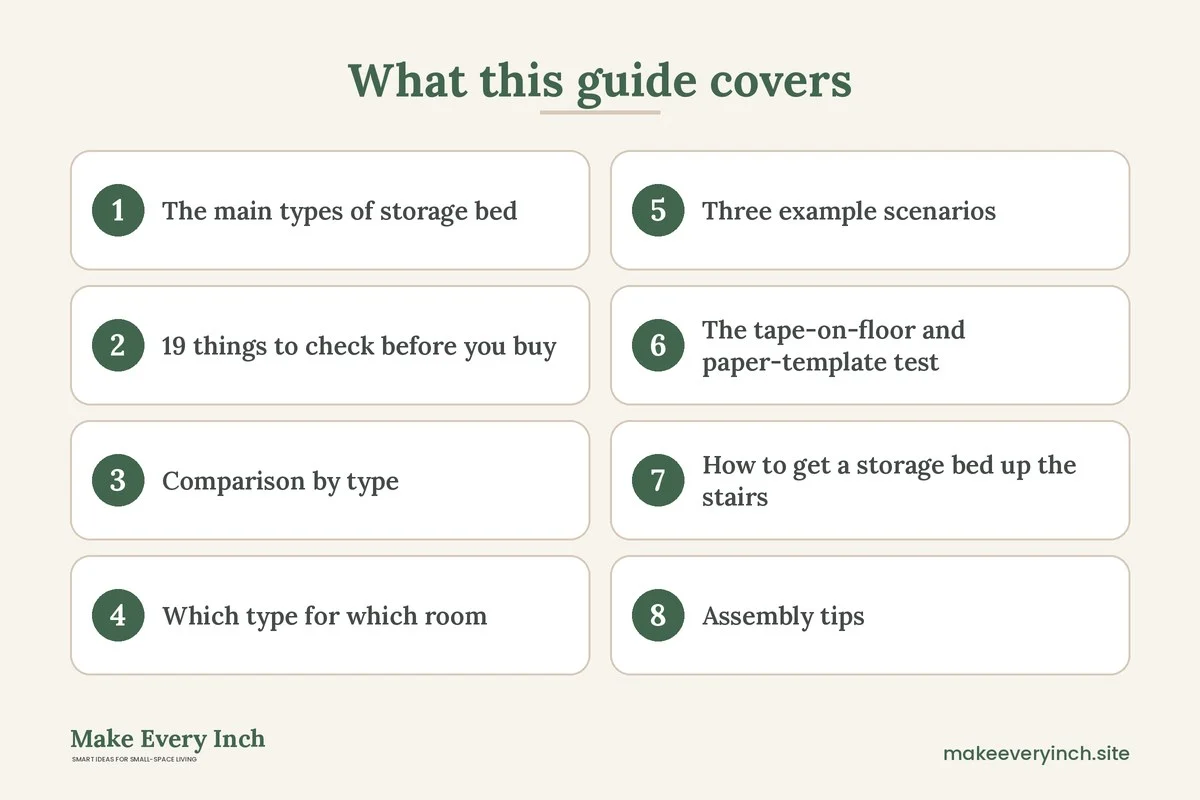
The best beds with storage turn the biggest piece of furniture in a small bedroom into a wardrobe, a linen cupboard and a place to sleep. They are also easy to get wrong. A drawer that hits the wall, a lift-up base that cannot rise under a shelf or a frame that will not turn a stair landing can undo the benefit. This guide covers the main types, 19 things to check before you buy, a comparison table, three example rooms, a paper-template test, budget ranges, common mistakes and a printable checklist. For the wider picture of storage in a bedroom, see our guide to small bedroom storage ideas.
This guide is educational, not a product review. We do not test or rank specific products, so use it to build your own shortlist.
The main types of storage bed
Drawer beds
A drawer bed has pull-out drawers built into the base, usually on one or both long sides or at the foot. They give easy access to everyday items, but each drawer needs clear floor space in front of it to open.
Lift-up or hydraulic beds
The whole base, or the mattress platform, lifts on gas struts or a mechanical arm to reveal one large cavity. This gives the most volume, and it needs no floor space beside the bed, but you must clear the bed to reach the contents and have headroom above the foot when lifted.
Ottoman beds
An ottoman bed is the common name for a lift-up bed with a hinged base, often lifting from the foot end or from the side. The terms overlap, so check the lift direction and how the lid is supported in the description.
Divan bases
A divan is an upholstered or fabric-covered box base, often with drawers fitted into the side or end. It sits low, hides the legs and suits a mattress of the same width. Many have no headboard, which you add separately.
Headboard storage
Some frames add cubbies, shelves or a ledge behind the pillows. This is light storage for a book, a phone and a glass of water, and it never replaces under-bed volume. Check the depth, since a deep headboard moves the bed away from the wall.
Platform frames with open space
A simple platform with tall legs is not a storage bed, but it leaves room for bins. If you like the idea, our guide to under bed storage ideas shows which containers work.
19 things to check before you buy
Fit and clearance
1. Room size and walkways
Measure the room, then measure the frame’s footprint, including the headboard and any overhang. Aim for at least 24 inches of walkway on the sides you use, and about 30 to 36 inches where you need to dress or make the bed. If you have to squeeze, a storage bed is a poor choice, because you will not open it.
2. Drawer pull-out depth
A drawer that is 20 inches deep needs about 20 inches of clear floor plus a few inches for your body or hands. Look at the stated drawer depth, not just the frame depth. Remember that the drawer may be shorter than the frame because of corner posts.
3. Lift-up headroom
A lift-up base rises through an arc, so the foot or side needs vertical space. Check for shelves, sloped ceilings, window sills and wall lights. If the bed lifts from the foot, you also need clear floor at the foot for the base to swing and for you to stand.
4. Door and window swing
Open the bedroom door, the closet door and any window and compare them with where the drawers will sit. A drawer that blocks a door is a daily annoyance. Mark the swing arcs on the floor before you commit.
5. Height from the floor
Add the base height to the mattress height. A tall total can make the bed hard to climb into, and a very low one makes lift-up access awkward. For most adults, a top surface somewhere around knee height is comfortable, but you know your own needs best.
Mattress and base
6. Mattress size and thickness
Match the frame to the mattress size exactly. Note that a twin, full, queen and king have fixed standard sizes, but some frames sit a little larger or smaller on the inside. Check the stated internal dimensions and the maximum mattress thickness, since a thick mattress on a low rail looks and slides badly.
7. Mattress type and support
Memory foam and hybrid mattresses need a firm, well-supported base. Slats should be close enough to prevent sagging, and a solid platform may be better for some foams. Check the mattress maker’s guidance, as some warranties require a slat gap of about 3 inches or less.
8. Slat spacing and center support
Look for slats that are spaced evenly and fixed, not loose. A wider bed needs a center support rail with a leg that reaches the floor. In a drawer bed, a center rail may cut into drawer space, so ask how the manufacturer solves it.
9. Ventilation
A mattress needs airflow, or moisture can build up. Solid platforms and fabric boxes can trap humidity, especially in a damp room. Slatted or perforated tops help, and a mattress that is aired every few weeks lasts longer.
Strength and safety
10. Weight rating
Find the total weight rating for the frame, then add the weights of the mattress, the sleepers and the stored items. A heavy mattress and full drawers add up quickly. A rating that leaves a clear margin over the combined load is a sensible target.
11. Gas struts and lift safety
Gas struts hold the base open, and over time they can lose pressure. Look for a design that includes a proper stay or lock, and ask whether replacement struts are available. Never lean on or reach under a base that is not securely held, and keep fingers, children and pets clear as it lowers.
12. Child and pet entrapment
A closed lift-up cavity can trap a child or a small pet. Check that the base cannot be closed and latched from the outside, and that there is airflow. Keep the lid or drawers closed with a safe latch, and do not allow children to play in or on the bed storage.
13. Drawer stops and runners
Drawers should have stops that prevent them from pulling completely out and dropping on feet. Metal runners with ball bearings usually feel smoother than wooden ones, but a well-made wooden runner can last as well. Test by pulling the drawer fully loaded, if you can.
Build, assembly and moving
14. Materials and finish
Solid wood, plywood and engineered wood all work, with trade-offs in weight, cost and durability. Check edges and corner joints, since a stored load stresses them. Look for finishes that are low in odor and easy to wipe, and be cautious about a very strong smell when you unbox it.
15. Assembly time and tools
Many storage beds are heavy and have many parts. Allow several hours and a second person, and read the instructions before you buy. Check whether it can be assembled in the room, or only in an open space. Pre-assembled drawers save time.
16. Moving it in and out
Measure the doors, hallways, stair landings and elevator, and compare them with the longest carton or piece. A frame in flat-pack is easier to carry than a fully assembled divan. If you rent and may move again, choose a bed that can be taken apart and rebuilt several times.
Daily use
17. What you plan to store
Match the storage to the contents. Drawers are best for clothes, shoes and linen you use weekly, while lift-up cavities suit bulky items, such as out-of-season bedding, luggage or a duvet. Avoid storing anything damp or anything that is a fire risk, such as batteries or fuel.
18. Cleaning and dust
The floor under a drawer bed can collect dust, and a lift-up cavity can trap it. Choose a surface that wipes clean, and check whether the drawers sit on a base that can be vacuumed. Lined drawers or storage bags keep stored fabric clean.
19. Warranty and returns
Read the warranty for the frame, the struts and the drawer runners, and check the return policy for large items. Ask who pays for return shipping. Keep your receipt, the instructions and a photo of the packaging labels.
Comparison by type
| Type | Access | Floor space needed | Capacity | Moving difficulty |
|---|---|---|---|---|
| Drawer bed | Easy, daily | Drawer depth beside bed | Medium | Medium to hard |
| Lift-up, side | Moderate | Lift arc beside bed | High | Hard |
| Lift-up, foot | Moderate | Space at the foot | High | Hard |
| Divan with drawers | Easy | Drawer depth | Medium | Hard when assembled |
| Headboard storage | Easy | Wall depth | Low | Easy |
| Platform with bins | Easy | Beside bed | Medium | Easy |

Which type for which room
A bedroom under 100 square feet
A small room usually cannot spare floor for drawers to open on both sides. A lift-up bed with a foot lift, or a platform bed with low, wheeled bins, can work if the foot has about 30 inches of clear space. Choose a lighter frame so that you can reposition it.
A shared or kids’ room
Choose a design with safe latches, no sharp corners and a lid that cannot slam. A drawer bed with stops is easier to supervise than a lift-up cavity. Make sure the frame is rated for the heaviest likely user.
A studio apartment
In a studio, the bed may double as a seat. A low-profile drawer bed along a wall can hold bedding and clothes, but it needs a clear side for use. See our guide to small space storage furniture for other pieces that work hard.
Three example scenarios
A 9 by 10 foot bedroom with a queen bed
The bed takes about 5 by 7 feet, and the walkway is tight. A bed pushed against one wall loses one side for drawers. A lift-up bed with a foot lift, with about 30 inches of free floor, may suit the room, as long as the closet door still opens. Check the room’s ceiling height as well.
A rental with a narrow staircase
The frame must go up a staircase with a tight landing. A flat-pack frame in several cartons is easier than an assembled divan. Plan for disassembly at move-out, and keep every bolt in a labeled bag.
A guest room used occasionally
Here, storage is for linens and spare bedding, not daily clothing. A lift-up bed holds bulky items well, and the infrequent use makes the effort of lifting acceptable. Keep a clear space at the foot, and add a small rug so the room does not feel bare. For a partner piece, see our guide to the best small dressers.
The tape-on-floor and paper-template test
Before you buy, make the bed’s footprint on the floor. Use painter’s tape to mark the frame’s length and width, then add a second outline for the drawers or lift arc. Walk around it, open the door, and stand where you would stand to open a drawer.
Step by step
- Measure the frame’s outer length and width, including the headboard
- Tape the footprint on the floor
- Tape the drawer depth on each side that has drawers
- Tape the foot clearance for a lift-up bed
- Stand and kneel in each spot as you would to reach the storage
- Open the door and any closet to check swing
- Leave the tape for a day or two, and check how it feels
For headroom, tape a paper outline on the wall, at the height the lifted base would reach. If a shelf, a sloped ceiling or a window sits inside it, change the plan.
How to get a storage bed up the stairs
Measure the narrowest point on the route, including the stair turn, the landing and any door frames. Check the carton dimensions on the listing, since the longest piece sets the limit. Remove the doors from their hinges if you need a few more inches, and protect the walls with blankets. Carry the heavy base pieces with a helper, and avoid dragging them. If the frame arrives assembled and will not fit, ask the seller whether a flat-pack option exists.
Assembly tips
Lay out all parts and count them against the list. Use a soft blanket on the floor, so you do not scratch the finish. Tighten bolts partly at first, then fully once the frame is square. Fit the drawers last, and check that they close without rubbing. For lift-up beds, fit the struts according to the instructions, and hold the base while you attach them, since they are strong. Re-tighten the bolts after a few weeks, since wood settles.
Care and maintenance
Vacuum under and around the bed monthly. Wipe the drawer runners and add a light dry lubricant if the maker recommends it. Do not overload drawers, and keep heavy items in the lower or central areas. Air out the mattress, and check the struts for leaks or slow lowering. If the lift seems weaker, stop using the lift and replace the parts before the base drops.
Budget guide
Prices vary widely by region, size and material, so treat these as rough, hedged ranges that you should check in your own market.
Lower range
Often a simple drawer frame or a basic platform in engineered wood. Expect lighter materials, fewer drawers and a shorter warranty.
Middle range
Often a sturdier frame, better runners, a lift mechanism with a proper stay and a longer warranty.
Higher range
Often solid wood or heavy upholstered frames, sturdier mechanisms and more finishes. A higher price does not guarantee fit, so measure anyway.
Compare the cost of a storage bed with the cost of a plain frame plus a dresser, as the dresser may not be needed. Our guide to small bedroom furniture ideas covers other trade-offs.
Mistakes to avoid
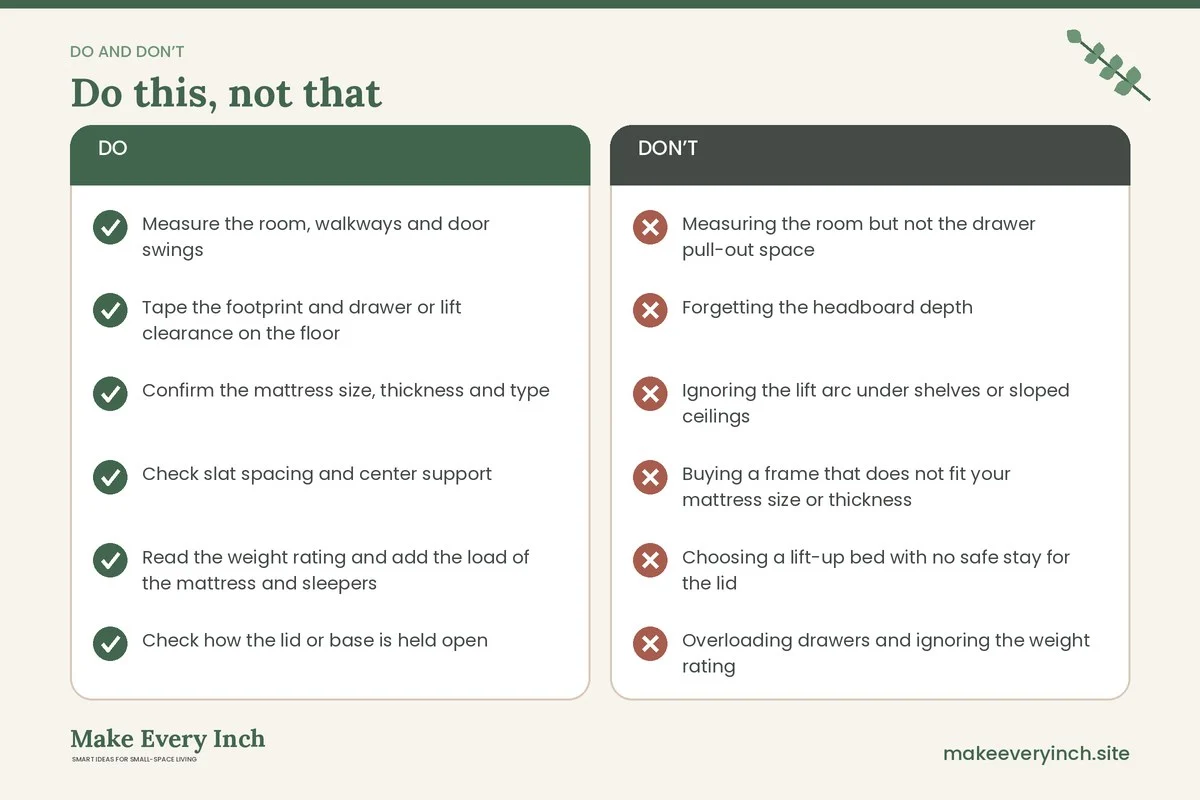
- Measuring the room but not the drawer pull-out space
- Forgetting the headboard depth
- Ignoring the lift arc under shelves or sloped ceilings
- Buying a frame that does not fit your mattress size or thickness
- Choosing a lift-up bed with no safe stay for the lid
- Overloading drawers and ignoring the weight rating
- Skipping the stairwell and elevator measurements
- Storing damp items in a closed cavity
- Not reading the warranty for struts and runners
Pre-purchase checklist
- Measure the room, walkways and door swings
- Tape the footprint and drawer or lift clearance on the floor
- Confirm the mattress size, thickness and type
- Check slat spacing and center support
- Read the weight rating and add the load of the mattress and sleepers
- Check how the lid or base is held open
- Check drawer stops and runners
- Measure the route into the home
- Plan assembly time and a helper
- Read the warranty and the return policy
- Decide what you will store first
FAQ
What is the difference between a lift-up bed and a drawer bed?
A lift-up bed raises the base to reveal one large cavity, while a drawer bed has pull-out drawers. Lift-up beds hold more bulky items, and drawer beds are easier for daily access, though they need floor space beside the bed.
Do storage beds need a special mattress?
Not normally, but the mattress must match the frame’s size and thickness limits. Memory foam and hybrid mattresses need firm support, so check the slats and the maker’s guidance.
Are gas struts safe?
They are designed to hold a load, but they can wear out. Look for a frame that includes a safe stay, replace struts that weaken and keep children and pets clear when the base is open.
Can a child get trapped in a storage bed?
It is possible in a closed cavity. Choose a design that cannot be latched from the outside and has airflow, and teach children that the storage is not a play space.
How much space do I need beside a drawer bed?
At least the depth of the drawer plus room to stand or kneel, which often means about 24 to 36 inches. Test the space with tape before you buy.
Will a storage bed fit in a small bedroom?
Often, if you choose the right type. A foot lift or a single-side drawer bed can fit where two-sided drawers cannot. Measure first.
How heavy are storage beds?
They are heavier than plain frames because of the extra panels and mechanisms. Check the shipping weight and plan for two people.
How do I clean under a storage bed?
Vacuum around the base monthly, wipe the drawer runners and lift the mattress to air the platform. Lined drawers keep stored items clean.
Keep going: Explore our small bedroom ideas, small bedroom layout ideas and under bed storage ideas.
Save this guide for later
Pin the ideas you like to Pinterest so you can come back to them when you plan your space.