16 Small Living Room Ideas Without a Coffee Table for Women, Planned Around What You Do
Quick answer: The best small living room ideas without a coffee table for women start with activities, not furniture. List what you do in the room, such as working, stretching, crafting, eating, reading and hosting, then give each activity a surface that stores away. Use nesting tables, a tray on a pouf, a narrow console, a folding side table or a bench, keep 30 to 36 inches for walkways, and clear the center of the floor.
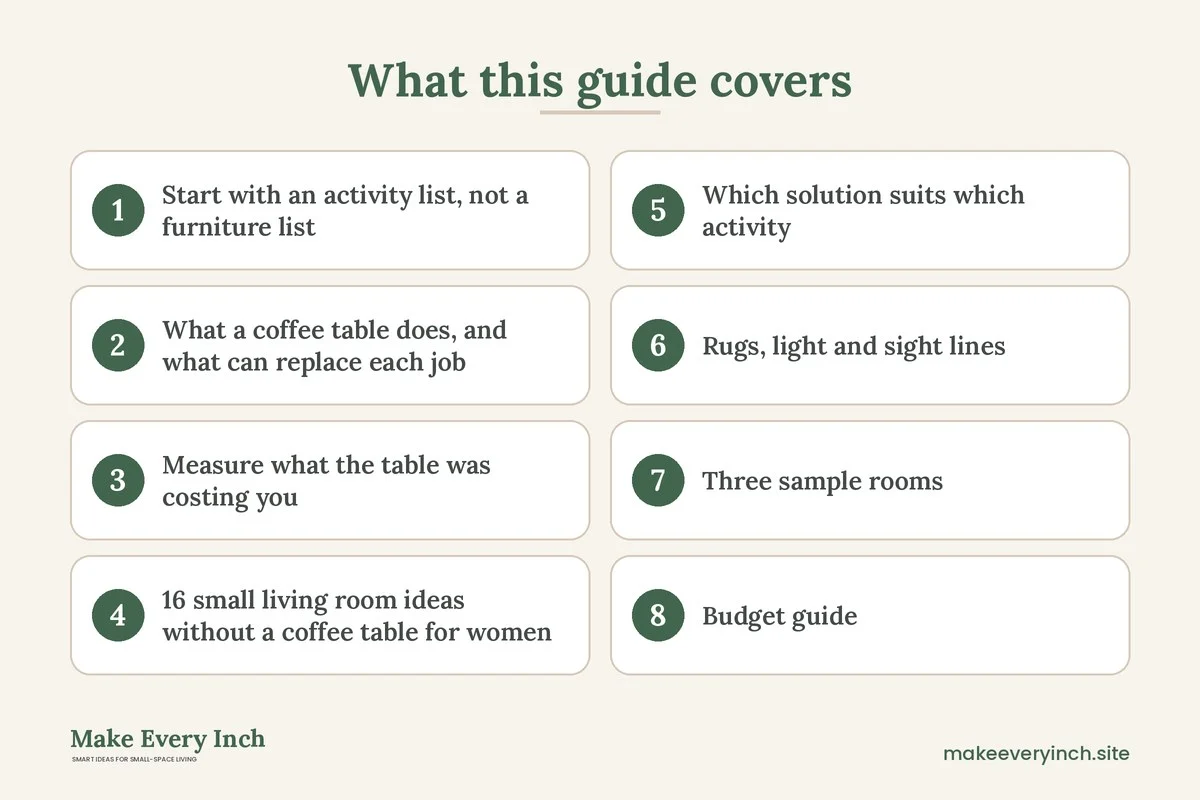
Small living room ideas without a coffee table for women are most useful when they begin with a question instead of a shopping list: what do you actually do in this room on an ordinary week? A coffee table is a single answer to many different needs. It holds a mug, a laptop, a remote, a plate, a stack of mail and a candle, and it takes up about 8 to 10 square feet of floor to do it. In a room under 150 square feet, that floor is often worth more than the table. This guide treats the room as a set of activities, gives 16 practical plans with measurements, shows what to use in place of the table for each task, and ends with a comparison table, three sample rooms, a checklist and a FAQ. It builds on our main guide to small living room ideas without a coffee table and the wider small living room ideas pillar, and it takes a more task-based approach than either.
Start with an activity list, not a furniture list
Grab a notebook and write down everything you did in your living room in the past seven days. Be honest and specific. Most lists include watching shows, eating at least a few meals, working on a laptop, reading, phone calls, folding laundry, stretching or exercising, a hobby such as sewing or painting, and having one or two people over. Next to each, note how often it happens, how long it lasts, and what you need within arm’s reach.
This list matters because every small living room has to make trade-offs. If you work from the sofa three days a week, you need a stable laptop surface at the right height more than you need a decorative table. If you stretch or do yoga every morning, you need a clear floor of about 3 by 6 feet more than you need anything on it. If you host twice a month, you need flexible surfaces that appear and disappear. A coffee table assumes that all of these needs are equal and constant, and they are not.
Once you have the list, circle the two or three activities that happen most often. Those get the best solutions. The rest get fast, foldable or stackable ones. The plans below are organized in the same way, so you can jump to the sections that match your week.
What a coffee table does, and what can replace each job
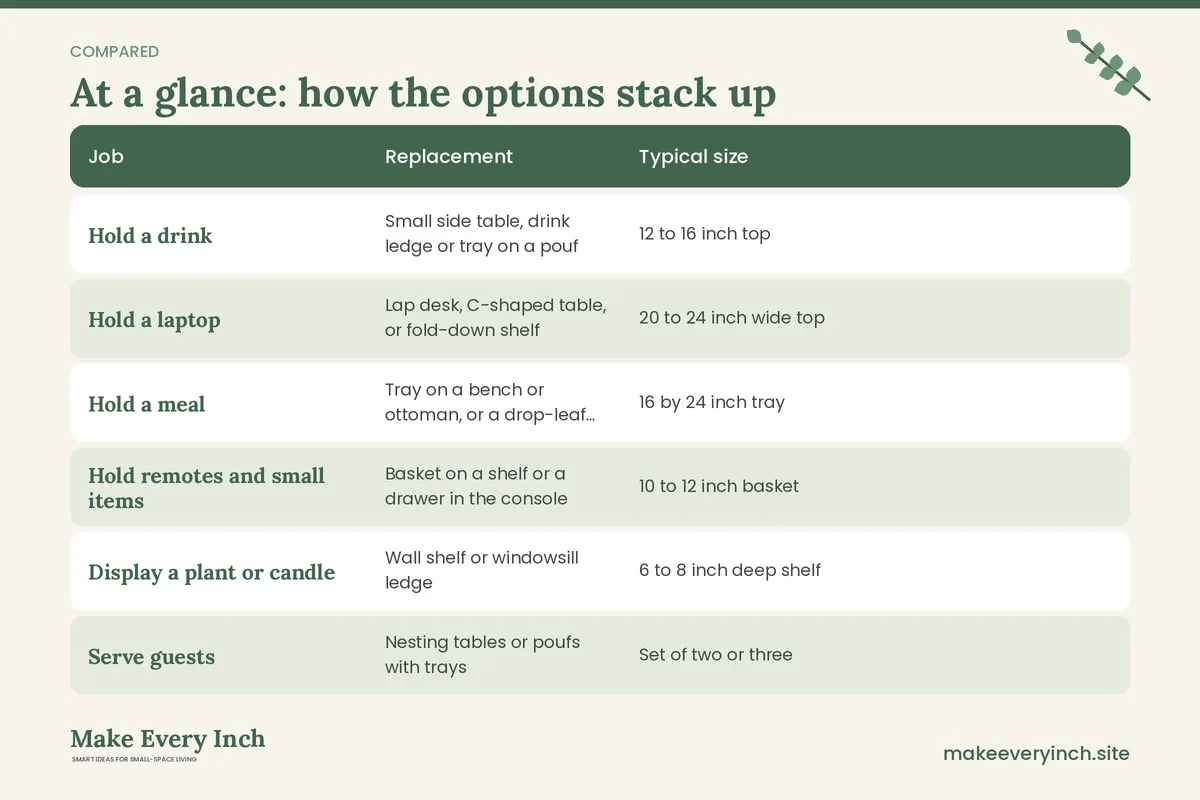
Before removing a coffee table, split its work into jobs. Each job has a smaller, cheaper or more flexible replacement.
| Job | Replacement | Typical size | |
|---|---|---|---|
| Hold a drink | Small side table, drink ledge or tray on a pouf | 12 to 16 inch top | |
| Hold a laptop | Lap desk, C-shaped table, or fold-down shelf | 20 to 24 inch wide top | |
| Hold a meal | Tray on a bench or ottoman, or a drop-leaf table | 16 by 24 inch tray | |
| Hold remotes and small items | Basket on a shelf or a drawer in the console | 10 to 12 inch basket | |
| Display a plant or candle | Wall shelf or windowsill ledge | 6 to 8 inch deep shelf | |
| Serve guests | Nesting tables or poufs with trays | Set of two or three | |
| Rest feet | Pouf or storage ottoman | 16 to 18 inches high |
When you see the jobs listed this way, the coffee table looks less like a requirement and more like a bundle of small tasks that you can handle with lighter pieces. Many of the best replacements also store flat, so the room can change shape from day to day.
Measure what the table was costing you
A typical coffee table measures about 18 by 36 inches to 22 by 44 inches. Add the 14 to 18 inch gap on every side that makes it usable, and the real footprint is 4 to 5 feet long and nearly 3 feet deep. In a room of 10 by 12 feet, that is around 12 percent of the floor, in the center, where it blocks every path.
Measure your own room before you commit. Mark the doors, the window sills, the radiators, the vents and the outlets. Subtract the swing of every door. Tape the footprint of your sofa on the floor, then walk the path from the door to the window, the kitchen and the sofa. If the path is under 30 inches anywhere, the coffee table was likely the problem. If you remove it and the room still feels tight, the sofa may be the next piece to review. For help with that, see our guide to small living room furniture ideas.
16 small living room ideas without a coffee table for women
Plans for working from home
1. The sofa desk with a slim console behind it
Float the sofa about 8 inches from the wall and place a console 10 to 12 inches deep and 28 to 30 inches high behind it. A laptop sits on the console when you work standing or on a tall stool, and the console stores a lamp, a plant and a basket for cables. When the work day ends, close the laptop and the surface goes back to being a display shelf. This plan works in a room at least 10 feet deep, because you need 30 inches behind the console to reach it.
2. A C-shaped table that slides over the sofa
A C-shaped side table has a base that slides under the sofa and a top that sits over your lap. Choose a top about 14 by 20 inches and a height between 24 and 26 inches for most sofas, and check that the base clears the sofa’s bottom edge. It takes up zero floor space when parked beside the arm and replaces both the coffee table and the laptop surface. It is also easy to move when you vacuum.
3. A fold-down wall desk in the TV or window wall
A wall-mounted drop-leaf shelf, about 16 by 30 inches, folds up to 3 inches deep. Mount it at 28 to 30 inches from the floor and use a stool or a dining chair that tucks away. If you rent, check the lease first, or use a freestanding foldable version that leans against the wall. See our post on renter-friendly shelving for removable options.
4. The window-seat work spot
If you have a deep window sill of 12 inches or more, add a cushion and a lap desk. The light is good, the screen faces away from the glare, and you do not need furniture that takes floor. Keep a small basket nearby for the charger and notebook so the setup disappears at the end of the day.
Plans for movement and floor space
5. A clear 3 by 6 foot zone for stretching
Many people want a place to stretch, do yoga or follow a workout video without moving a table. A rug about 5 by 8 feet gives you a defined area, and when it is clear of a coffee table, the open floor between the sofa and the TV is about 3 by 6 feet. Hang a mat on a hook or store it behind the sofa, so it is within reach. If the rug is thick, roll it under the sofa edge while you exercise, or choose a flat-weave rug that does not slide.
6. Furniture on slides for quick rearranging
Use felt pads or furniture sliders on lightweight pieces such as a pouf or a small bench, so you can push them aside in ten seconds. On wood or vinyl floors, use soft felt. On carpet, use hard plastic sliders. This turns the center of the room into a flexible zone with no permanent object in it.
7. A narrow bench at the foot of the sofa
A bench 14 to 16 inches deep and about 40 to 48 inches long can hold a tray when you want one and a pair of shoes or a stack of blankets when you do not. It sits at the sofa’s foot, which keeps the center open, and you can pull it forward for guests. A woven or upholstered top feels softer than a hard table if you bump into it.
8. A rolling cart that parks in a corner
A narrow cart about 12 inches wide with wheels carries drinks, a plant or craft supplies where you need them. It parks in a corner or beside the sofa when you are not using it. Lock the wheels when it holds a hot mug. The cart suits rooms where the same person moves between tasks all evening.
Plans for hobbies and craft
9. A tilt-top table for projects
A tilt-top round table, about 28 to 32 inches wide, can stand against a wall when closed and flatten into a work surface when needed. It suits sewing, puzzles, painting or journaling. Choose a version that sits at around 28 inches high so it also works for a chair and a laptop.
10. Rolling storage under the sofa
Flat bins with wheels, about 6 to 7 inches high, hold fabric, yarn, paper, a sketchbook or board games. They slide out when you start a hobby and disappear when you finish. Check the clearance under your sofa before you buy, because many sofas leave only 4 to 6 inches.
11. A shelf wall that serves as a display and a tool rack
Use the wall space beside the sofa for shelves 8 to 10 inches deep. Put finished work, books and plants on the upper shelves, and keep supplies in boxes below. A hobby you can see feels like part of the room instead of clutter. For vertical options, our guide on vertical storage ideas has more.
Plans for eating, hosting and everyday life
12. A tray on a pouf for meals
A round pouf 16 to 18 inches tall and 18 to 20 inches wide, topped with a tray about 16 by 24 inches, makes a quick meal surface. Store the tray flat behind a cabinet or against the wall. When you finish, the pouf becomes extra seating or a footrest. Pick a tray with a lip and a non-slip lining.
13. Nesting tables for guests
Two or three nesting tables take up about 2 square feet when stacked and 6 to 8 when spread. Choose a set where the tallest piece is around 20 to 24 inches and the smallest about 16 inches. When guests arrive, pull them apart and put one near each seat. When they leave, tuck them back under the largest one. This is the closest thing to a coffee table that folds itself away.
14. Poufs, floor cushions and a long runner of seating
For hosting more than four people, add two or three poufs and a few floor cushions that live in a basket or on a shelf. Put a low tray or two on the rug as a shared surface. It feels casual, and it costs far less than extra chairs. If the room is also used for a bed or a studio, see our guide to small apartment living room ideas for studios.
15. A narrow console behind the sofa as a serving spot
A console 10 to 12 inches deep behind the sofa becomes the place for drinks, snacks and a lamp, and guests can reach it without crossing the center of the room. It also supports a charging strip, a plant and a stack of trays. It is a good fit for any room where the sofa sits away from the wall.
16. A side table at each end of the sofa
If the room is under 130 square feet, put a small table at each end of the sofa, 14 to 18 inches wide and level with the arm, and skip the center. One can hold a lamp and a plant, and the other a tray, a book and a drink. The two tables define the seating zone and make the sofa feel anchored without anything in the middle. For lighting guidance on these tables, see our small living room lighting ideas.
Which solution suits which activity
Use this table to match your most frequent activities to the plans above.
| Activity | Best plans | Floor space used | |
|---|---|---|---|
| Working on a laptop | 1, 2, 3, 4 | 0 to 4 sq ft | |
| Stretching or exercise | 5, 6, 7 | Clear 18 sq ft when in use | |
| Sewing, crafting or puzzles | 9, 10, 11 | 4 to 8 sq ft when open | |
| Eating on the sofa | 12, 7, 8 | 2 to 4 sq ft | |
| Hosting four or more | 13, 14, 15 | 6 to 8 sq ft when open | |
| Reading and quiet evenings | 16, 4 | 2 to 3 sq ft | |
| Watching TV with snacks | 8, 12, 16 | 2 to 4 sq ft |
Pick one plan from each of your top three activities and combine them. For example, a person who works two days a week, stretches daily and hosts monthly could combine plans 2, 5 and 13 and need no permanent center furniture.
Rugs, light and sight lines
Without a coffee table, a rug becomes the center of the room. Choose a 5 by 8 foot rug for rooms under 150 square feet, and a 6 by 9 foot rug when the sofa is wider than 80 inches. Leave 6 to 10 inches of bare floor between the rug and each wall, and put at least the front legs of the sofa on the rug. A flat-weave rug is easiest to clean and works with a rolling cart. A rug pad prevents slipping, which matters when you stretch or move poufs.
Lighting should follow the activities too. A floor lamp near the sofa serves reading and crafts, and a small table lamp on the console gives soft evening light. Use warm bulbs of 2200 to 2700 K, and put the lamp shade at about 40 to 42 inches from the floor. Add a plug-in wall light if no side table is available. For lamps that fit narrow spaces, see our guide to best floor lamps for small rooms.
Finally, check your sight lines. Sit in each seat and look at the TV, the window and the door. A pouf or tray should never block the line between the sofa and the door, because you want an easy path to leave and to answer a knock.
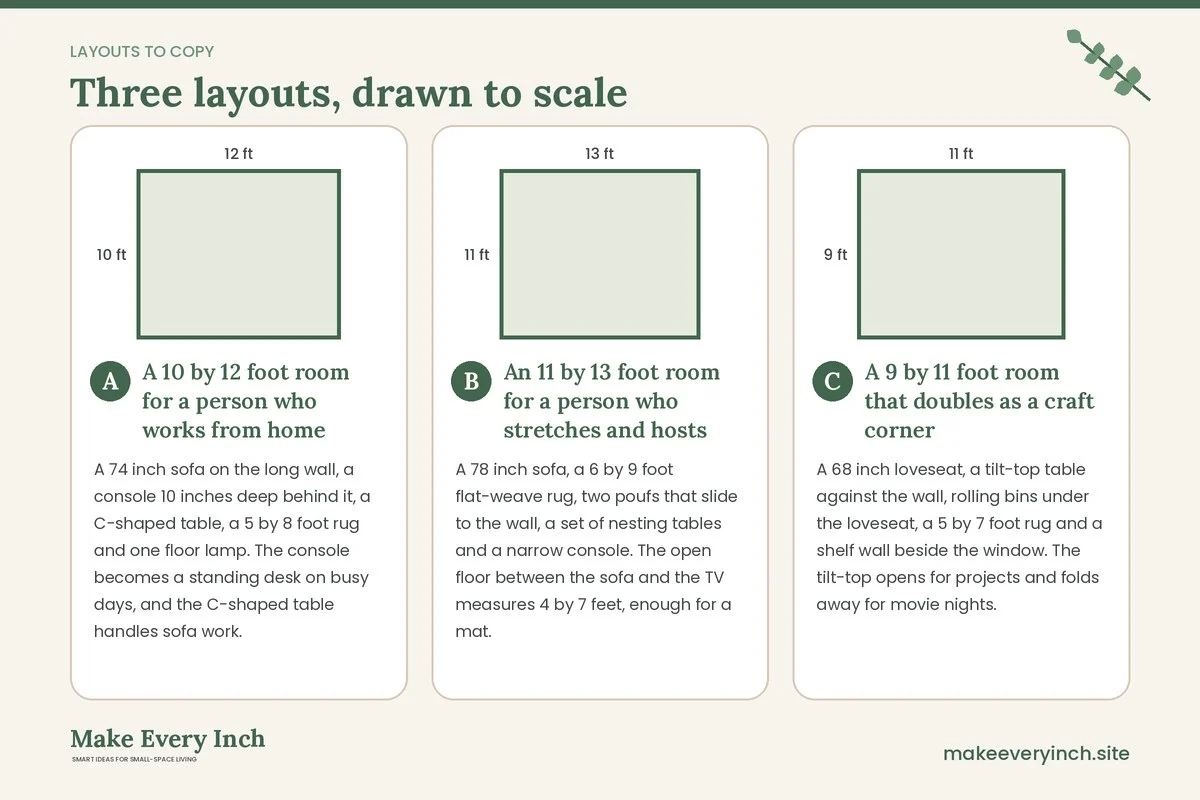
Three sample rooms
A 10 by 12 foot room for a person who works from home
A 74 inch sofa on the long wall, a console 10 inches deep behind it, a C-shaped table, a 5 by 8 foot rug and one floor lamp. The console becomes a standing desk on busy days, and the C-shaped table handles sofa work. The center is clear, so the path from the door to the window is 36 inches wide.
An 11 by 13 foot room for a person who stretches and hosts
A 78 inch sofa, a 6 by 9 foot flat-weave rug, two poufs that slide to the wall, a set of nesting tables and a narrow console. The open floor between the sofa and the TV measures 4 by 7 feet, enough for a mat. On guest nights, the tables and poufs come out, and the room seats six.
A 9 by 11 foot room that doubles as a craft corner
A 68 inch loveseat, a tilt-top table against the wall, rolling bins under the loveseat, a 5 by 7 foot rug and a shelf wall beside the window. The tilt-top opens for projects and folds away for movie nights. It is a compact setup that keeps the hobby in sight without taking the room over.
Budget guide
These ranges are rough and vary by region and retailer.
Under $100
A tray, a pouf or a stack of floor cushions, felt sliders, a basket and a lap desk. Use what you own and shift furniture to open the center.
About $150 to $400
A C-shaped table, a set of nesting tables, a narrow bench, a flat-weave rug or a second-hand console. These cover most of the plans above.
$500 and up
A wall-mounted desk, a custom shelf wall, a swivel chair or a sofa sized to your room. At this level, measure delivery paths and returns policies first.
Mistakes to avoid
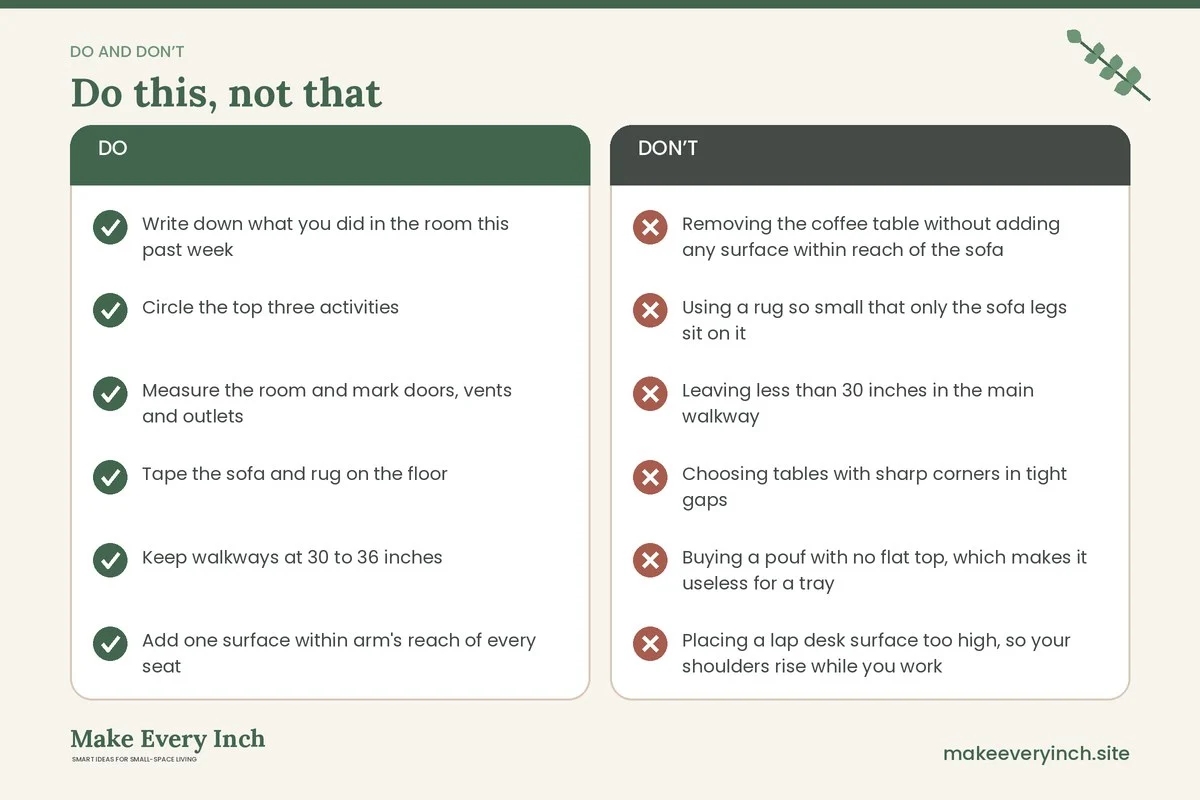
- Removing the coffee table without adding any surface within reach of the sofa
- Using a rug so small that only the sofa legs sit on it
- Leaving less than 30 inches in the main walkway
- Choosing tables with sharp corners in tight gaps
- Buying a pouf with no flat top, which makes it useless for a tray
- Placing a lap desk surface too high, so your shoulders rise while you work
- Ignoring cable management when the laptop moves to a console
- Putting hot drinks on a cart without locking its wheels
Checklist before you remove the table
- Write down what you did in the room this past week
- Circle the top three activities
- Measure the room and mark doors, vents and outlets
- Tape the sofa and rug on the floor
- Keep walkways at 30 to 36 inches
- Add one surface within arm’s reach of every seat
- Choose one solution for working, one for hosting and one for storage
- Check that every tray or pouf has a stable, flat top
- Place lamps at seated height with warm bulbs
- Live with the new layout for one week before you decide
FAQ
What can I use instead of a coffee table in a small living room?
Use nesting tables, a tray on a pouf, a bench, a C-shaped side table, a narrow console behind the sofa or a pair of side tables. Choose by the activity you do most.
Where do I put drinks and snacks without a coffee table?
Put a small side table at each end of the sofa, or use a tray on a pouf. A console behind the sofa also works for serving.
How do I work on a laptop without a coffee table?
Use a lap desk, a C-shaped table, a fold-down wall desk or a console. Keep your screen at about eye level, and sit with your feet supported.
Will a room without a coffee table look empty?
Not if the rug is the right size and the lighting is layered. Add a plant, a lamp and a tray on a pouf, and the center reads as open rather than empty.
How much floor space do I gain by removing a coffee table?
Usually 8 to 10 square feet of the table itself, plus the gaps around it, so about 12 to 15 square feet of usable floor.
Is a coffee table still useful for some people?
Yes. If you eat, play or work at it every day and the room is at least 12 feet wide, a small round table can be worth its space. The plans here are for rooms where that floor works harder as open space.
What is the best rug size for a room with no coffee table?
A 5 by 8 foot rug suits most rooms under 150 square feet. Use 6 by 9 feet if your sofa is wider than 80 inches.
How do I keep the room from looking cluttered without a coffee table?
Give every small item a home, such as a basket on a shelf, a drawer in the console or a lidded ottoman. Clear the surfaces at the end of each day.
Keep going: Keep going with our small living room layout ideas, small living room layout ideas for a cozy look and small living room storage ideas.
Save this guide for later
Pin the ideas you like to Pinterest so you can come back to them when you plan your space.