15 Small Living Room Ideas Without a Coffee Table for Families
Quick answer: The best small living room ideas without a coffee table for families clear the middle of the room for a soft play floor, then add low, rounded surfaces at the edges for snacks and homework. Choose pieces with round or padded corners, anchor tall furniture to the wall, keep a 36-inch path, and store toys in lidded bins within a child’s reach.
Small living room ideas without a coffee table for families begin with a floor, not a piece of furniture. A coffee table is a hazard in a house with a crawling baby or a running toddler. It has hard corners at exactly head height, it takes the middle of the room, and it ends up buried under mail, cups and half-finished puzzles. Removing it gives children a play floor and gives parents a clear line of sight. This guide shows how to plan that room. It covers the safety basics, the floor zones, 15 ideas, a table of what suits each age, three example rooms, a daily reset routine and a checklist. For the wider topic, see our hub on small living room ideas without a coffee table, the pillar guide to small living room ideas and the post on cozy small living room layout ideas.
Why families benefit from skipping the coffee table
Children use the living room differently from adults. They sit on the floor, they crawl, they build and they spread out. A coffee table makes the middle of the room a barrier, and in a small room the barrier leaves a few narrow strips of floor along the walls. Take it away and a room of 11 by 13 feet gains about 8 to 10 square feet of usable floor, which is enough for a play mat and a small block tower.
There is a safety reason as well. Sharp edges at the height of a toddler’s forehead are among the most common causes of minor bumps at home. A low, rounded surface or a soft ottoman changes the risk. This post gives practical ideas, not medical advice, and you should always supervise young children and follow the guidance on your products. If you are unsure about a particular item, check the manufacturer’s instructions.
The point is to design a room that is easy to supervise, easy to clean and easy to reset in five minutes at the end of the day.
Safety basics before you rearrange
Start with a short safety walk. Get down to a child’s eye level and look at the room from the floor. You will see corners, cords and wobbly furniture that you cannot spot from standing height.
- Round or pad every corner at child height. Choose tables, benches and TV units with rounded corners. Where a hard corner remains, use a soft corner guard made for the purpose.
- Anchor tall furniture to the wall. Bookcases, shelving units and TV stands can tip. Use the anchoring kit that comes with the item, or buy a furniture strap. Renters should check the lease and look at our no-drill storage ideas for renters for alternatives that do not damage walls.
- Manage cords. Gather lamp, charger and TV cords behind furniture, in a cord cover or on a clip, and keep them out of reach.
- Keep small items out of the play zone. Coins, batteries, magnets and small toy parts belong in a closed bin on a high shelf if you have a child who still puts things in their mouth.
- Check stability. Push each table and stool from the side. If it moves or tips, it is not ready for a child’s room.
- Avoid glass tops. Choose wood, fabric or plastic that will not shatter, and fix a rug pad under every rug to stop slipping.
These steps cost little and take an afternoon. They change how safe the room feels more than any style choice does.
Divide the floor into three zones
A room without a coffee table needs a clear plan for the floor. Divide it into three zones and the rest follows.
The play floor
This is the open middle, usually 5 by 7 feet or more. Cover it with a washable rug or foam play mats, and keep it free of furniture. Place it where you can see it from the sofa and the kitchen. A rug with a low pile is easier to clean and gives blocks a flat base.
The edge zone
The perimeter holds the furniture: sofa, bookcase, storage and side tables. Keep everything on this edge low and rounded, and leave a 36-inch path between the edge and the play floor so an adult can carry a laundry basket or a child.
The toy zone
Choose one corner or one wall for toys, and give it a bin per category. Children tidy better when each type of toy has a labeled home that they can reach. A low shelf or a bench with bins does the job.
15 small living room ideas without a coffee table for families
Surfaces that are safe for children
1. A soft ottoman with a tray
A padded ottoman has no hard corners and works as a footrest, a seat and, with a tray on top, a snack table. Use a lidded storage version to hide toys. Remove the tray when the children play, so the top stays soft. See the best storage ottomans for what to look for.
2. Round side tables at the sofa ends
A round table has no corner to hit. Place one at each end of the sofa, and choose a heavy base so it does not tip. Round tables also feel gentler in a crowded room.
3. A pair of poufs
Poufs serve as seats, footrests and, with a lap tray, a snack spot. They are light and soft, and they tuck into a corner at bedtime.
4. A nesting set with rounded edges
Nesting tables slide out for a puzzle or a craft session and slide back when the activity ends. Pick sets with rounded or bevelled edges, and keep them at the edge of the room during active play.
Floor-level play ideas
5. A foam play mat in the middle
Interlocking foam tiles create a clean, cushioned play area. They come apart, so you can stack them against the wall at night. Choose a neutral color so the room still looks like an adult space.
6. A big washable rug
A rug of at least 5 by 8 feet anchors the room. Choose a washable cover or a flat weave, and add a non-slip pad underneath. This is your new coffee table: a spot where everyone sits, builds and eats a snack picnic style.
7. A low child-height table in the corner
A small table of 18 to 20 inches in height with two stools serves as an art station. Tuck it into a corner so it forms part of the toy zone and not the walkway.
8. A floor cushion pile
Large floor cushions give children a place to flop, and they double as seats for guests. Keep them in a basket or a bench when not in use.
Storage that keeps the floor open
9. A bench with bins along one wall
A long, low bench at 16 to 18 inches high holds toys in bins and serves as seating. Children can pull a bin out and put it back. A bench replaces the coffee table’s storage role without taking floor space. Our small living room storage ideas offers more ways to make the walls work.
10. Wall-mounted shelves for adult items
Keep remotes, books and breakables on high shelves out of reach. A floating shelf above the sofa works well. Use the anchors that suit your wall, and check the weight limits.
11. A lidded basket for blankets
A big basket with a lid keeps throws tidy and stops small hands pulling them out. Place it beside the sofa where it doubles as a side surface for a drink.
12. Under-sofa bins
A shallow, wheeled bin under the sofa holds board games and puzzles. Check the clearance first, as many sofas leave only 4 to 6 inches.
Adult-friendly zones
13. A console behind the sofa
A narrow console of 10 to 12 inches deep at the back of a floating sofa gives adults a place for a lamp, a drink and a bowl of keys. Place it out of reach of toddlers by keeping decor on the back half. For layout details, see our small living room layout ideas.
14. A sofa tray for family movie night
A flat tray on the lap or on an ottoman holds popcorn and drinks. Put it away when the film ends, and the floor goes back to play.
15. A folding table in the closet
A narrow folding table stored behind a door or in a closet comes out for homework, a puzzle or a family game, then folds flat. It gives you a full table when you need one, without losing floor the rest of the week.
What suits each age
Different ages ask different things of the room. Use the table to match the idea to the stage you are in.
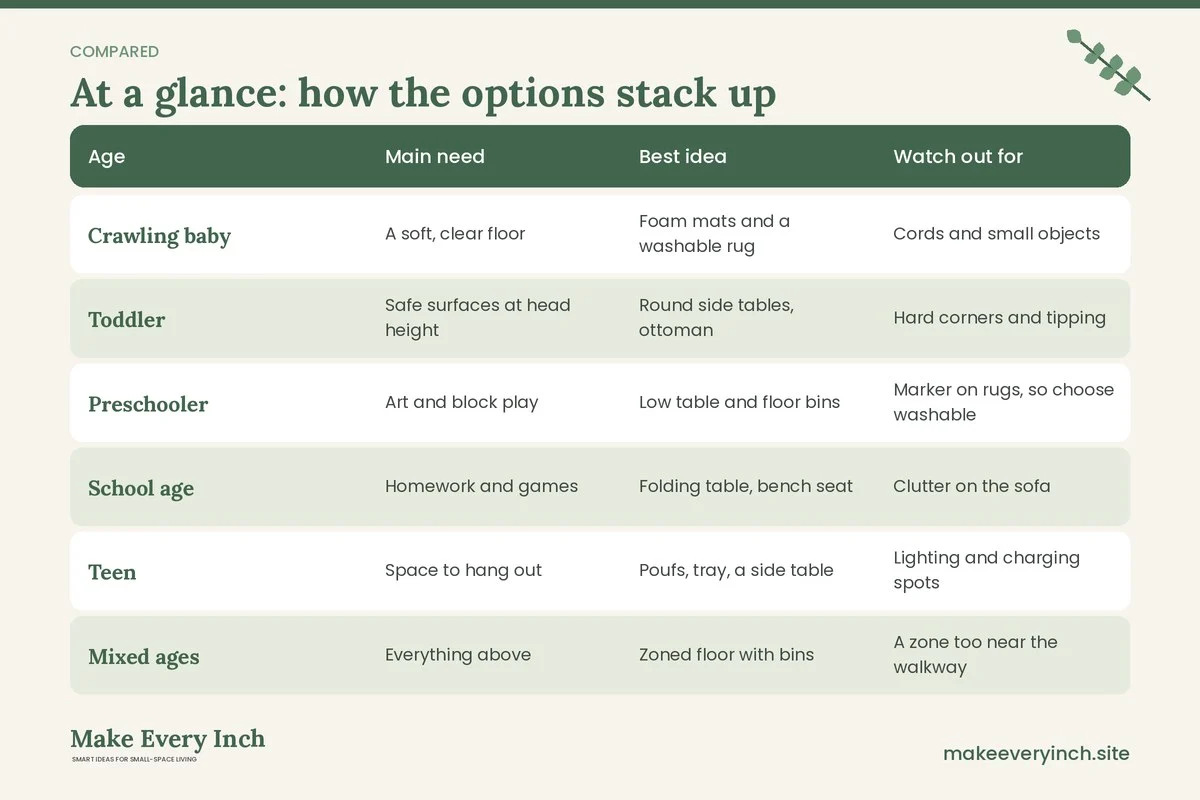
| Age | Main need | Best idea | Watch out for |
|---|---|---|---|
| Crawling baby | A soft, clear floor | Foam mats and a washable rug | Cords and small objects |
| Toddler | Safe surfaces at head height | Round side tables, ottoman | Hard corners and tipping |
| Preschooler | Art and block play | Low table and floor bins | Marker on rugs, so choose washable |
| School age | Homework and games | Folding table, bench seat | Clutter on the sofa |
| Teen | Space to hang out | Poufs, tray, a side table | Lighting and charging spots |
| Mixed ages | Everything above | Zoned floor with bins | A zone too near the walkway |
Three example family rooms
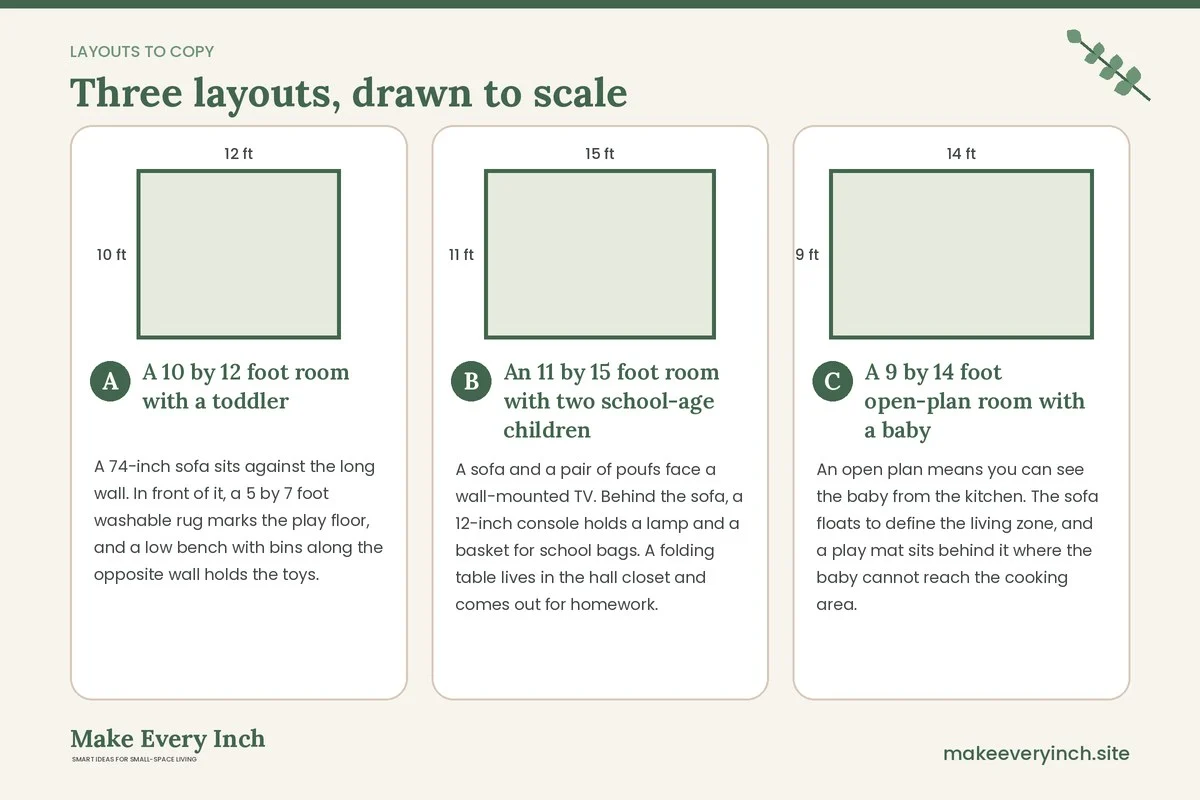
A 10 by 12 foot room with a toddler
A 74-inch sofa sits against the long wall. In front of it, a 5 by 7 foot washable rug marks the play floor, and a low bench with bins along the opposite wall holds the toys. Round side tables stand at the sofa ends, and the TV hangs on the wall with its cords behind a cover. This leaves a walkway of about 36 inches along the door side. The toddler plays on the rug in view of the sofa, and nothing has a hard corner at head height.
An 11 by 15 foot room with two school-age children
A sofa and a pair of poufs face a wall-mounted TV. Behind the sofa, a 12-inch console holds a lamp and a basket for school bags. A folding table lives in the hall closet and comes out for homework. The rug is 6 by 9 feet, which gives the children room to build a Lego city. Two floor bins slide under the console, and a bookcase anchored to the wall holds books at child height on the lower shelves and breakables on the upper ones.
A 9 by 14 foot open-plan room with a baby
An open plan means you can see the baby from the kitchen. The sofa floats to define the living zone, and a play mat sits behind it where the baby cannot reach the cooking area. Soft poufs line the edge, and a closed storage ottoman holds toys. A baby gate may be useful at the kitchen entrance, and you should follow the product guidance for fitting. Keep the main path clear for pushing a stroller to the front door.
Keep it clean
Families need surfaces that wipe clean and fabrics that survive spills. Choose a tight weave or a performance fabric for the sofa, wipeable tray tops and a rug you can machine wash or hose off. Keep a small basket of wipes and a cloth beside the sofa. Place a washable throw over the sofa arm to catch crumbs. A weekly vacuum of the play floor keeps dust and small crumbs from collecting.
Avoid dark, glossy surfaces that show every fingerprint, and choose matte finishes in medium tones. A rug with a pattern hides marks better than a solid color.
The five-minute daily reset
The no-table room only stays calm if the reset is quick. Try this routine at the end of the day.
- Ask each child to return their toys to the bin that has their picture or label on it.
- Stack the foam mats or fold the play blanket against the wall.
- Slide the nesting tables or the folding table back to their home.
- Put the tray and any cups in the kitchen.
- Return remotes and chargers to the shelf or basket.
- Wipe the side tables and the ottoman top.
Children often enjoy a short tidy-up when it comes with a song or a timer. A five-minute reset prevents the slow build-up that makes small rooms feel chaotic.
Lighting for a family room
Choose lamps with stable, heavy bases, and place them on high surfaces or behind furniture so small hands cannot pull them over. Wall sconces that plug in, or ceiling lights with dimmers, remove cords from the floor. A soft light in the evening helps children wind down. See our small living room lighting ideas for more options. A night light near the sofa makes late-night feeds and bathroom trips easier.
Mistakes families make
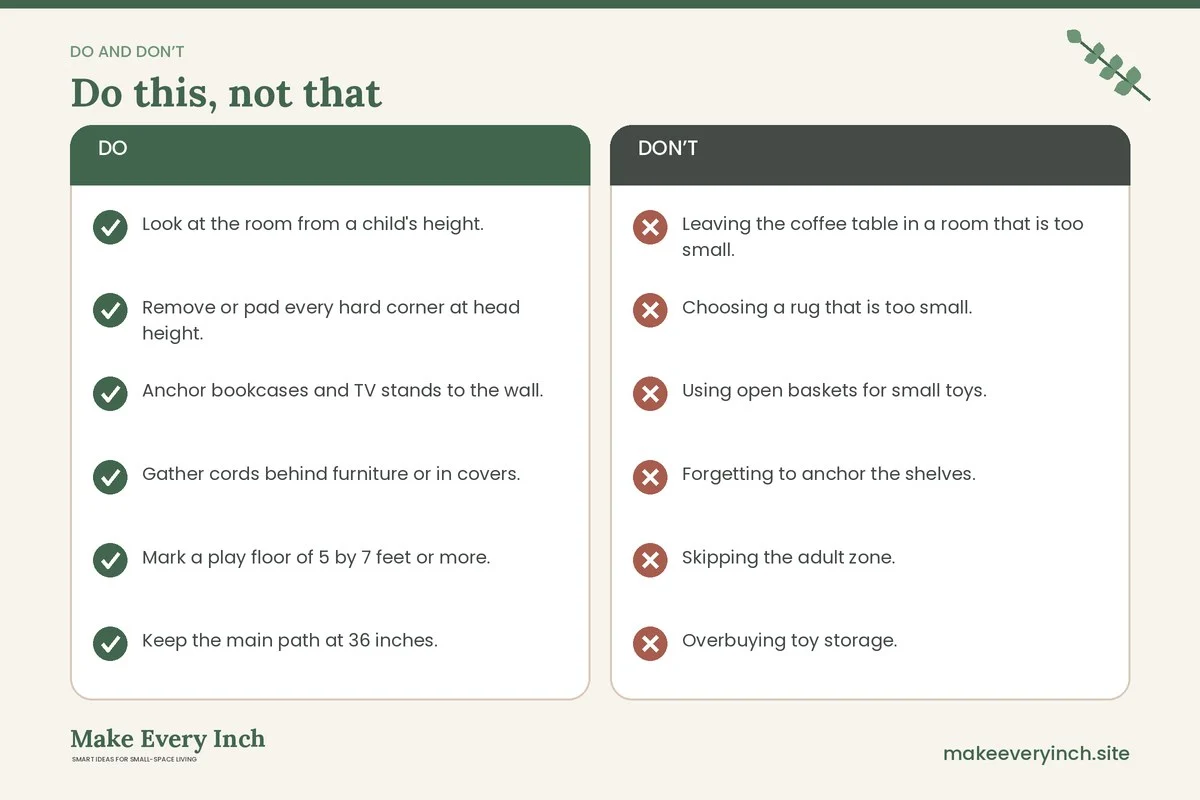
- Leaving the coffee table in a room that is too small. If the walkway drops below 30 inches, take it out.
- Choosing a rug that is too small. A rug that ends at the front of the sofa leaves the play floor on hard flooring. Go larger.
- Using open baskets for small toys. Pieces fall out, and the floor fills up. Use lids or bins with a lip.
- Forgetting to anchor the shelves. Anchoring takes minutes and removes a real risk.
- Skipping the adult zone. Parents need a place to sit and set down a mug, so keep a side table or a console for yourself.
- Overbuying toy storage. More bins means more toys. Rotate toys, storing half in a closet, and bring them out every few weeks.
Budget and shopping tips
Shop in order of impact. First the rug and the pad, because they define the play floor. Second the storage bench or ottoman, because it controls the clutter. Third the side tables. Look at second-hand listings for benches and nesting tables, check them for stability and wipe them with a mild cleaner. Choose pieces that suit a child’s growth: a bench works for toys now and shoes later. Consider a sofa that suits small rooms, as covered in our best sofas for small apartments guide.
Family checklist
- Look at the room from a child’s height.
- Remove or pad every hard corner at head height.
- Anchor bookcases and TV stands to the wall.
- Gather cords behind furniture or in covers.
- Mark a play floor of 5 by 7 feet or more.
- Keep the main path at 36 inches.
- Lay a rug with a non-slip pad.
- Set up a toy zone with labeled bins.
- Place a round side table at each end of the sofa.
- Keep a lidded basket for throws.
- Give adults a console or shelf for drinks and remotes.
- Plan a five-minute daily reset.
FAQ
Is it safer to have no coffee table with a baby?
Removing hard corners from the center of the room reduces bumps for a crawling or walking baby, though you still need to supervise and check your other furniture. Soft ottomans and round tables help.
What replaces a coffee table in a family room?
A soft ottoman with a tray, round side tables, nesting tables and a big rug cover the same jobs. Choose according to the age of your children.
How big should the play floor be?
Aim for at least 5 by 7 feet of clear floor in a small room. A larger room can offer more, but do not drop below that if toys and blocks are in daily use.
How do I handle snacks and drinks?
Use a tray on an ottoman, a lap tray or a low child table. Keep drinks with lids and keep spills off the sofa with a washable throw.
What if I need a table for homework?
Use a folding table that stays in a closet or behind a door, or a small round table by the window. Neither takes floor space during the week.
Do I need to anchor furniture if I rent?
Anchoring is recommended for tall pieces in homes with children. Check your lease, ask your landlord and use a method that suits your walls.
Keep going: Keep planning with our small living room ideas for renters, small living room furniture ideas and small living room makeover ideas.
Save this guide for later
Pin the ideas you like to Pinterest so you can come back to them when you plan your space.