19 Small Apartment Living Room Ideas Minimalist Style Makes Easy
Quick answer: The best small apartment living room ideas minimalist style offers start with a short “what stays” list: one sofa, one table, one lamp, one rug and one closed storage piece. Hide everything else behind doors, keep surfaces about 70 percent empty, limit the palette to three tones and add warmth with texture, not objects.
Small apartment living room ideas minimalist in style fail when they turn into an empty showroom nobody wants to sit in. A living room has to hold a sofa, a TV or a reading spot, a place to set a drink, a few belongings and sometimes a guest. This guide is about the living room only, so it skips the whole-apartment edit that our minimalist apartment ideas cover. You will get a core list of what stays, 19 ideas, a comparison table, three example rooms with dimensions, a step-by-step editing method, budget ranges, mistakes and a checklist. For general layout and storage advice, the pillars are small living room ideas and small apartment living room ideas.
The “what stays” list for a livable minimalist room
Minimalism in a living room works best as a short list you can say out loud. Five items earn permanent floor or wall space: a sofa, one table, one lamp, one rug and one closed storage piece. Everything else has to justify itself by doing a job you use weekly. Decor, a second chair, a stack of magazines and a basket of throws are all optional extras, not part of the core.
The sofa
Choose a sofa 72 to 82 inches wide with slim arms and visible legs. Legs 5 to 7 inches tall let you see floor beneath it, and visible floor makes a room read as larger. One sofa carries the whole room, so spend your money here.
The one table
A single table does the work of a coffee table and a side table. A round table about 28 to 32 inches across, or a nesting pair that tucks together, keeps a 30 inch walkway open. If you rarely use a coffee table at all, see our ideas for living rooms without a coffee table.
The lamp
One good floor or arc lamp replaces a harsh ceiling light and gives the room an evening mood. Choose a warm bulb around 2700K and a dimmer if you can add one at the plug.
The rug
A rug defines the seating zone so bare walls and empty corners feel intentional. Aim for at least the front legs of the sofa on the rug, and keep a neutral flat weave, which is easy to vacuum.
The closed storage piece
Closed doors are the heart of this style. A low credenza or a cabinet 14 to 18 inches deep swallows remotes, chargers, games, blankets and papers, so the surfaces can stay quiet.
19 small apartment living room ideas minimalist style makes easy
Furniture that earns its place
1. A sofa with raised legs and a low back
A low back, around 30 inches tall, keeps sight lines open across the room. Raised legs let light and your eye travel under the frame.
2. A single round table
Round edges remove sharp corners in a tight walkway. One 30 inch round table beside the sofa holds a lamp, a drink and a book without crowding.
3. One chair, not two
If you need extra seating, add a single armchair or a pouf instead of a matching pair. A lone chair angled toward the sofa makes a conversation corner and leaves room to breathe.
4. A bench instead of a console
A narrow bench 12 inches deep under a window or along a wall gives seating, a spot to drop a bag and a place to tuck baskets. It doubles as a surface without adding a bulky cabinet.
5. A nesting pair for guests
Two nesting tables stay stacked most of the time and spread out when friends come over. They are the minimalist answer to hosting without owning extra furniture.
Hidden storage that keeps surfaces clear
6. A wall-hung credenza
A cabinet mounted off the floor shows the floor underneath, and the room feels lighter. If you rent, a floor-standing version on short legs gives a similar effect.
7. A storage bench or ottoman
A lidded ottoman about 32 by 18 inches holds throws, board games and spare cables. Treat it as the dumping spot that never shows.
8. Doors on open shelves
Open shelving collects visual noise. If you own a bookcase, add doors, or put matching lidded boxes on each shelf so the lines stay even.
9. A single display shelf
Keep one shelf for objects you love, and limit it to three to five items with space between them. The empty gaps are part of the design.
10. A cable and remote station
A small tray or a lidded box holds remotes, and cable clips and a power strip box hide cords behind the TV stand. Cords are often the biggest source of visual clutter in a minimalist room.
Color, texture and warmth
11. A three-tone palette
Pick a light base such as warm white, a mid tone such as oatmeal or sand, and one dark accent such as charcoal or walnut. Repeating three tones makes the room read as calm even when you add pieces.
12. Texture in place of objects
Boucle, linen, wool, wood grain and woven jute add depth to a plain color scheme. One textured throw and two pillows in different weaves do more than a shelf of decorations.
13. One large piece of art
A single canvas or print about 30 by 40 inches fills a blank wall better than a gallery of small frames. Lean it on the credenza if you cannot drill.
14. Warm light at three heights
Add a floor lamp, a table lamp and a low accent light, all with warm bulbs. Layered, dimmable light makes a stripped-back room feel cozy after dark.
15. A living plant or branches
One large plant, such as a rubber plant or a snake plant in a plain pot, gives life and color. A few bare branches in a tall vase work with no care at all.
TV, guests and daily life
16. A TV that disappears
A TV on a low stand in a dark finish blends into the wall, and a cabinet with doors or a mounted TV with a sliding panel hides it when off. For more options, see our small living room TV wall ideas.
17. Guest seating that stores flat
Folding stools, floor cushions and a pouf can sleep in a closet. A fold-flat chair 16 inches deep stores behind a door until you need it.
18. A daily reset routine
A tray on the table collects small items, and a five-minute reset each evening returns the room to its base state. Minimalism is a habit as much as a look.
19. A rotating “one in, one out” rule
Whenever something new comes into the room, something leaves. The rule keeps the edit from drifting back into clutter after a month.
Comparison table: minimalist moves ranked by effort and impact
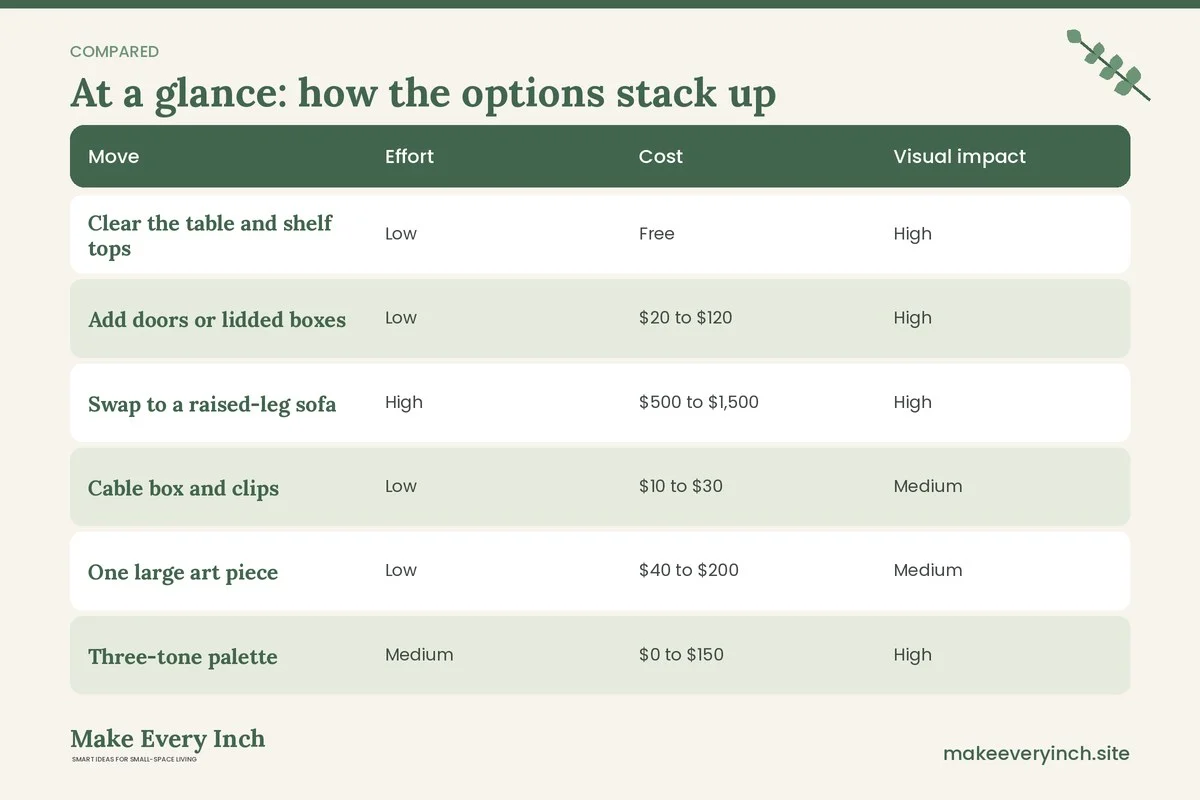
| Move | Effort | Cost | Visual impact | Best for |
|---|---|---|---|---|
| Clear the table and shelf tops | Low | Free | High | Every room |
| Add doors or lidded boxes | Low | $20 to $120 | High | Open shelves |
| Swap to a raised-leg sofa | High | $500 to $1,500 | High | Heavy, skirted sofas |
| Cable box and clips | Low | $10 to $30 | Medium | TV area |
| One large art piece | Low | $40 to $200 | Medium | Blank walls |
| Three-tone palette | Medium | $0 to $150 | High | Mixed colors |
| Wall-hung credenza | High | $150 to $500 | Medium | Owners, not renters |
| Nesting tables | Low | $40 to $150 | Medium | Hosts |
Three example living rooms with dimensions
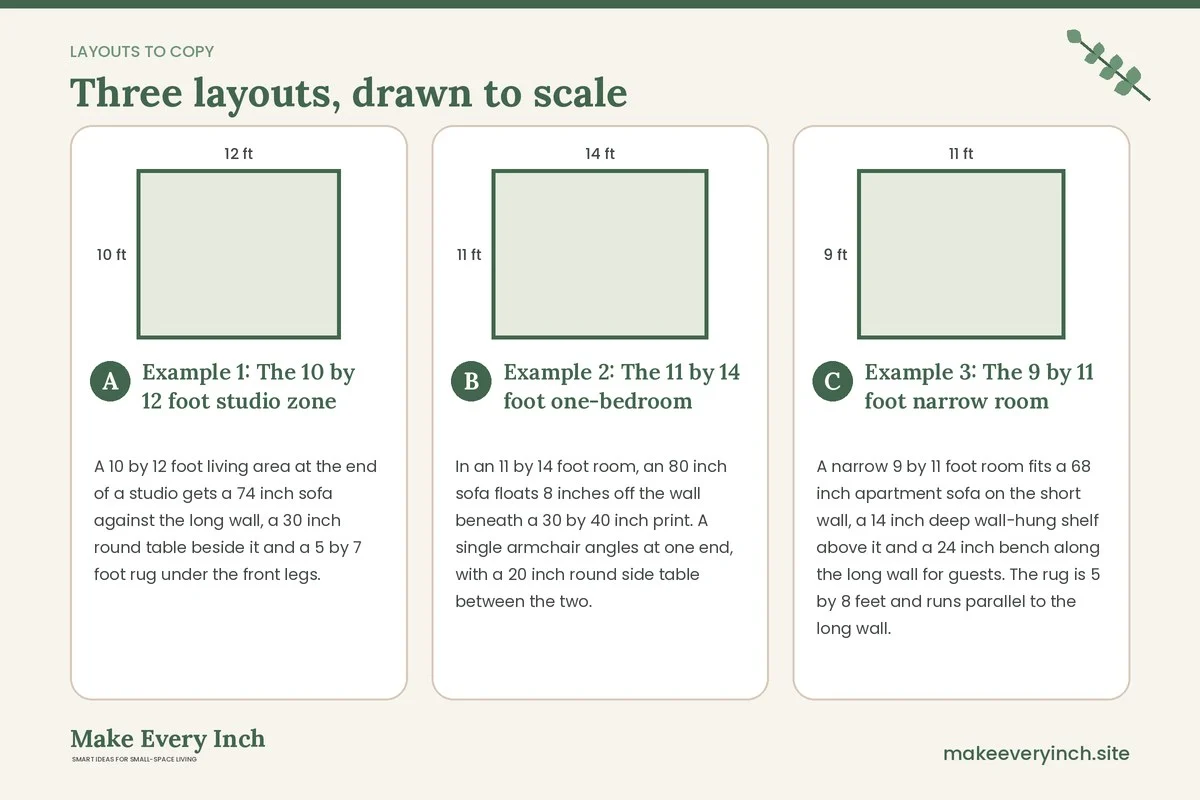
Example 1: The 10 by 12 foot studio zone
A 10 by 12 foot living area at the end of a studio gets a 74 inch sofa against the long wall, a 30 inch round table beside it and a 5 by 7 foot rug under the front legs. A 48 inch low credenza sits across from the sofa and holds the TV, which leaves a 36 inch walkway to the kitchen. Every other surface stays empty, and the one lamp stands in the corner by the window.
Example 2: The 11 by 14 foot one-bedroom
In an 11 by 14 foot room, an 80 inch sofa floats 8 inches off the wall beneath a 30 by 40 inch print. A single armchair angles at one end, with a 20 inch round side table between the two. A 60 inch credenza on the opposite wall holds all the storage, and a 6 by 9 foot rug anchors the seating. There is a 34 inch path to the balcony door.
Example 3: The 9 by 11 foot narrow room
A narrow 9 by 11 foot room fits a 68 inch apartment sofa on the short wall, a 14 inch deep wall-hung shelf above it and a 24 inch bench along the long wall for guests. The rug is 5 by 8 feet and runs parallel to the long wall. The TV mounts to the opposite short wall at eye level when seated, about 42 inches to the center, with cords run behind a paintable cable cover.
A step-by-step method for editing a living room
Step 1: Empty the surfaces
Take everything off the table, shelves, windowsills and the floor. Place it all in boxes or on your bed so you can see what the room looks like at zero.
Step 2: Return only the core list
Put back the sofa, one table, one lamp, the rug and one closed storage piece. Sit in the room for an evening and note what you miss.
Step 3: Sort the remainder into three piles
Keep the items you used in the past week, store the ones that are seasonal or sentimental, and let go of the rest. If you are unsure, box an item for 30 days and see whether you miss it.
Step 4: Give every item a home
Each category gets a spot: remotes in the tray, throws in the ottoman, games in the credenza. A thing without a home becomes clutter within a week.
Step 5: Add warmth last
Once the structure is right, add texture and one plant. Warmth added to a clear room feels deliberate, while warmth added to a cluttered room just adds more clutter.
Edit rules that keep the room calm
- Keep about 70 percent of horizontal surfaces clear.
- Limit visible objects to three per surface group.
- Hold the palette to three tones, plus natural wood.
- Match the finish on storage boxes and baskets.
- Align furniture edges to the rug or the wall, not at random angles.
- Keep at least 30 inches for main walkways and 18 inches between sofa and table.
Keeping minimalism warm: a texture and light plan
A stripped-back room needs a deliberate plan for warmth, since there are few objects to do the job. Start with light. Use one floor lamp near the sofa at about 60 inches tall, one table lamp at the credenza and, if you like, a small plug-in uplight in a corner. Three sources at three heights remove the harsh single-ceiling look and give you a dimmer evening setting.
Next, think about surfaces you touch. A sofa in a nubby weave, a wool or cotton rug, a wooden table and a ceramic lamp base all feel different under your hands. Pair a matte finish with one slightly glossy item, such as a glass vase or a metal lamp, so the room has a gentle contrast. Keep curtains light and long, hung high and wide so the window looks larger and the wall stays calm.
What to do with the things you love but do not use
Sentiment is the hardest part of a minimalist living room. Choose a single memory box with a lid, about 16 by 12 inches, and let it live in the credenza or under the bed. Photographs can be scanned and shown on a digital frame, or rotated through one frame monthly. If an object matters but has no daily job, display it alone on the display shelf for a month, then swap it for another. A rotating exhibit gives each item attention without crowding the room.
Books are the other common problem. Keep the ones you reread on one shelf, turn the spines inward or group them by color if you prefer a quiet look, and give the rest to a library sale. Magazines and mail belong in a closed tray in the entry, not on the living room table.
Seasonal and weekly upkeep
Minimal rooms rely on small routines. Each week, wipe the table and shelf, vacuum the rug and return the throw to the ottoman. Each season, swap one element: a lighter throw in summer, a heavier wool one in winter, a branch arrangement in spring. Rotating a single item keeps the room fresh without buying anything new. Twice a year, empty the credenza and check that everything inside still earns its place.
Budget guide
Prices vary by city and brand, so treat these as hedged ranges in USD.
Under $100
A cable box and clips, lidded storage boxes, one lamp bulb upgrade to warm white and a plant. Spend any remainder on a large print.
About $300 to $600
A slim credenza or a storage bench, a flat-weave rug in the 5 by 8 foot range and a floor lamp. This tier handles the storage and the lighting.
$800 and up
A quality sofa with raised legs, a solid-wood table and a second lamp. Invest in the sofa first, since it defines the room.
Mistakes to avoid
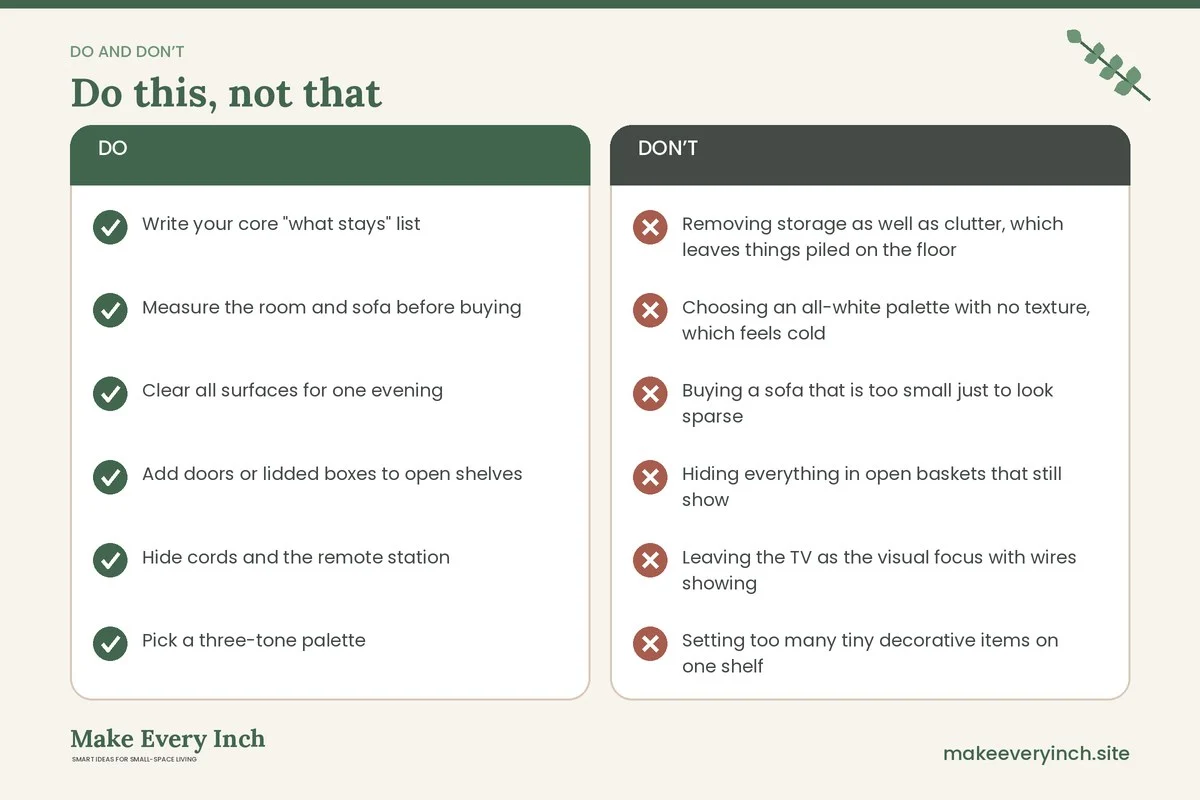
- Removing storage as well as clutter, which leaves things piled on the floor
- Choosing an all-white palette with no texture, which feels cold
- Buying a sofa that is too small just to look sparse
- Hiding everything in open baskets that still show
- Leaving the TV as the visual focus with wires showing
- Setting too many tiny decorative items on one shelf
- Skipping guest seating, then borrowing chairs from the kitchen
- Treating the edit as a one-time event
Minimalist living room checklist
- Write your core “what stays” list
- Measure the room and sofa before buying
- Clear all surfaces for one evening
- Add doors or lidded boxes to open shelves
- Hide cords and the remote station
- Pick a three-tone palette
- Add two textures and one plant
- Hang or lean one large piece of art
- Store guest seating flat
- Set a five-minute nightly reset
FAQ
How do I make a minimalist living room feel cozy?
Layer warm light, natural textures and one soft throw. A 2700K bulb, a wool rug and a boucle or linen pillow bring warmth without adding objects.
What furniture is essential in a minimalist living room?
A sofa, one table, one lamp, a rug and one closed storage piece cover most households. Add a chair only if you host often.
How many decor items should a minimalist living room have?
There is no fixed number, but three to five on a shelf with open space between them is a good starting point. Keep most surfaces clear.
Can a minimalist living room work with a TV?
Yes. Use a low stand in a dark finish, hide cords with a cable box and choose a cabinet or a mounted TV that blends with the wall.
What colors work best for a minimal small living room?
Warm white, sand, oatmeal, soft gray and one dark accent such as charcoal or walnut. Add natural wood and textiles to stop the palette from feeling flat.
How do I host guests in a minimalist living room?
Use nesting tables, floor cushions, a pouf and folding stools that store flat. Bring them out for the evening and put them away afterward.
Is minimalism practical for a family or a lot of belongings?
It can be, if you provide enough closed storage. The goal is to hide belongings neatly, not to own nothing.
How is this different from a minimalist whole apartment?
A living room needs to be edited around seating, light and entertainment. For the full-home approach, read our minimalist apartment ideas.
Keep going: Keep going with small apartment living room ideas for a cozy feel, Japandi small apartment living room ideas and hidden storage ideas.
Save this guide for later
Pin the ideas you like to Pinterest so you can come back to them when you plan your space.