13 Small Laundry Room Ideas for Narrow Spaces: Layouts That Fit
Quick answer: The best answer for a small laundry room narrow spaces problem is to build up and slide sideways instead of out. Stack the machines or place them side by side along the long wall, use bifold or sliding doors, add a shallow shelf above, and keep a walkway of roughly 24 to 30 inches if you can. Always check the appliance manual for clearance, ventilation and venting rules before you commit to a layout.
A small laundry room narrow spaces layout is a different puzzle from a small square room. In a square room you can rearrange the machines in several ways. In a narrow room, whether it is a hallway nook, a closet, a galley between two walls or a strip beside a water heater, there is usually only one workable arrangement, and every inch of width matters. The good news is that narrow rooms reward a plan. A long wall is a gift for shelves and rails, a short floor span makes everything easy to reach, and a door that behaves well can double your usable width. This guide covers how to measure a narrow space properly, the layouts that tend to work, 13 specific ideas, a comparison table, three example rooms, safety notes for dryers, water and electricity, and a checklist you can print. For the wider topic, start with our main guide on small laundry room ideas, and for supply storage see the companion post on how to organize laundry supplies in a small home.
Measure a narrow room the right way
Narrow rooms fool the eye. A space that feels fine when empty can become impossible once a door swing, a hose and a basket enter the picture. Take your measurements with a tape and write them on a sketch, not in your head.
- Width at three points: measure the floor width at the door, the middle and the far end. Walls are often not parallel, and the narrowest point decides what fits.
- Length: measure wall to wall along the floor and again at counter height, because baseboards, pipes and corners change the number.
- Ceiling height: note the lowest point, including beams, ducts and soffits.
- The appliance footprint: most manuals list the width, depth and height of the machine, and they often add the extra depth needed for hoses and vent connections behind it. Add that rear space to your depth figure.
- Door swing: note which way the door opens, how far the door travels and whether the machine door will open fully when the room door is closed.
- Services: mark the water supply valves, the drain, the dryer vent, the electrical outlets and any gas connection. Moving these is a job for a licensed professional, so your layout should work around them.
A useful rule of thumb is to leave about 24 to 30 inches of clear floor in front of a front-loading machine so you can stand, bend and move a basket. In very tight rooms people sometimes work with less, but a tape on the floor and a few minutes of pretending to load a wash will tell you if the number is livable for your body and your routine. Treat these figures as hedged ranges and check the manual and local codes for anything that affects safety.
Four layouts that tend to work in a narrow space
Machines stacked on one end
Stacking a dryer over a washer, or using a stackable pair, keeps the footprint to a single machine’s width. This is often the best use of a closet or a strip only a little wider than a machine. It frees the rest of the wall for shelves and a hanging rail. Check the manual to confirm that your machines are designed to stack, and use the manufacturer’s stacking kit. Stacked units are heavy and can vibrate, so the floor, the kit and the level of the machine all matter.
Machines side by side along the long wall
If the room is long and narrow, such as a galley, placing machines side by side along one wall keeps the opposite wall clear for a walkway. A countertop over a front-loading pair adds a folding surface, although many people prefer to leave a small gap and a removable top so they can reach behind the machines. Leave the gaps the manuals call for.
Machines at the end, storage along the side
In a hallway-shaped room, put the machines at the far end and run shelves or cabinets down one side. The room becomes a corridor with a work area at the end, and the walk-through is clear for the rest of the household.
Machines hidden behind a pair of doors
If the laundry sits in a hall or kitchen, bifold or sliding doors can hide the machines when they are not in use. Check that the doors can open fully and that the machine area has airflow, especially if a dryer is behind them.
13 small laundry room narrow spaces ideas
Make the doors work harder
1. Swap a swing door for a sliding or bifold
A standard door can steal 24 to 30 inches of floor in a narrow room. A bifold, a pocket door or a sliding panel takes much less. If you rent, ask permission before changing any door, and consider removing a door and hanging a curtain on a tension rod only if the lease allows it and the machines do not need a closed door for ventilation or noise.
2. Hang the door on the outside
Where the layout allows, reversing the swing so the door opens into the hall or out of the closet can free the whole floor. This is a landlord or owner decision and should be done by a competent person.
3. Use the back of the door
A shallow over-the-door organizer or a slim hook rail on the inside of the door holds lint rollers, a mesh bag, spare hangers and a small bottle. Keep the weight light, because heavy loads can strain a hollow door.
Go vertical above the machines
4. A single deep shelf above the machines
A shelf mounted above the machines at about 12 to 16 inches of clearance over the top gives you a place for baskets and bottles. Use a bracket system that suits your wall type, anchor into studs, and leave enough room to lift the machine lid or door. Never drill without permission if the home is a rental.
5. Two shallow shelves instead of one deep one
In a very narrow room, two shelves 8 to 10 inches deep can be easier to reach than one deep shelf. Keep heavier items on the lower shelf and lighter items on the upper one.
6. A tall, slim cabinet in the dead end
At the end of a narrow room, a cabinet 10 to 14 inches deep can hold detergent, a drying rack and cleaning supplies. If it is tall, anchor it to the wall so it cannot tip.
7. A rail for hanging dry-clean items
A wall-mounted rail, or a tension rod between two walls, gives you a hanging spot for items that must air dry. Make sure the rod is rated for the load and that hangers cannot touch a hot dryer vent.
Use the floor and the gaps
8. A slim rolling cart between machine and wall
A cart 6 to 9 inches wide can fit in the gap beside the machine, holding detergent and small items. Check that it does not block ventilation, and never wedge it where hoses or the vent run.
9. A fold-down shelf
A wall-mounted shelf that folds flat when not in use gives you a folding surface without taking up the floor. Choose a model rated for the load and anchor it to studs.
10. A countertop over front-loading machines
If the machines are side by side and the manual allows it, a countertop spanning both gives you a folding surface. Make it removable, leave the clearances the manual lists, and do not place heavy items where vibration can slide them off.
11. A pull-out hamper in a narrow base cabinet
A slim cabinet with a pull-out basket handles sorting without taking a walking lane. Choose breathable material to avoid trapped damp.
Use the walls and the ceiling
12. A ceiling-mounted drying rack
A rack that raises to the ceiling uses space you cannot use otherwise. It must be mounted into a joist, kept clear of lights and vents, and used only where you have permission and structural support. Consider a freestanding folding rack if you rent.
13. A pegboard or rail wall
A pegboard or rail on the long wall holds a small broom, a lint brush, a spray bottle in a bin and a drying rack. Because it is vertical, it takes almost no floor.
Comparing narrow laundry layouts
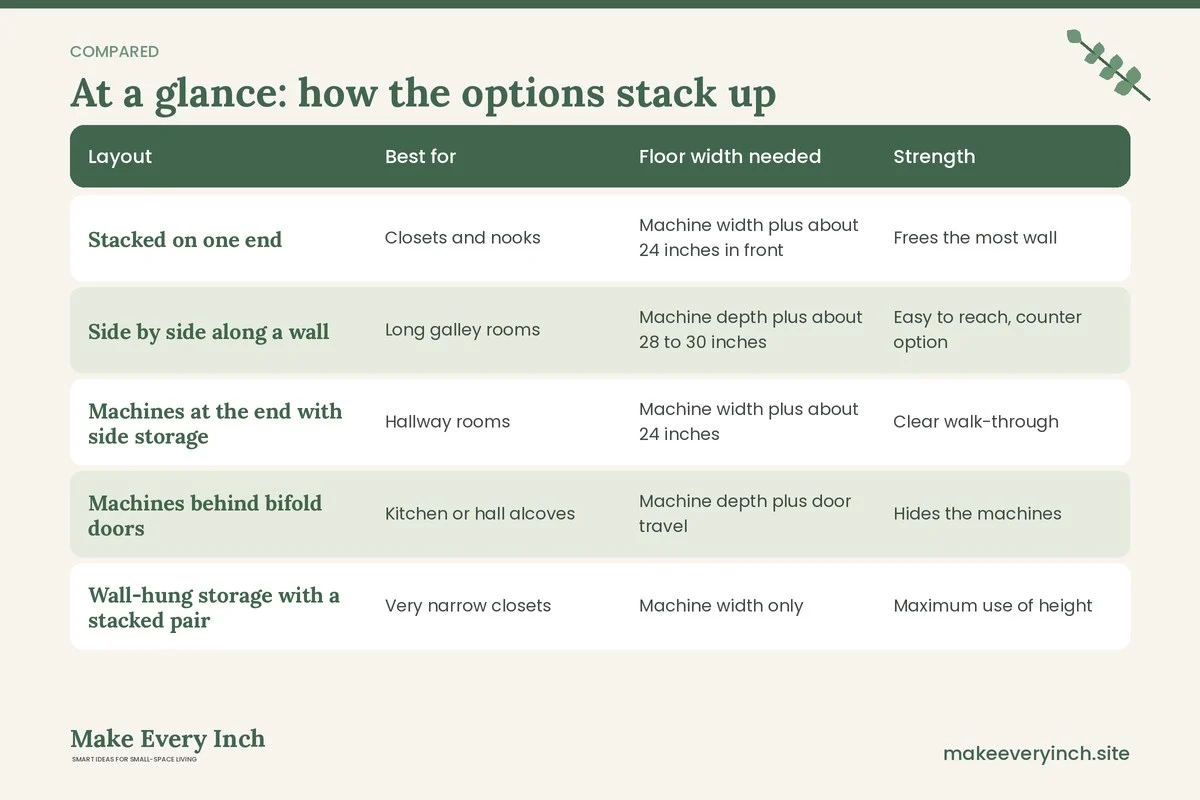
| Layout | Best for | Floor width needed | Strength | Watch out for |
|---|---|---|---|---|
| Stacked on one end | Closets and nooks | Machine width plus about 24 inches in front | Frees the most wall | Weight, vibration and reach |
| Side by side along a wall | Long galley rooms | Machine depth plus about 28 to 30 inches | Easy to reach, counter option | Needs a longer room |
| Machines at the end with side storage | Hallway rooms | Machine width plus about 24 inches | Clear walk-through | Storage must stay shallow |
| Machines behind bifold doors | Kitchen or hall alcoves | Machine depth plus door travel | Hides the machines | Airflow and heat from the dryer |
| Wall-hung storage with a stacked pair | Very narrow closets | Machine width only | Maximum use of height | Anchoring and reach |
These are rough planning ranges, not rules. The manuals, local codes and the actual layout of your room decide what is safe and workable.
Dryer clearance, lint and fire safety
A narrow room concentrates heat, lint and moisture in a small space, so safety deserves its own section.
- Read the manual. Every dryer lists required clearances at the back, sides and top, and the distance to a combustible surface. Follow the manual rather than a general rule.
- Keep the vent short and straight. A long, kinked or crushed vent hose traps lint and heat. Use the vent type the manual calls for, and have a professional check the route if you are not sure.
- Clean lint after every load. Empty the lint screen each time. Lint buildup in the screen, the vent and behind the machine is a known fire risk, so schedule a periodic vent cleaning.
- Never store flammables near the dryer. Keep cleaners, aerosols, rags with oil or solvent and anything combustible away from the heat source.
- Give it air. A dryer needs fresh air to exhaust properly. Louvered doors or a gap at the bottom of a closet door can help, but do not rely on guesswork. Check the manual for the required opening.
- Do not run the dryer if you leave the home. Many people prefer to run it only when someone is present.
- Check the venting rules. Local rules often require that a dryer vent to the outside, not into the room, the attic or a crawl space. If you are not sure, ask a licensed professional or your landlord.
Water, electricity and weight
- Know your shutoff valves. Make sure you can reach the water shutoff valves behind the washer. If you are stacking shelves or cabinets, do not block them. Consider turning the valves off when you travel.
- Check the hoses. Look for bulges, cracks and drips at the connections, and replace worn hoses with the type the manufacturer recommends.
- Add a drain pan if allowed. If the washer sits on an upper floor or above living space, ask about a drain pan and a leak sensor.
- Use a GFCI. Outlets near water are generally expected to have ground-fault protection. If your outlet does not, talk to an electrician or your landlord rather than adding an adapter.
- Do not overload outlets. Plug a washer and a dryer into the outlets the manual specifies, not into a power strip or a long extension cord.
- Respect weight and vibration. A stacked pair or a loaded wall shelf is heavy. Put machines on a solid, level floor, use the stacking kit the manual lists and do not hang heavy shelves above a vibrating machine unless anchored to studs.
- Anchor tall furniture. A tall cabinet in a narrow room can tip if a child pulls a drawer, so fix it to the wall with the hardware that suits your wall.
Three example rooms
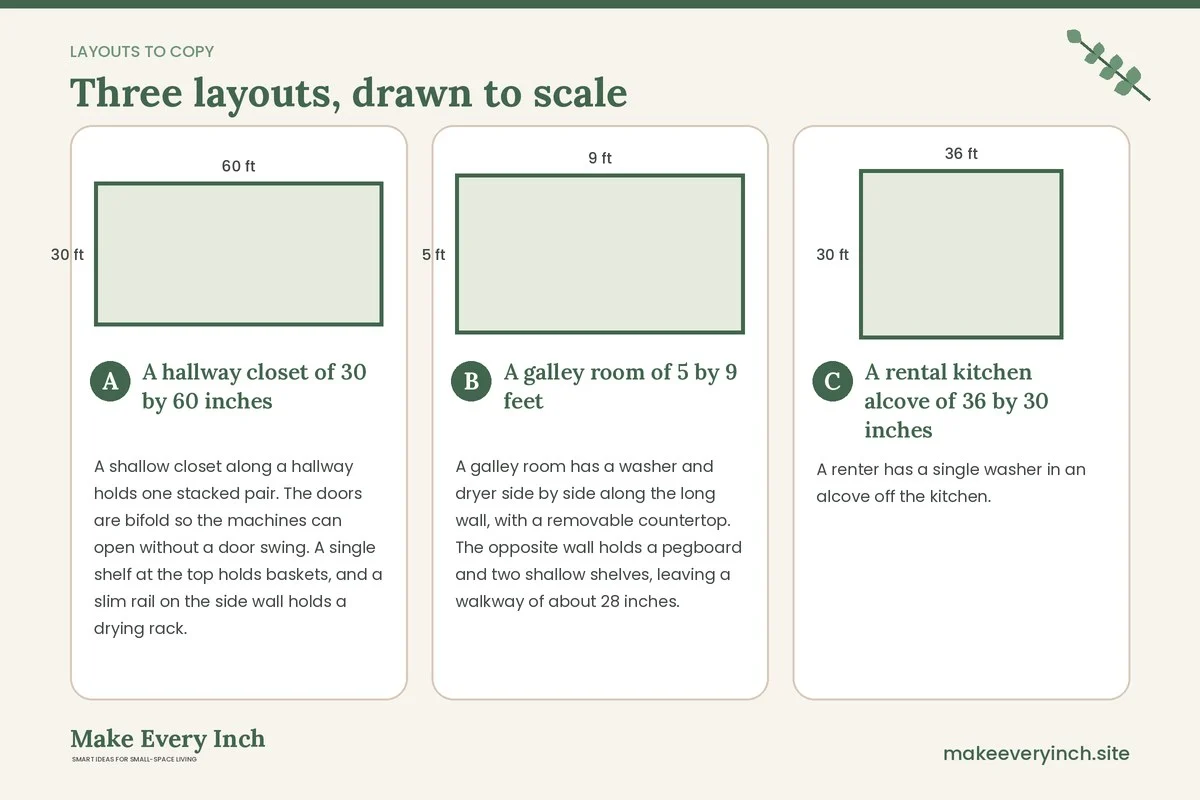
A hallway closet of 30 by 60 inches
A shallow closet along a hallway holds one stacked pair. The doors are bifold so the machines can open without a door swing. A single shelf at the top holds baskets, and a slim rail on the side wall holds a drying rack. The household leaves the closet doors open during dryer use and checks the manual for the opening size. Lint is cleaned after every load.
A galley room of 5 by 9 feet
A galley room has a washer and dryer side by side along the long wall, with a removable countertop. The opposite wall holds a pegboard and two shallow shelves, leaving a walkway of about 28 inches. A rolling cart sits at the far end and rolls out when the room is in use. The window is cracked for ventilation when drying, if the manual and home allow it.
A rental kitchen alcove of 36 by 30 inches
A renter has a single washer in an alcove off the kitchen. With the lease in hand, the renter uses removable, no-drill options only: an over-the-door organizer, a freestanding drying rack that folds flat and a tension rod for hanging items. The renter asks the landlord before adding any shelf and keeps all cleaners in a lidded bin on the floor, away from children and pets.
Chemical storage and cleaning supplies
A narrow laundry room is often the closest storage spot for cleaners, which is convenient and also a risk. Keep bottles upright, in a lidded bin, on a shelf out of reach of children and pets. Never mix cleaners, especially bleach with ammonia or acids, because the fumes can be dangerous. Keep products in their original labelled containers, and open a window or vent when you use strong products. Store detergent pods in a closed container.
Lighting and noise
Narrow rooms feel tighter when dark. A plug-in or battery light, or a motion-activated strip under a shelf, can brighten a corner without wiring. If you rent, choose options that need no hard-wiring. Machines are loud, so soft rugs, felt feet and a closed door can lessen noise in a hallway home. A rubber mat under a machine may reduce vibration, but check the manual first.
Mistakes to avoid
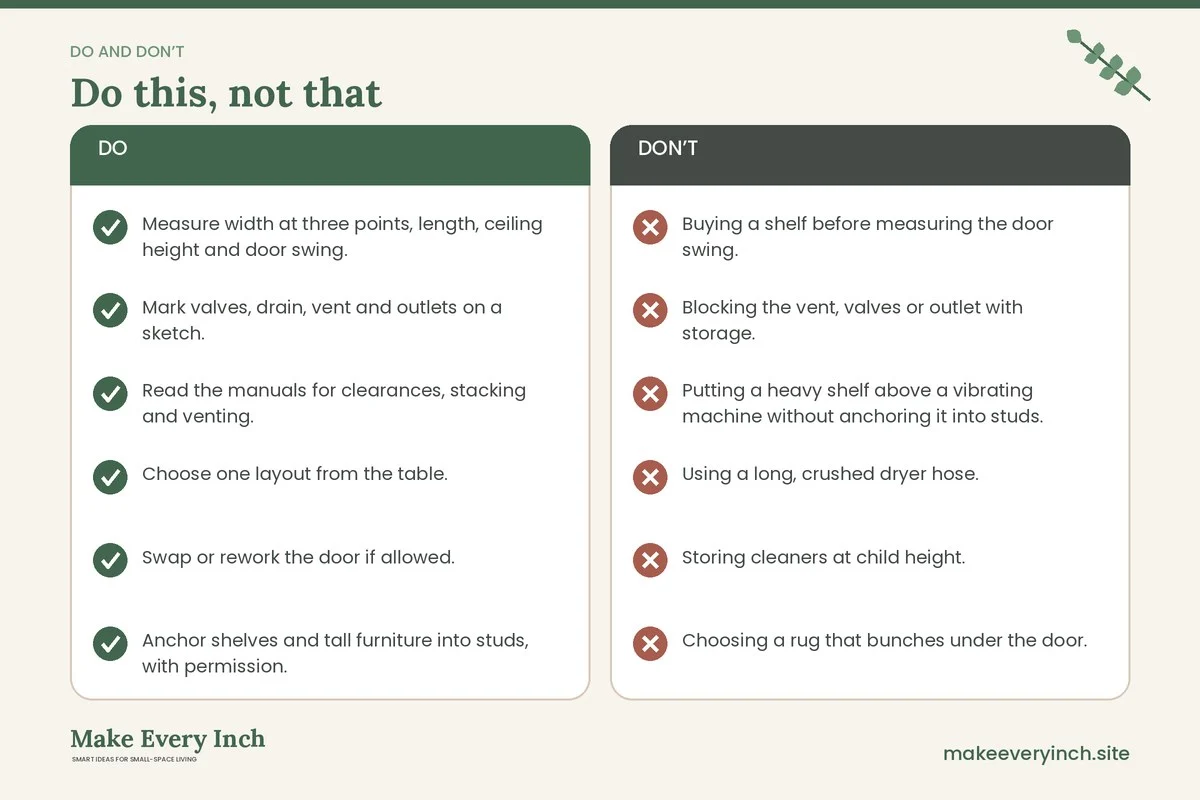
- Buying a shelf before measuring the door swing.
- Blocking the vent, valves or outlet with storage.
- Putting a heavy shelf above a vibrating machine without anchoring it into studs.
- Using a long, crushed dryer hose.
- Storing cleaners at child height.
- Choosing a rug that bunches under the door.
- Forgetting to ask the landlord about changes.
- Ignoring the manual’s clearance numbers.
Narrow laundry room checklist
- Measure width at three points, length, ceiling height and door swing.
- Mark valves, drain, vent and outlets on a sketch.
- Read the manuals for clearances, stacking and venting.
- Choose one layout from the table.
- Swap or rework the door if allowed.
- Anchor shelves and tall furniture into studs, with permission.
- Keep a clear walkway of roughly 24 to 30 inches.
- Confirm the dryer vent and airflow.
- Check that outlets near water are protected.
- Store cleaners out of reach and never mix them.
- Clean the lint screen after every load.
- Photograph the room before changes if you rent.
FAQ
How narrow can a laundry room be?
There is no single answer. Many people work with a clear floor of roughly 24 to 30 inches in front of a front-loading machine, but the manuals, local codes and your own comfort set the real limit.
Should I stack or place the machines side by side?
Stacking saves floor and works in closets, while side by side suits long rooms and gives you a counter. Choose based on your width, your reach and the floor.
Can I hide a laundry area behind doors?
Yes, with bifold or sliding doors. Make sure the dryer has the airflow the manual requires and leave the doors open while it runs.
What can a renter do in a narrow laundry space?
Use freestanding racks, over-the-door organizers, tension rods and a rolling cart. Ask permission before drilling or changing a door, and read our guide to no-drill storage ideas for renters.
How do I reduce fire risk?
Clean lint after every load, keep the vent short and clear, follow the manual’s clearances and keep flammables away from the dryer.
Can I put shelves above the machines?
Often yes, if they are anchored into studs, leave room to open the machine and are not placed where vibration or heat can affect them. Ask permission first if you rent.
Related ideas for other tight rooms
The same measure-first, build-up approach works across a small home. A tight laundry nook shares tricks with small bathroom ideas for narrow rooms, with the small bathroom ideas guide and with small kitchen ideas where an alcove houses machines. If the laundry sits near the front door, see small entryway ideas. For the overall approach to storage, read small space organization ideas and small closet ideas when the machines live in a closet. On a limited budget, budget small space ideas and renter friendly apartment decorating ideas offer more approaches. For a deeper look at storage in a small laundry area, see small laundry room organization.
Keep going: Keep going with our small laundry room ideas, our guide on how to organize laundry supplies in a small home and our tips for no-drill storage ideas for renters.
Save this guide for later
Pin the ideas you like to Pinterest so you can come back to them when you plan your space.