Small Closet Ideas: The Complete Guide to Storing More in Less Space
Quick answer: The best small closet ideas follow one order: edit what you own, use the full height with double rods and shelves, put hooks and organizers on the door, move bulky and off-season items out of prime space, and give shoes, bags and accessories their own zones. Check weight limits, anchor tall pieces, ask permission before drilling in a rental and air out paint and finishes before filling the closet.
Small closet ideas matter because a closet is the hardest-working storage in a small home, and it is rarely sized for the amount of clothing, bedding and gear that most people own. A shallow reach-in, a narrow walk-in or a single coat cupboard has to do the job of a whole dressing room. The answer is not one clever product. It is a sequence of choices about what stays, how high it goes, which surfaces carry the load and where everything else lives. This guide is the hub for everything on Make Every Inch about closets and clothing storage. It covers the edit, the measurements, hanging space, shelves, doors, shoes, bags, jewelry, closet types, seasonal and capsule methods, laundry and linen storage, safety, a comparison table and a checklist. Each section points to a deeper guide, and the final section lists every closet guide in one place. For the wider picture, read our main guide to small bedroom ideas, the room-by-room approach in small space organization ideas and our basic walkthrough of small closet organization ideas.
Start with an edit and a measurement
Every closet plan starts with two jobs that cost nothing: deciding what deserves the space and measuring the space you have. Take everything out, sort it into keep, move elsewhere and let go, and be honest about what you wore in the last year. Items that are kept for sentimental reasons or for a different season do not need to sit at eye level. A closet works best when the things you reach for daily occupy the easiest zone, and everything else sits above, below or somewhere else entirely.
Measure the width, the depth and the height of the closet, the height of the rod and the shelf, and the width of the door opening. A typical reach-in has a rod at about 60 to 66 inches and a shelf above it, which leaves a lot of wasted air under short clothing and above the shelf. Measure your longest hanging item and your most common one, since shirts, skirts and folded trousers need much less height than dresses and coats. These numbers tell you which of the later ideas will fit. Write them on your phone so you have them in a shop.
If your closet is a reach-in, our post on small reach-in closet organization ideas walks through the same steps for that format, including how to work with sliding and bifold doors that cover part of the opening.

Double your hanging space
Hanging space is the first thing people run out of, and it is also the easiest thing to multiply. Because most clothing is short, a single rod wastes the lower half of the closet. A second rod, hung below the first, can add a whole row of shirts, skirts and folded trousers. Our guide on how to double hanging space in a closet shows the measurements that make a two-rod setup work, including the typical spacing of about 40 inches between the top rod and the floor for long garments and about 80 inches overall.
Other tools help when a second rod will not fit. A hanging extender lets you add a short bar under your existing rod. Slim, non-slip hangers make a row about a third narrower. Cascading hangers stack several garments in the width of one. Matching hangers also help the eye, because a row of uniform hangers looks calm and takes up less visual space. For more ways to get height out of a small closet, see our collection of tiny closet ideas for more hanging space, which covers tension rods, over-the-door rods and ceiling-height solutions.
Keep a few principles in mind. Hang long items on the end where the rod is highest, group by type and then by color, and place the heaviest pieces nearest the support. Do not overfill a rod, since a crowded rod damages clothes and strains the fixings.
Shelves, bins and the space above the rod
The shelf above the rod is prime real estate and is often poorly used. Use matching baskets or bins so that the shelf looks tidy and the contents can be pulled out as a unit. Label the front of each one. Folded knits and jeans stay neater in shallow bins than in tall stacks, and a shelf divider stops a pile from sliding. Our guide on closet shelf organization ideas covers shelf dividers, bin sizes and which items belong high or low.
If the closet has no shelves at all, you can build the structure yourself without a renovation. A freestanding unit, a tension pole shelf or a stack of crates can stand in. The post on how to organize a closet with no built-in shelves shows how to create levels with tools you can take with you. If you want to do the work yourself, our DIY closet organization for small spaces guide covers cheap builds and adjustable systems.
When you reach the top of the closet, think about what is rarely used. Luggage, spare bedding and special-occasion items belong up there. Keep them in clear or labeled containers so that you remember what is inside, and keep a small step stool nearby so that you never need to climb on a drawer or a chair.
Use the door
A closet door is a flat surface that most people ignore. The inside of a swing door can hold a slim organizer, a row of hooks or a hanging rack, and the back of a bifold or sliding door can sometimes hold lighter items. The outside of the door can carry a mirror or a few hooks for the outfit of the day. Our guide to small closet door storage ideas lists what works on swinging, sliding and bifold doors and how much weight each type will carry.
Check clearance before you buy. An over-the-door organizer adds about 2 to 4 inches of depth, and that can stop the door closing when the shelf behind it is full. Check that hooks and racks do not bump the hanging clothes. If the door is hollow or thin, keep to lightweight items such as scarves, belts, hats, small bags and cleaning cloths.
Drawers without a dresser
Many small bedrooms cannot hold a dresser, and a closet can pick up the slack. Stacking drawers, fabric cubes, a slim rolling cart and hanging organizers with shelves are all possible. Our post on small closet drawer alternatives compares each one by capacity, depth and effort. The principle is simple. Choose something that fits the depth of the closet with a gap for the door, and keep it low so that the hanging space above stays usable.
If the closet will not take any extra furniture, think about where the rest of your clothing can live. A bed with storage underneath is one answer. Our guide to under bed storage ideas explains how to choose boxes, rollers and lift-up beds, and the wider small bedroom storage ideas post covers wardrobes, headboards and wall storage. Another approach is covered in clothing storage ideas for small bedrooms, which looks at freestanding racks, open wardrobes and mixed systems for rooms with no closet or a very small one.
Shoes, bags and accessories
Shoes take up more room than people expect, and they also drag in dirt, so they need their own zone. On the closet floor, a tiered rack or a shallow shelf lifts pairs off the ground and exposes them for easy picking. On the door, a hanging organizer holds flats, sandals and slippers. Overhead, a high shelf can store off-season boots in boxes. Our guide to shoe storage ideas for small closets lists the options by depth and capacity, and the broader small shoe storage ideas post covers hallways and bedrooms too.
Bags need support, shape and air. Stuffing them lightly keeps the shape, and hanging them from hooks or a rod keeps the straps free of creases. Soft slouchy bags can lean in a shelf bin, and structured bags need their own spot. Our post on handbag storage ideas for small closets covers shelf dividers, hooks, hanging pockets and display options.
Small accessories are the first things to get lost. Rings, necklaces and earrings need shallow, visible storage. Our guide on jewelry organization for small spaces shows how to use a door-back organizer, a wall board or a tray inside a drawer. Belts, ties and scarves work well on a rotating hook or a row of small hooks. Give every group a place, and the closet stays easy to scan.
Closet types and the plans that suit them
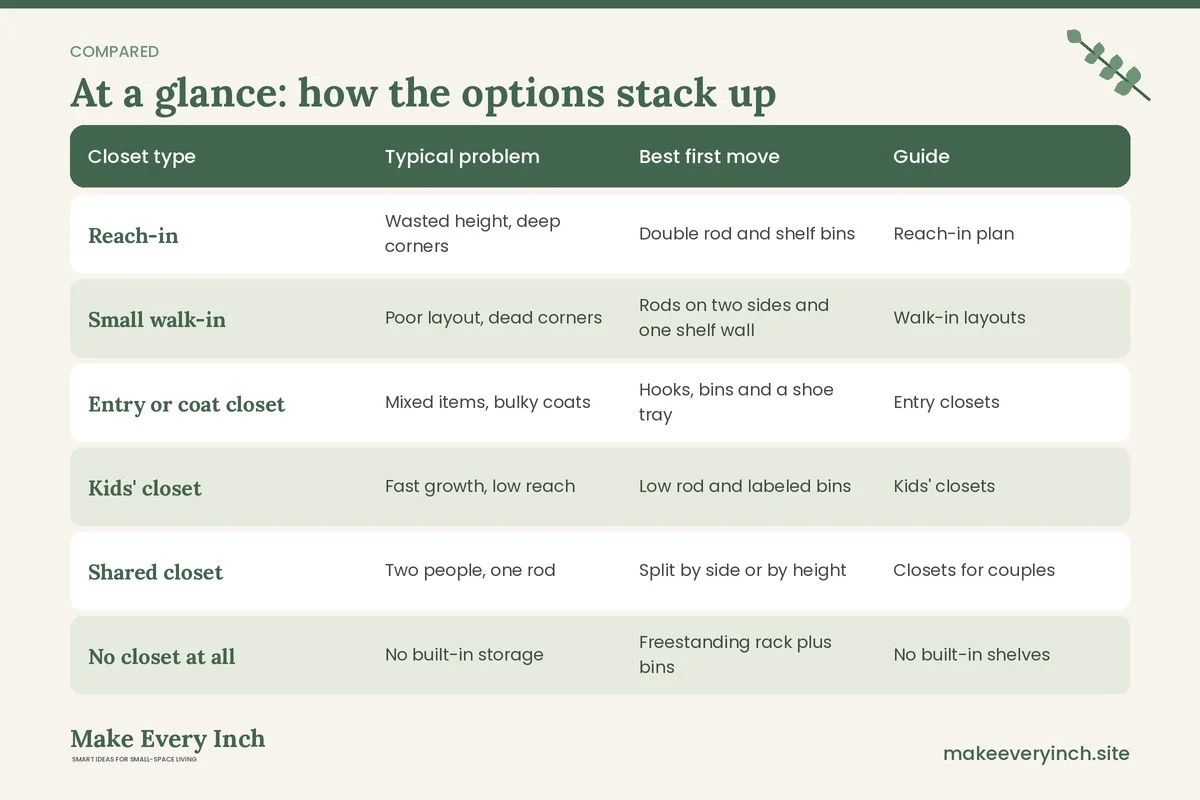
Different closets call for different plans. The table below compares the common types, their typical problems and the ideas that suit them best.
| Closet type | Typical problem | Best first move | Guide |
|---|---|---|---|
| Reach-in | Wasted height, deep corners | Double rod and shelf bins | Reach-in plan |
| Small walk-in | Poor layout, dead corners | Rods on two sides and one shelf wall | Walk-in layouts |
| Entry or coat closet | Mixed items, bulky coats | Hooks, bins and a shoe tray | Entry closets |
| Kids’ closet | Fast growth, low reach | Low rod and labeled bins | Kids’ closets |
| Shared closet | Two people, one rod | Split by side or by height | Closets for couples |
| No closet at all | No built-in storage | Freestanding rack plus bins | No built-in shelves |
Small walk-in closets
A walk-in closet feels like a luxury, but a small one has the same problems as a reach-in with the added issue of floor area. The key is to use the walls, keep an aisle of about 24 to 30 inches and avoid placing furniture in the middle. Use rods on two or three sides, set a shelf above them and place shoes and bins where the corner would otherwise be dead. Our guide to small walk-in closet layout ideas compares L-shaped, U-shaped and galley layouts and shows how to place a mirror and a bench without losing the aisle.
Entry and coat closets
A closet by the front door has a different job. It handles coats, bags, shoes, umbrellas and sometimes the vacuum. The essential idea is zoning, with coats on a rod, daily items on hooks and heavier items on the floor in a tray or bins. Our guide on small entry closet organization ideas shows how to split the space, and small coat storage ideas covers racks, hooks and hall trees for homes that lack a coat closet. If the entry is the problem, our broader small entryway ideas pillar is the best next step.
Kids’ closets
Children’s closets change quickly, so the best system is adjustable. Lower the rod so a child can reach it, use open bins for toys and school items, and add a high shelf for things that parents control. Labels with pictures help younger children. Our post on kids’ closet organization for small spaces shows how to build a closet that grows from toddler to teen.
Shared closets for couples
Two people in one closet need rules. Split by side, by level or by type of clothing, and agree on who gets the better shelf. A small closet works if each person has a defined zone and a place for shoes and accessories. Our guide on small closet ideas for couples covers fair splits, shared zones and what to do when one person owns more clothes.
Seasonal rotation and the capsule wardrobe
If your closet cannot hold a year of clothing, rotate. Keep the current season in the closet and store the opposite season in bins, vacuum-free boxes or a high shelf. Make the swap twice a year, and use the swap as a chance to wash, repair and let go of items. Our post on seasonal clothing storage in small homes explains how to pack, label and store clothes where space is tight, including under-bed and top-shelf options.
A capsule wardrobe is the next step. It reduces the number of pieces to a smaller set that mixes easily and covers most situations. The point is not to own a particular number of items. It is to own pieces you actually wear. A smaller wardrobe fits in a smaller closet and makes mornings easier. Our guide on capsule wardrobe storage for small closets shows how to arrange a lean set so that each piece is visible and accessible.
Linen and laundry storage
Bedding and towels are bulky, and a small home often lacks a linen closet. You can fold sheets inside their own pillowcases so that sets stay together, roll towels into baskets and use the top shelf of a bedroom closet for spare bedding. Our post on linen storage ideas without a linen closet lists solutions for bathrooms, hallways and bedrooms, including over-the-door racks, narrow carts and under-bed boxes.
Mistakes that waste closet space
Most small closets fail for a handful of avoidable reasons. They are overfilled, so nothing is visible. They have a single rod set too high, so the lower half is empty. They use bulky hangers that waste inches. They hold items that belong elsewhere. Or they are organized with products before the edit is done. Our post on small closet mistakes that waste space goes through each one with the fix, and it is a good read before you buy anything.
A few quick rules help. Buy storage after you edit, not before. Measure twice and buy once. Leave about ten percent of the space empty, so that the closet can absorb a new purchase. Check that every item in the closet has a home, and put things back there.
Safety: weight, anchoring, rentals, fumes and moths
Closet projects look harmless, but they involve weight, height and enclosed air, so a few safety habits matter.
- Weight limits: check the stated limit of every rod, shelf, hook and over-the-door organizer, and stay well under it. A loaded rod can carry much more than a thin tension rod or a stick-on hook. Spread heavy items, such as coats and denim, across several supports instead of piling them in one place.
- Anchoring: tall freestanding shelves, racks and dressers can tip, especially when drawers or bins are pulled out. Anchor tall pieces to the wall with the supplied straps or brackets into studs where possible, and do not leave children to climb on them.
- Hardware permission in rentals: drilling into walls, replacing rods or removing doors may be banned in a lease. Read the lease, ask the landlord in writing, photograph the closet before you start and keep original parts in a labeled box so that you can restore them. Choose removable options, such as tension rods, freestanding units, over-the-door hooks and adhesive hooks rated for the weight, when you are not sure.
- Low-VOC finishes: if you paint a closet, stain shelves or add new shelving made of pressed wood, choose low-VOC paint and finishes where you can, ventilate the room and let everything air out for several days before you fill the closet with clothes. A closet is a small enclosed space, and fumes can linger in fabric.
- Moth deterrents with caution: cedar and lavender sachets are common choices, and some traditional moth products use strong chemicals. Read labels, keep any product away from children and pets, do not let strong-smelling items touch fabric directly and ventilate. Clean clothes before storing them, because stains and sweat attract pests. If you suspect an infestation, ask a professional rather than adding more products.
- Door and ceiling loads: do not hang heavy items on a hollow door, and do not hang anything on a ceiling that is not a joist or a structural support.
- Step stools: use a stable step stool for high shelves. A chair or a drawer can slip or collapse.
Closet planning checklist
- Take everything out and sort into keep, move and let go.
- Measure width, depth, height, rod height and the door opening.
- Write the numbers on your phone.
- Check the lease before drilling or removing anything.
- Decide what must hang and what can fold.
- Add a second rod or an extender where clothes are short.
- Use matching slim hangers for a uniform row.
- Add shelf bins and labels above the rod.
- Use the door for light items, hooks and small organizers.
- Give shoes, bags and accessories their own zones.
- Move off-season and rarely used items to high or remote storage.
- Check the weight limit on every shelf, rod and hook.
- Anchor tall freestanding units to the wall.
- Air out any new paint or finishes before filling the closet.
- Leave about ten percent of the space free for growth.
- Schedule a quick reset every season.
All our small closet guides
Every guide in the closet cluster is listed here, with a one-line description.
- How To Double Hanging Space In A Closet: add a second rod or extender where clothing is short.
- Jewelry Organization For Small Spaces: compact ways to store rings, necklaces and earrings.
- Shoe Storage Ideas For Small Closets: racks, shelves and door pockets for pairs of every size.
- Small Reach-In Closet Organization Ideas: make a shallow reach-in work harder.
- Tiny Closet Ideas For More Hanging Space: tension rods, hooks and height tricks.
- Capsule Wardrobe Storage For Small Closets: store a lean wardrobe so that each piece is visible.
- Closet Shelf Organization Ideas: bins, dividers and shelf zones.
- Clothing Storage Ideas For Small Bedrooms: racks, wardrobes and mixed systems for tiny rooms.
- Handbag Storage Ideas For Small Closets: keep bags in shape and easy to reach.
- How To Organize A Closet With No Built-In Shelves: add levels without a renovation.
- Kids’ Closet Organization For Small Spaces: a closet that grows with a child.
- Linen Storage Ideas Without A Linen Closet: store sheets and towels elsewhere in the home.
- Seasonal Clothing Storage In Small Homes: rotate clothes without losing space.
- Small Closet Door Storage Ideas: use the door for hooks, racks and pockets.
- Small Closet Drawer Alternatives: bins, carts and hanging drawers.
- Small Closet Ideas For Couples: fair splits for a shared closet.
- Small Closet Mistakes That Waste Space: common errors and how to fix them.
- Small Entry Closet Organization Ideas: coats, bags and shoes by the front door.
- Small Walk-In Closet Layout Ideas: layouts that keep the aisle clear.
Related guides
If your closet problem is part of a larger one, these pillars and guides help:
- Small Closet Organization Ideas: the foundation guide for any closet.
- DIY Closet Organization For Small Spaces: build your own system.
- Small Bedroom Storage Ideas: wardrobes, beds and walls.
- Small Coat Storage Ideas: coats where there is no closet.
- Small Shoe Storage Ideas: shoes for the whole home.
- Under Bed Storage Ideas: use the space beneath the mattress.
- Small Bedroom Ideas: the bedroom pillar.
- Small Space Organization Ideas: the whole-home pillar.
- Small Entryway Ideas: the entry pillar.
- Studio Apartment Ideas: when the closet is the only storage.
- Budget Small Space Ideas: closets on a tight budget.
FAQ
How do I add storage to a small closet?
Start by editing what you own, then use the height with a second rod, shelf bins and door organizers. Move off-season items out of prime space and give shoes and bags their own zones.
What is the best way to double closet hanging space?
Add a second rod below the first when clothes are short, or use a hanging extender if a rod will not fit. Slim hangers narrow each row, and long items go on the high end.
How do I organize a small closet with no shelves?
Use freestanding shelves, a tension pole unit or stacked bins to create levels. Keep the heaviest items low and anchor tall pieces to the wall.
Can I change a closet in a rental?
Often, with limits. Read the lease and ask in writing before drilling or removing anything. Tension rods, freestanding units and rated adhesive hooks are the safest choices, and you should keep original parts to restore later.
How do I store off-season clothes?
Wash and dry them, pack them in labeled bins or boxes and store them high in the closet, under the bed or in another room. Swap them twice a year.
What should I do about moths?
Clean clothes before storing, keep the closet dry and ventilated and use deterrents with caution. Read labels, keep products away from children and pets and avoid direct contact with fabric. Call a professional if you see damage.
How much weight can a closet shelf or rod hold?
It depends on the material, the length and the fixings. Check the stated limit, stay well under it, and spread heavy items. When in doubt, add a support or use a sturdier system.
How do two people share a small closet?
Split by side or by level, give each person a shelf and a shoe zone, and keep shared items such as spare bedding in one agreed place.
Keep going: Keep going with our small closet organization ideas, small bedroom ideas and small space organization ideas.
Save this guide for later
Pin the ideas you like to Pinterest so you can come back to them when you plan your space.