16 Small Living Room Lighting Ideas for a Brighter Space
Quick answer: To get small living room lighting brighter space results, find where the room is actually dark, then fill those gaps with light at three heights: a soft ceiling or wall source, lamps at seated eye level and a low glow near the floor. Keep the bulbs a similar warm white, aim light at pale walls and ceilings so it bounces, keep shades light and clean, and never overload a socket or run cords where people walk.
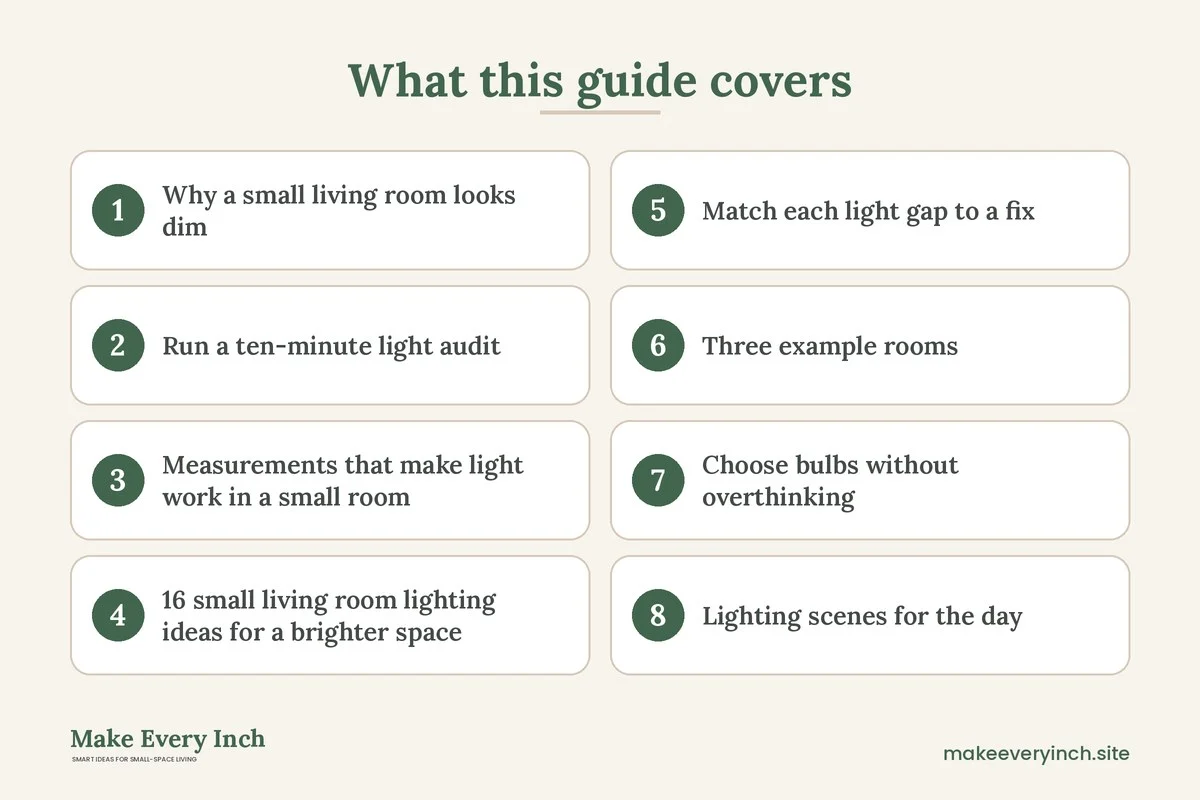
Small living room lighting brighter space is not simply a matter of buying a stronger bulb. A small room can feel dim even with a fixture overhead, because one source in the middle of the ceiling lights the floor and leaves the corners, the sofa and the walls in shadow. The eye reads those shadowy edges as a smaller room. This guide takes a different route from a general list of fixtures. It starts with a light audit that shows where the room loses brightness, then gives you measurements, 16 fixes, a table matching each gap to a solution, three example rooms, safety notes for cords and bulbs, a weekend plan and a checklist. If you want the wider picture first, read our main guide on small living room ideas, our overview of small living room lighting ideas and the room-agnostic guide to layered lighting ideas for small apartments.
Why a small living room looks dim
Most dim rooms share a few causes, and it helps to name yours before you buy anything. The first is a single overhead source. A lone ceiling light throws light straight down, so the floor and the coffee table are lit, but the vertical surfaces that the eye uses to judge a room, the walls and the corners, receive very little. The second is dark finishes. Deep wall color, dark curtains and a dark rug all absorb light, so the same lamp seems weaker. The third is blocked daylight. Heavy curtains that cover the glass, a tall bookcase in front of a window or a sofa back that rises to the sill all steal natural light. The fourth is a mismatch of bulbs, with one cool white bulb next to a warm one, which makes the room look patchy. The fifth is plain dust and grime, because dirty shades and bulbs cut output.
A bright room is not the same as a harshly lit one. The goal is an even, comfortable level of light across the walls and seating area, with a few brighter spots for reading or hobbies. That is why layering works better than a bigger ceiling bulb, and it is why the rest of this guide talks about heights and directions rather than power.
Run a ten-minute light audit
Do this audit twice, once in the middle of the day and once in the evening with every light on.
Step 1: Photograph the room from the doorway
Stand in the doorway and take a photo with the lights off, then another with the lights on. Phones often show dark corners more honestly than the eye does. Look at where the photo goes dark. Mark the corners, the wall behind the sofa and the spot beside the window.
Step 2: Walk the four zones
Stand at the sofa, the reading chair if you have one, the entry and the media wall. At each position, ask whether you can read a page comfortably, whether you cast a shadow on what you are doing and whether a bulb is in your direct line of sight. A glare spot in your eyes is as much a problem as a dim spot.
Step 3: Count your sources
Write down every light and note its height: ceiling, wall, table, floor, low. Most small living rooms have one at ceiling height and one or two lamps at table height, and nothing low or on the walls. Those missing heights are your opportunity.
Step 4: Map the sockets
Sketch the outlets and the switches. Note which are switched from the wall, because a switched outlet lets you turn a lamp on as you enter. Count free sockets. You will use this map to plan lamp positions without long cords, and it will warn you if you plan to put too many devices on one outlet.
Step 5: Check the surfaces
Stand beside the wall and the ceiling and look at their finish. A glossy or pale surface reflects light. A dark, matte one absorbs it. You may not be able to repaint a rental, so this step shows you where to aim light and where to add pale or reflective objects instead.
Measurements that make light work in a small room
These ranges are starting points, not rules. Adjust to your room and to what you see.
- Table lamp height: the bottom of the shade at roughly eye level when you are seated, often 38 to 42 inches from the floor to the shade bottom, so the bulb is hidden and the light falls on the page.
- Floor lamp reading height: the shade bottom near the shoulder when you are seated, with the lamp 12 to 20 inches behind and to the side of the shoulder.
- Wall washing distance: a lamp that bounces light up a wall works best 6 to 18 inches away from the wall, so the light spreads in a soft arc.
- Number of sources: many small living rooms feel balanced with four to six light points in total, spread across at least three heights.
- Color temperature: a warm white, often described as around 2700 to 3000 kelvin on packaging, suits a living room. Using the same range throughout avoids a patchy look.
- Dimmer range: a dimmable setting gives you bright for cleaning and cooking nearby and low for evenings. Check that the bulb and the dimmer are compatible.
- Shade color: a white or cream shade lets more light through than a dark one. A dark shade can still be useful for mood, but plan an extra source.
- Cord clearance: keep cords out of walkways, and plan a path of at least 30 inches wide so no one trips.
If you are unsure about wattage or fixture ratings, read the label on the lamp or fixture and never exceed the maximum bulb rating. Light-emitting diode bulbs run cooler and use less power than older types, so they are often a sensible choice in a small room where heat builds up under shades.
16 small living room lighting ideas for a brighter space
Use the ceiling and walls
1. Swap the shade or the bulbs in the ceiling fixture
If the fixture has a heavy dark or frosted shade, a lighter or open one can let more light into the room. Clean the glass inside, because dust and dead insects cut output. Use bulbs of the same warm white in every socket.
2. Flush or semi-flush fixtures in a low ceiling
In a ceiling under 8 feet, a flush fixture keeps head clearance and spreads light across the ceiling, which then bounces down. Avoid long hanging pendants where people walk. If you rent, check the lease before changing a hardwired fixture, and ask a qualified electrician for any wiring changes.
3. Plug-in wall sconces with covered cords
A plug-in sconce on each side of the sofa or beside a chair adds a wall-height source without a table. Choose models whose cord can be hidden in a channel or a cover. Always get permission before drilling into a wall, and consider a renter-friendly mount if the lease bans holes. For more options, see our guide to renter-friendly lighting ideas.
4. Picture lights or a lamp aimed at art
Light on a wall adds brightness to the whole room, because walls are large surfaces. A small battery or plug-in picture light over a frame lifts the whole side of the room.
5. Track or rail lights aimed at the walls
If you already have a track, point the heads at the walls and the ceiling corners instead of at the floor. This wall washing evens out the room.
Use lamps at table and floor height
6. A pair of table lamps at the sofa ends
Two lamps of equal height frame the sofa and light the room on both sides. They also give a seated reader light at the correct height. Place a lamp on a side table that is 20 to 26 inches high and keep the shade bottom near eye level.
7. An arc floor lamp over the sofa arm
An arc lamp lets you put the light where you need it without a table. The base stays behind the sofa and the arm reaches over the seat. Check that the base is stable and heavy enough, and anchor it or place it where a child or pet cannot tip it.
8. A torchiere or uplight in the dark corner
A floor lamp that shines up bounces light off the ceiling and fills a corner. It is among the simplest fixes for the darkest spot in the room. Keep the bulb a safe distance from curtains and the ceiling, and choose a model rated for the bulb you use.
9. A slim floor lamp beside the media wall
A glowing wall next to a bright screen reduces eye strain and makes the television look less like a black hole. A small lamp or a light strip behind the unit also softens contrast.
10. A task lamp for reading or hobbies
A directional lamp with a movable arm puts bright light on the book or the laptop only. That frees the other lights to stay soft.
Use low and hidden light
11. Under-furniture light strips
A strip of low-voltage light under the sofa, a console or a floating shelf lights the floor and makes the furniture appear to float, which makes the room feel larger. Use strips with a safe power adapter, keep them away from fabric and do not cover the adapter.
12. Behind-the-TV bias light
A small strip behind the television softens the contrast between the screen and the wall. Keep it on a separate switch or a smart plug.
13. A small lamp on a shelf or a console
A shelf lamp adds a glow at mid height and helps the wall look layered. Put it at the back of the shelf so the cord can drop behind.
Use daylight and reflection
14. Free the window
Pull curtains fully to the sides of the frame, mount the rod 4 to 8 inches beyond the window on each side and choose a light, sheer fabric if you need privacy. Check that nothing tall blocks the lower part of the glass. Daylight is the cheapest brightness you can add.
15. Hang a mirror opposite or beside the window
A mirror reflects daylight and lamplight and doubles the visual depth. Place it across from a window or beside a lamp, never where it reflects a bright bulb into your eyes. Mirrors are heavy, so use a stand or a lean position if you cannot drill, and anchor any tall leaning mirror to the wall with the landlord’s permission.
16. Choose pale, glossy and metallic accents
A pale rug, a glass tray or a brass lamp base reflects more light than matte dark finishes. You do not need to replace everything. Add two or three reflective items near a lamp, and the whole room benefits.
Match each light gap to a fix
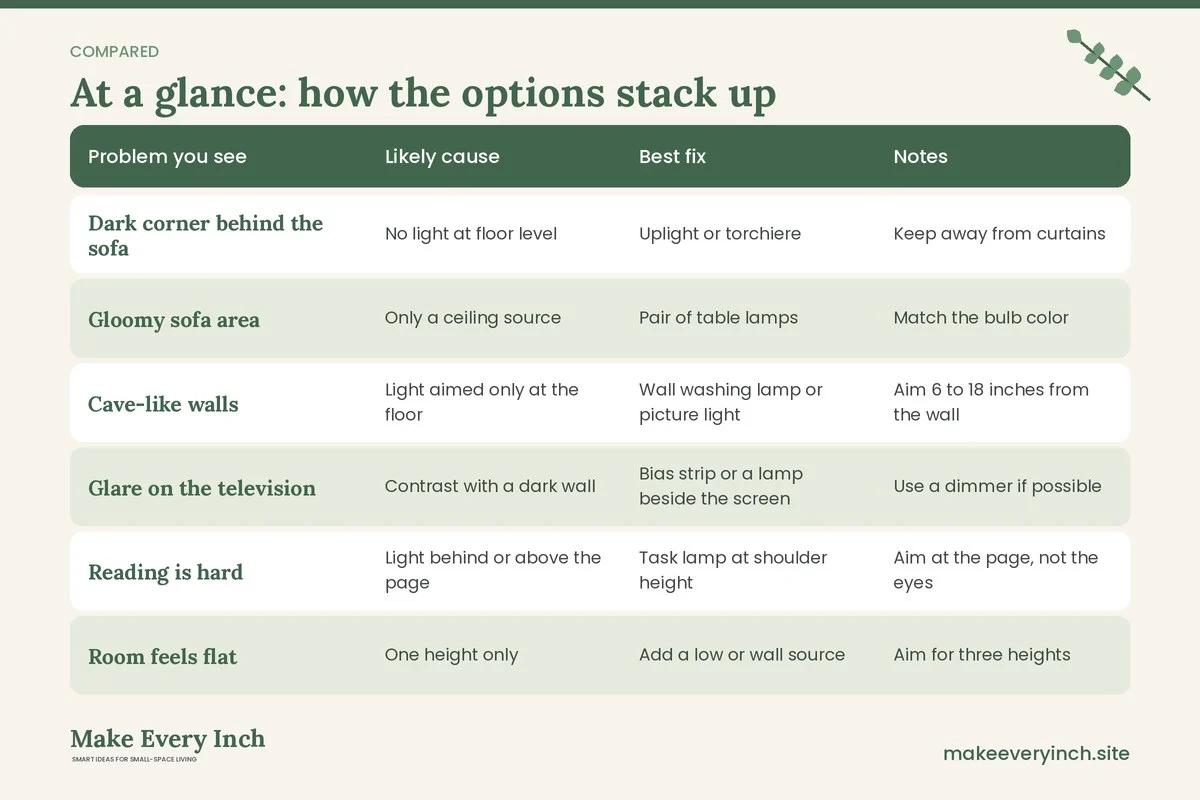
| Problem you see | Likely cause | Best fix | Notes |
|---|---|---|---|
| Dark corner behind the sofa | No light at floor level | Uplight or torchiere | Keep away from curtains |
| Gloomy sofa area | Only a ceiling source | Pair of table lamps | Match the bulb color |
| Cave-like walls | Light aimed only at the floor | Wall washing lamp or picture light | Aim 6 to 18 inches from the wall |
| Glare on the television | Contrast with a dark wall | Bias strip or a lamp beside the screen | Use a dimmer if possible |
| Reading is hard | Light behind or above the page | Task lamp at shoulder height | Aim at the page, not the eyes |
| Room feels flat | One height only | Add a low or wall source | Aim for three heights |
| Window feels small | Heavy or low curtains | Mount the rod wide and high | Use a sheer layer |
| Patchy color | Mixed bulbs | Use one warm white range | Replace all at once |
| Dead zone in a narrow room | Lamps all at one end | Move a source to the far end | Use a slim floor lamp |
| Cords everywhere | Few outlets | Cord covers and a smart plug | Do not overload outlets |
Three example rooms
Example 1: The north-facing room with one window
A living room 11 by 13 feet has a single north-facing window and white walls. Daylight is cool and soft, and the afternoon room is flat and gray. The owner moves the curtain rod out to the sides so the full glass shows, swaps the old dark shade on the ceiling fixture for an open one and adds a pair of table lamps at the sofa. A torchiere goes into the dark corner farthest from the window, and a mirror across from the glass pulls more of the light into the room. The warm lamps and the cool daylight can clash, so the owner keeps all bulbs in the same warm range and switches on the lamps before the daylight fades. The result is an even room without a single harsh pool.
Example 2: The rental with no ceiling light
An apartment living room has no fixture, only a switched outlet. The renter cannot drill. She plugs a floor lamp into the switched outlet so that one switch turns it on from the door, then adds a table lamp on a console, an arc lamp over the sofa and a light strip under the sofa. Plug-in sconces are attached with a removable mount she checks with her landlord. Cords run along the baseboard in covers. Because the lamps sit at four heights, the room reads as lit throughout, with no need for an overhead light. Before she moves out, she removes the mounts, cleans the walls and photographs them. For a larger plan of this kind, read our guide on small living room ideas for renters.
Example 3: The long, narrow room
A living room 9 feet wide and 15 feet long has a window at one end and a door at the other. The middle is dark. The owner puts a slim floor lamp near the door, a pair of lamps in the middle at the sofa and a lamp on a shelf near the window. Picture lights over two frames on the long wall wash it with soft light. The lights step down the length of the room, which makes the space look more even and keeps the eye moving. For ideas on this shape, see our narrow living room ideas.
Choose bulbs without overthinking
Bulbs cause more confusion than any other part of lighting, but a few simple choices cover most small living rooms. Choose bulbs that fit the fixture’s base and stay within its maximum rating. Choose a warm white in the 2700 to 3000 kelvin range for the whole room, and avoid mixing in a cool white. If you can, choose dimmable bulbs, and check that your dimmer is made for them, because mismatched pairs can flicker or buzz. Choose a high color accuracy rating if you value how fabrics and skin tones look, since it is often printed on the pack. For a bulb that sits under a thin shade, choose a lower brightness to avoid glare, and for a bulb that points up, choose a higher one. Keep a note of what you bought so you can replace bulbs with the same type.
Lighting scenes for the day
A bright room does not have to be bright all the time. Plan scenes, and make them easy to switch.
- Morning: open the curtains fully, turn on one lamp near the dark corner and leave the ceiling off.
- Daytime work: turn on a task lamp and the wall washer, and keep the ceiling at a medium level.
- Evening: turn on the lamps at the sofa and the low strip, and dim the overhead light.
- Movie night: switch to the bias light and one low lamp, and turn off the overhead.
- Cleaning: turn everything on for a short time, since dust shows in bright light.
A smart plug or a plug-in timer can turn lamps on at the same time each evening, which stops you from returning to a dark room. If you use smart devices, keep them updated and follow the maker’s instructions.
Safety notes for lighting
- Do not overload outlets. Plug high-power devices into separate outlets, and do not daisy-chain extension strips. If a plug feels warm, unplug it and call a qualified electrician.
- Respect bulb ratings. Never use a bulb above the lamp’s rated maximum. Keep bulbs away from fabric, curtains and paper shades.
- Keep cords off walkways. Use cord covers along walls, and do not run cords under rugs where they can wear or overheat.
- Anchor tall lamps. A tall floor lamp can tip. Choose a heavy, wide base, and keep it out of the way of children and pets. Cats and toddlers can pull on cords, so use short cords or covers.
- Get permission before drilling. Never drill into a wall or a ceiling without your landlord’s written permission. Use freestanding or adhesive options within the stated weight limits.
- Leave hardwiring to a professional. Only a qualified electrician should change a ceiling fixture, add a dimmer switch or install a new outlet.
- Mind water and damp. Keep lamps and cords away from plants being watered, open windows in rain and any liquids. Bathrooms and other wet areas need fixtures rated for damp locations and outlets with ground-fault protection, so do not move a lamp into one.
- Watch the heat. Keep light strips, shades and bulbs clear of curtains, and let bulbs cool before moving a lamp.
Common mistakes to avoid
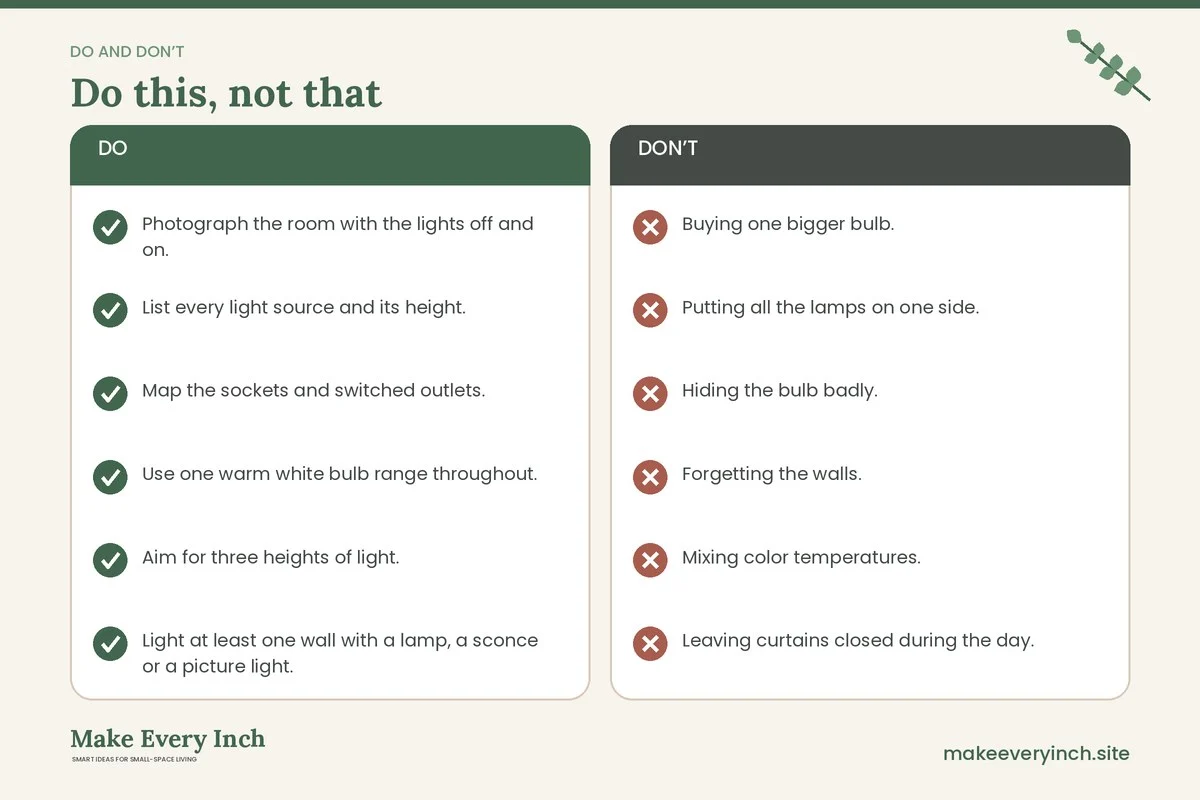
- Buying one bigger bulb. It lights the floor and leaves the corners dark, and it can cause glare.
- Putting all the lamps on one side. The room then tilts toward that side, so split sources across the room.
- Hiding the bulb badly. A visible bare bulb at eye level is uncomfortable. Choose a shade that covers it.
- Forgetting the walls. Walls are the largest surfaces, so light them.
- Mixing color temperatures. Replace all bulbs in the room at once.
- Leaving curtains closed during the day. Open them and enjoy the free light.
- Using dark shades with weak bulbs. A dark shade absorbs light, so add another source.
- Ignoring dust. Wipe shades and bulbs once a month with a dry cloth, with the lamp off and cool.
A weekend plan to brighten the room
Friday evening
Do the light audit, take photos and draw the socket map. Write a short shopping list for what is missing, such as one lamp, bulbs and cord covers.
Saturday morning
Clean the windows, the shades and the bulbs. Move the curtain rod or open the curtains wider. Free the window of any blocking furniture. Swap mismatched bulbs for one warm white.
Saturday afternoon
Place lamps at the sofa ends and in the dark corner. Mark cords with tape and hide them. Add a mirror or a pale accent near a lamp.
Sunday
Add the low light or the bias strip, set up a timer for the evening and photograph the room again at dusk. Compare it with the first photo. Adjust one lamp at a time. Keep a note of the final setup so you can restore it after a move or a spring clean.
Checklist
- Photograph the room with the lights off and on.
- List every light source and its height.
- Map the sockets and switched outlets.
- Use one warm white bulb range throughout.
- Aim for three heights of light.
- Light at least one wall with a lamp, a sconce or a picture light.
- Free the window and open the curtains fully.
- Place a mirror opposite or beside the glass.
- Put a lamp at each end of the sofa.
- Add a lamp for the darkest corner.
- Hide cords and keep walkways clear.
- Anchor or stabilize tall lamps.
- Do not overload any outlet.
- Get permission before drilling or changing fixtures.
- Dust shades and bulbs monthly.
FAQ
How can I make my small living room brighter without changing the ceiling light?
Add lamps at other heights. A pair of table lamps, a torchiere in the darkest corner and a light on the wall will brighten the room more than a stronger ceiling bulb. Opening the curtains and cleaning the window also helps.
What color bulb is best for a small living room?
Many people prefer a warm white in about the 2700 to 3000 kelvin range for a living room, because it is comfortable in the evening. Whatever you choose, use the same range in every lamp so the room looks even.
How many lamps does a small living room need?
Most small rooms feel balanced with four to six light points across three heights, but the right number depends on the size, the color of the walls and the daylight. Start with the dark spots from your audit.
Can I brighten a rental living room without drilling?
Yes. Use plug-in lamps, floor lamps, removable mounts approved by your landlord and light strips with adhesive rated for your wall. Always check your lease and test the adhesive in a hidden spot. See our guide to small apartment living room ideas without drilling for more.
Do mirrors really make a room look brighter?
A mirror placed across from a window or beside a lamp bounces light into the room and adds a sense of depth. Place it so it does not reflect a bare bulb, and secure it safely.
How do I stop glare on the television?
Avoid putting a bright lamp opposite the screen, use a soft bias light behind it and dim the room lights while you watch. A lamp to the side is gentler than a light in front.
Is it safe to leave lamps on a timer?
A timer is usually fine when the lamp and the plug are in good condition and rated for the load. Do not cover the lamp, keep fabric away from bulbs and follow the instructions on the timer.
Keep going: Keep planning with our small living room storage ideas, small living room decor ideas that avoid clutter and studio apartment lighting ideas.
Save this guide for later
Pin the ideas you like to Pinterest so you can come back to them when you plan your space.