Budget Small Space Ideas: The Complete Guide to Decorating Small Homes for Less
Quick answer: The best budget small space ideas follow a spend order: fix the free things first (declutter, rearrange, clean), then buy light, storage and one anchor piece, then add texture and decor last. Thrift hard-wearing furniture, use DIY for finishes, choose renter-safe changes you can take with you and skip anything that only looks good in photos.
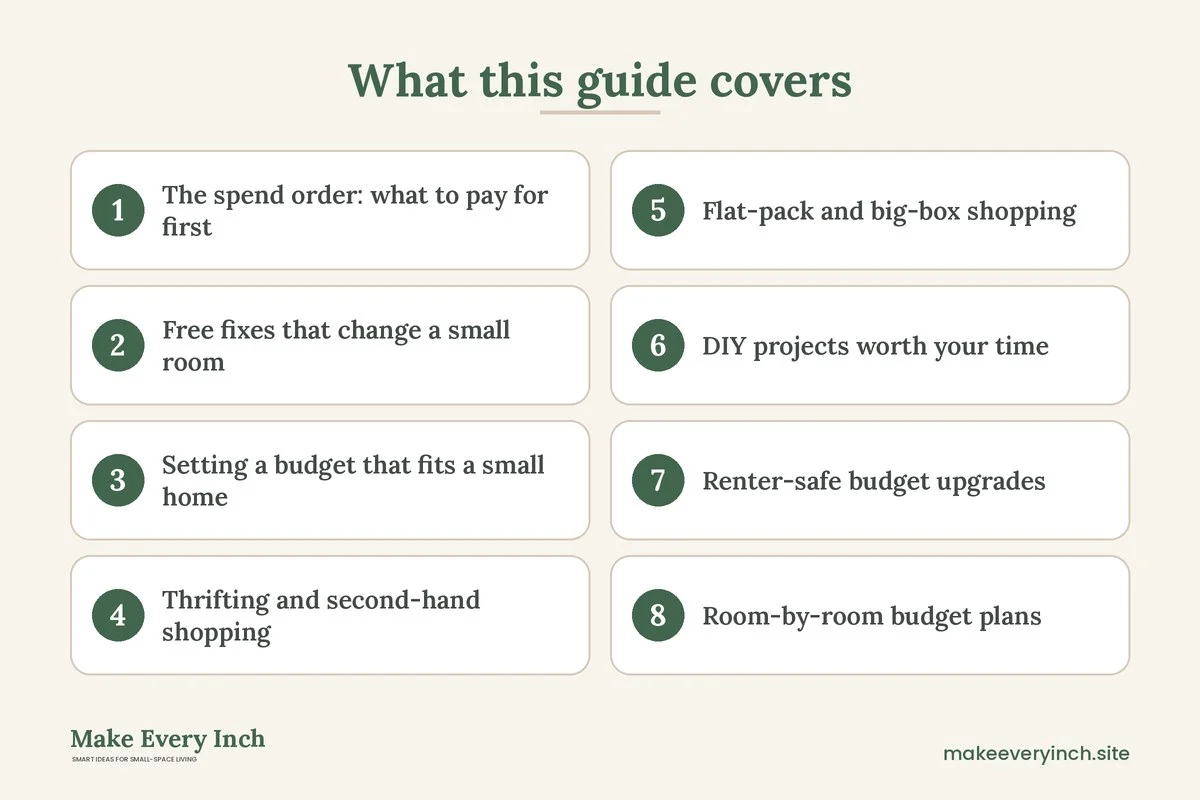
Budget small space ideas are less about finding cheap things and more about spending in the right order. A small home magnifies every choice. One well-chosen lamp or a cleared window can change a room more than a pile of impulse buys, and one wrong piece of furniture can crowd the whole floor. This guide is the hub for everything on Make Every Inch about decorating on a tight budget. It covers the spend order, the free fixes that cost nothing, how to shop for second-hand furniture, which DIY projects pay off, how to make changes as a renter, what is not worth spending on and how to plan a whole room. Each section points to a deeper guide, and the final section lists every budget guide in one place. If you want the room-specific versions, start with our small living room ideas, small bedroom ideas and small kitchen ideas guides, and come back here for the money side.
The spend order: what to pay for first
Most people shop in the wrong order. They buy a rug, a few cushions and a wall print, then discover that the room still feels cramped because the lighting is harsh and the storage is missing. A better order puts the things that change how the room functions ahead of the things that change how it looks.
Step 1: free fixes before any purchase
Before spending anything, move the furniture, clear the surfaces, wash the windows and take down what you do not use. These steps cost nothing and often give the biggest jump in space. The next section covers them in detail.
Step 2: light
Poor light makes a small room feel smaller and older. A warm lamp at seat height, a plug-in wall light and a bulb swap can lift a room for a modest sum. Light is the first purchase because it changes every other surface. See our guide to renter-friendly lighting ideas for ways to add it without wiring.
Step 3: storage
Clutter is the most common reason a small home feels tiny. Spend next on storage that works vertically and hides things: tall shelves, boxes with lids, hooks, under-bed containers and an over-door organizer. Our post on cheap storage ideas for apartments lays out the options and how to choose them.
Step 4: one anchor piece
Pick a single item that does the heavy lifting in each room: the sofa in a living room, the bed in a bedroom, the table in a kitchen or dining corner. Spend a larger share of the budget here, because this is the piece you use every day and the one that is hardest to fake. If you cannot afford a good new one, buy second-hand and clean it well.
Step 5: texture and softness
A rug, curtains, bedding and cushions come after the anchor piece. They add warmth and cover scuffs, and they are easy to find at a low cost in second-hand shops or sales. Keep the palette small so the room looks planned.
Step 6: decor and finishing touches
Art, plants, trays and candles go last. They are the cheapest way to add personality, and they are the easiest to swap later. If you are at the stage of finishing touches, read our guide to small apartment decor under 100 for what to pick when only a small sum is left.
Free fixes that change a small room
A surprising share of the improvement in a small home comes from things that cost nothing. Do these before any shopping, and you may find that you need to buy less.
- Rearrange the furniture. Pull the sofa off the wall slightly, turn the bed to a new wall or move the table into a corner. A new layout can free up a walkway. Our small living room layout ideas and small bedroom layout ideas show which plans work for different room shapes.
- Declutter in rounds. Remove anything you have not used in a year, then sort what remains by room. Fewer objects make a room look larger. See our guide to small apartment decluttering ideas.
- Clear the windows. Move furniture away from windows, open the curtains fully and wash the glass. More daylight helps the room feel bigger.
- Clean the surfaces. A deep clean of floors, switch plates, baseboards and cabinet fronts makes a rental look newly refreshed.
- Shop your own home. Move a lamp from one room to another, swap pictures between walls and use a stool as a bedside table. Often you already own the missing piece.
- Group like with like. Put all books in one place, all plants together and all cords in one basket. Groups look intentional.
- Edit the walls. Remove half the pictures and let the rest breathe. A few larger pieces beat many small ones.
- Clear the floor. Anything stored on the floor, such as bags, shoes or laundry baskets, makes a small room look smaller. Give each item a hook or a shelf.
Setting a budget that fits a small home
Small spaces need a smaller shopping list, so a budget is mostly a matter of choosing the right percentage for each category. A common approach is to split the money roughly into thirds: about a third on the anchor piece, a third on storage and light, and a third on soft furnishings and decor. Adjust the split to your needs. A bedroom, for example, may need more for bedding and less for storage.
Keep a short list and write down measurements before you shop. Add a buffer of around ten percent for the things you forget, such as hooks, bulbs, felt pads and cable clips. Track what you spend in a note on your phone, so that you stop when the budget does. For a whole-home plan, our small apartment makeover on a budget guide walks through the room order and the spending split.
Thrifting and second-hand shopping
Second-hand shopping is the strongest budget tool for a small home, because older furniture is often smaller, sturdier and made of solid material. It takes patience and a clear plan.
What to look for
- Solid wood and metal. These last, and they can be repainted or refinished.
- Small footprints. Slim consoles, narrow chests, small side tables and compact desks suit small rooms.
- Pieces with storage. Cabinets, trunks, benches and chests of drawers carry a lot of storage in a small footprint.
- Good bones. A wobbly leg or scuffed finish can be fixed. A broken frame or a damp smell is a reason to walk away.
What to avoid
- Upholstery with an odor or stains. Deep-cleaning does not always work, and it is hard to be sure of what is inside the cushion.
- Particleboard that has swollen. Water damage does not reverse.
- Anything you cannot carry up your stairs. Measure the piece, the doorways and the stairwell before you buy.
- Mattresses. Buy these new.
How to shop
Visit charity shops, estate sales, online marketplaces and community groups on a regular schedule, since good pieces move quickly. Carry a tape measure and a note of your room’s dimensions. Check drawers, joints and legs, and sit on seating. Ask for a lower price politely, and be willing to walk away. Our guide to thrifted apartment decor ideas goes deeper into what to look for in each category and how to style second-hand finds so they look chosen rather than random.
Flat-pack and big-box shopping
Flat-pack furniture is useful on a budget because it is made in many small sizes and it comes with plenty of modular storage. It rewards careful measuring, since sizes are given precisely, and it rewards patience, since assembly takes time. Mix flat-pack pieces with second-hand ones so that the room does not look like a showroom. A common trick is to use a basic flat-pack frame and add new handles, legs or a painted finish to personalize it. Our guide to small space ideas from big-box flat-pack stores covers the most useful categories, and our room guides cover the specifics: small apartment living room ideas on a budget, small bedroom ideas on a budget and small living room storage ideas on a budget.
DIY projects worth your time
DIY can save money, but only if the project is simple and the result is good. A project is worth doing if it uses cheap materials, takes a weekend or less and fixes a real problem. It is not worth doing if it needs expensive tools, if you have no space to work or if the outcome looks homemade in a bad way.
Good first projects
- Painted furniture. A coat of paint and new hardware can turn a worn second-hand dresser into a fresh piece. Sand lightly, use a primer and finish with a durable paint.
- A simple shelf. A plank on brackets fits an alcove or a wall. Measure carefully and use the right fixings for your wall.
- Fabric covers. A new cover on a cushion, a headboard or a seat refreshes a tired item.
- Framed prints. Print free or low-cost artwork at home or at a print shop, and use second-hand frames.
- Curtain upgrades. Hang the rod higher and wider than the window, and use full-length curtains. Add a lining or hem if needed.
- Cord and cable tidying. Clips, sleeves and a power strip on the back of a desk make a room look calmer.
- Painted accents. A painted door, a painted frame or a painted back panel on a bookshelf adds color at a low cost, with little risk.
Projects to approach with care
- Anything with electrics. Hire a qualified person for wiring, and use plug-in solutions otherwise.
- Load-bearing shelves. Use the correct anchors and respect weight limits.
- Big paint jobs in a rental. Check the lease first and get written permission.
Our guide to DIY apartment upgrades lists projects by skill level and tells you what to buy for each.
Renter-safe budget upgrades
Spending money on a rental is only wise if you can take the benefit with you or if the improvement is cheap enough to be worth it for a year. Renter-safe upgrades are removable, reversible and do not break the lease. They also prevent a deposit deduction.
What to upgrade first
- Lighting. Plug-in sconces, floor lamps and new bulbs move with you.
- Window treatments. Curtains on a tension rod or a rod that fits the existing brackets cover ugly blinds and add softness.
- Floors. A large rug covers worn or cold flooring. Use a non-slip pad underneath.
- Walls. Use adhesive strips, leaning art and temporary wallpaper. See our guides to renter-friendly wall decor ideas and removable wallpaper ideas.
- Kitchen and bath. Temporary backsplashes, new cabinet handles you can swap back and shower upgrades are renter-safe. See temporary backsplash ideas and renter-friendly kitchen upgrades.
- Storage. Freestanding shelves, over-door hooks and storage furniture need no drilling. See no-drill storage ideas for renters.
Always ask and document
Read the lease, take photos of each room on move-in and ask in writing before you do anything permanent. Keep the original handles, bulbs and fixtures in a labeled box so you can restore them. Our post on budget renter upgrades ranks the most valuable changes and shows how to remove each one safely, and the broader renter-friendly apartment decorating ideas hub covers the full topic.
Room-by-room budget plans
Every room has a different problem, so every room needs a different budget focus. Below is a short summary of each, with a link to the matching guide.
The living room
The living room is the most visible room, so many people overspend here. Focus the money on a comfortable sofa or seat, a rug, a lamp and storage that hides clutter. Keep the coffee table small or skip it. Use second-hand pieces for side tables and shelves. Our small living room makeover under 500 guide gives a detailed plan, and the small living room makeover ideas on a budget post offers more ideas. Also see small living room lighting ideas on a budget and small living room furniture ideas on a budget for what to buy. For the layout, read small living room layout ideas on a budget.
The bedroom
A bedroom needs a good bed, calm light and bedside storage. Put the money into bedding and a mattress topper before wall art. Use under-bed storage and an over-door hook. See our small bedroom makeover under 200 guide for a plan and our small bedroom ideas on a budget for more. If you need more storage, read under-bed storage ideas.
The kitchen
Kitchens cost the most per square foot, so small changes matter. Paint cabinet fronts, replace handles, add a plug-in light under the cabinets and organize with racks and risers. Our budget small kitchen makeover guide explains how to get a fresh look without a renovation, and small kitchen storage ideas covers the practical side.
The bathroom
A bathroom can be refreshed with a new shower curtain, a bath mat, a mirror and open shelving. Our small bathroom makeover ideas and renter-friendly bathroom upgrades cover this.
The entry
Even a tiny entry benefits from a hook, a tray and a mirror. See small entryway ideas.
The whole home
If you are tackling the full space at once, work room by room in order of use, starting with the one you spend the most time in. The small apartment makeover on a budget guide offers a step-by-step sequence for this.
Budget comparison: what gives the most for the least
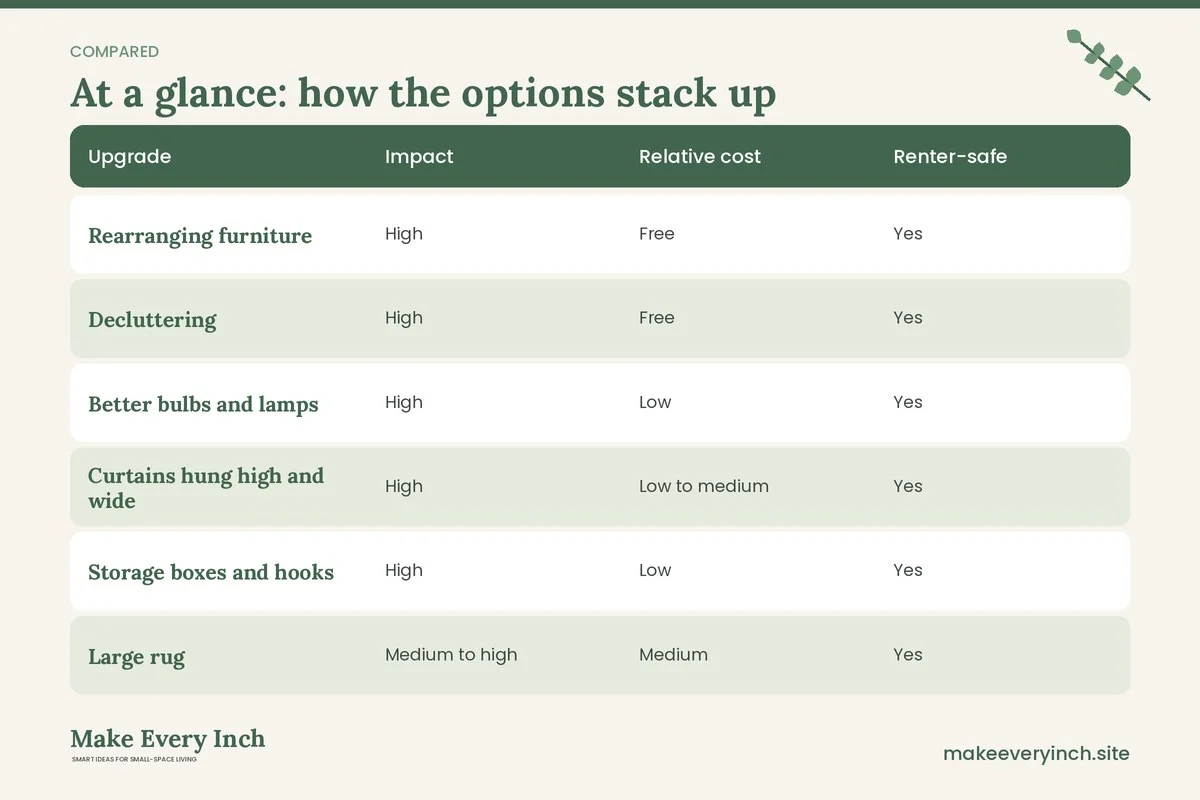
The table below ranks common upgrades by how much impact they give, how much they cost in relative terms and how easy they are to take with you. Use it to decide where to start.
| Upgrade | Impact | Relative cost | Renter-safe | Skill needed |
|---|---|---|---|---|
| Rearranging furniture | High | Free | Yes | None |
| Decluttering | High | Free | Yes | None |
| Better bulbs and lamps | High | Low | Yes | None |
| Curtains hung high and wide | High | Low to medium | Yes | Low |
| Storage boxes and hooks | High | Low | Yes | None |
| Large rug | Medium to high | Medium | Yes | None |
| Painted furniture | Medium | Low | Yes | Low |
| Second-hand anchor piece | High | Medium | Yes | Low |
| New cabinet handles | Medium | Low | Yes if saved | Low |
| Peel-and-stick finishes | Medium | Low to medium | Check lease | Medium |
| Painting walls | Medium to high | Low | Needs permission | Medium |
| Wall art and prints | Low to medium | Low | Yes | None |
| Matching furniture sets | Low | High | Yes | None |
What is not worth spending on
Knowing what to skip saves as much as knowing what to buy. These are the areas where small-space budgets tend to leak.
- Matching furniture sets. They fill a room fast and fit badly. Mixed pieces look more personal and let you choose the right size for each spot.
- Large decor with no job. A big statue or a stack of decorative books takes up space and does nothing. Choose items that store, light or seat.
- Low-quality mattresses and sofas. These are the pieces you use every day. Spend a bit more, or buy a good second-hand frame and a new mattress.
- Trend-driven items. A bright trend piece can feel dated within a year. Spend on neutral foundations and use cheap accessories for trends.
- Many small gadgets. Small kitchen gadgets, novelty organizers and one-use tools take up space and rarely get used.
- Permanent changes in a rental. If you will leave in a year, avoid anything that cannot go with you.
- Too many plants and trinkets at once. Add slowly, and keep only what you love.
- Oversized rugs that do not fit. A rug that goes up the wall or bunches at a door is a wasted purchase. Measure first.
Small-space buying rules that save money
A few rules prevent most budget mistakes in a small home. Apply them to every purchase, whether it is new or second-hand.
Measure twice and tape the footprint
Before buying a piece of furniture, mark its footprint on the floor with painter’s tape and live with it for a day. Walk the paths around it. Check the door swings, the drawer pulls and the window access. Many returns happen because a piece fits the wall but not the walkway.
Buy for the room you have
Do not buy for the room you plan to have in five years. A piece that is too large will crowd the space now, and a piece that is too small may still be useful later as a side table or a bench. If you expect to move, choose items that can serve in many rooms.
Choose pieces that do two jobs
A bench with storage, a bed with drawers, a table that folds and a ladder shelf that doubles as a plant stand all earn their place. See our posts on small space storage furniture and best beds with storage for ideas.
Go vertical
Walls and doorbacks are free storage. Tall shelves, wall hooks and hanging organizers use the space above eye level. Our vertical storage ideas guide explains how to do this without drilling.
Wait for the right price
Many items are cheaper at certain times of year, such as end-of-season sales or student move-out periods. If a purchase is not urgent, wait a few weeks and watch listings. Patience is a free budget tool.
Buy once where it matters
Spend more on items you touch every day, such as a bed, a seat, a desk chair and a pan, and less on items that only sit on a shelf. This approach saves money over time and avoids replacing weak pieces.
A sample weekend plan for a budget refresh
Many people stall because they do not know where to begin. This plan fits into a weekend and moves from free to cheap.
Saturday morning: reset
Clear every surface and put the contents into three piles: keep, donate and discard. Move the furniture to the layout you want to try and live with it all day. Wash the windows and wipe the baseboards.
Saturday afternoon: measure and list
Measure the room, the main furniture and the gaps. Write a short list of the three things that would help most, in the spend order above. Set a spending limit for each.
Sunday morning: shop second-hand
Visit one or two second-hand shops or check listings online, and look for the anchor piece or the storage item at the top of your list. Do not buy anything that does not fit your measurements.
Sunday afternoon: install and style
Hang curtains, set up the lamp, place the rug and add a few accessories from your own home. Stand back, photograph the room and note what still bothers you. That note is your next shopping list.
Making a small home look more expensive
Looks matter, and several tricks make a budget room read as considered.
- Limit the palette. Pick two or three main colors and repeat them across the room.
- Repeat materials. Wood, metal and fabric repeated around the room look planned.
- Hang art at the right height. The center of a piece should sit at about eye level.
- Use mirrors well. A mirror opposite a window doubles the light and adds depth.
- Layer the lighting. One overhead light feels flat, so add a lamp at seat height and a warm bulb.
- Hide cords. Visible cords make a room look messy.
- Iron and steam fabrics. Smooth curtains and bedding make a room look finished.
- Add one living thing. A plant or a branch in a vase adds life at little cost.
Budget checklist
- Declutter and rearrange before buying anything.
- Measure the room and tape the footprint of each new piece.
- Set a total budget with about ten percent in reserve.
- Buy light first, then storage, then one anchor piece.
- Check second-hand options before buying new.
- Keep a list of DIY projects and pick the simplest first.
- Read the lease and photograph each room before making changes.
- Choose removable and reversible upgrades.
- Skip matching sets, trend pieces and decor with no job.
- Spend more on the bed, the seat and the desk chair.
- Repeat colors and materials across the room.
- Review the room after two weeks and fix only what still bothers you.
All our budget small space guides
Every budget guide on Make Every Inch, in one place.
- Small Apartment Makeover On A Budget: a whole-home plan that sets the room order and the spending split.
- Small Bedroom Makeover Under 200: a low-cost bedroom plan covering bedding, light and storage.
- Small Living Room Makeover Under 500: a living room plan with a spending split and a shopping order.
- Budget Small Kitchen Makeover: cabinet, handle and lighting changes that refresh a kitchen without a renovation.
- Cheap Storage Ideas For Apartments: low-cost shelves, boxes and hooks that clear the floor.
- Small space ideas from flat-pack stores: the most useful flat-pack categories for small homes and how to mix them.
- Thrifted Apartment Decor Ideas: what to look for second-hand and how to style it.
- Small Apartment Decor Under 100: finishing touches to choose when only a small sum is left.
- Budget Renter Upgrades: removable changes ranked by value.
- DIY apartment upgrades: projects sorted by skill level, from painting to simple shelves.
- Small Living Room Makeover Ideas On A Budget: more living room ideas that cost little.
- Small Living Room Lighting Ideas On A Budget: lamps and bulbs that lift a living room.
- Small Bedroom Ideas On A Budget: bedroom ideas that put the money where it counts.
FAQ
What is the best way to decorate a small space on a budget?
Follow a spend order. Do the free fixes first, then buy light, storage and one anchor piece, then add texture and decor. This keeps money from going to items that do not change how the room works.
What should I buy first for a small apartment?
Start with lighting and storage. Light changes the feel of every surface, and storage removes the clutter that makes a small home feel cramped. Furniture and decor can follow.
Is thrifting worth it for a small home?
Yes, in most cases. Second-hand furniture is often smaller and more solid than new budget pieces, and it can be cleaned, painted or refinished. Measure carefully, inspect joints and avoid upholstery with odors.
How can I upgrade a rental without losing my deposit?
Choose removable changes, such as plug-in lights, curtains, rugs, leaning art, adhesive strips and swappable handles. Read the lease, photograph each room and keep original fixtures in a labeled box.
Which DIY projects are best for beginners?
Painted furniture, simple shelves, fabric covers, framed prints and cord tidying are good starting points. They use cheap materials, take a weekend or less and fix a real problem.
What is not worth spending money on in a small space?
Skip matching furniture sets, bulky decor with no function, trend-driven pieces and gadgets that are used once. Spend more on the bed, the seat and anything you use daily.
How do I make a small room look bigger without spending much?
Declutter, clear the windows, hang curtains high, use a mirror opposite a window and keep a limited palette. Light and clear floor space do most of the work.
How much should I set aside for a small room refresh?
It depends on the room and on your needs, but a useful habit is to split the money across an anchor piece, light and storage, and soft furnishings, and to keep a reserve of about ten percent for extras.
Keep going: Keep going with our small living room ideas, small bedroom ideas and small kitchen ideas.
Save this guide for later
Pin the ideas you like to Pinterest so you can come back to them when you plan your space.