How to Choose the Best Sofas for Small Apartments: 19 Things to Check
Quick answer: The best sofas for small apartments are the ones that clear your doorway and stairs, leave about 30 to 36 inches for walking, have slim arms and a moderate seat depth, and use a sturdy frame with a cleanable fabric. Measure the room and every point on the delivery path, tape the sofa outline on the floor, and check the return policy before you order.
Choosing the best sofas for small apartments is less about finding a magic model and more about running a handful of checks in the right order. A sofa that looks perfect online can block a doorway, crowd a window or fail to turn a corner in the stairwell. This guide teaches you how to choose. It covers the measurements that matter, the sofa sizes you will see, arm and leg styles, frame and cushion construction, fabrics, sleeper options, delivery and returns, a decision table by room size, three example rooms, a tape-on-floor method, a budget guide, common mistakes and a checklist. This is an educational guide, not a product review. The site does not test or rank specific products, so use the checks below to judge any sofa you are considering. If you are planning the whole room, pair this with our small living room furniture ideas.
Measure before you shop
Measure the room and the walking paths
Sketch the room and write down the wall lengths, the window and door positions, the radiator or vent locations and any built-ins. Mark the paths people use every day: door to couch, kitchen to couch, couch to balcony. A sofa should leave a clear path of about 30 to 36 inches where people walk often, and at least 24 inches in a tight spot you only pass occasionally. Measure from the baseboard, since moldings can eat an inch or two of floor. Our small living room layout ideas show how those paths shape where the sofa can go.
Measure the delivery path
Most returns happen because a sofa never got through the building, not because it was ugly. Measure the width of the front door, the hallway, every stair turn, the landing and the apartment door. If there is an elevator, measure its door opening and its interior depth and height. Note low ceilings, light fixtures, stair railings and tight corners. Write the smallest clear opening on a piece of paper and carry it with you when you shop.
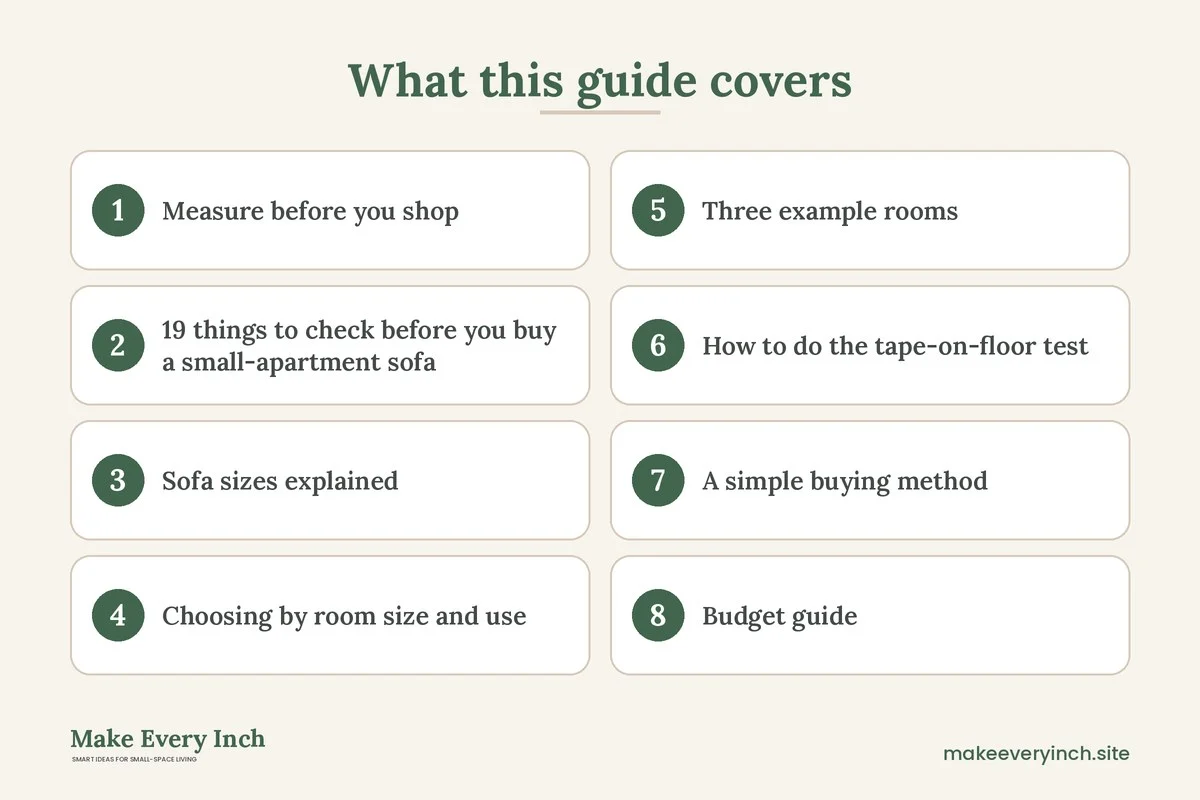
19 things to check before you buy a small-apartment sofa
Size and fit
1. Overall width
Width is the first number to check, and it decides where the sofa can live. Many compact sofas fall roughly between 60 and 84 inches wide, while a standard sofa often runs wider than that. Leave about 2 inches of air on each side if the sofa sits between walls or beside a table, and more if you want to open a window or a radiator valve.
2. Overall depth
Depth affects your walkway more than width does. A deep sofa pushes into the room, and the extra inches come out of the space you walk through. Many shallower sofas are around 32 to 36 inches deep overall, while a lounging sofa can pass 40 inches. Compare the overall depth to your room, not just the seat depth.
3. Seat depth and comfort
Seat depth is the distance from the front edge of the seat to the back cushion. A shallow seat of around 20 to 22 inches suits upright sitting and tighter rooms, while 23 to 25 inches suits lounging with legs up. Tall people often like more depth, and shorter people may find a deep seat leaves their feet hanging. Sit on a sofa for at least ten minutes in a store if you can, and look at the seat depth number on the spec sheet.
4. Overall height and back height
A low back keeps the room feeling open, especially if the sofa floats in front of a window or divides a studio. A back that sits under the window sill, or lower than a shelf behind it, is easier to live with. A high back gives more neck support for watching television. Pick the height by how you use the sofa, then check that it does not hide a window or a wall switch.
5. Seat height
Seat height from the floor changes how easy it is to stand up. Around 17 to 19 inches is a common range, and a lower seat feels sleek but can be hard for older relatives. If anyone with stiff knees will use the sofa, take the seat height seriously and avoid very low, deep seats with soft cushions.
6. Arm width and style
Arms can take up a surprising share of the footprint. Two thick arms of 8 inches each remove 16 inches of seating from the width. Slim track arms, narrow rolled arms and armless designs give you more seat for the same footprint. Thin arms look lighter, but wide flat arms can double as a place for a drink or a laptop tray. Pick arms based on whether you will sit against them.
7. Legs and visible floor
Visible floor under a sofa makes a small room feel bigger, and raised legs make it easy to vacuum or send a robot cleaner underneath. Legs of about 6 inches or more also let you slide a flat storage bin under. A skirted or sofa-to-floor base looks heavy but hides clutter, and it cannot be cleaned underneath. Check that the legs are attached with proper hardware and not just short screws into particle board.
8. Frame material
The frame decides how long the sofa lasts. Kiln-dried hardwood frames with corner blocks and glued, doweled or screwed joints are generally considered sturdier than frames of thin plywood or particle board held with staples. Ask the seller what the frame is made of, how the corners are joined and whether the frame is warrantied, and be wary if nobody can answer. A frame that is sturdy but light also carries up stairs more easily.
9. Suspension
Suspension is what sits under the cushions. Eight-way hand-tied springs, sinuous (serpentine) springs and webbing are the common systems, and each feels different. Sinuous springs are common in mid-range sofas and can give good support if the gauge is solid, while hand-tied springs are time-consuming to make and usually found at higher prices. Press on the seat and listen for creaks, since a noisy sofa is a warning sign.
10. Cushion fill
Cushion fill changes how the sofa feels and how it ages. Polyurethane foam holds shape, and higher-density foam tends to last longer than cheap foam that flattens in a year or two. Feather and down wrapped cores feel soft and need regular fluffing. Polyester fiber wrap is a budget softener that can lump. A foam core wrapped in a soft layer is a common compromise. Ask for the foam density and ask whether the cushions can be flipped or replaced.
11. Back cushions: fixed or loose
Attached, tight backs stay neat and need no fluffing, which suits small rooms where the sofa is always on show. Loose back cushions are comfortable, can be rotated and are often easier to clean, but they slump and look messy if you do not straighten them. Loose cushions also allow you to remove them and make the sofa slimmer for delivery.
Fabric and care
12. Performance fabrics
Performance fabrics are made to resist stains and wear, and they are a practical pick for a sofa that is also your dining chair, desk and bed. Read the label for cleaning codes, since a code of W means water-based cleaner, S means solvent-based cleaner only, WS allows either and X means vacuum only. Look at the abrasion rating where it is listed, and treat claims about stain proofing with some caution, since no fabric is stain-proof.
13. Leather and faux leather
Genuine leather wipes clean and handles spills, but it can scratch with claws, feel cold in winter and sticky in summer. Bonded and some coated faux leathers can crack or peel with age, so check what the product is actually made of before you pay for it. In a small apartment, a leather sofa usually looks more compact in a darker color, and a light one can show dye transfer from jeans.
14. Boucle and heavy textures
Boucle is soft and photogenic, and it has caveats. The loops can snag on claws and zippers, show dirt in light colors and be hard to spot clean. If you love the look, choose a tighter weave, a performance version and a darker or flecked tone, and consider it more for a guest-only seat than for a sofa that serves a dog and a toddler.
15. Color, pattern and removable covers
Light and mid tones make a sofa visually smaller, and a cover color near the wall color helps it blend in. A tiny pattern or flecked weave hides crumbs better than a flat color. Removable, washable covers are valuable, though check whether they are machine washable or dry-clean only, and whether you can buy a spare cover.
Function and buying terms
16. Sleeper and daybed options
If the sofa has to sleep a guest, check the mattress thickness, the weight of the mechanism and how much clear floor you need to open it. Pull-out sleepers need roughly the length of the sofa again in free floor, and a sleeper mattress can be thin and felt through the frame, so test the bed, not only the sofa. A daybed or a sofa with a pop-up trundle uses less floor, and a futon-style frame is light and simple. Compare the sleeping surface length with a real guest’s height.
17. Modular and reconfigurable pieces
Modular sofas arrive in sections, so they pass through narrow doors and stairs and can be rearranged when you move. Check how the sections connect, and whether the clips or hooks hold so the pieces do not slide apart. If you want something with a chaise, our sectional buying guide covers that in depth.
18. Pets, kids and cleaning
Think about who sits there. Claws, chewed corners, juice and muddy paws all affect your fabric choice. Tight weaves, microfiber and leather resist claws better than loose weaves, and removable cushion covers make accidents easier. A sofa with raised legs lets you see what is hiding underneath, and a throw you can wash protects a favorite corner.
19. Delivery, assembly and returns
Ask whether delivery is curbside, room of choice or white glove, and whether the carrier will remove the packaging. Ask whether legs and arms come off, whether the sofa ships in a box and whether the frame can be assembled in your room. Read the return policy for restocking fees, return shipping charges and who picks up. A generous return window is worth more than a small discount, since you cannot be sure about fit until the sofa is in the room.
Sofa sizes explained
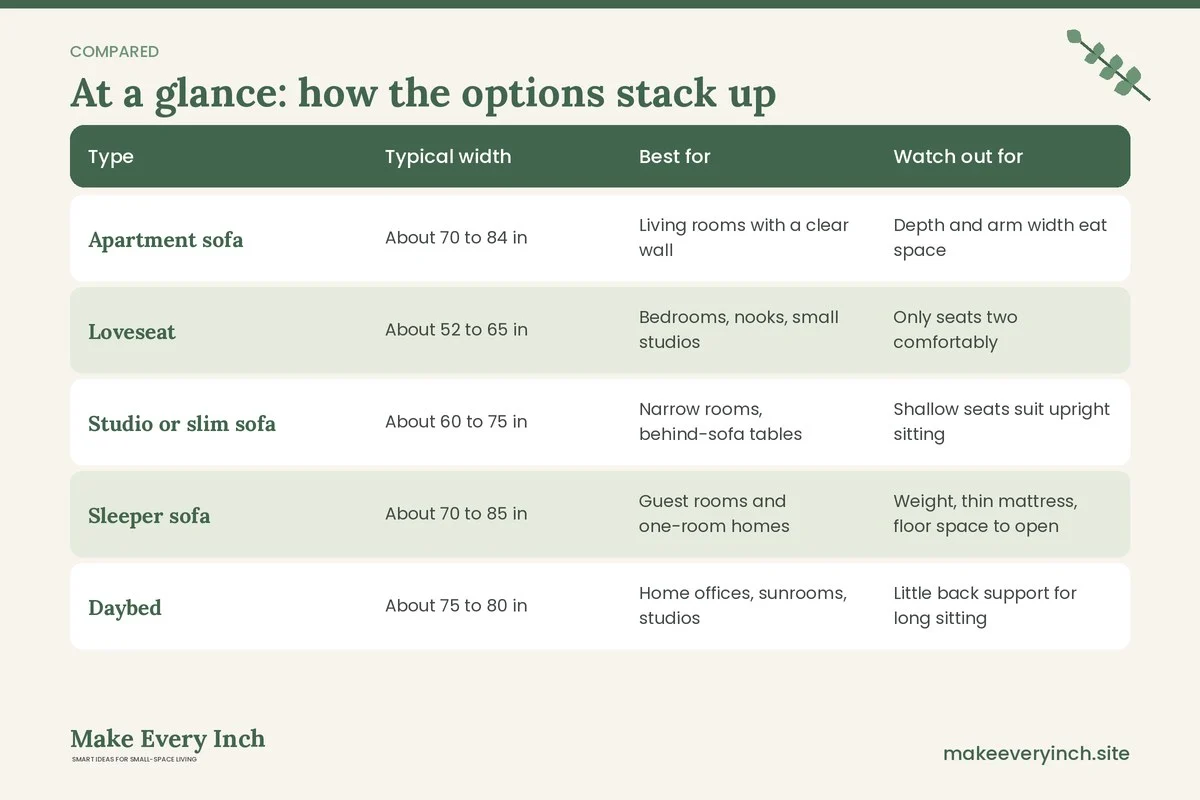
Names vary by seller, so rely on measurements and not labels. As a rough guide, an apartment sofa is a compact full-size sofa, a loveseat seats two, a studio sofa is slim and shallow, a sleeper opens into a bed and a daybed sits against a wall like a sofa and sleeps one person.
| Type | Typical width | Best for | Watch out for |
|---|---|---|---|
| Apartment sofa | About 70 to 84 in | Living rooms with a clear wall | Depth and arm width eat space |
| Loveseat | About 52 to 65 in | Bedrooms, nooks, small studios | Only seats two comfortably |
| Studio or slim sofa | About 60 to 75 in | Narrow rooms, behind-sofa tables | Shallow seats suit upright sitting |
| Sleeper sofa | About 70 to 85 in | Guest rooms and one-room homes | Weight, thin mattress, floor space to open |
| Daybed | About 75 to 80 in | Home offices, sunrooms, studios | Little back support for long sitting |
Choosing by room size and use
Use this table as a starting point, then confirm with tape on your own floor.
| Room size | Main use | Sofa idea | Layout note |
|---|---|---|---|
| Studio under 350 sq ft | Living and sleeping | Slim sofa or sleeper, low back | Float it to divide the sleeping zone |
| Living room about 10 by 12 ft | TV and guests | Apartment sofa about 72 to 80 in | Keep 30 in walking path |
| Living room about 12 by 14 ft | Lounging and hosting | Larger apartment sofa or loveseat plus chair | Room for a small side table |
| Narrow room under 9 ft wide | Passing through | Loveseat or slim sofa, arms narrow | Put it along the long wall |
| Home office or guest room | Occasional sleeping | Daybed or sleeper | Check floor space to open |
Three example rooms
The 10 by 12 living room
A renter has a door on one short wall, a window opposite and a television on the long wall. A sofa of about 76 inches along the long wall leaves a path of 36 inches to the window and room for a small rug. The renter picks slim arms, a seat depth around 21 inches and raised legs so the floor shows. The room reads as open, and the sofa fits through the building’s 30 inch hallway door, because the legs unscrew and the back cushions come off.
The studio apartment
A studio has to hold a bed, a work corner and a living area. A low-back sofa floated behind the bed edge separates the zones and keeps light moving. The owner chooses a sofa with a performance fabric because it doubles as a desk chair, and picks a slim table behind it for a lamp. See our small apartment living room ideas for layouts of this kind.
The guest room and office
One spare room serves as an office and a guest bed. A daybed with a trundle works as a sofa by day, and the trundle pulls out for a guest. The owner measures the clear floor needed to pull out the trundle and leaves that zone empty of furniture. The room stays usable without a bulky sleeper mechanism.
How to do the tape-on-floor test
This method takes ten minutes and prevents most sizing mistakes.
- Use painter’s tape to mark the sofa’s exact width and depth on the floor, including the arms.
- Mark the height with a stack of boxes or a taped outline on the wall.
- Mark door swings, drawers and the area you need to open a sleeper.
- Walk the paths you use every day, carrying a laundry basket if you have one.
- Live with the outline for a day or two, and sit on a chair at the tape edge to check legroom and sightlines to the television.
- Cut a cardboard template or use painter’s tape to mark the width and height of the sofa on the wall and on the doorway, and move that template along the delivery path.
If the tape feels tight, drop to the next size down. If it looks small, you can usually add a chair or an ottoman, which is easier than regretting a sofa that dominates.
A simple buying method
First, set your must-haves: the maximum width, depth and height, the sleeping need and the fabric needs. Second, build a short list by dimensions, then by construction details. Third, ask sellers for the frame material, foam density, fabric rating and delivery rules, and compare their answers in a simple notes table. Fourth, request fabric swatches and look at them in your room at different times of day. Fifth, read the return policy twice. Sixth, order, and plan the delivery day by clearing the path and arranging help.
Budget guide
The site does not track prices, so treat these as general, hedged ranges that change by region and season.
Lower spend
Expect simpler frames, thinner foam and fewer fabric choices. Look for a solid frame description and a decent return window, and consider buying slipcovers or cushions to refresh it later.
Middle spend
This is where many people find hardwood or reinforced frames, better foam and more fabric options. It is often the best balance for a sofa you plan to keep for several years.
Higher spend
You may get hand-built joinery, replaceable cushion cores and custom sizing. It makes sense if you expect to keep the sofa through several moves, though it does not guarantee a fit, so measure the same way. For ways to stretch a living room budget, see our small living room makeover under $500 and, if you buy secondhand, our thrifted apartment decor ideas.
Mistakes to avoid
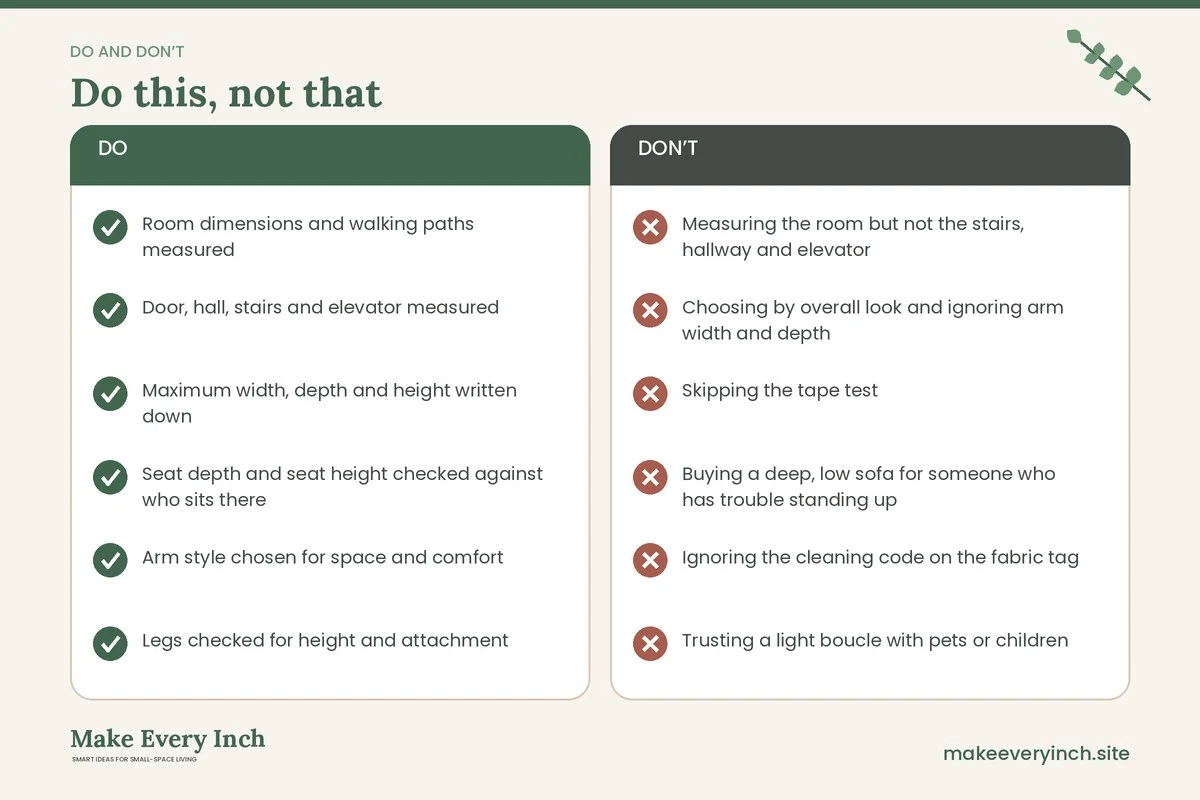
- Measuring the room but not the stairs, hallway and elevator
- Choosing by overall look and ignoring arm width and depth
- Skipping the tape test
- Buying a deep, low sofa for someone who has trouble standing up
- Ignoring the cleaning code on the fabric tag
- Trusting a light boucle with pets or children
- Choosing a sleeper without testing the mattress
- Overlooking the return fees and who pays for pickup
- Pushing the sofa flat against every wall and blocking vents or switches
Pre-purchase checklist
- Room dimensions and walking paths measured
- Door, hall, stairs and elevator measured
- Maximum width, depth and height written down
- Seat depth and seat height checked against who sits there
- Arm style chosen for space and comfort
- Legs checked for height and attachment
- Frame material and joints confirmed
- Foam density and fill type confirmed
- Fabric cleaning code and durability checked
- Swatch viewed in the room
- Sleeper mattress and opening space checked
- Delivery type, packaging and assembly confirmed
- Return window, fees and pickup confirmed
- Tape outline tested on the floor
FAQ
What size sofa is best for a small apartment?
It depends on the room, but many small apartments suit a sofa of roughly 70 to 80 inches wide and 32 to 36 inches deep. Use the tape test to confirm.
Is a loveseat better than a sofa in a small space?
A loveseat saves floor space and suits nooks, bedrooms and tiny studios. It seats two comfortably, so choose a sofa if you host more than two people often.
How much space should I leave around a sofa?
Leave about 30 to 36 inches for main walking paths, and about 14 to 18 inches between a sofa and a coffee table so you can reach it.
Are sleeper sofas worth it for small apartments?
They can be, if overnight guests are regular and you test the mattress and the floor space needed to open it. If guests are rare, an air mattress or a daybed may be simpler.
What fabric is best with pets or kids?
Tight weaves, performance fabrics and many leathers handle daily wear better than loose weaves. Check the cleaning code and the removable cover options.
Should I worry about boucle?
It is lovely, but the loops can snag and show dirt. Pick a tight weave and a forgiving color if you love it, and think twice with claws in the house.
How do I know if a sofa will fit through my door?
Measure the narrowest opening on the delivery path, then compare it to the sofa’s depth, height and diagonal, and check if the legs and arms come off. Ask the seller for the packed dimensions.
Is a modular sofa better for renters?
Often yes, because pieces move through tight doors and rearrange in a new home. Check how the sections connect, and see our small living room ideas for renters.
Keep going: Keep planning with our small living room furniture ideas, small living room layout ideas and guide to choosing a sectional.
Save this guide for later
Pin the ideas you like to Pinterest so you can come back to them when you plan your space.