16 Small Home Improvements with the Biggest Impact to Do First
Quick answer: The small home improvements biggest impact usually fix the things you touch every day: the front door zone, the main walkway, the lighting, the largest piece of furniture and the one cluttered surface everyone sees first. Start with changes that are cheap to reverse, such as clearing a path and swapping bulbs, then move to bigger moves like rehoming furniture. Measure first, keep exits clear and ask your landlord before anything permanent.
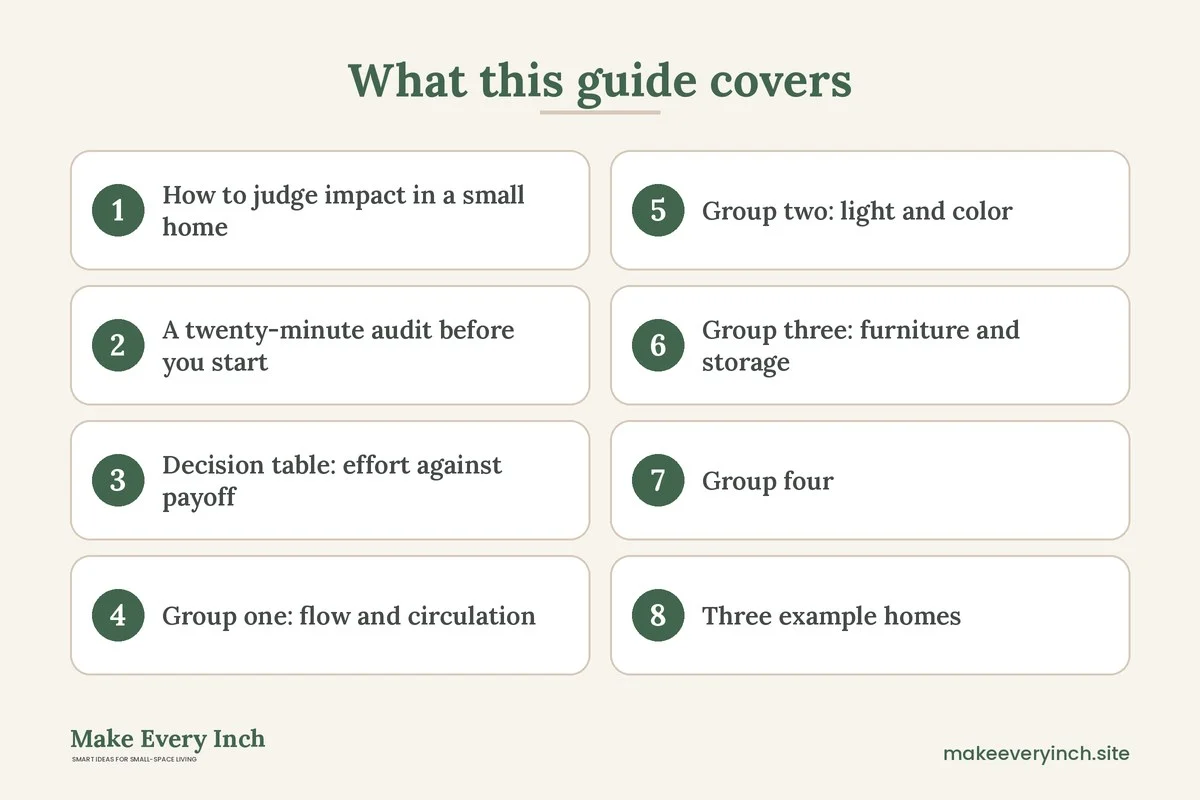
Small home improvements biggest impact lists tend to be a pile of unrelated tips, and that is exactly why most of them never get done. A small home does not need sixteen separate projects. It needs a few changes chosen for how they affect the whole place: how you walk through it, what you see when you come in, where light lands and where things go when you put them down. This guide ranks sixteen improvements across the entire home, not one room at a time, and it explains how to decide which ones to do first. It covers a quick audit, a decision table, the improvements grouped by what they change, three example homes, safety notes, mistakes and a checklist. For the full overview, start with our pillar guide on small home ideas, and for the practical side of fitting things in, see small space organization ideas.
How to judge impact in a small home
Impact is not the same as size. A new sofa is a big change with a modest payoff if the room still has a blocked path. Moving a basket of shoes out of the walkway is a tiny change that you feel every single day. When you compare options, judge each by four questions.
- How often do I notice it? Something you pass ten times a day outranks something you see once a week.
- Does it affect more than one room? A change to lighting, color or flow often improves several spaces at once.
- How easy is it to undo? Reversible changes let you experiment, which matters when you rent or when you are unsure.
- Does it make the home safer or easier to use? Clear exits and stable furniture belong on every list, whatever their appearance.
Keep those questions in mind as you read, and rate each improvement from one to five on each. The ones that score highest on frequency and reach are usually the best place to begin.
A twenty-minute audit before you start
Walk through your home from the front door to the farthest corner, slowly, as if you were a guest. Carry a notebook, and write down every place where you slowed down, turned sideways, tripped, searched for something or felt crowded. Do this once in daylight and once in the evening, because a home looks and works differently under different light.
Next, take three photos from the doorway of each main space and look at them on a screen. Photos reveal clutter, dark corners and awkward furniture angles that your eyes have learned to ignore. Then count the number of times you handle these items in a normal day: keys, shoes, bags, mail, dishes, towels and a charger. Whichever one causes the most friction needs a permanent home, and that becomes one of your first improvements.
Finally, mark the exits. Know where the door and any windows that open are, and check that nothing blocks them. This audit takes about twenty minutes and gives you a ranked list that is far more useful than any generic list of ideas.
Decision table: effort against payoff
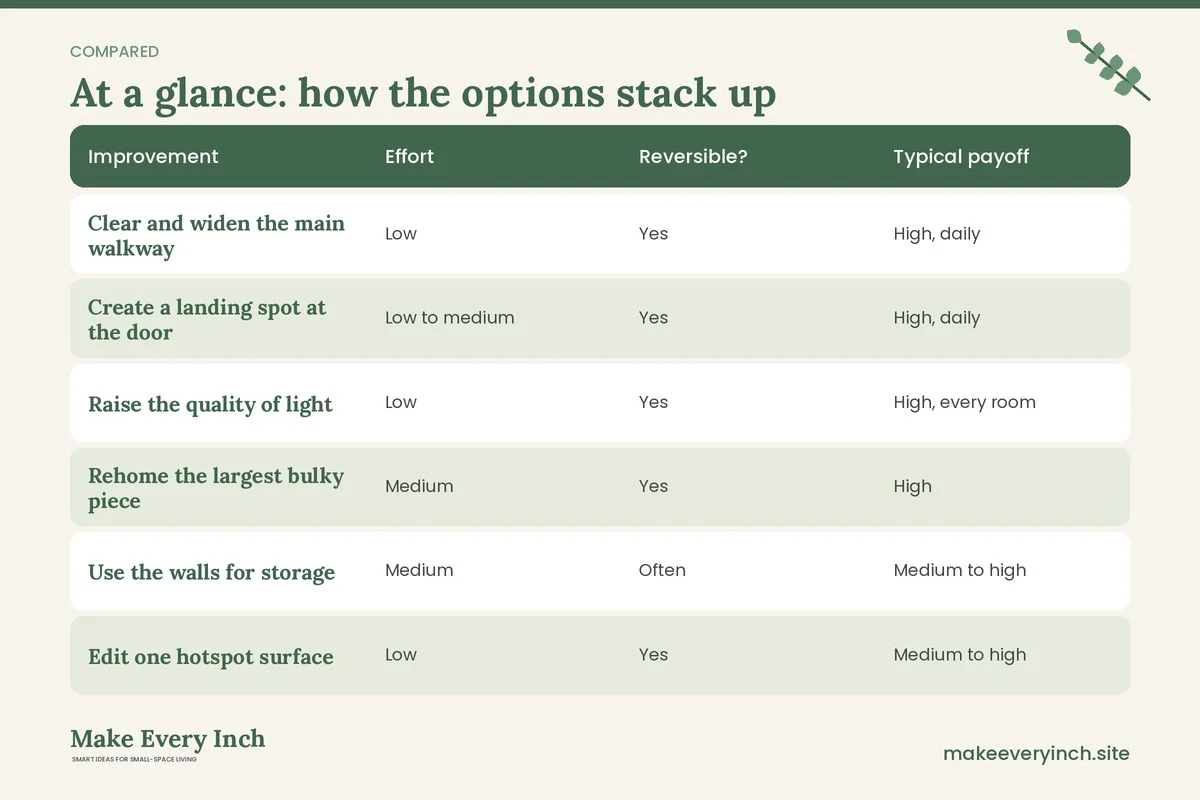
Use this table to pick your first three changes. The ranges are rough guides and your own home will differ, so treat them as a starting point rather than a promise.
| Improvement | Effort | Reversible? | Typical payoff | |
|---|---|---|---|---|
| Clear and widen the main walkway | Low | Yes | High, daily | |
| Create a landing spot at the door | Low to medium | Yes | High, daily | |
| Raise the quality of light | Low | Yes | High, every room | |
| Rehome the largest bulky piece | Medium | Yes | High | |
| Use the walls for storage | Medium | Often | Medium to high | |
| Edit one hotspot surface | Low | Yes | Medium to high | |
| Repaint in a light, low-VOC color | Medium to high | Needs permission | High, every room | |
| Add a mirror opposite a light source | Low | Yes | Medium | |
| Swap a door for a curtain or slider | Medium | Needs permission | Medium | |
| Fix a sticking door or drawer | Low | Yes | Medium, daily |
Group one: flow and circulation
Flow is the least glamorous topic and the one with the largest effect. A home that you can move through without turning sideways feels bigger than a larger home that fights you.
1. Clear and widen the main walkway
Trace the path you walk most often, usually from the front door to the kitchen and then to the bedroom or bathroom. Aim for a clear route of roughly 30 to 36 inches wherever you can manage it, and treat 24 inches as a tight minimum for short stretches that only one person uses at a time. Building codes and accessibility guidance vary, so treat these as comfort guides rather than rules. Mark the path with painter’s tape on the floor, and move whatever sits inside the tape. Often one chair, one basket or one narrow table is the entire problem.
2. Check door swings
A door that opens into a room can steal a surprising amount of floor. Draw the arc on the floor with tape and see what it hits. If a door swings into a bed or a desk, consider reversing the hinge side, rehanging it to open the other way, or replacing it with a sliding option, but only with your landlord’s permission if you rent. A door that stops against a stack of boxes is a safety concern as well as an annoyance, because you need the door to open fully in an emergency.
3. Open sightlines
People judge the size of a home by how far they can see. Standing at the entrance, look for the longest line of sight and keep it open. Keep tall furniture along the sides of that line rather than across it. A low sofa back, a glass or open-backed shelf and a bare window at the far end all lengthen the view. If you cannot remove a visual block, consider lowering it, thinning it or replacing a solid piece with an open one.
4. Pick one main zone per room
Even in a one-room home, grouping similar activities makes everything look calmer. Put sleep, work, eating and lounging in distinct areas, using a rug, a shelf or a change of light to hint at the boundaries. If you want to go further, see our guide to renter-friendly ways to divide a studio apartment. Zones reduce the number of decisions you make each day, because every object has an obvious place.
Group two: light and color
Light is the improvement that affects every room at once. It is also one of the easiest to adjust without altering the structure.
5. Raise the quality of light
Replace dim or harsh bulbs with ones of a consistent warm-white temperature, and aim for several sources at different heights in each main room. A ceiling light alone flattens a space, while a floor lamp, a table lamp and a task light give depth. Check the wattage rating printed on each fixture and never exceed it. For layered ideas, read our guide to layered lighting ideas for small apartments.
6. Clean the windows and clear the sills
This sounds trivial, and it often brings in noticeably more daylight. Wash the glass inside and out where you can safely reach, remove heavy curtains from the glass area and keep the sill free of objects. Choose a light fabric or a curtain hung high and wide so that it clears the glass when open. See our tips on small space curtain ideas to add height.
7. Repaint in a light color, safely
A fresh coat of a light, low-VOC paint can lift a small home dramatically, since light colors reflect more daylight. If you rent, get written permission first, and ask about the paint finish and color rules. Ventilate well while you paint and while the paint dries, follow the label’s drying times, and keep children and pets out of the area until the odor has faded. Never sand or scrape old paint in an older home without first learning whether it may contain lead, and use a professional if there is any doubt. For color choices, see colors that make small rooms look bigger.
8. Place a mirror opposite a light source
A mirror that faces a window or a lamp bounces light deeper into a room. Put it across from the light, not beside it, and check that it does not reflect a cluttered corner or create glare in your eyes. Anchor any large mirror to the wall using a method the lease allows, or lean a heavy mirror against the wall on a stable base where children and pets cannot tip it. See small room mirror placement ideas for more positions.
Group three: furniture and storage
Furniture takes up the most floor, so it carries the most potential for gain. The goal is fewer, better-sized pieces that do more than one job.
9. Rehome the largest bulky piece
Identify the largest item in each room and ask whether it is the right size. An oversized sofa, a deep dresser or a bulky bookcase can dominate a small space. Swapping one piece for a slimmer alternative often frees more room than removing five small objects. Measure doorways, stairs and corners before you buy or move anything, and remember that a piece you cannot get into the home is not an improvement. Read how to choose a sofa for a small living room for a measuring method.
10. Use the walls
Wall-mounted shelves, hooks and rails lift things off the floor. Before drilling anything, get permission in writing if you rent, and locate studs and avoid hidden wiring and pipes. Never rely on adhesive for heavy loads, and read the weight rating on any hardware. If drilling is not allowed, consider freestanding vertical options. See wall mounted furniture ideas for small homes.
11. Anchor every tall piece
Tall bookcases, wardrobes and dressers can tip, especially when children climb on them or drawers are pulled open. Use the manufacturer’s recommended anti-tip hardware, fix it into a stud or use a wall anchor suitable for your wall type, and keep heavier items on the lower shelves. This is one of the highest-value safety improvements you can make, and it takes only a few minutes per piece. If you rent and cannot drill, ask your landlord, and in the meantime place tall furniture where it cannot fall across a doorway or an exit route.
12. Edit one hotspot surface
Every home has one surface where clutter gathers, such as the kitchen counter, the entry table or the nightstand. Clear it completely, keep only the items you use daily and give everything else a proper home. Then keep that one surface under control for two weeks. A single calm surface shows you how the whole home can feel. For ongoing habits, read small home organization ideas that actually last.
Group four: arrival and everyday friction
The entrance sets the tone for the whole home, and small daily annoyances add up quickly.
13. Create a landing spot at the door
A hook for keys, a spot for shoes and a small surface or tray for mail and a bag stop the daily scatter. Even a narrow hallway can handle a slim shelf, a row of hooks and a small mat. Keep the area clear of anything that could trip someone coming in or going out. See small entryway ideas for layouts, and small home drop zone ideas for tidy habits.
14. Fix the small annoyances
A door that sticks, a drawer that jams, a cabinet that will not stay shut and a lamp with a short cord all cost you a small amount of patience each day. Fixing them is cheap and rewarding. Where a fix involves wiring, call a qualified electrician instead of improvising, and replace any damaged cords.
15. Manage cords and plugs
Loose cords make a small home look messy and can be a tripping hazard. Use clips or cord covers allowed by your lease, route cables along walls rather than across walkways and never run a cord under a rug where heat or wear can go unnoticed. Do not overload a socket or a power strip, check the ratings on both, and unplug high-draw appliances such as heaters when you leave. See renter-friendly ways to hide cords.
16. Improve air and ventilation
Stale air makes a small home feel smaller. Open windows when the weather allows, run the bathroom and kitchen fans while cooking and showering, and keep vents and radiators clear so air can circulate. Ventilation also protects against damp, which can damage belongings and paint over time. If you notice persistent damp or mold, tell your landlord, and do not paint over it.
Three example homes
These are illustrations rather than case studies, and the numbers are approximate.
Example 1: A 450 square foot studio
The audit shows that the bed, sofa and desk all fight over one wall, and the path to the bathroom narrows to about 20 inches. The first move is to turn the desk to face the window, which clears a path of roughly 30 inches. The second is to replace the harsh overhead bulb with warmer bulbs and add a floor lamp. The third is to give keys and shoes a dedicated spot by the door. Total effort is one weekend, and the home feels calmer and brighter without any permanent change.
Example 2: A two-bedroom rental with a dark hallway
The hallway has no window and swallows light. Rather than repaint, which the lease forbids, the renter adds a plug-in wall light, hangs a mirror opposite a bedroom door that opens to daylight and clears the shoe pile. The long sightline now ends in a bright, tidy view. Storage moves to a slim shelf in the living room, so the hallway stays clear and safe to use at night.
Example 3: A small family home with two children
Tall bookcases and dressers are already crowded, and a child has started climbing them. The family anchors each tall piece to the wall, moves heavy items to lower shelves and creates a low landing station for backpacks at the child’s height. They also check that nothing blocks the route from the bedrooms to the front door. These improvements are not glamorous, but they make the home safer and cut the morning chaos.
Safety notes you should not skip
- Egress: Keep at least one clear route from every sleeping area to the exit, and make sure windows meant for escape can open fully. Do not block them with furniture.
- Load-bearing walls: Never remove, cut or alter a wall without a qualified professional and the required permits. A wall that looks decorative may carry the building.
- Electrical load: Do not daisy-chain power strips, and do not exceed the rating of sockets, cords or bulbs. Hire a licensed electrician for any wiring.
- Anchoring: Anchor tall furniture and large mirrors, and keep heavy items low.
- Ventilation and paint: Use low-VOC paint, ventilate during and after painting and keep children and pets away until it is dry.
- Children and pets: Check cords, blind cords, small objects and tippable furniture at their level.
- Lease and drilling: Never drill, paint or alter fixtures without written permission if you rent.
Common mistakes to avoid
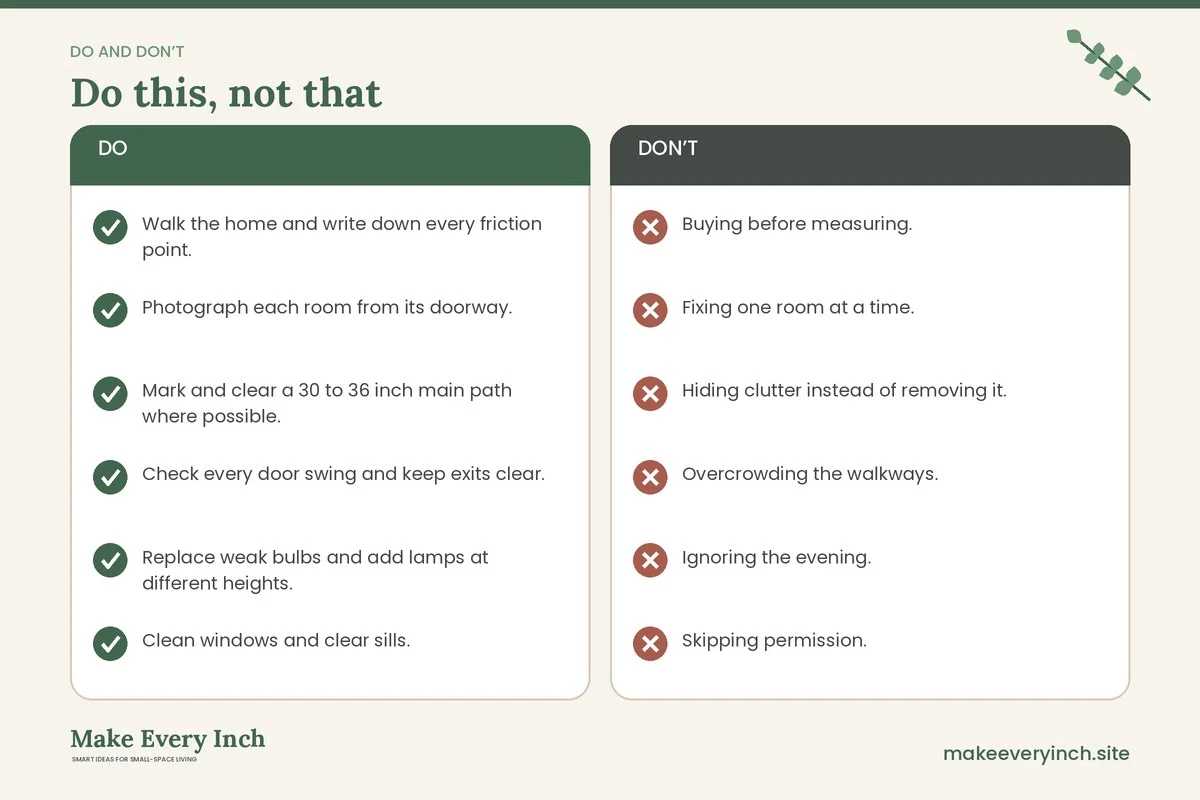
- Buying before measuring. A product that does not fit is clutter on arrival.
- Fixing one room at a time. Changes to light, flow and color work best when they connect from room to room.
- Hiding clutter instead of removing it. More containers can disguise the problem for a while, but the amount of stuff still has to fit.
- Overcrowding the walkways. Furniture that looks fine in a photo can make a path feel like an obstacle course.
- Ignoring the evening. A home that works in daylight may feel cramped and dim at night.
- Skipping permission. A change that costs your deposit is not an improvement.
A simple order of operations
If you are not sure where to begin, follow this sequence. First, clear the main walkway and mark the exits. Second, fix the lighting and wash the windows. Third, create a landing spot at the door. Fourth, rehome one bulky piece. Fifth, anchor tall furniture and tidy cords. Sixth, edit one hotspot surface. Seventh, consider paint or wall storage with permission. This order puts the free and reversible changes first, so you gain momentum before you spend time or money on anything larger.
Checklist
- Walk the home and write down every friction point.
- Photograph each room from its doorway.
- Mark and clear a 30 to 36 inch main path where possible.
- Check every door swing and keep exits clear.
- Replace weak bulbs and add lamps at different heights.
- Clean windows and clear sills.
- Place a mirror opposite a light source.
- Anchor tall furniture and large mirrors.
- Create a landing spot at the door.
- Tidy cords and avoid overloaded sockets.
- Clear one hotspot surface for two weeks.
- Ask permission before painting, drilling or changing fixtures.
FAQ
What is the single best improvement for a small home?
For most homes, it is clearing and widening the main walkway, because you feel it every day and it costs almost nothing. If your home already flows well, lighting is usually next.
Do I need to spend a lot to see a big difference?
No. Many of the highest-impact changes involve moving things, cleaning, rearranging and adjusting light. Spend only after you have used up the free improvements. For tight budgets, see budget small space ideas.
Which improvements are safe for renters?
Rearranging furniture, changing bulbs, using freestanding storage, adding plug-in lights and leaning mirrors are generally low-risk. Anything involving paint, drilling or fixtures needs written permission first. Our guide to renter-friendly small space upgrades that make a difference covers more options.
How do I decide between two improvements?
Choose the one that you notice more often and that affects more rooms. If they are equal, choose the one that is easier to undo.
How long should this take?
The audit takes about twenty minutes. Many of the first changes fit into a weekend, and you can spread the rest over a few weeks.
Keep going: Keep improving your home with our pillar guide to small home ideas, the practical small space organization ideas and the small room decor ideas that tie everything together.
Save this guide for later
Pin the ideas you like to Pinterest so you can come back to them when you plan your space.