16 Small Living Room Lighting Ideas Renter Friendly Plans With No Drilling
Quick answer: The best small living room lighting ideas renter friendly plans rely on plug-in sconces hung from removable hooks, lamps at three heights, arc and uplight floor lamps, and cord management that needs no screws. Aim for roughly 1,500 to 3,000 total lumens in warm 2700 kelvin bulbs, keep every cord flat and out of walkways, and leave any hardwired change to your landlord and a licensed electrician.
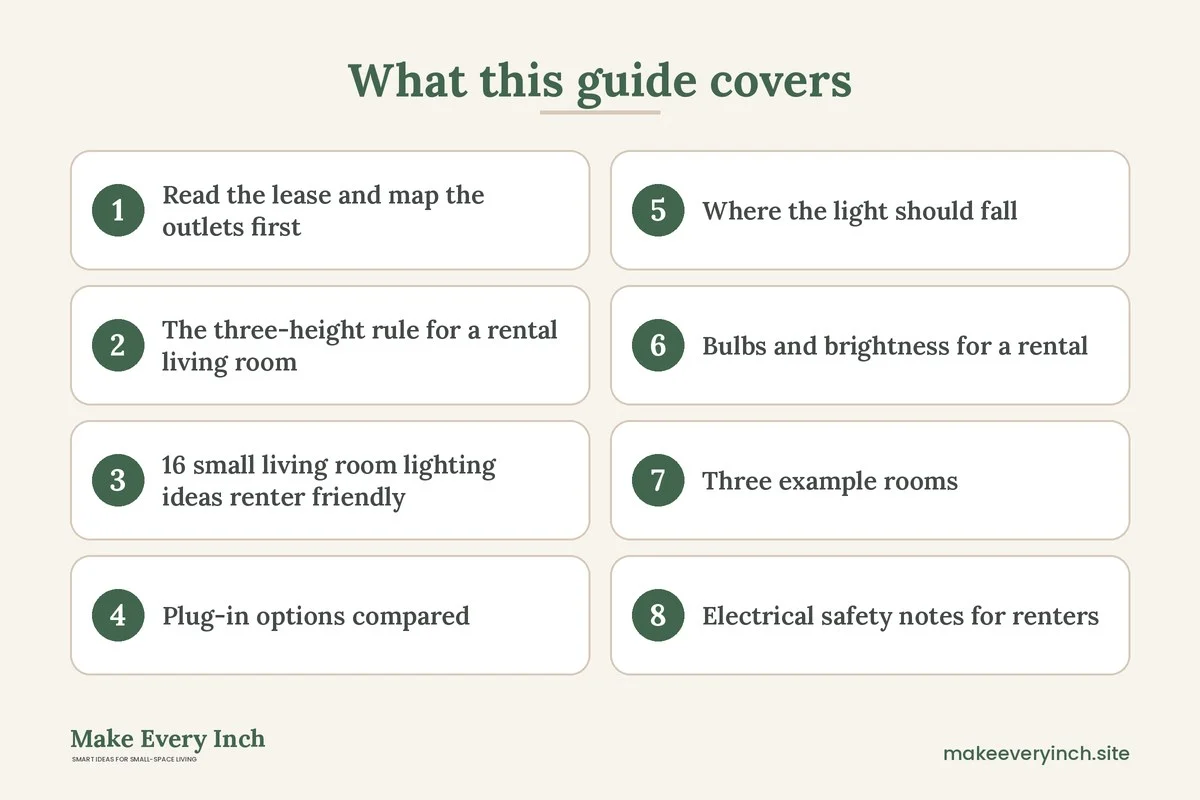
Small living room lighting ideas renter friendly enough to leave the walls and ceiling untouched start with a different question than the usual lighting advice. Instead of asking what you would install, ask what you can plug in, lean, clip or rest. Most rentals come with one harsh ceiling fixture, a few outlets in awkward places and a lease that forbids drilling. That is not a dead end. A living room can be lit beautifully with lamps, plug-in wall lights and a few quiet tricks, and all of it comes with you when you move. This guide focuses on the living room only, so it goes deeper on seating heights, sofa-side placement, television glare and cord routes than a whole-home list can. For lights in every room, see our wider guide to renter-friendly lighting ideas, and for the room-by-room overview read our main post on small living room lighting ideas and the small living room ideas pillar.
Read the lease and map the outlets first
Before buying anything, take ten minutes to survey the room. Renter-friendly lighting is built around what the room already offers, and outlets are the limiting factor.
- Read the lease. Look for language about nails, screws, adhesive, ceiling fixtures and electrical changes. Some leases allow small nail holes. Others ban adhesive on painted walls. When in doubt, ask in writing and keep the reply.
- Photograph the walls and ceiling. Take dated photos of the room as it is. They protect your deposit if a question comes up at move-out.
- Mark every outlet. Draw a quick sketch with the outlets, the switches and which outlets are controlled by a wall switch. Many living rooms have one outlet that is switched, and this is a gift: a lamp plugged into it can be turned on from the door.
- Measure the distance from the sofa to the nearest outlet. A standard lamp cord is about 6 feet long. If the outlet is farther than that from where you want light, plan for a longer cord or move the light.
- Test the wall. If you plan to use adhesive hooks, press one on a hidden spot for a few days and peel it slowly. Flat, recently painted walls are the most delicate.
If the room has a ceiling fixture you dislike, leave it. Swapping it is hardwired work, and in most rentals it needs the landlord’s permission and a licensed electrician. You can soften the fixture’s effect without touching it by using a warmer, dimmer-friendly bulb of the same size where the fixture allows, and by balancing it with lamps.
The three-height rule for a rental living room
The easiest way to make a small living room look designed, not just lit, is to place light at three heights. Each height does a different job.
- Low light, 12 to 30 inches from the floor. A small lamp on a floor-level stool, a lamp on a low side table or an uplight tucked in a corner. Low light grounds the room and makes the walls look like they extend.
- Mid light, 38 to 60 inches. Table lamps and plug-in sconces. This is where reading and conversation happen. The bottom of the shade should sit near eye level when you are seated, typically 38 to 42 inches from the floor.
- High light, 60 inches and above. Arc or uplight floor lamps, a plug-in sconce hung high or a lamp on a bookcase. High light washes the ceiling and lifts the room.
A rental with only a ceiling light has one high source and nothing else. Adding a mid and a low source can change the room completely, without a single hole.
16 small living room lighting ideas renter friendly
Plug-in sconces without drilling
1. A plug-in sconce on an adhesive hook
Lightweight plug-in sconces can hang from removable heavy-duty hooks rated for the weight of the fixture. Check the weight on the packaging, choose a hook with a safety margin, and follow the surface instructions. Place the sconce about 60 to 66 inches from the floor beside the sofa, and about 6 to 8 inches out from the sofa’s side edge so it lights the seat without glaring in the eyes. This idea works best on smooth, clean paint and is not suitable for textured walls.
2. A sconce on a single small nail
If the lease allows small nail holes, a single picture-hanging nail can carry most plug-in sconces. The hole is small and can be filled with spackle at move-out. This is more secure than adhesive for a heavier fixture. Always confirm the lease allows it first.
3. A leaning “sconce” on a shelf
A shelf-mounted light with a stand or a clip can imitate a sconce without touching the wall. Place a slim lamp at the end of a bookcase at roughly 50 to 60 inches high. It gives the same wall-washing glow and can move with you.
4. A sconce with a fabric cord cover
The weak point of a plug-in sconce is the cord. A paintable or fabric cord cover that sticks to the wall hides the cord, and some covers use removable adhesive. Test on a hidden spot. If the cover will not stick, run the cord along the edge of a bookcase or behind a curtain.
Lamps that do the heavy lifting
5. Matching table lamps at the sofa ends
A pair of lamps with bases 14 to 18 inches tall on side tables 20 to 26 inches high puts the shade bottom near eye level. Matching lamps look planned and give each person a reading light. If the sofa is flush against a wall, keep the base narrow, 6 to 8 inches wide.
6. One lamp on the floor
No side table? Place a lamp with a 6 to 8 inch base directly on the floor beside the sofa, ideally a tall one of 24 to 30 inches. It reads as a floor lamp but is easier to tuck into a corner and costs less than a large arc. Choose a stable base so it cannot tip.
7. An arc floor lamp over the sofa
An arc lamp sits 12 to 18 inches behind the sofa arm and arcs over the seat, lighting the page from above without needing a table. A weighted base of 10 to 12 inches keeps it stable. For rentals, an arc lamp is one of the strongest options because it needs no wall, no ceiling and no table. Our guide to the best floor lamps for small rooms lists features to check before buying.
8. An uplight in the corner
An uplight in the darkest corner bounces light off the ceiling and walls, which makes the room feel taller. Place it 6 to 12 inches from the wall, and choose a bulb of roughly 800 to 1,100 lumens. Keep the top of the lamp at least a foot from the ceiling, and follow the maximum wattage on the label.
9. A lamp on a bookcase or console
A small lamp of 10 to 14 inches tall on a bookcase or a console adds the third point of a triangle. It can light a dim wall or the area behind a television. Place it toward the back of the shelf so the cord can drop behind the furniture.
10. A clamp light on a shelf or chair
A clamp light with a padded jaw attaches to a bookcase edge or a sturdy chair frame. It gives reading light without touching the walls. Pad the clamp surface with a cloth, and aim it at the page and not the eyes.
Ambient and accent light with no tools
11. Warm string lights on a shelf
String lights draped along a shelf or the top of a bookcase give accent glow. Choose a warm color, a low-heat LED version and a set labeled for indoor use. Keep them away from curtains, and unplug them when you are out.
12. A mirror to double the light
A leaning floor mirror or a mirror hung on a removable hook placed across from a lamp or a window bounces the light deeper into the room. In a rental, a leaning mirror of 48 to 60 inches tall is the simplest option. Make sure it is stable and cannot slide.
13. Light behind the television
A small lamp or a plug-in strip placed behind or beside the screen at a low setting reduces the contrast between the bright screen and the dark wall. Bias lighting of roughly 100 to 200 lumens eases the eyes in an evening session. Use a product rated for indoor use, and keep it away from heat.
14. A picture light that sits on a ledge
A small battery or plug-in picture light on a shelf or a ledge can highlight a print. A leaning frame on a console with a small lamp beside it creates a gallery feel with no hanging.
Making the cords disappear
15. Route the cord with removable clips
Self-adhesive cord clips with removable tape guide a cord along a baseboard or the underside of a shelf. Keep the cord flat against the surface, and test the adhesive on a hidden spot. Pull the clips slowly at move-out, with a hairdryer on low to soften the adhesive if needed.
16. Hide the cord behind furniture
A cord that runs behind a sofa, a bookcase or a curtain disappears with no adhesive at all. Make sure the cord is not pinched by furniture legs and that it has enough slack to avoid strain on the plug. Never staple a cord or run it under a rug.
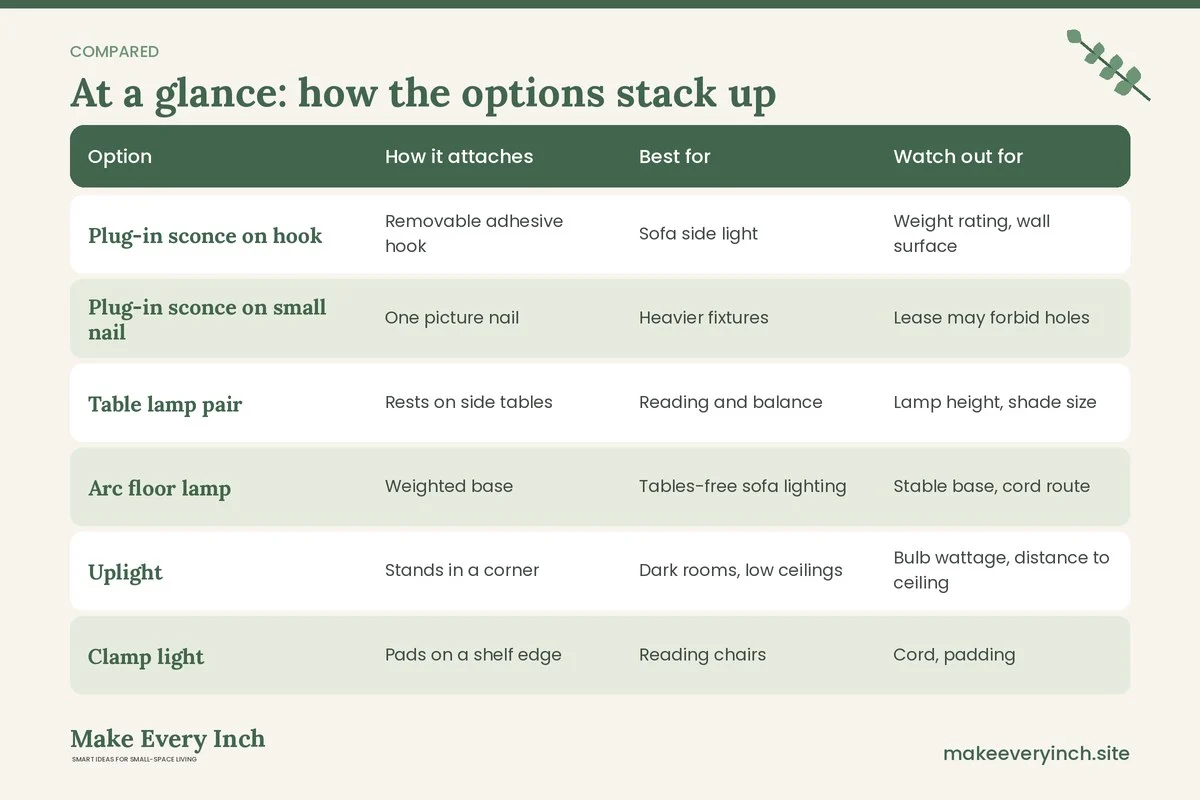
Plug-in options compared
Use the table below to compare the main renter-friendly options by how they attach, what they do best and what to watch.
| Option | How it attaches | Best for | Watch out for |
|---|---|---|---|
| Plug-in sconce on hook | Removable adhesive hook | Sofa side light | Weight rating, wall surface |
| Plug-in sconce on small nail | One picture nail | Heavier fixtures | Lease may forbid holes |
| Table lamp pair | Rests on side tables | Reading and balance | Lamp height, shade size |
| Arc floor lamp | Weighted base | Tables-free sofa lighting | Stable base, cord route |
| Uplight | Stands in a corner | Dark rooms, low ceilings | Bulb wattage, distance to ceiling |
| Clamp light | Pads on a shelf edge | Reading chairs | Cord, padding |
| String lights | Drape on a shelf | Accent glow | Heat, unplugging |
| Leaning mirror | Rests on the floor | Doubling light | Stability |
Where the light should fall
A common mistake is putting lamps where the outlets are and not where you need the light. Use these placement targets to fix that.
- Reading seat: the light source should be 15 to 25 inches from the book, slightly behind and to one side of the shoulder, so your head does not cast a shadow on the page. A task bulb of roughly 400 to 800 lumens is usually enough.
- Sofa center: keep the main seating area lit by at least two sources, so no one sits in a shadow.
- Television wall: keep screen glare off the walls on either side by adding a low lamp. Do not place a bright lamp directly beside the screen at the same height as it.
- Corners: light the darkest corner with a low source. An unlit corner makes a small room feel like it shrinks.
- Walkway: make sure the main path stays visible. A lamp at the end of the path can double as a night light.
Bulbs and brightness for a rental
Rental living rooms often have mismatched or old bulbs. Replacing them is a simple, reversible change.
- Warmth: choose warm white, near 2700 kelvin, for all lamps. A matching color unifies the room. If you want a crisper feel in a reading corner, 3000 kelvin is a reasonable step up.
- Brightness: a room of 100 to 150 square feet often feels comfortable with roughly 1,500 to 3,000 total lumens across several lights. Use more in a dark room and less in a sunny one.
- Dimming: choose dimmable bulbs for lamps you might want to soften, and use a plug-in dimmer rated for the bulb type. A dimmer on a lamp is a reversible way to add control.
- Fixture bulbs: if you want to improve the landlord’s ceiling light, replace the bulb with a warm one of the same base, and keep to the wattage printed on the fixture. Save the original bulb and put it back at move-out if your lease asks for it.
- Take them with you: bulbs, lamps and shades are yours. Pack them when you leave.
Three example rooms
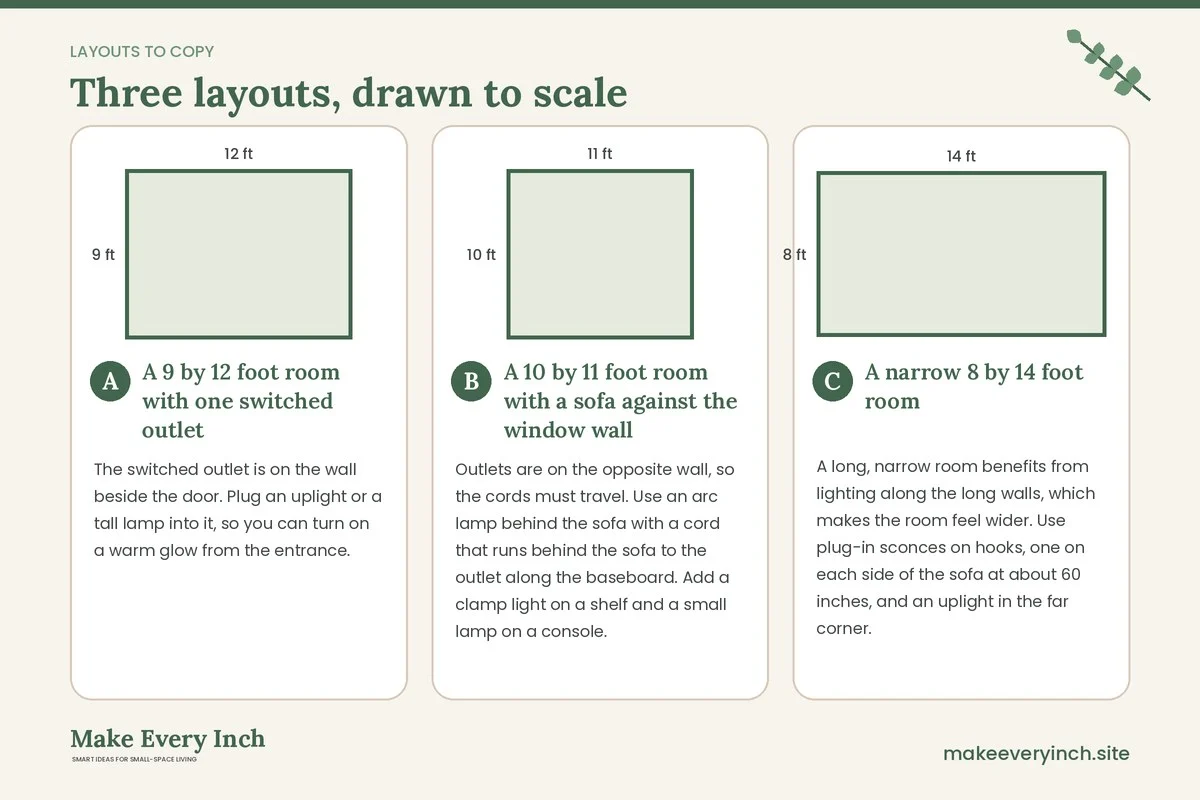
A 9 by 12 foot room with one switched outlet
The switched outlet is on the wall beside the door. Plug an uplight or a tall lamp into it, so you can turn on a warm glow from the entrance. Place a table lamp at each end of the sofa with a power strip that has a breaker, and tuck the strip behind the sofa. Keep the cords flat, and aim for roughly 2,000 to 2,500 total lumens. The ceiling light stays off during the evening.
A 10 by 11 foot room with a sofa against the window wall
Outlets are on the opposite wall, so the cords must travel. Use an arc lamp behind the sofa with a cord that runs behind the sofa to the outlet along the baseboard. Add a clamp light on a shelf and a small lamp on a console. Use cord clips along the baseboard in a straight line, and keep the cord out of the walkway. A leaning mirror on the opposite wall bounces the evening light.
A narrow 8 by 14 foot room
A long, narrow room benefits from lighting along the long walls, which makes the room feel wider. Use plug-in sconces on hooks, one on each side of the sofa at about 60 inches, and an uplight in the far corner. Place lights at both ends of the room. For more ideas on long rooms, see our post on narrow living room ideas.
Electrical safety notes for renters
Renting does not remove the need for caution. Follow these rules every time.
- Check the maximum wattage. Every lamp has a limit printed near the socket. Do not exceed it. LED bulbs let you get plenty of light at a low wattage.
- Never overload an outlet. Do not plug many lights, a heater and a television into the same outlet or strip. If a plug or strip feels warm, stop using it.
- Use a strip with a breaker. Use a power strip with a built-in breaker and a clear rating. Do not chain one strip into another.
- Keep cords visible and flat. Do not run cords under rugs, through doorways or across walkways, and do not staple or nail them.
- Pad adhesive hooks properly. Stay within the weight rating and check the hook after a few days. If the hook shifts, take the fixture down.
- Keep shades clear of fabric. Keep bulbs and shades away from curtains, paper and throws.
- Do not alter the house wiring. Replacing a ceiling fixture, adding a hardwired sconce or installing a wall dimmer is the landlord’s responsibility. If you need it, ask them and hire a licensed electrician.
- Report problems. If an outlet sparks, buzzes or feels hot, stop using it and tell your landlord.
Move-out and deposit tips
The good thing about these ideas is that they leave very little behind. A short routine at move-out keeps your deposit safe.
- Take down hooks slowly, pulling the tab parallel to the wall.
- Use a hairdryer on low to soften stubborn adhesive.
- Clean any residue with a soft cloth and mild soap, and test it in a hidden spot first.
- Fill any small nail holes with spackle if your lease asks for it.
- Put the original bulbs back in the fixtures.
- Compare the walls with your move-in photos.
For other approaches to a rental, read our guides to security-deposit-safe apartment upgrades and no-drill storage ideas for renters, and the broader small living room ideas for renters.
Common mistakes in rental living rooms
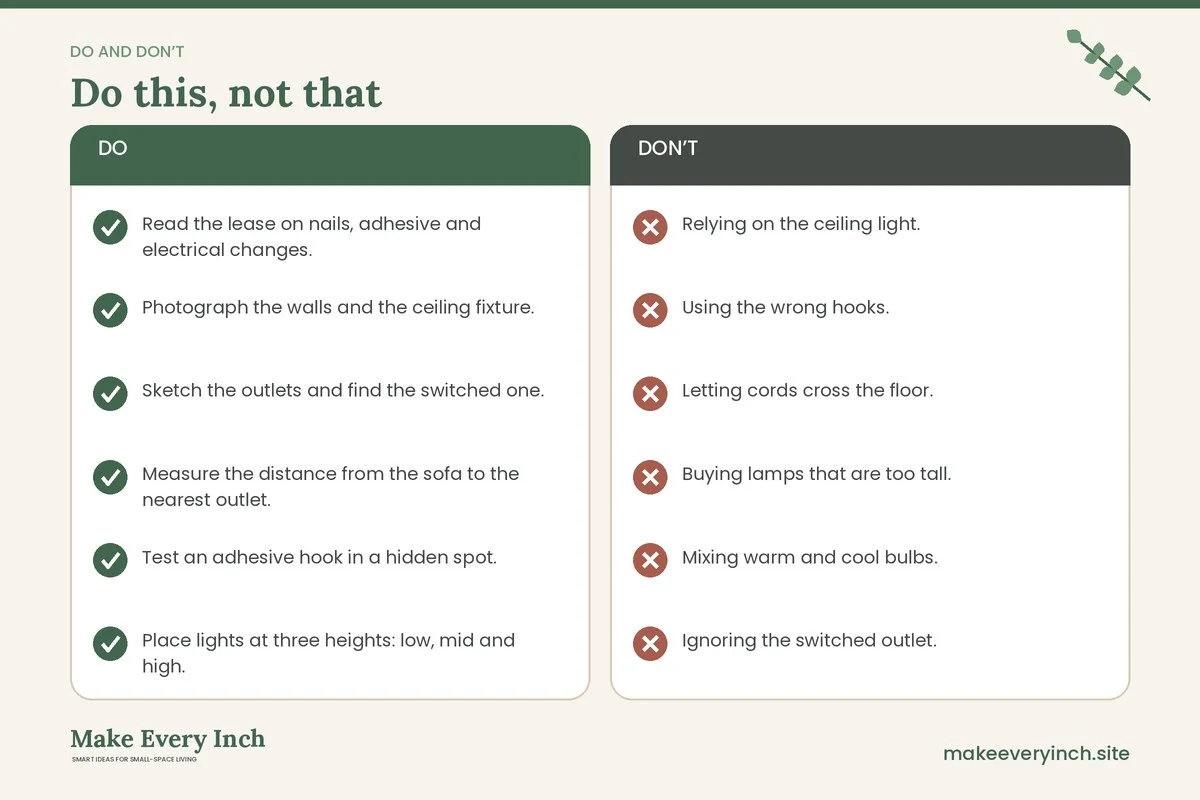
- Relying on the ceiling light. One harsh source flattens the room. Add lamps.
- Using the wrong hooks. A hook rated below the fixture’s weight will fall. Check the rating.
- Letting cords cross the floor. This is a trip hazard and looks messy.
- Buying lamps that are too tall. In a low-ceiling rental, a very tall uplight can leave no room for the light to spread. Keep it a foot or more below the ceiling.
- Mixing warm and cool bulbs. Choose one warmth.
- Ignoring the switched outlet. It is the easiest way to control a lamp from the door.
- Skipping the photos. Keep move-in photos to protect the deposit.
Renter living room lighting checklist
- Read the lease on nails, adhesive and electrical changes.
- Photograph the walls and the ceiling fixture.
- Sketch the outlets and find the switched one.
- Measure the distance from the sofa to the nearest outlet.
- Test an adhesive hook in a hidden spot.
- Place lights at three heights: low, mid and high.
- Set the shade bottom near eye level when seated.
- Keep the reading light 15 to 25 inches from the book.
- Use warm bulbs of about 2700 kelvin throughout.
- Stay under the wattage limit on every lamp.
- Use a power strip with a breaker, and do not chain strips.
- Keep cords flat and out of walkways.
- Leave hardwired changes to the landlord and a licensed electrician.
- Save the original bulbs for move-out.
FAQ
Can I install a wall sconce in a rental?
You can use a plug-in sconce that hangs from a removable hook or a single small nail, if the lease allows. A hardwired sconce needs the landlord’s permission and a licensed electrician.
What is the best lamp for a rental living room with no side tables?
An arc floor lamp or a tall lamp with a small base on the floor. Both bring light to the sofa without needing a table.
Will adhesive hooks damage my walls?
They can, especially on flat or freshly painted walls. Test in a hidden spot first, stay within the weight rating and remove the hook slowly by pulling the tab parallel to the wall.
How do I hide lamp cords without drilling?
Use removable cord clips along the baseboard, run the cord behind furniture or use a cord cover with removable adhesive. Keep the cord flat and never run it under a rug.
How bright should a small living room be?
Roughly 1,500 to 3,000 total lumens spread across several lamps is a comfortable range for many rooms. Use the lower end for relaxed evenings and the higher end for reading.
Can I change the bulb in the landlord’s ceiling fixture?
Usually yes, if you use a bulb that fits and stays within the fixture’s wattage limit. Keep the original bulb and check your lease.
What if my living room has only one outlet?
Use a power strip with a breaker to feed two or three lamps, and keep the total load within the rating. Do not chain strips. If you need more, ask your landlord about adding an outlet through a licensed electrician.
Do plug-in lights count as a permanent change?
No. Lamps, plug-in sconces and string lights come with you when you move, and adhesive hooks can be removed with care.
Keep going: Keep planning with our cozy small living room ideas, small living room layout ideas and small living room lighting ideas budget guide.
Save this guide for later
Pin the ideas you like to Pinterest so you can come back to them when you plan your space.