21 Japandi Apartment Ideas for Small, Calm Spaces
Quick answer: The best japandi apartment ideas combine Japanese restraint with Scandinavian warmth. Use a soft neutral palette, light and dark wood together, linen and paper textures, low furniture, one or two handmade ceramics, plenty of empty surface and a few living plants. Edit hard, choose quality over quantity, and let negative space do the work.
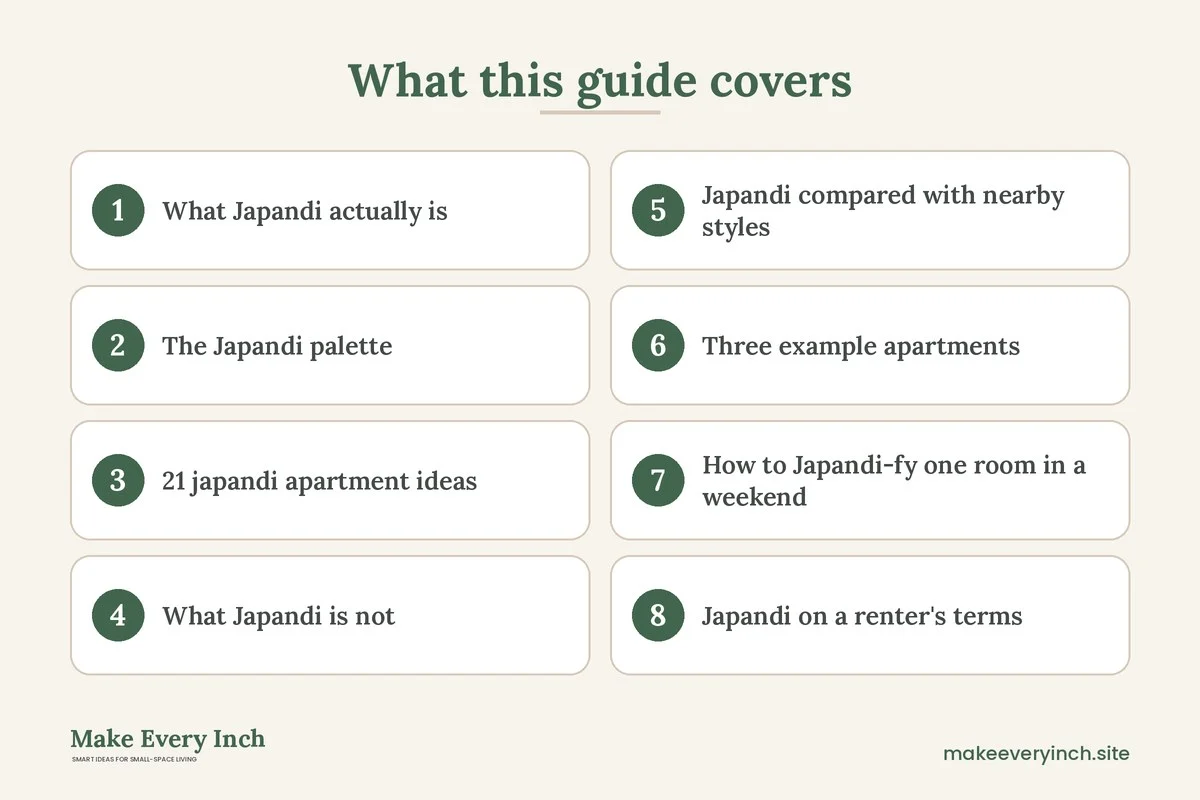
Japandi apartment ideas suit small homes because the style is built on less. It borrows the calm, edited feeling of Japanese minimalism and the soft, livable warmth of Scandinavian design, and the result is a room that feels spacious even when it is not. You do not need a renovation to get there. Most of the look comes from what you remove, how you arrange what stays and a short list of natural materials. This guide explains what Japandi really is, how to build the palette, 21 ideas for small apartments, a comparison table, three example homes, a step-by-step method, a budget guide, common mistakes and a checklist. If you want the brighter, more playful cousin of this style, read our guide to scandinavian small apartment ideas.
What Japandi actually is
Japandi is a hybrid. From Japan it takes the idea that every object should earn its place, that emptiness is useful and that imperfection is beautiful. From Scandinavia it takes the idea that a home should feel comfortable, with soft light, texture and furniture made for daily use. The Japanese word for finding beauty in the worn, the uneven and the incomplete is wabi-sabi, and the Danish idea of coziness is hygge. Japandi sits where those two meet.
In practice that means rooms with few objects, but not cold ones. A linen sofa, a wool throw, a pale oak table and a single hand-thrown vase feel serene rather than sparse. The furniture lines are simple and often slightly rounded, the colors are muted, and nothing shouts. If you like the idea but want more warmth and curves, see organic modern apartment ideas.
The Japandi palette
Start with a base of warm off-white, soft greige, pale sand or oatmeal on the walls. These tones reflect light without the glare of pure white, which suits small rooms and rentals with weak daylight. Layer in mid tones such as clay, warm gray and muted sage, then ground the room with one deep accent, such as charcoal, black-brown or deep indigo.
Keep the palette to three or four colors and repeat them. A charcoal lamp base, a dark frame and a black metal chair leg make a rhythm. Avoid bright primary colors, glossy finishes and busy pattern. If you want pattern, choose a subtle one such as a stripe in two close tones, or a woven texture that reads as pattern only up close.
21 japandi apartment ideas
Foundations: color, wood and light
1. Paint or fake a warm neutral base
Choose an off-white with a drop of yellow or gray rather than a stark white. If you cannot paint, bring the color in with a large linen curtain, a rug and bedding. A wall color around light reflectance value 70 to 80 keeps a small room bright without feeling clinical.
2. Mix light and dark wood
Pair a pale wood such as ash, birch or white oak with one darker piece such as walnut or a black-stained stool. The contrast is the Japandi signature, and it stops a room from looking flat. Keep the wood grain visible and the finish matte.
3. Use paper and washi light
A paper lantern or a washi shade gives a diffused, warm glow that suits low evening light. Round paper pendants are inexpensive, and plug-in versions work in rentals with a cord and a ceiling hook you can remove. Use warm bulbs around 2700 K.
4. Layer three kinds of light
Combine one soft overhead source, a floor lamp at seating height and a small table lamp. Low lights keep the eye near the floor, which makes ceilings feel higher. Dimmers or smart bulbs help you shift from bright morning to quiet evening.
5. Let sheer linen filter the window
Replace heavy drapes with natural linen or linen blend panels in an oatmeal or white tone. Hang the rod close to the ceiling and let the fabric touch the floor. The light that passes through is soft and slightly warm, which is the right mood for the style.
Furniture: low, simple and honest
6. Choose low-profile seating
A sofa with a seat height near 15 to 16 inches and slim legs shows more floor, and visible floor reads as space. Pick clean arms and a firm, supportive cushion. Boucle, linen and washed cotton all suit the look.
7. Use a low table or a floor-height zone
A coffee table 12 to 15 inches high echoes traditional Japanese living. In a tiny apartment, a round table with no corners moves easily and avoids bruised shins. A floor cushion and a small tray can turn a corner into a tea spot.
8. Keep the bed low and plain
A platform bed or a simple wood frame with a low headboard calms the bedroom. Choose bedding in white, oatmeal or stone, with one darker throw folded at the foot. Skip the pile of decorative pillows, and use two sleeping pillows and one lumbar.
9. Pick furniture with exposed joinery and slim legs
Tapered or peg legs, visible dovetails and rounded edges signal craft without ornament. A slim legged piece lets floor show beneath it, which makes a small room feel lighter. If you buy secondhand, look for mid-century Danish teak or simple pine farm tables you can refinish or leave as they are.
10. Add one rattan or cane piece
A cane-front cabinet, a rattan chair or a woven stool brings in a lighter, airier texture. It also adds a hint of Scandinavian warmth to the otherwise severe Japanese lines. One piece is enough, so do not match everything.
Texture and objects: the quiet details
11. Choose handmade ceramics
Matte glazes in stone, charcoal and speckled cream feel right, and slightly irregular shapes celebrate wabi-sabi. Group two or three vessels of different heights on a tray, rather than scattering many small pieces. A single large stoneware jar with dried grasses is enough on a shelf.
12. Display one thing per surface
Give each shelf or tabletop a single focal object and leave space around it. The empty area is not wasted, it is the point. Try the rule of one object, one tray and one plant per surface.
13. Use a natural fiber rug
Jute, sisal, wool or flatweave in sand and gray anchors the room and adds warmth underfoot. A 5 by 8 foot rug suits most small living rooms, with the front legs of the sofa resting on it. Flat weaves are easier for rentals, since they lie flat and clean easily.
14. Add a minimal wall composition
One large, calm piece, such as a simple ink-style print, a woven hanging or a plain wood panel, does more than a gallery wall. Lean it on a console if you cannot drill. Leave at least a hand’s width of space around the frame.
15. Bring in a living plant or branch
A bonsai, a pothos on a shelf, a snake plant by a window or a vase of bare branches brings life without color. Pick one or two forms with strong shape rather than many small plants. A branch arrangement, in the spirit of ikebana, is also kind to a small budget.
Layout and storage: negative space on purpose
16. Build negative space into the plan
Aim to keep roughly a third of the visible surfaces and floor open. Walk through the room and count the objects on each surface, then remove the weakest third. Empty space makes the remaining objects look chosen.
17. Hide the everyday with closed storage
Japandi depends on concealed storage, so choose cabinets with flat doors and finger pulls, lidded baskets and bins in matching tones. Store small appliances, cables and papers out of sight. See our guide to hidden storage ideas for ways to do it without building anything.
18. Zone with furniture, not walls
In a studio, use a low open shelf, a folding screen or a rug to mark sleeping, living and eating areas. A shoji-style screen with paper panels filters light and hides a bed or a desk. Keep the screen light enough to fold flat when you want the full room.
19. Create an entry moment
A bench, a few hooks and a tray for keys mark the transition from outside to inside, which echoes the Japanese genkan. Take shoes off at the door and keep a single pair visible. Our guides to small entryway storage and small shoe storage ideas show how to do this in a tight space.
Renter and daily habits
20. Use renter-friendly versions of the look
Freestanding furniture, plug-in lighting, tension rods, removable hooks and rugs deliver most of the style without touching walls. Read your lease, photograph every wall and floor first, and keep the original fixtures if you swap a light. Our renter-friendly apartment decorating ideas cover the details.
21. Make a daily reset ritual
Japandi only works if the surfaces stay clear. Spend five minutes each evening returning items to their homes, wiping the table and straightening the throw. The calm is partly a habit, not only a look.
What Japandi is not
It is not an all-white box, because the warmth of wood and textiles is half of the style. It is not stark minimalism with nothing in it, since a book, a plant and a favorite bowl are welcome. It is not a catalog of bamboo and Buddha figures, and decorating with imitation Asian motifs misses the point. It is also not a rule that everything must be expensive. A scuffed secondhand table with a good shape is more Japandi than a glossy new one with fake grain.
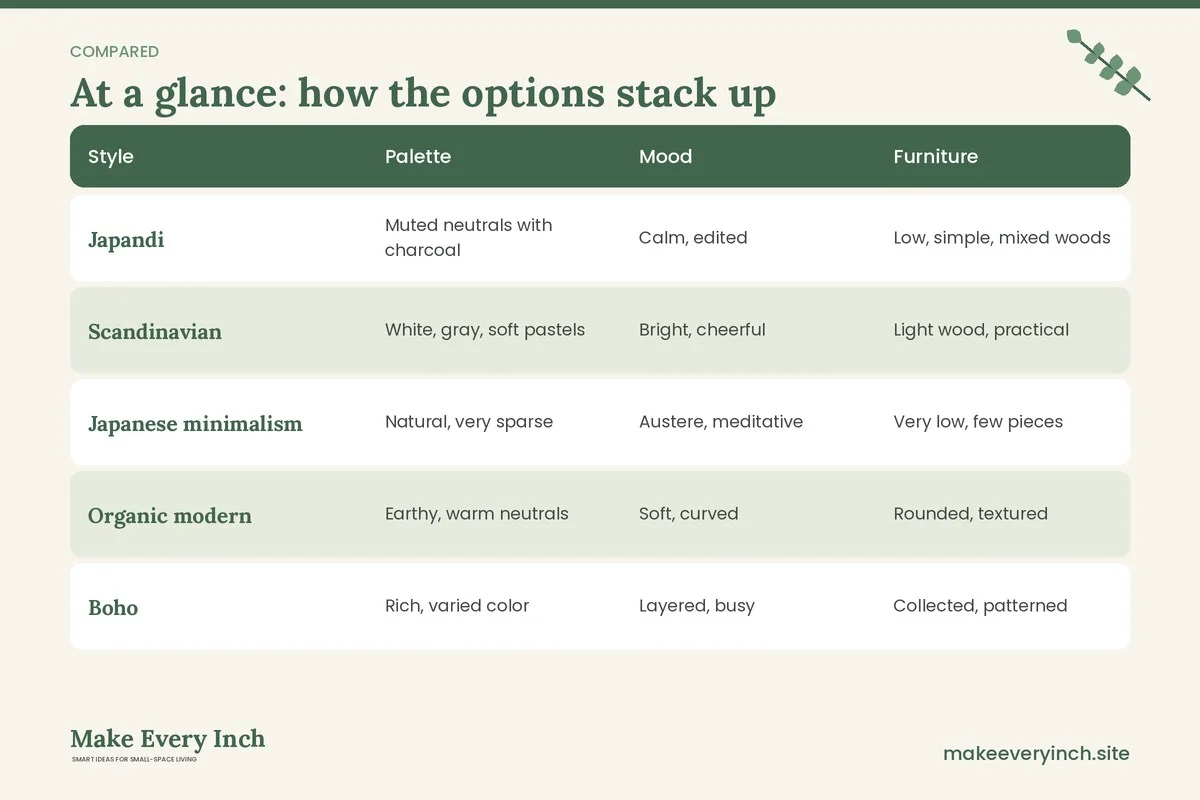
Japandi compared with nearby styles
| Style | Palette | Mood | Furniture | Best for |
|---|---|---|---|---|
| Japandi | Muted neutrals with charcoal | Calm, edited | Low, simple, mixed woods | Small homes that need quiet |
| Scandinavian | White, gray, soft pastels | Bright, cheerful | Light wood, practical | Dark climates and family homes |
| Japanese minimalism | Natural, very sparse | Austere, meditative | Very low, few pieces | Those who want the least |
| Organic modern | Earthy, warm neutrals | Soft, curved | Rounded, textured | Those who want more warmth |
| Boho | Rich, varied color | Layered, busy | Collected, patterned | Those who love variety |
Three example apartments
A 400 square foot studio
Use a low platform bed against one wall, with a fabric screen at its foot to separate it from the living area. A two-seat linen sofa faces a small round table, and a jute rug marks the living zone. Keep the kitchen counter nearly bare, with one wooden board and a ceramic jar. The palette is oatmeal walls, pale oak furniture and charcoal accents, and the only decor is a branch in a vase and a paper pendant.
A one-bedroom rental of 650 square feet
The living room has a low sofa, a walnut side table and a cane cabinet for media. Linen curtains hang high on a tension rod, and a 5 by 8 rug sits under the front of the sofa. In the bedroom, a simple wood bed, white bedding and one dark throw keep the room quiet. A small bench by the entry and a row of removable hooks create a genkan-style landing without any drilling.
A narrow city apartment
A long, narrow living room benefits from a slim sofa along one wall and a single low shelf on the other, which keeps the walking path at least 30 inches wide. Use a runner-style rug to lead the eye along the room, and hang a pendant over the dining end. Pale walls and one large piece of art on the short wall pull the room together. The narrow living room ideas guide has layouts for this shape.
How to Japandi-fy one room in a weekend
Step 1: Clear and sort
Take everything off the surfaces and group it by use. Keep what you use and love, and box the rest for a week. Anything you do not miss is a candidate to donate.
Step 2: Fix the base
Check the wall color, the curtains and the rug. Swap busy or bright textiles for natural, muted ones, even if that means borrowing or buying only one big item, such as a rug or curtains.
Step 3: Edit the furniture
Remove any piece that blocks a path or duplicates another. Move heavier furniture against the walls, and lower the visual weight by choosing legs you can see under.
Step 4: Add light and one natural material
Place a warm lamp at seating height and a paper shade overhead. Add one wood piece, one ceramic and one plant. Stop there.
Step 5: Edit again
Stand in the doorway and take a photo. Remove one more thing from every surface, and notice how the room settles.
Japandi on a renter’s terms
Many Japandi pieces are freestanding by nature, so the style fits a rental well. Use a plug-in pendant on a ceiling hook only if the lease allows it, or choose floor and table lamps instead. Hang linen curtains on a tension rod or an over-the-door rod. Cover a dated floor with a wool or flatweave rug. Replace a few cabinet knobs with simple wood or matte black ones, and keep the originals in a labeled bag. For walls, lean art on shelves, and use adhesive strips rated for the frame. Photograph the apartment before you begin and again at move-out. See security deposit safe apartment upgrades for more low-risk changes.
Plants, branches and the natural world
Greenery in a Japandi home is sculptural rather than lush. A single bonsai on a low table, a tall ficus in a corner or a small pot of moss draws attention to form. Bare or flowering branches, such as cherry, quince or magnolia, in a tall narrow vase give seasonal change with almost no upkeep. Choose pots in matte ceramic, unglazed clay or woven baskets with a liner. Keep plants away from drafts and radiators, and rotate them each week so they grow evenly.
Lighting for a calm evening
Lighting is where Japandi quietly succeeds or fails. Use bulbs with a warm color temperature around 2200 to 2700 K, and avoid bright cool bulbs in living spaces. Place lamps low, at about knee to elbow height when seated, so that the walls glow rather than the ceiling. A paper lantern floor lamp by the sofa and a small ceramic table lamp near the bed are good starts. Put the main ceiling light on a dimmer plug if you cannot rewire. Candles in simple holders add a final layer, and many people find that a single lit candle at dinner is enough. For more ideas, see renter friendly lighting ideas.
Budget guide
Under $150
Declutter, rehome surfaces, buy a paper shade, a pair of warm bulbs, a branch or a plant, and one handmade or thrifted ceramic. Switch to a single color of hangers and baskets.
About $500
Add linen curtains and a rod, a 5 by 8 natural fiber rug, a simple floor lamp and a secondhand wood side table. This is enough to change the feel of a living room.
$1,500 and up
Invest in a quality low sofa, a solid wood bed frame or dining table, and a cabinet with closed storage. Buy the largest pieces first, and buy them once. Prices vary by region and brand, so treat these as rough ranges.
Common mistakes to avoid
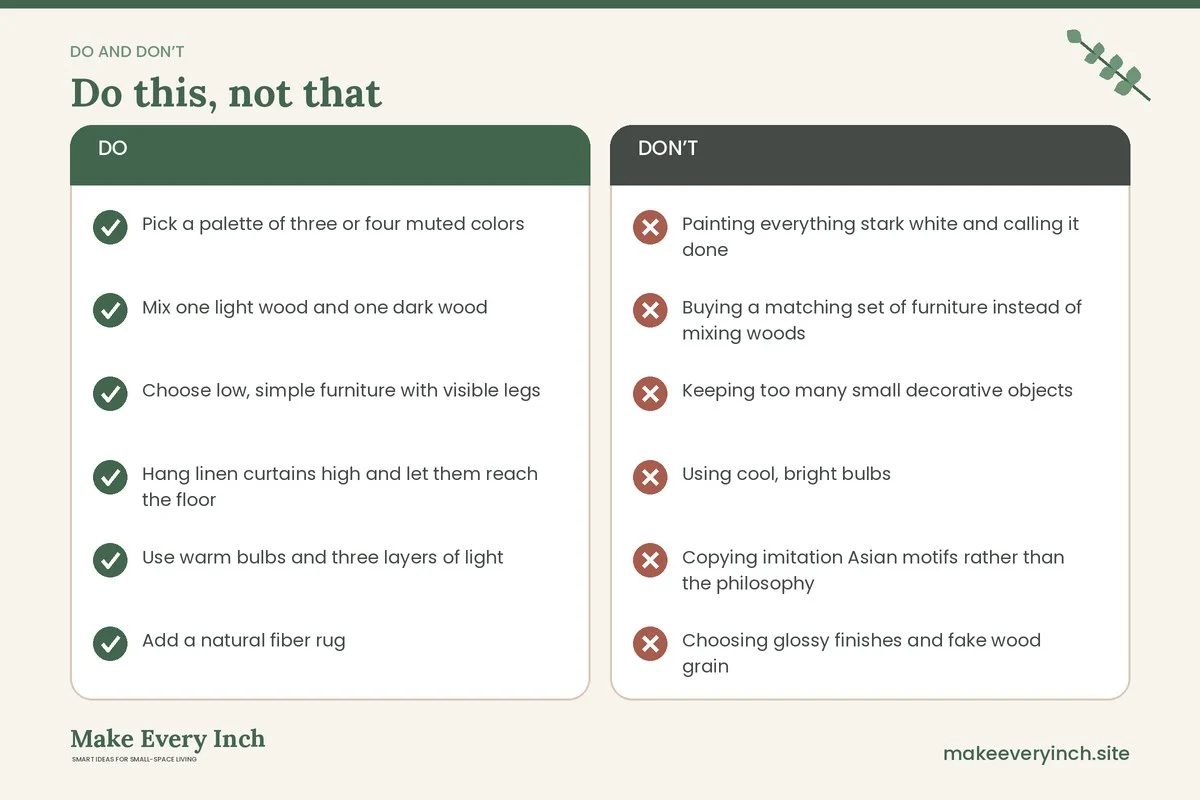
- Painting everything stark white and calling it done
- Buying a matching set of furniture instead of mixing woods
- Keeping too many small decorative objects
- Using cool, bright bulbs
- Copying imitation Asian motifs rather than the philosophy
- Choosing glossy finishes and fake wood grain
- Ignoring storage, so clutter ruins the calm
- Filling every shelf because there is space
- Skipping the lease check before changing fixtures
Japandi checklist
- Pick a palette of three or four muted colors
- Mix one light wood and one dark wood
- Choose low, simple furniture with visible legs
- Hang linen curtains high and let them reach the floor
- Use warm bulbs and three layers of light
- Add a natural fiber rug
- Limit each surface to a few objects
- Add one handmade ceramic and one plant or branch
- Hide everyday items in closed storage
- Create a landing spot at the door
- Photograph the apartment for your lease records
- Do a five-minute reset every evening
FAQ
What is the difference between Japandi and Scandinavian style?
Scandinavian design is brighter, with white walls, light wood and soft pastels, and it leans toward cozy practicality. Japandi is quieter and more muted, with deeper neutrals, darker wood accents and more emphasis on negative space and handmade imperfection.
Can I do Japandi in a rental?
Yes. Most of the look comes from freestanding furniture, linen curtains on tension rods, rugs, lamps and ceramics. Read the lease before changing any fixture, and photograph the apartment first.
What colors work best for Japandi?
Warm off-white, sand, greige and oatmeal make the base, with clay, sage and warm gray as supporting tones, and charcoal or black-brown as an accent. Avoid bright, saturated colors.
Is Japandi expensive?
It can be, but it does not need to be. The style depends on fewer, better things, so thrifted wood furniture, simple paper lighting and a few handmade ceramics deliver the look at modest cost.
How do I get the look without a lot of empty space?
Edit hard, store most things out of sight and keep surfaces mostly clear. In a small apartment, the sense of space comes from clear floors, visible legs and a calm, repeated palette.
What is wabi-sabi and how do I use it?
Wabi-sabi is the appreciation of imperfect, aged and natural things. Use it by choosing handmade ceramics with small irregularities, keeping a worn wooden table and leaving linen unironed.
Which plants suit a Japandi apartment?
Choose plants with a strong, simple shape, such as a bonsai, a snake plant, a pothos or a rubber plant. Bare or flowering branches in a vase also work and need less care.
How can I make Japandi feel warm rather than cold?
Add wood, wool, linen and warm bulbs, and avoid pure white and chrome. A knit throw, a jute rug and a lit lamp at dusk give the warmth that the Scandinavian side of the style promises.
Keep going: Explore our scandinavian small apartment ideas, cozy apartment ideas and small apartment living room ideas.
Save this guide for later
Pin the ideas you like to Pinterest so you can come back to them when you plan your space.