21 Scandinavian Small Apartment Ideas That Feel Light and Calm
Quick answer: The best scandinavian small apartment ideas start with a pale, warm white palette, then add layered lamps, light wood, soft textiles, furniture that works twice and very little clutter. Keep windows bare or sheer, give every object a home and use candles and plants for warmth. Nearly all of it works in a rental.
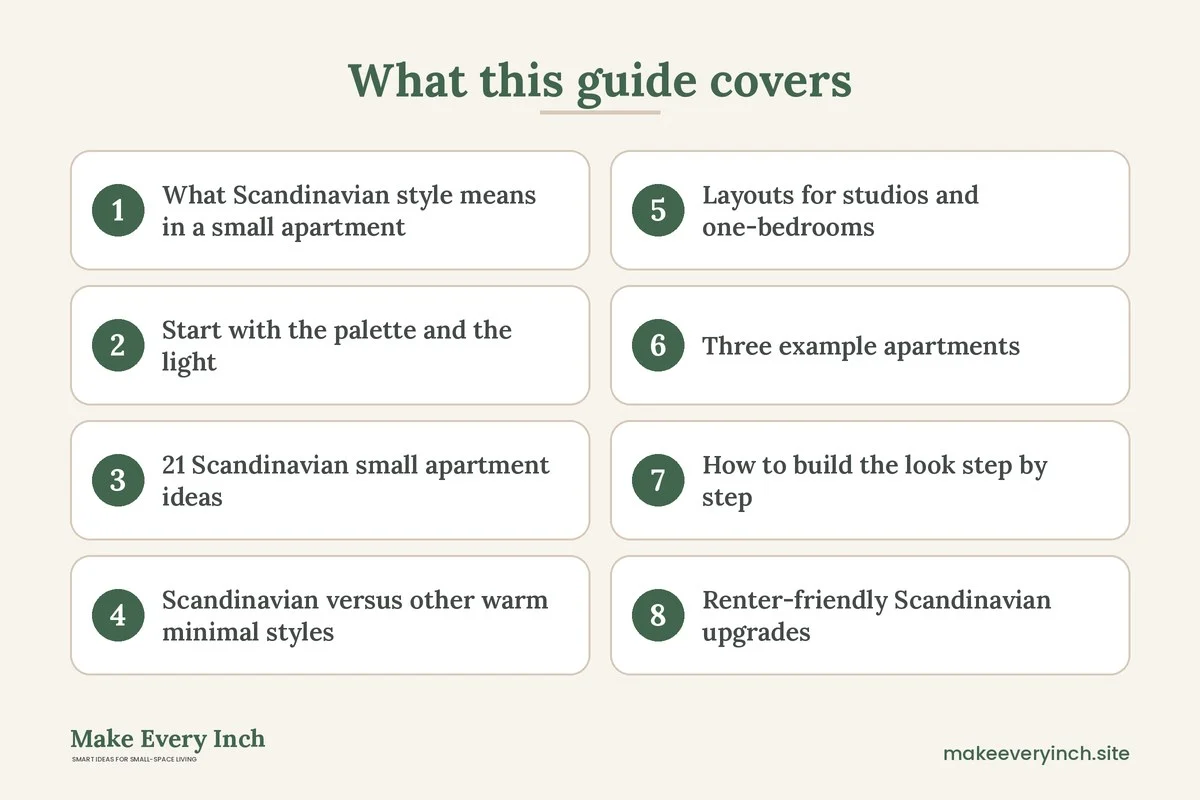
Scandinavian small apartment ideas work so well because the style was built for places with long dark winters and compact homes. The goal is a room that feels bright, quiet and lived in, not a showroom. It relies on light, simple shapes and a few well chosen things, which suits a studio or a one-bedroom where every square foot counts. This guide covers the palette, lighting, wood, textiles, furniture, clutter control, plants, windows, layouts, renter tweaks, a comparison table, three example apartments, a budget guide and the mistakes that make the style feel cold. If you want more warmth in the same spirit, see our guide to cozy apartment ideas.
What Scandinavian style means in a small apartment
Scandinavian design grew out of Denmark, Sweden, Norway and Finland, where daylight is scarce for months and homes need to feel warm indoors. Three ideas sit underneath it. First, light matters more than decoration, so surfaces are pale and windows are left open. Second, function comes first, so a chair or a shelf must earn its place. Third, comfort is a daily habit, which is where the Danish idea of hygge comes in: soft light, a blanket, a hot drink and a calm room.
In a small apartment these ideas become practical rules. Choose few colors, choose natural materials, keep floors visible and make sure every piece has a job. You do not need to buy Nordic brands. You need the principles, and most of them cost very little.
Start with the palette and the light
A warm white base
White walls reflect light, but a stark blue-white can feel clinical, especially on north-facing windows. Look for off-whites with a slight warm or gray undertone, and test a swatch on the wall for two days, since the color shifts from morning to evening. If you rent and cannot repaint, work with what is there and bring warmth through wood, textiles and lamp bulbs.
How many colors to use
A reliable pattern is about 60 percent base color, 30 percent secondary tones and 10 percent accent. In practice that means white or cream walls, light gray and pale wood on large surfaces, and one or two accents such as dusty blue, sage, muted terracotta or charcoal in small doses. Black works well as a thin line, such as a lamp stem, a picture frame or a chair leg.
21 Scandinavian small apartment ideas
Light and atmosphere
1. Layer three kinds of light
Scandinavian rooms rarely rely on one ceiling fixture. Combine a floor lamp for general glow, a table lamp for a corner and a small task light at the desk or by the bed. Three sources at different heights make the room feel larger and softer than one bright overhead bulb.
2. Choose warm bulbs
Use bulbs rated about 2700 kelvin for living areas and bedrooms, and not above 3000 kelvin even in the kitchen. Warm light flatters wood and fabric, and it makes a small room feel intimate. Check the box for the kelvin number, because many bulbs labeled soft white vary.
3. Add candles for hygge
Candles are part of everyday life in the region, not only for special evenings. Group three in different heights on a tray, and keep them away from curtains and shelves. Flameless LED candles with a flicker mode are a sensible choice if the lease bans open flames or you sleep deeply.
4. Hang a paper or fabric pendant
A round paper lantern or a linen shade diffuses light in all directions and hides a harsh fixture. Many renters can swap a shade without touching the wiring, and a plug-in swag kit with a cord and hook offers a pendant look where there is no ceiling box. See our renter friendly lighting ideas for more ways to do this safely.
Wood, materials and color
5. Use pale wood on the biggest pieces
Birch, ash, beech and light oak keep a small room airy. A pale wood coffee table, shelf or bed frame adds warmth against white walls without the visual weight of walnut or mahogany. If your floors are dark, use a light rug to bounce brightness back up.
6. Pick one wood tone and repeat it
Mixing three woods can look busy in a small space. Choose one main tone, such as light oak, and repeat it in two or three places, such as a stool, a picture frame and a tray. A second, very different tone can appear once as a contrast, for example a black metal side table.
7. Add a pale gray or soft blue accent
Cool gray, dusty blue and gray-green echo northern light and balance the warmth of wood. Use them in a throw, a cushion cover or a single piece of art. Stay with muted versions, since bright primary tones break the calm.
8. Keep patterns graphic and few
Scandinavian patterns tend to be simple: stripes, checks, large organic shapes and thin lines. Limit yourself to two patterns in a room, in different scales, and repeat a color from one in the other. A striped rug with a plain sofa is enough.
Textiles and softness
9. Layer a wool or sheepskin throw
Texture is how a pale room avoids feeling flat. Drape a wool throw over the sofa arm, and place a sheepskin on a wooden chair. Choose natural fibers such as wool, cotton and linen, which breathe and look better with age.
10. Use a low pile rug that fits the zone
A rug about 5 by 8 feet suits most studios, and 8 by 10 feet suits a living area where the front legs of the sofa sit on it. In a one-bedroom, a flatweave or short wool rug is easier to vacuum than a shag and sits flat under chair legs. Add a non-slip pad, which also protects the floor in a rental.
11. Choose linen or cotton bedding in soft tones
Plain white, oat, light gray or pale blue bedding keeps a bedroom calm. Add a second blanket folded at the foot of the bed, and one or two cushions only. The bed is the largest object in a small bedroom, so a clean, soft look there sets the tone. For more bedroom ideas, see our guide on small bedroom ideas.
Furniture that earns its place
12. Pick slim legs and visible floor
Furniture raised on thin legs lets you see the floor underneath, which makes a room feel bigger. Look for sofas, shelves and beds with legs at least 6 inches tall, so light and vacuum cleaners pass beneath. Avoid heavy skirted pieces that block the view.
13. Choose furniture with a second job
A bench with storage, a bed with drawers, a nesting table set or a drop-leaf dining table all save floor area. In a studio, one piece that does two jobs is worth more than two pieces that do one. Our guide to small space storage furniture lists options and sizes.
14. Use a daybed or a compact sofa
A sofa about 72 to 78 inches wide fits most studios and still seats two. A daybed with a back can serve as a sofa by day and a bed for guests. Keep arms slim, and choose a light fabric such as oat or light gray.
15. Use an open shelf for display, closed storage for the rest
A shelf with only a third of its space filled looks calm, while the same shelf packed to the edges looks messy. Put everyday items in closed baskets or boxes and keep only a few objects out. See our hidden storage ideas for ways to disguise the rest.
Clutter control and plants
16. Give every object a home
The Scandinavian look depends on bare surfaces, and bare surfaces depend on storage. Assign a basket for blankets, a tray for keys and a drawer for cables. When something has no home, it ends up on the table, so decide before you buy. If you are starting from a crowded room, read our small apartment decluttering ideas first.
17. Keep to the one in, one out habit
Each new object that arrives should replace something that leaves. This keeps shelves calm without a big purge every spring. Photograph each shelf when it looks right, and use the picture as a reset guide.
18. Add plants in a simple pot
Choose forgiving plants such as pothos, snake plant, ZZ plant or rubber plant, and place them in white, gray or terracotta pots. One large plant in a corner makes more impact than five small ones on a ledge. Plants bring the green that makes a pale room feel alive, and a bare branch in a vase works in winter.
Windows, walls and the whole room
19. Keep windows light and uncluttered
Daylight is the most valuable thing in a small room, so avoid heavy drapes that eat into the glass. Use sheer white or linen curtains hung close to the ceiling, or a simple roller shade in white or oatmeal. Hang a rod about 4 to 6 inches above the frame and extend it past the window sides so the glass stays clear when curtains are open.
20. Use mirrors to double the light
Place a large mirror opposite or beside a window to bounce light deeper into the room. A leaning floor mirror with a thin wood or black frame avoids drilling. Keep it free of clutter on the reflected side.
21. Add one wall of simple art
Choose one wall for art rather than scattering pieces everywhere. Line-drawing prints, botanical studies, or a large abstract in two or three muted tones suit the style. Use frames in white, black or light wood, and lean them on a shelf if you cannot make holes.
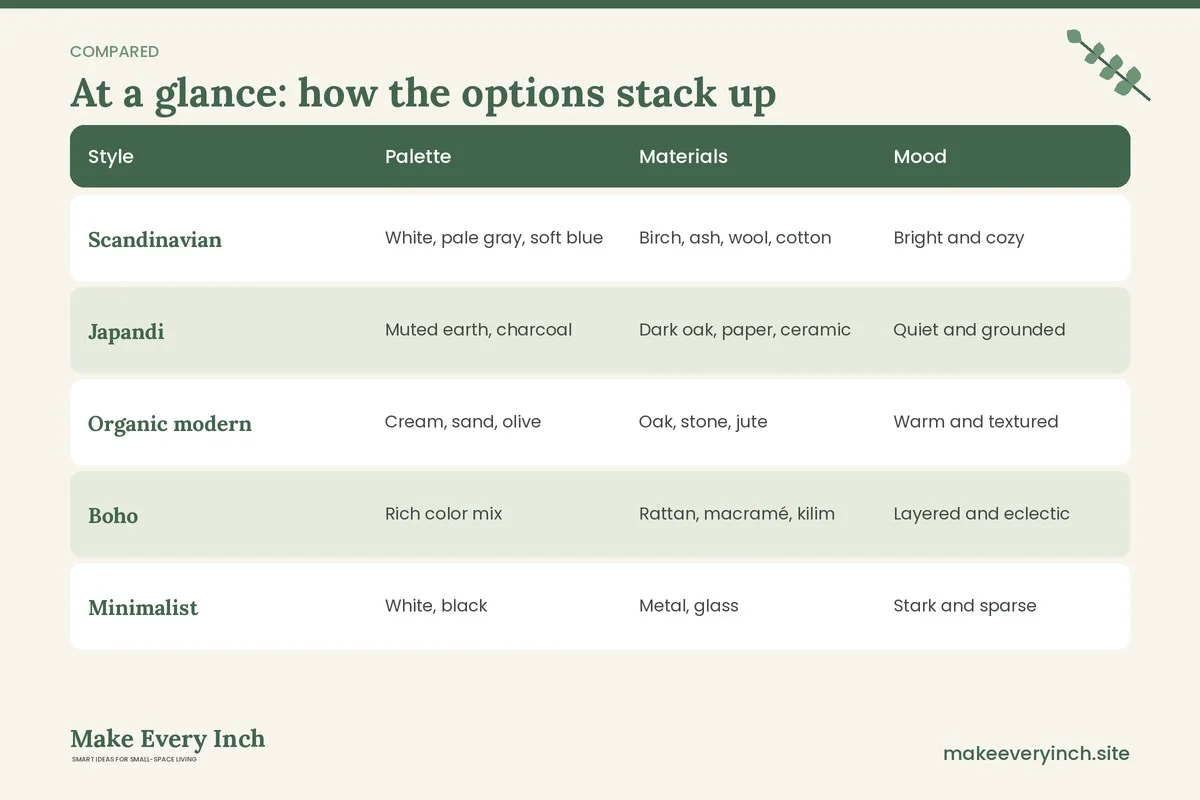
Scandinavian versus other warm minimal styles
| Style | Palette | Materials | Mood | Best for |
|---|---|---|---|---|
| Scandinavian | White, pale gray, soft blue | Birch, ash, wool, cotton | Bright and cozy | Dark apartments |
| Japandi | Muted earth, charcoal | Dark oak, paper, ceramic | Quiet and grounded | Calm bedrooms |
| Organic modern | Cream, sand, olive | Oak, stone, jute | Warm and textured | Larger living areas |
| Boho | Rich color mix | Rattan, macramé, kilim | Layered and eclectic | Collectors |
| Minimalist | White, black | Metal, glass | Stark and sparse | Very small spaces |
Scandinavian rooms are the lightest of these, with the most white and the least visual weight. If you like the calm but want deeper, earthier tones, read our guide to Japandi apartment ideas. If you want more texture and warmth with natural stone and jute, see organic modern apartment ideas.
Layouts for studios and one-bedrooms
A studio of about 400 square feet
Divide the room into zones with furniture, not walls. Place a bookcase or a low shelf behind the sofa to mark off the sleeping area, and keep it below eye level at about 36 to 48 inches so light still travels. Put the bed in the darkest corner, the sofa near the window and a small table in between. A rug under the sofa ties the living zone together, and a second, smaller rug can mark the bed zone.
A one-bedroom of about 600 square feet
Keep the living room open and calm, and make the bedroom the quietest room. In the living room, float the sofa slightly off the wall if there is a walkway behind it, and put a slim console behind it for lamps and keys. In the bedroom, choose a bed with drawers and two small bedside tables or wall shelves, and keep the floor clear on both sides by about 24 inches.
A narrow living room
Run furniture along the long wall and keep the opposite side open for walking. A round table and a slim sofa soften the tunnel effect. Use one tall lamp at the far end to draw the eye through the room, and see our guide to small living room ideas for more.
Three example apartments
The 380 square foot studio
A renter with a sofa bed, a round dining table and a tall, narrow bookcase used the bookcase as a divider. White walls stayed as they were. She added a sheepskin on the one chair, a wool throw, a linen shade on a plug-in floor lamp and a large mirror leaned beside the window. Total spend was about $500 to $700, mostly on the lamp, the rug and the mirror.
The 550 square foot one-bedroom
A couple kept the living room almost bare, with a light gray sofa, a pale wood coffee table, a 5 by 8 foot flatweave rug and two lamps. In the bedroom they used a bed with drawers, linen bedding and a paper pendant. Plants sat in matching white pots. The only wall art was a single large print leaned on a console.
The dark ground-floor apartment
A north-facing unit with small windows needed every bit of light. The renter chose warm white lamp bulbs, a pale oak table, sheer curtains hung wide and a big floor mirror opposite the window. She replaced a dark rug with a cream wool one. The room did not get brighter in the strict sense, but it felt bigger and warmer in the evening.
How to build the look step by step
Step 1. Clear and measure
Remove everything that does not belong, and measure the room, the windows and your main furniture. Sketch the floor plan on paper, with walkways of at least 30 inches.
Step 2. Fix the light
Swap harsh bulbs for warm ones, add a floor lamp and a table lamp, and soften the window. This step gives the biggest change for the least money.
Step 3. Choose the base palette
Pick one white, one wood and one gray. Look at what you already own, and move toward those colors with new pieces over time.
Step 4. Add texture
Introduce a rug, a throw, cushions and one or two items in natural fiber. Texture replaces pattern and color as the main source of interest.
Step 5. Edit and style
Remove a third of the objects from each surface, then group what remains in odd numbers. Add a plant and a candle, and step back to check the result.
Renter-friendly Scandinavian upgrades
Almost everything in this style can be done without changing the structure. Use plug-in lights, tension rods for curtains, leaning art and mirrors, and a large rug to cover an old floor. If your walls are builder beige, a few well placed white textiles and lamps will offset it. Peel-and-stick options exist too, and our guide to removable wallpaper ideas covers the risks. Read the lease before using any adhesive, and photograph walls, floors and fixtures before you begin and again when you move out. Keep original bulbs, shades and curtain hardware in a box so you can restore them. For a fuller list, see renter friendly apartment decorating ideas.
Budget guide
Under $100
Warm bulbs, a throw, two cushion covers, a plant and a few candles. Add a thrifted wooden stool or tray, and a simple print in a secondhand frame.
About $300 to $600
A 5 by 8 foot wool or cotton rug, a floor lamp, a paper pendant, linen curtains, linen bedding and a floor mirror. Prices vary widely, so compare large retailers and secondhand marketplaces.
$1,000 and up
A pale wood bed with drawers, a compact sofa in a light fabric, a drop-leaf table and a proper reading chair. Buy solid pieces slowly, and expect to pay more for real birch or oak than for veneer.
Mistakes to avoid
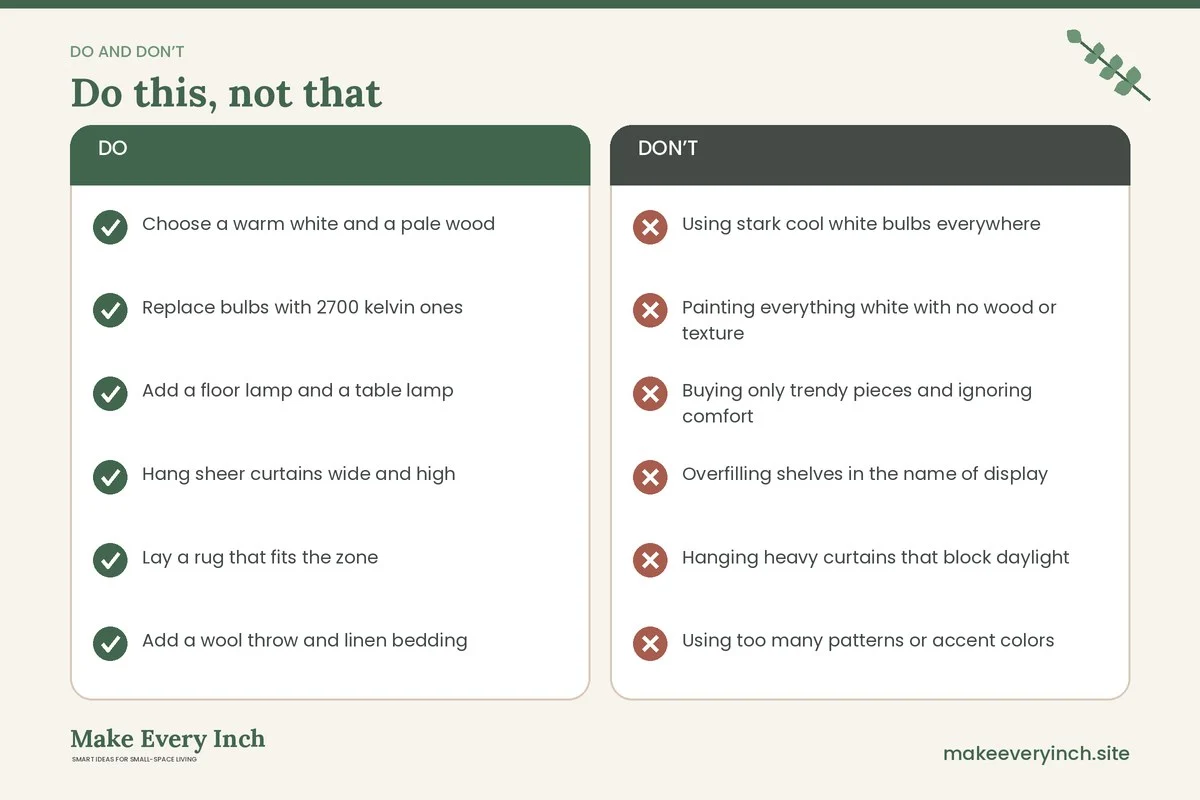
- Using stark cool white bulbs everywhere
- Painting everything white with no wood or texture
- Buying only trendy pieces and ignoring comfort
- Overfilling shelves in the name of display
- Hanging heavy curtains that block daylight
- Using too many patterns or accent colors
- Skipping a rug, which leaves the room echoing
- Choosing furniture with no storage
- Ignoring the lease when changing walls or fixtures
Scandinavian small apartment checklist
- Choose a warm white and a pale wood
- Replace bulbs with 2700 kelvin ones
- Add a floor lamp and a table lamp
- Hang sheer curtains wide and high
- Lay a rug that fits the zone
- Add a wool throw and linen bedding
- Pick furniture on slim legs
- Give every object a home
- Add one plant and a few candles
- Lean a mirror opposite the window
- Photograph the apartment for the lease
FAQ
What are the main features of Scandinavian style?
Light colors, pale wood, natural textiles, simple shapes, soft lighting and uncluttered surfaces. Function matters as much as looks, and the room should feel warm and calm.
Can I do Scandinavian style in a rental?
Yes. Lamps, rugs, textiles, plants, mirrors and furniture are all portable and need no drilling. Keep to adhesive-free methods if the lease is strict.
What colors suit a small Scandinavian apartment?
Warm white, cream, light gray, pale wood and a muted accent such as dusty blue or sage. Use black in small touches for contrast.
Is Scandinavian style too cold for a small space?
It can be if you use only white and cold bulbs. Add wool, sheepskin, wood and candles, and use warm light to make it inviting.
How do I make a dark apartment feel Scandinavian?
Use warm, layered lamps, sheer curtains, a large mirror and pale rugs. Painting is ideal if allowed, but lighting and textiles do much of the work.
How much does it cost to get the look?
A basic refresh can cost under $100, and a full room usually falls between $300 and $1,000. Buying secondhand wood furniture keeps the price down.
What is hygge, and how do I add it?
Hygge is a Danish idea of cozy contentment. Add candles, a blanket, soft lamps, a warm drink and a place to sit comfortably, and keep screens away from one corner.
What is the difference between Scandinavian and minimalist style?
Minimalism aims for as little as possible, often in stark tones. Scandinavian design keeps things simple, but welcomes wool, wood, plants and candles for warmth.
Keep going: Explore our cozy apartment ideas, Japandi apartment ideas and organic modern apartment ideas.
Save this guide for later
Pin the ideas you like to Pinterest so you can come back to them when you plan your space.