Renter Friendly Ways to Divide a Studio Apartment
Quick answer: The best renter friendly ways to divide a studio apartment are a ceiling-height curtain on a tension rod or freestanding track, a low open shelf, a folding screen and a defined area rug. Ask your landlord first, document the walls and floor with photos, keep a clear path to every door and window, never block an exit, and anchor or weight anything tall so it cannot tip.
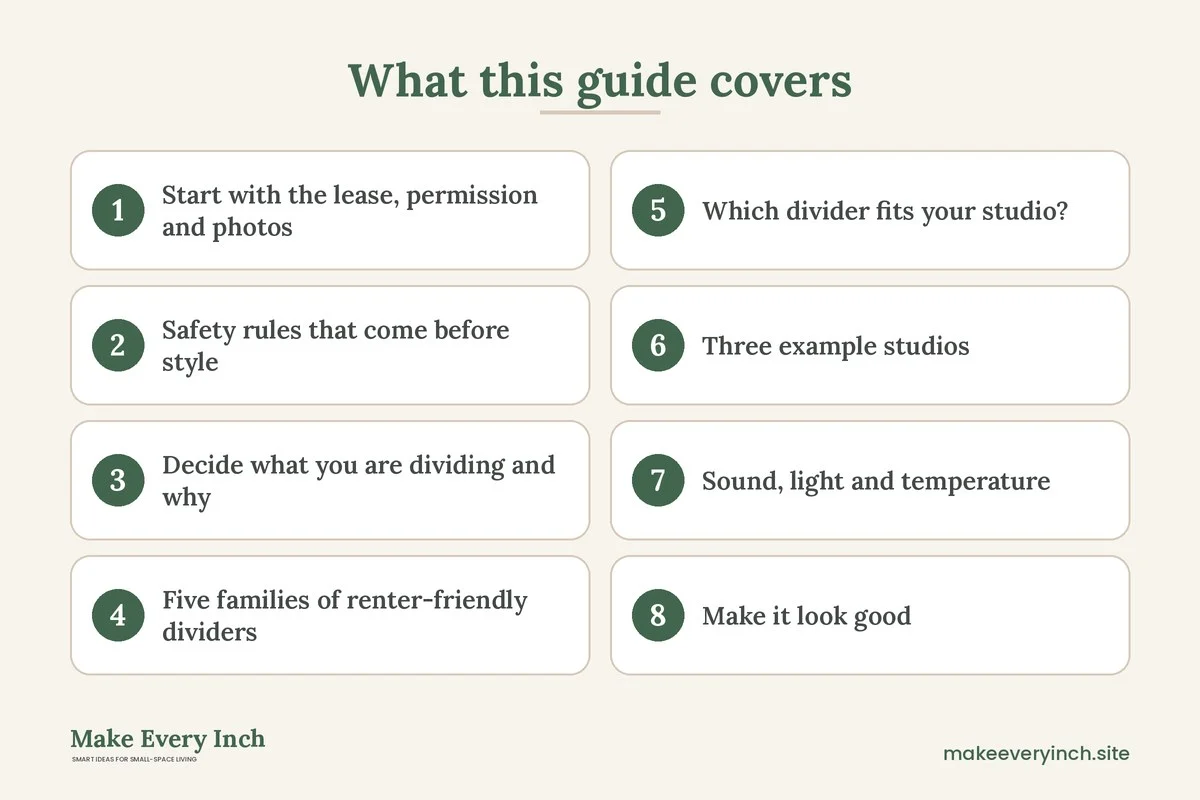
Renter friendly ways to divide a studio apartment solve a problem that every one-room home shares: the bed, the sofa and the desk all live in the same box, and nothing tells your eyes where one activity ends and the next begins. Walls are the obvious answer, but a lease rarely lets you build one, and drilling into a ceiling is usually off the table. The good news is that a divider does not have to be a wall. It only has to change what you see, what you hear a little, and how the room is used. This guide covers the lease and safety checks first, then how to decide what to divide, five families of dividers (curtains, shelves, screens, rugs and furniture), a comparison table, three example studios with measurements, a move-out plan and a checklist. It is written as a safety-first companion to our hub guide on renter-friendly apartment decorating ideas and takes a different angle from our project-based list of DIY room divider ideas for studio apartments, which focuses on building things. Here the focus is on what is allowed, what is stable and what is safe.
Start with the lease, permission and photos
Before you buy anything, read the section of your lease that covers alterations, nails, adhesive and fixtures. Most leases say something like “no alterations without written consent,” and a divider that touches the wall, the ceiling or a sprinkler pipe can fall under that line. The safest habit is to ask in writing. A short email that describes what you plan to use (for example a tension rod curtain, a freestanding bookcase and a folding screen) gives you a record of the answer. Many landlords say yes to anything that leaves no mark, and some say no to anything attached to the ceiling at all.
Then document the condition of the space. Take dated photos of the ceiling, the walls where a rod might press, the floors where furniture will stand and any existing scuffs or marks. Include a wide shot of the whole room. If you later remove a divider and find a faint mark on the wall or a dent in a softer floor, your photos show whether it was already there. Keep the photos with your lease and your move-in checklist.
Finally, think about your deposit. Damage-free methods protect it. A tension rod can leave a faint ring on fresh paint, felt pads protect hardwood and a rug pad can stain some finishes if it traps moisture. Test any pad or adhesive in a hidden corner first. Our guide to security-deposit-safe apartment upgrades covers more ways to protect your deposit.
Safety rules that come before style
A divider in a studio sits in the middle of a small, shared space where you sleep, so it deserves a short safety review. These points apply to every option below.
- Keep exits clear. Never block the route from the bed to the main door or to a window used as an emergency exit. In most places a bedroom-type sleeping area must have a way out, and a divider that creates a closed cell can break local rules or make a night-time escape harder. If you are unsure, ask your landlord or check local housing guidance.
- Leave sightlines to the door. A curtain or screen should be easy to push aside with one hand in the dark. Avoid anything that needs fastening.
- Keep fabric away from heat. Curtains and screens should stay well away from stoves, space heaters, candles and hot light bulbs. Choose fabric labeled flame resistant where possible, and keep a clear gap between fabric and any heat source.
- Respect smoke detectors and sprinklers. Do not hang anything from, or within the clearance zone of, a sprinkler head, and do not cover a smoke alarm. Sprinkler rules often require open space around the head, so ask building management before anything goes near the ceiling.
- Anchor tall furniture. Any bookcase or shelf above about waist height can tip, especially with weight on the upper shelves. Use the anchoring method your lease allows, such as a strap into a stud with permission, or weight the base and load heavy items low. If a unit cannot be anchored, choose a lower or wider one.
- Check weight on rods. A tension rod holds a lightweight curtain, not a heavy blanket. Follow the maker’s weight limit and use a shorter span where possible.
- Mind ventilation. Closing off a sleeping area completely can trap warm air, so leave a gap at the top or bottom. Avoid fresh paint or strong-smelling products inside a closed zone, and choose low-VOC options if you do paint anything with permission.
- Mind electrical cords. Do not run cords under rugs or through a curtain’s folds, and do not overload a power strip to light a divided corner.
Decide what you are dividing and why
Dividers work best when they have a clear job. Spend a day noticing which activities clash. A bed beside a desk blurs rest and work, a sofa beside a kitchen mixes cooking smells with relaxing, and an entry that opens straight onto the sleeping area leaves you feeling exposed. Ask which of four jobs the divider should do.
- Visual privacy. Hiding the bed from the door, or from the sofa when a guest is over.
- Zoning. Giving each activity a recognizable spot, so your brain switches modes.
- Storage. Using the divider itself to hold books, baskets or clothes.
- Light and sound. Letting daylight through while softening echo and noise.
A curtain is great for privacy and soft sound, a shelf is great for storage, a screen is quick and flexible, and a rug zones the floor without touching a wall. Most studios need a mix, with one primary divider and one or two light touches. Draw your floor plan on paper, with the door, windows, radiators, outlets and heat sources marked, before you decide where a divider can go.
Five families of renter-friendly dividers
Curtains and fabric
1. A tension rod curtain in an alcove or between two walls
Where the studio has a natural alcove or a hallway-like entry, a tension rod can span two walls with no screws. Choose a rod rated for the span and the fabric, keep the span as short as possible, and add a rubber-tipped end to protect paint. Pick a light curtain in linen, cotton or a sheer. A heavy fabric can pull the rod down, and a rod that slips in the night is a nuisance. Always test the rod against the wall for a day with a light weight first, then check the paint when you remove it.
2. A curtain on a freestanding frame
A freestanding frame with a base and two uprights holds a rail without touching the wall or ceiling. This gives you a divider that works anywhere in the room, including the middle. Look for a wide, heavy base and consider adding weight at the feet. It should be stable when you brush past it, because the curtain acts like a small sail. This is a good choice when ceilings are high, popcorn textured or protected by sprinkler rules.
3. A curtain on a ceiling track
Some landlords allow a hospital-style track attached to the ceiling, but this involves screws and so needs written permission. If you do not have permission, skip it. Ask only if you plan to stay a long time, and offer to fill the holes at move-out.
4. Layered sheers
Two panels of sheer fabric, one on each side of a bed zone, give soft separation and let light pass. Sheers also pair well with a bedside lamp for a cozy glow, as long as the lamp stays well away from the fabric.
5. A fabric screen made from a shower-curtain-style hanging
A lightweight panel on a rod across an entry can hide the kitchen mess from the living area. It is easy to take down, wash and store.
Shelves and open storage
6. A freestanding open bookcase
An open back lets light and a feeling of space through, and the shelves hold books, baskets and plants. Place it perpendicular to a wall so it forms an end to the sleeping zone, or float it with the back to the bed. Use the anchoring method your lease allows, since a bookcase is the divider most likely to tip. Load heavy items low and keep the upper shelves for light objects. For narrow models, see our guide to the best narrow bookshelves.
7. A low shelf at bed-height
A shelf that stays below about 36 to 42 inches does not block light or sightlines and is much less of a tipping risk. It can separate the bed from the living area while the top acts as a bedside table or a media surface. This is an excellent option when you worry about egress and ceiling height, since you can step over or around it.
8. A cube unit with baskets
A cube unit with fabric bins gives you closed storage inside an open frame. Alternate open and closed cubes so the shelf is light but hides clutter. Place the unit so the closed bins face the sleeping side.
9. A rolling shelf or cart
A tall, narrow rolling unit can slide to make a wider opening when you have guests. Choose locking wheels, and keep the load low. Do not roll it near an exit when it is full.
Screens and panels
10. A folding screen
A three or four panel folding screen is among the fastest solutions. It stands anywhere, folds flat in a closet and does not touch a wall. Choose a model with a wide zigzag stance, because a flat, straight screen can topple. Keep it at least a foot from heaters and candles. A screen is excellent behind a bed or desk for privacy, and it can double as a backdrop for video calls.
11. A slatted or lattice partition
Open slats or lattice pass light and air while still blocking direct sightlines. They feel less heavy than a solid panel in a small studio. Look for a stable foot design.
12. A pegboard or fabric-covered panel on legs
A freestanding panel can hold hooks and baskets and works as a hybrid between a screen and storage. Weigh the base and keep the load light.
13. A plant-based divider
A line of tall plants on a stand or a shelf softens the edge of a zone and cleans the look. Choose plants that suit your light, and place saucers to catch water so the floor stays dry.
Rugs and floor zones
14. A defined area rug under each zone
A rug sets the footprint of a zone without a wall. A sofa zone on one rug and a bed zone on another, or on bare floor, tells your eyes that these are different places. Choose different colors or patterns for each, and keep the pieces at least a few inches apart or overlapped intentionally. Use a non-slip pad rated for your floor, and test it in a corner, since some pads can mark certain finishes. Roll the edges flat so nobody trips.
15. A runner as a boundary
A long runner can mark a path between the entry and the main room. It makes the entry a corridor and keeps shoes in a clear zone.
16. Tape or floor lines for planning
Before buying anything, mark your zones on the floor with painter’s tape. Live with it for a few days. This is a free test of how big each zone should be, and it removes easily from most floors, though you should check the tape on delicate finishes.
Furniture as a divider
17. A sofa with its back to the bed
The back of a sofa, set about 6 to 12 inches in front of the sleeping area, forms a clean line. Add a narrow console behind it for a lamp and keys. The sofa should be heavy enough to stay put, and you should keep a path to the bed.
18. A desk back-to-back with the bed
A desk with a finished back that faces the bed works if the room is deep enough. Keep a path of at least 30 inches. Our guide to the best desks for small apartments can help you find a compact one.
19. A dresser or storage bed as a half wall
A tall dresser at the foot of the bed acts as a half wall and holds clothes. Anchor it, since dressers are another tip hazard. A storage bed frees up floor space as well.
20. A bench at the foot of the bed
A bench or a low trunk marks the end of the sleeping zone and holds blankets.
Which divider fits your studio?
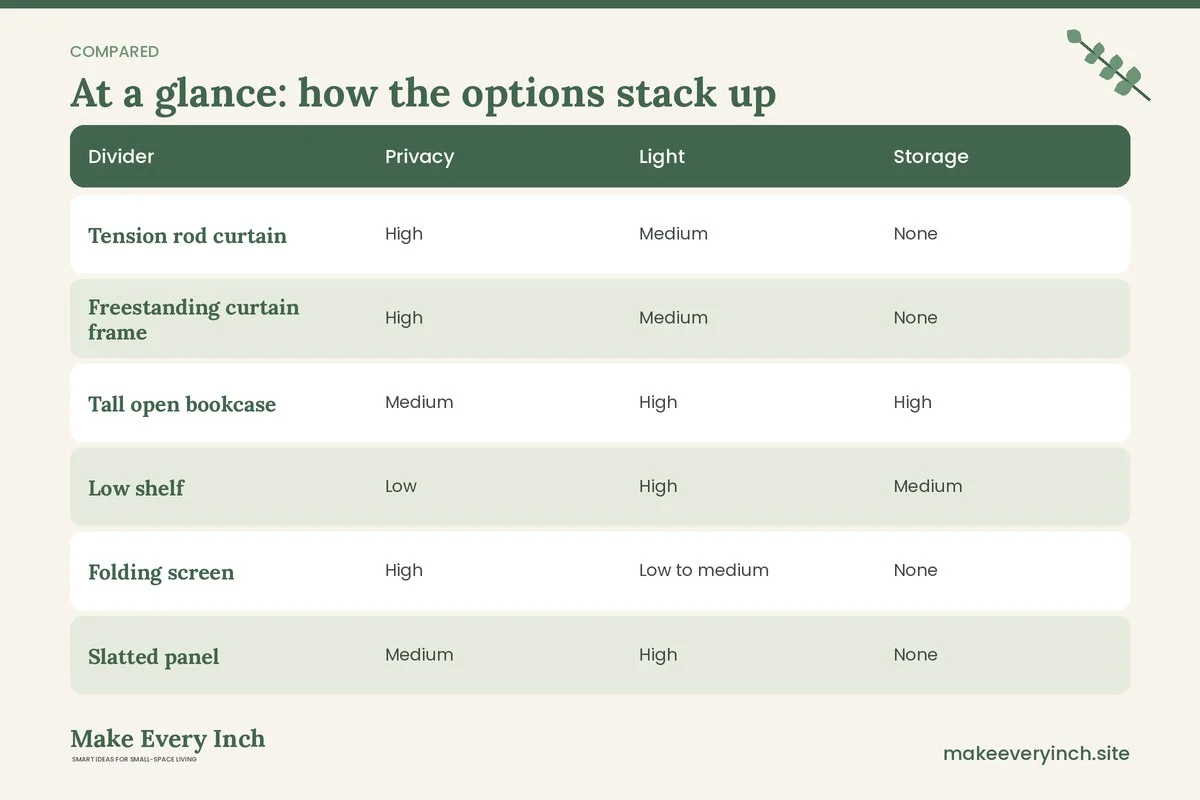
The table below compares the main options. Ratings are general and depend on your room, your lease and the exact product.
| Divider | Privacy | Light | Storage | Tip risk | Wall contact | Best for |
|---|---|---|---|---|---|---|
| Tension rod curtain | High | Medium | None | Low | Slight pressure | Alcoves and entries |
| Freestanding curtain frame | High | Medium | None | Medium | None | Open floor plans |
| Tall open bookcase | Medium | High | High | High if unanchored | None, strap needs permission | Zone with storage |
| Low shelf | Low | High | Medium | Low | None | Bed or sofa edge |
| Folding screen | High | Low to medium | None | Medium | None | Quick privacy |
| Slatted panel | Medium | High | None | Medium | None | Airy separation |
| Area rug | Low | High | None | None | None | Marking zones |
| Sofa back | Medium | High | Low | Low | None | Living and sleeping edge |
Three example studios
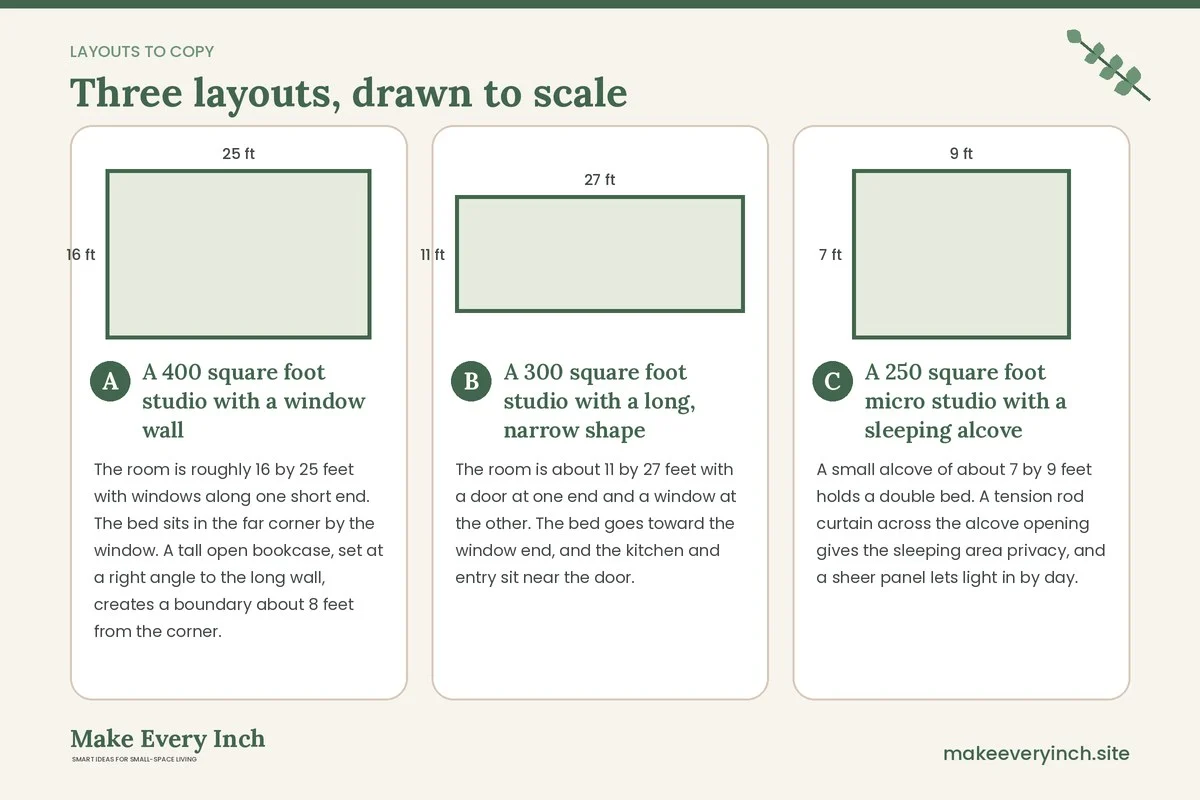
A 400 square foot studio with a window wall
The room is roughly 16 by 25 feet with windows along one short end. The bed sits in the far corner by the window. A tall open bookcase, set at a right angle to the long wall, creates a boundary about 8 feet from the corner. Its open back lets daylight reach the sofa. The bookcase is anchored with permission, and a sheer curtain on a freestanding frame closes off the bed side at night. A 5 by 8 foot rug under the sofa sets the living zone, and the bed zone has its own smaller rug. A clear path of about 36 inches runs from the bed to the front door and from the bed to a window. This plan favors storage and light.
A 300 square foot studio with a long, narrow shape
The room is about 11 by 27 feet with a door at one end and a window at the other. The bed goes toward the window end, and the kitchen and entry sit near the door. A tension rod curtain on a short span at the narrowest point cannot be used because the room is too wide, so a folding screen at the entry hides shoes and the kitchen from the bed. A low bookshelf between the sofa and the bed marks the transition. The long, narrow shape means a runner along one side helps keep the path clear. Because there is only one window, check egress with your landlord and keep the route from bed to door unblocked. Both the screen and the shelf are light enough to move if you rearrange.
A 250 square foot micro studio with a sleeping alcove
A small alcove of about 7 by 9 feet holds a double bed. A tension rod curtain across the alcove opening gives the sleeping area privacy, and a sheer panel lets light in by day. The curtain hangs so that it can be pushed aside with one hand. A narrow shelf on the living side holds the lamp and books, and a single rug in the living area marks the zone. Because the alcove is small, ventilation is a priority, so the curtain stays open during the day and the bed has a gap above the rod for air. Nothing hangs near the ceiling sprinklers.
Sound, light and temperature
A divider changes how a studio feels as well as how it looks. Fabric softens echo, so a heavy curtain or a rug cuts the bounce of a hard-floored room. A bookshelf filled with books also absorbs some sound, though no renter-friendly divider blocks noise from a partner on a call. For light, choose sheers or open shelves in the day and heavier curtains at night. For temperature, remember that a curtain in front of a radiator or vent traps heat and blocks airflow, so keep a gap. If you use a space heater near a divider, follow the heater’s clearance guidance and never leave it on unattended.
Make it look good
A divider looks best when it looks like part of the room. Match the divider’s color to the walls or the sofa so it recedes, or use a strong accent and repeat it elsewhere. Repeat materials, such as wood on a shelf and a wooden frame on a screen. Style the top of a low shelf with a lamp, a plant and a few books, but keep tall objects away from the edge. On the sleeping side of a bookcase, add a headboard or a piece of art leaned against a wall so the back does not look unfinished. Our guide to renter-friendly wall decor ideas has options that do not need nails.
Lighting for divided zones
A divided studio needs light in each zone. Use a plug-in sconce or a clip-on lamp in the bed zone, a floor lamp in the living zone and a task light at the desk. Avoid wiring a lamp into the ceiling. For more ideas, see our guide to renter-friendly lighting ideas. Keep bulbs cool to the touch near fabric, and use LED bulbs, which run cooler than older types.
Moving out: remove without a trace
When the lease ends, plan your removal. Take down tension rods slowly, release the pressure and check for a ring on the paint. Wipe any mark gently with a damp cloth. Lift rugs and pads and check the floor. Remove anchoring straps and fill any approved holes with a suitable filler as agreed with the landlord. Compare the room with your move-in photos, take new photos and keep them. A walkthrough with the landlord, where possible, closes the file.
Mistakes to avoid
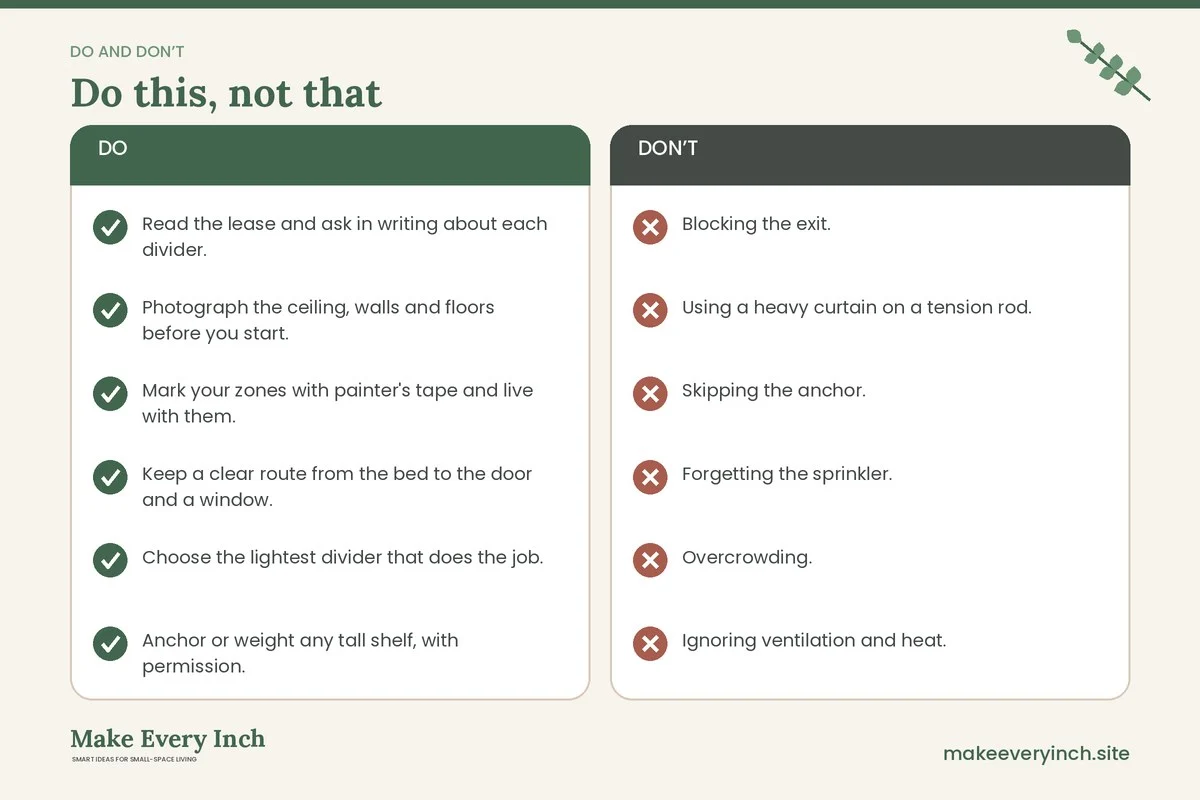
- Blocking the exit. The most serious mistake is a divider that traps you in a sleeping cell. Always keep a clear path.
- Using a heavy curtain on a tension rod. The rod can slip. Use a lighter fabric or a freestanding frame.
- Skipping the anchor. Tall shelves tip. Strap them with permission or choose a low model.
- Forgetting the sprinkler. Do not hang anything near a sprinkler head.
- Overcrowding. A divider that shrinks both zones makes the studio feel worse. Test with tape first.
- Ignoring ventilation and heat. Leave gaps and keep fabric away from heaters.
- Skipping the photos. Without a record, small marks can become deposit disputes.
Studio divider checklist
- Read the lease and ask in writing about each divider.
- Photograph the ceiling, walls and floors before you start.
- Mark your zones with painter’s tape and live with them.
- Keep a clear route from the bed to the door and a window.
- Choose the lightest divider that does the job.
- Anchor or weight any tall shelf, with permission.
- Keep fabric away from heaters, candles and sprinklers.
- Use a rod rated for the curtain’s weight and span.
- Add a rug or a runner to mark each zone.
- Light every zone separately.
- Leave a gap for ventilation.
- Photograph the room again at move-out.
FAQ
Can I divide a studio without drilling?
Yes. Tension rods, freestanding curtain frames, folding screens, open bookcases and area rugs all work without drilling. A tall shelf may still need a strap into the wall, which needs permission, or you can choose a low model instead.
What is the cheapest way to divide a studio?
A folding screen or a curtain on a tension rod is usually the simplest, and a rug costs nothing in terms of damage. Try tape on the floor first to confirm where a divider belongs.
Is it safe to put a divider near the bed?
It is, as long as you keep a clear path to the door and a window, keep fabric away from heat, and leave airflow. Do not create a fully closed cell.
Will a tension rod damage paint?
It can leave a faint ring, especially on fresh or soft paint. Test it in a hidden spot, use rubber ends and check the wall after a few days.
Do I need landlord permission for a screen or a rug?
A freestanding item usually does not need it, but a quick message is a good habit. Anything that attaches to a wall or ceiling does need permission.
How do I stop a bookcase from tipping?
Use an approved anchor, load heavy items low, and choose a wide base. If you cannot anchor it, choose a lower, wider unit.
Keep going: Keep going with our DIY room divider ideas for studio apartments, the companion guide on renter-friendly shelving ideas without drilling and our list of small apartment living room ideas for studios.
Save this guide for later
Pin the ideas you like to Pinterest so you can come back to them when you plan your space.