Small Entryway Wall Decor Ideas
Quick answer: The best small entryway wall decor ideas combine one large mirror, one or two pieces of art, a row of hooks that look good empty, and a soft light source. Keep the art at about 57 inches to its center, scale pieces to two thirds of the furniture below, leave 3 to 4 inches between frames and use adhesive or leaning methods in a rental. Never drill without permission.
Small entryway wall decor ideas matter more than most people expect, because the entry wall is the first thing you see on the way in and the last thing you see on the way out. It is also usually the busiest wall in the home. Coats hang on it, bags brush against it, and the door swings near it. That means decor here has to look good, survive daily contact and stay out of the way. This guide covers how to plan a tight wall, how to scale mirrors and art, how to make hooks work as decor, how to light the wall, how to hang things without damaging a rental, and how to arrange the elements in three example entryways. It includes a comparison table, a checklist and a FAQ. For the broad picture, see our pillar guide to small entryway ideas. If you are also choosing a place to sit, our post on small entryway bench ideas covers bench sizes, seat height and anchoring.
Start with the wall, not the art
Before you buy anything, look at the wall as a working surface. List what it must do every day. It may need to hold coats, keys and a bag. It may need to reflect light so you can check your appearance. It may need to stay clear of a door swing or a radiator. Only the space that is left after those jobs is free for decoration.
Walk the entry with a notepad and check four things.
- The door swing: open the front door fully. Anything hung within the door’s arc at head height can be struck by the handle, and heavy frames near the hinge side can rattle when the door closes.
- The walking width: in a narrow hall of 36 inches, a frame that sticks out 2 inches matters. Choose flat art and slim frames, because shoulders and bags brush the wall at about 30 to 54 inches from the floor.
- The light source: note the windows, the ceiling light and any outlets. Mirrors and glossy frames bounce glare, so know where the light comes from.
- The wall condition: look for scuffs, texture, dampness or fresh paint. These affect which hanging methods will hold. If the paint is recent, wait the time the paint maker recommends before applying adhesive, because newly painted surfaces can peel.
Take a photo of the wall before you start. In a rental, the photo is proof of the original condition, and it also helps you plan, since you can sketch on top of it.

Scale rules for small walls
Small entries fail in two ways. The decor is too small and looks lost, or it is too big and crowds the space. Scale rules prevent both.
- Hang art at eye level: the center of a piece or group should sit at roughly 57 inches from the floor, which is a common gallery height. In an entry where people are mostly standing, this works well. If the ceiling is very low, drop it to 54 to 56 inches.
- Relate art to furniture: a piece above a bench, console or shoe cabinet should span about two thirds of the furniture width, and sit 6 to 8 inches above it. A tiny frame over a wide console looks adrift.
- Use odd numbers and limited sizes: one large piece beats five tiny ones in a small space. If you want a group, three pieces in a clear layout look calmer than a scatter.
- Keep frame gaps tight: 2 to 4 inches between frames makes a group read as one unit.
- Respect the 3-inch rule for depth: in narrow halls, aim for decor that projects 3 inches or less from the wall. A shadow box or a deep shelf can catch coats.
- Go tall in a narrow space: a tall, narrow mirror or a vertical stack of frames draws the eye up and makes the ceiling feel taller.
- Leave breathing room: about one third of the wall should remain bare. A small entry feels calm when not every inch is used.
If you are working in a hallway, our guide to narrow hallway ideas shows how to treat a long wall as a gallery without crowding the passage.
Mirrors: the hardest working decor
A mirror is the first thing to consider, because it does two jobs. It lets you check your appearance before leaving, and it bounces light around a space that often has no window. A mirror placed opposite or beside a light source brightens the entry. A mirror placed to reflect a dark corner just doubles the dark, so check the reflection before you commit.
Choosing size and shape
For a wall above a console or bench, choose a mirror about two thirds the width of the furniture and tall enough to show your head and shoulders. A full-length mirror, about 55 to 65 inches tall, lets you check your whole outfit and makes a narrow entry feel larger. A round mirror softens a space full of right angles. An arched mirror adds height. A pair of small mirrors can work as a set, though one big mirror usually looks more sophisticated.
Placement and safety
Do not place a mirror directly opposite the front door if you do not like the glare of daylight. Hang it slightly off to the side. Mount at a height where the center is near eye level, which is about 57 to 60 inches. Glass is heavy, so check the weight against the hanging method. A large mirror needs proper fixings into studs or rated anchors, and a full-length mirror that leans on a wall should be secured with a strap or bracket so it cannot slide or tip. This matters most in homes with children and pets. In a rental, a leaning mirror avoids drilling, though a safety strap is still wise if the landlord allows a small fixing.
Keep mirrors away from the door’s swing path and out of the way of bags. Fit corner protectors or choose a frame with a rounded edge in a tight space. Use a mirror with safety backing where available, since it holds the glass together if it breaks.
Art: small walls, big impact
Art in an entry should read quickly. People pass through quickly, so bold shapes, strong color and simple compositions do better than fine detail.
One statement piece
A single large print or painting makes a small wall feel intentional. Choose a piece with a vertical format in a narrow space, and keep it simple. A large abstract piece in a limited palette suits a tight hall. If you want a story, a landscape with a calm horizon line leads the eye outward.
A small gallery
If you love a collection, plan it on the floor first. Lay the frames out, photograph the arrangement and then hang from the photo. Use a grid layout for a tidy look, or a single row of equal frames for a calm one. In an entry, a vertical stack of two or three frames above a bench works well. Keep the frames in one color family so the group looks like a set.
Picture ledges and leaning art
A narrow ledge, about 3 to 4 inches deep, lets you swap pieces without new holes. A ledge also holds a small plant or a key dish. In a rental, lean large pieces on a console or a shoe cabinet. A leaning frame should rest against the wall at a gentle angle, with a non-slip pad beneath it.
Fabric and texture
A woven hanging, a flat tapestry or a framed textile adds softness to a hard-surfaced entry. Fabric absorbs echo in a tiled hall, which can make the space feel calmer. Keep fabric away from heat sources and from the door’s draft, which can make it swing. If you plan to hang it on a rod, check how much weight the hanging method holds.
For more ways to fill walls without damaging them, read our long guide to renter-friendly wall decor ideas.
Hooks that double as decor
In an entry, hooks are not optional. They hold coats, bags and keys. The trick is to choose hooks that look like decor even when empty, so the wall never looks like a cloakroom.
- A wooden rail with pegs: a single rail, 24 to 48 inches long, carries four or five pegs. Choose a rail that matches the style of the room. It looks like a feature, and the pegs bear the weight.
- Sculptural single hooks: hooks in brass-toned, matte black or ceramic finishes look like small art pieces. Space them 6 to 8 inches apart for coats, or 4 to 5 inches for scarves and hats.
- Hooks on a backboard: mount a few hooks on a painted or stained board, which you can hang as one unit. This makes a tidy panel that can lean or hang with fewer fixings. A board also spreads the load.
- Over-the-door hooks: these use the back of a door and need no wall fixing. They suit a rental, and they hold light items such as a scarf or a tote.
- Hanging rail with a shelf: a shelf above the hooks holds hats, a plant and a small basket. Keep the shelf shallow, about 6 to 8 inches, and keep the top clear so it does not become a drop zone.
- Adhesive hooks: removable hooks work for light items, and they are the main tool for renters who cannot drill. Check the rated weight on the pack and stay well below it, because coats and wet bags weigh more than they look.
Mount hooks at two heights where children live: about 48 inches for children, and 64 to 66 inches for adults. For a household with long coats, mount the highest row so the hem clears the floor and any bench by a few inches. For more storage ideas, see our post on small coat storage ideas, and for floor-level options, our guide to small shoe storage ideas.
A heavy load needs a proper fixing. A full row of winter coats can add up to 20 pounds or more, so fix rails into studs or use anchors rated for the weight, and follow the instructions on the pack. Never drill without permission in a rental, and never hang a heavy coat rack from adhesive alone.
Lighting the entry wall
Light changes the way the wall reads, and small entries often have a single weak ceiling light. Add layers.
Wall sconces and plug-in lights
A pair of wall sconces on either side of a mirror gives a flattering light on your face and warms the wall. In a rental, a plug-in sconce with a cord cover avoids hardwiring. Route the cord neatly along the wall, never across a walkway, and use a cord cover where it must cross a path. Do not run a cord under a rug, which is a fire and trip risk. If the sconce needs a wall fixing, ask permission first.
Picture lights and LED strips
A slim picture light above a frame highlights art. A battery or rechargeable light avoids wiring. An LED strip under a floating shelf or behind a mirror makes a soft glow. Choose products certified for your region’s electrical standards, and avoid covering them with fabric or paper, which can overheat. Keep the power supply in a ventilated place and unplug it if you notice heat or a burning smell. Dimmable options let you set a low evening light.
Choosing the color temperature
Warm white, about 2700 to 3000 Kelvin, makes an entry feel welcoming. Cooler light suits a task area but can feel clinical at the door. Keep the same warmth across all the bulbs in view, so the wall looks coherent.
Our guide to renter-friendly lighting ideas lists more options that do not require an electrician, and our post on apartment entryway decorating shows how lighting fits into a finished entry.
Electrical safety applies. Do not overload a socket with several adapters. Keep lights away from coats that could touch a hot bulb, and prefer LED bulbs, which run cooler. Hardwired changes need a qualified electrician and, in a rental, the landlord’s approval.
Renter-safe hanging: what to use and when
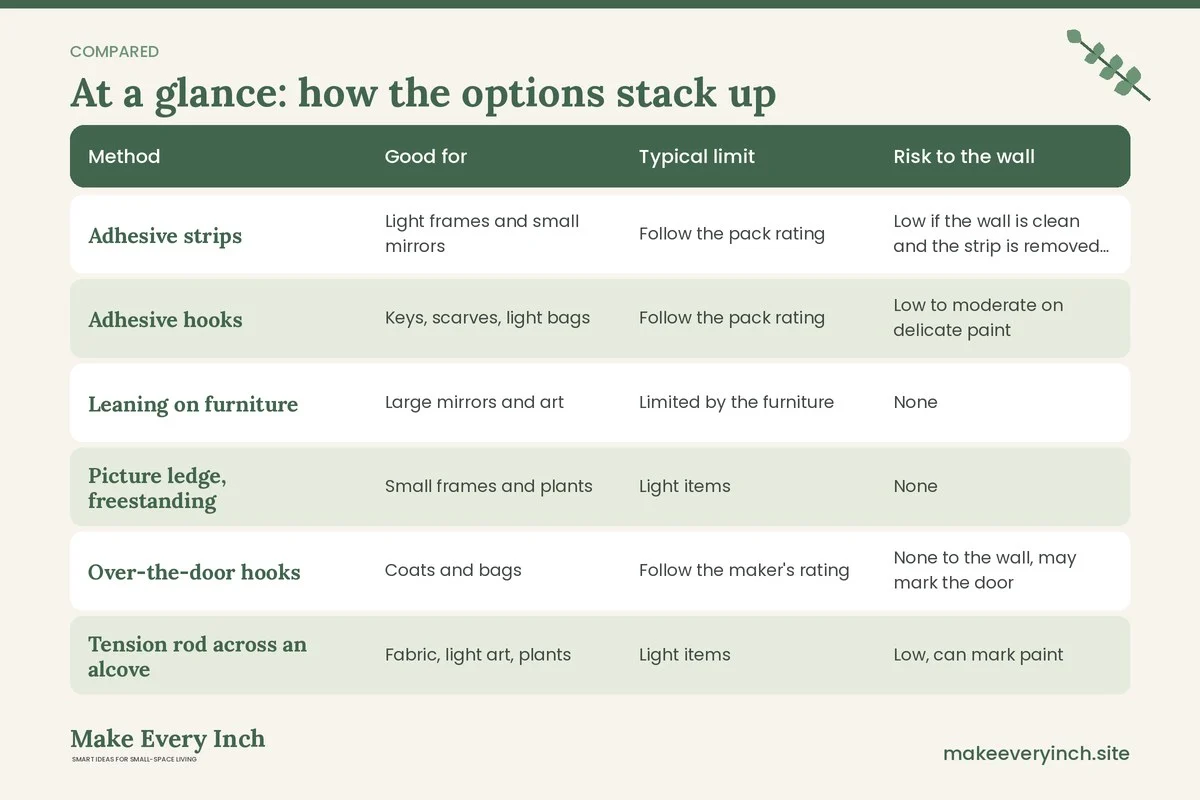
If your lease forbids nails, you still have options. The rule is to match the method to the weight, test in a hidden spot and follow the pack instructions. Never drill without permission. The table ranks the common methods.
| Method | Good for | Typical limit | Risk to the wall |
|---|---|---|---|
| Adhesive strips | Light frames and small mirrors | Follow the pack rating | Low if the wall is clean and the strip is removed slowly |
| Adhesive hooks | Keys, scarves, light bags | Follow the pack rating | Low to moderate on delicate paint |
| Leaning on furniture | Large mirrors and art | Limited by the furniture | None |
| Picture ledge, freestanding | Small frames and plants | Light items | None |
| Over-the-door hooks | Coats and bags | Follow the maker’s rating | None to the wall, may mark the door |
| Tension rod across an alcove | Fabric, light art, plants | Light items | Low, can mark paint |
| Removable wallpaper panels | Backdrop behind hooks | Not a load bearer | Moderate if the wall is fresh paint |
| Small nail holes with permission | Frames and rails | Depends on the fixing | Fillable at move-out |
Before you apply anything, clean the wall with a mild cleaner and let it dry. Press the adhesive firmly for the time the pack recommends and wait before hanging the item. To remove adhesive, pull the tab slowly, parallel to the wall, so the strip stretches and releases. If the paint lifts, stop and warm the area gently with a hair dryer on a low setting. Never pull hard.
Some surfaces do not accept adhesive. Textured walls, dusty plaster, humid walls and fresh paint hold poorly. If your wall fails a hidden-spot test, use leaning methods or over-the-door hooks instead. For deeper guidance, read our post on no-drill storage ideas for renters, and for backdrops see our guide to removable wallpaper ideas.
The permission conversation
If you want to drill, ask the landlord in writing. Say exactly what you will hang, how many holes it needs and that you will fill the holes at move-out. Keep the reply. Some landlords allow small nails but not anchors, so be specific. If permission is refused, respect it. A drilled hole in a rental can cost a deposit, and a wall can hide pipes and wires.
Safety around drilling
If you own the home or you have permission, check for hidden hazards. Use a stud finder, and a detector for pipes and wires if you can. Switch off the power to the area if you are unsure. Wear eye protection and a dust mask when you drill. Choose the correct anchor for the wall: a stud for heavy loads, rated hollow-wall anchors for plasterboard and masonry fixings for brick. When in doubt, ask a professional.
Comparison of decor elements for small entries
| Element | Typical size | Best spot | Main job | Watch out for |
|---|---|---|---|---|
| Large mirror | 24 to 36 inches wide | Opposite or beside a light | Light and space | Glare and heavy glass |
| Full-length mirror | 14 to 20 inches by 55 to 65 inches | Side wall, secured | Outfit check | Tipping, door swing |
| Single art piece | 18 to 30 inches wide | Above bench or console | Focus | Too small for the wall |
| Gallery of three | 8 by 10 inches each | Above a console | Personality | Crowding |
| Hook rail | 24 to 48 inches long | Above bench | Coats and bags | Weight and fixings |
| Sconce pair | 6 to 8 inches wide | Either side of a mirror | Warm light | Cords and wiring |
| Picture ledge | 24 to 36 inches long | Beside the door | Swappable art | Items sliding off |
| Fabric hanging | 20 to 30 inches wide | Blank side wall | Softness | Fire and draft |
Color and finish choices
Wall color sets the tone for decor. Light, warm neutrals bounce light and make a small entry feel open. A deep color on a small wall can feel cozy if there is good lighting, though it will make the space feel smaller in a dim hall. If you paint, choose a low-VOC paint, open a window, and let the paint dry fully before you hang anything, following the product label. Keep a brush and a small tin of the wall color for touch-ups, because entry walls get scuffed often. A scrubbable finish such as satin or eggshell handles wiping better than flat paint.
If you cannot paint, use removable wallpaper on a single panel behind the hooks or the mirror, or a large piece of art in the color you want. Frames in one finish, such as black, natural wood or brass-toned, tie the elements together. Mixing two finishes is fine if you repeat each at least twice.
Three example entry walls
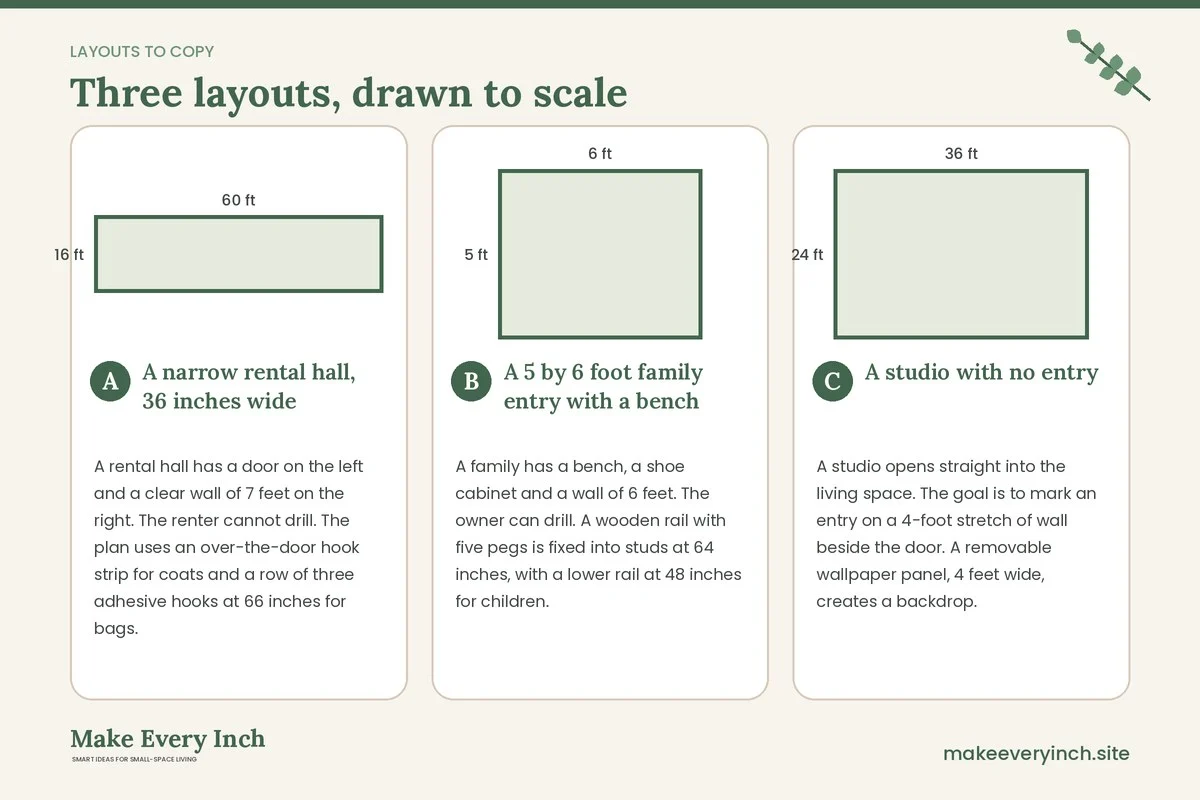
A narrow rental hall, 36 inches wide
A rental hall has a door on the left and a clear wall of 7 feet on the right. The renter cannot drill. The plan uses an over-the-door hook strip for coats and a row of three adhesive hooks at 66 inches for bags. A tall, narrow mirror, 16 by 60 inches, leans against the wall near the end, with a strap if the landlord allows a small fixing. Above the hooks, a single large print with a slim frame sits at 57 inches to center, hung with strips rated well above its weight. A plug-in sconce near the end of the hall adds a warm glow, with its cord clipped along the baseboard. The hall still has about 34 inches of clear width.
A 5 by 6 foot family entry with a bench
A family has a bench, a shoe cabinet and a wall of 6 feet. The owner can drill. A wooden rail with five pegs is fixed into studs at 64 inches, with a lower rail at 48 inches for children. Above the bench, a round mirror of 28 inches hangs with its center at 58 inches, flanked by a pair of hardwired sconces installed by an electrician. A picture ledge at 52 inches holds two small frames and a dish. The wall color is a warm off-white in a scrubbable finish, applied with low-VOC paint while the room was ventilated. Bench size and seat height are covered in our post on small entryway bench ideas.
A studio with no entry
A studio opens straight into the living space. The goal is to mark an entry on a 4-foot stretch of wall beside the door. A removable wallpaper panel, 4 feet wide, creates a backdrop. On it hang a rail with three sculptural hooks, a mirror of 24 by 36 inches and a small shelf, all with adhesive rated for the weight. The panel visually defines the entry as a zone, even without a wall. A rug and a stool below finish the corner. For more on this approach, see our guide to no entryway apartment ideas.
Step-by-step: plan and hang a small entry wall
1. Photograph the bare wall and note any scuffs.
2. List the wall’s daily jobs, such as coats, keys, bags and a mirror check.
3. Measure the wall width, the height to the ceiling and the clear walking width.
4. Cut paper templates of each piece and tape them to the wall.
5. Place the hooks and mirror first, since they have a job, then add art.
6. Mark the center of the art at about 57 inches and check the spacing with a level.
7. Choose the hanging method for each piece and check the weight.
8. Clean the wall, apply adhesive as directed and wait before loading.
9. Add lighting and route cords safely.
10. Step back, remove one item if the wall feels crowded, and live with it for a week before you add more.
Common mistakes
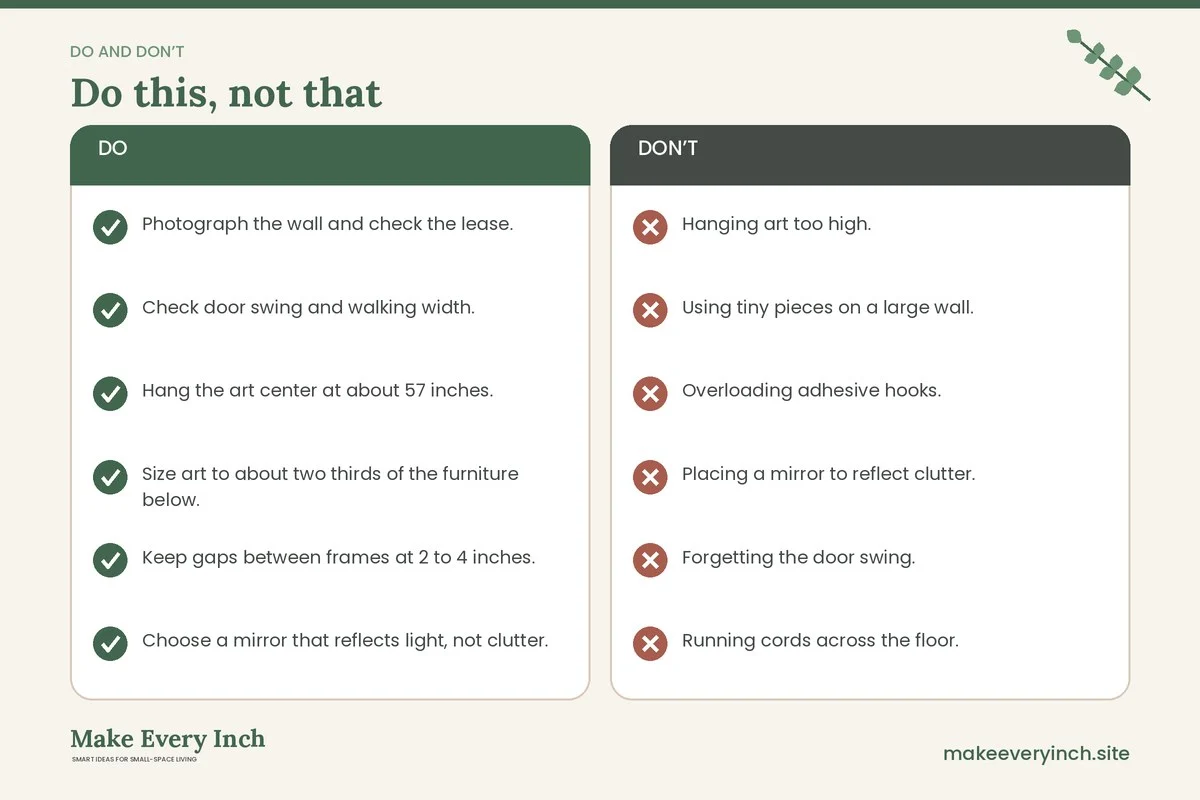
- Hanging art too high. Many people hang art near the ceiling. Keep the center near 57 inches.
- Using tiny pieces on a large wall. A small frame looks lost, so scale up.
- Overloading adhesive hooks. A wet coat is heavier than a dry one.
- Placing a mirror to reflect clutter. Check the reflection before you commit.
- Forgetting the door swing. A frame in the arc will be knocked.
- Running cords across the floor. This is a trip hazard and can damage the cord.
- Painting without ventilation. Open a window and use low-VOC paint.
- Drilling without checking. Pipes, wires and the lease all matter.
- Leaving no bare wall. A cluttered wall looks smaller.
Checklist
- Photograph the wall and check the lease.
- Check door swing and walking width.
- Hang the art center at about 57 inches.
- Size art to about two thirds of the furniture below.
- Keep gaps between frames at 2 to 4 inches.
- Choose a mirror that reflects light, not clutter.
- Secure any full-length mirror with a strap or bracket.
- Pick hooks that look good when empty.
- Match each hanging method to the weight and stay below the rating.
- Add a warm light at the wall and route cords safely.
- Use low-VOC paint and ventilation if you repaint.
- Never drill without permission, and check for pipes and wires.
FAQ
What is the best wall decor for a small entryway?
A large mirror, one statement piece of art and a rail of decorative hooks cover the main jobs. Add a warm light to finish the wall.
How high should I hang art in an entryway?
Hang the center at about 57 inches from the floor. Above a bench or console, place the bottom edge 6 to 8 inches above the furniture.
Can I decorate an entryway wall in a rental?
Yes. Use adhesive strips and hooks within their rated weight, lean large pieces on furniture, hang fabric from a tension rod or use over-the-door hooks. Ask permission in writing before you drill.
Should I put a mirror in a small entryway?
Usually yes, because it adds light and a place to check your appearance. Place it where it reflects light, not a dark corner or clutter.
How do I make hooks look like decor?
Choose a rail or sculptural hooks that match the room, group them on a board and keep a plant or small basket above. Make sure the fixing suits the weight.
What lighting works for a tiny entry with no window?
Layer a ceiling light with a plug-in sconce or a picture light, and use warm white bulbs. Keep cords tidy and avoid overloading sockets.
How much wall should I leave empty?
About one third of a small wall should stay bare, so the decor has breathing room.
Keep going: Keep going with our guides to small entryway ideas, small entryway bench ideas and renter-friendly wall decor ideas.
Save this guide for later
Pin the ideas you like to Pinterest so you can come back to them when you plan your space.