Small Bathroom Ideas with a Tub
Quick answer: The best small bathroom ideas with a tub keep the tub and make it work harder: hang a curtain on a straight or curved rod to widen the feel, use a clear or half-height glass panel or sliding door where a swinging door will not fit, and put storage on the wall and the tub’s own ledge instead of on the floor. Keep the floor outside the tub clear, ventilate well, add a non-slip mat or textured surface inside, and never drill into tile or the tub surround without permission.
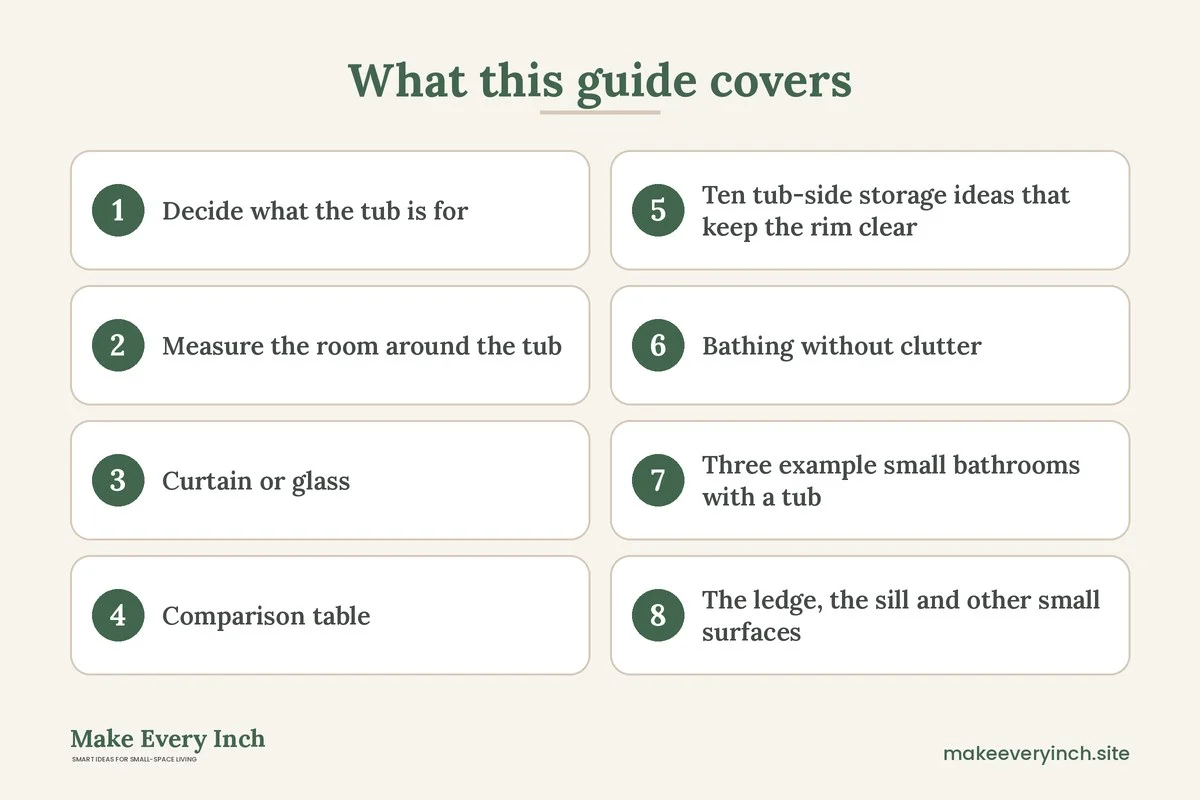
Small bathroom ideas with a tub start from a simple fact: in a room of 35 to 50 square feet, the tub is the largest object you own, and it is not going anywhere. A standard alcove tub is about 60 inches long, 30 to 32 inches wide and roughly 14 to 20 inches tall at the rim, so it takes up a full wall and a good share of the floor. Instead of fighting it, the goal is to make the tub do three jobs at once: be a bath, be a shower, and quietly store what the room needs. This guide covers how to measure and plan around a tub, the curtain versus glass decision, ten tub-side storage ideas, ledge and sliding door options, three example rooms, a comparison table, a daily routine for bathing without clutter, weight and slip safety, ventilation, and a checklist. For the broader topic, read our main guide to small bathroom ideas, then pair this post with our guide to a small bathroom with a walk-in shower.
Decide what the tub is for
Before you buy a single curtain or caddy, decide how the tub really gets used in your home. Many households fall into one of three groups. Some people shower every day and almost never bathe. Others bathe often, especially with children, pets or sore muscles. The third group uses the tub as a storage room: it holds a laundry basket, a stack of towels, a bucket and a rack of bottles. Each group should plan differently.
If you only shower, treat the tub as a shower tray with a high edge. Your priorities are a curtain or screen that keeps water in, a mat that grips, and wall storage at shoulder height. If you bathe often, you want a clear rim, a place to rest a book or a cup, a headrest or a folded towel at the back, and a soak without a wall of bottles in view. If the tub has become a storage room, the first step is to give each of those items a home somewhere else, because a clear tub makes a bathroom feel several square feet larger on sight.
Also be honest about who uses it. Young children, older adults and anyone with mobility limits need a lower step, solid grab points and a surface that does not slip. Those needs shape the rest of the plan, so write them down before you shop. If a household member has a medical or mobility concern, ask a qualified professional about grab bars and a safe layout instead of guessing.
Measure the room around the tub
Small bathroom ideas with a tub only work when the numbers add up, so take a few minutes with a tape measure and write the answers on paper.
- Tub length and width: a common alcove tub is about 60 inches long and 30 to 32 inches wide, though older homes may have shorter or narrower versions. Measure yours rather than assuming.
- Rim height: many tubs have a rim 14 to 20 inches above the floor. A higher rim needs a stronger step habit and a grab point for safe entry.
- Clearance in front of the tub: try to keep at least 21 inches of clear floor in front of the toilet and the vanity and about 24 to 30 inches in front of the tub if you can. Building codes vary, so check your local rules before any renovation.
- Ceiling height: a standard 8 foot ceiling lets you hang a curtain rod high, around 78 to 84 inches, which makes the room feel taller.
- Wall space: note the length of each wall without a window, door or fixture. These are your storage walls.
- Door swing: a door that opens into the room may hit the tub, the toilet or the vanity. Test it with the door fully open and mark where it lands.
Draw a simple floor plan on graph paper, one square for every 6 inches. Place the tub, the toilet, the vanity and the door swing. The leftover floor shows what is available for a stool, a basket or a bath mat, and it often shows less than you hoped. That is useful information, because it tells you to build up the walls instead of out onto the floor.
Curtain or glass: choosing the tub enclosure
The first big decision in a small bathroom with a tub is what keeps the water in. There are three main groups: a fabric or vinyl curtain, a fixed glass panel and a sliding or hinged glass door. Each affects light, cleaning, cost of installation and the feel of the room, and none is right for every home.
Curtains
A curtain is the lightest option. It costs the least to change, needs no tools beyond a rod, and can be washed. For a small room, choose a curtain that is as long as the rod’s height allows, hung on a rod set as high as you can reach safely, so the room reads taller. A curtain in a light color or a simple pattern lets the eye move past it. Curtains do collect soap film and mildew in damp rooms, so pull the curtain closed after bathing to let it air flat, and wash or replace the liner when it shows spots. Hang the curtain inside the tub, with the hem inside the rim, so water runs back into the bath instead of onto the floor.
A curved rod bows outward at about the shoulder, and it adds a few inches of elbow room inside the tub. It suits anyone who feels squeezed. A tension rod avoids drilling but must be set firmly, and a rod that is not seated can fall, so check it regularly. If you need a permanent rod fixed to tile, ask for permission first and use the right waterproof fixings for the surface.
Fixed glass panels
A single fixed glass panel, sometimes called a splash screen, covers about the width of the shower end of the tub and leaves the rest open. It lets light through, keeps the tub and the rest of the room visible, and makes the room read bigger because there is no curtain across the whole width. The downside is that water can escape around the open end when the shower is angled badly, so aim the head toward the panel and the wall. A fixed panel is a fitted item. It should be installed by a qualified person, and in a rental you need permission from the landlord.
Sliding and hinged glass doors
A sliding glass door suits a small bathroom because it needs no swing space. Two panels glide past each other on a track, so the door never hits the toilet or the vanity. A hinged door is neater to clean but swings into the room by roughly the width of the panel, which many small bathrooms cannot spare. Glass doors collect mineral spots and soap residue, and the bottom track holds water, so plan to wipe it down regularly. Doors must use safety glass, and they need to be fitted correctly to the tub rim, so do not attempt it without a professional if you are unsure.
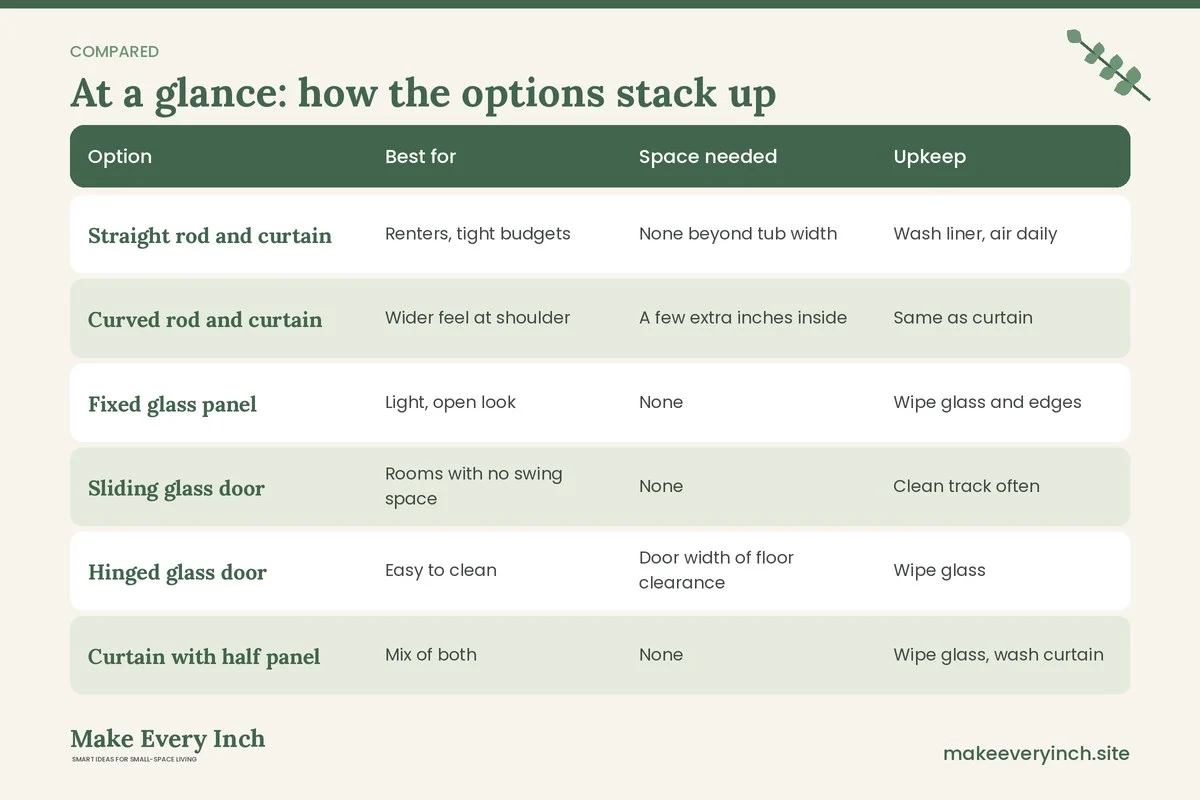
Comparison table: tub enclosures at a glance
| Option | Best for | Space needed | Upkeep | Main watch-out |
|---|---|---|---|---|
| Straight rod and curtain | Renters, tight budgets | None beyond tub width | Wash liner, air daily | Mildew if left bunched |
| Curved rod and curtain | Wider feel at shoulder | A few extra inches inside | Same as curtain | Rod must be seated firmly |
| Fixed glass panel | Light, open look | None | Wipe glass and edges | Splash at open end |
| Sliding glass door | Rooms with no swing space | None | Clean track often | Needs proper fitting |
| Hinged glass door | Easy to clean | Door width of floor clearance | Wipe glass | Swing may hit fixtures |
| Curtain with half panel | Mix of both | None | Wipe glass, wash curtain | Needs a fitted panel |
Ten tub-side storage ideas that keep the rim clear
A small bathroom with a tub cannot afford floor clutter, so almost all of the storage should sit on the walls or inside the tub’s own footprint. These ten ideas all follow that rule.
Inside the tub area
1. A shower caddy that hangs from the rod or showerhead
A hanging caddy holds shampoo, soap and a razor without drilling. Choose one with drain holes and hooks that fit the pipe or rod. Check the weight limit and keep it to a few items, because a heavy caddy can pull the rod down.
2. Suction or adhesive hooks for loofahs and razors
Hooks rated for wet rooms keep small tools off the rim. Press them on clean, dry, smooth tile, and test them for a day before you rely on them. Tiles with a texture or a deep grout line will not hold suction well.
3. A corner shelf on a tension pole
A tension pole in the corner of the tub holds several shelves at different heights. It uses no drilling, and it is tall enough to keep bottles above water level. Make sure the floor of the tub is dry and the pole is seated firmly, and avoid loading it with heavy items.
4. A built-in or purchased niche
A recessed niche is excellent, but it is a renovation job that involves cutting into a wall and waterproofing the opening, so it needs a professional. If you do not own the home, ask the landlord. A renter-friendly alternative is a stick-on shelf rated for wet use.
At the tub rim and ledge
5. A tub tray across the rim
A narrow wooden or bamboo tray holds a cup, a candle and a book across the rim. It is removable, so it goes away when you are not bathing. Choose a tray that grips the rim on both sides and does not wobble, and never put a lit candle near a curtain or any flammable item.
6. A tub-side caddy for towels
A small basket or ladder at the end of the tub holds a towel within reach. Keep it dry and off the floor path, and use it for one or two towels rather than a stack.
7. A ledge or window sill
If your tub has a deep sill, use it. Keep it to three items at most, such as a soap dish, a small plant and a bottle. A crowded ledge turns into a spot for mildew and dust.
On the walls
8. Floating shelves above the toilet and beside the tub
A shelf mounted well above the tub and out of the splash zone holds spare towels and a plant. Mount it into studs or with the correct anchors, and drill only with permission. For more ideas, see our guide to small bathroom shelving ideas.
9. An over-the-door rack
A rack over the door holds a robe, a towel or a small basket without touching the wall. It is perfect for renters. Check that the door still closes smoothly.
10. A narrow cabinet above the toilet
A slim cabinet or an over-the-toilet unit uses dead space and holds extra rolls, a cleaning kit and a few towels. Our list of the best over-the-toilet storage covers what to look for, and the guide to tiny bathroom storage ideas explains how to build a full system around it.
Bathing without clutter: a routine that keeps the tub clear
Even great storage fails if every bath ends with bottles scattered across the rim. These habits keep the tub looking calm.
- One product per job: keep a single shampoo, a single conditioner and a single soap in the tub area. Store backups elsewhere, and decant refills into one pump bottle if you want a uniform look.
- A pull-out rule: items that are only used during a bath, such as a bath pillow or a tray, come out when you run the water and go away when you drain it.
- Dry before storing: wipe the rim and let the curtain or the glass dry before the next person walks in. A dry tub grows less mildew.
- A weekly reset: once a week, remove everything from the shelves, wipe them, and throw away empties. It takes less than ten minutes.
- A towel plan: hang one towel per person, and keep spares in a basket outside the splash zone.
If you want to tidy the whole room as well, our guide to small bathroom organization ideas walks through zones for the vanity, the toilet area and the tub.
Three example small bathrooms with a tub
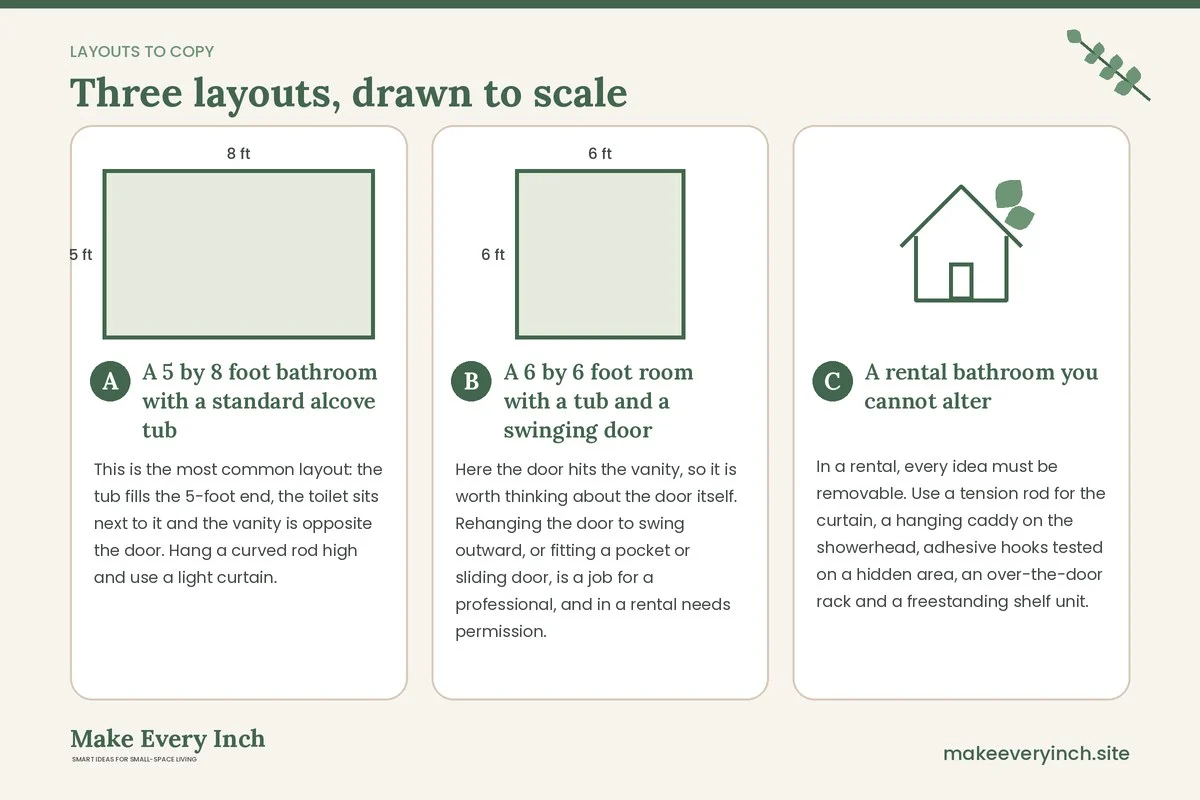
A 5 by 8 foot bathroom with a standard alcove tub
This is the most common layout: the tub fills the 5-foot end, the toilet sits next to it and the vanity is opposite the door. Hang a curved rod high and use a light curtain. Add a corner shelf on a tension pole inside the tub, a hook rail on the back of the door and a slim over-the-toilet unit. The rim stays clear, the vanity top holds only a soap dish and a cup, and the floor is free for a small bath mat with a grip backing. The room feels larger because the eye travels up the tall curtain rather than stopping at a short one.
A 6 by 6 foot room with a tub and a swinging door
Here the door hits the vanity, so it is worth thinking about the door itself. Rehanging the door to swing outward, or fitting a pocket or sliding door, is a job for a professional, and in a rental needs permission. If you cannot change the door, use a wall-hung narrow sink or a corner sink to free the swing, and swap a fixed shower curtain for a sliding glass door only if you own the home. Add a ladder shelf for towels and a recessed or stick-on shelf for bottles.
A rental bathroom you cannot alter
In a rental, every idea must be removable. Use a tension rod for the curtain, a hanging caddy on the showerhead, adhesive hooks tested on a hidden area, an over-the-door rack and a freestanding shelf unit. Take photos of the room before you start, check your lease, and keep the original curtain rod in a bag in case the landlord wants it back. Our guides to renter-friendly bathroom ideas and renter-friendly bathroom upgrades go further on this approach.
The ledge, the sill and other small surfaces
A tub often comes with small extra surfaces that go unused: a wide rim, a corner shelf molded into the surround, a window sill or a step. Each one is a chance to remove an item from the vanity or the floor.
A wide rim of 3 to 5 inches can hold a tray or a few folded washcloths if the user is careful, but a narrow rim should stay empty because items fall into the water. A molded corner shelf is perfect for one bottle of soap and one sponge, and nothing more. A window sill above a tub needs special care: keep it to items that tolerate steam and drips, and consider a moisture-resistant plant. Avoid glass jars or candles on a sill that can be knocked into the tub.
Where a tub is built into a surround with a ledge at the back, the ledge makes a good resting place for a bath pillow or a small basket during a bath. Lift it away afterward so the ledge can dry.
Weight and slip safety around a tub
Bathrooms are among the most common places for slips at home, and a small room with a tub raises the stakes. Treat the following as a minimum and ask a professional if you are unsure.
- Slip resistance: use a non-slip mat or adhesive strips inside the tub if the surface is smooth. Replace them when they curl, peel or grow mildew. Outside the tub, use a bath mat with a grip backing, and wipe up puddles at once.
- Grab points: a grab bar is a safety device and should be fixed into solid framing or with approved anchors by a competent installer. Do not use a towel bar as a handhold, because it may pull out of the wall. A suction grab handle is not a replacement for a fixed bar and can release suddenly.
- Weight on the rim: a tub rim is not built to hold a person sitting or standing for long, so do not rely on a tray or a caddy to support weight. Likewise, do not hang heavy items from a shower rod, which can pull out of the wall.
- Shelves and anchors: anchor tall or heavy storage to the wall, especially in homes with children. Use fixings rated for damp rooms, and mount into studs where possible. Ask permission before drilling into tile, and ask a professional to drill tile and waterproof the fixings, because a cracked tile or a leaking hole can cause hidden damage.
- Electrical safety: keep any electrical item, such as a hair dryer, a radio or a heater, away from the tub. Sockets in a bathroom must be of the right type and position, and in many places they must be protected by a ground fault or residual current device (a GFCI in North America). Do not add or move a socket yourself, and do not use extension cords in the wet zone. Ask a licensed electrician for any change.
- Hot water: if a child, an older adult or someone with reduced sensation uses the bath, check the water temperature before they get in.
- Lighting: a bright, well-placed light helps you see the edge of the tub. Our guide to small bathroom lighting ideas explains which fixtures are suitable near water.
Ventilation, mold and finishes
A tub puts a lot of moisture into a small room. Without ventilation, steam settles on the ceiling, the grout and the curtain, and mildew follows. The remedy is simple.
Run an extractor fan during the bath and for about 15 to 20 minutes afterward, or open a window if you have one. Leave the door ajar, if privacy allows, to let air circulate. Squeegee or wipe the walls after bathing, and spread the curtain flat so it dries. If the fan sounds weak or the ceiling stains keep coming back, ask a professional to check the duct and the fan’s capacity.
If you decide to repaint, use a paint labeled for bathrooms or damp rooms, choose a low-VOC formula, and open windows and run the fan while you work and afterward. Do not paint over active mold. Clean and treat the surface first following the product’s instructions, wear suitable protection and ask a professional if the patch is large or keeps returning. Choose light, slightly glossy finishes in wet areas because they wipe clean more easily. Our guide to small bathroom makeover ideas shows how to combine paint, hardware and lighting on a small budget of effort.
Making the tub feel smaller or the room feel larger
Some tricks work by changing perception rather than adding storage. Use a few of them together for the best effect.
- Match the tub and wall color. A white tub against pale walls blends in and takes up less visual space than a dark wall that makes it pop.
- Run tile or paint to the ceiling. A line at shoulder height cuts the room in two, while a continuous surface lifts the eye.
- Use a mirror opposite the window. It bounces light and makes the room feel deeper. Hang it on a stud or with the right anchors, and choose a moisture-resistant mirror.
- Keep a single floor color. A continuous floor, with one small mat, avoids visual breaks.
- Choose a slim vanity. A wall-hung or narrow vanity gives you leg room and shows more floor. Our post on small bathroom vanity ideas offers options.
- Pick open legs. Furniture with visible legs lets the eye see the floor beneath, which suggests a larger room.
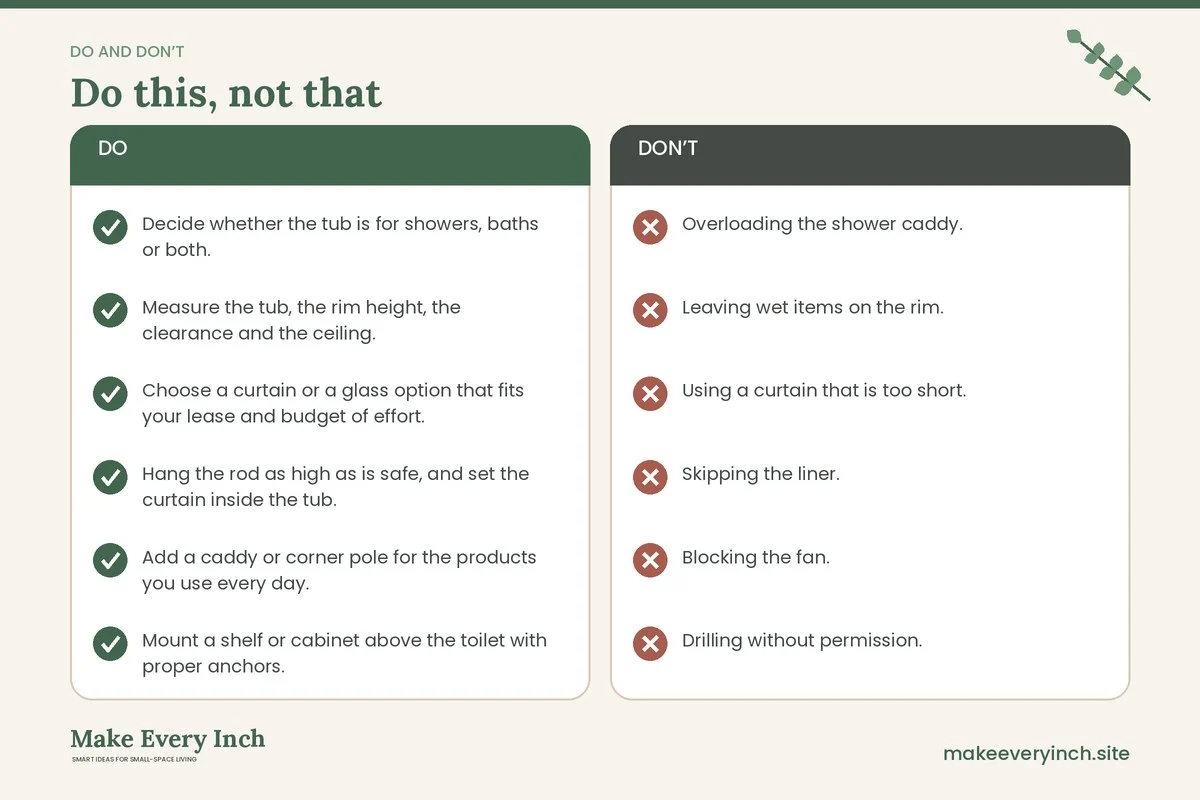
Mistakes to avoid
- Overloading the shower caddy. A heavy caddy can pull the rod down and strain the pipe it hangs from.
- Leaving wet items on the rim. They breed mildew and block the cleaning route.
- Using a curtain that is too short. It lets water escape and makes the room look small.
- Skipping the liner. A decorative curtain without a liner can soak through.
- Blocking the fan. Do not hang towels over the extractor or cover the vent.
- Drilling without permission. In a rented home, this can cost you your deposit.
- Ignoring the door swing. An item that blocks the door is a hazard as well as a nuisance.
- Buying before measuring. Always check the tub width, the ceiling height and the available wall before you shop.
A cleaning and care calendar
A small bathroom with a tub shows dirt faster than a large one, so a light routine beats an occasional deep clean. Wipe the walls and rim after the last shower of the day. Once a week, wash the mat, clean the drain cover and wipe the shelves. Once a month, wash the curtain or liner following the care label, descale the showerhead as the manufacturer suggests and check the caulk lines for gaps. If caulk is cracked or black, plan to replace it, since gaps let water behind the tub where you cannot see it. In a rental, tell the landlord if you spot a leak or soft wall, because hidden moisture is a repair issue.
Checklist: small bathroom ideas with a tub
- Decide whether the tub is for showers, baths or both.
- Measure the tub, the rim height, the clearance and the ceiling.
- Choose a curtain or a glass option that fits your lease and budget of effort.
- Hang the rod as high as is safe, and set the curtain inside the tub.
- Add a caddy or corner pole for the products you use every day.
- Mount a shelf or cabinet above the toilet with proper anchors.
- Put a rack or hooks on the back of the door.
- Place a non-slip mat inside the tub and a grip mat outside.
- Keep electrical items away from water and ask an electrician about sockets.
- Run the fan or open the window during and after use.
- Wipe the rim and let the curtain dry after each bath.
- Clean the shelves and replace the mat when worn.
- Get permission before drilling, and use waterproof fixings.
FAQ
What is the best shower curtain for a small bathroom with a tub?
A light-colored curtain that reaches the rim, hung high on a rod, makes the room feel taller. Add a liner or choose a water-repellent fabric, and consider a curved rod if you want extra elbow room.
Should I choose glass or a curtain for a small tub?
Glass lets in more light and looks cleaner, but it costs more to fit and needs more wiping. A curtain is cheaper and easier to change, but it needs washing and drying. For a rental, a curtain is usually the practical choice.
Can I keep a tub in a very small bathroom?
Usually yes, and many people prefer to keep it for resale or for bathing children. If you are weighing a change to a shower, ask a professional about cost and local rules, and read our guide to small bathroom ideas with a walk-in shower before you decide.
How do I add storage without drilling into tile?
Use a hanging caddy, a tension pole, an over-the-door rack, a freestanding ladder shelf or an over-the-toilet unit. Adhesive options exist for wet areas, but test them in a hidden place first and follow the weight rating.
How do I stop mildew on the shower curtain?
Open the curtain flat after use, run the fan, wipe the tub walls, and wash or replace the liner when it shows spots. Keep the bathroom ventilated, and fix any leak that is making the room damp.
Is it safe to put a shelf over the tub?
It can be, if it is mounted out of the splash zone, anchored to studs or with suitable fixings, and loaded with light items. Never hang heavy objects above where someone sits or stands. Ask a professional if you are unsure.
How do I make a small tub more comfortable for baths?
Add a folded towel or a bath pillow at the back, a tray across the rim for a cup, and a mat with grip. Keep the bottles on a wall shelf so the rim stays free, and always check the water temperature.
Are there grab bar options for renters?
A fixed grab bar needs proper anchoring and the landlord’s permission. Some tubs have a built-in handle. Do not rely on suction handles for support, and ask a professional about safe options.
Keep going: Keep planning with our small bathroom ideas, small bathroom organization ideas and small bathroom ideas with a walk-in shower.
Save this guide for later
Pin the ideas you like to Pinterest so you can come back to them when you plan your space.