16 Small Room Window Treatment Ideas That Add Light and Height
Quick answer: A good small room window treatment lets in light, adds privacy only where needed and makes the ceiling feel taller. Mount the rod several inches above the frame (often 4 to 8 inches), extend it past the frame on each side so the glass stays clear, choose light or sheer fabric in a shade close to the wall, and keep cords short or cordless. Check the lease before drilling.
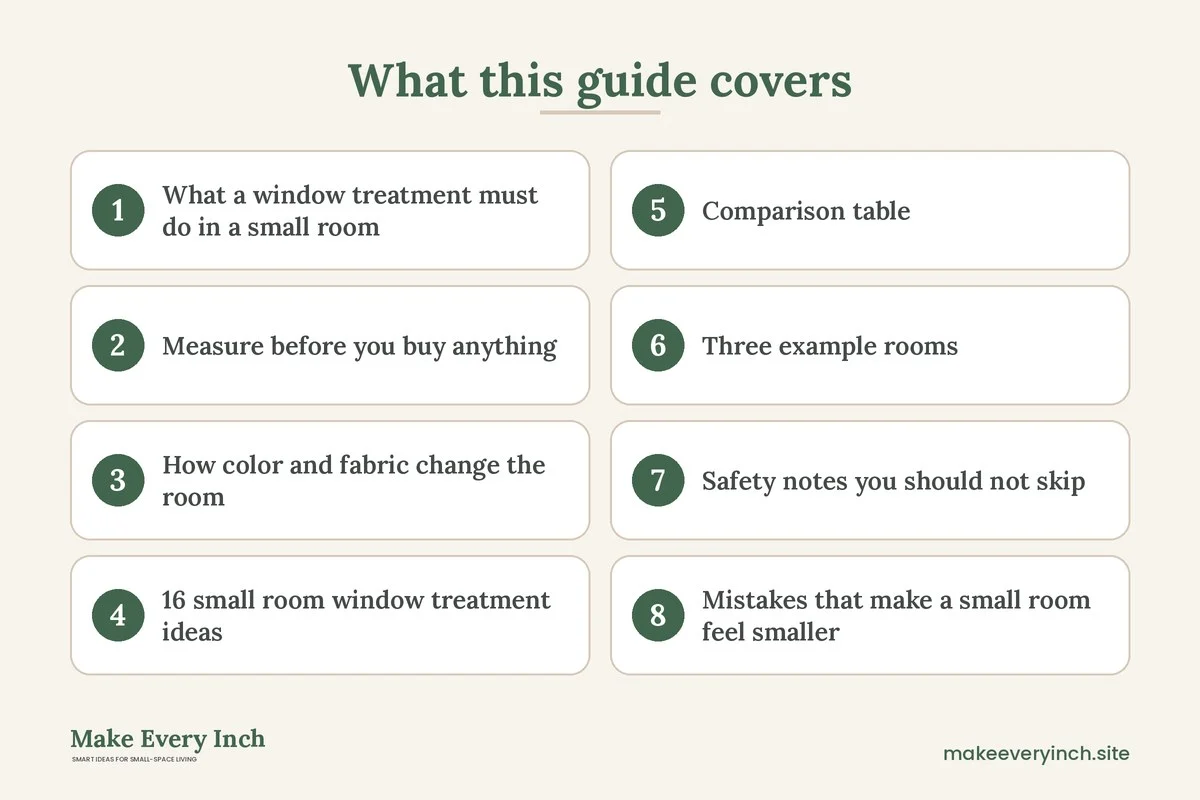
A small room window treatment has more work to do than the same treatment in a large room. It has to control glare and privacy, but it also decides how big the room feels. A heavy drape hung right at the frame can swallow a third of the glass and make a narrow wall look squat. A thin shade that stops at the sill can leave the window looking small and the ceiling looking low. A well-chosen treatment does the reverse: it stretches the window visually, lets daylight travel deep into the room and softens hard edges without taking up floor space. This guide covers how to measure, how to choose fabric and color, 16 specific ideas, a comparison table, three example rooms, safety notes and a checklist. For the wider approach to making a compact room feel finished, start with our pillar guide on small room decor ideas.
What a window treatment must do in a small room
Before choosing a style, name the jobs. Most small rooms need some mix of the following, and each job points toward a different product.
- Light control. Do you want to block glare on a screen, dim a bedroom for sleep or simply keep the room bright? Sleeping rooms need more blocking than living rooms.
- Privacy. A ground-floor or street-facing window may need coverage by day and by night. A window facing a rooftop or a tree may need none.
- Visual height and width. Treatments can lift the ceiling line and widen the wall.
- Insulation and noise. Thick fabric and lined layers can soften drafts and street sound, though the effect is modest and depends on the window.
- Storage and clearance. A radiator, a desk or a bed below the window limits how long a curtain can be.
Write down the top two jobs for each window. A bedroom window might be “block morning light” and “feel taller.” A kitchen window might be “keep daylight” and “stay clear of the stove.” The list keeps you from buying a pretty product that fails at the job that matters.
Measure before you buy anything
Most window treatments look wrong because of measurement, not because of taste. Take these measurements with a metal tape and write them down.
- Window width including the trim. Measure the outside edge of the frame on both sides.
- Window height from the sill to the top of the frame.
- Distance from the top of the frame to the ceiling. This tells you how high the rod can go.
- Distance from the frame to the nearest wall or corner. This decides how far the rod can extend sideways.
- Distance from the sill to the floor. This sets curtain length.
- Depth of the sill and anything below it, such as a radiator, a desk or a bed headboard.
Two rules of thumb guide most layouts, and both are hedged because rooms differ. First, many designers place the rod somewhere between 4 and 8 inches above the frame, or about halfway between the frame and the ceiling when the gap is small. Second, extending the rod 6 to 12 inches beyond each side of the frame lets the panels stack against the wall and leaves the glass uncovered when the curtains are open. In a tight room with a nearby wall or corner, you may only get a few inches, and that is fine.
If the ceiling is low, the rod can rise nearly to the ceiling line, which makes the wall look taller. If there is a crown molding or a beam, place the rod just below it. If the window is tall and narrow, the extra width on each side will make it feel more balanced.
How color and fabric change the room
Color and weight matter more in a small room than pattern. A few principles hold in most spaces.
- Match the wall or go one step lighter. Panels in nearly the same shade as the wall blur the boundary between window and wall, and the room reads as larger. A strong contrast draws the eye to the window and shortens the wall.
- Choose light-filtering fabric for daytime rooms. Linen-look weaves, cotton blends and light polyester let daylight in while softening the view. Thin sheer layers can look airy, but they offer little privacy at night when lights are on.
- Add a lining where you need darkness. A lined or blackout panel in a bedroom helps with sleep and early sun. A lining also helps a thin fabric hang straight.
- Keep patterns small or vertical. A thin vertical stripe emphasizes height. A large pattern on a lot of fabric can overwhelm a small room, so use it on a single shade or a pair of narrow panels.
- Watch the weight. Heavy velvet or thick lined drapes need a sturdy rod and solid anchoring. In a rental with thin walls, a lighter fabric is both safer and easier to hang.
When you pick samples, look at them in the window at the time of day you use the room. Daylight changes color through the day, and a fabric that looks warm at noon can look gray in the evening.
16 small room window treatment ideas
Curtains that make the window look bigger
1. A high-mounted rod with floor-length panels
Hang the rod close to the ceiling and let the panels fall to just above the floor, often about half an inch clear of it. The long vertical line stretches the wall. This is the single most useful move in a room with a standard ceiling, and it works even over a small window.
2. A wide rod that clears the glass
Extend the rod beyond the frame so the open panels sit on the wall and not in front of the glass. In a small room, this can add noticeable daylight without any change to the window itself.
3. A single panel on one side
Where a window sits in a corner or beside furniture, one panel on the open side with a tieback can look intentional and use less fabric. It is a neat answer for a window next to a desk or a bookcase.
4. Sheer panels with a second layer
A sheer panel on an inner rod and a heavier panel on an outer rod give both daylight and privacy control. The double-rod setup needs about 3 to 4 inches of wall depth, so measure first.
Shades and blinds for tight spots
5. A roman shade inside the frame
Inside the frame, a flat roman shade keeps the wall clean and works above a desk, a radiator or a kitchen counter. It folds up neatly when open and still lets daylight through when set at a partial height. Choose a cordless or continuous-loop style with a cord safety device.
6. A roller shade in a light shade
A roller shade is the slimmest option and suits very small windows. Outside-mount it a few inches above and past the frame to make the window feel larger. Light fabrics keep the room open, and a blackout version suits a bedroom.
7. A cellular shade for insulation
Honeycomb-style shades trap a layer of air, which can help with drafts and glare. They are thin and tidy, though they will not give the soft, draped look of fabric.
8. A bamboo or woven shade for texture
Natural woven shades bring warmth and pattern without a strong color. They filter light in a gentle way. Check how they handle a humid room like a bathroom, since some materials may warp.
9. Slim blinds in a pale tone
Narrow-slat blinds in white or a pale neutral keep sightlines clean. Choose wand control or a cordless lift for safety. Dust collects on slats, so plan a quick wipe in your weekly clean.
Layered and low-commitment ideas
10. A café curtain for the lower half
A short curtain on a rod across the middle of the window gives privacy at eye level while letting daylight in from above. It is a good fit for kitchens, bathrooms and street-level windows.
11. A tension rod inside the frame
A tension rod needs no screws, which suits a rental. It holds a light curtain, a café panel or a lightweight fabric. Stay within the weight limit printed on the rod, and press it against a sturdy frame. For more options without tools, see our guide to renter friendly window treatment ideas.
12. Window film for privacy
A static-cling or adhesive frosted film gives privacy while letting light through. It suits bathrooms and street-level windows. Test a corner first, follow the lease, and read the removal notes on the package.
13. A valance or fabric swag over a plain shade
A soft valance above a simple shade hides the hardware and adds a little softness. Keep it flat and tailored in a small room, because a big ruffle will look heavy.
Special windows and tricky spots
14. A window seat or deep sill treatment
Where a deep sill doubles as a seat, a short curtain or a shade that stops at the sill keeps the seat usable. Add a cushion and a pillow to turn the sill into a reading nook, as long as the window and sill can carry the weight.
15. A bay or corner window
Use a curved or flexible rod, or a series of individual shades, so each pane can be controlled. A pale color keeps the nook airy.
16. A small high window
Narrow, high windows in bathrooms or stairwells often need only a simple shade or a film. A short roller shade on a small bracket is enough, and it keeps the wall below clear for storage.
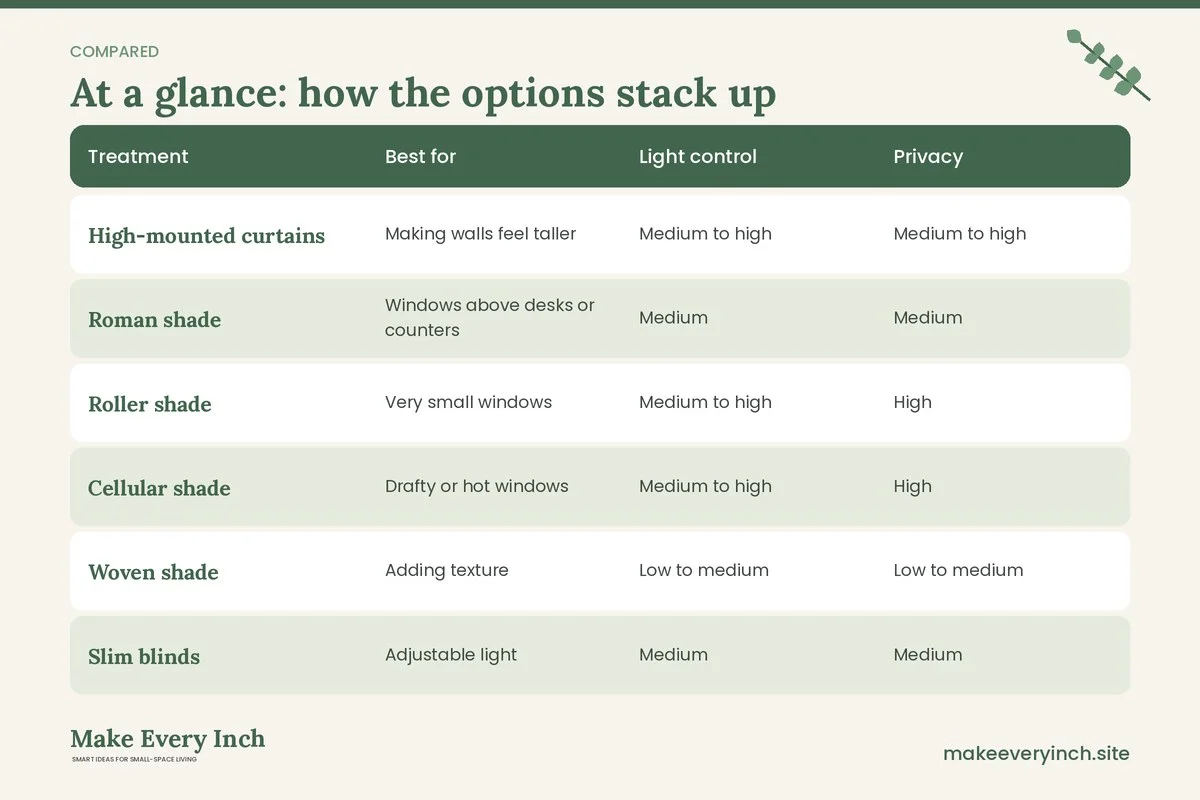
Comparison table: which treatment fits which job
| Treatment | Best for | Light control | Privacy | Room feel | Notes |
|---|---|---|---|---|---|
| High-mounted curtains | Making walls feel taller | Medium to high | Medium to high | Soft, tall | Needs a sturdy rod and anchoring |
| Roman shade | Windows above desks or counters | Medium | Medium | Tailored | Choose a cordless style |
| Roller shade | Very small windows | Medium to high | High | Clean, flat | Slim and easy to mount |
| Cellular shade | Drafty or hot windows | Medium to high | High | Minimal | Limited softness |
| Woven shade | Adding texture | Low to medium | Low to medium | Warm | Check humidity |
| Slim blinds | Adjustable light | Medium | Medium | Neat | Dust care needed |
| Sheer curtains | Bright living rooms | Low | Low by night | Airy | Pair with a second layer |
| Café curtain | Kitchens and baths | Low | Medium | Cottage-like | Leaves the top clear |
| Tension rod panel | Rentals | Low to medium | Low to medium | Light | Respect the weight limit |
| Window film | Privacy with light | Low | High | Frosted | Test and check the lease |
Three example rooms
A 9 by 10 foot bedroom with one window
The room has a single window on the wall beside the bed, and about 12 inches of ceiling gap above the frame. Mount a rod about 6 inches above the frame and extend it by 8 inches each side. Hang two lined panels in a soft shade close to the wall color, with the bottoms about half an inch above the floor. Add a pale roller shade inside the frame for a clean daytime look. When the panels are open, the glass is clear. When they close, the room is dark enough for sleep. The bedside lamp stays clear of the fabric, and any plug-in light should keep its bulb away from the curtain. For more bedroom ideas, see our guide to small bedroom ideas.
An 11 by 12 foot living room with a large window and a sofa below it
A sofa sits under the window, so heavy fabric would pile against the cushions. Choose a roman shade or a roller shade mounted just outside the frame, plus a pair of simple sheer panels on a high rod. Keep the sheers at least a few inches clear of any heater, and make sure the sofa back does not trap them. A pair of narrow lamps at the sofa ends adds evening light, and you can read more in our guide to small living room lighting ideas. The result is a light, tall wall that does not fight the sofa.
A narrow galley kitchen with a window over the sink
Fabric near water and a stove is a hassle. A café curtain on a tension rod, a short roller shade or a film keeps the window clear of splashes. Keep any fabric well away from burners and hot appliances, and wash it often. A shade that stops at the sill leaves room for a plant or a soap dish. Pale tones help the daylight bounce around a narrow space.

Safety notes you should not skip
Window treatments touch a few real hazards, and most are simple to avoid.
- Cords. Looped cords on blinds and shades are a strangulation hazard for young children and can tangle pets. Choose cordless or motorized options where kids or pets live, or keep cords short and secured with a cleat or a tension device placed high on the wall.
- Rod weight and anchoring. A heavy rod with thick fabric can pull screws out of drywall. If you are allowed to drill, find a stud or use anchors rated well above the load. Do not hang heavy drapes from adhesive hooks.
- Drilling in a rental. Do not drill into walls, trim or window frames without written permission. If you cannot drill, use a tension rod within its limit or a no-drill bracket and keep the load light.
- Tension rods. They can slip if the fabric is heavy or the frame is uneven. Check the rod weekly at first, and do not use one above a bed or a crib.
- Heat and light. Keep curtains clear of radiators, heaters, stoves and lamps. A bulb under or beside a curtain can heat the fabric, so follow the lamp’s wattage limit and use cooler bulbs where fabric is close.
- Ladders. Use a stable step stool or ladder for rods, and ask someone to hold it if the surface is slippery.
- Window film and chemicals. Ventilate the room when applying adhesives or cleaning products, and follow the label.
Mistakes that make a small room feel smaller
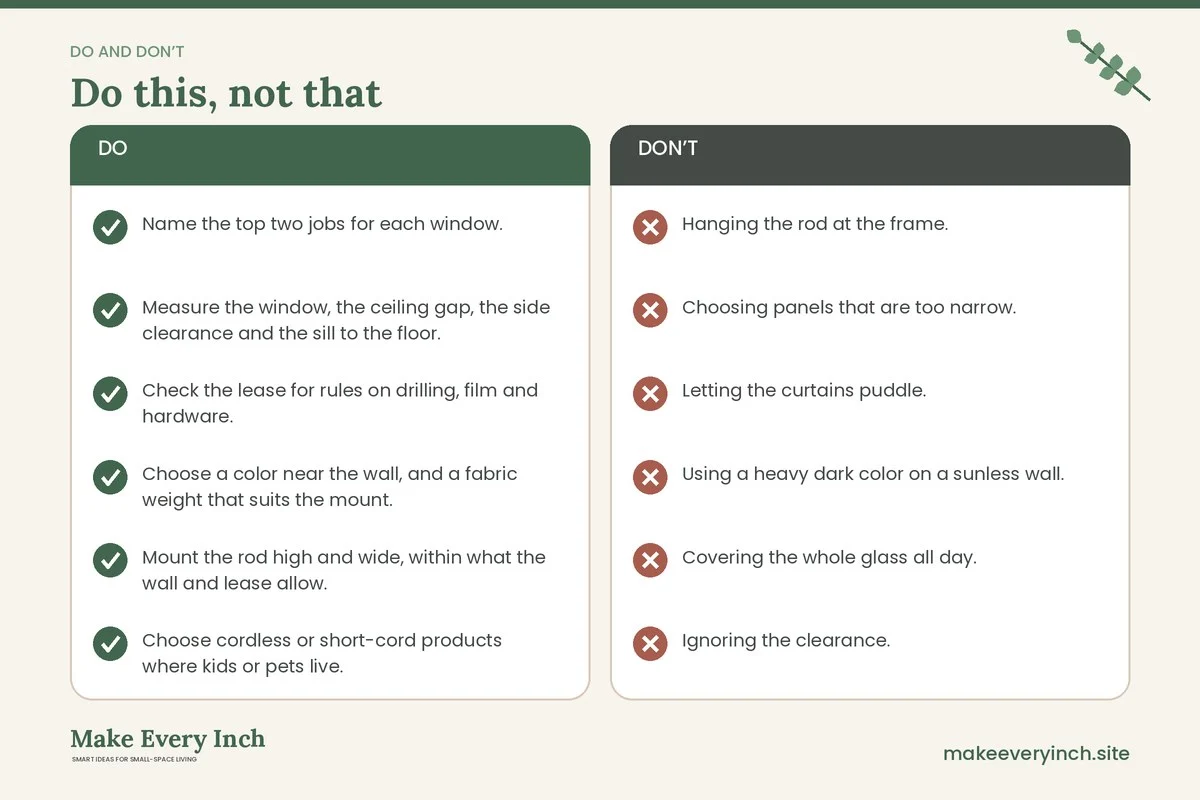
- Hanging the rod at the frame. It cuts the wall short. Go higher.
- Choosing panels that are too narrow. Thin curtains look skimpy. Aim for panels that are about one and a half to two times the rod width when closed, though the ideal varies with fabric.
- Letting the curtains puddle. Extra fabric on the floor collects dust and looks fussy in a small room.
- Using a heavy dark color on a sunless wall. It can make the room feel cave-like. Our guide to dark apartment ideas shows how to handle low-light rooms.
- Covering the whole glass all day. Keep curtains open by day so the window does its job.
- Ignoring the clearance. A curtain that blocks a door, a vent or a radiator becomes a daily annoyance.
Care, cleaning and longevity
A small room works best when everything is easy to maintain. Check the care label on any panel before you buy it. Machine-washable fabric is a safer choice for kitchens, children’s rooms and rooms with pets. Vacuum the folds of curtains and shades every few weeks with a soft brush attachment. Wipe blinds with a damp microfiber cloth. Reinstall brackets if they loosen, and replace them if a screw hole becomes stripped. Rotate or flip a shade if the sun fades one side. Wash sheers gently and hang them damp so wrinkles fall out.
If you move often, choose treatments that go with you: tension rods, standard-width panels and shades that fit common window sizes. Keep the original hardware and screws in a labeled bag.
Match the treatment to the rest of the room
A window sits within a larger scheme. Pick the shade and weight of the treatment after you know the wall color and the main furniture. If you are still choosing paint, our guide on small dining room color schemes shows how a few related tones can open a space. For decor style, see apartment decorating styles and pick fabric that suits the look. If a room feels busy, repeat one fabric in a pillow or a throw so the window ties into the whole. If you plan wall art next to the window, keep a few inches clear so the curtain can open. Our companion post on small space wall art ideas shows how to balance the two.
Budget-minded ways to improve a window
You do not need a full new set. Try these in order of effort.
- Raise and lengthen what you already have. Moving an existing rod higher and swapping to longer panels can change the room without new fabric.
- Wash and press the panels. Wrinkled fabric reads as cheap. A clean, pressed panel looks crisp.
- Remove a layer. Heavy drapes plus blinds plus a valance can be too much. Taking away a layer can open the window.
- Swap the hardware. A slim rod in a finish that matches the wall disappears, while a thick contrasting rod becomes a feature.
- Use thrift and hand-me-down fabric. Vintage linens, bed sheets or table cloths can become simple panels with clip rings. See our post on budget small space ideas for more ways to stretch a spend.
A quick planning checklist
- Name the top two jobs for each window.
- Measure the window, the ceiling gap, the side clearance and the sill to the floor.
- Check the lease for rules on drilling, film and hardware.
- Choose a color near the wall, and a fabric weight that suits the mount.
- Mount the rod high and wide, within what the wall and lease allow.
- Choose cordless or short-cord products where kids or pets live.
- Keep fabric away from heaters, stoves and hot bulbs.
- Use anchors or studs for heavy loads, and tension rods only within their limit.
- Leave a few inches of space for art, lamps and furniture.
- Open the curtains every day.
Frequently asked questions
How high should I hang curtains in a small room?
Many people mount the rod somewhere between 4 and 8 inches above the frame, or nearer the ceiling when the gap is small. The exact height depends on your ceiling, trim and window, so hold the rod up with a helper and look at it before you drill.
Can a window treatment make a room look bigger?
It can help. High-mounted rods, wide rods that clear the glass and fabric close to the wall color all make a window and its wall look larger. The effect is visual and it is modest, but it is a low-cost way to improve the feel of a room.
What is the best option for a rental with no drilling?
Tension rods, adhesive-free shades that sit in the frame and window film are the usual choices. Always check the lease, and use light fabric so nothing falls.
Are sheer curtains private enough?
Sheers give daytime privacy, but when lights are on at night people outside may see in. Pair them with a roller or roman shade, or choose a lined panel, if you need evening privacy.
Should the curtains match the wall?
Close to the wall color is a safe choice in a small room. A soft contrast or a subtle texture can still look good, as long as it does not cut the wall in two.
Are blinds with cords safe?
Cords can be dangerous around young children and some pets. Choose cordless or motorized options, and secure any remaining cord out of reach, following the maker’s instructions.
How long should curtains be?
Many people choose a length that clears the floor by about half an inch, or a length that just kisses the floor for a softer look. Avoid puddling in a small room, where the extra fabric looks bulky.
Keep going: Ready to dress the rest of the room? Explore small room decor ideas, plan better evening light with renter friendly lighting ideas and see how a gallery fits next to your window in small space wall art ideas.
Save this guide for later
Pin the ideas you like to Pinterest so you can come back to them when you plan your space.