Small Bathroom Ideas That Feel Spacious
Quick answer: The best small bathroom ideas that feel spacious change what the eye reads, not the size of the room. Use clear glass instead of a curtain, a large mirror that reflects a window or light, layered warm-white lighting, wall-hung fixtures that show floor, one light color family and a floor that is mostly clear. Keep electrical, ventilation and slip safety in mind, and never drill into tile without permission.
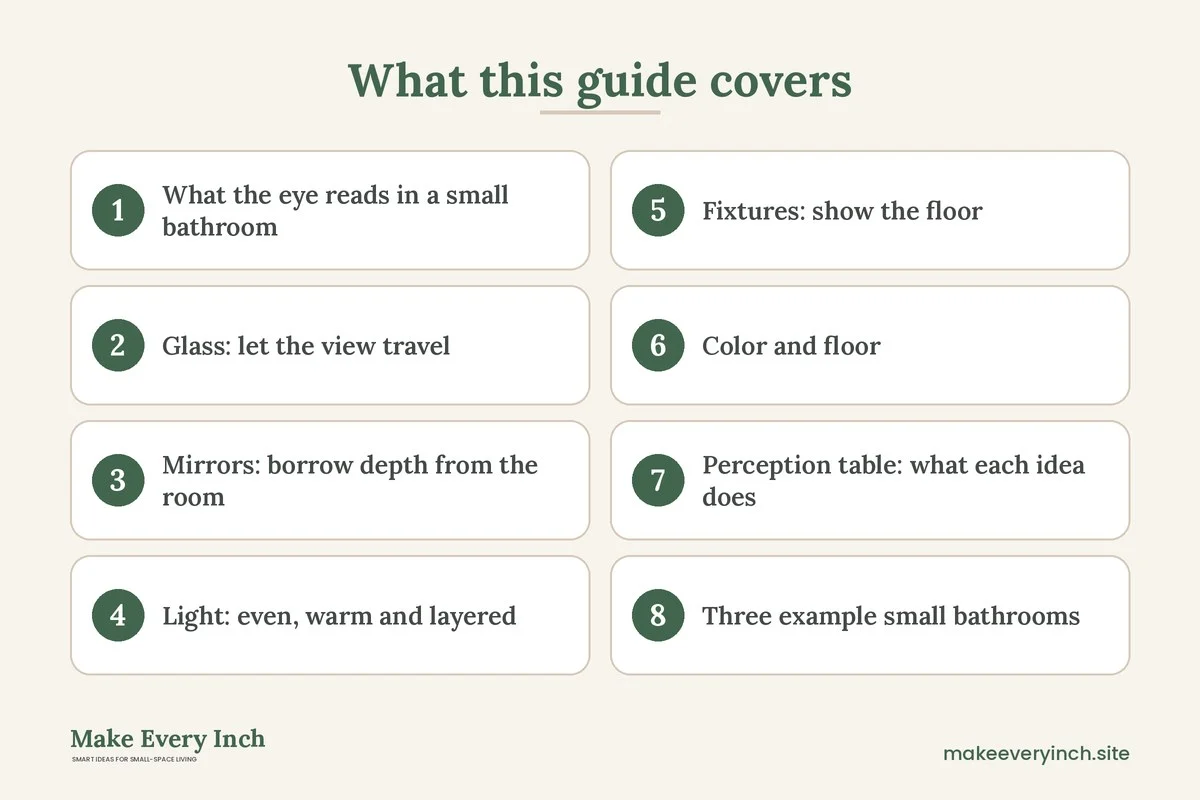
Small bathroom ideas that feel spacious are not about knocking down walls. Most small bathrooms are fixed in size by the pipes, the tub and the lease, and the room measures what it measures. What you can change is how the room is perceived. People judge a space by how far the eye travels, how much floor is visible, how evenly the light falls and how many interruptions break up the view. This guide focuses on that perception side. It covers the five things the eye reads, ten ideas grouped by glass, mirrors, light, fixtures, color and floor, a comparison table, three example bathrooms, a safety section, mistakes and a checklist. For the full overview of the room, start with our small bathroom ideas pillar. For fixture placement and clearances, read the companion post on small bathroom layout ideas that work.
What the eye reads in a small bathroom
Before buying anything, stand in the doorway and notice where your eye stops. In a cramped bathroom the view usually ends within three feet, at a shower curtain, a bulky vanity or a dark wall. A room feels larger when the eye keeps moving, so the goal is to push those stopping points farther away or remove them. Five cues do most of the work.
- Sightlines: how far you can see from the door. A clear line to a window, a mirror or a pale far wall feels deeper than a line that ends at a curtain.
- Visible floor: the more floor you can see, the bigger the room feels. Furniture that touches the floor hides it, and furniture lifted off the floor shows it.
- Light: even, shadow-free light makes walls recede. Pools of light with dark corners make a room feel like a box.
- Contrast: strong contrast chops the room into pieces. Low contrast between wall, trim and fixtures lets the surfaces blend into one calm shape.
- Visual noise: items on every ledge, a busy pattern and mixed finishes all add stops. Fewer, calmer items let the eye rest.
None of these cues change the real floor area, and it is worth saying so plainly. A room that is 5 by 8 feet stays 5 by 8 feet. But the difference between a bathroom that feels like a closet and one that feels like a calm little spa often comes down to these five cues, and most of them can be improved without a remodel.
Glass: let the view travel
The shower or tub area is usually the largest visible object in a small bathroom, and a heavy curtain turns it into a wall. Replacing or changing what covers the wet zone is often the single biggest perception shift.
1. A clear glass panel instead of a curtain
A fixed or hinged clear glass panel lets the eye see the back wall of the shower, so the room appears to continue behind the glass. Clear glass reads as almost invisible, while frosted or heavily patterned glass reads as a wall. Many small baths use a single fixed panel about 30 to 36 inches wide, with the open side facing the shower head away from the door. A panel needs proper installation and sealing, so for a rental or an unfamiliar job, ask the landlord or a qualified installer. Do not attempt to drill into tile or a tub surround without permission and the right bits and fixings.
2. A clear or lightly textured curtain
If glass is not an option, a clear liner on its own, or a very light, sheer-looking curtain, keeps the sightline open. Hang the rod high, near the ceiling, and let the fabric fall to just above the tub rim. A high rod draws the eye up and makes the ceiling feel taller. A tension rod avoids drilling in a rental, but check the maximum span and check that the ceiling or wall can bear the load. For more rental-safe ideas, see our guide to renter-friendly bathroom ideas.
3. A glass shelf or a glass door on a cabinet
A cabinet with a glass front shows its contents, and a clear shelf lets light pass through. Both feel lighter than a solid door. Keep only a few tidy items behind glass, such as rolled white towels, because a crowded glass shelf adds visual noise.
Mirrors: borrow depth from the room
A mirror is the classic space trick because it shows a second version of the room. It works best when it reflects something worth seeing.
4. One large mirror instead of a small medicine cabinet
A mirror that runs nearly the width of the vanity, or a pair that fill the wall, doubles the apparent width. A common approach is a mirror about as wide as the vanity top, or a few inches narrower, hung so the bottom sits roughly 4 to 8 inches above the faucet or backsplash. The exact height depends on the people using it, so test with painter’s tape before you commit. A mirror is heavy, so use fixings rated for the weight and the wall type. Do not hang one with an adhesive that is not rated for its weight, and do not drill into tile without permission. In a rental, a leaning mirror or a mirror hung on an existing hook may be safer than a new hole.
5. Place the mirror opposite the light
A mirror that faces a window, a lit doorway or a wall light bounces that light across the room. A mirror that faces a dark corner bounces the dark. Before deciding where to hang it, stand where the mirror will be and see what it would reflect. If it faces a plain wall, consider whether a light there would improve the reflection.
6. A mirrored or reflective cabinet face
A mirrored cabinet door hides storage and gives the effect of a mirror at once. Choose a cabinet whose glass is fully sealed and rated for a damp room, and keep the cabinet depth shallow if the room is narrow so it does not stick out into the walkway. Our guide to small bathroom shelving ideas lists shallow options.
Light: even, warm and layered
Dim corners shrink a room. Bright, even light does the opposite, and a bathroom needs light that flatters faces and shows the whole space.
7. Layer three kinds of light
Use general light for the room, task light for the mirror and, if you can, a soft accent such as a small night light. General light from a ceiling fixture alone throws shadows under the eyes, so add light on both sides of the mirror, or a bar above it that spreads evenly. Warm-white bulbs, often around 2700 to 3000 kelvin, flatter skin and keep the room friendly, while cool bulbs can feel clinical. A slightly higher brightness rating is useful in a windowless room. For more, see our detailed post on small bathroom lighting ideas.
8. Respect the wet zones
Bathroom fixtures carry rules about water and electricity. Anything near a tub, shower or sink needs to be rated for damp or wet locations, and outlets in a bathroom are normally protected by a ground fault circuit interrupter, often shortened to GFCI. Rules vary by place, so check local requirements, and have a licensed electrician do any wiring changes, including swapping a hard-wired fixture. Never run an extension cord or place a plug-in lamp where it could fall into water. In a rental, changing a hard-wired fixture usually needs the landlord’s permission, and a battery or rechargeable wall light with a damp-rated body is a safer swap than anything that plugs in near the tub. Always switch off the circuit at the breaker before changing a bulb in a fixture that is not working correctly.
Fixtures: show the floor
9. Wall-hung or slim-profile fixtures
A wall-hung vanity, a floating shelf and, in a remodel, a wall-hung toilet leave a strip of floor visible beneath them. That strip makes the room feel bigger because the eye sees the floor running on to the wall. The vanity or toilet type is a structural decision involving plumbing and wall framing, so it belongs to a plumber or contractor and, in a rental, to the landlord. A smaller step is a pedestal sink or a narrow vanity with open legs that shows floor. Floor-to-ceiling cabinets can have the opposite effect, but when painted the same color as the wall they recede. See our guide to small bathroom vanity ideas for sizes.
A wall-hung item must be anchored to studs or to rated hardware in solid backing. Tall or heavy items such as a storage tower should be anchored to the wall, because water and humidity make a loose unit more likely to move, and a tip is dangerous in a small wet room.
Color and floor: one family, mostly clear
10. One color family, low contrast
Pale colors reflect more light, and a single family of tones keeps the eye moving. White, soft cream, pale grey, light sage and pale blue are all familiar choices. Painting the walls, ceiling and trim in close tones, or the same color in different finishes, removes the lines that chop the room. A slightly lighter ceiling than the walls makes the ceiling feel higher. If you want contrast, concentrate it in one place, such as a dark towel, rather than scattering it.
Paint for a bathroom should be suited to humidity. Choose a product labeled for bathrooms or damp rooms, preferably low-VOC, and keep the window open or the fan running while it dries. Follow the label for dry time and ventilation. Check the lease before painting, and ask the landlord in writing. A rental often does not allow it, so see our guide on renter-friendly bathroom upgrades for options that do not involve paint.
A mostly clear floor
Keep the floor free of bins, stools, scales and stacked baskets, and let the floor be seen from the door. Move things to the wall, the back of the door, or a tall shelf. A single small rug at most, because a large rug breaks up the floor and is a slip risk when wet. If you use a rug or mat, choose one with a non-slip backing and check that it lies flat and does not curl. Wipe up puddles, because a wet tile floor is a hazard for anyone, especially children and older people.
A continuous floor also helps. Large tiles with thin grout lines, or a single color of tile, look calmer than small tiles with high-contrast grout. If you cannot replace the floor, consider a peel-and-stick or click-in option where the lease allows, and prepare the surface according to the product instructions.
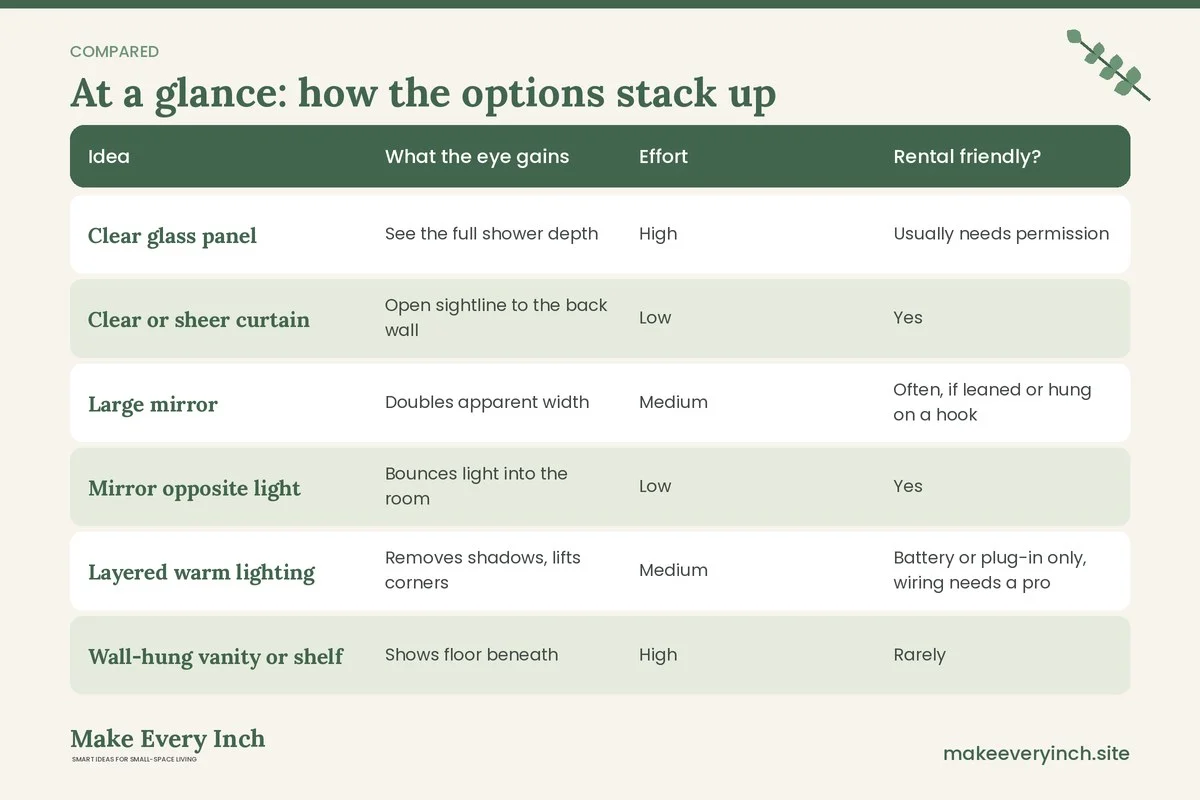
Perception table: what each idea does
The table below summarizes how each idea changes the way the room reads. Effort and rental suitability are rough guides, not guarantees, and you should check your lease and local rules.
| Idea | What the eye gains | Effort | Rental friendly? |
|---|---|---|---|
| Clear glass panel | See the full shower depth | High | Usually needs permission |
| Clear or sheer curtain | Open sightline to the back wall | Low | Yes |
| Large mirror | Doubles apparent width | Medium | Often, if leaned or hung on a hook |
| Mirror opposite light | Bounces light into the room | Low | Yes |
| Layered warm lighting | Removes shadows, lifts corners | Medium | Battery or plug-in only, wiring needs a pro |
| Wall-hung vanity or shelf | Shows floor beneath | High | Rarely |
| Slim pedestal or open-leg vanity | Shows floor, lighter shape | Medium | Sometimes |
| One color family | Removes lines that chop the room | Medium | Needs permission for paint |
| Matching towels and accessories | Cuts visual noise | Low | Yes |
| Clear floor | Visible floor reads as depth | Low | Yes |
Three example small bathrooms
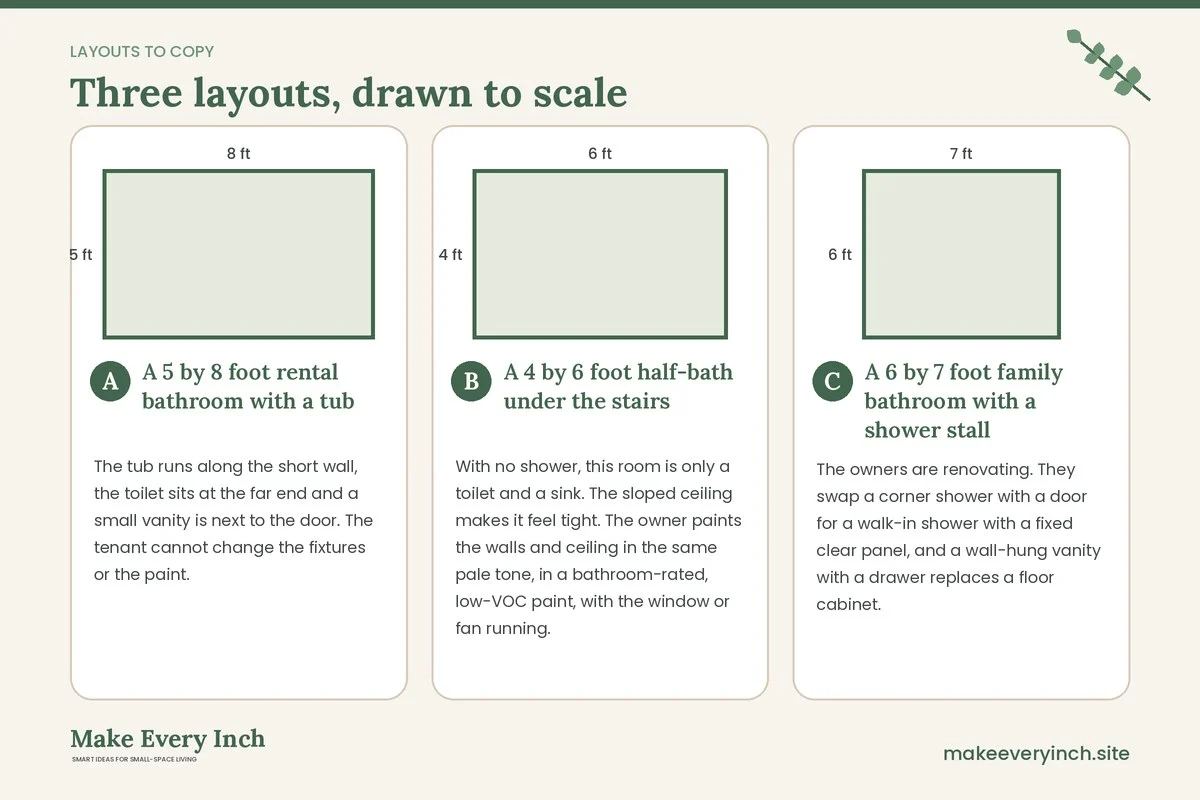
A 5 by 8 foot rental bathroom with a tub
The tub runs along the short wall, the toilet sits at the far end and a small vanity is next to the door. The tenant cannot change the fixtures or the paint. The best moves are a clear liner on a high tension rod, white towels and a small mirror swapped for a larger leaning mirror on the vanity, if the landlord agrees and the lean is stable. A battery-powered or plug-in light is not safe near the tub, so the tenant adds a damp-rated, rechargeable wall light by the mirror, if the lease allows an adhesive mount. The floor is cleared of everything except a flat, non-slip mat. The room reads as lighter and deeper without touching any fixed element.
A 4 by 6 foot half-bath under the stairs
With no shower, this room is only a toilet and a sink. The sloped ceiling makes it feel tight. The owner paints the walls and ceiling in the same pale tone, in a bathroom-rated, low-VOC paint, with the window or fan running. A pedestal sink replaces a bulky cabinet, and a rectangular mirror hangs on a stud with proper fixings. A warm wall light on each side of the mirror removes shadows. A slim shelf above the toilet holds a plant and one basket. The result feels calm because the room contains almost nothing, and the surfaces blend together.
A 6 by 7 foot family bathroom with a shower stall
The owners are renovating. They swap a corner shower with a door for a walk-in shower with a fixed clear panel, and a wall-hung vanity with a drawer replaces a floor cabinet. They keep one tile color for floor and wall, with matching grout, so the eye does not stop at the corner. Plumbing and waterproofing work go to a licensed professional, and the contractor checks local rules for electrical and ventilation. A mirror cabinet with a sealed edge provides hidden storage. The result is a room that appears wider because the shower is not boxed in and the floor runs on.
Safety checks before you change anything
A bathroom is a wet, small and sometimes unventilated room, so a few checks come first.
- Electrical: use only fixtures rated for the zone. Keep plugs away from water. Outlets should be protected by a GFCI according to local rules, so ask a licensed electrician if you are unsure. Never touch switches with wet hands.
- Ventilation and mold: a fan or window removes the moisture that causes mold. Run the fan during and after a shower, often for 20 minutes, or open the window. If the fan is weak, noisy or absent, tell the landlord or a professional. Mirrors, glass and pale paint all show mold quickly, so a ventilated room stays bright.
- Slip risk: keep the floor clear and dry, use non-slip mats and consider a grab bar in a household with older adults, installed into studs or rated anchors by a professional.
- Anchoring: secure tall cabinets and heavy mirrors with rated fixings, in studs or the correct anchors for the wall type.
- Waterproof fixings: use stainless or coated screws and sealed anchors in the wet area, so they do not rust and stain.
- No drilling into tile without permission: in a rental, drilling is often forbidden, and drilling tile can crack it or break a waterproof layer. Ask first, and use adhesive hooks rated for damp surfaces where the lease allows them.
- Children and caregivers: put sharp, heavy and chemical items out of reach.
Mistakes that make a small bathroom feel smaller
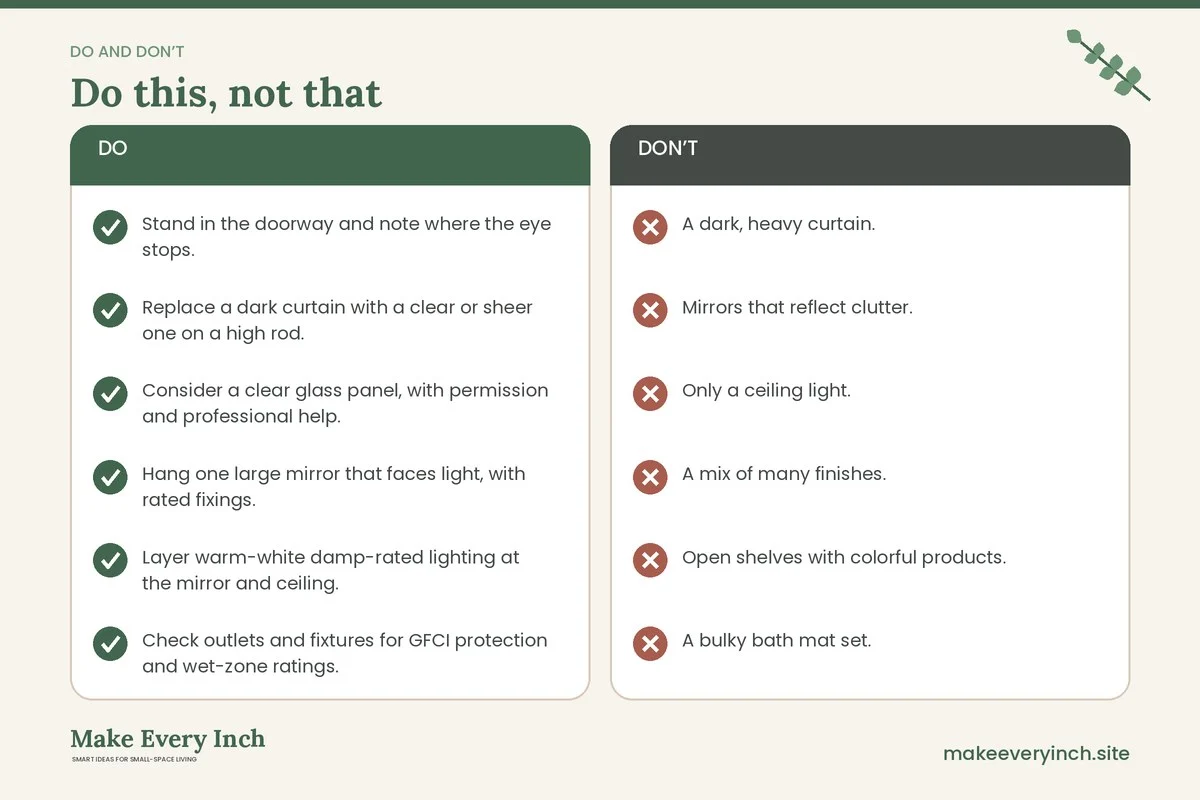
- A dark, heavy curtain. It blocks the view and absorbs light. Choose a clear one.
- Mirrors that reflect clutter. A mirror that faces a pile of towels doubles the pile.
- Only a ceiling light. Shadows make the room look smaller and unflattering.
- A mix of many finishes. Gold, black, chrome and wood all together add noise. Pick two at most.
- Open shelves with colorful products. Decant products into matching bottles or hide them in a basket. Our post on small bathroom organization ideas shows how.
- A bulky bath mat set. A single flat mat is enough.
- A large rug that covers most of the floor. It hides the floor you want to show.
- Too many bins on the floor. Lift storage to the wall or over the door. See our tiny bathroom storage ideas for ways to do this without taking floor space.
- Skipping the fan. Moisture ruins paint and makes the room feel stale.
A weekend plan in three steps
You do not need to do everything at once. A short plan helps you decide what to try first.
Step 1: clear and look
Remove everything that does not belong, wipe surfaces and stand in the doorway. Take a photo, because photos reveal clutter you no longer see. Note the first thing your eye lands on.
Step 2: change the cheapest cue
Swap the curtain for a clear one, tidy the shelf, rehang a mirror in a better spot with a safe fixing, or replace a bulb with a warm-white damp-rated one. These small steps change the room immediately and need little commitment.
Step 3: plan the bigger change
If the room still feels tight, think about the larger moves, such as a glass panel, a smaller vanity or a paint refresh. Measure first with painter’s tape and read our guide to small bathroom makeover ideas for ways to sequence a bigger project. If you rent, read the lease and talk to the landlord before anything permanent.
Small details that add up
A few details are easy to overlook. Hang towels in the same color family, folded or rolled the same way, so they read as one block instead of several. Keep a single plant or a small branch for life, ideally one that tolerates humidity, because too many plants add visual noise. Use a single soap dispenser and a matching cup, and put everything else out of sight. A neat row of matching items looks calmer than the same items in mismatched packaging.
Consider the door too. A door that swings into the room uses floor and blocks the sightline when open. Replacing it with an outward swing, a sliding door or a curtain across the doorway is a bigger job, but a mirror on the back of the door, hung with a safe fixing, adds reflection without using wall space. If you cannot change the door, keep the room behind it clear so it opens fully.
Finally, mind the smell and the sound. A room that feels stuffy feels smaller, and a quiet fan helps you want to run it. If the fan is loud, you may not run it as long as you should, and moisture builds up. A good fan is a comfort and a mold-prevention tool at once.
Checklist
- Stand in the doorway and note where the eye stops.
- Replace a dark curtain with a clear or sheer one on a high rod.
- Consider a clear glass panel, with permission and professional help.
- Hang one large mirror that faces light, with rated fixings.
- Layer warm-white damp-rated lighting at the mirror and ceiling.
- Check outlets and fixtures for GFCI protection and wet-zone ratings.
- Keep one color family, with trim and ceiling in close tones.
- Use low-VOC bathroom paint if you paint, and ventilate while it dries.
- Lift storage off the floor with wall, door or shelf options.
- Anchor tall cabinets and heavy mirrors.
- Keep the floor clear and dry, with a flat non-slip mat.
- Run the fan or open the window after every shower.
- Never drill into tile without permission.
FAQ
Do mirrors really make a small bathroom look bigger?
They can, mostly by reflecting light and depth. The effect depends on what the mirror reflects, so place it opposite a window or a light, not a pile of clutter.
Is a glass shower panel better than a curtain in a small bathroom?
It usually opens the sightline more, because clear glass lets you see the whole shower. It also costs more and needs correct installation and sealing, so a clear curtain is a cheaper step. In a rental, ask before changing anything fixed.
What color makes a small bathroom feel bigger?
Light, low-contrast colors tend to feel more open, such as white, cream, pale grey or soft sage. The most important point is to keep the tones close, so the eye does not stop at sharp lines.
Are wall-hung vanities safe?
They can be, when installed into solid backing with rated hardware by someone who knows the wall construction. A poorly mounted unit can fail, so do not guess. Ask a professional if you are unsure.
Can I add lighting to a rental bathroom?
Often, yes, with a damp-rated battery or rechargeable light and a removable mount, if the lease allows. Do not change hard-wired fixtures without the landlord’s permission and a licensed electrician. Never place a plug-in lamp where it could fall into water.
How do I stop mold from making the room feel dirty?
Run the fan during and after showers, wipe wet surfaces and keep towels from piling up. If mold keeps returning, tell the landlord, since it can point to a ventilation or leak problem.
Should I choose a rug for the floor?
Only a small, flat, non-slip one, if at all. A bare, visible floor reads as more space, and a loose rug can be a slip risk. Dry the floor after a shower either way.
Keep going: Keep going with our small bathroom ideas pillar, the practical guide to small bathroom layout ideas that work and our ideas for a narrow bathroom.
Save this guide for later
Pin the ideas you like to Pinterest so you can come back to them when you plan your space.