Thrifted Furniture Ideas for Small Homes
Quick answer: The best thrifted furniture ideas for small homes focus on pieces with a small footprint and a job: a narrow dresser, a drop-leaf table, a compact chair, a sturdy bench or a slim bookcase. Measure the room and the doorway first, inspect joints, drawers and surfaces, check for pests and strong odors, avoid old finishes you cannot identify, and refresh with low-VOC paint or new hardware.
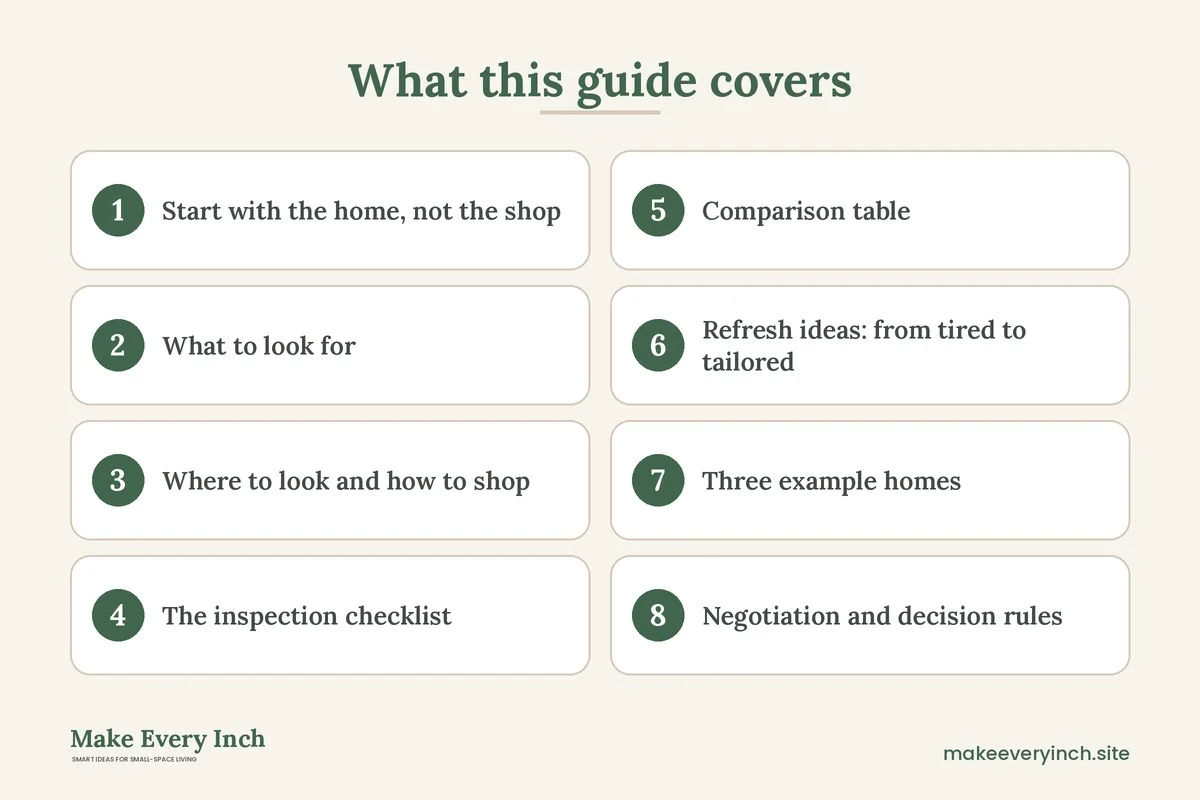
Thrifted furniture ideas for small homes work because older furniture is often built from solid materials, scaled to smaller rooms and priced well below new pieces of similar quality. The risk is that a bargain that does not fit, wobbles or brings in pests is no bargain at all. This guide gives you a way to shop with a tape measure, a short inspection routine, a safety checklist, refresh methods for tired finishes and a scale guide so each piece earns its footprint. It covers where to look, what to prioritize, a comparison table, three example homes, a refresh plan and an FAQ. Costs are described in relative terms, because local markets vary enormously. For the bigger money-saving picture, read our main guide on budget small space ideas, the companion post on small space organization ideas and the sibling guide to DIY room divider ideas for studio apartments, where a thrifted screen or bookcase often does double duty.
Start with the home, not the shop
The most common thrifting mistake is browsing first and measuring later. Reverse the order.
Write a needs list
List the three pieces that would change your home most. Typical answers are a place to sit, a surface to work or eat on and somewhere to store clothes or books. Next to each, write the space it must fit, the job it must do and the maximum footprint you can accept. A list prevents impulse buys, and in a small home an impulse buy can take over a room.
Measure the space and the route
Measure the target spot in width, depth and height. Then measure the path the piece must travel: the building entrance, the stairwell, the elevator if there is one, the door frames and any tight turns. Furniture often fails at the doorway rather than in the room.
- Door width: measure the clear opening, not the frame. Most interior doors give about 28 to 32 inches, and some older homes less.
- Stair turns: long pieces such as sofas and bookcases need a diagonal clearance. A piece can often be tilted, but only if its depth allows it.
- Legs and handles: legs unscrew from many tables and handles can come off. Ask if the seller will allow this for transport.
- Ceiling height: tall wardrobes and bookcases need extra height to tilt upright.
Keep your measurements in a note on your phone, along with a paper tape in your bag. Add a rough cardboard or tape outline on the floor of the target spot so you can judge the visual weight, not only the dimensions.
Know your scale
Small homes need pieces that look lighter than they measure. Look for legs that raise the body off the floor, open backs, slim arms and a seat height that suits the room. A low, deep sofa from a bygone era may cost little but will swallow a living room. A lean mid-height chair with exposed legs reads as half the size.
- Keep the walkway around furniture to roughly 30 to 36 inches where possible.
- Choose a dining table sized for the household plus one, not the largest gathering.
- A bedroom dresser is often best at around 16 to 20 inches deep in a tight bedroom.
- A desk of 20 to 24 inches deep fits most walls.
- Bookcases of 10 to 12 inches deep keep floor space.
See our guide to the best furniture for small apartments for more scale rules, and small living room furniture ideas on a budget for pieces to prioritize first.
What to look for: pieces that earn their footprint
Not every thrift find suits a small home. These categories tend to deliver the most value for the space they take.
Seating
- Armless or slim-arm chairs: use less width than club chairs and tuck against a wall.
- Benches: work at an entry, at a table or at the foot of a bed, and they store neatly.
- Loveseats and apartment sofas: check the frame and cushion firmness and avoid pieces with strong smells.
- Stools and ottomans: versatile and easy to move. Look for firm tops and sturdy legs.
- Dining chairs: buy by the pair and check the joints. Mismatched sets can look deliberate with a shared paint color.
Tables
- Drop-leaf and gateleg tables: fold to a narrow strip and open for guests. A strong choice for studios.
- Small round tables: easier to walk around than rectangles. Pedestal bases free up legroom.
- Console tables: shallow pieces of around 10 to 14 inches work in halls and behind sofas.
- Nesting tables: two or three surfaces in one footprint.
- Side tables with a shelf or drawer: hold a lamp and a few belongings.
Storage
- Narrow dressers and chests: a tall, thin chest has a small footprint and a lot of volume. See the best small dressers for sizes to aim for.
- Bookcases and open shelving: often the best bargain, because solid wood shelving ages well. For sizes, see the best narrow bookshelves.
- Cabinets and sideboards: a low sideboard stores dining items and doubles as a media stand.
- Trunks and blanket chests: a seat, a coffee table and storage in one.
- Hall trees and hooks: useful when there is no entryway. See our small entryway ideas.
Beds and desks
Bed frames are worth buying secondhand only if they are in good condition and you replace the mattress with a new one. A desk should match your depth limit, and a secretary desk or a drop-front writing desk closes up to hide work. Find more on desks in the best desks for small apartments.
Where to look and how to shop
Thrift stores, charity shops, estate and yard sales, community marketplaces, online listings, furniture banks, reuse centers and curbside finds all supply used furniture. Each has a different feel.
- Charity and thrift stores: low and moderate cost, items checked in and displayed, some with return policies. Visit often since stock changes quickly.
- Estate and moving sales: can offer solid, older pieces in good condition. Arrive early for the best choice and later in the day for negotiating.
- Online marketplaces: wide selection and easy filtering. Ask for dimensions, extra photos and a video of any drawer or joint. Meet in public or bring someone along for pickups, and tell a friend where you are going.
- Curbside finds: the lowest cost and the highest risk. Check carefully for pests, damp and structural damage before bringing anything inside.
- Reuse centers and furniture banks: often have affordable pieces and community programs.
Bring a tape measure, a flashlight, a small level or a ball that will show a slope, a few microfiber cloths and gloves. Take photos of the room and a list of your measurements.
The inspection checklist
Use this in the shop or at the seller’s home. It takes five to ten minutes and prevents most disappointments.
Structure
- Wobble test: push on the corners and the top. A little give in a chair is normal, but a rocking table needs checking.
- Joints: look for gaps at the corners, loose dowels and cracked glue lines. Tight joints with visible dovetails are a good sign.
- Legs and feet: check for splits, loose screws and uneven wear.
- Flatness: place a level or a marble on the top, and sight down the edge for warping.
- Weight: a solid piece usually feels heavy. Very light pieces may be hollow or thin veneer, which can be fine but is less repairable.
Drawers and doors
- Pull each drawer fully and check the runners. A drawer that sticks may only need wax, while a broken runner is more work.
- Look for dovetail corners rather than staples.
- Open and close doors. Hinges should feel firm and doors should line up.
- Check the bottom panels of drawers for cracks or sagging.
Surfaces and finish
- Surface scratches and water rings can often be refreshed. Deep gouges, bubbling veneer or peeling laminate cost more effort.
- Look under the top and inside drawers for clues about the finish and age.
- A thick, glossy or flaking old paint on pre-1978 furniture may contain lead, so do not sand or scrape it without testing first. A hardware-store lead test kit or a professional can confirm. When in doubt, seal it with a coat of paint without disturbing it, or choose another piece.
Upholstery and cushions
- Lift cushions and check seams, zips and the frame under the fabric.
- Press the foam. It should spring back, not stay compressed.
- Smell it. Smoke, mildew and pet odors can be hard to remove.
- Check for stains and frayed fabric, and inspect the webbing or springs.
Pests and hygiene
This is where thrifting can go wrong, so be thorough.
- Look in seams, under cushions, behind drawer rails and along the underside of the frame for dark specks, shed skins, small blood spots, webbing, sawdust or tiny round holes.
- Pass on any piece with signs of bed bugs, moths, roaches or woodworm (fresh frass or powder beneath small holes).
- Avoid upholstered pieces from unknown sources unless you can inspect them in good light, and consider leaving mattresses and heavily stuffed items.
- Wipe hard surfaces with a mild soap solution before bringing the piece inside, and vacuum fabrics thoroughly.
- Quarantine the piece in an entry area, garage or hallway for a week or two where possible, then inspect again.
- If you suspect an infestation, contact your landlord or a pest professional rather than treating it yourself.
Safety extras
- Stability: any tall piece such as a dresser, bookcase or wardrobe should be anchored to a wall stud, if your lease allows. If drilling is not allowed, choose a lower piece, keep heavy items at the bottom and place it where children and pets cannot climb it.
- Child safety: old cribs, bunk beds and drop-side cots may not meet current safety standards. Look up recalls before using such items, and avoid buying them secondhand.
- Electrical: lamps, radios and anything with a cord needs checking. Look for frayed or cracked cords and damaged plugs, and have vintage wiring checked or replaced before use.
- Glass and mirrors: check for cracks and loose frames. Secure heavy mirrors properly, and only with permission for any wall fixings.
- Hazardous finishes: avoid pieces with strong chemical smells, crumbling foam or flaking paint indoors.
- Recalls: search the maker and model if you can see a label, since some furniture has been recalled for tipping hazards.
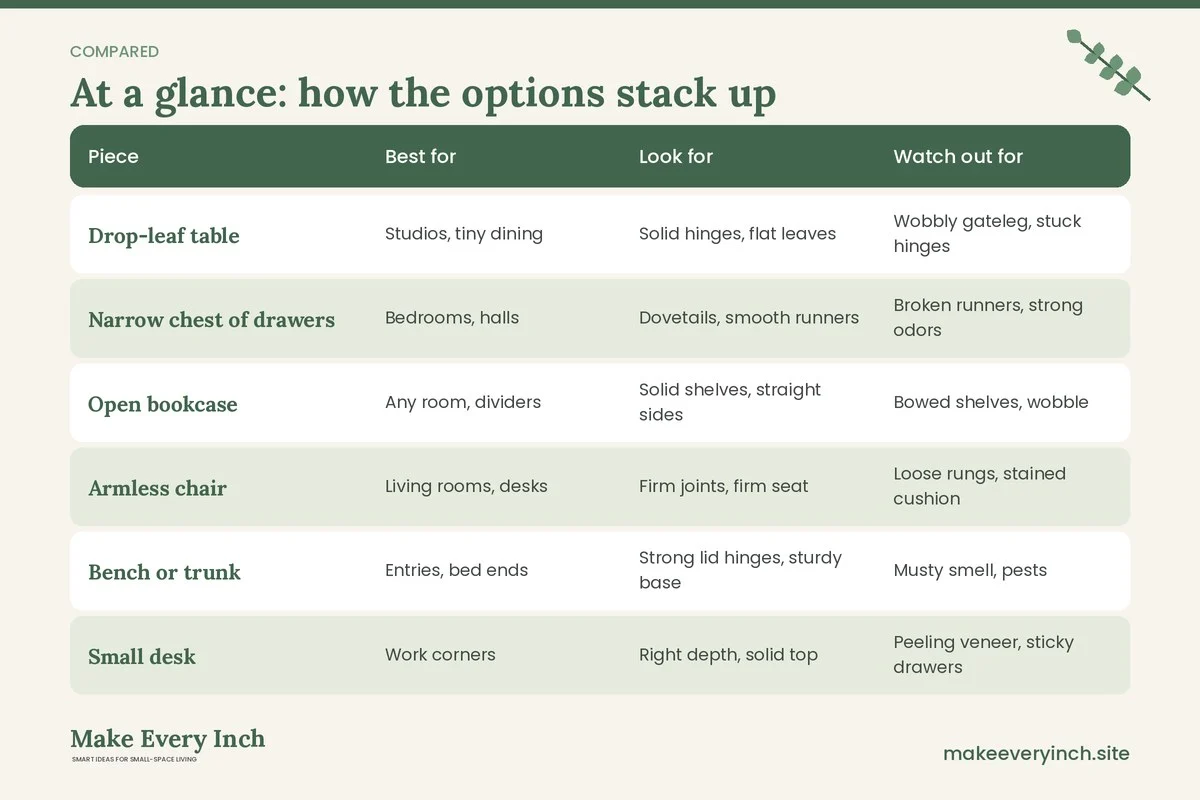
Comparison table: thrifted pieces for small homes
| Piece | Best for | Look for | Watch out for | Effort to refresh |
|---|---|---|---|---|
| Drop-leaf table | Studios, tiny dining | Solid hinges, flat leaves | Wobbly gateleg, stuck hinges | Low |
| Narrow chest of drawers | Bedrooms, halls | Dovetails, smooth runners | Broken runners, strong odors | Low to medium |
| Open bookcase | Any room, dividers | Solid shelves, straight sides | Bowed shelves, wobble | Low |
| Armless chair | Living rooms, desks | Firm joints, firm seat | Loose rungs, stained cushion | Medium |
| Bench or trunk | Entries, bed ends | Strong lid hinges, sturdy base | Musty smell, pests | Low |
| Small desk | Work corners | Right depth, solid top | Peeling veneer, sticky drawers | Medium |
| Sideboard | Dining, media | Shallow depth, solid doors | Heavy, hard to move | Medium |
| Floor lamp or table lamp | Lighting | Stable base, safe cord | Frayed wiring | Low to medium |
Use the table to pick which categories to hunt first. In general, hard-surfaced wood pieces such as tables, shelves and chests are easier to inspect and clean than upholstered ones.
Refresh ideas: from tired to tailored
A secondhand find often needs only a little care. Choose the lightest touch that works.
Clean first
Wipe with mild soap and a damp cloth, dry thoroughly, then assess. Many pieces look better after cleaning alone. Use a wood cleaner or a gentle wax on solid wood to revive the shine.
Light repairs
- Tighten loose screws and replace missing ones.
- Reglue loose joints with wood glue and clamp them overnight.
- Wax drawer runners with candle wax or paraffin so they slide.
- Replace sagging drawer bottoms with thin plywood or hardboard.
- Fill small dents with wood filler and sand lightly.
Paint and finishes
Painting is the fastest way to unify mismatched finds. A set of pieces in one color reads as a collection.
1. Test an unknown finish for lead if the piece is old, before sanding.
2. Clean and lightly scuff the surface. Use a damp cloth or a vacuum to control dust, and wear a dust mask and eye protection when sanding.
3. Prime with a stain-blocking primer if the old finish is dark or glossy.
4. Apply two thin coats of low-VOC water-based paint, letting each dry.
5. Seal with a clear low-VOC topcoat on tabletops.
6. Work with windows open or a fan running, and let the piece cure for several days before using it in a bedroom.
Avoid solvent-heavy strippers and oil-based finishes indoors unless you can ventilate properly and wear appropriate protection.
Hardware
New knobs and pulls are a low-effort change. Measure the spacing between existing screw holes before buying. If you are filling the old holes, use filler and sand them smooth.
Upholstery
A slipcover, new cushion cover or a simple staple-gun reupholster can transform a chair. Replace aging foam with new foam if it has lost its spring. Choose a durable, tightly woven fabric for seating. If the fabric or foam has an unpleasant smell that persists, think carefully before keeping the item.
Legs and lift
Adding or replacing legs on a sofa or cabinet makes it look lighter and shows more floor. Make sure the new legs are rated for the load and attach them properly.
Three example homes
Example 1: The studio with a drop-leaf and a bookcase
A 380 square foot studio needs a table, storage and a way to divide the bed from the living area. The shopper looks for a drop-leaf table that sits against the wall when closed, a pair of mismatched dining chairs that get a coat of the same paint, and a secondhand bookcase that stands at the end of the bed. The table folds to roughly 10 inches deep for daily use and opens for dinner guests. The bookcase is lower than 5 feet, with the heaviest books on the bottom shelf. Total effort is modest: a morning of cleaning, painting and a shopping trip. For more ideas about dividing a studio, read our guide to DIY room divider ideas for studio apartments and the small apartment living room ideas for studios.
Example 2: The one-bedroom with a thrifted dresser and a bench
A one-bedroom has a small closet. The dresser must be narrow and tall to fit a nook beside the bed. The shopper chooses a chest of drawers that is roughly 18 inches deep, tests the drawers, wipes the interior and paints the outside in a soft neutral. A bench at the foot of the bed holds spare blankets. The tall chest is anchored to the wall with the landlord’s permission, and a lamp sits on top rather than something heavy. A thrifted mirror leans on the floor rather than being hung, because the lease forbids holes. Read our post on small bedroom furniture ideas for more.
Example 3: The renter in a tiny living room
A small living room needs seating, a table and storage. The shopper picks an apartment-size loveseat, inspects the frame and cushions and sniffs for odors, then adds a trunk as a coffee table that also hides blankets, and a pair of nesting tables for guests. A secondhand floor lamp has its cord checked and rewired before use. A slim console sits behind the loveseat for keys and mail. Everything fits within a 30 to 36 inch walkway. For ideas on soft touches and decor, see our guide to thrifted apartment decor ideas and the vintage apartment ideas roundup.
Negotiation and decision rules
Prices are flexible at many sales, but treat bargaining politely and avoid pressure.
- Walk the room twice before deciding. If a piece is still the best thing you saw, it is worth considering.
- Ask about the history of the piece, including pets, smoking and storage conditions.
- Ask about returns at shops that offer them.
- Set a limit in your own mind in advance, so the thrill of the hunt does not push you past it.
- Consider delivery: a cheap piece that needs a van and two helpers may not be a deal.
- Pass gracefully: the next good find is usually around the corner.
A useful rule is the 3-question test. Does it fit the measured space and the route in? Is it sound, clean and safe? Would you buy it at a fair price if you saw it new? If any answer is no, move on.
Mixing thrifted and new
A small home does not need all-secondhand furniture. The best approach often mixes the two.
- Buy new for pieces that wear and carry health risks: mattresses, pillows and upholstered pieces from unknown sources.
- Buy thrifted for solid wood pieces that age well: tables, bookcases, chests and chairs.
- Buy new for items that need to meet current safety standards, such as children’s furniture.
- Use new hardware, lamps or cushions to polish a thrifted piece.
Our guide to budget renter upgrades and cheap storage ideas for apartments help you decide where to spend and where to save.
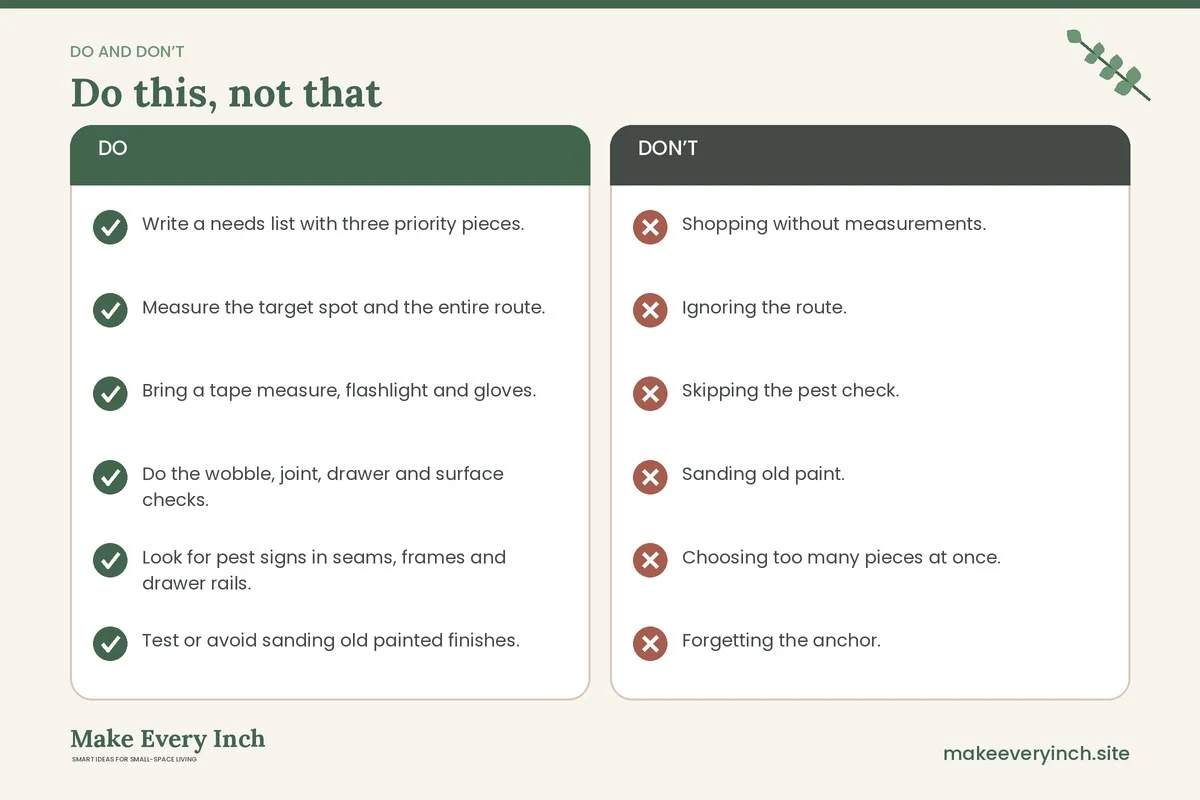
Mistakes to avoid
- Shopping without measurements. The piece looks smaller in a store.
- Ignoring the route. A table that cannot get through the door is not a bargain.
- Skipping the pest check. Treat every upholstered or crevice-filled piece with suspicion until inspected.
- Sanding old paint. Test for lead first and ask a professional if unsure.
- Choosing too many pieces at once. Buy one, place it, live with it and then add the next.
- Forgetting the anchor. A tall, secondhand dresser without an anchor can tip.
- Over-restoring. Some wear adds character. Fix the structure, then decide how much more to do.
- Painting in a closed room. Always ventilate and use low-VOC products.
Checklist
- Write a needs list with three priority pieces.
- Measure the target spot and the entire route.
- Bring a tape measure, flashlight and gloves.
- Do the wobble, joint, drawer and surface checks.
- Look for pest signs in seams, frames and drawer rails.
- Test or avoid sanding old painted finishes.
- Check cords, plugs and bulbs on lamps.
- Check recalls for any labeled pieces.
- Plan to anchor tall furniture, with permission for holes.
- Clean and quarantine before bringing the piece into living areas.
- Refresh with low-VOC paint and ventilation.
- Place one piece at a time and reassess.
FAQ
Is thrifted furniture safe to bring into a small home?
Usually yes, if you inspect for pests, damage, odors and tipping hazards, clean it well and avoid items such as older cribs. Quarantining a piece in an entry area for a short time is a sensible extra step.
How do I check for bed bugs on secondhand furniture?
Use a flashlight to look in seams, cushions, joints and behind drawer rails for dark spots, shed skins and live insects. If you find any signs, leave the piece. Avoid secondhand mattresses entirely.
What size furniture works best in a small home?
Pieces with a small footprint and visual lightness: legs that show floor, shallow depth and open backs. Always measure the room and the route before buying.
Can I paint old furniture safely?
Yes, with precautions. Test old finishes for lead before sanding, wear a mask and eye protection, work in a ventilated space and use low-VOC water-based paint and sealer.
Do I need to anchor a thrifted dresser?
Anchor any tall piece to a wall stud, with the landlord’s consent where holes are involved. If you cannot drill, choose a lower piece and keep heavy items at the bottom.
Is it cheaper to thrift or buy new?
Thrifted pieces are often lower in cost for equivalent quality, but time, transport and refresh effort add up. Compare the full picture before deciding.
Keep going: Keep going with our guide to thrifted apartment decor ideas, the roundup of diy apartment upgrades and the post on DIY room divider ideas for studio apartments.
Save this guide for later
Pin the ideas you like to Pinterest so you can come back to them when you plan your space.