13 Small Home Linen Closet Alternatives That Hold Towels and Sheets
Quick answer: The best small home linen closet alternatives are a dresser drawer or two, a lidded bench or ottoman, vacuum-free under-bed boxes, a slim shelf over the toilet or door, a ladder or open rack in the bathroom, and a cabinet on a spare wall. Start by counting how many sheet sets and towels you really need, store each set inside its own pillowcase, keep linens dry and ventilated, and anchor any tall unit to the wall.
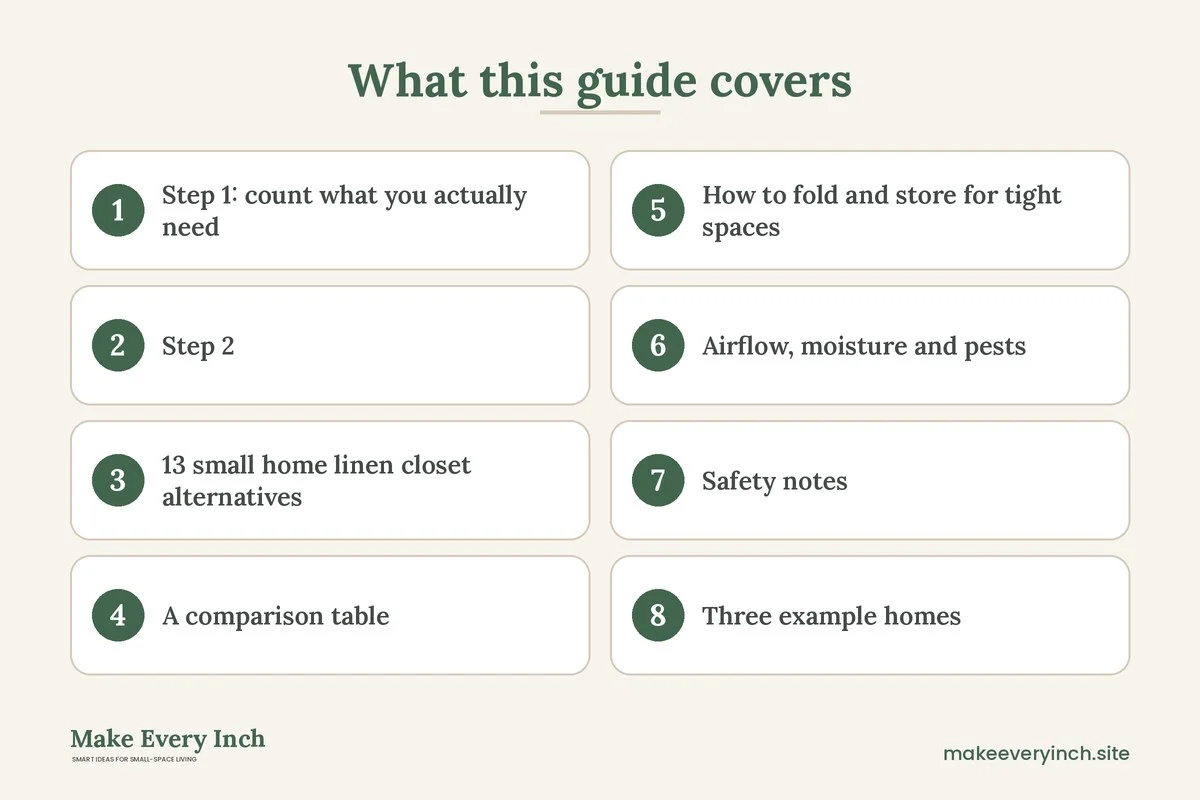
Small home linen closet alternatives become important the moment you realize your home does not have a linen closet at all, or has one that is full of vacuum parts and paperwork. The usual answer is to buy a bigger cabinet, but a better answer is to work out how much linen you need, divide it by use, and then place each group where it is used. Bath towels belong near the bath. Sheets belong near the bed. Guest bedding belongs somewhere dry and out of the way. This guide uses a capacity formula and a location-by-use approach to find the right alternatives for your home. It covers 13 ideas, a comparison table, folding methods, airflow and moisture tips, three example homes, a checklist and a FAQ. For a broader view of the topic, start with our main guide to small space organization ideas, then compare it with our earlier post on linen storage ideas without a linen closet, which focuses on folding and bedroom spots, while this one focuses on counting, placement and airflow.
Step 1: count what you actually need
Most linen closets overflow because they hold twice as much as anyone uses. Before you look for a new space, work out the right amount. A simple formula keeps it honest.
Sheets and bedding
For each bed, you need one set on the bed, one set in the wash and one spare. That is three sets per bed. A set includes a fitted sheet, a flat sheet if you use one, and pillowcases. If you rotate in a heavier winter set, add a fourth set for that season. For a two-bed home, that is six to eight sets at most. Anything beyond that is usually duplicates or sets that do not fit any bed you own.
Towels
Count one bath towel per person in use, one in the wash and one spare. For a household of two, this is six bath towels, plus a similar number of hand towels and washcloths. Add a pair of guest towels if you host. If you use a gym towel or a beach towel, keep it separate so it does not enter the bathroom rotation.
Blankets and extras
Keep one throw per sofa seat you actually use, one extra blanket per bed and a single guest blanket. Everything else is a candidate for donation or seasonal storage. For seasonal pieces, see our post on seasonal clothing storage in small homes, since the rules for folding and sealing are similar.
Do the math with your space
Measure how much space a folded set takes. A folded queen sheet set in a pillowcase takes roughly the area of a large book, often 10 to 14 inches wide and 4 to 6 inches high. A stack of four folded bath towels is often 12 to 14 inches wide and 8 to 10 inches high. Multiply by the number you need and compare with the spaces below. If your total is more than a single shelf or two drawers, reduce it before you buy storage.
Step 2: split linens by where they are used
The reason a hall linen closet worked is that it was central. In a small home with none, the better strategy is to disperse. Divide linens into three groups.
- Bedroom group: current and spare sheet sets and blankets. Store them in the bedroom, within an arm’s reach of the bed.
- Bathroom group: bath towels, hand towels and washcloths. Store them in the bathroom so wet and dry towels are in the same room.
- Guest and seasonal group: guest bedding, extra blankets and heavy winter pieces. Store them in the driest, least-used spot in the home.
Splitting linens this way removes the need for a single large cabinet. Each group fits a smaller space, and each space is close to where the linen is used.
13 small home linen closet alternatives
Bedroom spots
1. A dresser drawer for sheet sets
Dedicate one drawer to bedding. Fold each set and tuck it into its own pillowcase, then stand the bundles on edge so you can see each one. A 4 to 6 inch deep drawer holds three sets. This is the cheapest alternative, because many homes already have a dresser. If you do not, see our guide to small bedroom storage ideas.
2. Under-bed boxes with breathable lids
Flat boxes or fabric bins fit under most beds with 6 to 10 inches of clearance. They suit spare blankets and guest bedding. Choose breathable fabric or a box with a vented lid so moisture does not collect. Avoid putting damp items into a closed box, and keep the box dry. For layouts and clearances, read under bed storage ideas.
3. A storage bench at the foot of the bed
A lidded bench can hold a throw, a spare duvet and a pillow. Choose a design with a slow-close hinge or a lid stay so a child’s fingers cannot get trapped. Check the weight limit before you sit on it, and keep it away from heaters.
4. The top shelf of a wardrobe
A wardrobe often has dead space above the hanging rail. A pair of fabric bins on the top shelf can hold the seasonal blanket and guest bedding. Keep heavy items low and light items high, and use a stable step stool rather than a chair.
Bathroom spots
5. A ladder or open rack for towels
A leaning ladder rack or a freestanding open rack holds rolled or folded towels in a narrow footprint. Open racks have the advantage of airflow, so towels dry between uses. A rack that is 12 to 14 inches deep fits most bathrooms. Anchor a tall rack to the wall, because wet towels add weight and make it top heavy.
6. Over-the-toilet shelves
A freestanding unit above the toilet uses space that nothing else wants. Put a stack of folded towels on the middle shelf and a basket of washcloths on the lower one. Make sure the unit does not block a ventilation fan or a window. Read our review post on best over the toilet storage for sizes and clearance.
7. Rolled towels in baskets
Rolled towels fit round or square baskets neatly, and a row of three baskets on a shelf can store a household’s supply. A roll takes less depth than a fold and shows the color at a glance. Use baskets that can be wiped, and keep them away from the tub edge.
8. Wall hooks and a towel bar
For towels in use, a couple of hooks or a bar behind the door keep the damp ones off the floor. If you rent, choose an over-door option or an adhesive hook within its weight rating. Do not drill into tile without permission. Our post on small bathroom organization ideas covers more of these layouts.
Hall and living room spots
9. A narrow cabinet on a spare wall
A shallow cabinet 12 to 16 inches deep fits a hallway or the end of a living room and holds a week of sheets and towels. Use doors to hide the contents, and add a small gap at the back for airflow if the wall is exterior. Anchor to the wall studs with permission if you rent.
10. A cart or trolley
A narrow rolling cart is an easy alternative when you have a corner but no wall space. It can hold folded towels, then roll next to the bath on laundry day. Lock the wheels when loaded, and keep it out of the walkway.
11. A lidded ottoman or bench in the hall
A hall bench with storage can hold a spare duvet or a couple of blankets. Keep the contents clean and dry before they go in, and add a sachet if you like. For more ideas, see hidden storage ideas.
12. A closet door rack
If you do have another closet, an over-door rack or a hanging organizer on the back of the door adds four to six pockets for washcloths, pillowcases and small sets. Check your door clearance and hinge strength first, and compare it with the options in our post on small closet door storage ideas.
13. A shelf above a door or window
A shelf above a door frame is out of the way and can hold a bin of guest sheets. Use it only if the shelf is rated for the load, and install it only with permission. Keep heavy items lower down, and use a bin with a handle so you can lift it safely.
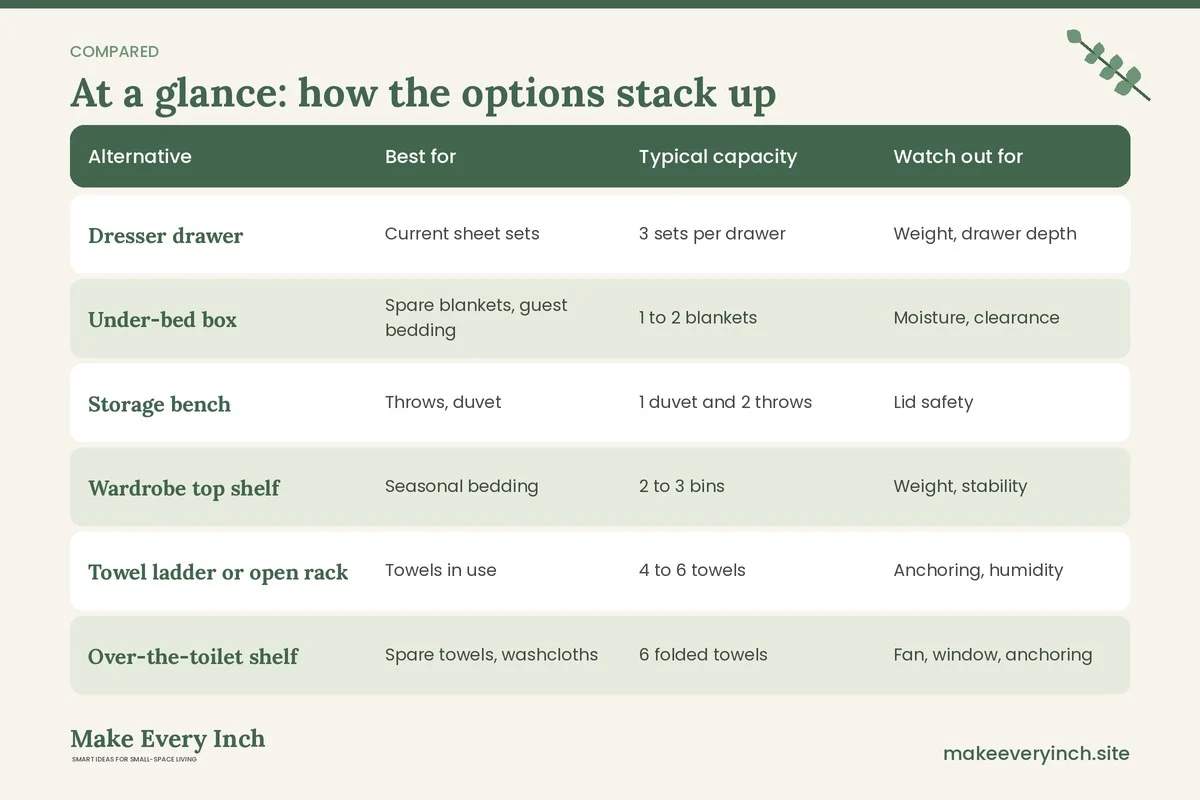
A comparison table
| Alternative | Best for | Typical capacity | Watch out for | |
|---|---|---|---|---|
| Dresser drawer | Current sheet sets | 3 sets per drawer | Weight, drawer depth | |
| Under-bed box | Spare blankets, guest bedding | 1 to 2 blankets | Moisture, clearance | |
| Storage bench | Throws, duvet | 1 duvet and 2 throws | Lid safety | |
| Wardrobe top shelf | Seasonal bedding | 2 to 3 bins | Weight, stability | |
| Towel ladder or open rack | Towels in use | 4 to 6 towels | Anchoring, humidity | |
| Over-the-toilet shelf | Spare towels, washcloths | 6 folded towels | Fan, window, anchoring | |
| Narrow cabinet | A full week of linen | 4 sets and 6 towels | Anchoring, depth | |
| Rolling cart | Moveable towel supply | 6 towels | Walkway, wheel locks |
Use the table to pick two or three alternatives that match your count from step one. Most small homes work best with a combination of a drawer, a towel rack and one hidden spot for guest bedding.
How to fold and store for tight spaces
Folding is the cheapest way to gain space. A few methods suit different alternatives.
- Sheet set in its own pillowcase. Fold the fitted sheet in thirds, then in half, stack it with the flat sheet and pillowcases, and slip the bundle into one pillowcase. The set stays together and stands on edge.
- Towels folded in thirds, then in half. Stack with the folded edge facing out so the stack looks uniform. Roll towels instead if the shelf is shallow.
- Blankets folded to the shelf size. Fold to the width of the space, then roll for baskets.
- Duvets in breathable covers. Avoid sealing them in airtight plastic for long periods, since trapped moisture can cause odors. If you use vacuum bags, check the label and limit compression time.
- Labels on the front. A simple tag with the bed size or room name stops mix-ups.
Airflow, moisture and pests
Linen storage has one big enemy: damp. Towels that are not fully dry smell musty, and blankets stored in humid areas can grow mildew. Small homes with no closet often put linen in the least ventilated corner, so check these points.
- Dry everything before storing. Fully dry towels, sheets and blankets before you fold them. A slightly damp load can taint everything around it.
- Leave a gap. Do not pack a shelf tight. A finger of space around each stack helps air move.
- Avoid exterior walls and cold floors. Cold surfaces can attract condensation. Raise boxes a few inches off the floor with a slim riser or tray.
- Use breathable containers. Cotton, linen or vented plastic let air circulate better than sealed boxes.
- Watch the bathroom. Steam from the shower can get into cabinet fabrics. Run the exhaust fan during and after showers and keep spare towels in a closed cabinet or a bag rather than on an open rack if the room is very humid.
- Choose pest-friendly storage. Keep linen off the floor and check seams in older homes. Cedar blocks or lavender sachets are common choices, and you should keep any scented item out of reach of children and pets.
Safety notes
- Anchor tall furniture. A narrow cabinet, ladder rack or tall shelf can tip, especially when towels are wet. Anchor them to wall studs using the supplied hardware, and ask for permission if you rent.
- Do not drill without permission. Prefer over-door, tension and freestanding solutions until the landlord agrees.
- Check weight limits. A stack of wet towels is heavy. Do not exceed the rating of a shelf, hook or rod.
- Electrical and ventilation. Keep linens away from heaters, lamps, power strips and ventilation openings. Never cover a heater or a fan with towels, and keep stacks clear of lights.
- Wet areas and GFCI. In a bathroom, keep sockets away from wet towels and make sure outlets near water are GFCI protected.
- Child and pet safety. Lidded benches and cabinets need slow-close hinges or lid stays. Keep scented sachets, small items and drawstring bags out of reach.
- Low-VOC finishes. If you paint or refinish a cabinet, choose a low-VOC product and ventilate the room until the odor fades before storing linens inside.
Three example homes
Example 1: a studio with one dresser
A studio has no closet apart from a small wardrobe. The owner keeps two sheet sets in a dresser drawer, each in its own pillowcase, and a spare in an under-bed box. A ladder rack in the bathroom holds four towels, and the rest live in a basket under the sink. A lidded bench at the foot of the bed holds a throw and a guest duvet. The whole system fits in the existing furniture, and nothing was drilled into the walls.
Example 2: a one-bedroom with a narrow hallway
A one-bedroom has a 36-inch-wide hallway and no linen closet. The owner places a shallow cabinet 14 inches deep against one wall, anchored to the stud with permission, and keeps the bed linens and spare towels inside. The bathroom has a small over-the-toilet shelf for daily towels, and the bedroom has a single drawer for current sheets. Because the cabinet is shallow, the hall still has more than 30 inches of clear walkway.
Example 3: a rented two-bedroom with kids
A rented two-bedroom has no hall closet and a rule against drilling. Each child has a drawer for their own sheets and pajamas, and a rolling cart in the hall carries the towels. The adults use a lidded ottoman in the living room for the guest bedding and blankets. A free-standing ladder rack in the bathroom is leaned against the wall with a non-slip pad, and wall-mounted storage was swapped for an over-door rack. Everything can move out at the end of the lease.
Mistakes to avoid
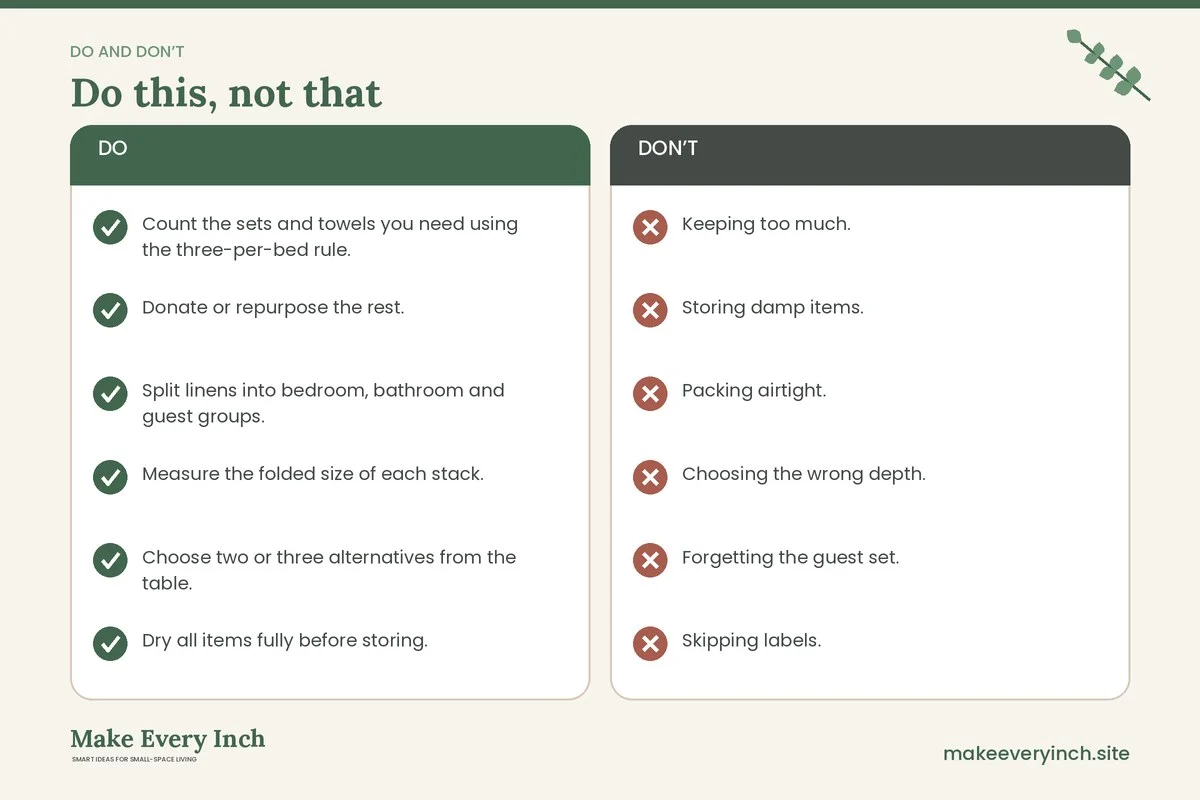
- Keeping too much. The most effective alternative is a smaller supply. Count first, then store.
- Storing damp items. Even a slightly damp towel can spoil a whole stack.
- Packing airtight. Compression bags and sealed bins trap moisture and can flatten fibers.
- Choosing the wrong depth. A cabinet that sticks out too far eats walkway. Measure first.
- Forgetting the guest set. Without a plan, guests lead to a sudden pile on the sofa.
- Skipping labels. Unlabeled bins turn into a lottery on laundry day.
- Ignoring the anchor. A tall unit that is not fixed is a hazard in any home with children.
For more pitfalls, read small home organization mistakes to avoid.
Checklist
- Count the sets and towels you need using the three-per-bed rule.
- Donate or repurpose the rest.
- Split linens into bedroom, bathroom and guest groups.
- Measure the folded size of each stack.
- Choose two or three alternatives from the table.
- Dry all items fully before storing.
- Leave a small air gap around each stack.
- Anchor tall furniture to the wall with permission.
- Check weight limits on hooks, shelves and racks.
- Keep linen away from heaters and vents.
- Label each box or drawer.
- Review the system every season.
FAQ
What can I use instead of a linen closet?
A dresser drawer for sheets, a rack or shelf in the bathroom for towels, an under-bed box for spare blankets and a lidded bench or narrow cabinet for guest bedding. Choose according to how many sets you need and where each is used.
How many sheet sets do I need?
Most households need three per bed: one on the bed, one in the wash and one spare. Add a heavier set if you change bedding seasonally.
How do I keep towels from smelling in a small bathroom?
Dry them fully, hang them in open air and use the exhaust fan. If the room is humid, keep spare towels in a closed cabinet or in another room.
Is it safe to store linens under the bed?
Yes, if the area is dry and the boxes are breathable. Keep out any item that is damp, and leave a small gap for airflow. Our guide to small bedroom organization ideas offers other ways to use the space.
Can I use vacuum bags for bedding?
They can save space for seasonal items, but long-term compression may flatten fibers and trap moisture. Read the product label and avoid sealing anything that is not fully dry.
What if I rent and cannot drill?
Use freestanding racks, over-door organizers, carts and benches. Anchor tall units only with permission. Our post on organization ideas for renters gives more no-drill solutions.
Keep going: Keep planning with our small space organization ideas, small home cleaning supply storage ideas and vertical storage ideas.
Save this guide for later
Pin the ideas you like to Pinterest so you can come back to them when you plan your space.