Seasonal Clothing Storage in Small Homes
Quick answer: Good seasonal clothing storage in small homes follows a simple loop: sort, wash or clean everything, dry it fully, pack it in breathable bins or lightly compressed bags, label the outside and store it flat in a cool, dry place such as under the bed or on a high shelf. Avoid damp rooms, skip mothballs, use cedar or lavender as gentle deterrents and swap seasons twice a year.
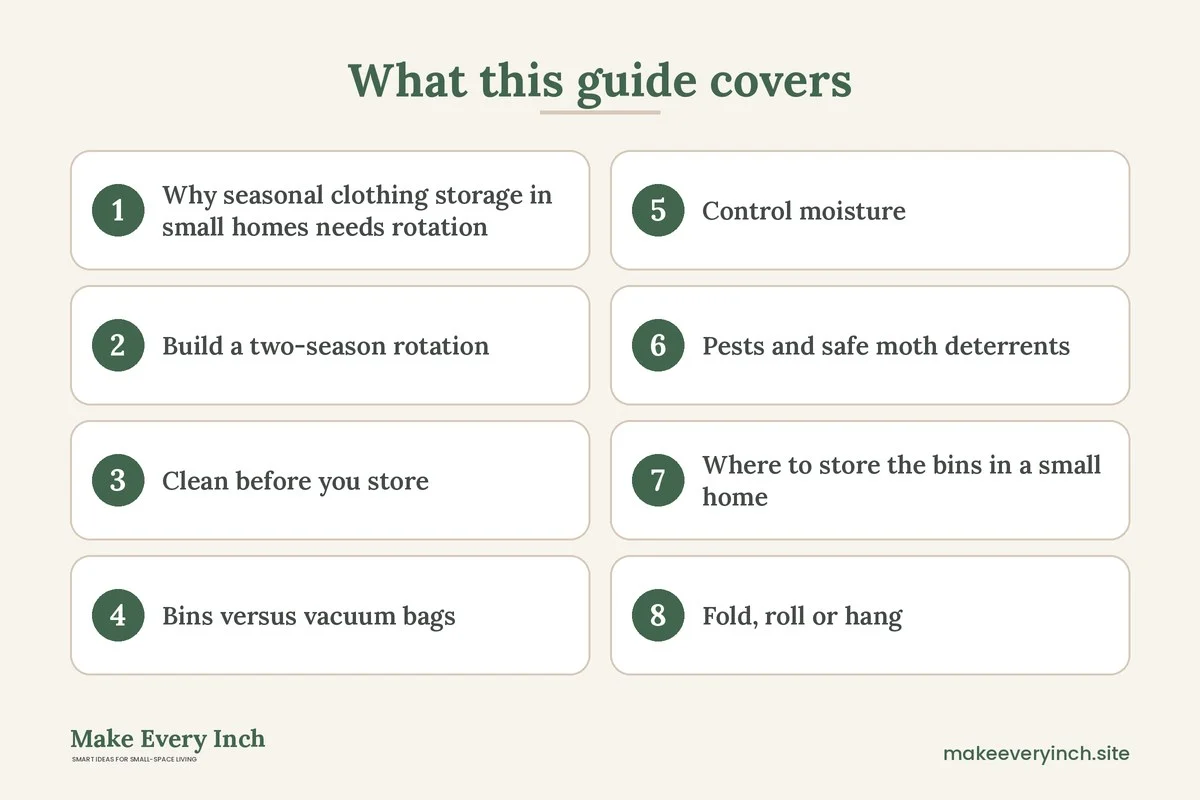
Seasonal clothing storage in small homes is a puzzle of space, time and care. A small closet cannot hold a full year of clothes at once, so something has to leave twice a year, and whatever leaves has to come back clean, fresh and uncrushed. Done badly, the stored sweaters smell musty, the coat has a hole and the swimsuit is lost behind a suitcase. Done well, the swap takes one afternoon and the closet feels roomy again. This guide gives you the full system: how to build a rotation, what to clean before storing, how to choose between bins and vacuum bags, how to control moisture and pests, where to put the bins in a small home and how to label them so you can find things. It also has a comparison table, three example homes, safe moth deterrents, a checklist and an FAQ. For the room-level plan, start with our pillar guide to small closet ideas, and for the accessory side of the swap, see handbag storage ideas for small closets.
Why seasonal clothing storage in small homes needs rotation
A closet works best when it holds what you wear now. Out of the whole wardrobe, most people wear a fraction in any given season, and the rest sits in the way. Rotation takes advantage of that by moving out-of-season clothes to a deeper, less convenient place and bringing in the clothes you need. The closet shrinks to a size you can see into, and you stop digging through shorts in January.
Rotation does not suit every garment. Keep year-round basics in the closet: underwear, socks, jeans, T-shirts, light layers and anything you wear in more than one season. Keep an emergency layer for unexpected weather, such as a light jacket in summer. Store only the clearly seasonal items: heavy sweaters, parkas, scarves, boots, swimwear, linen dresses and sandals. A good target is to store roughly a third to a half of what you own. Climates with mild winters may rotate less, and those with four hard seasons may rotate more.
Build a two-season rotation
A simple two-season plan is easier to keep than a four-season one, and most small homes only need two. The first group is warm-season clothing, and the second is cold-season clothing. Pick two dates, one in spring and one in autumn, and stick them on the calendar. Many people choose the weekends when the weather first flips, since the need is obvious then.
Here is a repeatable process that you can run on one afternoon.
1. Empty the closet and the dresser into piles on the bed. Work in daylight if you can, so stains and holes are visible.
2. Sort each piece into four groups: keep in rotation, keep year-round, repair or clean, and donate or discard.
3. Be honest about fit and use. If you did not wear it last season, it is a candidate to leave. See our decluttering rules for small homes for a quick test.
4. Clean everything that is going into storage. More on that in the next section.
5. Pack, label and place the bins.
6. Bring the new season out. Check each item, air it and press or wash what needs it.
7. Refill the closet in a clean, planned layout, with the most worn items at easy reach.
A small home benefits from a rule that one item in means one item out. When a new coat arrives, an old one leaves. Otherwise the stored bins grow each year and spill into the rest of the home. For a deeper closet plan, read our guide to small closet organization ideas.
Clean before you store
Cleaning before storage is the most important step. Stains you cannot see set over months, and body oils, sweat, food spills and perfume attract insects. A garment that looks clean after one wear can come out of storage with yellow patches. Follow this order.
- Check the care label for each piece and follow it. Wash, hand wash or dry clean as the label says.
- Wash or clean everything, even items you wore once. Pay attention to underarms, collars and cuffs.
- Treat stains early, and test any stain remover on a hidden seam. Use mild products and read the label. Ventilate the room when you use anything with a strong smell, and keep products away from children and pets.
- Dry completely. Damp fabric in a sealed bin grows mildew within days. Air-dry clothes until they feel dry throughout, including thick seams and pockets, then let them rest another few hours. Dry wool and knits flat so they do not stretch.
- Do not use starch or heavy fabric softener on items going into storage, since residues can attract pests.
- Fix small problems. Sew loose buttons, patch small holes and repair seams now, not in autumn.
- Empty pockets and remove belts, pins and anything metal that could rust.
If an item is dry clean only, pick it up from the cleaner, and take it out of the plastic cover before you store it. The plastic bags that cleaners use are meant for carrying and can trap moisture and fumes during long storage.
Bins versus vacuum bags
The central question in seasonal storage is how to pack. Both rigid bins and vacuum-compression bags have a role in a small home, and the right choice depends on the fabric.
Rigid bins and boxes
Rigid bins protect clothes from crushing, insects and spills. A lidded bin of 40 to 60 quarts holds a season of knits or a few jackets and stacks neatly. Cloth boxes with lids breathe and are good for natural fibers, but they offer less protection from water and insects. Plastic bins protect against pests and water leaks, but trap moisture if clothes are not fully dry. Whichever you choose, pick a size that you can lift without strain, and do not pack so full that the lid bulges.
Vacuum and compression bags
Vacuum bags squeeze out air and can shrink a bulky load to a fraction of its size. They are most useful for bulky, resilient items like synthetic puffer jackets, comforters and pillows, though even these should not stay compressed for years. They can damage some fabrics.
- Avoid wool, cashmere, down-filled items and delicate knits. Long compression crushes fibers, flattens loft and can leave creases that do not relax.
- Avoid leather and fur. These need air, and compression may crack or mark them.
- Do not leave items compressed forever. Many makers advise limiting compression time. Check the instructions and consider a season at most.
- Check bags for leaks after a day. A bag that loses air is a bag that is not protecting its contents.
- Make sure items are fully dry before sealing. Moisture trapped in an airtight bag is a recipe for mildew.
- Do not overfill. A bag stretched too tight may split at the seam.
For many small homes the best approach is a mix: rigid bins or cloth boxes for knits and structured items, and a few vacuum bags for the bulkiest, most durable pieces such as spare bedding or synthetic coats.
Comparison table: choosing a container
| Container | Best for | Strengths | Watch out for |
|---|---|---|---|
| Lidded plastic bin | Knits, T-shirts, scarves | Stacks well, keeps out pests and spills | Trapped moisture, brittle lids |
| Cloth storage box | Wool, linen, delicate items | Breathes, soft sides | Less pest protection, can sag |
| Vacuum bag | Synthetic coats, comforters | Big space saving | Crushes wool and down, air leaks |
| Garment bag on a rod | Dresses, suits, coats | Keeps shape, easy to see | Needs rod space, use breathable fabric |
| Cardboard box | Short-term only | Easy to find, breathable | Attracts pests, weak when damp |
| Under-bed drawer | Light and flat items | Uses unused height | Dust, shallow depth |

Control moisture
Moisture is the biggest enemy of stored clothes, more than time. It breeds mildew, causes odors and attracts insects. In a small home it can come from a bathroom, a kitchen, a drying rack or a poorly ventilated closet. Use these habits.
- Store in a cool, dry place. A spot near an interior wall in a conditioned room is better than a basement, an attic or against an exterior wall. Temperatures that swing hot and cold cause condensation inside containers.
- Keep bins off the floor when the floor can get damp. A shallow shelf or a few inches of riser helps, particularly on concrete or in a ground-floor room.
- Do not store near pipes, a water heater or a window that sweats in winter.
- Add a moisture absorber if the space is humid. Silica packs or a reusable moisture-absorbing pouch can help, but keep them away from children and pets, and follow the label. A dehumidifier in the room is another option in damp climates.
- Check the bins mid-season. Open one, sniff and look for spots. A musty smell is a sign that something was damp when it went in.
- Let clothes breathe now and then. If you can, air the stored items on a dry day once a year, such as when you rotate.
- Ventilate the closet. A door left slightly open on dry days and a louvered door can help. If you have a habit of drying laundry indoors, keep it away from the storage area, and see our guide to small laundry room organization for drying setups that protect the rest of the home.
If you find mildew, take the item outside, brush off the spores, wash or dry clean it according to the label and let it dry in the sun if the fabric allows. Wear a mask when you handle moldy items. If mold is spreading on walls or shelves, treat it as a building problem and ask for help, since cleaning clothes does not fix the cause.
Pests and safe moth deterrents
Clothes moths are the usual concern, and the damage comes from the larvae, which eat natural fibers such as wool, silk, fur and feathers. Soiled clothes are the favorite food, which is why cleaning before storing matters so much. Other pests, such as carpet beetles and silverfish, may also appear.
Prevention first
- Clean clothes thoroughly, as described above.
- Seal natural-fiber items in tightly closed containers, since moths cannot get through a sealed lid or a closed zipper.
- Vacuum the closet, the corners, the baseboards and the shelves before each swap. Larvae hide in lint and dust.
- Wipe shelves and bins with a damp cloth and let them dry fully.
- Check items twice a year for small holes, webbing or tiny cocoons.
Safe deterrents
- Cedar blocks or rings. Cedar has a pleasant smell and is commonly used as a gentle deterrent. The scent fades, so lightly sand the surface once a year to refresh it. Cedar is not a cure for an existing infestation, and it works best alongside clean clothes and sealed containers.
- Dried lavender sachets. Many people like these for the fragrance, though they work as a mild deterrent at best. Keep sachets from touching delicate fabrics, in case oils stain.
- Pheromone traps. These traps attract male moths and help you spot a problem early. They are a monitor, not a complete solution. Place them out of reach of children and pets.
- Freezing. If you find signs of pests in a small item, sealing it in a bag and freezing it for several days is a common approach. Let it return to room temperature in the bag before opening it, to avoid condensation.
- Heat and washing. Washing or drying at the highest temperature allowed by the care label kills moths at all stages. Dry cleaning does the same.
Chemical caution
Be careful with traditional mothballs. They contain pesticides that are harmful if swallowed or if their fumes are inhaled for long periods, and they are especially dangerous to children and pets. The smell lingers in fabric and in a home, and it is hard to remove. Many places restrict how they may be used, and the label says to use them only in sealed containers where fumes cannot reach living spaces. In a small home with little air movement, the safest approach is to skip them and rely on cleaning, sealing and gentle deterrents. If you already have a serious infestation, consider asking a licensed pest professional, and keep children and pets away from any treated area. Always follow label instructions for any product you use, and never put any pesticide in a bag next to clothes you will wear unless the label allows it.
Where to store the bins in a small home
The best location is a place you will not lose and that stays dry. Small homes have more hiding spots than you think.
- Under the bed. A bed with 8 to 14 inches of clearance can hold shallow bins or rolling drawers. Keep the area clean, since dust collects there, and use lidded boxes. For a longer list of options, read our guide to under-bed storage ideas. A bed frame with built-in drawers works too, as long as the weight on the drawer slides stays within the rating.
- The top closet shelf. A shelf above the rod is ideal for light, bulky items such as folded scarves and sweaters. Keep heavy bins off high shelves, use a stable step stool and never overload the shelf. A bin that falls from above head height is a hazard.
- Above the door or in the gap above a wardrobe. Many wardrobes leave 12 to 18 inches to the ceiling. A row of fabric boxes there is out of sight. If the wardrobe is tall, anchor it to the wall, and keep the heaviest items low.
- Behind the sofa or a console. A flat, narrow bin slides behind a sofa or under a console table in a living room.
- Inside a bench or ottoman. A storage bench in the entry or the bedroom holds a bin of knits. Check our guide to the best storage ottomans for what to look for.
- A friend’s or a family member’s spare space. For very bulky coats, a spare closet elsewhere may be the best option.
- A rental storage unit. This is a last resort, since conditions vary and clothes in an unconditioned unit face heat and damp.
Whatever you choose, avoid the hot attic and the damp basement, and avoid anywhere near a heater, vent or sunny window. Our post on small bedroom storage ideas offers other ways to find space in a bedroom.
Fold, roll or hang
How you pack affects both the volume and the condition of clothes.
- Fold knits flat. Hanging a sweater stretches the shoulders. Fold it in thirds with the arms in and lay it flat in the bin.
- Roll T-shirts, leggings and soft cottons. Rolls take less volume than folds and let you see each item. They suit bins with a depth of about 8 to 10 inches.
- Hang coats and dresses. A garment bag made from breathable fabric keeps them in shape. Use wide, padded hangers for coats to support the shoulders.
- Layer with tissue. For delicate items, add acid-free tissue between layers to reduce creases and protect from color transfer.
- Put the heaviest items at the bottom. In a bin, jeans and sweaters go underneath and lighter pieces go on top.
- Keep sets together. Pack a scarf, hat and gloves in one bag inside the bin, so you can find them as a set.
Label so you can find things
A small home has no room for a mystery bin. A good label turns a hunt into a one-minute job.
- Put a label on two sides of each bin, so you can read it from any angle.
- Name the season and the owner. For example, “Winter knits, Sam.”
- List the contents. A short list taped inside the lid saves you from opening five bins.
- Add a date. Writing the date helps you see what has been in storage for too long.
- Use a photo. A phone photo of each packed bin lets you see the contents without opening it. Keep the photos in an album called “Storage.”
- Number the bins and keep a master list on your phone, with where each bin lives.
- Color-code by season or by person if you have a household of several people.
Use labels that stay put, such as paper labels in a sleeve or washable tags. Avoid writing directly on a bin if you may reuse it.
Three example homes
A studio apartment of about 450 square feet
The closet holds one rod and a shelf. Cold-season items fill two 50-quart lidded bins, which sit under the bed with a 12-inch clearance. A garment bag holds two coats on the closet rod’s far end. The top shelf holds a cloth box of scarves, hats and gloves, labeled. Twice a year the owner spends two hours on the swap, and the closet never holds more than 30 hangers. Cedar rings hang from the rod and are sanded each autumn.
A one-bedroom apartment for a couple
There are two small closets and an entry with no storage. Each partner has two bins, and they sit on a high shelf in the bedroom closet and behind the sofa. The couple keep bulky comforters in vacuum bags on the top shelf and the winter coats in garment bags in the guest closet. A shared note on their phones lists each bin with a photo. They switch seasons on the same weekend. If you have a bedroom with no closet, read about small bedroom ideas without a closet for ways to adapt this plan.
A family of four in a small house
Four wardrobes make a lot of clothing, and kids outgrow things quickly. Each child has a labeled bin for next size up, kept on a high shelf with the heaviest at the bottom. A rack in the garage is out of the question because of damp, so the family uses a hall cupboard and under-bed boxes. Anything that no longer fits goes in a donate bag the same day. Keep small items such as buttons and loose hardware away from young children, and anchor tall shelves and wardrobes to the wall. For a hands-on plan for a shared space, see our DIY closet organization for small spaces.
Storing shoes, boots and accessories
Footwear is bulky and often overlooked. Clean shoes and boots, let them dry fully, and stuff them with paper or shoe trees to keep their shape. Keep leather boots upright with supports in the shaft, and store sandals in a flat box. Wrap each pair in a cloth bag, and label the bin. Gloves, scarves and hats go in a small box or bag within the bin, so they stay together. For bags, follow the shape retention tips in our handbag storage ideas for small closets.
Mistakes to avoid
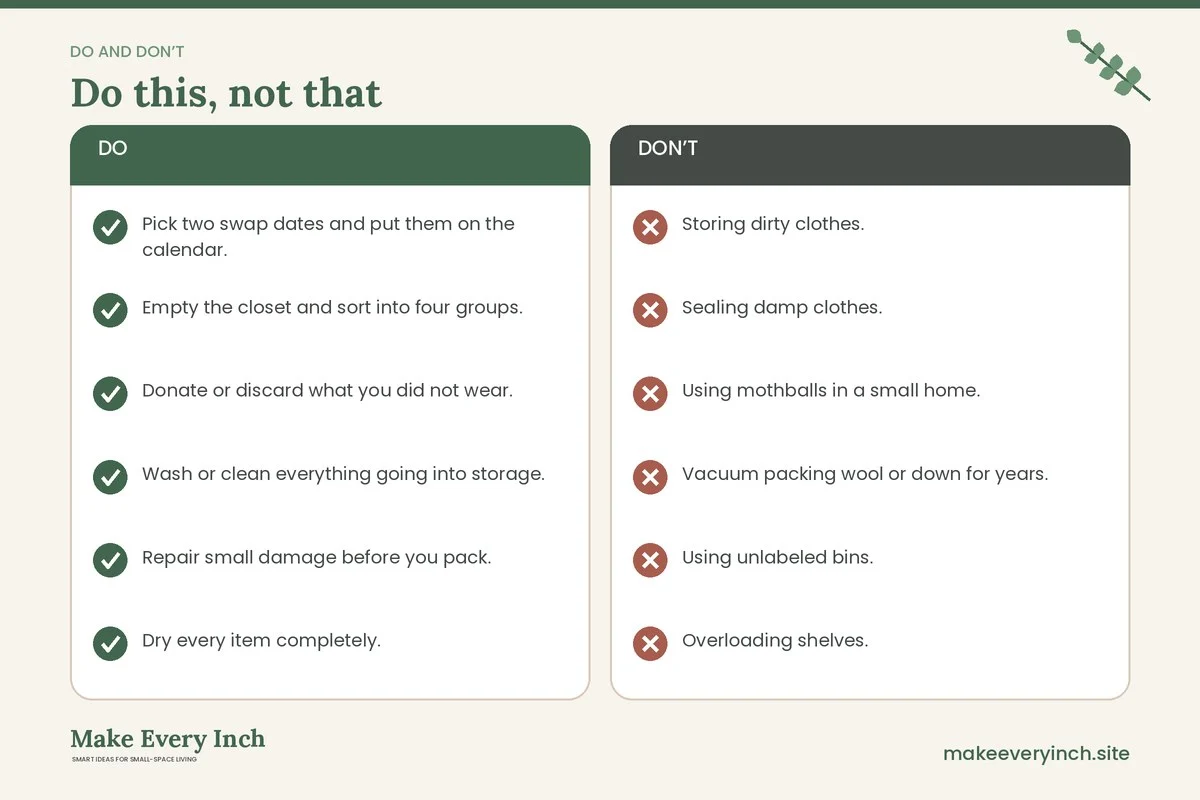
- Storing dirty clothes. Stains and body oils attract pests and set permanently.
- Sealing damp clothes. Moisture leads to mildew and a musty smell.
- Using mothballs in a small home. The fumes are harmful and the smell lingers.
- Vacuum packing wool or down for years. The fibers flatten and lose their spring.
- Using unlabeled bins. You will open every one when you need a single item.
- Overloading shelves. A heavy bin on a high shelf can bend the shelf or fall.
- Hanging knits. Sweaters stretch on hangers, so fold them.
- Ignoring the swap date. Without a date, the stored bins stay out too long and the closet stays crowded.
- Skipping the mid-season check. A short look can catch a problem before it spreads.
Seasonal storage checklist
- Pick two swap dates and put them on the calendar.
- Empty the closet and sort into four groups.
- Donate or discard what you did not wear.
- Wash or clean everything going into storage.
- Repair small damage before you pack.
- Dry every item completely.
- Choose bins or boxes for knits, and use vacuum bags only for durable bulky items.
- Fold knits flat and hang coats in breathable bags.
- Add cedar or lavender, and avoid mothballs.
- Label each bin on two sides and add a contents list.
- Store in a cool, dry place off the floor.
- Check one bin mid-season for moisture or pests.
- Anchor tall storage and keep heavy bins low.
FAQ
How do I store winter clothes in a small apartment?
Clean everything, dry it fully and pack knits in lidded bins or cloth boxes. Store the bins under the bed, on a high closet shelf or in a hall cupboard, and label each one.
Are vacuum bags bad for clothes?
They are fine for durable, bulky items such as synthetic coats and bedding for a short season. Avoid them for wool, down, leather and delicate knits, which can be crushed or damaged.
How do I keep moths out of stored clothes?
Wash or dry clean everything first, seal natural fibers in closed containers, vacuum the storage area and add cedar or lavender as gentle deterrents. Check items twice a year.
Are mothballs safe to use?
Traditional mothballs contain pesticides and their fumes can harm people and pets, especially in a small, poorly ventilated space. Many people skip them. If you use any product, follow the label and keep it out of reach of children and pets.
Should I wash clothes before storing them?
Yes. Even clothes that look clean carry oils and traces of sweat that attract insects and cause yellowing. Make sure everything is completely dry before packing.
Can I store clothes under the bed?
Yes, in lidded boxes or rolling drawers, as long as the area is dry and clean. Check the clearance first, and keep the weight of drawers within their limits. Our under-bed storage ideas post has more options.
How often should I rotate my wardrobe?
Twice a year suits most small homes, in spring and in autumn. Homes in mild climates may need to rotate less often.
Where should I not store clothes?
Avoid damp basements, hot attics, garages and spots near heaters or sunny windows. Cool, dry and dark is best.
Keep going: Keep going with our pillar guide to small closet ideas, the companion post on handbag storage ideas for small closets and our guide to small space organization ideas.
Save this guide for later
Pin the ideas you like to Pinterest so you can come back to them when you plan your space.