Small Home Organization Mistakes to Avoid
Quick answer: The small home organization mistakes to avoid most often are buying containers before sorting, overfilling every shelf, giving items no fixed home, ignoring how you actually live, storing things far from where you use them and organizing one room while the rest of the home leaks clutter. Sort first, leave 20 to 30 percent of space empty, assign every category an address and test the system for two weeks.
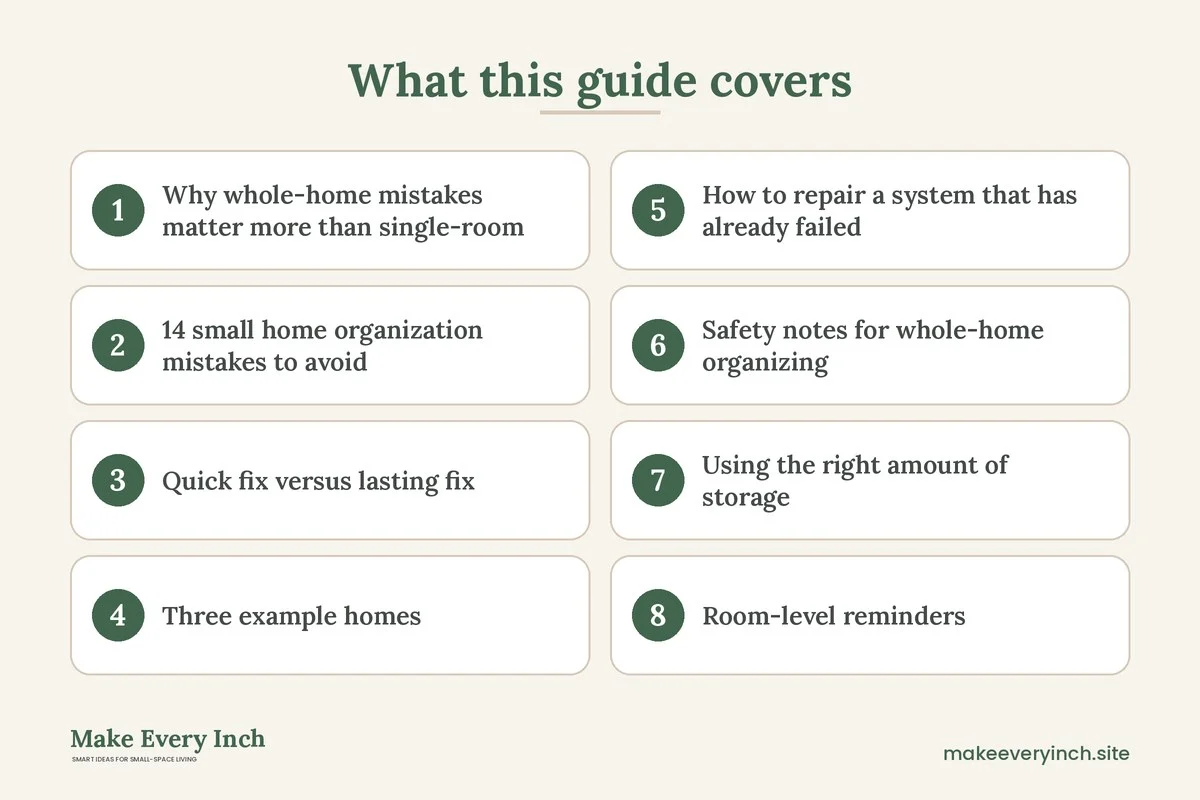
Small home organization mistakes to avoid are rarely about a lack of effort. Most people who live in a small home try hard. They buy bins, watch tutorials and spend a weekend rearranging, and then the clutter returns within a month. The reason is usually not laziness. It is that a handful of predictable errors undermine the whole system from the start. This guide looks at the mistakes that cut across the entire home, not just one room. It covers 14 common errors with a fix for each, a table that compares the quick fix with the lasting fix, three example homes, a repair plan for a system that has already failed and a checklist. If you want the positive version of the advice, start with our main guide to small space organization ideas. For one room only, our post on small kitchen storage mistakes to avoid goes deep on cabinets and counters, and the companion plan in how to organize a small home room by room shows the order to work in.
Why whole-home mistakes matter more than single-room ones
In a large house, a messy closet stays a messy closet. In a small home, everything touches everything. A pile of mail on the entry table spills onto the dining table. A full closet pushes clothes onto a chair, and the chair becomes a laundry shelf. Because rooms are small and often open to each other, one failing system pushes its overflow into the next room and the damage spreads.
This is why the mistakes below are grouped by the way they behave across the home. Some happen before you start, such as buying the wrong things in the wrong order. Some happen while you work, such as cramming too much into too little space. Some happen afterward, when a good system slowly decays because nobody maintains it. Spotting which stage your home is stuck in tells you where to put your energy.
14 small home organization mistakes to avoid
Mistakes made before you start
1. Buying containers before sorting
This is the most common mistake of all. Bins feel like progress, so people buy a set, bring it home and then try to fit their belongings into it. The containers decide the system, instead of the belongings deciding the containers. The result is a pile of boxes that are the wrong size, and a few that hold nothing at all. The fix is to sort first, count each category and measure the space, and only then buy. A rough rule is that you should be able to name the shelf, drawer or hook where each container will live before you purchase it.
2. Skipping the sort because it feels slow
Organizing without sorting is just moving clutter from one place to another. If you tidy a drawer of 40 pens without removing the dried-up ones, you have a tidy drawer of 40 pens. Sorting is the step that gives you space back, and in a small home, space is the real prize. Use three piles: keep, let go and unsure. Put the unsure pile in a box with a date written on it. If you do not open the box in 60 to 90 days, it can leave. Our guide to small apartment decluttering ideas walks through sorting in more detail.
3. Copying a photo instead of solving your own problem
A photo of a neat pantry with matching jars looks wonderful, but it solves the problem of the person who took it. Your problem might be that you cook in a hurry, share the space with children or have a pantry that is only 8 inches deep. Before you copy a look, write down what is going wrong in your home, such as keys that vanish, a towel pile that tips or a bag that has no hook. Choose the system that fixes that problem, even if it looks less pretty.
4. Organizing the room you like, not the room that hurts
People tend to start with the room that is the most fun or most photogenic. The result is a lovely bookshelf and a front door that is still a mess. Start where the daily friction is. If you trip over shoes every morning, begin at the entrance. If you cannot find a clean towel, begin in the bathroom. Fixing the point of most pain gives you a quick win and the energy to keep going.
Mistakes made while you work
5. Overfilling every shelf and drawer
A full shelf feels efficient, but a shelf packed to the edges is hard to use. You cannot see what is at the back, you must move three things to reach one, and putting something away becomes a puzzle. As a guide, aim to leave about 20 to 30 percent of each storage area empty. This slack lets you add a new item without a reshuffle, and it makes the daily act of putting things away quick enough that you actually do it.
6. Giving items no fixed home
If an item has no address, it lives wherever you last put it. Keys on the counter, a charger on the sofa and a bag on the chair are all signs of homeless items. Give every category one named spot, then say the spot out loud so everyone in the home knows it. Labels help, especially in shared homes. The aim is that anyone can guess where an item lives, and can put it back without asking.
7. Storing things far from where you use them
Storage works when it sits within one or two steps of the place of use. Cleaning supplies at the far end of the hallway, a hairdryer in a cabinet two rooms away and coats in a closet down the corridor all create friction. The rule of thumb is to store an item where you first pick it up and where you put it down. Shoes belong near the door, towels near the shower and the can opener near the stove. Moving a few things by a few feet often removes the need for any new storage at all.
8. Hiding everything inside closed boxes
Closed boxes look calm, but if you cannot remember what is inside, you will buy a duplicate or avoid the box entirely. Opaque containers need labels. Frequently used things need open storage, such as baskets, trays or hooks, since the lid is a barrier that most people will not tolerate every day. Keep closed containers for items you need once a month or less, and open ones for the daily round.
9. Ignoring vertical space
A small floor means that the walls and doors are your only extra capacity. Many small homes have storage space at head height and above that sits empty. Wall shelves, over-the-door hooks, tall narrow bookcases and rails can add a lot of room without using any floor. Our guide to vertical storage ideas lists options by wall type. Take care with anything tall. Anchor bookcases and tall units to a wall stud to prevent tipping, and never drill into a rental wall without written permission. If you rent, our post on no-drill storage ideas for renters shows what to use instead.
10. Forgetting the dead zones
Dead zones are spaces that are present in every home but rarely used: behind doors, under beds, the top of the wardrobe, the gap above the fridge and the side of a cabinet. They are not glamorous, but they add up. A slim box under the bed, a rail on a door or a narrow rolling cart in a 7-inch gap each add useful capacity. See under-bed storage ideas for ways to use the largest dead zone in most homes. Check clearances before you buy, and keep heat sources, vents and radiators clear.
Mistakes made after the work is done
11. Designing for the best day, not the worst day
A system that works only when you have time and energy will fail on a busy week. If putting a coat away needs three steps, it will end up on a chair. Build for the tired version of yourself, with one-step actions such as a hook instead of a hanger, an open bin instead of a lidded box and a basket you can toss things into. A tidy system should survive a bad week without collapsing.
12. Never resetting the system
Even a well-made system drifts. Mail piles up, new items arrive and old ones stay. Schedule a ten-minute daily reset and a monthly fifteen-minute check. During the check, remove what you no longer use, re-label anything that has changed and ask whether any spot is consistently overflowing. An overflowing spot is a sign that the category has outgrown its space.
13. Letting incoming items outrun outgoing ones
Even the best storage fails when more comes in than goes out. In a small home the limit is physical, so a one-in, one-out rule for categories such as clothes, mugs, books and linens keeps the balance. Delay impulse purchases for a few days, and ask where an item will live before you bring it home. If you cannot answer, the item is a clutter risk.
14. Organizing alone in a shared home
If one person sets up the system and the others are not involved, the system is only half used. Hold a short meeting. Ask each person where they would look for each item, and let the answers shape the labels and zones. Children can manage low hooks and open bins, and partners are far more likely to follow a system they helped design.
Quick fix versus lasting fix
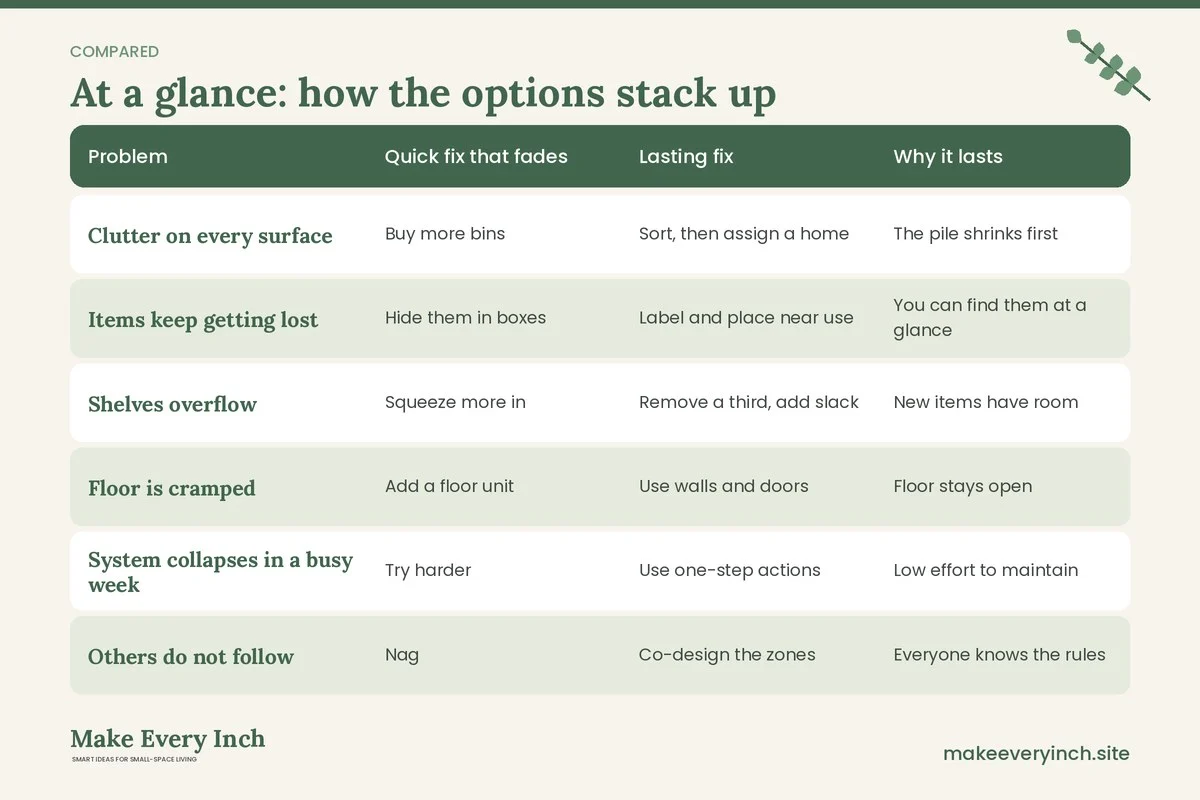
The table below sets out what people usually do in response to each problem alongside what tends to hold up over time.
| Problem | Quick fix that fades | Lasting fix | Why it lasts |
|---|---|---|---|
| Clutter on every surface | Buy more bins | Sort, then assign a home | The pile shrinks first |
| Items keep getting lost | Hide them in boxes | Label and place near use | You can find them at a glance |
| Shelves overflow | Squeeze more in | Remove a third, add slack | New items have room |
| Floor is cramped | Add a floor unit | Use walls and doors | Floor stays open |
| System collapses in a busy week | Try harder | Use one-step actions | Low effort to maintain |
| Others do not follow | Nag | Co-design the zones | Everyone knows the rules |
| Clutter returns | Annual clear-out | Ten-minute reset and monthly check | Drift gets corrected early |
Three example homes
A 450 square foot studio
The owner has a single closet, a kitchen along one wall and a bed in the corner. The first mistake was buying 12 matching bins before sorting. After the sort, only five were needed and the rest went back. The fix was to put the bed on risers about 8 inches high, to use the space below for flat boxes and to hang a rail inside the closet door for bags and scarves. The closet shelf was left about a quarter empty so a seasonal swap would not cause a pile on the floor. The studio now needs a ten-minute evening reset, and nothing more.
A 700 square foot one-bedroom for a couple
The couple had a tidy kitchen and a chaotic entrance. The pain point was in the hallway, where six pairs of shoes, two bags and a pile of mail sat on the floor. They had organized the room they liked, not the room that hurt. The fix started at the door. A narrow shoe rack that holds four pairs, a row of hooks mounted at 60 to 65 inches and a shallow tray for mail took less than an hour to set up. Each person got one hook and one tray. Our guide to small entryway organization covers the details.
A 900 square foot two-bedroom with a child
A parent had bought colorful lidded boxes for the toys, but the child never used them. The lids were a barrier. The fix was to switch to open, low baskets at the child’s height, with a picture label on each. A single basket of daily toys sat in the living room, and the rest rotated through a closed bin in the closet. Overfilling was the second mistake. Each basket got a rule: when it is full, something must leave before something new arrives.
How to repair a system that has already failed
If your home has already been through one failed attempt, do not start from scratch. Use the steps below to find the weakest link.
- Walk the home with a notebook. Write down every spot where items pile up. These piles show you where an item has no home.
- Name the cause. For each pile, ask whether it is an overfilled space, a missing home, a distance problem or a habit problem.
- Fix the cheapest cause first. Moving a hook costs nothing, and buying a cabinet costs a lot. Try rearrangement before you purchase.
- Run the trial. Change one zone at a time and live with it for two weeks. If it holds, move on.
- Return what does not fit. Unused containers are clutter. Return them if you can, or donate them.
Safety notes for whole-home organizing
A few rules apply to every room. Anchor tall furniture, such as bookcases, shelving units and wardrobes, to a wall stud with the hardware the maker supplies, especially if children or pets live in the home. Do not store heavy items on high shelves. Never drill into a wall in a rental without written permission from the landlord. Keep electrical outlets, panels and heaters clear, and do not run cords under rugs or pack storage against a heat source. When you paint a shelf or cabinet, use low-VOC paint and keep windows open while it dries. Keep cleaning products, medicines and small items out of reach of children, and in a locked or high spot.
Using the right amount of storage
A final mistake is thinking that more storage is always the answer. A small home often has enough capacity but has too many belongings or too little order. Before you buy furniture, measure the storage you already have, and compare it with what you own. Our post on cheap storage ideas for apartments is a good place to look if you decide you need some extra capacity, and our guide to small-space storage furniture helps when you want a piece that earns its footprint. If you want to hide things well, read about hidden storage ideas.
Think about how each category earns its space. Seasonal items might live on a high shelf, daily items at hand height and rarely used items in the dead zones. Matching the frequency of use to the ease of access is the single biggest idea in this guide.
Room-level reminders
These mistakes show up differently in different rooms, so a brief reminder for each may help.
- Kitchen: Too many gadgets and no zones. See small kitchen organization ideas.
- Bedroom: Overstuffed under-bed storage and a chair that becomes a clothes pile. See small bedroom organization ideas.
- Bathroom: Products stacked on the sink. See small bathroom organization ideas.
- Closet: Hangers with no limit. See small closet organization ideas.
- Living room: Open surfaces becoming drop zones. Give the room a basket and a rule.
- Entrance: No hook, no tray and no shoe spot. A five-minute fix with big payoff.
Mistakes checklist
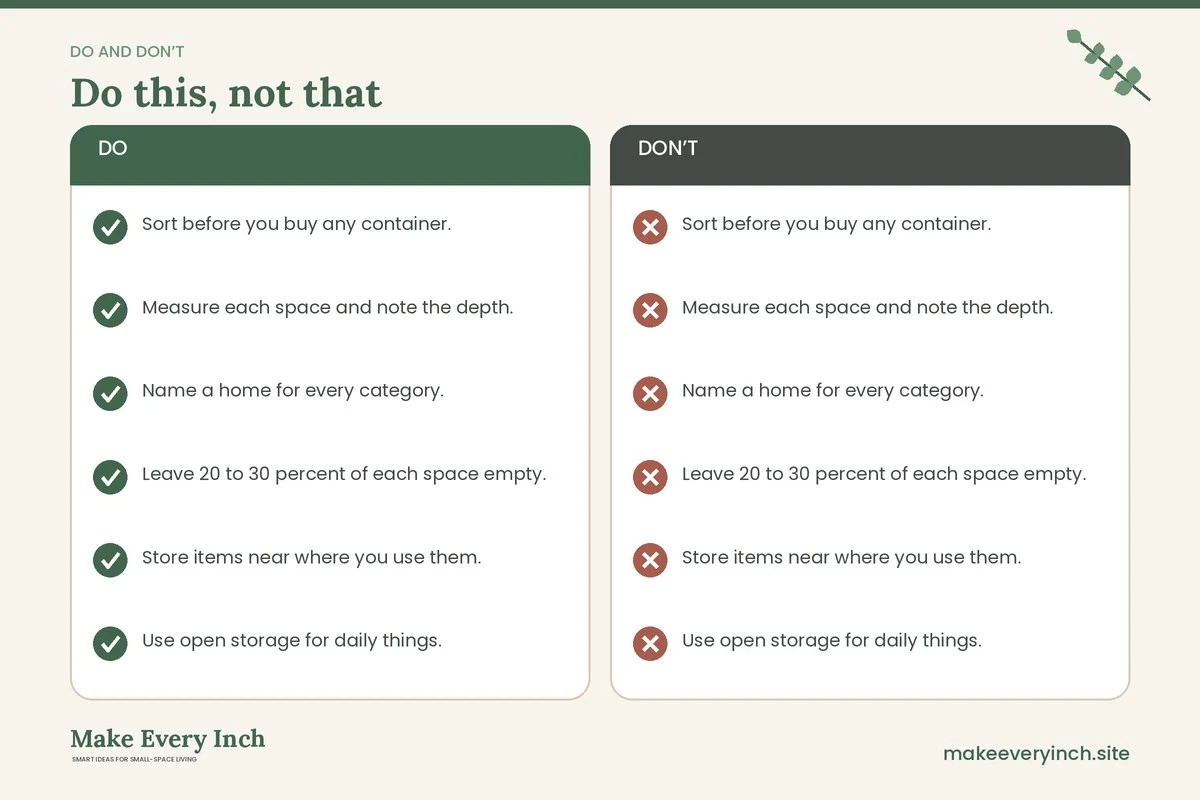
- Sort before you buy any container.
- Measure each space and note the depth.
- Name a home for every category.
- Leave 20 to 30 percent of each space empty.
- Store items near where you use them.
- Use open storage for daily things.
- Label closed boxes.
- Use walls and doors before the floor.
- Anchor tall furniture to a stud.
- Ask permission before drilling in a rental.
- Build one-step actions for busy days.
- Do a ten-minute daily reset.
- Do a monthly check for overflow.
- Apply a one-in, one-out rule.
- Involve everyone who lives in the home.
FAQ
What is the biggest small home organization mistake?
Buying containers before sorting. It locks you into the wrong sizes and hides the real issue, which is usually too many belongings for the space available.
How full should shelves and drawers be?
Leave about 20 to 30 percent of the space empty. This makes it quick to put things away and leaves room for new items without a reshuffle.
Is it a mistake to use closed boxes?
Not always. Closed boxes suit rarely used items, but daily items do better in open baskets, trays or hooks because lids discourage use.
Where should I start in a small home?
Start where the daily friction is greatest, often the entrance, the kitchen counter or the bedroom chair. A quick win builds momentum. Our plan for how to organize a small home room by room suggests a full order.
How do I stop clutter from coming back?
Use a short daily reset, a monthly check and a one-in, one-out rule. A system that is easy on a bad day is more likely to last.
Can I organize a rental without drilling?
Yes. Use adhesive hooks within their weight limits, tension rods, over-the-door organizers and freestanding shelves. Our guide to organization ideas for renters covers many options.
Keep going: Keep going with our small space organization ideas, the room-by-room plan for how to organize a small home room by room and our guide to small apartment decluttering ideas.
Save this guide for later
Pin the ideas you like to Pinterest so you can come back to them when you plan your space.