Small Home Office Storage Ideas
Quick answer: The best small home office storage ideas sort a workspace into four zones: paper, supplies, tech and archive. Keep only daily items within arm’s reach, move weekly items to a drawer or shelf at chest height, send monthly items to a closed box or high shelf, and archive the rest off site or in a digital folder. Anchor tall units, avoid overloading power strips and ask before drilling.
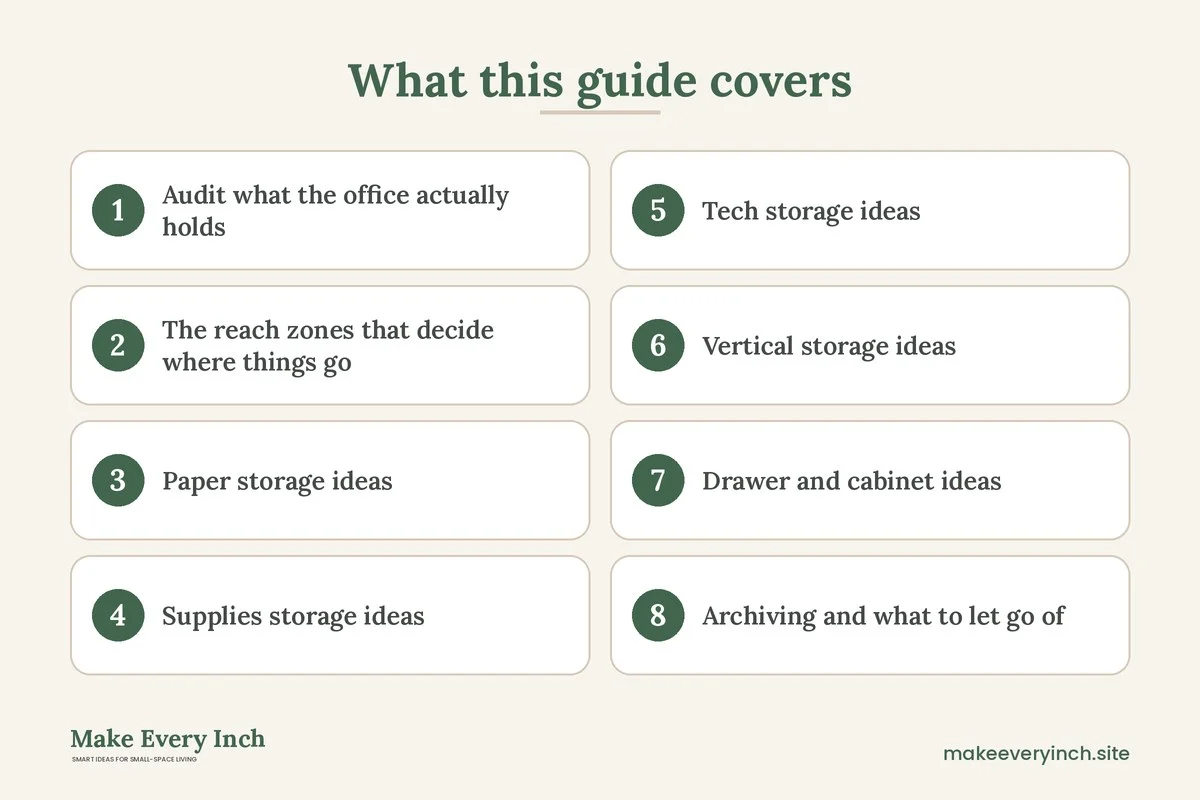
Small home office storage ideas work best when they start with a question instead of a purchase: what does this workspace actually hold? A desk in a bedroom corner, a laptop on a kitchen peninsula and a converted closet all fill up with the same four things, which are paper, supplies, tech and files you may need later. When they have no home, they pile up on the work surface, and a small surface covered in piles is the main reason a tiny office feels cramped. This guide shows how to plan storage for a small home office by zone. It covers an audit of what you hold, the reach-zone measurements that decide where things go, ideas for paper, supplies, tech, vertical space, drawers and archiving, a comparison table, three example rooms, safety notes and a checklist. For the bigger picture, read our pillar on small home office ideas, and for the paper side in depth see small home paper organization ideas. If you have no desk at all, our companion post on small home office ideas without a desk covers that setup.
Audit what the office actually holds
Before you buy a single box, empty the desk, the top of any shelf and the drawer closest to your chair. Sort everything into four piles: paper, supplies, tech and other. Then count. Most small offices turn out to hold far more paper than expected, a handful of supplies that are used daily and a large number that are never touched, and a tangle of cables and chargers.
Next, mark each item by how often you touch it. Use three labels: daily, weekly and rarely. A pen, a notebook and a charger are daily. A stapler, a stamp roll and a spare notebook are weekly. Tax papers, warranty manuals and old project files are rare. This single label decides where each item lives, and it prevents the most common mistake, which is giving the best real estate to things that are rarely used.
Finally, set a ceiling. A small office does not grow, so decide how many drawers, shelf inches and boxes it gets, and treat that as the budget. When the paper box is full, something leaves before something new enters. A fixed limit does more to keep an office tidy than any labeling system.
The reach zones that decide where things go
Storage is only useful if you can reach it without breaking your work rhythm. These zones are useful starting points. Adjust them for your own height and reach, and treat the numbers as guides rather than rules.
- Desktop zone (0 to 10 inches from your hands): daily tools only. A pen cup, a notebook, a lamp and the device you work on. Everything else leaves the surface.
- Arm’s reach zone (within about 24 to 28 inches of your seat): weekly items. A top drawer, a rolling cart, a tray on the desk’s side or a shelf unit next to the chair.
- Stand-and-reach zone (about 30 to 60 inches from the floor): monthly items. Shelves at roughly elbow to shoulder height, good for binders, reference books and labeled boxes.
- Low zone (below about 24 inches): heavier, rare items, such as a box of old files, a printer paper ream or a spare monitor.
- High zone (above about 66 inches): light, rarely touched items, such as archive boxes of paper that you keep for legal or personal reasons.
A 24 inch deep desk holds a lot of clutter in its back half. Keep the back 6 to 8 inches for a monitor stand, a lamp or a small shelf riser, and keep the front 16 to 18 inches clear for your keyboard and notebook. If you can, aim for a clear surface of about 18 by 24 inches for the work you are doing right now. Everything else should live somewhere else.
Paper storage ideas
Paper is the largest storage problem in most small offices, and it needs a system that is simple enough to follow on a tired Friday. Use three trays or folders: to do, to file and to read. Anything that arrives goes into one of them, and each gets a weekly review. Whatever is done leaves the desk the same day.
1. A single in-tray, not five
One shallow tray at the corner of the desk collects incoming mail and documents. A shallow tray has limited height, and that limit forces a weekly clear-out.
2. A vertical file on the shelf, not in a drawer
Vertical file holders store paper on its edge. This takes much less floor and shelf area than flat stacks, and each folder is visible from the side. A holder that is 3 to 4 inches wide can hold a surprising number of active folders.
3. A short-term and a long-term folder
Use a small expanding folder with 8 to 12 pockets for papers you need within the year, such as recent bills, medical forms and receipts you may return. Use a separate box for long-term documents. Our guide on small home paper organization ideas walks through what to keep and what to scan.
4. Scan and shred
For anything you only need to read or prove once, scan it, name the file clearly and shred the original if it is safe to do so. A phone scanning app is usually enough for routine paperwork. Keep originals of anything that is legal or hard to replace, such as identity documents, property deeds and tax records. Check local rules about how long to hold financial and tax documents.
5. A paper rule for the desktop
Nothing lies flat on the desk overnight. If it is not in the active tray, it is in a folder or in the recycling.
Supplies storage ideas
Supplies multiply because they are cheap and small. The fix is containment, not removal.
6. A shallow drawer organizer with fixed compartments
A shallow organizer in the top drawer holds pens, tape, scissors, a stapler and clips. Measure the inside of the drawer before you buy, and leave a quarter inch of room so the organizer slides without jamming. Fixed compartments prevent the drawer from becoming a junk pit.
7. A single pen cup, with a limit
Keep five to eight pens on the desk and send the rest to the drawer. Duplicates are the first thing to go in the audit.
8. A supply caddy that moves
A small portable caddy holds the things you use in short bursts, such as scissors, tape and a ruler. It can sit on a shelf and travel to the dining table when the office doubles as a family space.
9. Magnetic and rail systems
A magnetic strip or a small rail on a wall holds metal tools and hanging cups. Only use these if the wall can be marked or drilled with permission, or use adhesive-based versions that stay within their weight limit.
10. A bulk-buy shelf with a limit
If you store paper reams, ink or boxes of envelopes, give them a single shelf or box, and do not restock until it is empty.
Tech storage ideas
Tech creates its own kind of clutter: cables, chargers, adapters and the devices themselves. It also introduces safety questions.
11. A charging drawer or box
A drawer or lidded box with a hole at the back for cords holds chargers and a power strip. Keep the power strip itself visible and ventilated, never buried under paper or fabric, and never plug one power strip into another. Do not exceed the strip’s rated load, and check that the total draw of the devices you plug in stays comfortably within it. Our guide to renter-friendly ways to hide cords has more cable routing ideas.
12. Cable labels and a cable box
Label both ends of each cable with a small tag. Keep spare cables in a labeled box, coiled loosely rather than tightly wound, so insulation is not stressed.
13. A laptop stand with storage below
A riser holds the screen at a better height and creates a shelf underneath for a keyboard, a notebook or a small tray. Ergonomic comfort varies from person to person, so treat the height as a starting point and adjust to what feels comfortable.
14. A hidden printer shelf
A printer needs a stable, ventilated spot. A lower shelf or a cart that rolls out of a closet works well. Leave a few inches of space around vents so heat can escape.
15. Device parking
Give phones, tablets and e-readers a single parking spot, such as a stand or a shallow tray, so they do not wander across the desk.
Vertical storage ideas
When the floor is limited, the wall and the height of the room are the largest unused resources. For more general ideas, see our guide on vertical storage ideas.
16. A narrow bookcase beside the desk
A bookcase 10 to 12 inches deep fits next to a desk without crowding the walkway. Choose a unit with a back panel or a wall anchor point so you can secure it, and anchor any tall unit to the wall studs with the hardware that suits your wall type. Ask your landlord before drilling, and consider freestanding options that lean on safe anchoring alternatives only if the unit’s instructions allow. Our post on the best narrow bookshelves lists what to look for.
17. Shelves above the desk
A shelf 12 to 18 inches above the monitor holds a lamp, books or boxes. Leave at least 15 to 18 inches between the desk surface and the shelf if you sit under it, so you do not bump your head when you stand. Shelves must be mounted into studs or with suitable anchors for the weight, and you should never drill without permission. Our guide on no-drill storage ideas for renters covers other options.
18. A pegboard or wire grid
A pegboard or a wire grid turns a wall into a flexible set of hooks, baskets and small shelves. It spreads the load across several mounting points. Check the weight limit and use only the hardware designed for it.
19. Over-the-door organizers
An over-the-door pocket organizer holds paper, small supplies and cables on the back of a closet or office door, with no marks on the wall. Check that the door still closes and that the hooks do not scratch the door’s edge.
20. A tall, narrow rolling cart
A cart that is 12 to 16 inches wide rolls out when needed and tucks back beside the desk or into a closet. It is useful in a rental because it requires no mounting.
Drawer and cabinet ideas
21. A file drawer, or a file box where there is no drawer
If your desk has a deep drawer, a hanging file frame works well. If it does not, a lidded file box on the floor under the desk does the same job and can leave with you at move-out.
22. Divide a drawer into zones
A single shallow drawer can hold a stationery zone, a cable zone and a personal zone. Use dividers so items do not slide into each other.
23. Under-desk drawers on rails
Clip-on or screw-on drawers add storage beneath a desktop. Only use screw-on versions where the lease and the desk allow it, and check that the drawer does not hit your knees.
24. Credenza or cabinet behind a door
A closed cabinet hides visual noise. In a living room or bedroom office, a cabinet with a door lets the workspace disappear at the end of the day, which helps with mental separation. For more ideas, see hidden storage ideas.
25. Ottoman or bench storage
A storage ottoman can hold paper boxes, a laptop and cables, and it doubles as seating. See best storage ottomans for what to check before buying.
Archiving and what to let go of
Archiving is the part most people skip, and it is the reason small offices overflow. Create a clear flow: active, recent and archive.
- Active: on the desk or in the tray, reviewed weekly.
- Recent: in a drawer or folder, kept for the current year.
- Archive: in a labeled box on a high or low shelf, with the year written on the outside and a short list taped to the lid.
- Digital archive: scanned files in folders named by year and topic, backed up in at least two places.
Set a yearly date, such as the first weekend of January, to move the previous year’s recent papers into the archive and to decide which archived boxes can be shredded. Use a simple rule for deciding: keep what the law, the insurer, your accountant or a future you will actually ask for, and let the rest go. Check local guidance for how long to hold tax and financial records, because it varies by place and situation.
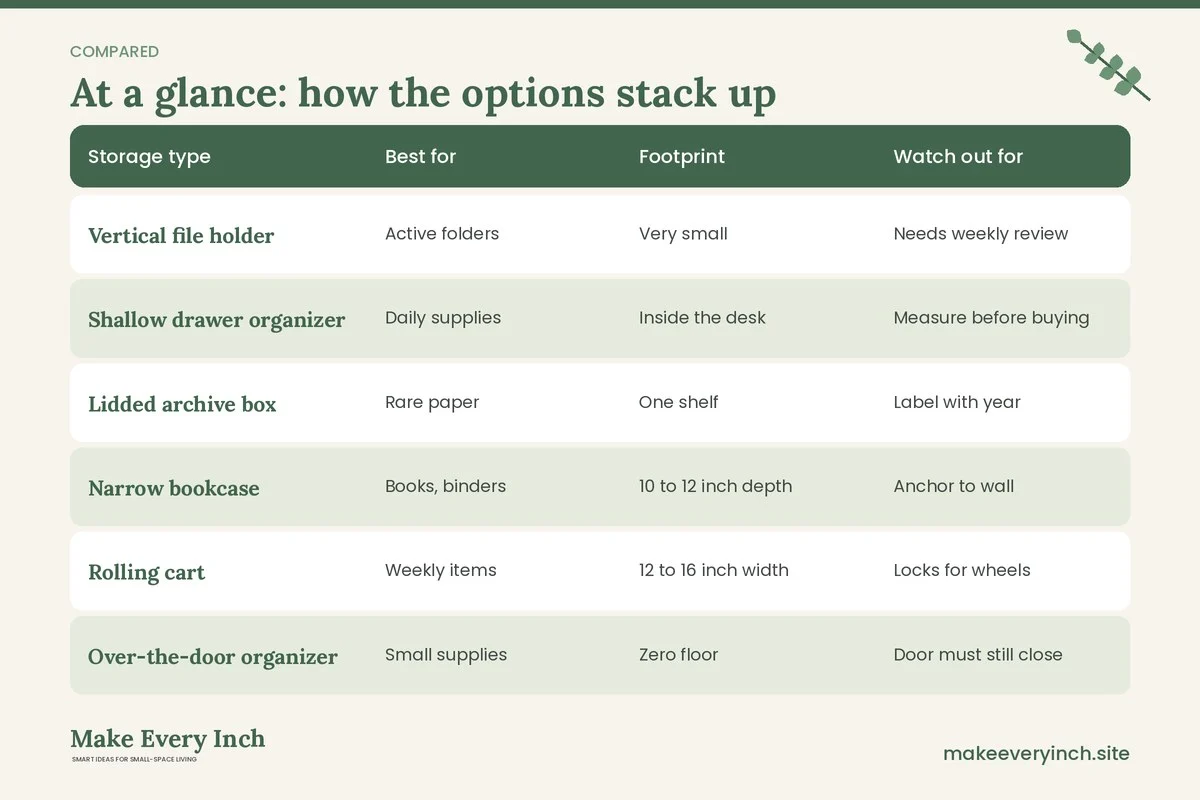
Comparison table: which storage type fits which job
| Storage type | Best for | Footprint | Watch out for |
|---|---|---|---|
| Vertical file holder | Active folders | Very small | Needs weekly review |
| Shallow drawer organizer | Daily supplies | Inside the desk | Measure before buying |
| Lidded archive box | Rare paper | One shelf | Label with year |
| Narrow bookcase | Books, binders | 10 to 12 inch depth | Anchor to wall |
| Rolling cart | Weekly items | 12 to 16 inch width | Locks for wheels |
| Over-the-door organizer | Small supplies | Zero floor | Door must still close |
| Charging box | Chargers, strip | Small | Ventilate, do not overload |
| Storage ottoman | Seasonal paper | Seat footprint | Weight and lid hinges |
Three example small offices
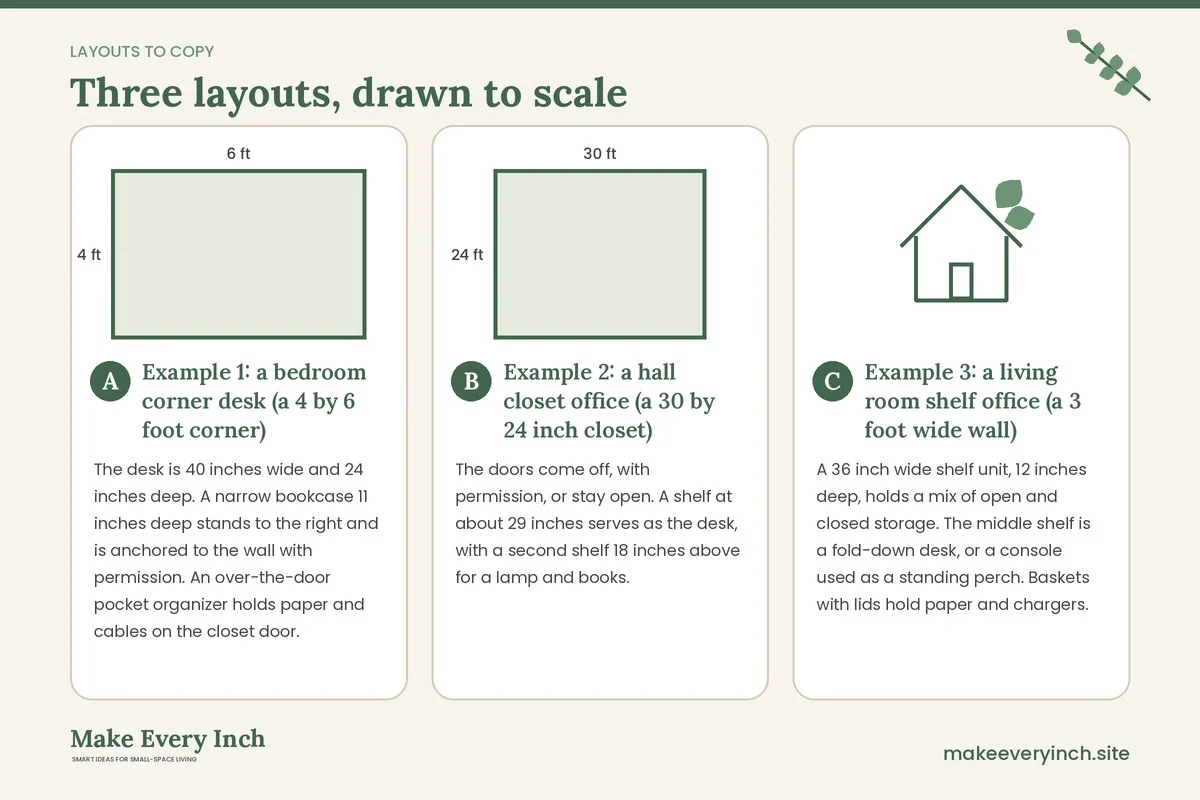
Example 1: a bedroom corner desk (a 4 by 6 foot corner)
The desk is 40 inches wide and 24 inches deep. A narrow bookcase 11 inches deep stands to the right and is anchored to the wall with permission. An over-the-door pocket organizer holds paper and cables on the closet door. A lidded box under the bed holds the archive. The top drawer holds a fixed organizer for supplies. The desk surface holds a laptop, a lamp and a pen cup, and everything else is out of sight. The bedroom reads as a bedroom at night because a basket takes the laptop and notebook.
Example 2: a hall closet office (a 30 by 24 inch closet)
The doors come off, with permission, or stay open. A shelf at about 29 inches serves as the desk, with a second shelf 18 inches above for a lamp and books. A wire grid on the side wall holds a few hooks, a small basket and a clip for papers. The printer rolls out on a cart. A tall box on the floor holds files. A power strip sits on the shelf and is kept clear of paper. Ventilation matters because a closet can trap heat from a laptop and a printer, so leave the door open when working and keep the strip uncovered.
Example 3: a living room shelf office (a 3 foot wide wall)
A 36 inch wide shelf unit, 12 inches deep, holds a mix of open and closed storage. The middle shelf is a fold-down desk, or a console used as a standing perch. Baskets with lids hold paper and chargers. A rolling cart holds supplies and travels to the sofa. Doors on the lower cabinet close at the end of the work day. For related ideas, see studio apartment ideas for working from home.
Safety and lease notes
- Anchor tall furniture. Bookcases and cabinets can tip, particularly when drawers are open or the top is loaded. Use the anchoring hardware recommended for your wall type, and ask the landlord before making holes.
- Respect weight limits. Paper is heavy. A single file box can weigh far more than expected, so check the rated load of shelves, hooks and adhesive products and use the lower number.
- Manage electricity. Do not daisy-chain power strips, do not cover them, and do not plug high-draw heaters or appliances into the same strip as your devices. If a strip feels warm or smells odd, unplug it.
- Keep cords safe. Route cords away from walkways and chair wheels, and avoid running them under rugs.
- Allow airflow. Printers, routers and laptops produce heat. Do not enclose them tightly.
- Lighting. Place task lighting to avoid glare on the screen, and avoid a bright light directly behind or facing your monitor.
- Paint and fumes. If you repaint a shelf or cabinet, choose a low-VOC product and ventilate the room while it dries.
- Lease first. Read the lease on drilling, adhesives and changes to walls and doors before you begin.
- Ergonomics. Chair, desk and screen heights suit different bodies. This guide is not medical advice, so if you have pain or a health condition, speak to a qualified professional.
Common mistakes to avoid
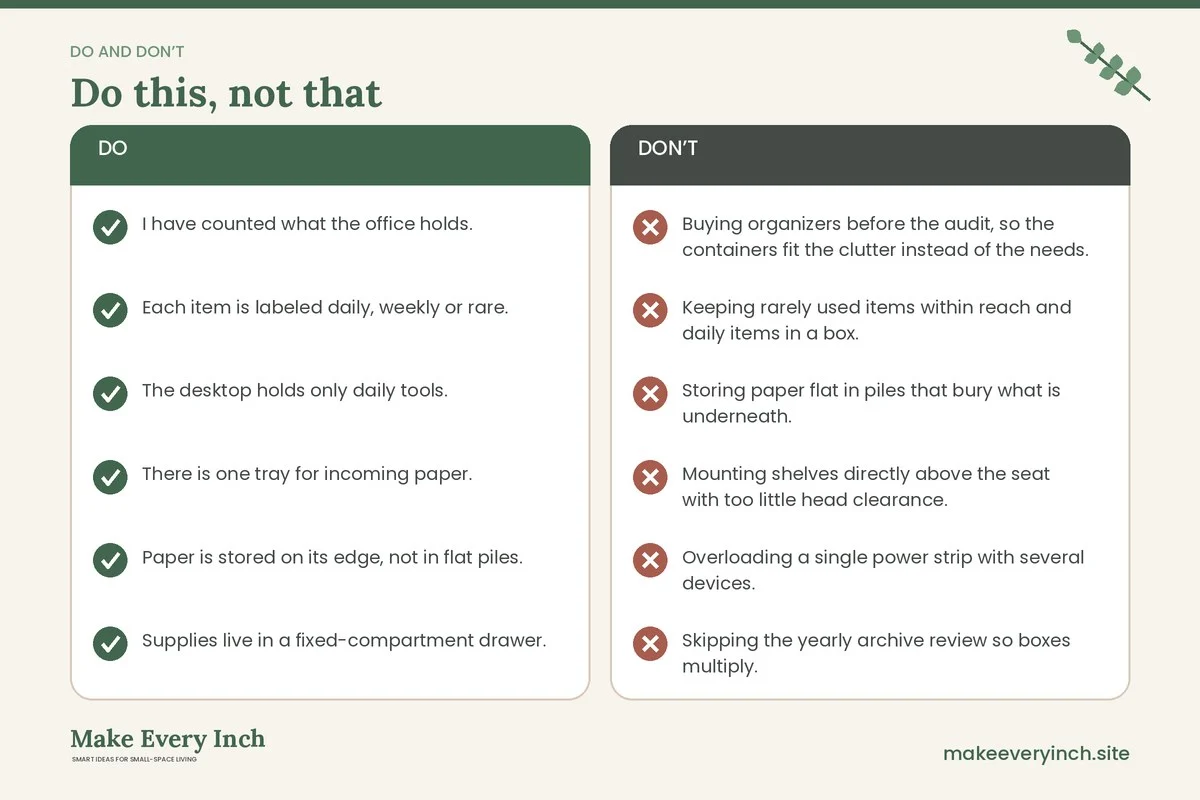
- Buying organizers before the audit, so the containers fit the clutter instead of the needs.
- Keeping rarely used items within reach and daily items in a box.
- Storing paper flat in piles that bury what is underneath.
- Mounting shelves directly above the seat with too little head clearance.
- Overloading a single power strip with several devices.
- Skipping the yearly archive review so boxes multiply.
- Using decorative boxes with no labels, which means every search becomes an opening of every box.
A 30-minute reset routine
1. Clear the desktop and sort the items into daily, weekly and rare.
2. Empty one drawer and give every item a compartment.
3. Process the in-tray into to do, to file and to read.
4. Scan three papers and shred the originals if safe.
5. Coil and label any loose cables, and check the power strip is uncovered.
6. Wipe the surface and set out only the daily items.
Checklist
- I have counted what the office holds.
- Each item is labeled daily, weekly or rare.
- The desktop holds only daily tools.
- There is one tray for incoming paper.
- Paper is stored on its edge, not in flat piles.
- Supplies live in a fixed-compartment drawer.
- Chargers and the power strip are ventilated and not overloaded.
- Tall shelving is anchored, with permission.
- Archive boxes are labeled with the year.
- A yearly review date is on the calendar.
FAQ
How much storage does a small home office need?
It depends on how much paper and equipment you hold. A common starting point is one shallow drawer for supplies, one vertical file or box for active paper and one shelf for reference items. Add more only after the audit shows a real need.
What is the best way to store paper in a small office?
Use a three-part flow: an in-tray for incoming items, a vertical file or folder for active papers and a labeled archive box for long-term records. Scan what you can, and keep originals of important legal documents.
How do I add storage without drilling?
Use freestanding bookcases, rolling carts, over-the-door organizers, under-bed boxes, storage ottomans and adhesive hooks within their weight limits. See our guide on no-drill storage ideas for renters.
Where should I put a printer in a tiny office?
Put it on a stable shelf or cart with airflow around it and within reach of an outlet. Many people store it low or in a closet and roll it out only when needed.
How high should a shelf above a desk be?
Leave enough clearance to sit and stand without bumping your head, often 15 to 18 inches above the desk surface, and make sure the shelf is securely mounted for its load. Adjust for your own height.
How do I stop the desk from filling up again?
Set a ceiling for the storage you have, process the in-tray weekly and clear the desktop at the end of each day. A short routine works better than an occasional big clean-up.
Keep going: Keep going with our pillar on small home office ideas, the paper system in small home paper organization ideas and the layout guide for small home office ideas without a desk.
Save this guide for later
Pin the ideas you like to Pinterest so you can come back to them when you plan your space.