12 Small Living Room TV Wall Ideas Minimalist Style for a Calm Room
Quick answer: The best small living room tv wall ideas minimalist style rely on subtraction. Keep one clear focal object, hide or shorten every cable, leave at least a third of the wall empty, and mount the screen so its center sits roughly 40 to 46 inches above the floor. Pick one storage piece, one light source and one decorative element, then stop. Always follow the TV and mount instructions for stud and anchor requirements.
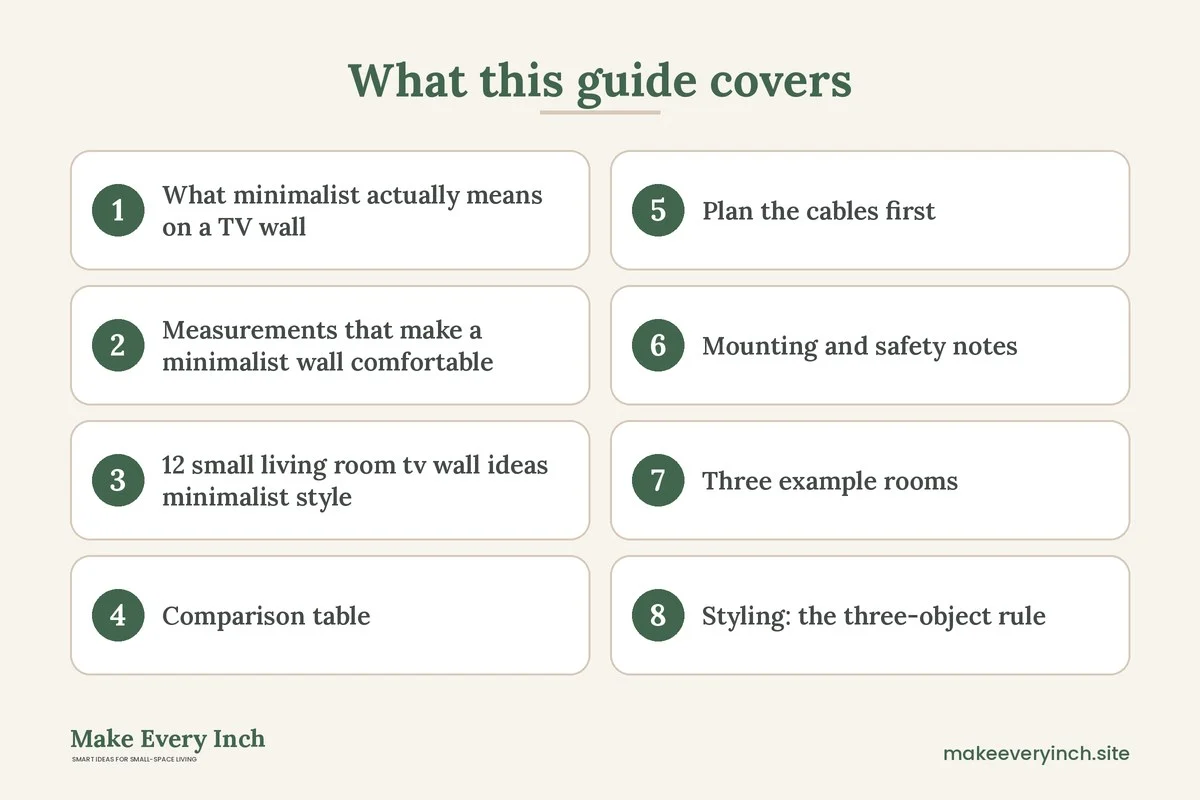
Small living room tv wall ideas minimalist in spirit are less about owning fewer things and more about deciding what the wall is for. In a small room the television wall is usually the largest uninterrupted surface, so it sets the mood for everything else. When it carries a screen, a console, a router, three speakers, a cluster of frames and a tangle of cords, the room feels busy even if the rest is tidy. A minimalist wall does the opposite. It lets the screen be the only strong shape, gives the eye somewhere to rest, and keeps the practical things out of sight. This guide covers the editing method, the measurements that keep a mounted screen comfortable, 12 specific ideas, a comparison table, three example rooms, a cable plan, a checklist and an FAQ. For the full overview, start with our main guide to small living room tv wall ideas and the wider small living room ideas pillar. If you also want a softer, warmer take on a similar wall, see our companion post on small living room tv wall ideas japandi.
What minimalist actually means on a TV wall
Minimalism is often mistaken for emptiness, but a wall with nothing on it and a screen floating in a sea of cords is not calm, it is unfinished. A better definition is intention. Every object on the wall has a job, and anything without a job leaves. That gives you a simple test you can apply to every item: does it help you watch, store, light or rest your eyes? If the answer is no, it does not belong on the wall.
Three principles keep a minimalist TV wall consistent.
- One hero: the screen is the hero when it is on, and the wall is the hero when it is off. Avoid adding a second strong focal point such as a large mirror or a loud piece of art beside the screen.
- A quiet palette: keep the wall, the console and the surrounding furniture within two or three tones. A matte wall in a soft neutral makes a dark screen look like part of the room instead of a hole in it.
- Negative space: aim to leave around a third to a half of the wall visibly empty. This is the part that feels like a luxury in a small room, and it is also the part people try to fill first.
A useful way to hold yourself to this is the one-in, one-out rule. Before adding something to the wall, take something off it. It stops the slow creep that turns a clean wall into a shelf of souvenirs within a year.
Measurements that make a minimalist wall comfortable
A calm wall still has to be comfortable to watch. These ranges are starting points that suit most small rooms. Adjust for your own seating and sight lines, and treat them as hedged guidance rather than strict rules.
- Viewing distance: a common rule of thumb is to sit about 1.2 to 1.6 times the screen diagonal away for a modern high-resolution set. For a 43 to 55 inch screen that works out to roughly 5 to 7 feet, which fits most small rooms.
- Screen center height: about 40 to 46 inches from the floor, which is near eye level when seated on a standard sofa. Many people mount too high. If you must tilt your head back, lower it.
- Bottom edge above a console: leave 6 to 10 inches between the console top and the screen bottom so the two read as separate shapes, or 2 to 4 inches if you want them to read as one unit.
- Console depth: 12 to 16 inches suits a small room and keeps the walkway clear. Deeper units steal floor space you cannot spare.
- Walkway in front of the wall: keep 30 to 36 inches clear where people walk past the wall, and 24 inches in a side path that is used only occasionally.
- Side margin: leave at least 6 to 10 inches of empty wall to either side of the screen, and more if the wall is wide. Tight margins make the screen look squeezed.
- Screen width as a share of the wall: about one third to one half of the wall width keeps the proportions calm.
Tape the outline of the screen on the wall with painter’s tape before you drill anything. Sit on the sofa for ten minutes and check your neck, your sight line and how the shape feels in the room. Moving tape costs nothing, while moving holes costs time and paint.
12 small living room tv wall ideas minimalist style
Ideas that keep the wall almost bare
1. The floating screen on a plain wall
Mount the screen flat or on a slim low-profile bracket and leave the surrounding wall completely plain. Paint the wall a soft matte neutral so the screen edge does not glare against a pure white. The only other item is a low console or nothing at all. This is the purest version of a minimalist wall and works best when the screen is the only thing you want to look at.
2. A recessed or flush mount with in-wall cable routing
A flush or recessed setup places the screen close to the wall surface and runs power and signal cables inside the wall, using products that are designed and rated for in-wall use. This removes the dangling cord, which is the single biggest source of visual noise. Follow the TV and mount instructions, and for any work inside a wall, check local rules or hire a qualified person. If you rent, ask permission first, since it changes the wall.
3. A color-matched wall so the screen recedes
Paint or choose a wall color close to the screen’s dark tone, such as a deep charcoal, a muted green or a warm taupe. When the TV is off, the black rectangle melts into the surface instead of standing out. In a small room, this is a cheap way to make the screen feel smaller. Test a sample patch beside your furniture and check it at night as well as during the day.
4. A single shelf below the screen
One floating shelf, 8 to 10 inches deep and as wide as the screen or slightly narrower, holds a streaming box, a small plant and a couple of objects. Keep the shelf in the same finish as the wall or the console so it reads as part of the architecture. Resist the urge to add a second shelf. If you need more storage, move it to the floor level.
Ideas that hide or shrink the equipment
5. A low, closed console with a single top object
A closed cabinet at 14 to 20 inches high hides the router, the game console and the remotes behind doors. The top holds a single object, such as a lamp or a ceramic vase. Choose flat fronts without visible handles, or with push-to-open doors, for the cleanest lines. See our guide to small living room storage ideas minimalist for more closed storage plans.
6. A wall-hung cabinet with the screen above
A wall-hung cabinet keeps the floor visible, which makes a small room feel larger. Mount it at a height that leaves the floor clear beneath, and fix it to studs or with wall anchors rated well above the load, following the cabinet instructions. The visible floor continues under the unit and extends the sense of space.
7. A hidden or art-style screen
Some screens display artwork when idle, and some setups use a sliding panel or a roller screen to cover the television. When closed, the wall looks like a plain panel or a picture. These suit people who watch only a few hours a week. Make sure any panel allows ventilation around the TV so it does not overheat, and follow the manufacturer’s clearance guidance.
8. A single cable channel painted to match
When in-wall routing is not possible, a paintable cable cover running down from the screen to the outlet hides the cords in a neat strip. Paint it the wall color and it nearly disappears. This is the easiest option for renters, and many covers attach with adhesive, so check the wall finish first.
Ideas that add calm without clutter
9. One piece of art, offset on purpose
If a wall feels too bare, add a single piece of art on the side of the screen, with its center near the screen center height. Choose one large quiet piece over several small ones. Leave at least 10 to 12 inches of space between the art and the screen edge, so the two do not compete.
10. A hidden light source behind the screen
A low-output bias light or a warm strip behind the screen softens the contrast between a bright picture and a dark wall, which many people find easier on the eyes in an evening room. Choose a warm color temperature, around 2700 to 3000 kelvin, and keep the strip out of sight so you see the glow rather than the fitting. See our small living room lighting ideas for more.
11. Matching furniture legs and tones
Choose a console, side tables and a sofa that share a wood or metal tone. Matching materials make the whole zone read as one composition and reduce the need for decoration. A pale wood against a soft white wall is a simple, low-effort combination.
12. A rug that defines the TV zone
A single flat-weave rug, 5 by 8 feet or 6 by 9 feet, grounds the seating area facing the wall. Pick a solid or near-solid color with a low pile so it stays calm and cleans easily. Keep the front legs of the sofa on the rug, and let the rug edge stop about 6 inches short of the console.
Comparison table: which minimalist approach fits your room
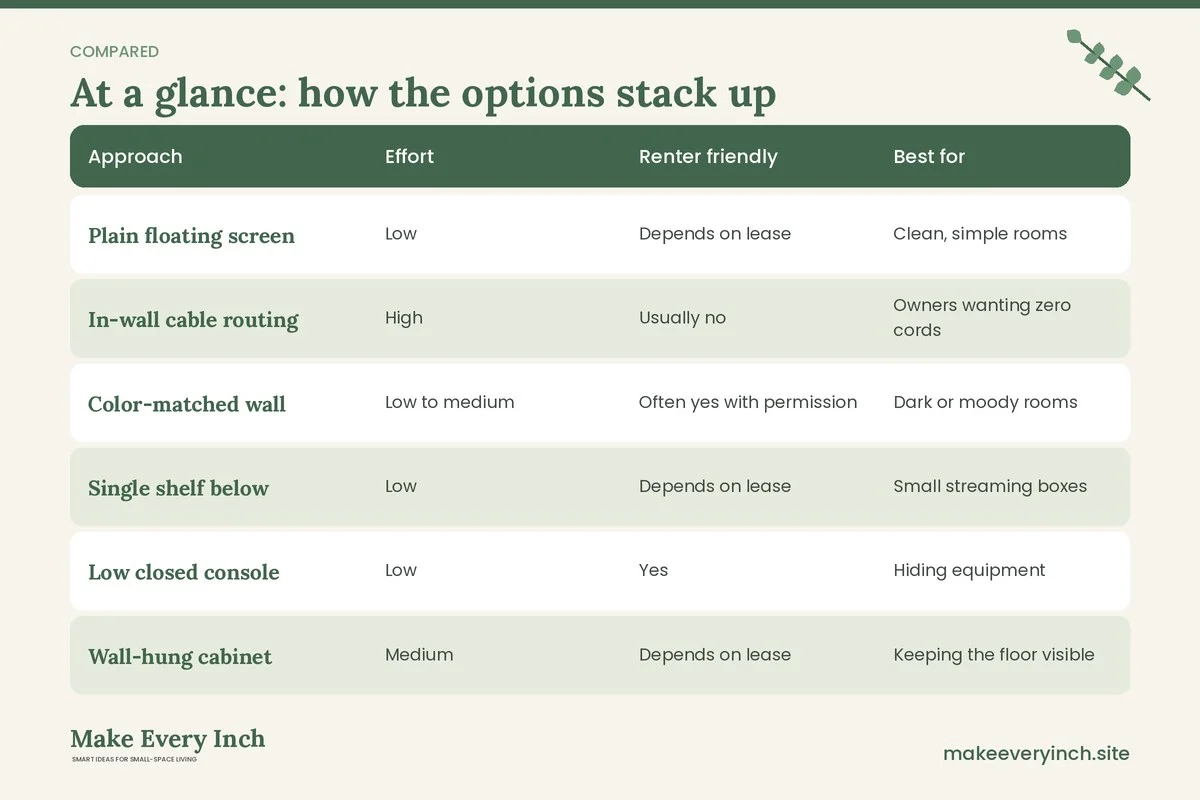
The table below compares the approaches by effort, flexibility and who they suit. Ranges are rough and depend on your wall and your tools.
| Approach | Effort | Renter friendly | Best for | Watch out for |
|---|---|---|---|---|
| Plain floating screen | Low | Depends on lease | Clean, simple rooms | Cable visibility |
| In-wall cable routing | High | Usually no | Owners wanting zero cords | Safety and local rules |
| Color-matched wall | Low to medium | Often yes with permission | Dark or moody rooms | Needs a proper test patch |
| Single shelf below | Low | Depends on lease | Small streaming boxes | Overfilling the shelf |
| Low closed console | Low | Yes | Hiding equipment | Depth in a tight room |
| Wall-hung cabinet | Medium | Depends on lease | Keeping the floor visible | Stud and anchor placement |
| Hidden or art screen | Medium to high | Depends | Light TV watchers | Ventilation |
| Paintable cable cover | Low | Often yes | Tidy cords fast | Adhesive on delicate paint |
Plan the cables first
Cables are the biggest enemy of a calm wall, so plan them before you choose anything else. Start by counting what must connect to the screen. Many modern setups need only power plus one signal cable, and some devices work wirelessly. Fewer cables means fewer problems.
1. Count the devices. List everything: streaming box, game console, soundbar, router. Remove anything you do not use weekly.
2. Choose the shortest cable that works. A cable that is too long creates loops, and a loop is visual clutter. Leave a little slack for movement, but no more.
3. Group power in one place. Use a single power strip placed inside the console or behind it. Check its rating and do not overload it.
4. Use sleeves or clips. Bundle cords with a cable sleeve or clips on the back of the console so only one clean line runs to the wall.
5. Keep power and signal tidy but safe. Do not run cords under rugs where they can be damaged, and do not hide power strips where they can overheat.
If you plan any in-wall wiring, follow local rules and the product instructions, and use a qualified person where needed. A rented home usually means surface solutions only.
Mounting and safety notes
A mounted television is heavy and falls with force, so treat the installation seriously.
- Read the TV and mount instructions first. They list the bracket pattern, the screw size, the weight limit and the wall types the mount is rated for.
- Find studs, or use the right anchors. Many mounts are designed to be fixed into wall studs. If the wall has no stud where you need it, use anchors rated for the load in the instructions, and consider a bracket that spreads the load. Do not rely on a plain screw in drywall.
- Check what is behind the wall. Use a detector to look for pipes and wires before drilling.
- Respect the weight and size ratings. Choose a mount rated comfortably above the weight of your screen.
- Get a second person. Lifting a screen onto a bracket is easier and safer with two people.
- Stand furniture needs anchoring too. A tall or narrow cabinet should be fastened to the wall with the anti-tip fittings in its instructions, especially if children or pets live with you.
- Leave airflow. Keep vents clear and follow the manual’s clearance guidance.
If you rent, read your lease before drilling. Our post on no-drill storage ideas for renters offers surface options, and a freestanding media stand removes the need to mount at all.
Three example rooms
A 10 by 12 foot room with a 43 to 50 inch screen
The sofa sits on the long wall, about 6 feet from the TV wall. The screen is mounted with its center near 42 inches, above a 14-inch deep closed console. The wall is painted a soft warm gray, the console matches the wall tone, and one large piece of art hangs on the opposite wall, not beside the screen. Cables run down a painted cover to a power strip inside the console. The result is a wall with only two visible objects.
A narrow 9 by 14 foot room
When the room is long and narrow, put the TV on the short wall so the seating can sit farther back and the walkway stays on the side. A wall-hung cabinet keeps the floor clear, and a rug runs along the length of the room. Seating distance of 7 to 8 feet suits a screen up to 55 inches. For other narrow-room tricks, read our narrow living room ideas.
A studio living zone of 9 by 11 feet
In a studio, the TV wall may also be the room divider. A single floating shelf and a plain screen on a freestanding stand mean nothing is fixed to the wall, which helps in a rental. Keep the surrounding furniture to a sofa and one side table. A rug marks the living zone, and the rest of the studio stays quiet. See our small apartment living room ideas for studios.

Styling: the three-object rule
Once the equipment is hidden, the wall and the console need a little life, or the room can feel cold. The three-object rule keeps this controlled. On any surface, place up to three objects that vary in height: one tall, one medium and one low. For example, a slim vase, a small stack of books and a ceramic bowl. If you place more, the arrangement stops looking intentional.
Keep colors to one accent. A single plant adds softness without adding noise. Choose a pot that matches your palette, and avoid trailing plants that hide the lines of the console. Replace objects seasonally rather than adding to them.
Mistakes to avoid
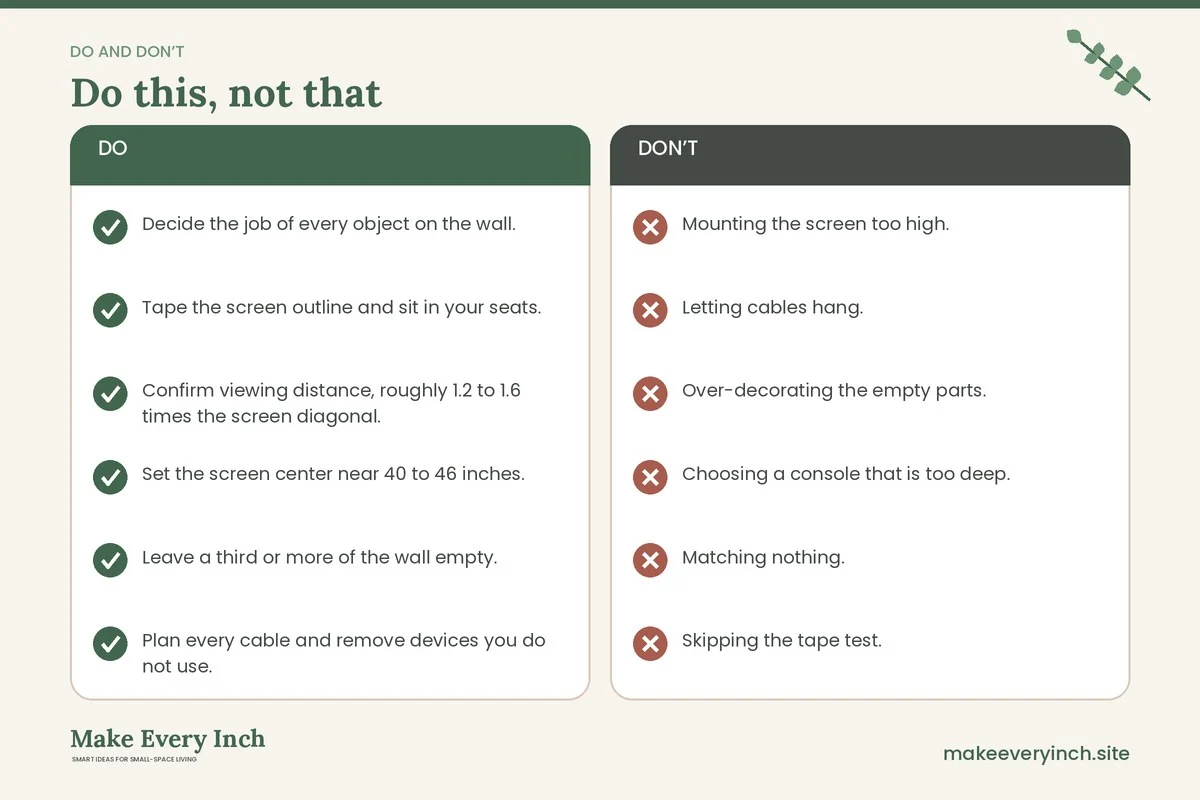
- Mounting the screen too high. The center should sit near seated eye level, not at the ceiling line.
- Letting cables hang. A single loose cord undoes a clean wall.
- Over-decorating the empty parts. The empty wall is the design, not a gap to fill.
- Choosing a console that is too deep. Anything over about 16 inches costs you walkway in a small room.
- Matching nothing. A minimalist wall depends on a consistent palette, so check each new piece against your two or three tones.
- Skipping the tape test. Always tape the screen outline and live with it for a day.
- Ignoring glare. A glossy screen opposite a bright window can be hard to watch, so place the wall away from direct light or add curtains.
Minimalist TV wall checklist
- Decide the job of every object on the wall.
- Tape the screen outline and sit in your seats.
- Confirm viewing distance, roughly 1.2 to 1.6 times the screen diagonal.
- Set the screen center near 40 to 46 inches.
- Leave a third or more of the wall empty.
- Plan every cable and remove devices you do not use.
- Pick one storage piece and keep it closed.
- Read the TV and mount instructions, then use studs or rated anchors.
- Anchor any tall furniture with the supplied fittings.
- Paint or choose two to three quiet tones.
- Add one light source and one object group of three.
- Keep 30 to 36 inches of walkway.
FAQ
How high should I mount a TV in a minimalist living room?
Aim for the center of the screen at about 40 to 46 inches from the floor, close to seated eye level. If you tilt your head back, lower it. Tape the outline first and test it from your seat.
How big should the TV be in a small living room?
Many people find a 43 to 55 inch screen comfortable at a viewing distance of about 5 to 7 feet. A common rule is a distance of roughly 1.2 to 1.6 times the diagonal, though preferences vary.
How do I hide TV cables without cutting into the wall?
Use a paintable cable cover, a sleeve behind the console and a single power strip inside a closed cabinet. These solutions leave the wall intact and suit renters.
Should I hang art around the TV?
Keep it to one quiet piece with generous spacing, or none. Several small frames around a screen create the clutter a minimalist wall is meant to avoid.
Can I do this in a rental?
Yes, with a freestanding media stand, a console and a cable cover that attaches with an adhesive. If you want to mount the screen, check the lease first. Our small living room ideas for renters post has more options.
Is a minimalist TV wall boring?
Not when the proportions, materials and lighting are right. Texture and a good light source give a calm wall depth without adding objects.
Keep going: Keep planning with our minimalist apartment ideas, small living room layout ideas minimalist and small living room tv wall ideas for renters.
Save this guide for later
Pin the ideas you like to Pinterest so you can come back to them when you plan your space.