Decluttering Rules for Small Homes
Quick answer: The most useful decluttering rules for small homes are to set a capacity limit for every storage space, sort by category instead of by room, use keep, donate and decide boxes, follow one-in, one-out for new items, and keep sentimental items to a defined box. A small home has a fixed amount of room, so the limit has to come before the sorting.
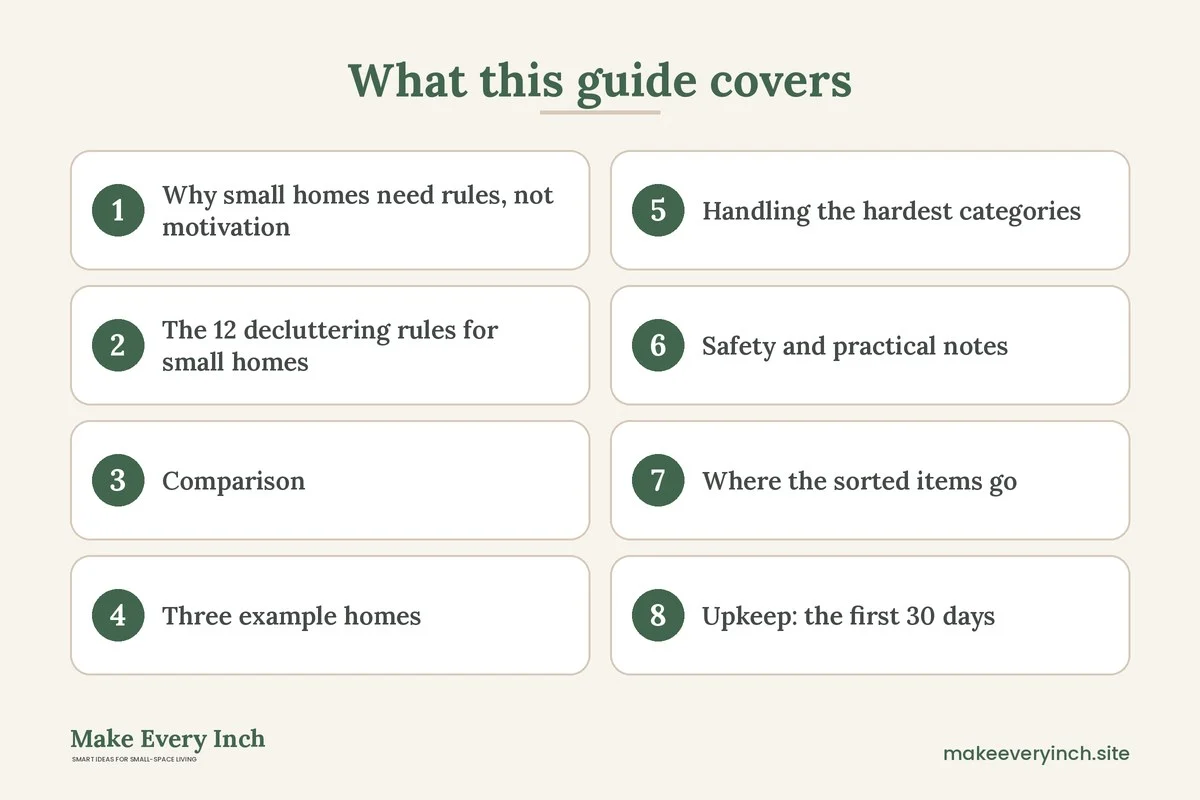
Decluttering rules for small homes work differently from the advice written for large houses. In a big house you can tolerate overflow, because the garage, the attic and the spare room absorb it. In a small home there is no overflow. Every object you own is competing for a shelf, a drawer or a patch of floor, and the moment your belongings pass the capacity of your storage, the surfaces start to fill. That is why a small home can feel cluttered after only a few extra bags of shopping. This guide gives you 12 concrete rules you can apply in a weekend, with the measurements, box systems and numbers that make each rule easy to follow. It covers the mindset shift, the 12 rules, a comparison table of methods, three example homes, a sentimental item plan, upkeep routines and a checklist. For the wider topic, start with our pillar guide on small space organization ideas, and pair this post with our existing guide to small apartment decluttering ideas, which focuses on room-by-room tactics. For families, see the companion guide on small home organization for families.
Why small homes need rules, not motivation
Most decluttering advice leans on motivation: wait until you feel inspired, hold each item and ask how it makes you feel. That approach can work once, but it rarely lasts in a small home, because motivation fades long before the next delivery arrives. Rules last longer. A rule is a decision you make once, in a calm moment, so you do not have to make it again every time you stand in front of a full drawer.
Small homes also have an advantage that large ones lack: the limits are visible. You can see when the closet rail is full, you can feel when the drawer sticks, and you can hear the cupboard door complain. Use those signals. The rules below turn them into numbers, so clutter becomes something you measure rather than something you vaguely dislike.
A few ground rules before you begin. Work in short sessions of 45 to 90 minutes, because decision fatigue sets in after that and every item starts to look like a keeper. Keep water and a snack nearby. Wear shoes, since you will be lifting boxes and bags. If you share the home, agree in advance that each person decides only about their own things, and treat shared items as a separate conversation.
The 12 decluttering rules for small homes
Rule 1: Set a capacity limit for every storage space
Before you remove a single item, decide how full each space is allowed to be. A good working target is to fill closets, shelves and cabinets to about 80 percent, leaving 20 percent free so you can see, reach and put things back without a struggle. For a closet rail, that might mean leaving a hand’s width of empty rail. For a shelf, it means every item sits in a single layer you can see, with a gap of a few inches at the end. For a drawer, it means you can close it with one finger.
The limit does the job that willpower cannot. When the space is full, something has to leave before something else arrives. A limit also makes the problem finite. You no longer ask how much to throw away, which has no answer. You ask what fits into this one shelf, which does.
Rule 2: One in, one out for the things that multiply
One-in, one-out means that for every new item you bring home, a similar one leaves. It works best on categories that multiply on their own: clothes, shoes, mugs, towels, books, bags, toys and kitchen gadgets. If you buy a new jacket, an old jacket goes to the donate bag the same day. If a new mug arrives as a gift, the chipped mug goes.
Apply the rule at the moment of arrival, not later. The best habit is to put the outgoing item by the door before you unpack the new one, so the swap happens while you are still holding the purchase. Do not apply this rule to consumables such as food, toiletries and cleaning supplies, where a simple stock limit works better (see Rule 9). For items you need two of, such as a spare towel set, define the number once and stick to it.
Rule 3: Sort by category, never by room
Sorting room by room is the most common mistake. If you tidy the bedroom, then the bathroom, then the kitchen, you handle the same kind of item in three places and never see how much you own. Sort by category instead. Gather every item of one type into a single pile, then decide.
A sensible order moves from easiest to hardest, which builds momentum and saves the emotional items for when your decision muscles are warm:
- Clothes, including coats and accessories
- Shoes and bags
- Books, magazines and paper
- Kitchen items, including food storage and gadgets
- Bathroom and toiletries
- Cleaning supplies and tools
- Decor and small furniture
- Hobby and craft items
- Sentimental items, last
In a small home, you can often fit a full category on the bed or the floor. Seeing 14 black T-shirts together is far more persuasive than finding them in four drawers over six months.
Rule 4: Use the keep, donate and decide boxes
Use three boxes, or three clear zones on the floor, with a fourth bag for trash and recycling. The keep box holds items you use and like. The donate box holds items that are in good condition but no longer serve you. The decide box is the most useful and the most neglected. It holds items you cannot decide on in under ten seconds.
The rule for the decide box is to write a date on it, usually 30 to 90 days ahead, and put it somewhere out of sight, such as the top of a wardrobe or the back of a closet. If you do not open it before that date, you donate the contents without looking. The box turns hesitation into a time limit. If you do open it for a specific item, that tells you the item matters, and it moves back to the keep area. Most people find that the box stays shut.
Rule 5: Ask three practical questions, not a feelings question
The question “does it spark joy” does not scale to a kitchen full of cables and takeaway menus. Replace it with three practical questions you can answer fast:
- Have I used it in the past 12 months, or will I use it in the next three, for a specific reason?
- Do I have another item that does the same job?
- Would I buy it again today at the same price and effort?
If the answers are no, yes and no, the item can go. For seasonal items, such as a heavy coat or a camping stove, extend the window to the full cycle of the year or the event. Keep the questions on a card taped inside a cupboard door if that helps, so you apply them the same way every time.
Rule 6: Give every item a home, and make the home easy
An item with no home lives on a surface. In a small home that surface is usually the dining table, the sofa arm or the counter. After you decide what stays, give each keeper a single, specific spot, and make putting it away take one motion. Open shelves, hooks and shallow bins beat lidded boxes and deep stacks, since a task that takes three steps will not happen on a tired evening.
Group homes by where the item is used, not by what it is. Scissors, tape and a pen belong near the place where you open mail, not in a distant drawer with other tools. Keys, wallet and a charging cable belong at the door. This is the point where storage products help, but only after you have decided what to keep. For ideas, see our guides to vertical storage ideas and hidden storage ideas.
Rule 7: Keep surfaces nearly clear
Clear surfaces are the clearest sign of a decluttered small home, and they are a rule you can see at a glance. Aim to keep the floor, the bed, the dining table and at least half of every counter free of items that do not belong there. A useful limit is three objects per surface, plus things in daily use. A coffee table might hold a tray, a candle and a remote. A bedside table might hold a lamp, a glass and a book.
If you break the rule, treat the surface as a signal. A pile on the table usually means a missing home, not a lack of discipline. Ask where the pile items should live and fix that gap instead of cleaning the pile again.
Rule 8: Limit duplicates to a defined number
Duplicates are the quietest source of clutter. Set a number for each duplicate category and write it down. A small home might hold, for example, four to six bath towels per household of two, two sets of sheets per bed, six to eight mugs, a handful of storage containers with matching lids and one or two cutting boards. These are examples, not targets. Adjust for the size of your household and how often you do laundry or host guests.
When you count, remove the weakest items first: stained, mismatched, worn or never used. Containers without lids, single socks and cables for devices you no longer own all go. Keep the best, and let the number cap future purchases.
Rule 9: Use stock limits for consumables
Pantry items, toiletries, cleaning products and paper goods creep up when they are on sale. Set a stock limit for each: for example, no more than one spare of each toiletry, or enough pantry staples to fill one shelf. Store spares in one labeled bin or one shelf, and when the bin is full, you stop buying. See our guides on small kitchen pantry ideas and small kitchen organization ideas for ways to fit stock into tight kitchens.
A simple method is to rotate by date. New items go to the back, old ones to the front, and you use the front first. Once a month, check the bin for expired or half-used products and clear them.
Rule 10: Make a rule for paper and digital clutter
Paper is a heavy source of clutter in small homes because it arrives without being invited. Set up a three-part system at the entrance of the home: a recycling bin, a to-do tray and a file box. Open mail over the bin and discard envelopes and flyers immediately. Place bills and forms that need action in the tray, and clear the tray weekly. File only what you must keep, such as tax documents, identity papers and warranties, in one slim box with labeled folders. Many documents can be scanned and stored digitally, but check which originals your local rules require you to keep before you shred anything.
Treat digital clutter the same way. Photos, downloads and screenshots do not take up floor space, but they do take your attention. Spend ten minutes a month on the phone and desktop, deleting duplicates and old files.
Rule 11: Keep sentimental items in a defined container
Sentimental items are where decluttering rules often stall, because the value is emotional and not practical. The best solution is a fixed container and a fixed size. Choose one memory box per person, such as a lidded box about 12 by 16 by 10 inches, and agree that it holds only the items that matter most. Anything that does not fit means a choice, not a bigger box.
Add three techniques for the harder cases. Photograph bulky items, such as a child’s artwork or a pile of cards, and keep the photo instead of the object. Keep the part and not the whole, for example one tie from a collection, a square from a quilt or a single plate from a set. And use the display test: if an item matters, it should be seen or used, not buried. If you find you want to display it, give it a shelf or a frame. If you cannot find a place for it, you may be keeping the guilt, not the memory. Inherited items need patience. It is fine to keep them in the decide box for a longer period, and to ask relatives if anyone else wants them.
Rule 12: Schedule a short, recurring reset
The final rule keeps all the others working. Put decluttering on the calendar in small, repeatable slots. A daily five-minute tidy returns items to their homes. A weekly 15-minute check clears surfaces, the tray of paper and the decide box. A seasonal one-hour review swaps clothes, checks stock limits and tests each capacity limit. A yearly review looks at the sentimental box and the big categories.
The slots are short on purpose. A small home never gets very cluttered between visits, so a short reset is enough, and a short reset is easier to start. Link each slot to an existing habit, such as the Sunday evening reset or the first day of the new season.
Comparison: which decluttering method suits which situation?
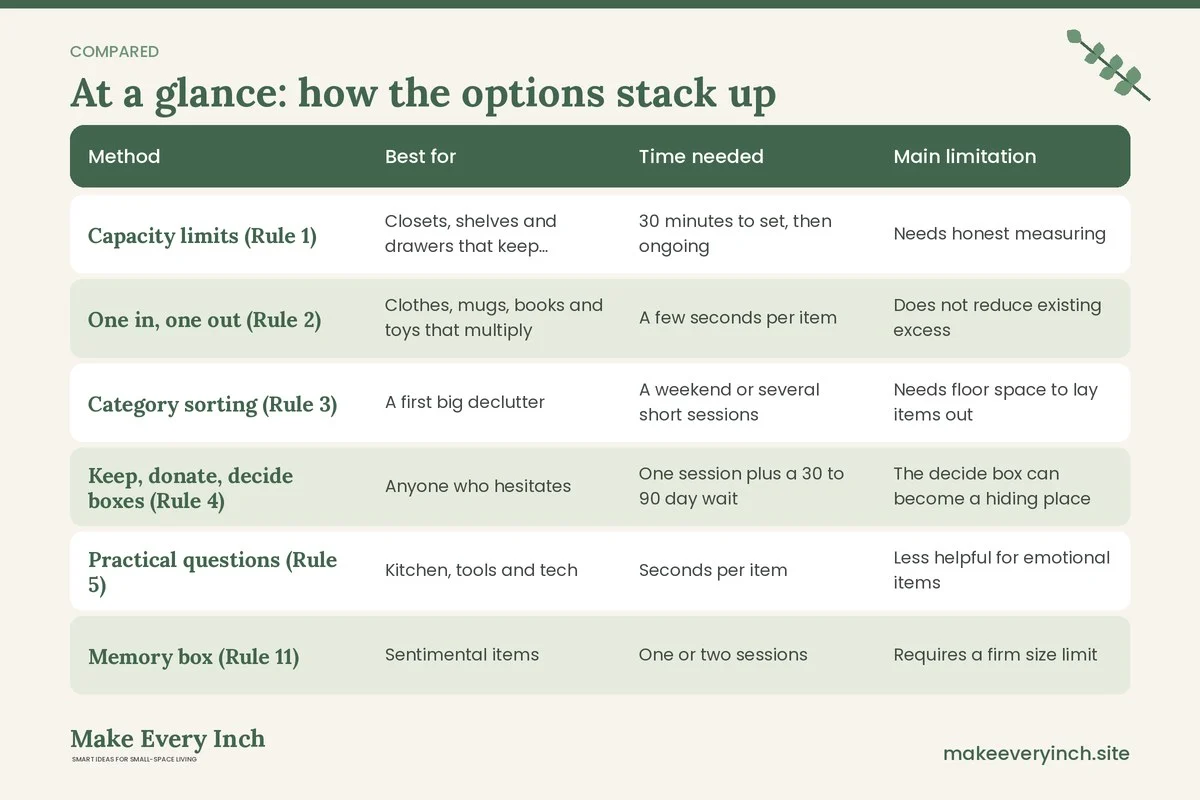
No single method fits every household. Use the table below to match a method to the problem you face.
| Method | Best for | Time needed | Main limitation |
|---|---|---|---|
| Capacity limits (Rule 1) | Closets, shelves and drawers that keep overflowing | 30 minutes to set, then ongoing | Needs honest measuring |
| One in, one out (Rule 2) | Clothes, mugs, books and toys that multiply | A few seconds per item | Does not reduce existing excess |
| Category sorting (Rule 3) | A first big declutter | A weekend or several short sessions | Needs floor space to lay items out |
| Keep, donate, decide boxes (Rule 4) | Anyone who hesitates | One session plus a 30 to 90 day wait | The decide box can become a hiding place |
| Practical questions (Rule 5) | Kitchen, tools and tech | Seconds per item | Less helpful for emotional items |
| Memory box (Rule 11) | Sentimental items | One or two sessions | Requires a firm size limit |
| Weekly reset (Rule 12) | Maintaining results | 15 minutes a week | Needs a fixed time to stick |
Three example homes
A 450 square foot studio for one person
The studio has one closet, a small kitchen and a combined living and sleeping area. The occupant begins with Rule 1 by measuring the closet rail at 48 inches and deciding to leave 8 to 10 inches empty. Sorting clothes by category shows that they own 11 pairs of jeans and 26 shirts, far more than the rail holds. After using the three questions, they keep what fits within the limit, send the rest to the donate bag and place five uncertain items in a decide box under the bed for 60 days. Rule 2 then keeps the rail from filling up again. For the kitchen, they apply Rule 8 and keep six mugs, six plates and a single set of containers with matching lids. The surface rule keeps the single counter free for cooking.
A one-bedroom apartment for a couple
Two people share one closet, a single bathroom and a hallway cupboard. The couple agree that each person decides only about their own items, and they sort shared categories together at a table with coffee. They set capacity limits per person, such as half the rail and half of each shelf. The paper system sits by the front door, with a recycling bin under the console, a tray for action items and a slim box for permanent files. Their memory boxes sit on the top shelf of the closet. A weekly 15-minute reset on Sunday evening keeps the rest in order. For more storage options, read our guide on small bedroom organization ideas.
A small house of 900 square feet with a spare room
The spare room is the danger zone: it slowly becomes a storage room, and every unsorted object ends up there. The owner sets a capacity limit by tape-marking a zone of the floor, 4 by 6 feet, as the only allowed storage area, and everything else must go. They sort by category, moving every item of a type into the room and working through the piles. The decide box goes on the highest shelf, and a donation drop-off is scheduled in the calendar for the same week, so items leave the home quickly instead of waiting in the hallway. Once the room is cleared, they choose a purpose for it, such as an office or a guest bed, so it does not drift back into storage.
Handling the hardest categories
Clothes
Clothes are the largest category in most small homes. Turn all hangers backward at the start of a season, and turn each hanger the right way after you wear the item. At the end of the season, anything still backward goes to the decide box. Check fit and condition honestly: if it needs repair and you have not repaired it in six months, it is not a repair project, it is clutter. For closet ideas, see our guide to small closet organization ideas.
Books and media
Books are heavy and take up shelf space. Keep the ones you reread, reference books and a handful of favorites. Libraries and e-readers cover the rest. A one-shelf limit works well: when the shelf is full, a book leaves for each one that arrives. A narrow unit can help; see our guide to the best narrow bookshelves.
Kitchen gadgets
Single-purpose gadgets are often the first to go. Ask which tools you have used in the last year, and keep multi-purpose ones. Store the rest in a cabinet by use, with daily tools within reach and rarely used ones high up or at the back. Read our post on small kitchen storage mistakes to avoid for more.
Gifts and freebies
Gifts are tricky because they carry social weight. A gift’s job is done when it is given and received. If you do not use or like it, it is acceptable to pass it on, as long as you do so kindly. Say no to freebies at events, and consider asking friends and family for consumables, experiences or a donation instead of objects.
Items for a future you
Many small homes hold clothes for a future size, equipment for a hobby you may start and tools for a project you might do. Be honest with the future version of yourself. If the plan has no date, the item goes in the decide box. If you do start the project, you can borrow, rent or buy again, and you will have space to use it.
Safety and practical notes
Decluttering involves lifting, climbing and sometimes disposing of hazardous items, so a few precautions help.
- Lift safely. Do not carry heavy boxes up or down stairs alone, and bend your knees. Split heavy books into smaller boxes.
- Use a stable step stool for high shelves and never stand on a chair or a pile of boxes.
- Dispose of hazardous items properly. Old paint, batteries, electronics, medicines, light bulbs and cleaning chemicals often need special disposal. Check your local waste service or a collection point before putting them in the bin.
- Anchor tall furniture. If clearing space makes you move shelves or dressers, anchor tall pieces to the wall with the proper hardware where the lease and the wall allow it, and never drill without permission if you rent. Freestanding options and furniture straps designed for the wall type may suit rentals.
- Mind electrical items. Do not overload sockets while moving appliances, and recycle damaged cords instead of keeping them.
- Ventilate when cleaning. Open a window when you use strong cleaning products, and choose low-VOC options if you repaint a freshly cleared room.
- Protect your data. Wipe old phones, laptops and drives before you donate or recycle them, and shred documents with personal details.
Where the sorted items go
A decluttering session fails if the donate bag lives in the hallway for a month. Plan the exit before you begin. Options include donation centers, charity shops, friends and family, community groups, and local reuse or swap events. Items in poor condition can be recycled as textiles or electronics where schemes exist. Set a deadline: the donate bag leaves the home within a week, and if you can, in the same weekend. If you want to sell items, pick a limit, such as two weeks of listing. After that, they go to donation. Selling is a reasonable choice for larger or higher-value items, but it should not delay the rest.
Upkeep: the first 30 days
The first month after a declutter is when the habits form. Use this simple plan to lock in the results.
- Days 1 to 7: Practice the five-minute daily tidy. Put each item back in its home and check that the home still works.
- Days 8 to 14: Do the first 15-minute weekly reset. Open the paper tray, check surfaces and review the decide box date.
- Days 15 to 21: Test the one-in, one-out rule. Track anything new that comes in and what leaves.
- Days 22 to 30: Check each capacity limit. If any space has crept above 80 percent, run a quick sort of that space.
At the end of the month, adjust the rules that did not work. Homes and routines differ, and the best rules are the ones you actually keep.
Common mistakes to avoid
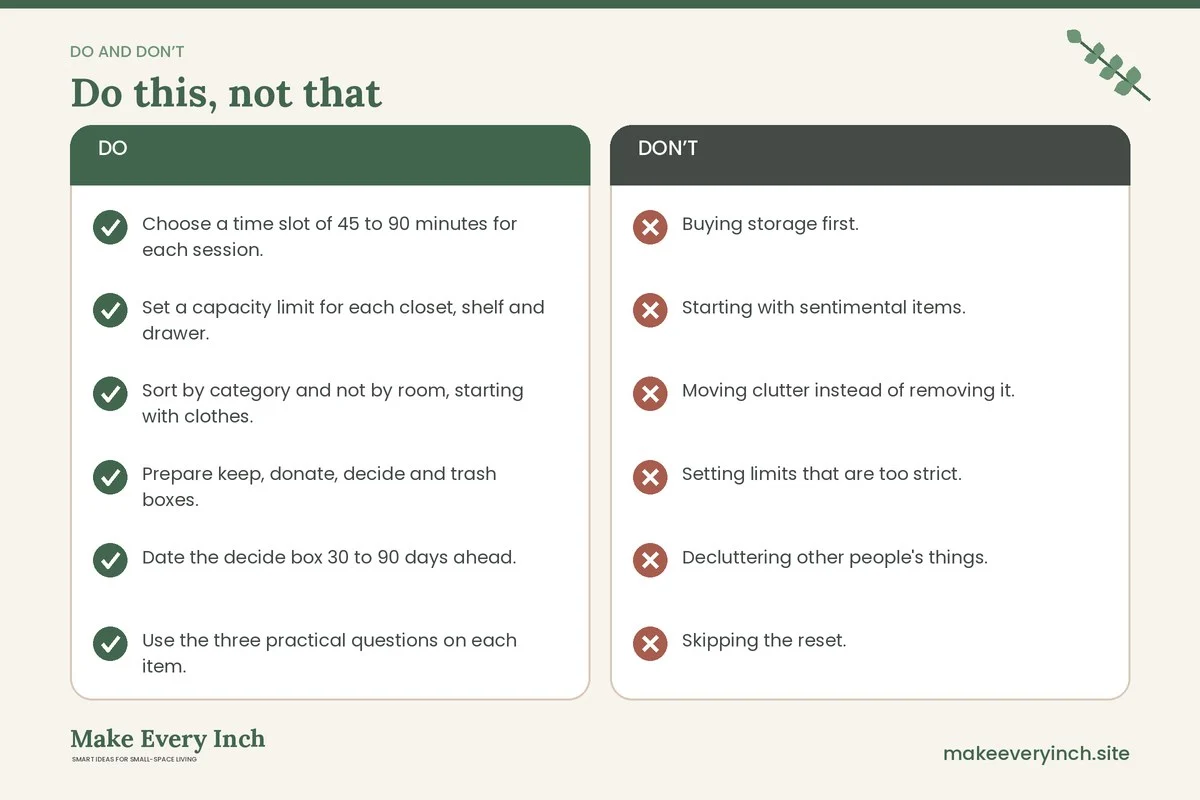
- Buying storage first. Containers fill whatever space you give them. Declutter, measure, then buy only what you need.
- Starting with sentimental items. They are the hardest and drain your energy. Leave them for last.
- Moving clutter instead of removing it. A box shifted to the closet or the car is not a decluttered home. Make sure items leave.
- Setting limits that are too strict. A limit you cannot keep leads to rebound buying. Start at 80 percent and adjust.
- Decluttering other people’s things. Respect each person’s belongings, and agree on a method for shared spaces.
- Skipping the reset. Without upkeep, even a perfect result fades in a few months.
Decluttering checklist
- Choose a time slot of 45 to 90 minutes for each session.
- Set a capacity limit for each closet, shelf and drawer.
- Sort by category and not by room, starting with clothes.
- Prepare keep, donate, decide and trash boxes.
- Date the decide box 30 to 90 days ahead.
- Use the three practical questions on each item.
- Define a number for duplicates, such as towels and mugs.
- Set stock limits for consumables.
- Create a paper system with a bin, a tray and a file box.
- Choose one memory box per person.
- Plan where the donated items will go before you start.
- Apply one in, one out from the first day.
- Schedule a five-minute daily tidy and a 15-minute weekly reset.
FAQ
What is the best order to declutter a small home?
Work by category and in order of emotional difficulty: clothes, shoes and bags, books and paper, kitchen items, bathroom items, tools, decor, hobby items and finally sentimental items. This builds momentum and saves the hardest decisions for last.
How many items should I keep?
There is no universal number. Use capacity limits instead: fill each space to about 80 percent and keep what fits. The limit adapts to the size of your home and your habits.
How do I stop clutter from coming back?
Use the one-in, one-out rule, schedule a weekly reset, and give every item a specific home. Most clutter returns because items have no home or because new things arrive faster than old ones leave.
What should I do with items I cannot decide on?
Place them in a dated decide box for 30 to 90 days. If you do not open the box, donate it without looking. If you open it for an item, that item has proven its value.
How do I handle sentimental items in a small space?
Choose one memory box per person with a defined size. Photograph bulky items, keep only the best part of a collection, and display things that matter instead of storing them out of sight.
Do these rules work for renters?
Yes. The rules rely on sorting, limits and routines instead of building work. For storage that does not damage walls, read our guide to no-drill storage ideas for renters, and check your lease before drilling or fixing anything to a wall.
How long does a first declutter take?
A one-bedroom home usually takes a few weekends of focused sessions, depending on the amount you own and how many decisions are hard. Short, repeated sessions tend to work better than a single exhausting day.
Keep going: Keep going with our guides to small space organization ideas, small apartment decluttering ideas and cheap storage ideas for apartments.
Save this guide for later
Pin the ideas you like to Pinterest so you can come back to them when you plan your space.