Small Home Paper Organization Ideas
Quick answer: Small home paper organization ideas start with triage, not furniture. Sort every piece of paper into recycle, shred, act on, keep or scan. Hold active papers in one upright file or tray, and move finished records to a single archive box. Scan what you need to retain, back it up in two places, and check official guidance for how long to keep tax, legal and medical documents. Store originals in a dry spot away from heat, and keep the most important ones in a fire-resistant box.
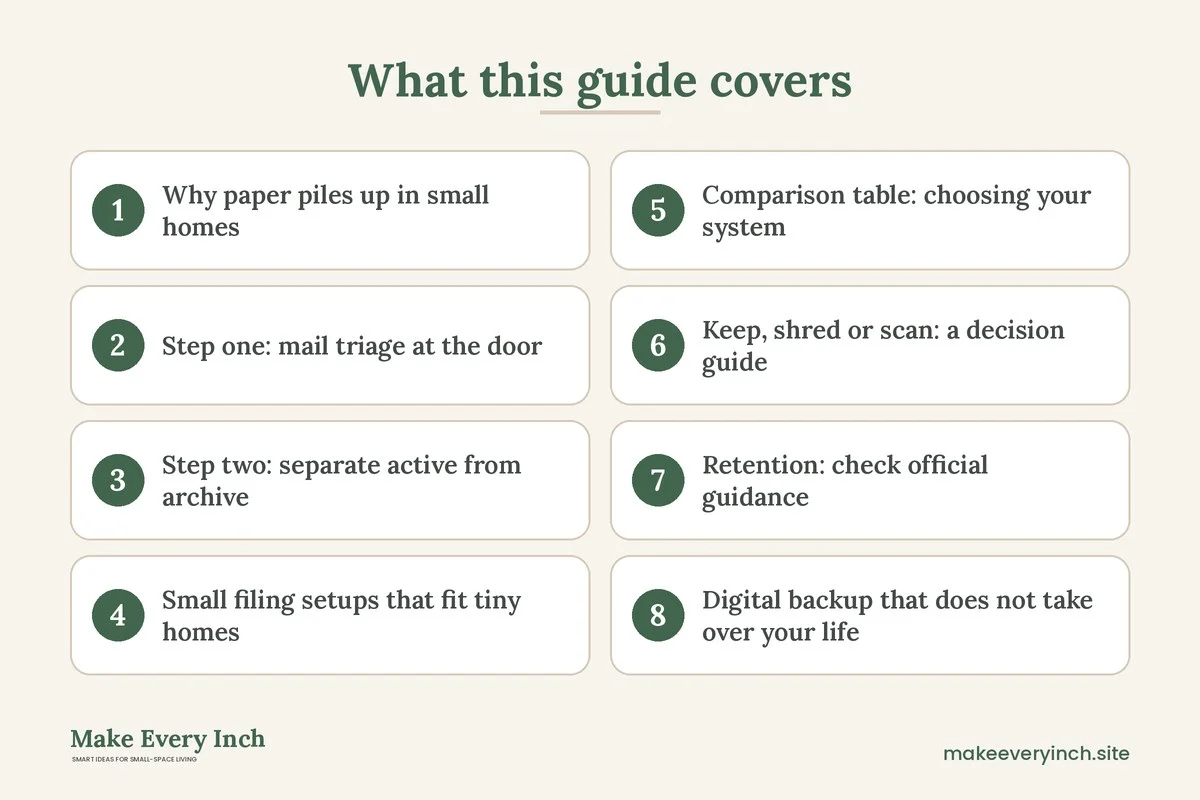
Small home paper organization ideas are really about decisions. In a small home, paper rarely arrives in a dramatic pile. It slides in a few envelopes at a time, lands on the counter and quietly takes over. Statements, school forms, warranties, takeout menus, appointment cards and catalogs share the same surface until a table you wanted for dinner becomes a filing cabinet. The fix is not a bigger cabinet. It is a short system that sorts paper at the door, keeps what is active within reach and moves the rest out of sight or off paper altogether. This guide covers a five-bin triage, how to separate active papers from the archive, small filing setups for every kind of home, a comparison table, a digital backup routine, retention guidance with a strong reminder to check official sources, document safety, three example homes, a weekly routine and a checklist. For the broader plan, see our pillar on small space organization ideas. If your mail lands near the door, pair this with our post on small home drop zone ideas.
Why paper piles up in small homes
Paper builds up because it carries a hidden to-do. A bill needs paying, a form needs signing, a letter needs a reply. Because you cannot tell whether a page is important until you read it, you put it down and promise to come back. In a small home, “down” is often the same few surfaces you use for cooking, eating and working, so the piles are visible and stressful.
Three habits cause most of the trouble.
- No landing spot. Mail has no assigned place, so it lands wherever you are standing.
- No decision at the door. Junk travels farther into the home because nobody sorts it at the start.
- No exit. Papers move in, but there is no routine for moving them out, so the only direction is more.
The remedy is to give paper a short route: one place to land, one quick decision, one home for each outcome and one date each month when the route is cleared. This works in a studio, a one-bedroom or a shared apartment, because it relies on habits and a little vertical space, not on a large desk.
Step one: mail triage at the door
Triage means deciding what a piece of paper is in a few seconds. Do it standing up, as soon as the mail arrives, ideally over a recycling bin. Use five categories.
- Recycle: flyers, catalogs, unsolicited offers and anything with no personal details. Put it in the bin straight away.
- Shred: anything with a name, an account number, a signature line, a medical detail or a pre-approved offer in your name. Keep a small bag, a box or a locked bin near the sorting spot and shred in batches.
- Act: bills, forms, invitations and anything with a date or a reply. These go into the active tray.
- Keep: items you must retain, such as tax records, contracts, warranties or medical papers. Put them in the active file for now, then move them to the archive when they are done.
- Scan: papers you want to keep as a copy, but do not need as originals, such as receipts, recipes and kids’ artwork. Place them in a scan folder and process them weekly.
A useful rule is to touch each piece only once. If you pick up a letter, decide before you put it down. If a decision is not possible, such as when you need to look something up, put it in “act” with a sticky note that says what you need. Opening mail near the recycling and the shredding bag prevents the “I’ll deal with it later” pile from forming. For a place to do this, our small home drop zone ideas show shelves, door pockets and wall slots that fit tiny entries.
A two-minute triage script
Stand at the door with the mail. Say “recycle, shred, act, keep or scan” for each piece. Rip open envelopes, remove inserts you do not need and put the envelope itself in recycling unless it has an address you need. Put “act” items into the tray with the oldest due date on top. The whole process should take two minutes for a normal day’s mail, and about five if you have a backlog. If you are stuck with a stack, set a timer for ten minutes and work through it. Stop when the timer ends.
Step two: separate active from archive
The single most helpful distinction is between papers you need this month and papers you must keep but rarely touch. Treat them as two systems.
Active papers
Active papers are things you act on or look at often: bills to pay, forms to return, appointments, a current insurance card and upcoming travel details. They should fit within a small footprint, about the size of a letter tray or a single slim file. Keep them where you pay bills, ideally within arm’s reach of your usual seat. Rules for the active zone include the following.
- Keep it small. If it cannot be held in one slim file or tray, you are keeping too much.
- Use upright, not flat. Standing papers are visible, while flat piles hide the one you need.
- Sort by action, not topic. A file called “To pay” or “To sign” is more useful than a file called “Bank”.
- Empty it on a schedule. Once a week, process the tray. Pay, sign, file or discard.
Archive papers
Archive papers are records you may need again but do not touch each month: past tax returns and supporting documents, property papers, appliance manuals, warranties and old insurance policies. They live in a closed container, labeled by year or category, stored somewhere dry and cool. A single archive box per person or household is plenty for most people, because much of the old paper can be scanned and then shredded where it is safe to do so.
The point of this split is speed. When a bill arrives you open the active tray. When a lender asks for an old statement, you open the archive. You never have to dig through years of paper to find this month’s form.
Small filing setups that fit tiny homes
You do not need a four-drawer cabinet. Choose the setup that matches the space you have and the amount of paper you keep.
Vertical and wall options
1. A wall-mounted file pocket
A set of two or three file pockets on a wall holds active papers at eye level. Use wall space where a desk is not possible, and check the lease before drilling. If you cannot, choose a version that hangs from a door. Our guide to vertical storage ideas has more ways to use height.
2. A magazine file on a shelf
Magazine files hold folders upright and fit on a narrow shelf. Label each by category, such as “Home”, “Health” and “Money”. They cost little space and are easy to move.
3. An over-the-door pocket organizer
Clear pockets hang over a closet or pantry door. Each pocket holds a category, and you can see inside. It is a flexible choice for renters, because it leaves no mark on the wall.
Desk and surface options
4. A tiered letter tray
A two-tier tray on the desk or counter splits “to act” from “to file”. It uses about 10 by 13 inches of footprint.
5. A slim desktop file
A narrow, upright file for hanging folders fits on a shelf or in a desk corner. If you work from the bedroom, see our ideas for a small bedroom desk that includes space for a file.
6. A drawer divider
If you have a desk drawer, add dividers and use it as a file drawer. A shallow drawer holds a few dozen folders on edge.
Portable and hidden options
7. A file box with a lid
A lidded box, about the size of a shoebox, holds a year of archive paper and slides on a closet shelf. Label the front, not the top, so you can read it when stacked.
8. A document case
A compact case with a handle holds the papers you may need to grab fast, such as passports, birth certificates and insurance details. Keep it with your emergency items, and make sure everyone in the home knows where it is.
9. Under-bed or under-sofa storage
Flat boxes slide under a bed and hold archive papers, away from daily view. Keep them off the floor if there is any chance of damp, and avoid areas near a heater or a radiator. See our guide to under-bed storage ideas for options.
10. A hidden compartment in furniture
A bench, an ottoman or a console with a lid can hold a file box. Our list of hidden storage ideas shows several shapes.
Comparison table: choosing your system
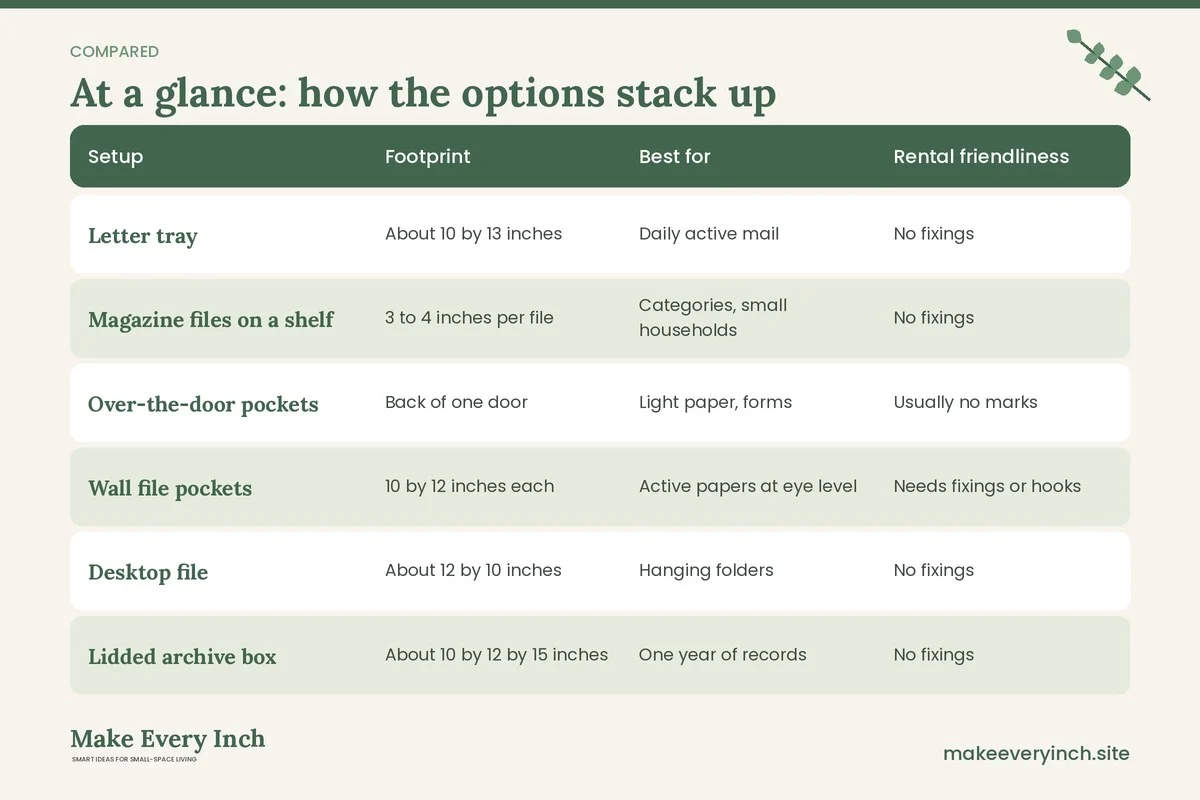
Use this table to match a setup to your home. Sizes are approximate, so measure your own space.
| Setup | Footprint | Best for | Rental friendliness | Main watch-out |
|---|---|---|---|---|
| Letter tray | About 10 by 13 inches | Daily active mail | No fixings | Can grow into a pile |
| Magazine files on a shelf | 3 to 4 inches per file | Categories, small households | No fixings | Needs a shelf |
| Over-the-door pockets | Back of one door | Light paper, forms | Usually no marks | Door must close |
| Wall file pockets | 10 by 12 inches each | Active papers at eye level | Needs fixings or hooks | Check the lease |
| Desktop file | About 12 by 10 inches | Hanging folders | No fixings | Takes desk space |
| Lidded archive box | About 10 by 12 by 15 inches | One year of records | No fixings | Keep dry and cool |
| Document case | Briefcase size | Key documents to grab | No fixings | Keep contents updated |
| Digital folder | No physical space | Scans and statements | Not applicable | Needs backups |
Keep, shred or scan: a decision guide
If you are unsure about a document, go through these questions in order.
- Is it a legal or identity document? Birth certificates, passports, deeds, wills and similar originals generally belong in a safe place. Do not shred them, and ask the issuing body about replacements.
- Is it needed for tax, benefits or a legal matter? Keep it for the period set by your tax authority or advisor, and keep the supporting records.
- Is it a warranty, a receipt or a manual? Keep the proof of purchase while the item is under warranty. Many manuals are available online, so you can scan or discard the paper.
- Does it have personal details? Shred it when you no longer need it, and do not put it whole in a recycling bin.
- Is it sentimental? Keep a small selection, scan the rest and store the originals in a labeled box.
- Can you easily get it again? Many statements are available online. If so, download, back up and recycle the paper.
When in doubt, keep it for now with a review date. A short “review by” label on a folder turns a vague worry into a plan.
Retention: check official guidance
How long you should keep each kind of document depends on where you live, your circumstances and the type of record. The suggestions below are only general starting points and are not legal, financial or tax advice. Before shredding anything important, check the official guidance from your tax authority, your financial institution, your insurer, your healthcare provider or a qualified professional.
- Tax records: Many tax authorities ask taxpayers to keep returns and supporting records for several years. The exact period varies and can be longer in some cases. Confirm with your local tax body.
- Bank and card statements: Many people keep them for around a year unless they support a tax return or a dispute. If the statement is available online, check how far back the provider keeps it.
- Pay records and benefits: Keep these until you have checked them against annual summaries. Some benefit records may need to be kept longer.
- Home, lease and property papers: Keep your lease for its term and for a while afterward, and keep property records for as long as you own the home and then for a period that official guidance sets.
- Insurance policies: Keep the current policy and any claims paperwork. Check how long the insurer or the rules for your area ask you to retain it.
- Medical records: Ask your provider about access to records and what you should hold. Many providers can give you copies on request.
- Identity and legal documents: Keep originals, since replacements can take time. Ask the issuing office how to replace them.
- Receipts and warranties: Keep them for the warranty period or for as long as you might need to return or claim.
Write the retention period on the label when you file a document, such as “Keep until 2031, check tax guidance”. That small note prevents you from keeping paper forever or shredding it too early.
Digital backup that does not take over your life
Scanning shrinks the archive, but it only helps if the files are easy to find and safe. Keep the system small.
- Pick a simple folder structure. Use top folders such as “Home”, “Money”, “Health”, “Work” and “Identity”, and subfolders by year.
- Name files consistently. A pattern like “2026-03-electric-bill” sorts in order and is searchable.
- Scan at a readable quality. Check that text is clear and that the whole page is in the frame. A phone scanning feature is enough for most papers.
- Back up in two places. Keep one copy on your device or an external drive, and a second in a trusted online backup. Think about a third, offline copy for the most important files.
- Protect the files. Use strong passwords and two-step sign-in, and encrypt drives that hold sensitive records.
- Do not destroy originals too soon. Some documents need the paper original. Check before you shred, and keep the scan for at least a short time to confirm it is readable.
- Schedule the scan. Once a week, scan the “scan” folder, file the digital copy and discard or shred the paper.
Digital storage reduces the physical footprint, but it adds a habit. Set a monthly reminder to check that backups still work and that new files are in the right folders.
Document safety at home
Papers that matter deserve protection from the common risks of fire, water, theft and loss.
- Fire: A fire-resistant box or bag can protect key documents, but ratings vary in how long and how hot they hold. Read the rating, and keep copies elsewhere. Do not store papers near heaters, radiators, candles or cooking areas. Keep boxes away from exits that you would need to use.
- Water and damp: Keep papers off the floor, away from windows, pipes, bathrooms and kitchen sinks. Use plastic sleeves or a sealed box for important items. Look for damp and mold on a regular basis.
- Theft and privacy: Keep identity papers in a locked box or drawer, and shred anything with account details. Do not leave unopened financial mail in a shared entry.
- Weight and stability: Boxes of paper are heavy. Keep them on a sturdy shelf at a sensible height, not on top of a tall, unanchored cabinet. Anchor tall furniture to the wall, with permission if you rent.
- Access: Make sure a trusted person knows where the key documents are, and store the key or code in a safe place.
- Shredding: Use a cross-cut shredder or a trusted shredding service for sensitive items. Do not put whole documents with personal details in bins.
- Electronics: Do not store loose paper on top of a power strip, an adapter or a hot device. Keep chargers and cords clear of paper piles.
If a document is damaged or lost, contact the issuing body promptly for guidance on replacement.
Three example homes
A studio with one kitchen counter
The counter is the only landing spot, and the mail used to pile up on it. The fix is a wall-mounted pocket by the door for the day’s mail, a small lidded box in the closet for archive papers and a letter tray on a bookshelf for bills. Mail is triaged at the door, and a recycling bag hangs on a hook. Once a week, the household pays bills, scans receipts and empties the tray. Total space used: about one shelf and one small wall.
A one-bedroom with a work-from-home desk
A slim desktop file holds this month’s papers, and a magazine file on a shelf holds categories such as “Home” and “Health”. Archive boxes slide under the bed, labeled by year. A document case in the closet holds passports and insurance details. Scans live in a folder with a clear naming pattern, backed up to two places. For the desk, our post on best desks for small apartments lists shapes that leave room for a file.
A shared apartment with two people and a small kitchen
Each person has a tray for their own mail, and one shared tray holds household bills. A small file box in the hall closet holds the lease, utility accounts and appliance manuals. The pair meets for ten minutes each Sunday to pay bills and scan receipts. Their kitchen counter stays clear, which helps the rest of their small kitchen organization.
A weekly and monthly routine
A paper system needs a rhythm. Keep it short and put it on the calendar.
- Daily (two minutes): Triage the mail at the door. Put each piece into its category.
- Weekly (ten minutes): Empty the “act” tray. Pay bills, sign forms, scan the scan folder and shred what is ready.
- Monthly (twenty minutes): Move finished papers to the archive box. Check that digital backups are working. Review anything marked “review by”.
- Yearly (an hour): Start a new archive box for the year. Review the oldest box against official retention guidance. Shred what is safe to shred, and update your list of key documents.
Pair the routine with something pleasant, such as a cup of tea or a favorite playlist, so that it does not feel like a chore. If you also want to clear the rest of the home, see our guide to small apartment decluttering ideas.
Mistakes to avoid
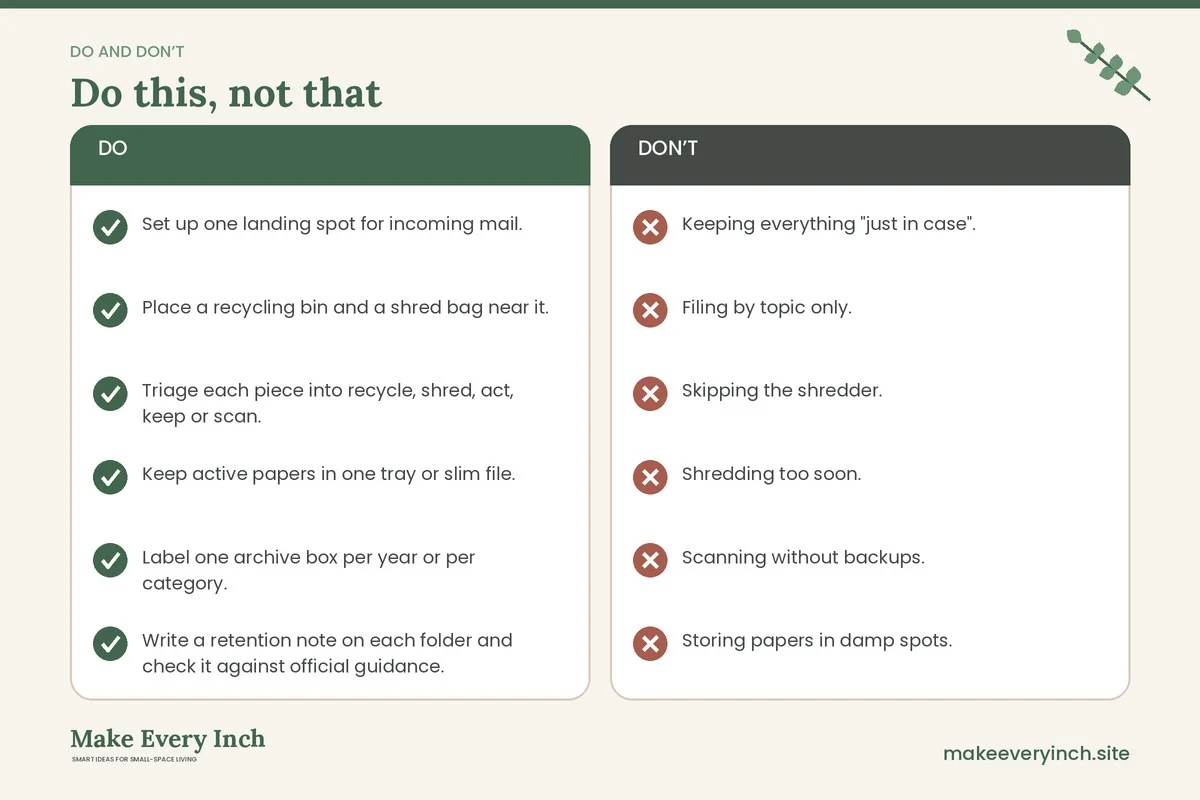
- Keeping everything “just in case”. A box of unlabeled paper is as hard to use as a pile.
- Filing by topic only. A “Bills” folder that mixes paid and unpaid items hides what needs action.
- Skipping the shredder. Papers with personal details need safe disposal.
- Shredding too soon. Check retention guidance before you destroy tax, legal and identity papers.
- Scanning without backups. A single copy on one device is a risk.
- Storing papers in damp spots. Basements, bathrooms and window ledges damage paper.
- Blocking exits with boxes. Keep archive boxes out of walkways and away from doors.
- Overbuying organizers. Sort first, then buy the smallest container that fits what remains. Our list of cheap storage ideas for apartments can help you reuse what you already have.
Checklist
- Set up one landing spot for incoming mail.
- Place a recycling bin and a shred bag near it.
- Triage each piece into recycle, shred, act, keep or scan.
- Keep active papers in one tray or slim file.
- Label one archive box per year or per category.
- Write a retention note on each folder and check it against official guidance.
- Create a simple digital folder structure and a naming pattern.
- Back up scans in at least two places.
- Store key originals in a locked, fire-resistant, dry spot.
- Anchor tall storage to the wall, with permission.
- Schedule a ten-minute weekly session and a monthly archive check.
- Tell a trusted person where the key documents are.
FAQ
How do I organize paper in a small home?
Triage mail daily into recycle, shred, act, keep and scan. Keep active papers in one tray or slim file, and move finished records to a labeled archive box. Scan what you can and back it up.
How long should I keep important documents?
It depends on the type of document and where you live. Tax, legal, insurance and medical records have different rules, so check official guidance from the relevant authority or a qualified professional before you shred.
Should I scan everything?
No. Scan papers you want to reference but do not need as originals, such as receipts and statements. Keep originals of identity and legal documents unless the issuing body says otherwise.
What is the safest way to get rid of papers with personal details?
Use a cross-cut shredder or a trusted shredding service. Do not put whole documents with account numbers or addresses in the bin.
Where do I store papers if I have no closet or desk?
Use a lidded box under the bed, a magazine file on a shelf, an over-the-door pocket organizer or a storage bench. See our ideas for small bedroom organization for more spots.
How do I protect documents from fire and water?
Store key papers in a fire-resistant box or bag with a rating that suits your needs, keep them off the floor and away from heat and damp, and keep digital copies elsewhere.
Keep going: Keep going with our small space organization ideas, small closet organization ideas and small home drop zone ideas.
Save this guide for later
Pin the ideas you like to Pinterest so you can come back to them when you plan your space.