13 Small Living Room Ideas Without a Coffee Table Modern Rooms Can Use
Quick answer: The best small living room ideas without a coffee table modern rooms rely on replace the single big table with a lighter piece that does one job well: a C-table that slides over the sofa, a nesting pair in stone or metal, a low leather ottoman with a tray, or a slim side table at each end of the sofa. Keep 30 to 36 inches for walkways, set any low surface 14 to 18 inches from the sofa edge, and limit the room to two or three materials so the open floor reads as deliberate.
Small living room ideas without a coffee table modern in style start from a simple observation: a modern room is defined by clean lines and visible floor, and a coffee table often takes both away. A standard rectangular table is about 48 inches long and 24 inches deep, which is eight square feet of furniture sitting in the exact spot you walk across most. Remove it, and a 10 by 12 foot room suddenly breathes. The question is what replaces it, because you still need a place for a mug, a remote, a laptop and a bowl of snacks. This guide covers 13 modern replacements, the clearances that keep each one comfortable, a materials palette, a comparison table, three example rooms, a short buying checklist and an FAQ. For the full overview of going without the table, read our parent guide to small living room ideas without a coffee table, and for the wider topic see small living room ideas.
What “modern” means when the coffee table goes
Modern design, in the everyday sense used for homes, favors straight or softly curved lines, a limited palette, hard-wearing finishes and plenty of empty space. It is not the same as minimal, which removes almost everything, and it is not the same as mid-century, which leans on warm wood and tapered legs. A modern small living room usually uses neutral walls, one or two strong materials such as metal, stone-look surfaces, glass or smooth leather, and a handful of pieces that each earn their place.
That makes a coffee table swap easier than in a traditional room, because modern pieces are already built to be light. A slim steel C-table, a pair of round nesting tables and a low upholstered block all look at home against a sleek sofa. The risk in a modern room is the opposite of clutter: it is coldness. Without the anchoring table, a sofa and a rug can look like a showroom. The ideas below keep the room warm by choosing at least one soft or natural element for every hard one.
Three rules guide every choice in this guide. First, replace the function, not the footprint: if you only need a surface for two drinks, you do not need 24 by 48 inches. Second, keep surfaces movable, so you can clear the center for guests, workouts or a floor picnic. Third, match the height to the seat. A sofa seat sits about 17 to 19 inches from the floor, so a surface between 15 and 20 inches high feels natural, and anything taller than the seat starts to work like a side table instead.

Measure first: clearances that make a coffee-table-free room work
Before you buy, measure the room and tape the sofa on the floor. Then use these numbers.
- Sofa to surface: 14 to 18 inches. Closer than 12 inches and your knees bump it. Farther than 20 inches and you lean forward to reach a cup.
- Main walkway: 30 to 36 inches wide. In a tight room, 28 inches is the least you should accept for a path you use daily.
- Sofa to opposite seat: 7 to 9 feet if two seats face each other, so people can talk without raising their voices.
- Side table beside the sofa: the top should be within 2 inches of the sofa arm height, and 10 to 14 inches wide is enough for a lamp and a glass.
- Rug edge: at least the front legs of the sofa on the rug, and 6 to 10 inches of floor visible at the walls.
- TV distance: about 1.5 to 2.5 times the screen diagonal, so a 55 inch screen sits roughly 7 to 11 feet from the eyes.
If you remove the coffee table, you gain about 18 to 22 inches of depth in front of the sofa. Use it. Either leave it as open floor, which gives a modern room its famous airy look, or put one slim piece in it. The walkway should stay on the side of the room with the door, so people never have to cross a seating group. Our guide to small living room layout ideas shows how to plan the paths around a seating group in more detail.
13 small living room ideas without a coffee table modern rooms can use
Replace it with one slim piece
1. The steel C-table
A C-table has a base that slides under the sofa or chair, with the top floating over your lap. The top is usually 12 to 16 inches wide and 18 to 24 inches long, and the height is about 22 to 26 inches, so it clears the sofa arm. Choose a powder-coated or brushed metal frame with a simple top in wood, stone-look composite or glass. It sits against the sofa, takes a laptop, and rolls away when you need floor. It is the single most useful modern swap, because nothing sits in the walkway.
2. A round nesting pair
Two round tables, one larger and one about 20 percent smaller, tuck together when you are alone and spread apart for guests. A typical pair is 22 and 16 inches across, with heights of 18 and 15 inches. Curves soften a boxy modern room and remove the sharp corner that catches a hip. Pick contrasting finishes, such as a black metal base with a pale top, and keep both pieces in the same shape language.
3. A square nesting set of three
If the room is a rectangle with straight lines, a stacked set of three square tables echoes the grid. Slide the smallest to the arm of the sofa, the middle one to the chair and keep the largest in reserve. Check that the smallest top is at least 12 inches wide, or it will not hold a plate.
4. A low block ottoman with a tray
An upholstered ottoman about 30 inches square and 16 to 18 inches high gives you a footrest, extra seat and a surface in one. The tray is what turns it into a table, so choose a flat tray with a raised lip, in metal, wood or lacquered finish, about 16 by 22 inches. Remove the tray, and the ottoman becomes seating. For storage options, see our review of the best storage ottomans.
5. A leather pouf pair
Two compact poufs about 16 inches across and 15 inches high replace a table in a tight room. Place them side by side in front of the sofa, with a small tray on one. Smooth leather or leather-look upholstery suits a modern palette, and a tight seam looks crisp. They also pull up as extra seats, which suits a studio.
Spread the function around the room
6. A slim side table at each end
Two side tables flanking the sofa do more than one coffee table, because everyone sits within reach of a surface. Choose tops 14 to 18 inches across and keep the height equal to the sofa arm. A matching pair looks formal, while two different shapes, such as one round and one square, look more relaxed.
7. A bench or low console behind the sofa
A narrow console, 10 to 14 inches deep, behind a floating sofa gives you a place for lamps, a drink and a bowl of keys. Keep a 30 inch path behind it if people walk there. It works best in a room that is longer than it is wide, and it pairs naturally with a modern long sofa. See narrow living room ideas for ways to use this plan.
8. A wall-mounted shelf at seat height
A ledge shelf mounted at about 24 to 28 inches from the floor and 8 to 10 inches deep holds a drink next to the sofa without touching the floor. It suits modern interiors because it reads as a line, not as an object. In a rental, ask before drilling, or use a freestanding ladder shelf from our guide on renter-friendly shelving.
9. A tray on the sofa arm
A wooden tray with a flat underside that sits across the sofa arm holds a cup and a phone. It costs almost nothing and stores flat in a drawer. Choose a smooth, slightly weighted piece so it does not slip, and keep it for relaxed evenings only.
Use floor and furniture you already own
10. A stool or accent bench as a table
A short stool, 16 to 18 inches high, can play the table role in the center. Pick one with a solid top, for example a stone-look or wood disc, and a slim leg. When guests arrive, it becomes a seat. A bench about 40 inches long, placed at the foot of the sofa, does the same job for two people.
11. A tall plant stand and a floor lamp
Replace a table with a vertical plan: a stand about 24 inches high holding a plant next to a sofa arm, and a floor lamp with a small shelf. Our list of the best floor lamps for small rooms includes styles with built-in trays or shelves, which keep the surface count high and the footprint low.
12. A rug as the anchor
Without the table, the rug carries the layout. Use a flat-weave or low-pile rug in a geometric pattern or a solid neutral, large enough that the sofa’s front legs sit on it. A 5 by 8 foot rug fits many rooms, and a 6 by 9 foot rug suits a sofa wider than 80 inches. The pattern should be calm, with a repeat of 6 to 12 inches, so it does not fight the clean lines.
13. A fold-away tray table
For a tiny room, a folding tray table stores behind the sofa or beside the TV unit. Open it for dinner or a laptop, and fold it flat after. Look for a top at least 14 by 20 inches and a locking brace, so it stays steady when a mug sits on it.
Modern materials that keep the room warm
A modern room without a coffee table can look empty if every material is hard. The fix is a simple pairing system: for every cold surface, add one warm or soft one.
- Metal with wood: a black or brushed steel C-table with a walnut or oak-look top.
- Stone-look with textile: a marble-look nesting table beside a boucle or linen sofa.
- Glass with wool: a clear top lets the rug show through, which suits very small rooms because it keeps the floor visible. Add a wool rug to avoid a hospital feel.
- Leather with plants: a leather ottoman against a green plant looks fresh rather than corporate.
- Lacquer with matte: limit glossy finishes to one piece, and keep everything else matte.
Keep the palette to two main colors, such as warm gray and charcoal, plus one accent that repeats three times: a cushion, a vase and a book spine are enough. Use odd numbers for groupings, such as three objects on a tray. For more on the style as a whole, our guide to modern small apartment ideas and the minimalist apartment ideas guide show how these rules scale to other rooms.
Comparison table: which swap fits your room
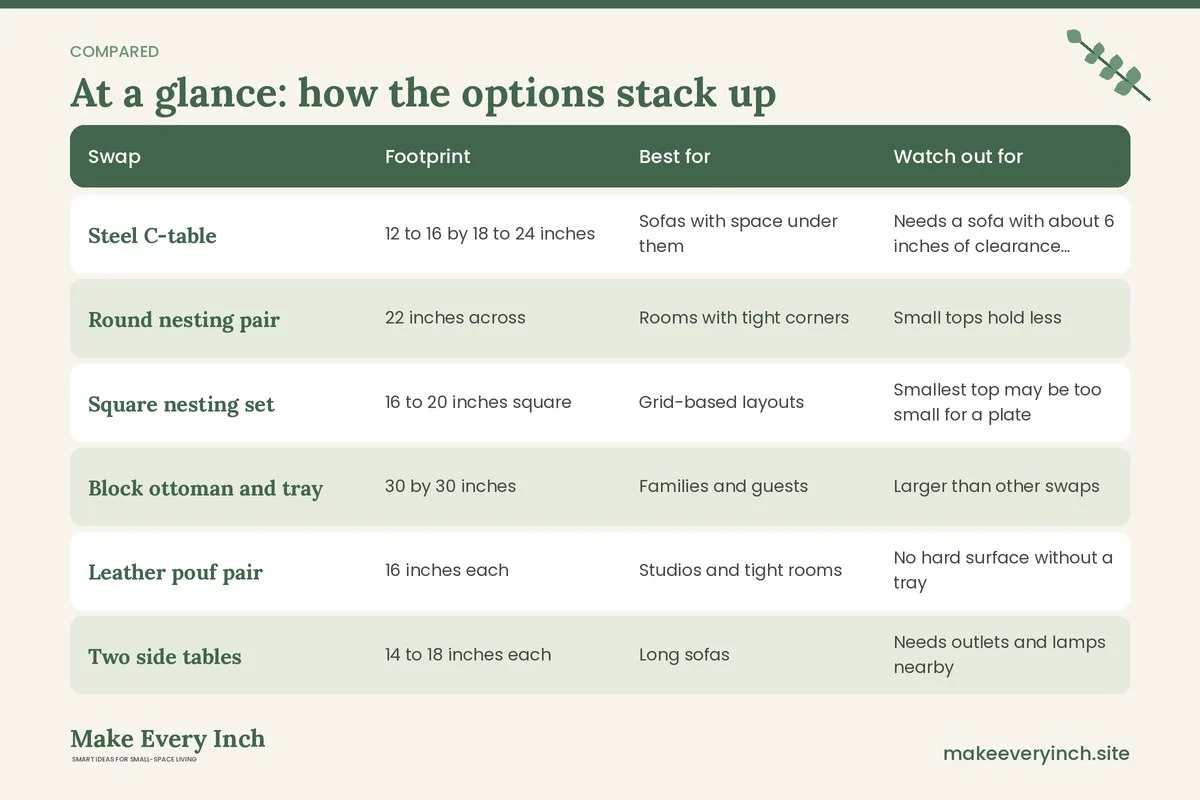
| Swap | Footprint | Best for | Watch out for |
|---|---|---|---|
| Steel C-table | 12 to 16 by 18 to 24 inches | Sofas with space under them | Needs a sofa with about 6 inches of clearance below the frame |
| Round nesting pair | 22 inches across | Rooms with tight corners | Small tops hold less |
| Square nesting set | 16 to 20 inches square | Grid-based layouts | Smallest top may be too small for a plate |
| Block ottoman and tray | 30 by 30 inches | Families and guests | Larger than other swaps |
| Leather pouf pair | 16 inches each | Studios and tight rooms | No hard surface without a tray |
| Two side tables | 14 to 18 inches each | Long sofas | Needs outlets and lamps nearby |
| Console behind sofa | 10 to 14 by 40 to 55 inches | Floating sofas | Needs a path behind |
| Wall shelf | 8 to 10 inches deep | Renters who may drill | Needs a stud or anchors |
| Fold-away tray table | 14 by 20 inches open | Tiny rooms | Less stable than a solid table |
Use this table as a filter. If you have a sofa that sits on short legs, rule out the C-table, because the base will not slide under. If you have children or pets at floor level, choose the ottoman and tray, since a soft edge is safer than stone-look corners. If the room doubles as a workspace, the C-table is the best bet, because it brings the surface to your lap.
Three modern example rooms
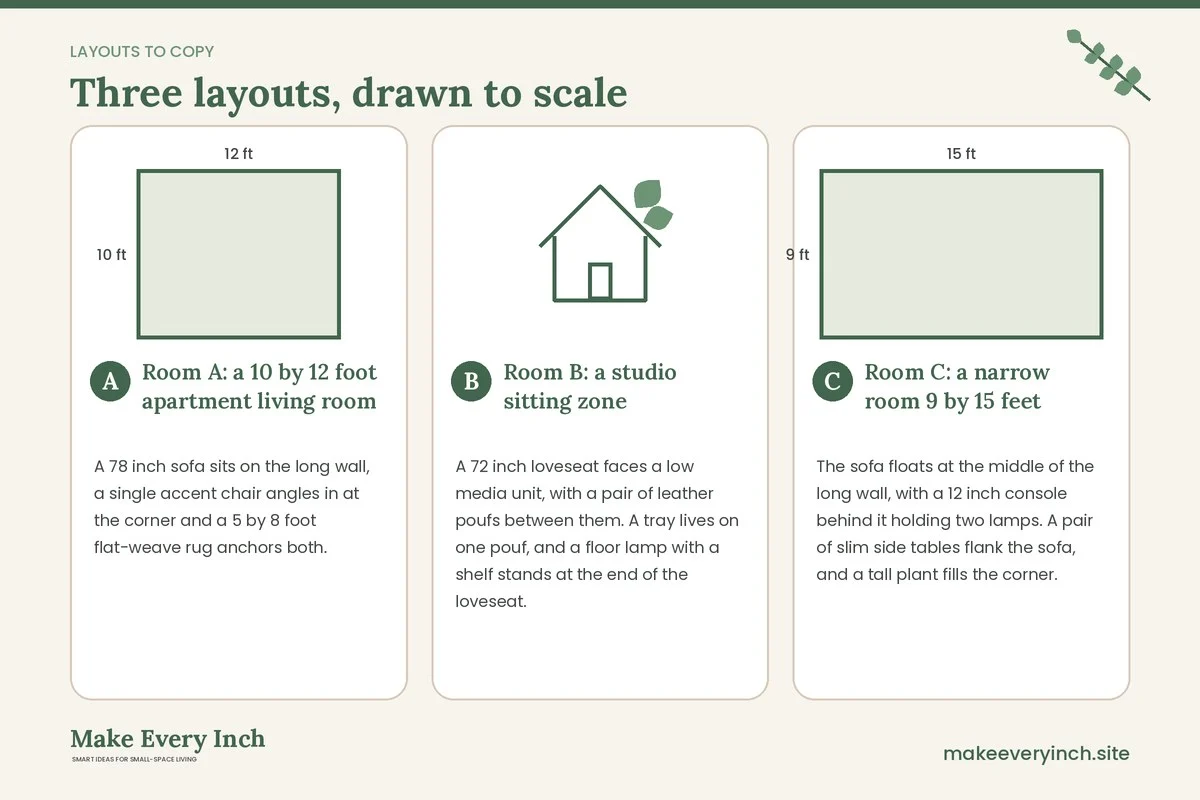
Room A: a 10 by 12 foot apartment living room
A 78 inch sofa sits on the long wall, a single accent chair angles in at the corner and a 5 by 8 foot flat-weave rug anchors both. The coffee table is gone, replaced by a steel C-table that lives next to the chair and slides over the sofa for laptops. A round side table at the far arm holds a lamp. The walkway from the door to the window is 34 inches wide, and the center of the rug is clear. The result is about 8 square feet of floor recovered, and the room reads as larger.
Room B: a studio sitting zone
A 72 inch loveseat faces a low media unit, with a pair of leather poufs between them. A tray lives on one pouf, and a floor lamp with a shelf stands at the end of the loveseat. Because the poufs are light, they move to the bed area for visitors. The sofa to TV distance is about 8 feet, and the path to the kitchen runs along the window at 32 inches. See our hub on small apartment living room ideas for more studio plans.
Room C: a narrow room 9 by 15 feet
The sofa floats at the middle of the long wall, with a 12 inch console behind it holding two lamps. A pair of slim side tables flank the sofa, and a tall plant fills the corner. There is no table in front at all, so the 30 inch walkway runs straight from the entry to the window. A 6 by 9 rug under the sofa’s front legs ties it together. If you use this plan, check that the console and the path leave 30 inches behind the sofa.
A step-by-step plan to make the switch
1. Live without it for a week. Move the coffee table to another room, and note what you reach for. If you only lose a mug spot, a side table is enough. If you lose a work surface, choose a C-table or a tray ottoman.
2. Measure the gap. Mark the 14 to 18 inch zone from the sofa edge with tape, and note any vents, outlets or door swings.
3. Pick the function first. Decide whether you need a drink spot, a laptop spot, a footrest or a guest seat. Choose the swap from the table above that handles the main one.
4. Check heights. Measure your sofa seat and arm height. Choose a surface between the two, or within 2 inches of the arm.
5. Set the light. Without a table, a lamp has to live on the floor or on a side table, so confirm that you have a spot. Our guide to small living room lighting ideas covers the options.
6. Test with real objects. Put a mug, a laptop and a bowl on the new surface, and see if it feels stable.
7. Keep the old table for a month if you can. Sell or store it only after you are sure the new setup works.
Styling a modern room with no coffee table
A bare floor in front of the sofa can feel unfinished until you add a few quiet touches. Choose a large piece of art, such as a framed print about 30 by 40 inches, and hang it with the center at 57 inches from the floor. Keep the sofa clear of more than three cushions, and use one in a texture such as wool or boucle. Add one plant at least 3 feet tall, and place it where a table might have stood. Finish with a tray on a side table that holds one candle and one book, and leave the rest empty.
Cable control matters in a modern room. With no table to hide behind, the cords from lamps and chargers are more visible, so route them along the baseboard and use a cable cover painted to match the wall. A small basket or a lidded box near the sofa holds the remotes and keeps surfaces clear. If you want to keep the walls undamaged, our no-drill storage ideas for renters shows options that hold up without screws.
Mistakes to avoid
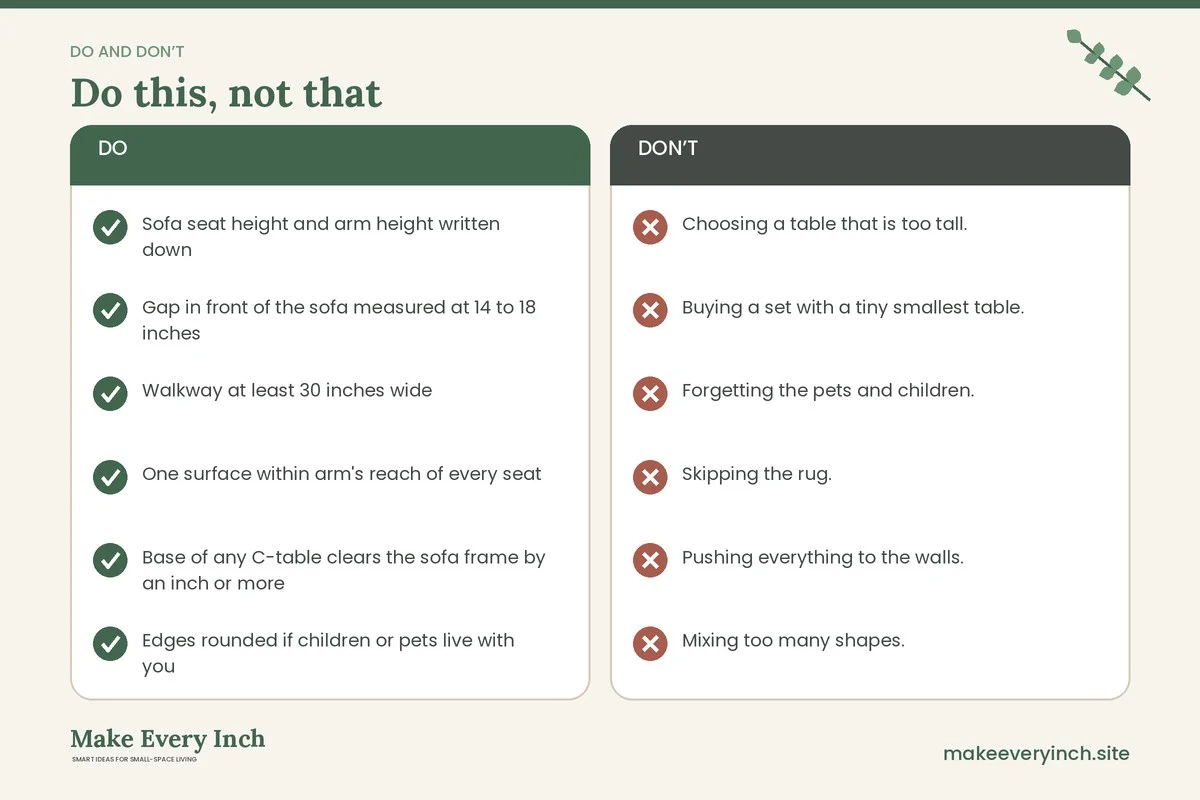
- Choosing a table that is too tall. A top higher than the sofa seat plus arm feels like a bar.
- Buying a set with a tiny smallest table. If the top is under 12 inches, it holds a phone, not a plate.
- Forgetting the pets and children. Glass and sharp stone-look corners are risky at floor height.
- Skipping the rug. With no table, a missing rug leaves the sofa floating.
- Pushing everything to the walls. A modern room still needs one anchor in the middle, which can be a rug, a plant or a round side table.
- Mixing too many shapes. Choose one dominant shape, round or square, and use the other only once.
Modern buying checklist
- Sofa seat height and arm height written down
- Gap in front of the sofa measured at 14 to 18 inches
- Walkway at least 30 inches wide
- One surface within arm’s reach of every seat
- Base of any C-table clears the sofa frame by an inch or more
- Edges rounded if children or pets live with you
- No more than three materials in the seating group
- A tray or lid on every low surface that needs a flat top
- Outlets and lamps placed near the side tables
- A way to move the pieces aside for floor space
FAQ
What replaces a coffee table in a modern small living room?
A C-table, a pair of nesting tables, a low ottoman with a tray, or two slim side tables all work. Choose by function, since each handles drinks, laptops or footrests differently.
How far should a table sit from the sofa?
Keep 14 to 18 inches between the sofa edge and any low surface, so you can reach it but still stand up. Keep 30 to 36 inches for main walkways.
Does a modern living room look empty without a coffee table?
It can, if every surface is hard. Add a rug, one tall plant and a textured cushion to anchor the group, and the open floor looks intentional.
Are nesting tables good for small modern rooms?
Yes. They tuck together to save floor and spread apart for guests. Choose a set where the smallest top is at least 12 inches wide.
Can an ottoman replace a coffee table?
Yes, with a tray on top for a flat surface. Pick a firm top, about 16 to 18 inches high, so mugs stay steady.
What about renters who cannot drill?
Use freestanding pieces such as C-tables, poufs, nesting sets and floor lamps with shelves. Our renter-friendly apartment decorating ideas guide covers more.
How do I decide between a C-table and an ottoman?
Choose a C-table if you work on a laptop or want zero floor footprint. Choose an ottoman if you want a footrest and an extra seat for guests.
Can I combine two of these swaps?
Yes. A C-table beside the sofa plus a pair of poufs for guests covers almost every need, and each piece can be stored or moved when the room needs more space.
Keep going: Keep going with our small living room ideas, the parent guide to small living room ideas without a coffee table and our small living room layout ideas for a cozy room.
Save this guide for later
Pin the ideas you like to Pinterest so you can come back to them when you plan your space.