18 Small Space Wall Art Ideas for Tight Walls and Tiny Rooms
Quick answer: Small space wall art works best when scale, spacing and placement are planned before anything goes up. Choose fewer, larger pieces or one tight group, hang the center around 57 inches from the floor, keep art about two thirds the width of the furniture below, leave 2 to 3 inches between frames, and use anchors or studs for anything heavy. Never drill without permission.
Small space wall art has a different job from art in a large home. In a big room, a single canvas can float on a wide wall and nobody notices if it is a little small. In a small room, every wall is close to the eye, doors and windows cut the wall into narrow strips, and furniture sits right underneath. Art that is too small looks lost, art that is too busy makes the room feel crowded, and art hung at the wrong height shrinks the ceiling. The reward for getting it right is large: well-chosen art gives a compact room a focal point, pulls color through the space and makes it feel personal instead of temporary. This guide covers how to read your walls, sizing rules, 18 specific ideas, a scale table, three example walls, hanging methods and safety, and a checklist. For the wider approach to finishing a compact room, see our pillar guide on small room decor ideas.
Read your walls before you buy art
Walk through the room and sort the walls into three types. Each type calls for a different kind of art.
- The focal wall. This is the wall you see first when you enter, often the one behind the sofa or the bed. It can take the largest piece or the main group.
- The strip walls. These are narrow sections between a door and a corner, or between two windows. They suit tall, slim art, a single vertical piece or a short column of small frames.
- The working walls. These hold a desk, a kitchen counter or a shelf. Keep art here light and quiet, so it does not compete with tasks.
Then note the obstacles: light switches, vents, thermostats, door swings, radiators and the edge of any window. Art should keep a few inches clear of all of them, and nothing should block a vent or a switch. Take a photo of each wall in daylight, because your eye will miss proportions that a photo reveals.
Finally, decide on the mood. A calm room often wants one large, soft piece. A lively room may handle a collected wall. If you are not sure, pick a limited palette of two or three colors drawn from the rug, the bedding or the sofa, and let the art repeat them.
The scale and spacing rules that matter
Most failed gallery walls fail on scale and spacing, so these numbers are worth keeping. They are hedged guidelines, not laws, and a tape and some paper will tell you more than any rule.
- Eye level. Many people hang the center of the art, or the center of a group, at about 57 inches from the floor. In a small room with low ceilings or lower seating, you can go a little lower, around 54 to 56 inches.
- Over furniture. Hang art about 6 to 8 inches above a sofa, a bed headboard or a console. A frame or a group about two thirds the width of the furniture looks balanced. Art much narrower than the furniture looks like a stamp.
- Gaps between frames. Keep 2 to 3 inches between neighbors. Tighter gaps look like a single unit and suit a small wall. Wide gaps make a wall look scattered.
- Overall group shape. Treat the group as one big shape, such as a rectangle, and stay inside it. Odd edges rarely work in a tight room.
- Distance from corners and doors. Leave at least a few inches, so the art does not look pinched.
- Ceiling gap. If a piece nearly touches the ceiling, the room looks shorter. Leave a noticeable gap, often 12 inches or more on a standard wall.
Use paper templates. Trace each frame on kraft paper or newspaper, cut the shapes out and tape them to the wall with painter’s tape. Stand back, move them around and photograph the result. Only mark the wall once the layout feels right.
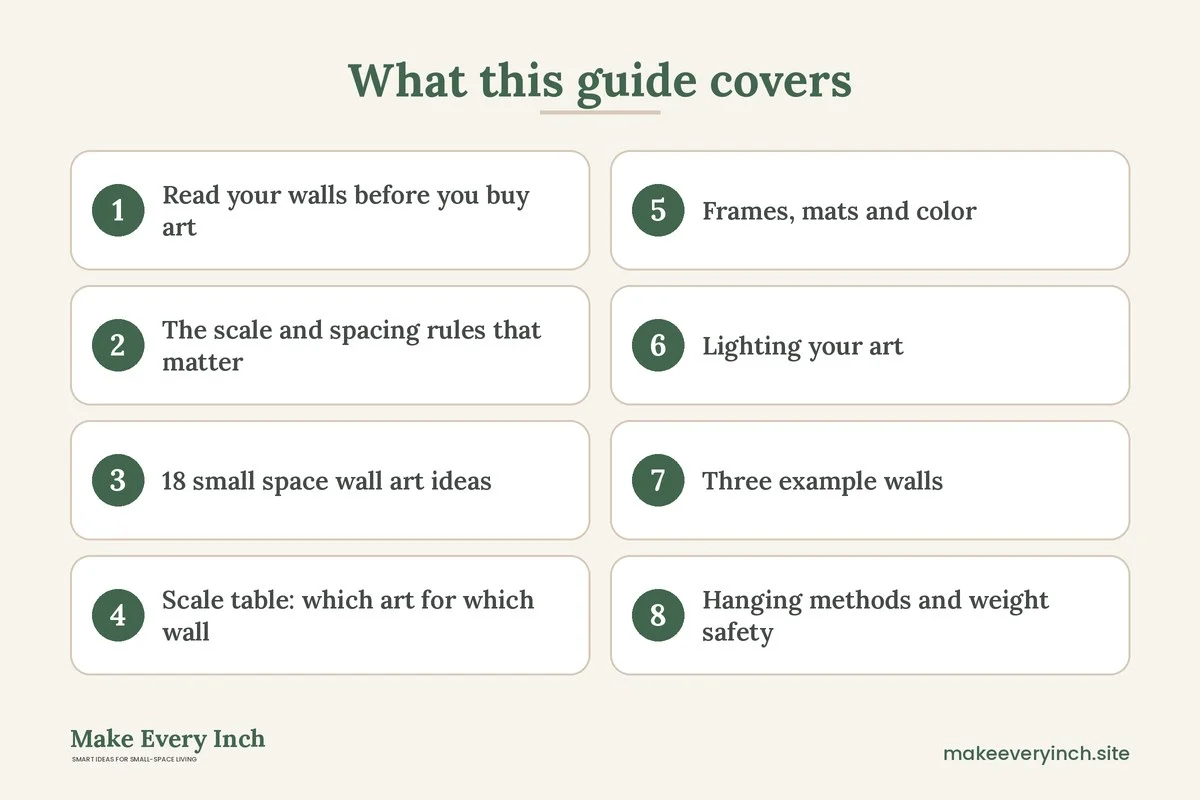
18 small space wall art ideas
One big statement
1. A single oversized piece
One large piece, often about two thirds the width of the furniture, makes a small room look intentional. Fewer frames also mean fewer visual lines to clutter the room. Choose calm imagery such as landscapes, abstracts or soft color fields.
2. A statement mirror as art
A decorative mirror serves as art and bounces daylight into a dark corner. Place it where it reflects a window or a lamp, not a pile of clutter. Mirrors are heavy, so read the section below on hanging weight.
3. A large textile
A woven hanging, a quilt or a framed fabric panel adds warmth and softens echo in a hard-walled room. It is lighter than glass and often easier to hang.
4. A diptych or triptych
Two or three matching panels, hung with narrow gaps, work like one big piece. They suit an awkward width that a single piece cannot fill.
Groups that stay tidy
5. A tight grid
Use identical frames in equal rows and columns, with 2 inches between them. A grid is neat and easy to plan, and it suits a modern or minimalist room.
6. A salon wall in a compact block
Mix sizes, but keep a narrow gap and a shared frame color or matting. Anchor the group around one larger piece, and keep the overall shape a rectangle. Keep it to a manageable number of pieces on a small wall.
7. A ladder of frames in a hallway
A hallway has little width, so a vertical column or a single line of small frames at eye level reads as a gallery without crowding the passage. See our guide to hallway gallery wall ideas for small homes.
8. A staircase arrangement
Where a stair wall rises, step the frames along the slope with even spacing. Keep the lowest edge parallel to the stair line.
Art that leans, sits and layers
9. Art leaning on a shelf or console
Leaning art needs no holes, which suits a rental. Lean the biggest piece at the back and layer smaller ones in front. Secure the frames so a bump does not send them down.
10. A picture ledge
A narrow ledge holds frames you can swap in minutes. Choose a ledge with a lip deep enough to stop the frames sliding. If you cannot drill, choose a freestanding version.
11. Art on a bookcase
Rest a frame on a shelf, among books. It adds depth and color and costs no wall space at all.
12. Art over a headboard
A wide, low piece above a bed makes the room feel finished. Hang it so the bottom edge clears the headboard by 6 to 8 inches and so nothing can fall on a sleeper. Use secure hanging hardware, and avoid heavy glass directly above a pillow when you can. Our guide to small bedroom ideas shows more bedroom layouts.
Slim and vertical ideas
13. Tall, narrow art on a strip wall
A tall piece between a door and a corner uses a wall that would otherwise be dead. A narrow vertical piece also pulls the eye upward.
14. A column of three small prints
Stack three small prints with equal gaps in a narrow space. It fills a strip without crowding the room.
15. Art on the back of a door
The inside of a door is a flat, rarely used surface. Hang a light frame with a removable hook that suits the door, or use a wire and clips for postcards. Mind the weight so the door still closes.
Low-commitment and renter ideas
16. Adhesive strips for light frames
Strips rated for the weight of the frame hold small prints. Use the number the package recommends, clean the wall first and test a hidden spot. Our guide to renter friendly wall decor ideas covers the options in detail.
17. Peel-and-stick art or decals
Removable decals and panels add pattern for a small area. Check the lease and test a corner before committing. See removable wallpaper ideas.
18. Art that is not on the wall
Paint a canvas yourself, frame a scarf or lean a tray against the wall. Art is not only paper and frames, and a collection of objects can stand in for a print.
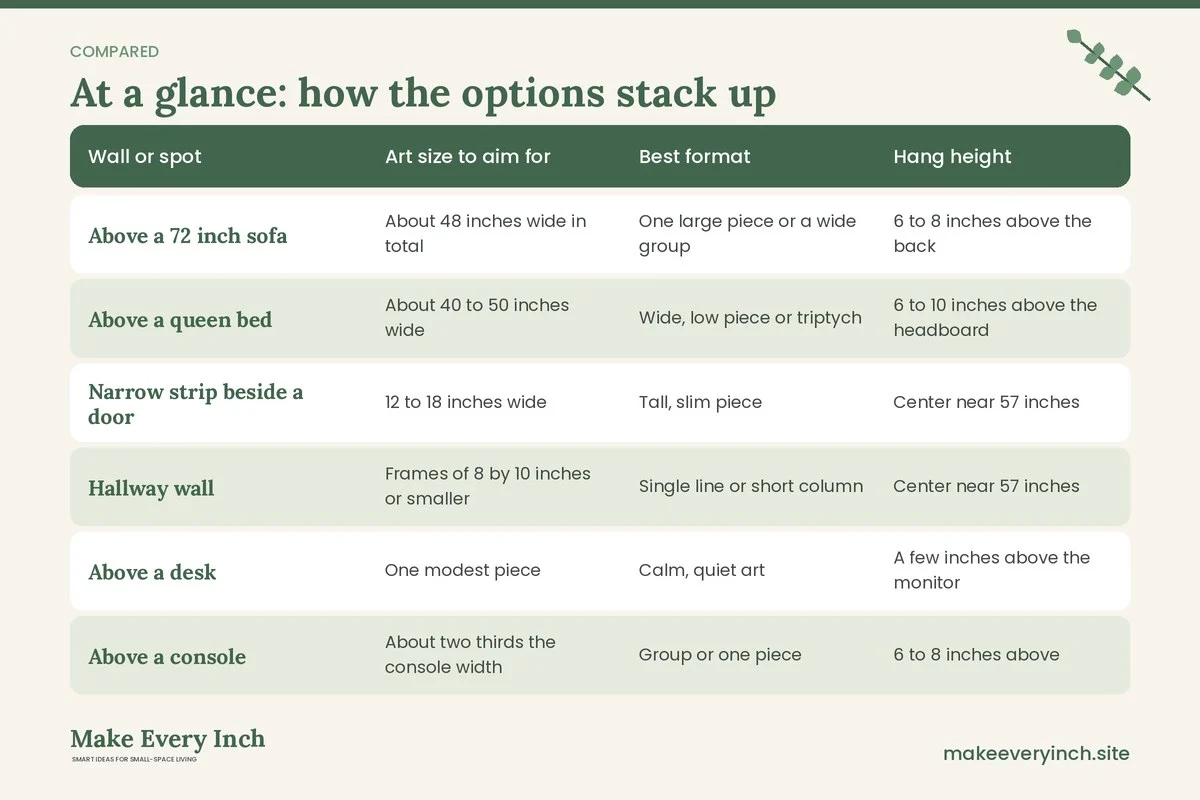
Scale table: which art for which wall
| Wall or spot | Art size to aim for | Best format | Hang height | Notes |
|---|---|---|---|---|
| Above a 72 inch sofa | About 48 inches wide in total | One large piece or a wide group | 6 to 8 inches above the back | Keep it two thirds the sofa width |
| Above a queen bed | About 40 to 50 inches wide | Wide, low piece or triptych | 6 to 10 inches above the headboard | Secure with strong hardware |
| Narrow strip beside a door | 12 to 18 inches wide | Tall, slim piece | Center near 57 inches | Leave clearance for the door |
| Hallway wall | Frames of 8 by 10 inches or smaller | Single line or short column | Center near 57 inches | Keep depth shallow |
| Above a desk | One modest piece | Calm, quiet art | A few inches above the monitor | Avoid busy images |
| Above a console | About two thirds the console width | Group or one piece | 6 to 8 inches above | Lean or hang |
| Kitchen or dining wall | Small to medium | Moisture-resistant prints | Eye level | Keep away from the stove |
| Bathroom wall | Small | Sealed or framed behind glass | Eye level | Keep clear of steam sources |
Frames, mats and color: small choices that add up
The frame often matters as much as the art. A few guidelines keep a small room calm.
- Use a limited set of frame finishes. Two finishes, such as black and a light wood, look intentional. Five finishes look random.
- Use mats generously. A wide mat gives a small print presence and makes a group feel unified. Choose a mat color close to the wall, and the print will appear to float.
- Pick lighter frames on dark walls and darker frames on pale walls. The contrast keeps the edges visible.
- Repeat a color. Pull one tone from the art into a cushion, a vase or a throw. Our guide to apartment decorating styles can help you choose a direction.
- Mind the glare. Glass can reflect a window or a bright lamp. If a wall has strong glare, choose non-glare glazing or an unframed canvas.
Lighting your art
Good light turns a print into a feature, but lamps and bulbs have limits. Plug-in picture lights, clip-on lamps and small spotlights all add focus. Choose a fixture whose wattage rating suits the bulb, and use a low-heat bulb near paper and fabric. Never place a bulb touching art, frames or curtains, and never overload a socket with a string of adapters. Run cords flat and tidy, using cord covers where they cross a path, and keep them away from sinks and from chairs where they can trip someone. For more on light, see our guide to renter friendly lighting ideas and small living room lighting ideas. Also keep valuable prints out of direct sun, because sunlight can fade paper and ink over time.
Three example walls
A 12 foot living room wall with a 72 inch sofa
The sofa sits on the focal wall with a window to its right. Choose one large piece or a three-frame group about 48 inches wide in total, with the center around 57 inches from the floor and the bottom edge 6 to 8 inches above the sofa back. Keep the group away from the window so the curtain has room to move. If you want a mirror, put it on the opposite wall to reflect the window. A pair of matching frames on the strip beside the window finishes the corner. For more living room ideas, see small living room ideas.
A bedroom strip wall between a closet and a corner
The wall is only about 20 inches wide. Hang a single tall print or a column of three small ones, with the center near 57 inches and a few inches clear of the closet door. Add a slim plug-in light if there is an outlet nearby, using a cord cover if the cord must cross the wall. The narrow shape matches the narrow wall, and the vertical lines lift the room.
A hallway that is 36 inches wide
A deep frame would catch shoulders. Choose shallow frames, 8 by 10 inches or smaller, in a single line at eye level, or a short column with tight gaps. Pick light or white mats so the hall feels wider. Use adhesive strips rated for the frame weight if you cannot drill, and keep any art near the end of the hall away from the door swing. For more on this idea, read our guide to hallway gallery wall ideas for small homes.
Hanging methods and weight safety
How you hang art matters as much as what you hang. Match the hardware to the load, and follow the weight rating on every package.
- Adhesive strips. Good for light frames, and often a fit for rentals. Clean the surface, press firmly for the time recommended and use the right number of strips for the weight. Do not use them on textured, damp or flaking walls, and do not use them to hang a heavy mirror.
- Picture hooks and small nails. Suitable for light and medium frames when the lease allows small holes. Use two hooks on wide frames so they stay level.
- Wall anchors. Heavier art needs anchors rated well above its weight, or a screw into a stud. Choose the anchor type for the wall material, such as drywall, plaster or masonry. Plaster and tile need special care and often a pilot approach.
- Studs. A stud finder helps you locate studs, but run a check for hidden wires and pipes before you drill. If you are unsure, ask a professional.
- Mirrors. Mirrors are heavy and the glass can shatter. Use hardware and anchors rated for the weight with a wide safety margin, hang them securely, and do not place a large mirror above a bed, a crib or a seat where a fall could injure someone. Leaning a mirror is safe only if it is secured to the wall with an anti-tip strap or bracket, where you have permission.
- Never drill without permission. In a rental, read the lease. Photograph the walls before you start and ask in writing if you need to.
- Earthquake and kids. In homes with children or in areas that shake, use museum putty or secure hooks on the lower corners of frames, and keep heavy art off the walls beside beds.
- Safe ladders. Use a stable stool, and have a helper hold it if you are working at height.
When you are done, check the level with a small level or a phone app, and step back to look from across the room.
Mistakes that shrink a small room
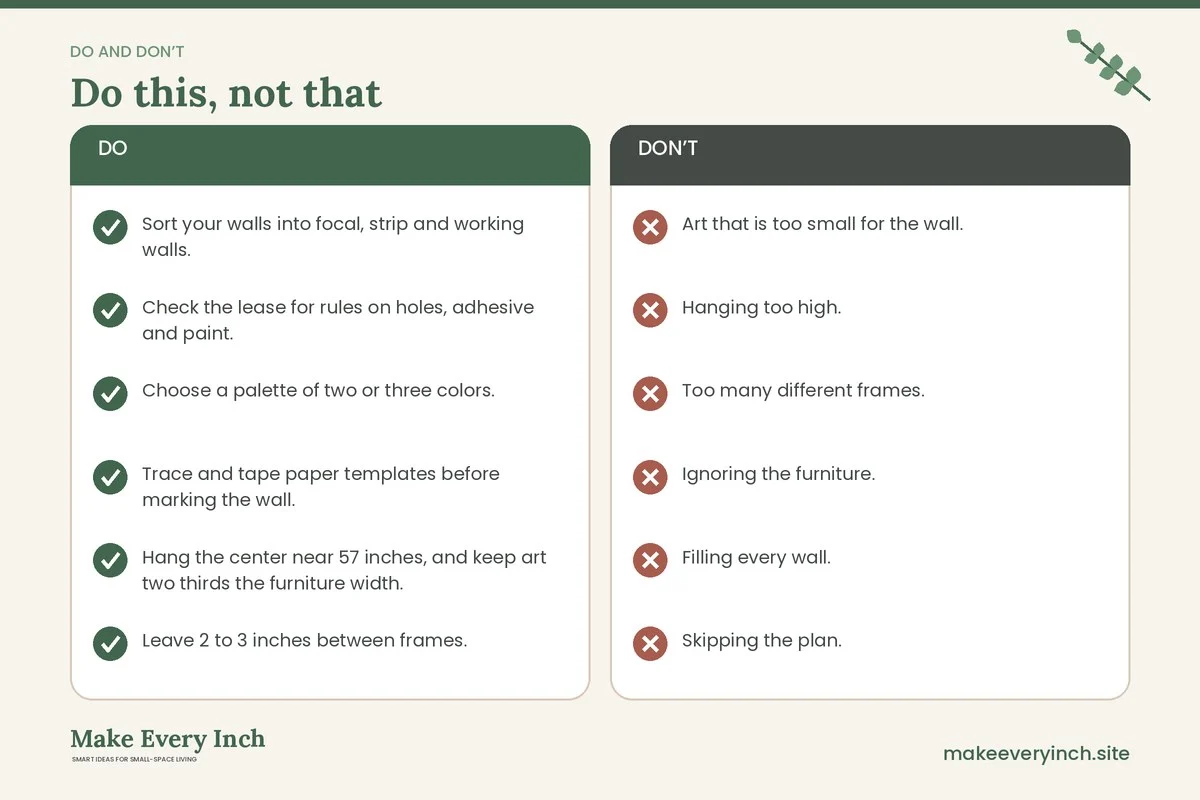
- Art that is too small for the wall. A tiny frame on a big wall looks lost. Go bigger or group pieces.
- Hanging too high. Art near the ceiling disconnects from the furniture. Aim for the center at about 57 inches.
- Too many different frames. Visual noise makes a room feel smaller. Limit the finishes.
- Ignoring the furniture. Art should relate to what is beneath it.
- Filling every wall. Leave at least one calm wall. Negative space is part of the design.
- Skipping the plan. Without templates, the wall ends up full of holes.
- Forgetting the doors and windows. Check swings and curtains before you mark the wall.
Care and rotation
Dust frames with a soft cloth, and wipe glass with a damp cloth sprayed from a bottle, not the glass. Rotate seasonal prints a few times a year to keep a small room feeling fresh. Store extra prints flat in a portfolio or under the bed, which ties into our guide to small space organization ideas. If you like to change art often, choose a ledge, a rail or leaning pieces and avoid permanent holes.
For a tight budget, look at printable art, vintage finds, scarves, maps and your own photos. You can frame prints in thrifted frames with new mats. Our guide to budget small space ideas has more ways to stretch a spend, and our companion post on small room window treatment ideas shows how to balance the wall with the window next to it.
A quick planning checklist
- Sort your walls into focal, strip and working walls.
- Check the lease for rules on holes, adhesive and paint.
- Choose a palette of two or three colors.
- Trace and tape paper templates before marking the wall.
- Hang the center near 57 inches, and keep art two thirds the furniture width.
- Leave 2 to 3 inches between frames.
- Match the hardware to the weight, and use studs or anchors for heavy pieces.
- Keep mirrors and glass away from beds and seating unless they are securely anchored.
- Keep bulbs and cords clear of art, and never overload a socket.
- Leave one calm wall.
Frequently asked questions
How big should wall art be in a small room?
A common guide is about two thirds the width of the furniture beneath it. In a tight room, one larger piece or a tight group usually looks better than several tiny frames.
How high should I hang art?
Many people hang the center at about 57 inches from the floor. Over furniture, the bottom edge sits about 6 to 8 inches above it. Adjust a little for low ceilings or low seating.
Can I hang art without making holes?
Yes. Use adhesive strips within their weight rating, lean pieces on shelves or furniture, use a freestanding ledge, or hang light items on removable hooks. Check the lease and test a hidden spot first.
Is a gallery wall too busy for a small room?
It can be, but a tight, orderly group with shared frames and mats works well. A single large piece is a calmer choice.
Are mirrors good wall art in a small space?
They can be, because they reflect light. They are heavy, so use rated hardware and anchors, and place them where they cannot fall on people.
How do I light wall art safely?
Use a fixture and bulb that suit each other, keep bulbs away from paper and fabric, avoid overloaded sockets and manage cords so they cannot trip anyone.
What art suits a rental?
Prints in light frames on adhesive strips, leaning pieces, textiles on a tension rod and removable decals are common choices, as long as the lease allows them.
Keep going: Ready to finish the room? Explore small room decor ideas, plan your hanging with renter friendly wall decor ideas and light your art with small living room lighting ideas.
Save this guide for later
Pin the ideas you like to Pinterest so you can come back to them when you plan your space.