15 Small Living Room Lighting Ideas Budget Plans That Look Rich
Quick answer: The best small living room lighting ideas budget plans put money into bulbs and layers before fixtures. Aim for roughly 1,500 to 3,000 total lumens in a small room, split across three or four lights at different heights. Start with warm bulbs of about 2700 kelvin, add one lamp near the sofa, then a second light low in a far corner. Many people can build this for a modest sum, often less than a single statement chandelier would cost.
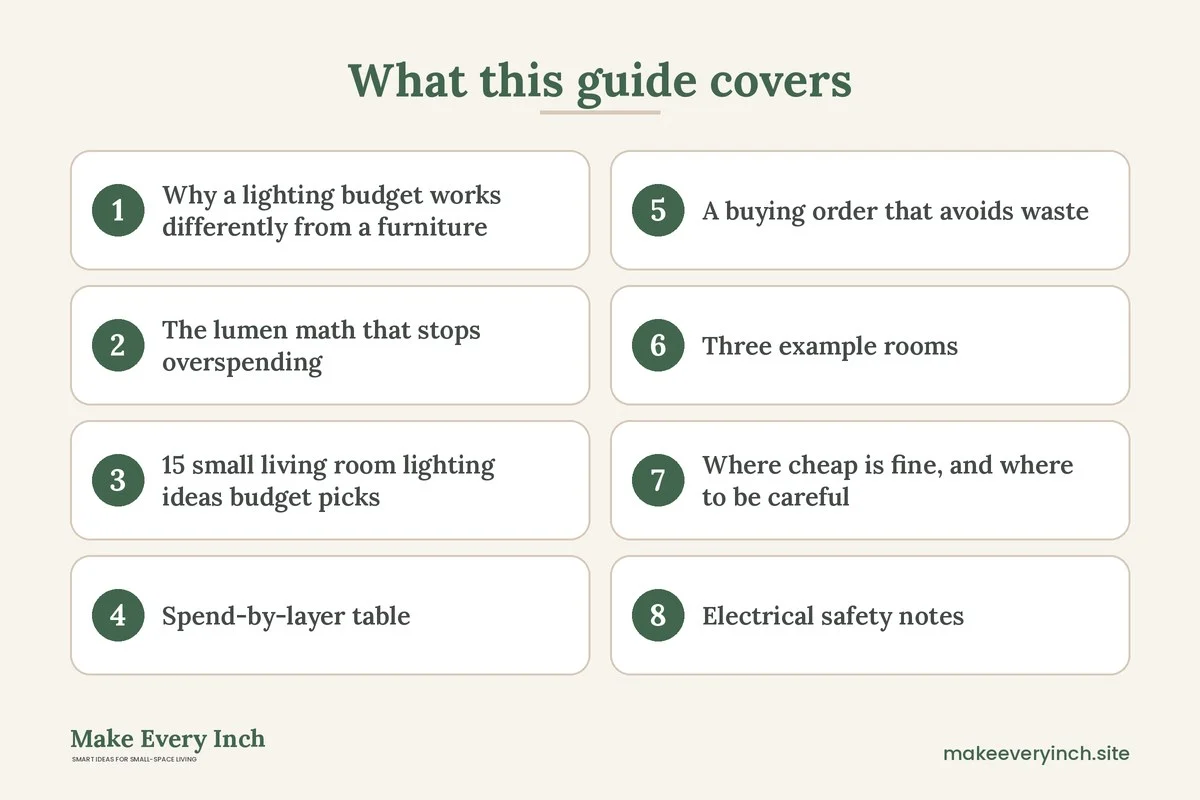
Small living room lighting ideas budget plans start with one honest fact: the cheapest way to improve a dark room is rarely a new fixture. It is usually a better bulb, a lamp moved to a smarter spot, or a second light source that stops the single ceiling light from flattening everything. A small living room does not need a lot of expensive equipment. It needs enough light in the right places, at the right warmth, at the right height. This guide shows how to get there without overspending. It covers the lumen math that keeps you from buying too much, a spend-by-layer table with hedged ranges, 15 ideas ordered from cheapest to most involved, a buying order, three example rooms, secondhand tips, safety notes and a checklist. For the full overview, read our main guide to small living room lighting ideas and the broader small living room ideas pillar.
Why a lighting budget works differently from a furniture budget
A sofa or a rug is a single purchase that you either like or do not. Lighting is a system, and the parts depend on each other. A beautiful lamp with the wrong bulb looks harsh, and a great bulb in a bad position leaves a corner dark. That is good news for a tight budget, because small changes to the system often matter more than any one expensive part.
There are three levers, and they are listed here from cheapest to most costly.
- Bulbs: swapping the bulb changes warmth, brightness and glare for a small amount of money. This is the highest-return move in almost every living room.
- Placement: moving a lamp costs nothing. A lamp on a shelf, a stool or a side table at the right height can fix a room that feels flat.
- Fixtures: new lamps, shades and plug-in lights cost the most, and they should come last, after you know what the room is missing.
Prices change by region, store and season, so treat every range in this guide as a rough planning guide, not a promise. Check local prices before you buy, and use the ranges only to compare layers against each other.
The lumen math that stops overspending
Many shoppers buy by watts, which is an old habit. Watts measure energy use, while lumens measure the light you actually get. Look for lumens on the box. A small living room of 100 to 150 square feet usually feels comfortable with a total of roughly 1,500 to 3,000 lumens across all its lights, with the lower end for relaxed evening use and the higher end for reading, crafts or a bright day-to-night feel.
A simple way to split that number:
- Ambient light: about half of the total, from a ceiling fixture, a floor lamp that bounces light off the ceiling, or two or three lamps spread around.
- Task light: roughly 400 to 800 lumens at the reading seat, from a lamp or an arc light placed close to the book.
- Accent light: 100 to 300 lumens, from a small lamp on a shelf, a string of lights or a picture light, to add depth.
You do not need all of it at once. A room with three well-placed 450 to 800 lumen bulbs often looks richer than a room with a single 2,000 lumen bulb in the middle of the ceiling. Check the maximum wattage printed on every lamp and fixture. Never exceed it, and note that efficient LED bulbs let you get high lumens at low wattage, which keeps heat down and stays within the lamp’s rating.
Color temperature matters just as much as brightness. Warm white, near 2700 kelvin, feels cozy and flatters skin and wood. A neutral white of 3000 to 3500 kelvin suits a working corner. Bulbs above 4000 kelvin can feel clinical in a living room, so most people avoid them there. Choose one warmth for the whole room and keep it consistent, because mixed bulbs make the room look patchy.
15 small living room lighting ideas budget picks
Free and nearly free
1. Move the lamps you already own
Walk the room and gather every lamp in the house, including bedroom and desk lamps. Place one at each end of the sofa and one in the darkest corner. A common problem is that all the light sits on one side. Spreading three lamps around the perimeter makes the room feel wider, and it costs nothing.
2. Raise a lamp to the right height
A table lamp should have its shade bottom at about eye level when you sit, usually 38 to 42 inches from the floor to the bottom of the shade. If your side table is low, add a stack of books under the lamp or choose a taller base. A lamp that sits too low throws glare into the eyes, and one that is too high lights the ceiling and not the page.
3. Open the window path
Before buying lights, check the daylight. Pull curtains fully past the window frame, trim any blinds that block the top third, and wash the glass. Daylight is free, and a window uncovered by 4 to 6 inches on each side can noticeably brighten a small room. Move a mirror opposite or adjacent to the window to bounce the light deeper into the room.
4. Turn off the overhead on purpose
Try an evening with the ceiling light off and only lamps on. Many people discover that the room feels larger and calmer. If you keep the overhead for chores, put it on a dimmer or use a lower-lumen bulb for evenings.
Under a small budget
5. Swap every bulb for one warmth and one family
A set of warm LED bulbs in a matching kelvin range often costs only a small amount per bulb. Replace all the bulbs in the living room at once, and the room will look more coherent. Pick bulbs that are rated for the fixtures you own. If a lamp has a dimmer, check the bulb is labeled dimmable.
6. Add a dimmable bulb with a simple plug-in dimmer
A basic inline or plug-in dimmer can lower the light of a lamp for a movie night. Check the rating on the dimmer, and match it to the bulb type, since not every LED works with every dimmer. A dimmer is one of the cheapest ways to give a single lamp two moods.
7. A clip-on or spring-clamp light
A clamp light attached to a bookcase, a shelf edge or a headboard-style frame gives focused task light for a reading chair. Pair it with a warm bulb, and aim it at the page and not at the face. Keep the cord short and routed along the furniture.
8. A string of warm lights
Small warm string lights on a shelf, a mantel or the top of a bookcase add accent light. Choose a set with a warm color and a low-heat LED rating. Wrap them loosely, keep them off fabric that traps heat and unplug them when you leave.
9. Fabric or paper shades
A new shade can change a lamp for a small cost. A drum shade in a pale linen or a paper lantern spreads light softly. A white or cream lining reflects more light than a dark one, which matters in a small room. Match the shade width to the base: a good shade is roughly two thirds of the lamp’s height.
10. A secondhand lamp
Thrift stores, online marketplaces and yard sales often have solid lamp bases for a small sum. Check the cord for cracks, the plug for bent prongs and the socket for rust or scorch marks. A frayed cord or loose socket is not worth saving, because rewiring is a job for someone who knows what they are doing. Our thrifted apartment decor ideas post covers what to look for when you shop secondhand.
A little more investment
11. A floor lamp that bounces light up
An uplight or an arc floor lamp placed behind or beside the sofa gives soft ambient light. Look for a stable base, a sturdy neck and a wattage rating that matches your bulb. A good floor lamp often replaces two table lamps in a narrow room because it frees the surface. Read our guide to the best floor lamps for small rooms for the features worth checking.
12. A plug-in wall sconce
A plug-in sconce with a cord cover or a cord that runs neatly down the wall lights the sofa without using table space. If you rent, choose a sconce that hangs from a single small hook, or a version that mounts without screws. Verify the lease before you drill, and avoid running cords across walkways.
13. Smart bulbs in the places you use most
A smart bulb allows dimming and warm to cool changes from a phone. Use them only where they pay off, such as a reading lamp or a lamp across the room that is hard to reach. A plain bulb with a switch is cheaper, and a smart bulb is a treat and not a need.
14. A picture light or a slim shelf light
A battery-powered or plug-in picture light turns a single frame into a feature. Slim LED strips under a shelf make the shelf glow and add depth. Choose products that are rated for indoor use and have a warm color. Keep strips away from heat and moisture.
15. A small table lamp in a bookcase or entry nook
One tiny lamp at the end of a bookcase or on a console by the door lights a dim corner and provides the third point of a lighting triangle. A lamp that is 10 to 14 inches tall suits a shelf, and it often adds more depth to a room than a larger lamp in the middle of the floor.
Spend-by-layer table
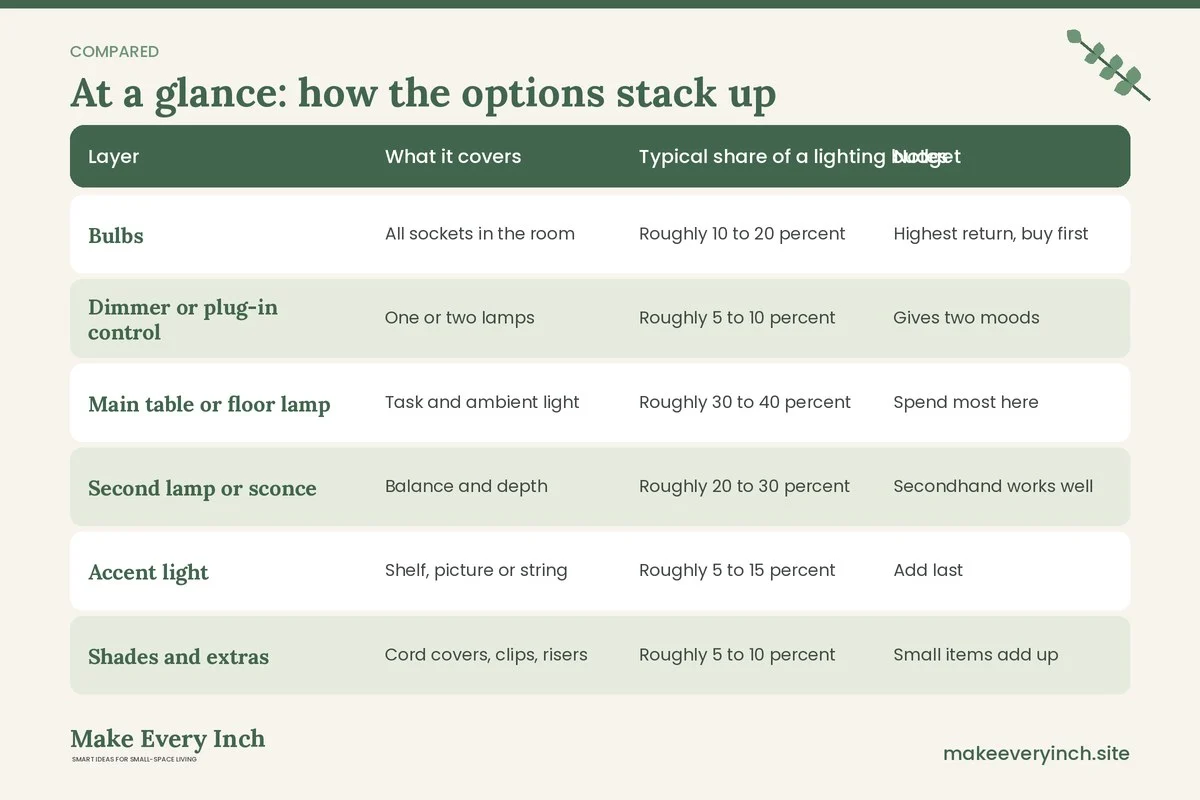
The ranges below describe how much of a small budget a typical layer might take. They are rough, hedged guides and will vary by region, store and season, so use them to compare layers and not to set a fixed price.
| Layer | What it covers | Typical share of a lighting budget | Notes |
|---|---|---|---|
| Bulbs | All sockets in the room | Roughly 10 to 20 percent | Highest return, buy first |
| Dimmer or plug-in control | One or two lamps | Roughly 5 to 10 percent | Gives two moods |
| Main table or floor lamp | Task and ambient light | Roughly 30 to 40 percent | Spend most here |
| Second lamp or sconce | Balance and depth | Roughly 20 to 30 percent | Secondhand works well |
| Accent light | Shelf, picture or string | Roughly 5 to 15 percent | Add last |
| Shades and extras | Cord covers, clips, risers | Roughly 5 to 10 percent | Small items add up |
If your budget is very small, put the first part into bulbs and one good lamp, and leave accent lights for later. You can always add a string of lights next month.
A buying order that avoids waste
Buy in the order below. Live with each step for a few evenings before you add the next, since the room often tells you what it needs.
- Step one: check every socket, and replace mismatched bulbs with one warmth.
- Step two: reposition the lamps you own and note which corner is still dark.
- Step three: add one lamp near the main seat. This is the task light.
- Step four: add a second lamp or a sconce in the corner that is farthest from the first. Aim to place lights at three different heights, such as low, mid and high.
- Step five: add a dimmer or a smart bulb on the lamp you use most.
- Step six: finish with an accent light, such as a string or a picture light.
Stopping early is fine. Many small living rooms look finished after step four.
Three example rooms
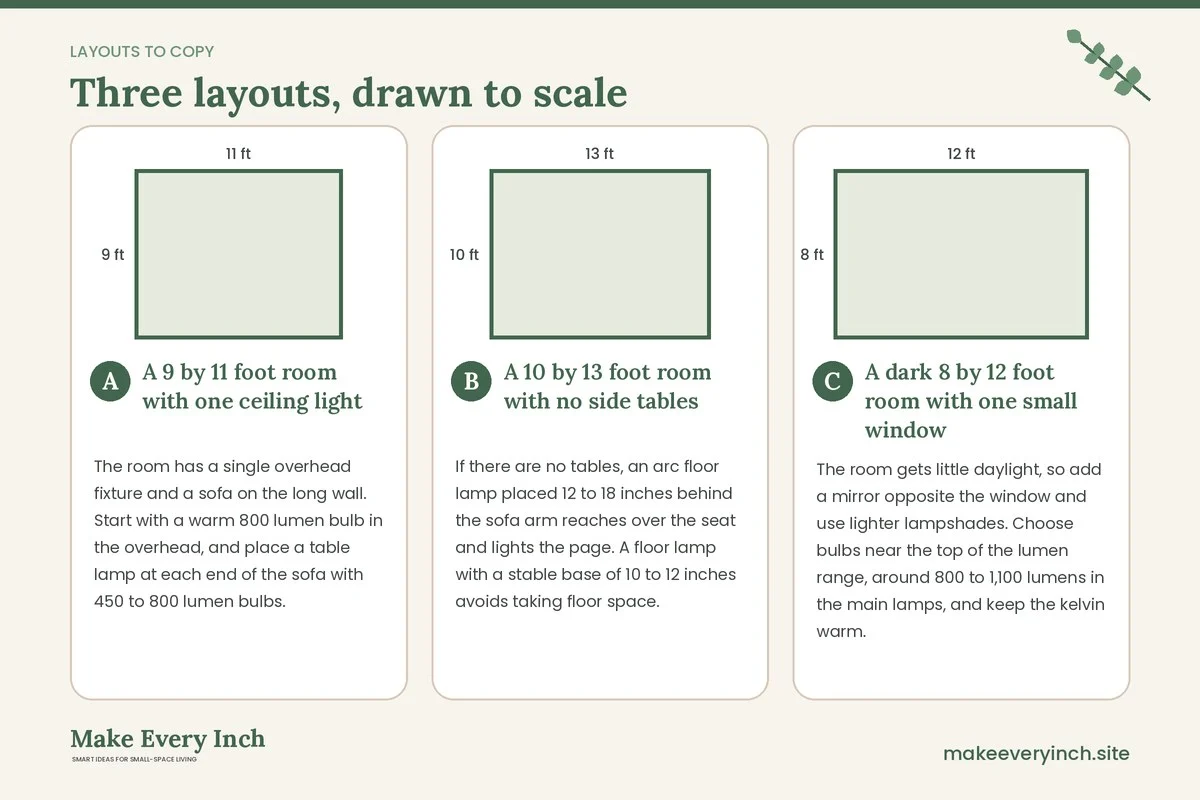
A 9 by 11 foot room with one ceiling light
The room has a single overhead fixture and a sofa on the long wall. Start with a warm 800 lumen bulb in the overhead, and place a table lamp at each end of the sofa with 450 to 800 lumen bulbs. The side tables are 22 to 26 inches high, so choose lamps with a base of 14 to 18 inches that put the shade bottom near eye level. Add a small lamp on a bookcase for the third height. The total sits at roughly 2,000 to 2,500 lumens, and you have not replaced a single fixture.
A 10 by 13 foot room with no side tables
If there are no tables, an arc floor lamp placed 12 to 18 inches behind the sofa arm reaches over the seat and lights the page. A floor lamp with a stable base of 10 to 12 inches avoids taking floor space. Add a clamp light on a nearby shelf, and move the television glare out of the room by placing a small lamp behind the screen at a low setting. The result is two lamps and one clamp, and it needs only one outlet if you use a power strip with surge protection and keep the load within its rating.
A dark 8 by 12 foot room with one small window
The room gets little daylight, so add a mirror opposite the window and use lighter lampshades. Choose bulbs near the top of the lumen range, around 800 to 1,100 lumens in the main lamps, and keep the kelvin warm. A uplight in the darkest corner can lift the whole ceiling. Our guide to dark apartment ideas explains more tricks for rooms that miss the sun.
Where cheap is fine, and where to be careful
Some parts of a lighting setup are safe to buy cheaply, and some are not.
Fine to save on:
- Lamp bases, shades and risers, since these are mostly style.
- Basic string lights from a trusted source, if the product is labeled as indoor and carries a safety mark from a recognized testing body.
- Clip-on lights and small shelf lights.
- Secondhand tables and stools used as lamp stands.
Be careful with:
- Cords and plugs. Choose cords that are in good shape, with intact insulation and a plug that fits snugly in the outlet. A cheap, thin cord that feels hot is a warning sign.
- Power strips. Choose a strip with a built-in breaker and a clear rating, and never plug one strip into another.
- Bulbs in enclosed fixtures. Use bulbs that are rated for enclosed spaces, and never exceed the wattage printed on the fixture.
- Anything that mounts to the wall or ceiling. Hardwired sconces, ceiling fixtures and anything that needs to be wired into the house circuit should be installed by a licensed electrician. A budget is not a reason to skip this.
Electrical safety notes
Cheap lighting is only a good deal if it is safe. Follow these rules in every room.
- Respect the wattage limit. Every lamp and fixture has a maximum bulb wattage printed near the socket. Do not exceed it, even with a bulb that seems small. LED bulbs use fewer watts for the same light, so they are easy to keep within the limit.
- Do not overload outlets. Avoid plugging many lights, a heater and a TV into one outlet or one strip. If a plug or strip feels warm, unplug it and have it checked.
- Keep cords visible and flat. Do not run cords under rugs, through doorways or across walkways. Cords that are pinched or covered can overheat and are a trip hazard.
- Leave space around shades. Keep shades and bulbs away from curtains, paper and fabric. A hot bulb touching a shade can become a fire risk.
- Unplug when you leave. String lights and cheap lamps should be unplugged when nobody is home.
- Hire a licensed electrician for hardwiring. Replacing a ceiling fixture, adding a hardwired sconce or installing a dimmer switch in the wall should be done by a licensed professional. Turning off the breaker is only part of the job.
If a light flickers, smells hot or buzzes, stop using it until you know why.
Common budget lighting mistakes
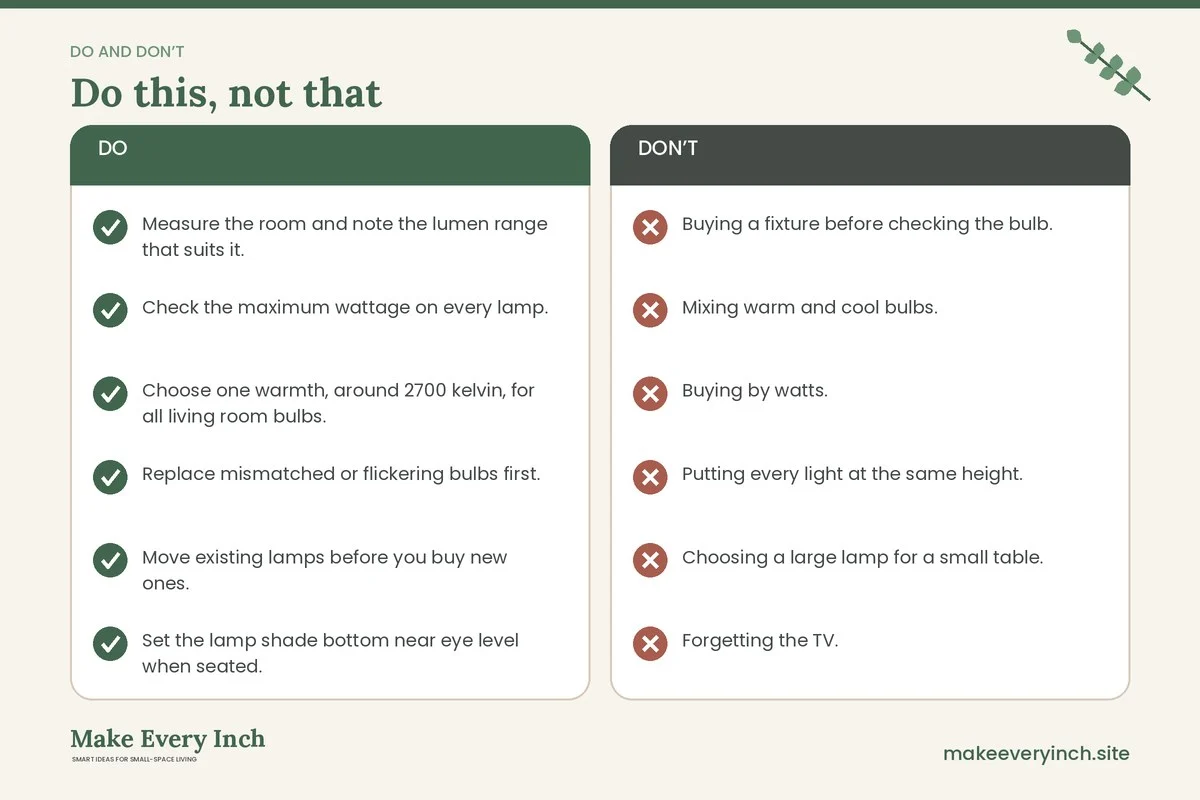
- Buying a fixture before checking the bulb. A plain bulb change often fixes the room for a fraction of the cost.
- Mixing warm and cool bulbs. A room with several kelvin values looks patchy, so match them.
- Buying by watts. Check the lumens, since a low-watt LED can be brighter than an old-style bulb.
- Putting every light at the same height. Three lamps at table height still leave the ceiling and floor dim. Use low, mid and high.
- Choosing a large lamp for a small table. A big base crowds the surface, so measure the table first.
- Forgetting the TV. A dark room with a bright screen strains the eyes. A low lamp behind or beside the screen reduces the contrast.
- Hiding the cord badly. A tidy lamp with a messy cord looks cheap. Use clips, a cord cover or a route along the baseboard.
Making a budget room look more expensive
Some tricks add a finished look without more spending.
- Use odd numbers of lights. Three or five light sources look more natural than two or four.
- Keep bulbs hidden. Choose shades that cover the bulb at eye level so you do not see the glare.
- Match shade colors. Two lamps with different bases and the same shade color look planned.
- Paint or wrap a cord. A fabric cord cover in a color that matches the wall disappears.
- Group lights in a triangle. Place the lights so that they form a loose triangle around the seating, and the eye moves smoothly around the room.
For more ideas on stretching a small sum across a whole room, see our guides to a small living room makeover under 500 and small apartment decor under 100, and the wider list of budget renter upgrades.
Budget lighting checklist
- Measure the room and note the lumen range that suits it.
- Check the maximum wattage on every lamp.
- Choose one warmth, around 2700 kelvin, for all living room bulbs.
- Replace mismatched or flickering bulbs first.
- Move existing lamps before you buy new ones.
- Set the lamp shade bottom near eye level when seated.
- Place lights at three different heights.
- Add one lamp near the main seat for reading.
- Add a second light in the farthest corner.
- Put the most-used lamp on a dimmer.
- Inspect secondhand cords, plugs and sockets.
- Keep cords flat, visible and out of walkways.
- Use a power strip with a breaker, and do not chain strips.
- Leave hardwiring to a licensed electrician.
FAQ
How much light does a small living room need?
Most small living rooms feel comfortable with roughly 1,500 to 3,000 total lumens, spread across several lights. Use the lower end for relaxed evenings and the higher end for reading or hobbies. Always follow the wattage limit on each fixture.
What is the cheapest way to improve a dark living room?
Replace the bulbs with warm LEDs of a matching color, then move lamps to the corners that are darkest. These two steps usually cost very little and can change the room more than a new fixture.
Is it better to buy one expensive lamp or several cheap ones?
For a small room, several smaller lights at different heights usually work better than one costly lamp. If you can only afford one good piece, put it next to your main seat as a reading light.
Which bulb color is best for a living room?
Warm white, around 2700 kelvin, is the usual choice. Some people prefer 3000 kelvin for a slightly crisper feel. Avoid very cool bulbs in the main seating area.
Are secondhand lamps safe?
They can be, if the cord, plug and socket are in good condition. Check for cracks, scorch marks and loose parts. If anything looks damaged, skip it or have it repaired by a qualified person.
Can I use string lights as my main light?
They work well as accent light, but they rarely give enough light for reading or daily use. Combine them with at least one lamp that has a proper bulb.
Do I need a dimmer?
Not at first, but a simple dimmer on the lamp you use the most gives you two moods for a small cost. Make sure the bulb and the dimmer are compatible.
When should I call an electrician?
Call a licensed electrician for any hardwired work, such as replacing a ceiling fixture, adding a wall sconce wired into the house or installing a dimmer switch.
Keep going: Keep going with our cozy small living room ideas, small living room layout ideas and small living room lighting ideas that are renter friendly.
Save this guide for later
Pin the ideas you like to Pinterest so you can come back to them when you plan your space.