Small Entryway Bench Ideas
Quick answer: The best small entryway bench ideas match the bench type to your clearance. A shallow bench of 10 to 14 inches deep suits a narrow hall, a wall-mounted bench saves floor space, a storage bench hides shoes, and a convertible bench doubles as a console or a step stool. Aim for a seat height of 17 to 19 inches, leave at least 36 inches of walking space, and anchor anything tall or wall-mounted.
Small entryway bench ideas start with a simple truth: a bench is the one piece of furniture that lets you sit down to put on your shoes, and it is also the piece that most often crowds a tiny entry. Choose a bench that is too deep and you will turn sideways to open the front door. Choose one that is too flimsy and it wobbles every morning. This guide focuses only on the bench itself. It explains the four bench types, the dimensions that decide whether one fits, the right seat height, how much weight a bench should carry, how to anchor and mount it safely, and how to dress it so it looks like part of the home. It includes a comparison table, three example entryways, a checklist and a FAQ. For the big picture, read our main guide to small entryway ideas, and keep the companion guides on small entryway storage and small entryway organization nearby. If you also want to dress the walls above the bench, see our post on small entryway wall decor ideas.
Decide whether you really need a bench
A bench earns its footprint only if somebody will actually sit on it. Before you shop, spend a week noticing how your household puts on and takes off shoes. Some people sit on the floor, some lean on the wall and some perch on a stair. If nobody sits, a bench becomes an expensive shelf, and a slim console or wall hooks may serve you better. Our guide to small coat storage ideas and the guide to small shoe storage ideas cover those alternatives.
Ask three questions. Who needs to sit, and for how long? Lacing a boot takes a minute, while helping a toddler with a snowsuit takes much longer. What do you want to store near the door? Shoes, a bag, a dog leash and a package all want a home. And how much floor is free once the door is fully open? The answers decide the bench type more than the style does.
If you live in an apartment with no true foyer, a bench can create the entry by marking a landing zone just inside the door. Our post on no entryway apartment ideas shows how a bench, a rug and a mirror can define that zone without a wall.
Measure the space before you choose
Measurements are the whole game in a small entry. Take these five before you look at a single bench.
- Door swing: open the front door fully and measure the floor it sweeps. Nothing should sit in that arc. Also note whether the door opens toward the wall where you want the bench.
- Clear width: measure from the wall where the bench would go to the opposite wall or to the first obstacle. Subtract the bench depth to find the walking width left over.
- Wall length: measure the stretch of wall that is free of doors, switches and radiators. A bench works best with a few inches of breathing room at each end.
- Ceiling height and sloped areas: if the wall is under a stair, note the height at the low point, because a person sitting needs about 40 inches of headroom from the floor.
- Fixtures: note the height of light switches, thermostats and outlets. A seat back or a shelf above the bench must not block them.
Then apply the walking rule. Aim for at least 36 inches of clear walking width in an entry, because one adult carrying a bag needs about that much. If the entry is a tight hallway, 30 inches is the practical minimum, and you should choose a bench no deeper than 12 inches. Our guide to narrow hallway ideas explains the hallway version of these clearances in more detail.
The four bench types, one by one
Shallow benches
A shallow bench is 10 to 14 inches deep, which is narrower than a standard bench of 16 to 18 inches. At that depth it works as a perch rather than a seat. You sit on the front edge to pull on a shoe. A shallow bench is the right answer when the clear width is between 40 and 48 inches, because it leaves the walking space intact.
What to look for: a top wide enough to hold a foot, which is about 10 inches, and legs that sit flush with the edges so you do not trip on a splayed foot. Slat tops and open frames look lighter in a tiny entry than a solid block. A shallow bench often has a lower shelf for baskets or shoes, and that shelf can add function without adding footprint. Choose a length of 30 to 48 inches. Shorter than 30 and it feels like a stool, longer than 48 and it dominates a small wall.
Trade-offs: shallow benches tip more easily because the base is narrow, so test the stability by pressing on one end before you commit. Wide feet or a rear brace help, and a tall household member may find a very shallow bench uncomfortable. Because the sitting surface is small, shallow benches are best for short stops, not for children who need help with boots.
Wall-mounted benches
A wall-mounted bench is a fixed shelf-style seat attached to the wall, often with a bracket or a floating hanger. It frees the floor entirely, which makes the entry look larger and makes sweeping easy. The depth can be 12 to 16 inches, and the seat is usually mounted so that the top sits 17 to 19 inches from the floor.
What to look for: solid brackets or a rail screwed into studs or properly rated wall anchors, a smooth edge, and a depth that matches the space. Many people pair a wall-mounted bench with hooks above it and a shoe tray below it. This stack uses vertical space and leaves the floor open for a rug.
Trade-offs: wall-mounted benches need drilling, so a renter must get permission first. Never drill into a rental wall without written approval, and check for pipes or wires behind the wall before you drill. A wall-mounted bench also has a weight limit that depends on the fixings and the wall type, so follow the maker’s guidance and use hardware rated for the wall material. If you cannot drill, skip this type and choose a freestanding shallow bench instead, or see our guide to no-drill storage ideas for renters for options that rely on tension or adhesive.
Storage benches
A storage bench hides shoes, hats, gloves and bags inside a lid, a drawer or a cubby. It usually runs 14 to 18 inches deep and 30 to 48 inches long. The closed storage makes a tiny entry look tidy, because the clutter disappears. It is the right pick for households with many pairs of shoes or for families who want to shut away mess.
What to look for: a lid that opens with a soft-close hinge or a lift-up support, so it does not slam on fingers. A cushion that is firm enough to sit on, and cubbies that fit the shoes you actually own. A lift-lid bench needs clear space in front for the lid to open, so check that the lid swing does not hit the door or the wall. A cubby bench with open fronts avoids that problem but shows the contents.
Trade-offs: storage benches are heavy once filled, and they are deeper than other types. Keep the contents light, with seasonal items at the bottom, so the bench stays easy to move for cleaning. For more ideas on what goes inside, read our post on small entryway storage.
Convertible benches
A convertible bench changes job. It may be a bench that folds flat against the wall, a bench that slides under a console, a bench that turns into a console with a flip-up seat, or a stool pair that nests under a shelf. These pieces suit studios, hallways and homes where the entry doubles as another room.
What to look for: a hinge or a leg that locks firmly in both positions, and a flat surface that stays level. A folding bench should have a support bar or latch, and a sliding bench should have glides that protect the floor. Convertible pieces often have thinner frames, so check the maker’s weight rating.
Trade-offs: a convertible bench has more moving parts to fail, so inspect hinges and locks from time to time. Keep fingers clear of the folding joint, and never let a child play on a folding bench. For homes with a small entry that must do many things, a convertible piece is a clever compromise, and our guide to apartment entryway decorating shows how to blend it into a styled corner.
Comparison table
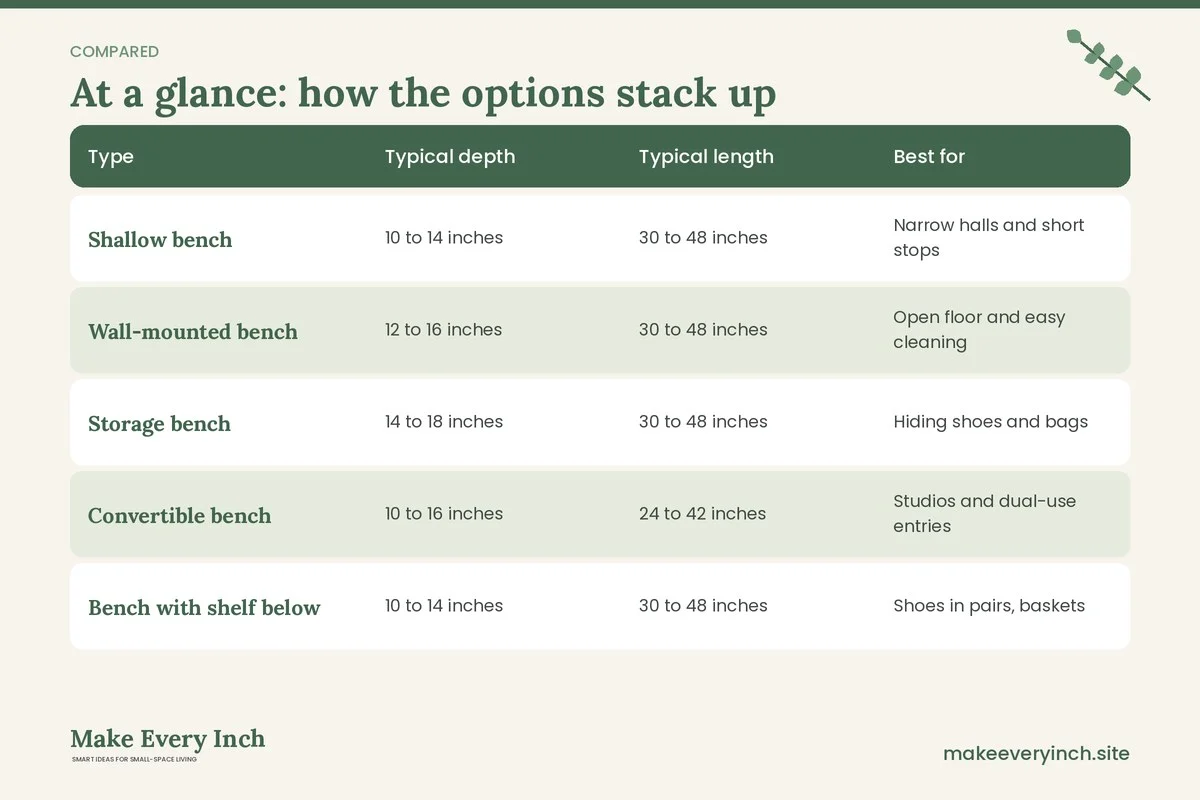
The table summarizes how the four bench types compare. Treat the ranges as typical figures, not as promises, and always read the dimensions for the specific piece you buy.
| Type | Typical depth | Typical length | Best for | Main drawback |
|---|---|---|---|---|
| Shallow bench | 10 to 14 inches | 30 to 48 inches | Narrow halls and short stops | Small seat and easy to tip |
| Wall-mounted bench | 12 to 16 inches | 30 to 48 inches | Open floor and easy cleaning | Needs drilling and permission |
| Storage bench | 14 to 18 inches | 30 to 48 inches | Hiding shoes and bags | Deep and heavy when full |
| Convertible bench | 10 to 16 inches | 24 to 42 inches | Studios and dual-use entries | Moving parts to maintain |
| Bench with shelf below | 10 to 14 inches | 30 to 48 inches | Shoes in pairs, baskets | Open storage shows clutter |
Dimensions that make a bench comfortable
Comfort is mostly numbers. Use the following ranges as a starting point, and adjust for the people in your household.
Seat height
Seat height is measured from the floor to the top of the seat. For most adults, 17 to 19 inches is comfortable, because it places the knees at roughly a right angle. A taller person may like 19 to 20 inches, and a household with young children or older adults who find standing up difficult may prefer 18 to 20 inches, because a higher seat is easier to rise from. A low bench of 14 to 16 inches suits small children and works as a footstool. If you add a cushion, count the compressed thickness, which can add 1 to 3 inches.
Depth, length and clearances
Depth should leave 36 inches of walking width, as noted above. Length should be at least 24 inches for one person and 36 inches for two. Leave 2 to 4 inches of space at each end of the wall, so the bench does not collide with a door frame or a radiator cover. If there is a shelf above the bench, keep at least 16 inches between the seat and the shelf, so a seated adult does not hit their head. Hooks above the bench should be mounted at a height where the hanging coat does not touch the seat. A coat hook at 60 to 66 inches off the floor usually works for adults.
Weight capacity
The weight a bench should carry depends on who sits on it. A bench used by adults should support at least 250 to 300 pounds as a reasonable safety margin, even if only one person sits at a time, because people drop onto a seat with force. A bench for children can be rated lower, though you should still avoid benches that feel flimsy. Check the maker’s stated load rating, which is usually printed in the product details or on the packaging. If a rating is not given, be cautious. Do not stand on a bench, because a standing person puts a concentrated load on a small area and raises the risk of tipping. Use a proper step stool instead.
For storage benches, remember that the contents add weight. A full load of boots can weigh 20 pounds or more, and the lid must carry both the contents and the person. A wall-mounted bench has a rating that depends on the fixings, so use only the hardware recommended and mount into studs or rated anchors. If you are unsure, ask a professional, because a falling bench can injure someone.
Anchoring and safety
A bench is low, so it seems harmless, but several details matter.
- Anchor tall pieces: if your bench has a high back, a coat rack on top, or tall side panels, secure the top to the wall with a tip-over restraint, as you would a bookcase. A bench with a shelf above it can topple when a child climbs it. Use the hardware that suits your wall, and follow the instructions.
- Mount wall benches into solid material: use a stud finder, then fix brackets into studs when you can. If studs do not align, use anchors rated for the wall type and the load. Plasterboard anchors vary a lot, so choose according to the stated rating.
- Check behind the wall: before drilling, check for pipes and wires. A hidden pipe or cable is a serious hazard. If you are not certain, hire a qualified person.
- Never drill without permission: in a rental, a lease may forbid drilling. Ask in writing, and keep the reply. If the answer is no, choose a freestanding bench or a tension-based solution.
- Keep walkways clear: an unclear path is a trip hazard, especially in the dark. Leave the path from the door to the rest of the home free of cords, shoes and bags.
- Mind the electrical points: do not block outlets or place a bench where a cord must run across the floor. A plug-in lamp should have its cord routed along the wall, not across the path.
- Use non-slip feet: felt pads protect floors, and rubber feet stop sliding on tile. Check that the bench does not creep when you sit down.
- Round the corners: sharp corners at knee height are a hazard in a narrow hall. Choose rounded edges, especially when children are around.
- Keep it away from heat: do not place a padded bench against a radiator, because the heat can damage the cushion and the finish.
Materials and finishes
Material affects weight, durability and the look. Solid wood is sturdy and repairable, and it is heavier. Metal frames with a slat top look light and cost less in space, but they can scratch floors, so add pads. Engineered wood panels hold storage well, though edges can chip and swell if the bench stands in a wet area. Upholstered tops feel comfortable, though they show dirt and wet shoes can stain them. In a rainy climate, a hard-wearing top or a removable, washable cover is easier to maintain. Rattan and woven styles bring texture, though they are lighter and can snag clothing.
If you paint or stain a bench, choose a low-VOC product and work in a ventilated space. Open a window, keep the room airy while the finish dries, and follow the label for drying time before you use the bench. Never sand old paint without checking whether it may contain lead if the piece is very old, and consider a protective mask for dust.
Styling the bench so it looks planned
A bench becomes part of the home when you dress it with a little care. Place a firm cushion or a woven mat on the seat, add a small basket underneath for gloves and scarves, and hang a bag on a hook above. Keep the top mostly clear. A bench that holds a pile of mail looks like a shelf, and a bench with only a plant, a tray or one folded throw looks calm.
Pair the bench with a rug that is easy to shake out. A runner or a small mat should sit under the front legs, so the bench does not slide. In a narrow entry, choose a rug that fits within the width, with 2 to 3 inches of floor showing on each side. A mirror above the bench visually widens the space, and our post on small entryway wall decor ideas covers mirrors, art and lighting in detail. A wall of hooks above the bench handles coats, and you can combine it with ideas from small coat storage ideas.
If you want a DIY bench, our guide to DIY entryway storage for tiny homes shows several approaches. Use sound joints, a flat top and corner braces, and check that the finished bench is stable before use.
Three example entryways
A 3-foot-wide apartment hall
A rental apartment has a front door that opens into a hall 36 inches wide and 8 feet long. A deep bench is out of the question. A freestanding shallow bench 11 inches deep and 36 inches long leaves about 25 inches of walking space, which is tight, so the better plan is to place it along the section of the wall beyond the door swing and keep it short. A slat top and open legs let the eye pass through. Beneath it sits a low tray for two pairs of daily shoes. On the wall above, three removable hooks hold coats. The bench is not anchored to the wall because it is low, but a felt pad under the legs keeps it from sliding. The household treats the bench as a perch for a quick lacing and keeps the other shoes in a closet.
A 5 by 6 foot entry in a family home
A family of four has a small entry with a door opening against the side wall. The wall opposite is clear for 6 feet. A storage bench 16 inches deep and 42 inches long sits on that wall, with cubbies for children’s shoes. The seat height of 18 inches suits the children and the adults. The lid is replaced by cushioned, fixed top and open cubbies so there is no lid swing to hit the door. Above it, a rail with hooks at two heights, about 48 inches for children and 64 inches for adults, holds backpacks and coats. Because the rail carries a heavy load, it is fixed into studs, and the tall unit is secured to the wall with a restraint. The remaining floor is 40 inches wide, comfortable for the family.
A studio with a shared entry and living space
A studio has no entry at all, and the door opens straight into the room. The owner wants a bench but also needs the wall for a desk. A convertible bench, 14 inches deep, serves as a seat by the door and slides under a console table that doubles as a laptop spot. A mirror above the console reflects light from the window. A wall-mounted shelf for keys is added only after the landlord agrees in writing. When guests arrive, the bench pulls out to become a second seat. The owner checks the maker’s weight rating and avoids standing on it. A tray under the console holds shoes, and a folded throw on the bench makes the corner feel like part of the living area.
Choosing the right bench: a quick decision guide
If the clear width is under 40 inches, choose a shallow bench or a wall-mounted bench. If you cannot drill, choose a freestanding shallow bench. If you have many shoes or a family, choose a storage bench with cubbies. If the entry shares space with another room, choose a convertible bench. If none of the above fits because the door swings into the only free wall, consider a stool or a fold-down seat instead, or place the seat elsewhere in the home.
Common mistakes
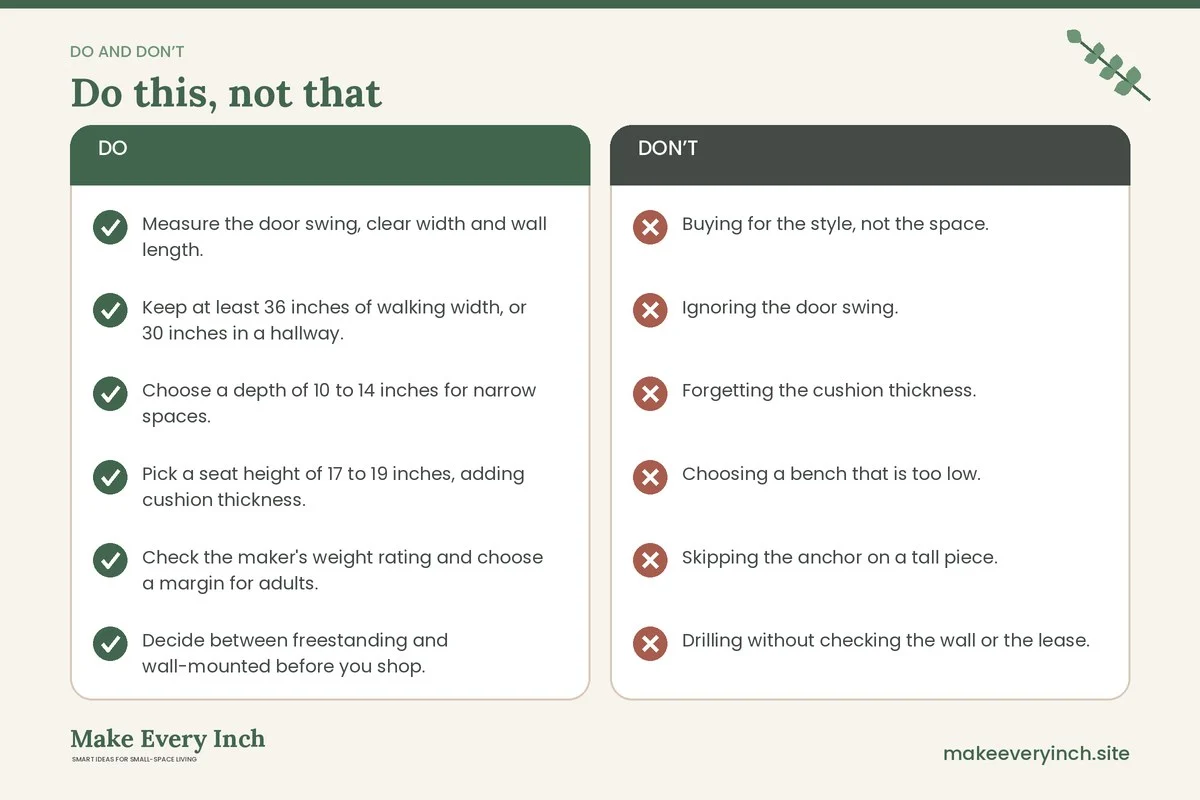
- Buying for the style, not the space. A bench that looks perfect online may be 6 inches too deep for your hall.
- Ignoring the door swing. If the door hits the bench, you will damage both.
- Forgetting the cushion thickness. A thick pad can raise the seat above a comfortable height.
- Choosing a bench that is too low. Anything under 16 inches is hard to rise from.
- Skipping the anchor on a tall piece. A top-heavy unit can tip, especially with children.
- Drilling without checking the wall or the lease. This can cause damage and cost your deposit.
- Overfilling a storage bench. A heavy load makes the lid hard to open and the bench hard to move.
- Leaving shoes on top. A bench that doubles as a shoe shelf loses its seating function.
- Blocking light and outlets. Keep switches and sockets reachable.
Checklist before you buy
- Measure the door swing, clear width and wall length.
- Keep at least 36 inches of walking width, or 30 inches in a hallway.
- Choose a depth of 10 to 14 inches for narrow spaces.
- Pick a seat height of 17 to 19 inches, adding cushion thickness.
- Check the maker’s weight rating and choose a margin for adults.
- Decide between freestanding and wall-mounted before you shop.
- Get written permission before drilling in a rental.
- Check for pipes and wires behind the wall.
- Anchor any tall bench or shelf above it to the wall.
- Add felt pads or rubber feet to suit the floor.
- Choose low-VOC finishes and ventilate when painting or staining.
- Plan hooks, a rug and a mirror to finish the corner.
FAQ
How deep should a bench be in a small entryway?
For a narrow entry, 10 to 14 inches is usually enough, while a standard bench of 16 to 18 inches suits an entry that is at least 5 feet wide. Always check that 36 inches of walking space remains.
What is the best seat height for an entryway bench?
Most adults find 17 to 19 inches comfortable. Add cushion thickness to your calculation, and choose a slightly higher seat if anyone has difficulty standing up.
How much weight should a bench hold?
For adult use, look for a stated capacity of 250 to 300 pounds or more, and follow the maker’s guidance. Avoid standing on the bench. Wall-mounted benches depend on the fixings, so use the recommended hardware.
Do I need to anchor an entryway bench to the wall?
A low freestanding bench does not usually need it. A bench with a tall back, a shelf, or a coat rack above it should be secured to the wall with a restraint, especially in a home with children.
Can I install a wall-mounted bench in a rental?
Only with written permission from the landlord. Drilling without permission can lead to charges. If drilling is not allowed, choose a freestanding bench or a tension-based option.
What if I have no room for a bench at all?
Use a fold-down seat, a stool that tucks under a console, or a pair of hooks and a wall tray. Our guide to small entryway ideas offers other ways to create a landing zone.
Is a storage bench or an open shelf bench better?
A storage bench hides clutter, and an open bench is easier to reach and has no lid swing. Choose based on how many items you want to hide and how much clearance you have.
Keep going: Keep going with our guides to small entryway ideas, small entryway storage and small entryway wall decor ideas.
Save this guide for later
Pin the ideas you like to Pinterest so you can come back to them when you plan your space.