23 Tiny Kitchen Ideas for Kitchens Under 50 Square Feet
Quick answer: The best tiny kitchen ideas pare the kitchen down to a core kit, use every wall, door and cabinet top for storage, add a movable counter such as a cart or a fold-down shelf and light the work area well. Buy multi-use tools, keep counters clear and use vertical space first.
Tiny kitchen ideas are for kitchens of 50 square feet or less: a corner of a studio, a kitchenette in a micro-apartment, a wall of appliances in a tiny home or a closet-sized galley. Here, every inch counts and nearly every item must earn its place. This guide shares 23 ideas, a minimal kit list, a comparison table, three example kitchens, a cooking and cleaning routine and a checklist so a tiny kitchen can still feed you well.
Start with a minimal kit
In a tiny kitchen, the tools you own decide how much space you have. Choose a core set and resist the urge to add more. A realistic kit for one or two people includes one 10 to 12 inch skillet, one 2 to 3 quart saucepan, one stockpot, one baking sheet, one chef’s knife, one paring knife, one serrated knife, one cutting board, two mixing bowls, a colander, a set of measuring cups and spoons, a spatula, a wooden spoon, a ladle, tongs and a whisk. Add a kettle and a toaster oven or a multi-cooker if you cook often.
Dishes should match the number of people who live in the home plus one or two guests. Choose stackable dishes, nesting bowls and glasses that fit inside each other. Keep only the number of mugs that fit on one shelf. Everything beyond the kit goes in a box in a closet or out of the home.
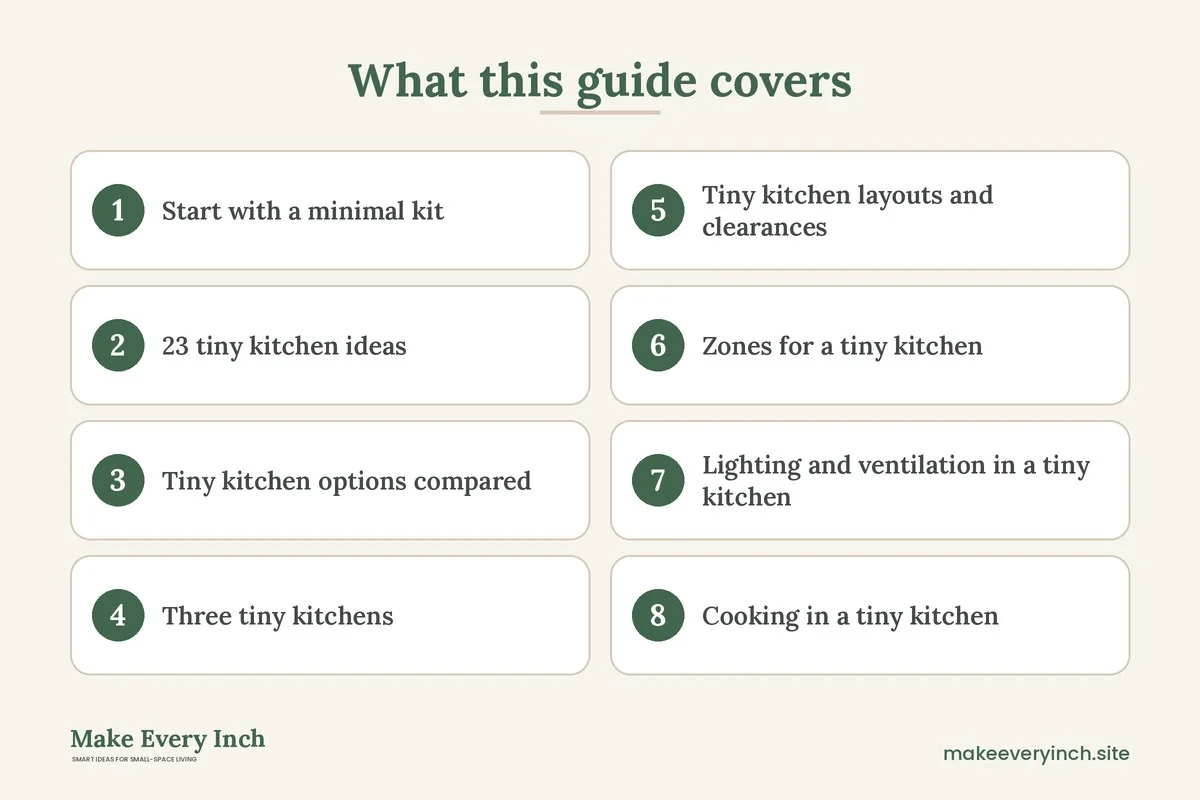
23 tiny kitchen ideas
1. Use a wall rail and hooks
Hang mugs, utensils and small pots from a rail above the counter. The wall is the biggest unused surface in a tiny kitchen.
2. Add a magnetic strip
Knives, scissors and metal tools live safely on a strip and free a drawer.
3. Hang shelves high
Shelves above the door or above the window hold seldom-used items. Use a step stool and keep items light.
4. Use the inside of cabinet doors
Racks, hooks and bins hold lids, wraps, boards and towels.
5. Choose a movable counter
A rolling cart or a fold-down shelf gives you extra work space that you can fold away. Choose a cart 12 to 16 inches wide with locking wheels.
6. Add a cutting board over the sink
A board that sits over the sink doubles the counter area when you chop.
7. Use stackable containers
Matching stackable containers save space in the fridge and cabinets. Choose square ones, which waste less space than round.
8. Use a compact dish rack
A rack that folds or sits over the sink dries dishes without taking counter space. Use a roll-up mat if the sink is small.
9. Use shelf risers in cabinets
Risers double the shelf space and make the back of a shelf useful.
10. Use a lazy Susan
A turntable on a shelf brings items to you.
11. Use slim appliances
A 24 inch fridge, a two-burner cooktop and a countertop oven fit in a tiny kitchen. Choose multi-use appliances.
12. Choose a multi-cooker or toaster oven
One appliance that can bake, roast, steam and cook rice replaces several items.
13. Use under-cabinet lighting
LED strips light the counter and make a small kitchen feel bigger. Choose battery or plug-in lights for rentals.
14. Use a mirror or a glossy backsplash
Reflective surfaces bounce light and make the room look deeper.
15. Use light colors
White, cream and pale sage make walls recede. Use one color for walls and cabinets.
16. Put a plant or herb on the sill
A small plant adds life without taking floor space.
17. Use a trash and recycling bin that fits
Choose a slim bin that fits in a cabinet or on a door. Use small bags and empty it often.
18. Use a small table or bar
A fold-down table or a counter shelf at 36 or 42 inches gives you a place to eat or work.
19. Store flat items vertically
Trays, sheets and boards stand on edge in a rack or a divider and take less room.
20. Use the top of the fridge
A basket holds light items, and the side holds magnetic hooks.
21. Add a toe-kick drawer
A shallow drawer under a cabinet stores baking sheets and boards.
22. Use a spice rack on the wall or the door
A narrow rack keeps spices in sight and out of cabinets.
23. Edit often
Once a month, remove items you do not use and keep the counters clear. A tiny kitchen cannot hold clutter.
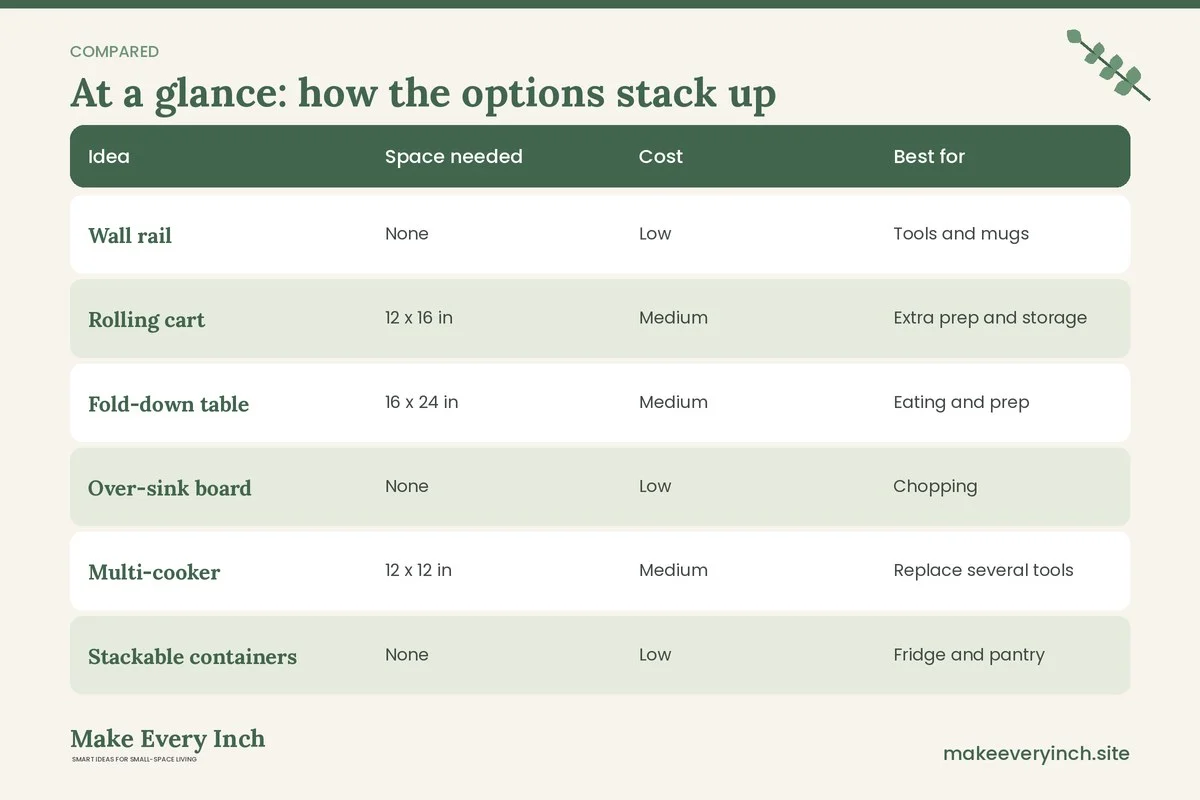
Tiny kitchen options compared
| Idea | Space needed | Cost | Best for | Notes |
|---|---|---|---|---|
| Wall rail | None | Low | Tools and mugs | Use studs for weight |
| Rolling cart | 12 x 16 in | Medium | Extra prep and storage | Needs a spot to park |
| Fold-down table | 16 x 24 in | Medium | Eating and prep | Needs wall mounting |
| Over-sink board | None | Low | Chopping | Check the sink width |
| Multi-cooker | 12 x 12 in | Medium | Replace several tools | Needs a cabinet |
| Stackable containers | None | Low | Fridge and pantry | Match shapes |
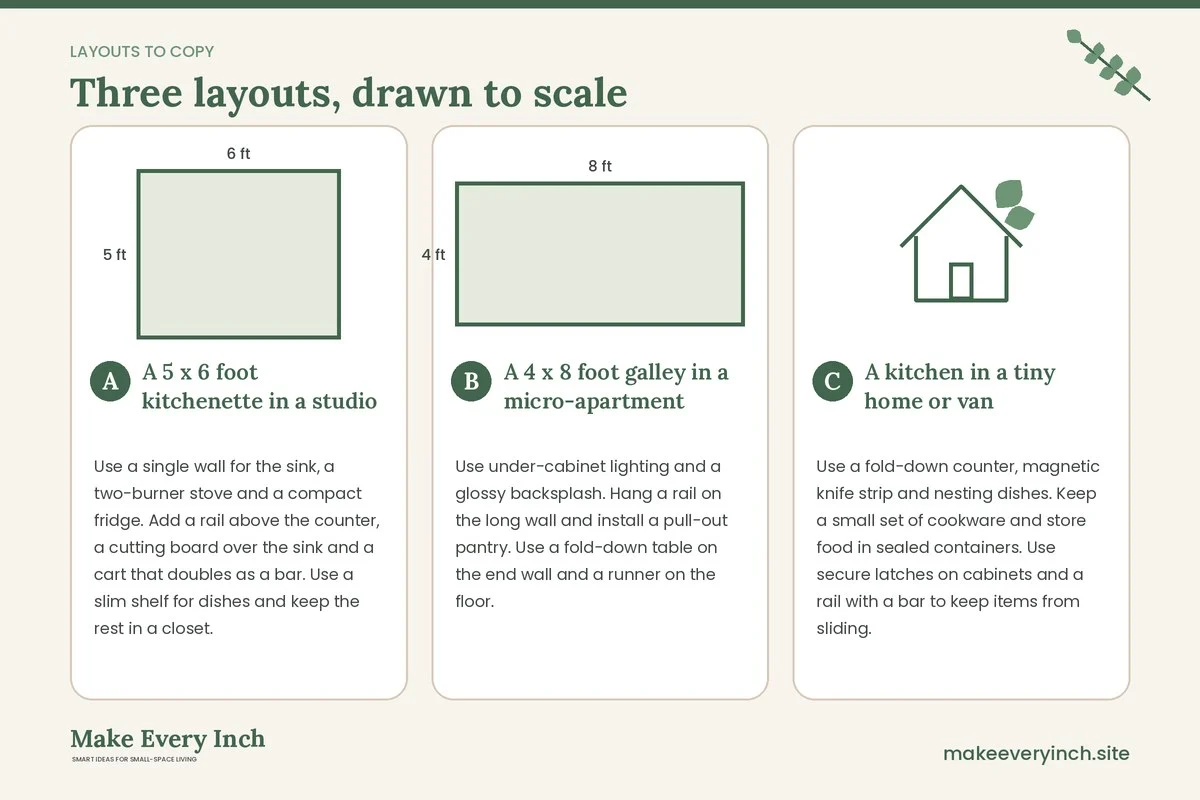
Three tiny kitchens
A 5 x 6 foot kitchenette in a studio
Use a single wall for the sink, a two-burner stove and a compact fridge. Add a rail above the counter, a cutting board over the sink and a cart that doubles as a bar. Use a slim shelf for dishes and keep the rest in a closet.
A 4 x 8 foot galley in a micro-apartment
Use under-cabinet lighting and a glossy backsplash. Hang a rail on the long wall and install a pull-out pantry. Use a fold-down table on the end wall and a runner on the floor.
A kitchen in a tiny home or van
Use a fold-down counter, magnetic knife strip and nesting dishes. Keep a small set of cookware and store food in sealed containers. Use secure latches on cabinets and a rail with a bar to keep items from sliding. See small kitchen ideas for more layouts.
Tiny kitchen layouts and clearances
Even in a very small kitchen, a few clearances protect safety and comfort. Keep at least 15 inches of counter on each side of a cooktop if you can, or a heat-proof board to extend the surface. Leave 36 inches in front of the sink and the refrigerator and 42 inches in front of the stove. Do not place flammable items such as towels or paper within 12 inches of the burners. Check that cabinet doors, oven doors and the refrigerator door can open without hitting each other. If the kitchen is a single wall, keep the path in front of it clear and place the cart or table to the side.
| Layout | Typical size | Best for | Key idea |
|---|---|---|---|
| Single wall | 6 to 10 ft long | Studios | Use a cart for extra counter |
| Corner L | 5 x 6 ft | Micro-apartments | Use a lazy Susan in the corner |
| Closet galley | 4 x 8 ft | Narrow spaces | Use drawers and a mirror |
| Kitchenette cabinet | 4 to 6 ft wide | Small units | Use a fold-down shelf |
Zones for a tiny kitchen
Even a kitchen of 40 square feet can have zones. The prep zone is the counter next to the sink, the cooking zone is the stove and the area next to it, the storage zone is the fridge and shelves, and the clean-up zone is the sink and the drying rack. Keep the tools for each zone within an arm’s length of that zone. For example, a rail above the stove holds spatulas and tongs, a drawer beside the sink holds knives and peelers and a basket on the shelf holds oils and spices. Zones keep the work flowing and stop you from moving through the whole kitchen for a single task.
Lighting and ventilation in a tiny kitchen
A tiny kitchen needs bright, even light and good ventilation. Use a ceiling fixture of at least 800 lumens, and add an under-cabinet strip for the counter. Choose 3000K to 3500K for a clear but warm light. If you have no hood, use a window fan or a small exhaust fan, and keep lids on pots to reduce steam. Wipe grease from the walls to prevent buildup, and clean the filter in a range hood each month. Keep a smoke detector outside the kitchen and a small extinguisher within reach.
Cooking in a tiny kitchen
Cooking is easier if you plan around the space. Choose recipes with few steps and few pots, such as one-pan meals, sheet-pan dinners and soups. Prep all ingredients before you start so you do not need counter space for everything at once. Use a tray to carry ingredients and a bowl for scraps. Wash dishes as you cook and use the same cutting board for several tasks. Plan meals for the week, so you shop in small amounts and avoid crowded shelves. Batch cook once a week and store meals in stackable containers.
Food storage in a tiny kitchen
Buy small quantities and use clear, stackable containers. Keep a list of what you have on a card inside the door, and shop with a list. Use the fridge door for sauces and the freezer for batch meals. Keep staples such as rice, pasta, oil, spices and canned tomatoes in one cabinet and fresh items in the fridge. Buy produce that keeps, such as carrots, cabbage and apples, and use delicate items first. Avoid buying bulk packs unless you can store them. A tiny kitchen is easier to keep clean and fresh when you buy less.
Cleaning a tiny kitchen
A small space shows mess quickly, but it is quick to clean. Wipe the counter and the stove after each meal. Wash dishes before bed. Empty the trash often and take out recycling weekly. Once a week, wipe the front of the cabinets, clean the sink and mop the floor. Once a month, clean the fridge and the oven. Keep a small caddy under the sink with a sponge, a cloth, a spray and a brush. Use a degreasing spray on the walls above the stove before you hang adhesive items.
Making a tiny kitchen feel like a real kitchen
A tiny kitchen can still be pleasant to use. Keep one thing on the counter that you love, such as a good kettle, a wooden bowl or a plant. Use a bright dish towel and a small rug or runner for color. Play music while you cook and keep a window open when you can. Choose a good knife and a good pan, since one well-made tool makes a big difference when the kit is small. Keep your favorite spices and oils within reach and rotate the rest. When a tiny kitchen is neat, bright and stocked with the things you use, cooking becomes a short daily ritual instead of a struggle.
Appliances for a tiny kitchen
Choose appliances that earn their space. A compact 24 inch refrigerator with a small freezer is enough for one or two people. A two-burner cooktop, either electric or induction, saves counter space and can be stored away. A toaster oven can bake, roast and toast. A multi-cooker can replace a rice cooker, slow cooker and steamer. A countertop dishwasher is an option if you have no built-in one. A kettle and a small coffee maker are worth the space if you use them daily. If you have a roommate, share one blender or mixer and store it in a closet. Check the voltage and the circuit before you plug in several high-power appliances at once.
Sample weekly routine for a tiny kitchen
On Sunday, plan three or four meals, check the fridge and write a short list. Shop in small amounts. Cook a pot of grains or beans and roast a tray of vegetables, then store them in stackable containers. During the week, mix and match to make quick meals with one or two pans. Wash dishes after each meal and wipe the counter. On Saturday, empty the fridge of leftovers, wipe the shelves and put away items. A routine like this keeps the kitchen calm and the food fresh, and it takes less than an hour a week.
Tiny kitchen ideas for renters
Use adhesive hooks, a tension rod under the sink and freestanding shelves. Add plug-in lights, peel-and-stick tile and a washable runner. Store the original hardware and shelves in a box. Take photos at move-in and move-out. See renter kitchen ideas.
Tiny kitchen mistakes to avoid
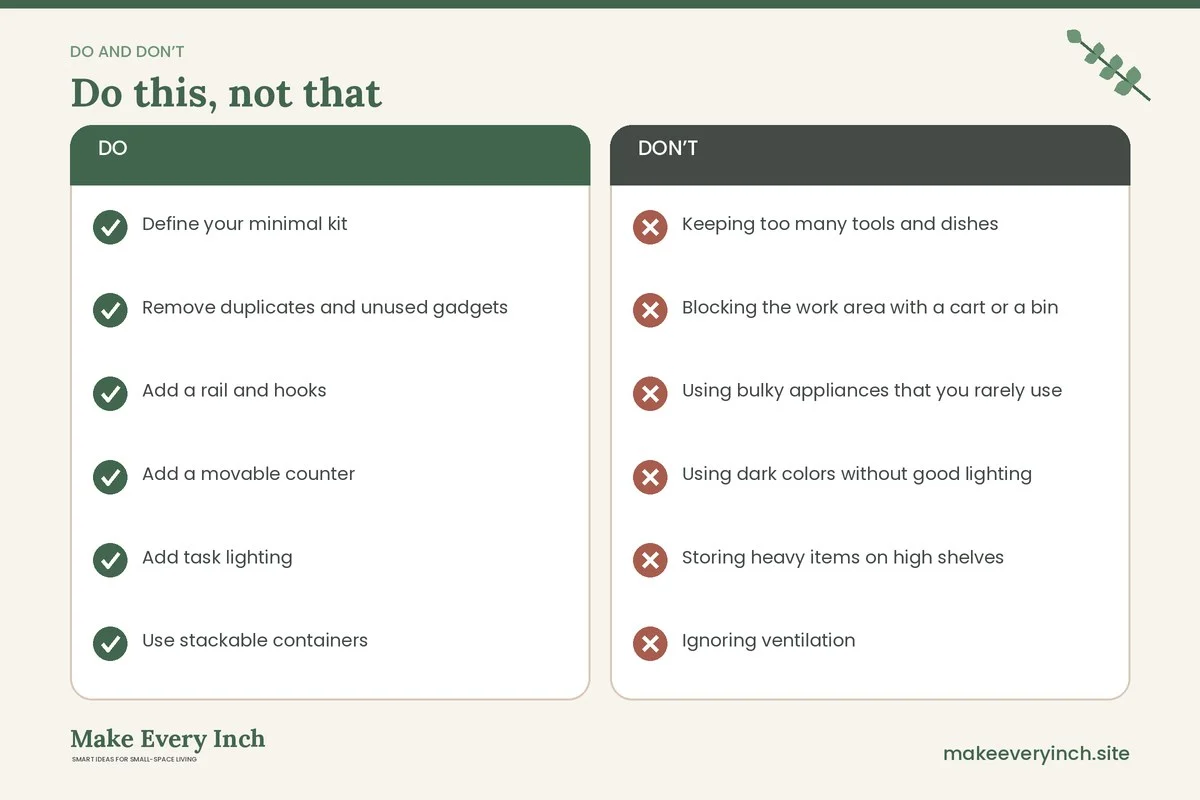
- Keeping too many tools and dishes
- Blocking the work area with a cart or a bin
- Using bulky appliances that you rarely use
- Using dark colors without good lighting
- Storing heavy items on high shelves
- Ignoring ventilation
- Buying organizers without measuring
- Forgetting trash and recycling
Before you buy anything for a tiny kitchen, measure it, write down the three tasks that annoy you most and solve only those first. A tiny kitchen rewards patience: each small fix you test for a week tells you far more than a shopping spree, and it keeps the space calm.
Keep a short note on your phone listing the five tools you reach for most, because those five decide which pieces deserve the best spot in the room.
Tiny kitchen checklist
- Define your minimal kit
- Remove duplicates and unused gadgets
- Add a rail and hooks
- Add a movable counter
- Add task lighting
- Use stackable containers
- Keep counters clear
- Review each month
FAQ
How do I make a tiny kitchen work?
Pare down to a core kit, use walls and doors for storage, add a movable counter and light the workspace well.
How can I add counter space to a tiny kitchen?
Use a cutting board over the sink, a cart, a fold-down shelf or a table. Clear the counter of anything you do not use daily.
What appliances do I need in a tiny kitchen?
A refrigerator, a stove or a cooktop and a microwave or toaster oven. Add a multi-cooker or a kettle if you use them often.
How do I store food in a tiny kitchen?
Use stackable containers, shelf risers and a pull-out pantry. Buy in small quantities and keep a list.
What colors work in a tiny kitchen?
Light colors such as white, cream and pale sage, with one accent.
How can I make a tiny kitchen feel larger?
Use light, a mirror or glossy backsplash, clear counters and fewer items on display.
Can I cook full meals in a tiny kitchen?
Yes, with a minimal kit, planning and a few good tools.
How do I keep a tiny kitchen clean?
Wipe as you go, wash dishes daily and do a short weekly clean.
Keep going: Explore our small kitchen ideas, small kitchen organization ideas and galley kitchen ideas.
Save this guide for later
Pin the ideas you like to Pinterest so you can come back to them when you plan your space.