21 Vintage Apartment Ideas for Small Spaces That Feel Collected
Quick answer: The best vintage apartment ideas for small spaces mix a few well-chosen older pieces with simple modern basics. Pick one era or color thread, thrift for solid wood, brass, glass and wool, add vintage lamps and a small rug, and limit each surface to a few objects. Check cords, finishes and cookware for safety, and keep everything removable if you rent.
Vintage apartment ideas work especially well in small homes, because older furniture is often built smaller, in solid materials, and with more character than a flat-pack equivalent. The risk is clutter. A room full of charming finds turns into a storage unit very quickly, and a tiny apartment shows every extra object. This guide explains what vintage really means, how to shop for it, how to blend it with new pieces, how to care for old wood, which safety checks matter, and how to keep a rental deposit safe. It includes 21 ideas, a comparison table, three example rooms, a budget guide and a checklist. If you are starting from a blank rental, our guide to renter-friendly apartment decorating ideas covers the basics that make everything below easier.
What vintage actually means
In general, vintage describes items that are at least 20 years old, while antique usually means 100 years or more. Those are trade conventions rather than laws, so sellers use the words loosely. For decorating, the useful question is not the label but the look and the build quality. A 1970s teak sideboard, a 1950s brass lamp and a 1920s oak chair can all work in one room if they share a tone, a scale or a material.
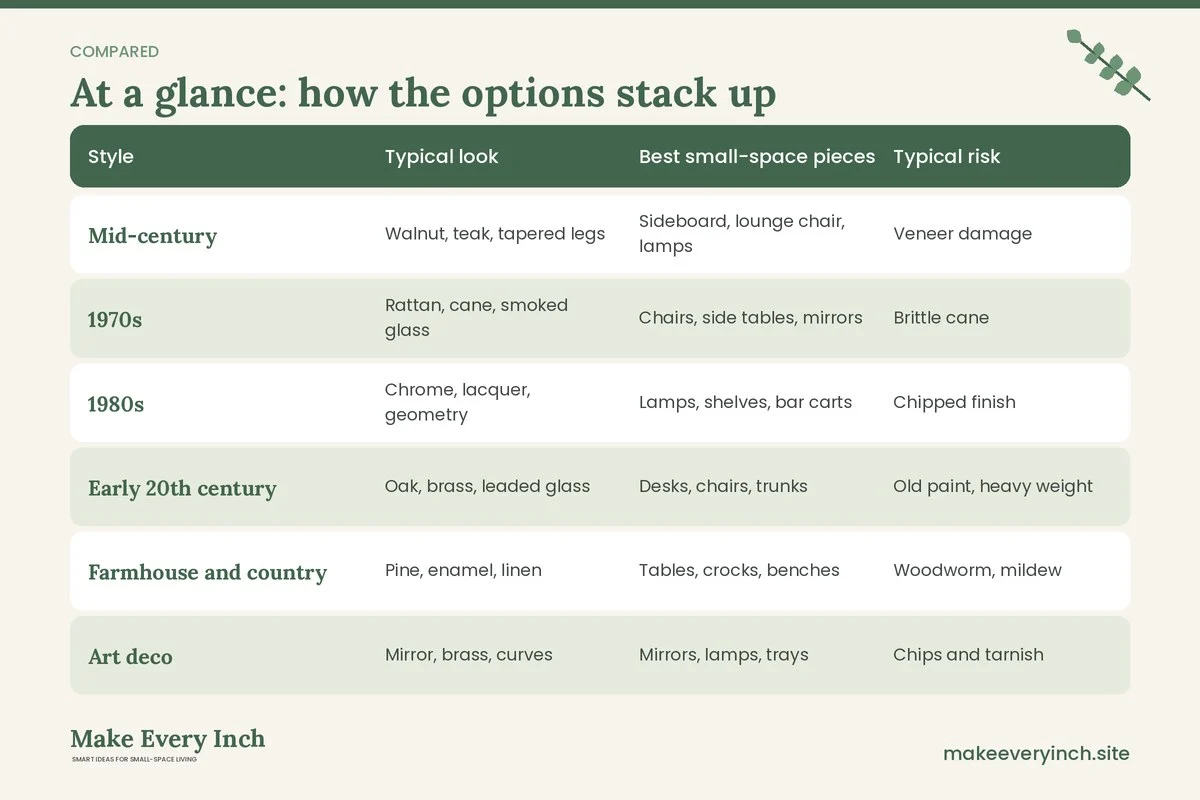
You will often hear about eras. Mid-century pieces, roughly the 1940s to 1960s, favor slim legs, curved plywood and warm woods. The 1970s bring rattan, smoked glass, cane and earthy colors. The 1980s lean on chrome, lacquer and bold geometry. Older pieces, such as Victorian or early 20th century oak, are heavier and darker. In a small apartment, mid-century and 1970s pieces are usually the easiest to fit, because they stand on legs and show the floor underneath.
Patina is the soft wear that develops over decades, such as a darkened brass handle, a worn edge on a table or a gentle fade on a rug. Some patina adds depth, and some is damage. A water ring or a light scratch can be part of the story. A wobbly joint, active insect holes or a strong smoke smell is a problem. Learn to tell the two apart before you buy.
Set a narrow brief before you shop
Collected rooms look intentional because they follow rules. Choose a small set before you leave the house. One dominant wood tone is a good start, such as warm walnut or pale oak. Add one metal, either brass or chrome, and a color family of three or four shades. Measure your doorways, your lift and the spot where the piece will sit, and write the numbers on your phone. Take a tape measure and a photo of the room to every sale.
Decide how many vintage pieces the room can hold. A useful ratio for a small room is about one third vintage and two thirds simple new or neutral pieces. The old items become highlights, and the plain items give them space to be noticed.
21 vintage apartment ideas
Choose the big pieces first
1. A vintage sideboard as a TV stand and storage
A low sideboard, often 55 to 70 inches wide and 16 to 18 inches deep, replaces a bulky media unit. The sliding doors hide cables and board games, and the top holds a lamp and one plant. Check that the legs are firmly attached and that the drawers run smoothly.
2. A compact mid-century sofa or loveseat
Look for a sofa under 72 inches wide with tapered legs, which lets light and floor show beneath it. Test the frame by lifting one corner, and press the seat to check the springs. Reupholstery can cost more than a new sofa, so buy one with fabric you already like.
3. A drop-leaf or gateleg table
These tables fold to 10 to 14 inches deep against a wall, then open to seat four. They suit studios where the dining area doubles as a desk. Check that the hinges are intact and that the leaves sit level when raised.
4. A secretary desk or writing bureau
A fold-down desk gives you a workspace that closes into a cabinet. Cubbies hold stationery and chargers, and the closed front looks like a piece of furniture rather than an office. Look for one with a depth of about 14 to 18 inches.
5. Mismatched wooden chairs
Four chairs from four makers, painted or stained in one color, read as deliberate. Check each chair for rocking joints, because glue and clamps can fix them, but cracked legs are harder. Stack or hang the extras so they do not crowd the room.
Light and glow
6. Vintage table and floor lamps
Brass swing-arm lamps, ceramic bases and glass globes give a room warm, low light, which flatters wood and fabric. Replace the cord, plug and socket with new, UL-listed parts or have the lamp rewired before use. A new shade in a drum or empire shape often refreshes an old base for a modest cost.
7. A plug-in sconce in an old style
A swing-arm sconce that plugs into the wall with a cord cover gives you reading light beside a bed or sofa with no hardwiring. Choose a warm bulb, around 2700K. See renter friendly lighting ideas for ways to place plug-in fixtures without drilling.
8. A glass or ceramic pendant shade on a plug-in cord
A vintage opal glass shade or a ceramic dome can hang from a hook and a ceiling-hook cord set where the lease permits. Keep it away from curtains and hold bulb wattage under the shade’s rating. If the landlord says no, use the same shade on a floor lamp.
Rugs, textiles and softness
9. A worn wool or kilim rug
Flatwoven kilims and low-pile wool rugs hide wear and suit small rooms, because they do not add bulk. A 5 by 8 foot size anchors a seating group, and 2 by 6 foot runners fit hallways and galley kitchens. Use a thin non-slip pad under the rug, and check it for moths by looking at the underside and the fringe.
10. Layered rugs for patina and warmth
A small vintage rug over a neutral flat rug adds pattern without a big spend. Keep the lower rug a few inches larger on each side, and tape corners flat so no one trips. See small apartment living room ideas for seating layouts that work with a layered floor.
11. Vintage linens for curtains and bedding
Old tablecloths, cotton sheets and embroidered runners can become café curtains, pillow covers or a bed topper. Wash them gently, test the fabric for brittleness and avoid anything with a strong smell of mildew. Soft, faded cotton looks lived in, even in a rental.
Display and walls
12. A gallery of thrifted art and frames
Mix oil paintings, botanical prints and old maps in frames with simple profiles. Painting every frame the same color, or limiting the metal to brass, keeps the wall calm. Hang with adhesive strips rated for the weight, and lean larger pieces on a ledge, as shown in renter friendly wall decor ideas.
13. A mirror with an old frame
A gilded or carved wood mirror reflects window light and makes a narrow wall feel deeper. Lean it on a dresser or console instead of hanging it, and keep it away from direct sun on a flammable surface. Foxing, which is the speckling on the back glass of old mirrors, is cosmetic, but a cracked pane is not.
14. One shelf of curated objects
Limit a vintage shelf to a few categories, such as ceramics, books and a clock. Group by color or height, and leave a third of the shelf empty. The empty space is what lets the objects look chosen.
15. Old books as a color block
Cloth-bound books arranged by spine color add warmth and texture. Buy them by the stack at a library sale, and keep them in a bookcase or stacked flat under a lamp. Check for musty smells, which are hard to remove.
Kitchen and dining
16. Vintage serving pieces used every day
A pottery bowl, an enamel pot or a wooden board on the counter is both decoration and tool. Choose items you will use at least weekly, so they earn their place. Keep cookware safe, as covered in the safety section below.
17. A vintage bar cart or kitchen trolley
A small wheeled cart adds prep surface, storage and a place for glasses or plants. Look for one around 18 by 28 inches with a lower shelf. See small kitchen cart ideas for ways to use one.
Bedroom and entry
18. A vintage dresser used as a nightstand
A narrow chest of drawers beside the bed holds clothes and a lamp. Line the drawers with fresh paper, and check that they slide easily. A low dresser works as a bench at the foot of a bed as well.
19. A wooden trunk as a coffee table and storage
A steamer trunk holds blankets, and the lid serves as a table. Place felt pads underneath to protect floors, and check that the lid hinges and the lid supports hold. Avoid trunks with strong chemical smells, since the lining may be old.
20. A coat tree or hall bench
A bentwood coat tree takes up about a square foot of floor and replaces missing hooks. A narrow bench with a basket underneath gives you a seat and shoe storage. Both fit the ideas in small entryway ideas.
21. Old window frames and architectural salvage
A salvaged window frame leaned on a console becomes a mirror or a photo frame. Be careful with very old painted salvage, since it may have lead paint, which is covered in the safety section.
Vintage styles compared
| Style | Typical look | Best small-space pieces | Typical risk | Price range |
|---|---|---|---|---|
| Mid-century | Walnut, teak, tapered legs | Sideboard, lounge chair, lamps | Veneer damage | Medium |
| 1970s | Rattan, cane, smoked glass | Chairs, side tables, mirrors | Brittle cane | Low to medium |
| 1980s | Chrome, lacquer, geometry | Lamps, shelves, bar carts | Chipped finish | Low |
| Early 20th century | Oak, brass, leaded glass | Desks, chairs, trunks | Old paint, heavy weight | Medium to high |
| Farmhouse and country | Pine, enamel, linen | Tables, crocks, benches | Woodworm, mildew | Low to medium |
| Art deco | Mirror, brass, curves | Mirrors, lamps, trays | Chips and tarnish | Medium to high |
Thrifting and flea market tactics
Where to look
Estate sales, church and hospice thrift stores, flea markets, online local marketplaces and house clearance sales usually give better prices than curated vintage shops. Go early for the best pieces, and go late in the day for markdowns. Many estate sales discount items by half on the last day, though policies vary, so check the listing.
What to bring
Carry a tape measure, a flashlight, a small magnet, a phone with the room photo, cash in small bills and a blanket for the car. The flashlight shows cracks and repairs, and the magnet separates solid brass, which does not attract a magnet, from brass plate over steel, which does.
How to inspect furniture
Pull out drawers and look for dovetail joints, which signal good construction. Sit on chairs and shift your weight, because loose joints will wobble. Smell the inside of drawers and cabinets, since smoke, mold and mothballs are difficult to remove. Look underneath for pinholes or fine sawdust, which can mean wood-boring insects, and walk away if you find them.
How to negotiate
Be polite and specific. Point out real flaws, ask for a bundle price on several items and offer slightly less than you would pay. Never haggle at a charity shop with fixed prices. At a flea market, a polite offer of about 20 percent below the asking price is common, and sellers may still say no.
What to skip
Skip pieces that smell strongly, upholstery with unknown stuffing or stains, anything that will not fit through your door and items you only like because they are cheap. Take a photo and sleep on large purchases, if the seller will hold them.
Mixing old and new
A collected room uses repetition. Repeat a wood tone in three places, a metal in three places and a color in three places. A vintage sideboard looks best beside a simple modern sofa, and a vintage rug looks best under plain furniture. Let one piece lead, and make the others quiet.
Match scale and leg height. Furniture on legs lets light pass beneath, which makes a small room feel bigger. Keep large dark pieces to one wall, and use pale walls and curtains to balance them. Plain white or warm gray walls give old objects a neutral stage. For a look that blends old and new in a more modern frame, see modern small apartment ideas, and for a quieter approach with fewer objects, see minimalist apartment ideas.
Caring for old wood furniture
Clean gently
Start with a soft cloth and a mild solution of a few drops of dish soap in warm water, wrung out well. Dry immediately. Do not soak wood or use harsh sprays, since moisture lifts veneer and old glue.
Feed and polish
If the finish looks dry, a thin coat of paste wax or a quality furniture wax restores a soft sheen. Rub it in with a cloth, let it dry and buff. Avoid heavy oil on a finish you do not know, since it can leave a sticky surface. Test any product on a hidden spot first.
Fix small damage
White rings from hot cups can sometimes be eased with gentle buffing and wax. Scratches can be filled with a matching wax stick. Loose chair joints can be reglued with wood glue and clamped overnight. Do not sand or refinish a very old piece unless you know its value, because refinishing can reduce it.
Protect from the environment
Keep wood away from radiators, vents and direct sun, which cause cracking and fading. Use coasters, felt pads and a table pad. Aim for steady indoor humidity, and wipe up spills quickly.
Safety checks for vintage finds
Electrical items
Old lamps and appliances may have brittle cords, missing ground pins or worn sockets. Do not plug in anything with cracked or frayed insulation. Rewire lamps with a new cord set and a UL-listed socket, or have a lamp repair shop do it. Never leave an unchecked vintage heater, iron or toaster running unattended.
Lead paint
Lead paint was common in US homes and on painted furniture before it was banned for consumer use in 1978. If a painted piece may be older than that, do not sand, scrape or burn it. Cover chipped areas with a sealed coat, or use a lead test kit and follow the product directions. Avoid putting old painted pieces where small children chew on surfaces.
Cribs, high chairs and baby items
Vintage cribs and cots may not meet current safety standards, with drop sides, wide slat gaps or lead paint. Do not use an old crib for a baby. Use it as a decorative planter or book display instead. Check recalls for any older child items.
Cookware and dishes
Old ceramic glazes, colorful pottery and some vintage dishes may contain lead or cadmium, especially if chipped. Use a lead test kit if you plan to eat or drink from them, and keep suspect pieces as decoration. Aluminum and chipped enamel cookware can wear and flake. Cast iron, stainless steel and intact enamel are generally safer choices, when cleaned well.
Upholstery and mattresses
Old foam may crumble and old stuffing may harbor pests. Do not buy a used mattress. Use a stain test and sniff test on upholstery, and be wary of anything with pet or smoke odors.
Heavy items and stability
Tall bookcases and chests can tip. Anchor them with a tipping strap when the lease allows, or place heavy items low and keep drawers closed.
Renter-friendly vintage
Vintage is naturally renter-friendly because it stands on its own. Use leaning mirrors, freestanding lamps, rugs and furniture, and avoid mounting anything. Place felt pads under every leg, and use rug pads that do not stain floors. Photograph the apartment before you move in, and photograph any floor you cover.
Do not refinish rental built-ins or change fixtures. If the lease allows small changes, replace cabinet knobs with vintage ones, and keep the originals in a labeled bag. For wall hangings, use strips and ledges from renter friendly wall decor ideas. For storage that needs no drilling, see no drill storage ideas for renters.
Avoiding clutter in a small room
Set a limit for each surface. A coffee table may hold three objects, a shelf may be one third empty and a dresser top may hold a lamp and a tray. Use trays to group small things, since a tray makes a collection look like a vignette.
Follow a one in, one out rule, so each new find replaces something. Store seasonal pieces under the bed or in a closet, and rotate them. Keep a box for items you love but do not use, and review it every few months. See small apartment decluttering ideas for a method that sticks.
Edit by category. If you own twelve vases, keep four. Display the best three and store the rest. Choose one display type, such as ceramics or books, so the room has a theme rather than a pile.
Three example rooms
The studio with a mid-century core
A 400 square foot studio uses a 64 inch teak sideboard as a TV stand, a small loveseat on tapered legs and a drop-leaf table by the window. A kilim rug marks the living area, and a brass lamp lights the sofa. Walls stay warm white, and the only art is one large framed print leaned on the sideboard.
The one-bedroom with a thrifted gallery
A one-bedroom living room has a plain gray sofa, a vintage trunk as a coffee table and a mix of thrifted frames above a console. The frames are all painted black, and the mats are cream. A secondhand lamp with a new shade sits on the console. The result feels collected because only the frames and the trunk are old.
The renter bedroom with cozy layers
A small bedroom has a vintage dresser as a nightstand, an old quilt on the bed and a plug-in swing-arm sconce. A small wool rug sits beside the bed, and a lean mirror stands in the corner. Nothing is drilled, and all of it moves to the next apartment. See cozy apartment bedroom ideas for more bedroom layering.
How to build a vintage room step by step
Step 1. Edit what you have
Clear the room of anything you do not love, and photograph the empty space. Measure walls, windows and floor.
Step 2. Choose your thread
Pick one wood, one metal and a color family. Write them on a note and carry it to sales.
Step 3. Buy the anchor first
Find the largest piece, such as a sideboard or sofa, before the small objects. The anchor sets the scale for everything else.
Step 4. Fix and clean
Clean each piece, repair loose joints, rewire lamps and fumigate or isolate anything doubtful. Keep new finds in a hallway or balcony until they pass inspection.
Step 5. Add light and a rug
Place lamps at different heights, and lay a rug that fits. These two items change the feel of a room more than any decoration.
Step 6. Style and subtract
Add art and plants, then remove one third of the objects. Take a photo, and see whether the room reads as calm.
Budget guide
Prices vary by region and season, so use these as rough guides.
Under $150
A thrifted lamp with a new cord, a few frames and a mirror, a set of linens and one chair, mostly from thrift stores and online listings. Spend the remainder on new shades and bulbs.
About $400
A small sideboard or dresser, a vintage rug in the 4 by 6 foot range, two lamps and a trunk. Expect to pay more in cities and for named designers.
$1,000 and up
A good sofa or lounge chair, a larger wool rug, quality lighting and a restored table. At this level, check provenance and condition carefully, and buy from sellers who allow returns.
Mistakes to avoid
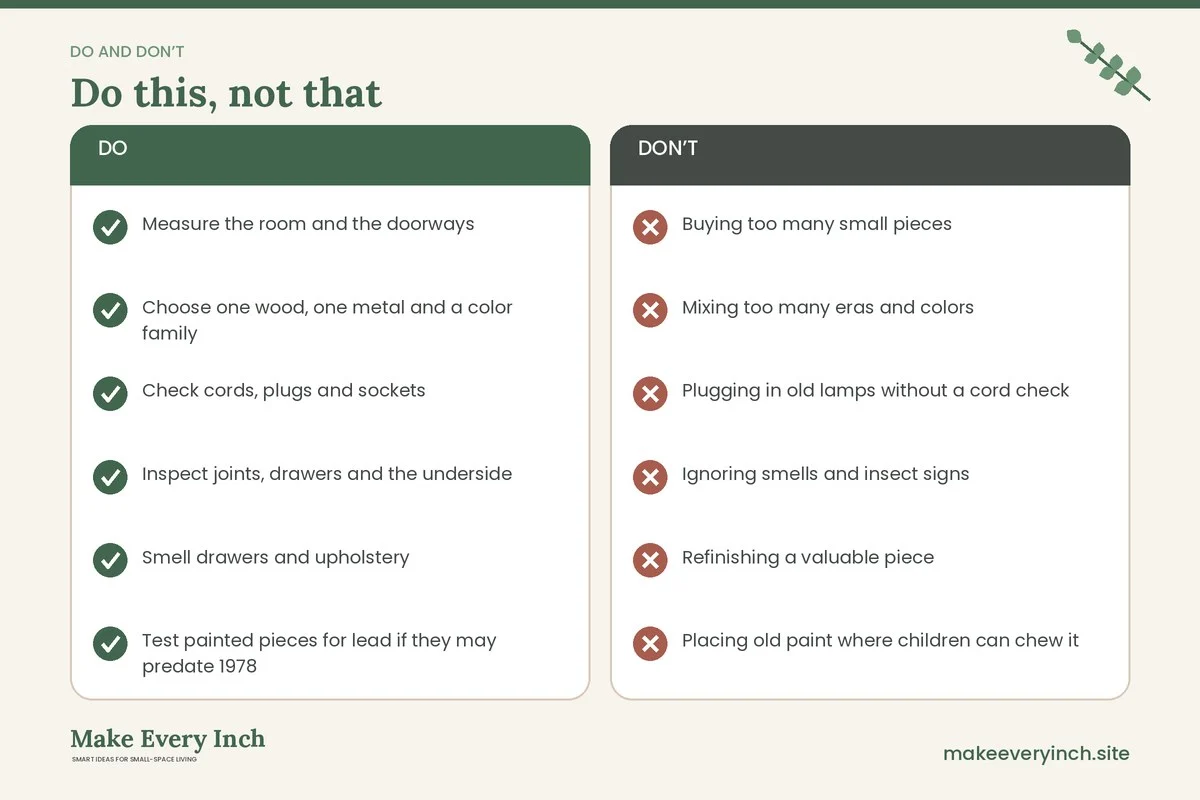
- Buying too many small pieces
- Mixing too many eras and colors
- Plugging in old lamps without a cord check
- Ignoring smells and insect signs
- Refinishing a valuable piece
- Placing old paint where children can chew it
- Buying furniture that does not fit through the door
- Using vintage cribs or unsafe baby items
- Treating every old item as precious
Vintage apartment checklist
- Measure the room and the doorways
- Choose one wood, one metal and a color family
- Check cords, plugs and sockets
- Inspect joints, drawers and the underside
- Smell drawers and upholstery
- Test painted pieces for lead if they may predate 1978
- Use felt pads and rug pads
- Photograph the apartment before moving in
- Limit each surface to a few objects
- Follow one in, one out
FAQ
What is the difference between vintage and antique?
Vintage usually means at least 20 years old, and antique usually means 100 years or more. The terms are conventions, so check each seller’s description.
How do I mix vintage and modern furniture?
Repeat a wood, a metal and a color in three places, and let one vintage piece lead. Keep the rest simple.
Is vintage furniture good for small apartments?
Often yes, since many older pieces are smaller and built from solid wood. Measure first, and choose pieces on legs.
How do I make vintage lamps safe?
Replace the cord, plug and socket with new UL-listed parts, or have a repair shop rewire it. Do not use a lamp with cracked insulation.
Can I use old painted furniture at home?
Test it for lead if it may be from before 1978, avoid sanding and keep it away from children who chew surfaces.
How do I get a musty smell out of vintage items?
Air the piece outside, wipe with a vinegar and water mix and use baking soda or charcoal in drawers. If the smell persists, return it or skip it.
How do I decorate vintage style in a rental?
Use freestanding furniture, rugs, lamps and leaning art. Use strips for light frames, and keep the original fixtures.
How can I do vintage on a budget?
Shop estate sales, thrift stores and online listings, buy solid wood that needs only cleaning and rewire lamps yourself or at a repair shop. For more, see small apartment makeover on a budget.
Keep going: Explore our small apartment makeover on a budget, cozy apartment ideas and organic modern apartment ideas.
Save this guide for later
Pin the ideas you like to Pinterest so you can come back to them when you plan your space.