15 Small Room Decor Ideas for Neutral Lovers
Quick answer: Small room decor neutral lovers enjoy most is built on one undertone, three or more textures and a few darker accents for contrast. Pick warm, cool or true neutrals and stay in that family, vary the finish (matte, woven, nubby, glossy), repeat each shade at least three times, and add light layers so the room reads soft instead of flat.
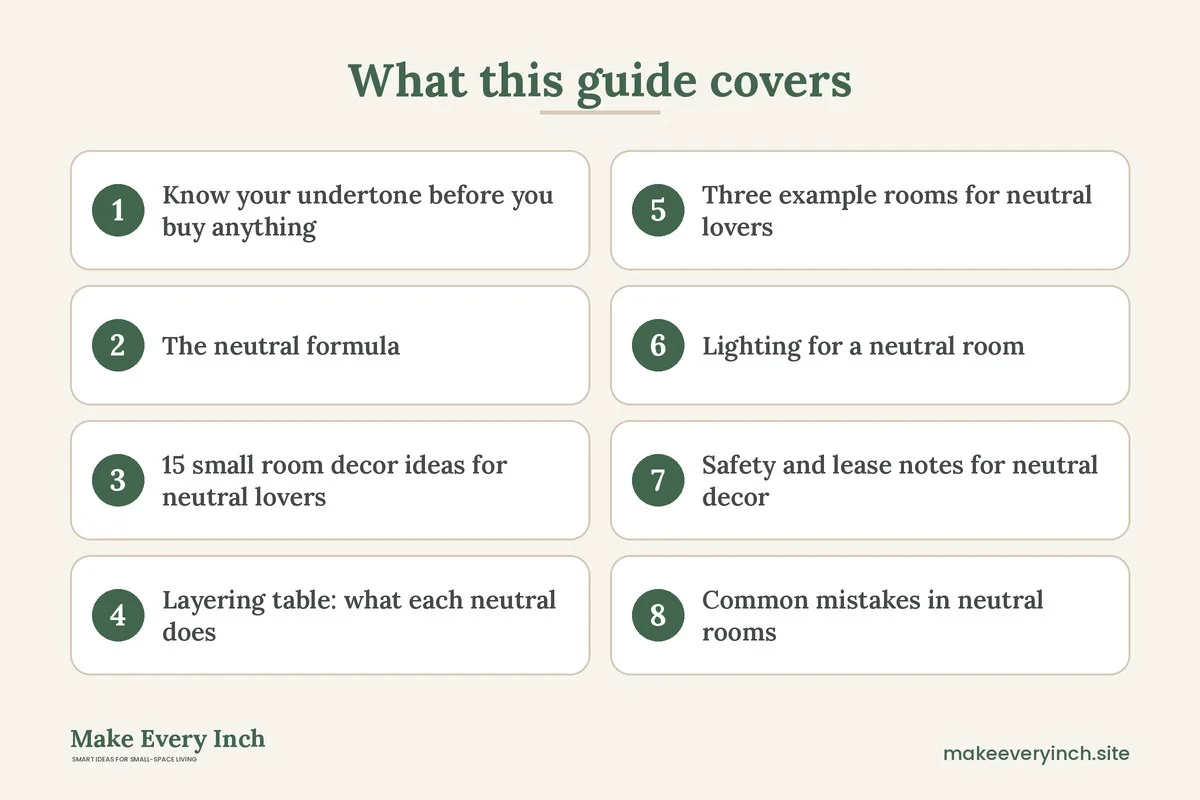
Small room decor neutral lovers can pull off is not about beige everywhere. It is about choosing a quiet palette on purpose and then giving it enough depth that the room feels designed rather than unfinished. Neutrals suit small rooms because they reduce visual noise, let light bounce around and make walls recede. The risk is that a room with only cream and white can feel flat, cold or like a waiting room. This guide shows how to avoid that. It covers undertones, the texture and contrast formula, 15 ideas, a layering table, three example rooms, lighting and safety notes, mistakes and a checklist. For the wider topic, read our main guide to small room decor ideas, then see the sibling post on small room decor with warm wood if you want to bring natural grain into a neutral scheme.
Know your undertone before you buy anything
Every neutral leans a little warm, cool or green-gray. Mixing leanings is the number one reason a neutral room looks “off”. A cream sofa next to a gray-blue rug can make both look dingy, even though each is fine alone.
Find your leaning by holding a plain white sheet of paper against the shade. If the shade looks yellow, peachy or pinkish beside the paper, it is warm. If it looks blue, gray or slightly purple, it is cool. If it looks green or khaki, it is an earthy neutral. Greige and taupe sit in the middle and can swing either way depending on light.
- Warm neutrals: cream, ivory, sand, camel, oatmeal, soft tan. They suit north-facing rooms and rooms with little daylight.
- Cool neutrals: pale gray, stone, soft white with a blue cast, charcoal. They suit south-facing rooms that get strong sun.
- Earthy neutrals: putty, mushroom, olive-gray, clay. They suit rooms with plants and natural materials.
Choose one family for the big surfaces (walls, sofa, rug, curtains) and let the small items drift a little. A room with a warm base can carry one cool accent, such as a charcoal throw, and it will look like contrast rather than a mistake.
The neutral formula: texture, contrast and repetition
A neutral room works when it has three things. If you can tick all three, the room will read as rich instead of bland.
- Texture: at least three different surfaces, such as a nubby bouclé-style upholstery, a smooth ceramic, a woven basket and a linen curtain.
- Contrast: at least one dark note, such as black picture frames, a charcoal pillow or a dark metal lamp base. About 10 percent of the visual weight in a light room is usually enough.
- Repetition: each shade or material appears three times in different places. A black frame, a black lamp base and a black curtain rod tie the room together.
Another useful guide is the 60-30-10 idea. Roughly 60 percent of the room is the main neutral (walls, large rug), 30 percent is a second neutral (sofa, curtains) and 10 percent is the accent (pillows, art, a plant). Treat these as rough guides, not strict rules. In a small room the percentages blur, so use them to check balance rather than to measure.
15 small room decor ideas for neutral lovers
Walls and big surfaces
1. A single warm white on walls and trim
Painting walls, trim and ceiling in the same off-white (or in three shades within the same family) blurs the corners and makes the room feel taller. A flat or matte finish hides wall flaws, while a satin finish on trim adds a quiet edge. Check the lease before painting, use low-VOC paint if you have permission, and keep windows open while it dries.
2. A tone-on-tone feature wall
Instead of a bright accent wall, choose one wall a shade or two deeper than the rest. A soft mushroom behind the bed or sofa gives the eye a place to rest without adding a new color. If painting is not allowed, see our guide to removable wallpaper ideas and read the lease and the product instructions first.
3. Limewash-look or textured finishes
A subtle, cloudy finish adds movement to a neutral wall. Where the lease bans paint, you can get a similar effect with a large piece of linen fabric stretched on a frame and leaned against the wall.
4. A neutral rug with a visible weave
A rug with a chunky or looped weave adds texture underfoot without introducing a pattern. Choose a size that lets the front legs of the sofa or bed sit on it, and use a rug pad so it does not slide.
Soft furnishings
5. Layered textiles in one color family
Combine linen, wool, cotton and velvet in shades of oatmeal and stone. The shades barely differ, but the surfaces catch light differently, which creates depth. Use a throw, two or three pillows and a curtain in this mix.
6. Pillows with a quiet pattern
A subtle stripe, a tonal herringbone or a hand-block print in two close neutrals keeps the sofa from looking plain. Aim for three to five pillows in a mix of sizes, and include one in a darker shade.
7. Floor-length curtains in a light, loose weave
Hang the rod close to the ceiling or about 4 to 6 inches above the window frame, and let the curtain fall to just above the floor. Sheer or lined linen-look panels filter light softly, and they make the window feel taller. For more, see our renter-friendly window treatment ideas.
8. A bed or sofa dressed in one shade with one contrast
White or ivory bedding looks crisp, but add a darker blanket across the foot or a stone-colored quilt to anchor it. On a sofa, a charcoal throw does the same job.
Objects and accents
9. Ceramics, glass and stone in matching shades
A cluster of three vases or bowls in different heights but the same palette reads as a single sculpture. Place them on a tray or a stack of books to make a vignette that is easy to dust and move.
10. Black or dark metal details
Frames, a lamp base, a curtain rod or a small side table in black give the room punctuation. Pick one finish, such as matte black or dark bronze, and repeat it three times.
11. Natural materials for warmth
Baskets, rattan, jute and a bowl of wood beads soften the cool edges of a pale room. These pieces also double as storage. For more on keeping surfaces calm, read our small space organization ideas.
12. Plants in neutral pots
Green is a natural neutral. A trailing plant on a shelf or a tall plant in a corner adds life without adding a new hue. Before buying, check whether the plant is toxic to cats or dogs, and keep any toxic plant out of reach or choose a pet-safe species.
13. Art in black and white or sepia
Line drawings, photographs in tonal prints and abstract shapes in beige and charcoal keep the palette tight. For hanging options that protect the walls, see our guide to renter-friendly wall decor ideas.
Light and shine
14. One mirror with a simple frame
A mirror placed opposite a window bounces daylight deeper into the room. Choose a plain thin frame in black or wood. Check the weight, use hardware rated well above it and anchor into a stud or use the correct wall anchor. Never hang a heavy mirror with adhesive strips unless the product states that it is rated for that weight, and keep mirrors away from beds and seats if you are unsure of the fixing.
15. Layered lamps with warm bulbs
A neutral room gets its mood from light. Use one table lamp, one floor lamp and, if you like, a small accent light, all with warm bulbs. See the lighting section below and our renter-friendly lighting ideas.
Layering table: what each neutral does
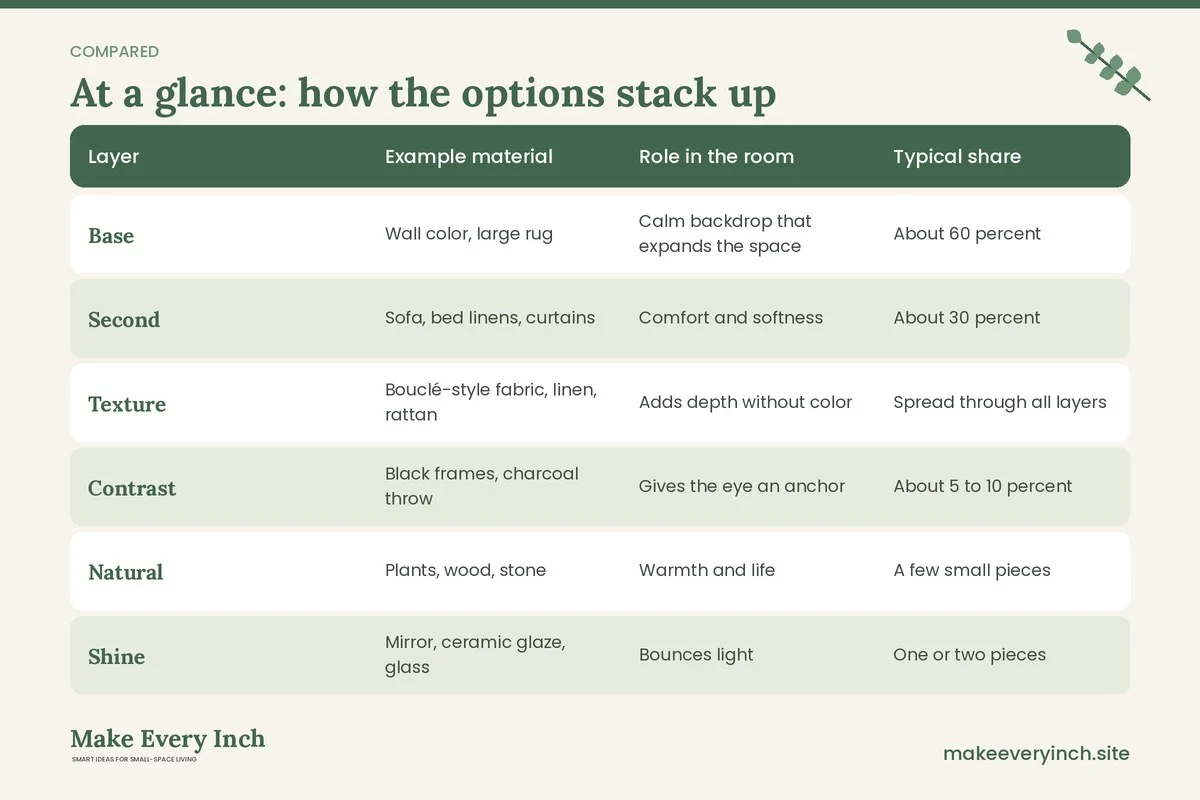
Use this table to check that your room has more than one job for each shade.
| Layer | Example material | Role in the room | Typical share |
|---|---|---|---|
| Base | Wall color, large rug | Calm backdrop that expands the space | About 60 percent |
| Second | Sofa, bed linens, curtains | Comfort and softness | About 30 percent |
| Texture | Bouclé-style fabric, linen, rattan | Adds depth without color | Spread through all layers |
| Contrast | Black frames, charcoal throw | Gives the eye an anchor | About 5 to 10 percent |
| Natural | Plants, wood, stone | Warmth and life | A few small pieces |
| Shine | Mirror, ceramic glaze, glass | Bounces light | One or two pieces |
Three example rooms for neutral lovers
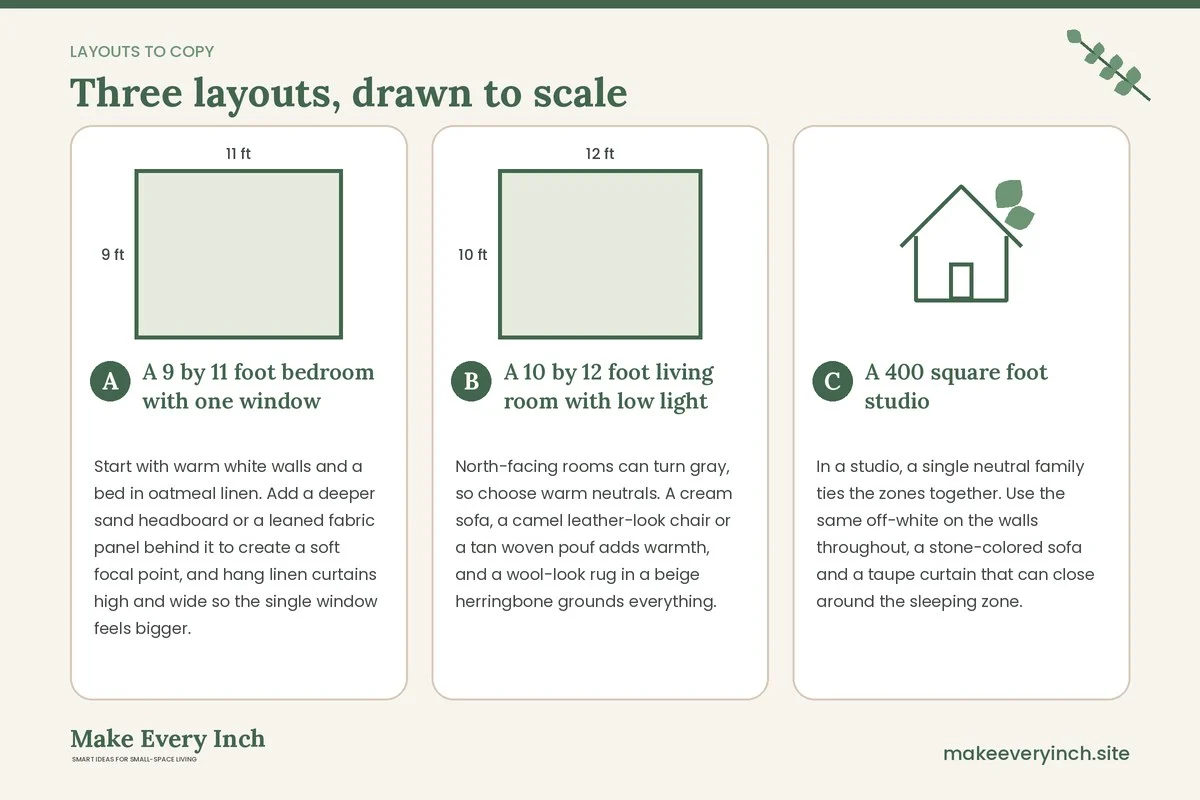
A 9 by 11 foot bedroom with one window
Start with warm white walls and a bed in oatmeal linen. Add a deeper sand headboard or a leaned fabric panel behind it to create a soft focal point, and hang linen curtains high and wide so the single window feels bigger. A black bedside lamp on each side and a thin black frame above the bed give contrast. A jute rug under the lower two thirds of the bed, a cotton throw and a small plant on the dresser complete the scheme. The result stays calm and sleepy, with plenty of texture. For more bedroom planning, see our small bedroom ideas.
A 10 by 12 foot living room with low light
North-facing rooms can turn gray, so choose warm neutrals. A cream sofa, a camel leather-look chair or a tan woven pouf adds warmth, and a wool-look rug in a beige herringbone grounds everything. Place a mirror across from the window and add two lamps with warm bulbs at 2700 kelvin. The black metal floor lamp and a charcoal throw provide the dark note. For layouts and furniture sizes, read our small living room ideas.
A 400 square foot studio
In a studio, a single neutral family ties the zones together. Use the same off-white on the walls throughout, a stone-colored sofa and a taupe curtain that can close around the sleeping zone. Repeat black accents in the lamp, the shelf brackets (if permitted) and the picture frames. A rug under the living area defines the zone without a divider. See our studio apartment color schemes for palettes that scale across an open plan.
Lighting for a neutral room
Neutrals depend on light more than any other palette, because they have no hue to carry the room. Daylight changes the color of a wall by the hour, so look at the room in the morning, the afternoon and at night before you commit.
- Bulb color: warm white bulbs, often around 2700 kelvin, make beige and cream glow. Cooler bulbs can turn the same shades gray, so keep bulb color consistent across the room.
- Layers: use at least three light sources at different heights, such as a floor lamp, a table lamp and a small accent lamp. Overhead light alone flattens a neutral room.
- Shades: a drum or linen shade diffuses light softly. A dark shade makes a pool of light, which suits reading corners.
- Floor lamps: slim arcing or tall lamps save floor space. See our best floor lamps for small rooms for what to look for.
Electrical and heat safety matters in a small room where lamps sit close to fabric. Check the maximum wattage printed on each lamp and never exceed it. Where a lamp does not state a limit, choose a low-wattage LED bulb that runs cooler. Do not plug several high-draw items into one outlet or one cheap extension, avoid running cords under rugs, keep shades and curtains at a safe distance from bulbs and switch lamps off when you leave the room. If a plug or cord feels warm, unplug it.
Safety and lease notes for neutral decor
Neutral schemes often involve painting, hanging mirrors and adding rugs, and each has a safety step.
- Paint: ask the landlord for written permission first. Choose a low-VOC paint if you are allowed to paint, open windows during and after painting, and give the room time to air out before sleeping in it.
- Wallpaper: only use removable wallpaper with permission, and test a small hidden area before committing.
- Mirrors and art: weigh the piece, check the hardware rating and anchor into studs or with the right anchors. Do not drill without permission. Tall mirrors that lean should be fixed to the wall or secured so they cannot tip.
- Cords: route lamp cords along walls, not through walkways, and keep them out of reach of children and pets.
- Plants: many popular houseplants are toxic to pets. Check each species before bringing it home.
- Rugs: use a non-slip pad and keep corners flat to prevent trips.
Common mistakes in neutral rooms
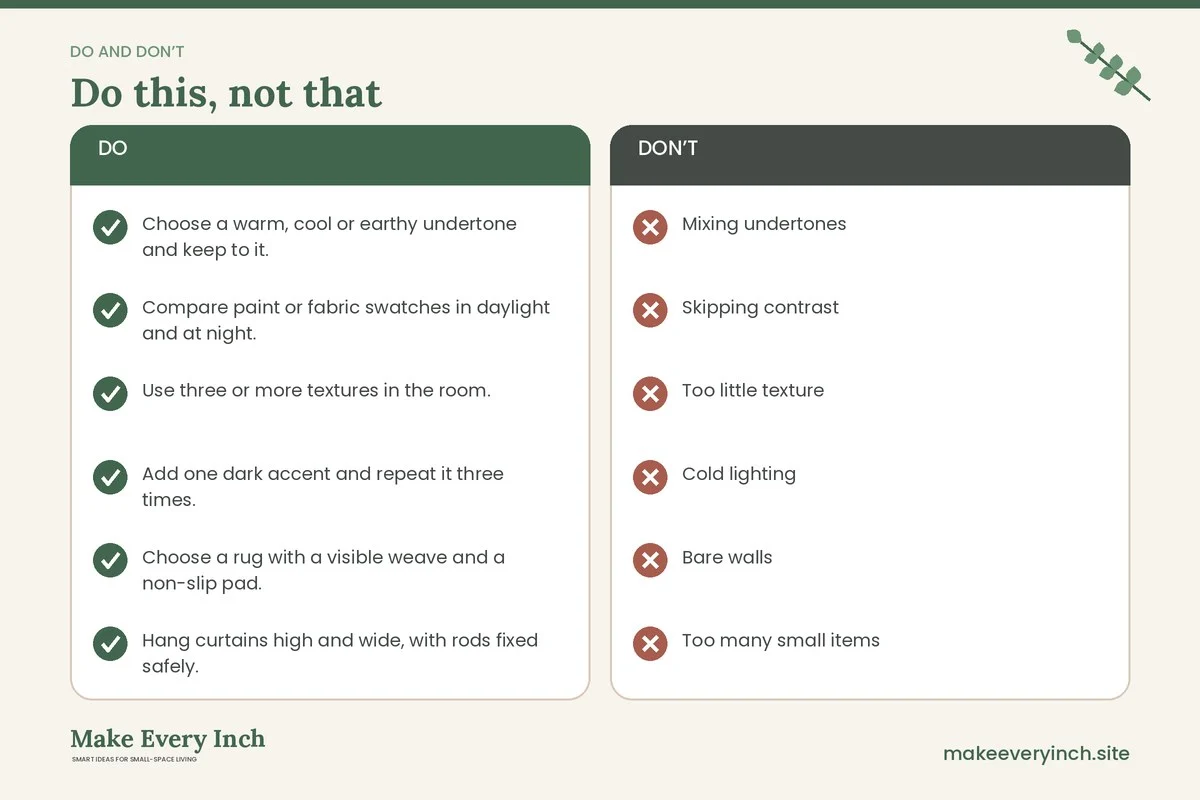
- Mixing undertones: a pink beige beside a green-gray looks muddy. Hold samples together in daylight first.
- Skipping contrast: all light shades, all the time, makes a room look washed out. Add a dark note.
- Too little texture: a smooth sofa, smooth rug and smooth curtains feel flat. Vary the weave.
- Cold lighting: a harsh white bulb turns warm neutrals sallow.
- Bare walls: a neutral palette still needs art, a mirror or a shelf to give the walls a purpose.
- Too many small items: clutter in neutral tones still looks cluttered. Group items on trays and edit often.
- Ignoring the floor: a bare floor in a cool tone can chill the room. A rug warms it.
Budget-friendly neutral upgrades
Neutral decor can be done gradually. Start with the items that change the room the most: curtains, a rug and lighting. Swap pillow covers and throws before replacing furniture, and use what you own in a new arrangement. Second-hand ceramics and baskets are easy to find and fit a tonal scheme well. For more ideas, browse our budget small space ideas and the guide to apartment decorating styles if you want to push your neutrals toward a particular look, such as calm Scandinavian or soft modern.
Neutral lover’s checklist
- Choose a warm, cool or earthy undertone and keep to it.
- Compare paint or fabric swatches in daylight and at night.
- Use three or more textures in the room.
- Add one dark accent and repeat it three times.
- Choose a rug with a visible weave and a non-slip pad.
- Hang curtains high and wide, with rods fixed safely.
- Use warm bulbs and three layers of light.
- Check lamp wattage limits and avoid overloaded sockets.
- Hang mirrors and art with hardware rated above their weight.
- Get written permission before painting or drilling.
- Check every plant for pet toxicity.
- Edit decor to groups of three on trays.
FAQ
Will an all-neutral small room look boring?
Not if you layer texture and add contrast. A mix of nubby, smooth, woven and glossy surfaces, plus a dark accent, gives a neutral room plenty of interest.
Which neutral makes a small room look bigger?
Light neutrals with a soft glow, such as warm white or pale sand, reflect light and blur corners. Painting the walls and trim the same shade helps too.
Can I mix warm and cool neutrals?
You can, if one dominates and the other appears in small doses. Keep the large pieces in one family and use the other in accents.
Are dark neutrals okay in a small room?
Yes. A deeper shade such as charcoal or mushroom can make a small room feel cozy and enclosed. Use it on one wall or in furniture rather than everywhere, and add enough light.
How do I add color without leaving my neutral palette?
Use plants, wood tones, a single muted accent in art or one pillow. Natural materials add color in a way that still feels neutral.
Do I need permission to paint a rental?
Yes, in most leases. Get the answer in writing, and ask about restoring the color at move-out. If painting is not allowed, use removable and freestanding options.
Keep going: Keep planning with our small room decor ideas, small bedroom ideas and small dining room color schemes.
Save this guide for later
Pin the ideas you like to Pinterest so you can come back to them when you plan your space.