Small Living Room Lighting Ideas: 16 Ways to Brighten a Compact Space
Quick answer: The best small living room lighting ideas use three layers: ambient light (overhead or wall), task light (reading lamps) and accent light (lamps, LED strips). Choose warm bulbs around 2700K, add a mirror opposite a window and use plug-in sconces or floor lamps to save space.
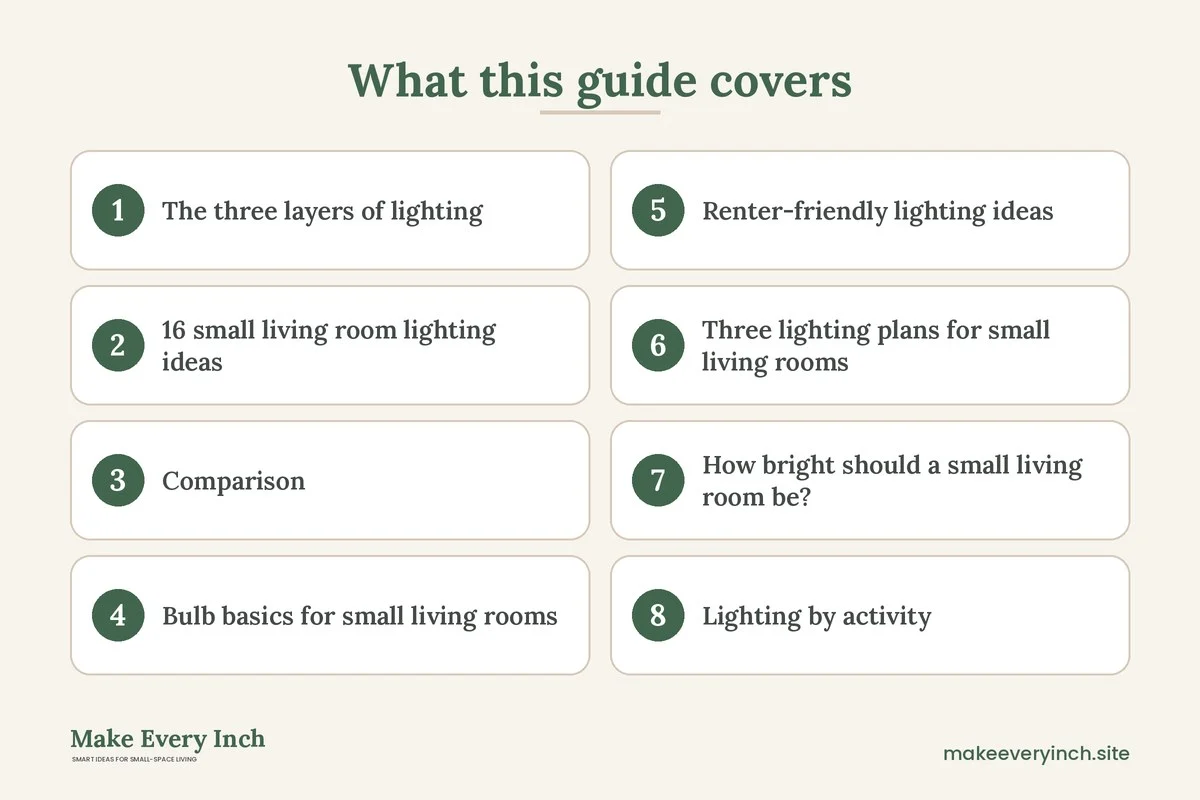
Small living room lighting ideas matter more than most people expect. A single overhead fixture can flatten a room, create shadows and make it feel smaller. Layered lighting adds depth, makes walls recede and sets the mood for work, relaxing and entertaining. This guide shares 16 ideas, a comparison of fixture types, bulb basics, renter-friendly options and a checklist.
The three layers of lighting
- Ambient: general light for the whole room, such as a ceiling fixture, wall sconces or a large floor lamp.
- Task: focused light for reading, working or hobbies, such as an arc lamp or desk lamp.
- Accent: decorative light that highlights art, shelves or plants, such as small lamps or LED strips.
16 small living room lighting ideas
1. Swap the overhead fixture for a flush or semi-flush mount
Low-profile fixtures save visual space, especially in rooms with low ceilings. Choose a diffuser that spreads light evenly.
2. Add a slim floor lamp in a corner
A floor lamp bounces light off the walls and fills dark corners. A torchiere-style lamp can brighten the ceiling too.
3. Use plug-in wall sconces
Plug-in sconces save table space and suit renters. Use cord covers to hide the cord.
4. Choose an arc floor lamp over the sofa
An arc lamp provides reading light without a side table. Make sure the base is stable.
5. Use small table lamps on shelves or consoles
Small lamps at different heights create a warm, layered look without taking much space.
6. Add LED strip lights
Strips behind a TV, under shelves or along a ceiling edge give soft accent light. Choose warm white for a cozy feel.
7. Use a mirror opposite a window or lamp
Mirrors reflect light and add depth. Place them where they bounce light, not glare.
8. Hang curtains that let in daylight
Sheer or light-filtering curtains soften daylight. Hang them high and wide so the window looks larger.
9. Choose light-colored walls and reflective accents
Pale walls bounce light. Metallic or glass accents add sparkle without bulk.
10. Install dimmers or smart bulbs
Dimmers adjust light for movie time or reading. Smart bulbs offer similar control without rewiring.
11. Use clip-on or swing-arm lamps
These attach to shelves or headboards and save surface space.
12. Add picture lights or art lighting
A small light above art adds depth and can serve as ambient light.
13. Place a lamp near the entry
A lamp near the entry makes the room feel welcoming and gives you light when you walk in.
14. Use a pendant lamp (plug-in) for a corner
A plug-in pendant on a hook can brighten a corner. Make sure the hook is installed safely and allowed by your lease.
15. Choose matching bulb temperatures
Mixed bulb colors look uneven. Pick warm white (around 2700K) for living rooms or a consistent neutral tone.
16. Keep lamps off the walkway
Place lamps where cords and bases will not trip anyone. Wall sconces and corner lamps help with this.
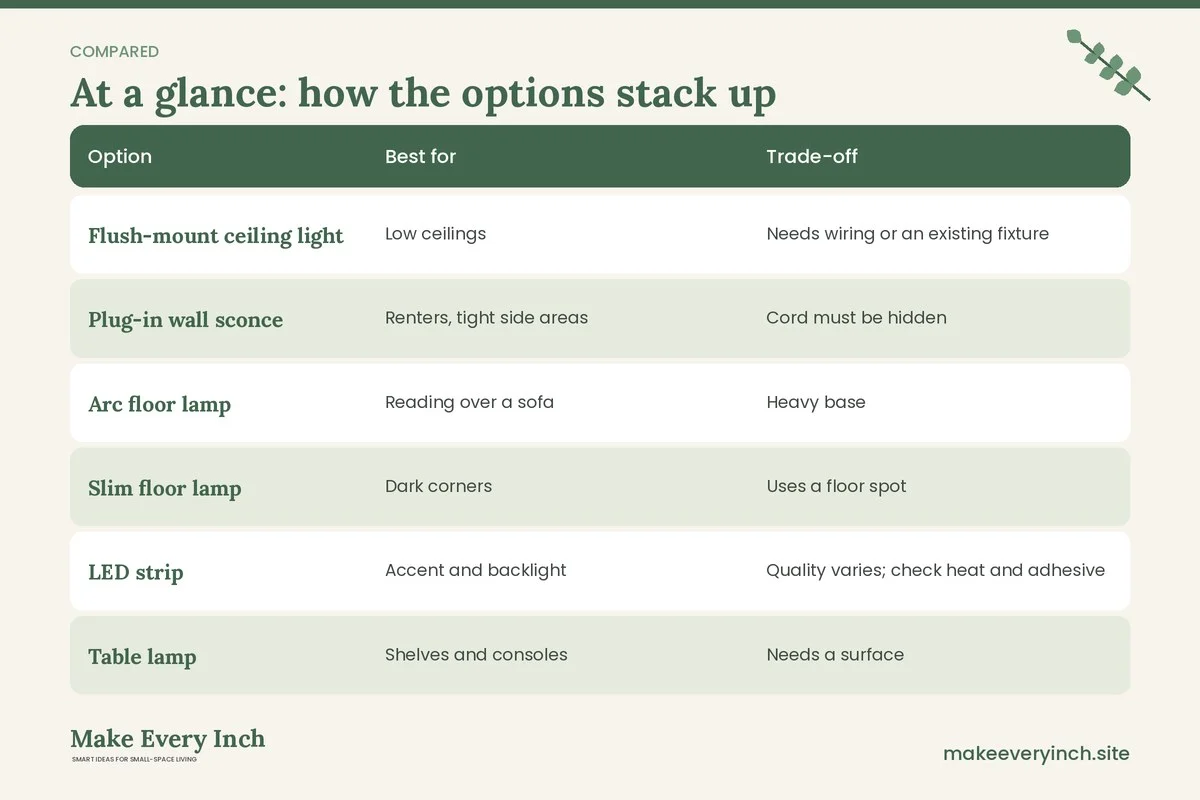
Comparison: lighting options for small living rooms
| Option | Best for | Trade-off |
|---|---|---|
| Flush-mount ceiling light | Low ceilings | Needs wiring or an existing fixture |
| Plug-in wall sconce | Renters, tight side areas | Cord must be hidden |
| Arc floor lamp | Reading over a sofa | Heavy base |
| Slim floor lamp | Dark corners | Uses a floor spot |
| LED strip | Accent and backlight | Quality varies; check heat and adhesive |
| Table lamp | Shelves and consoles | Needs a surface |
Bulb basics for small living rooms
- Color temperature: around 2700K is warm and cozy; 3000K is a softer white; 4000K+ feels cool and more office-like.
- Brightness: measured in lumens. Living rooms often need a mix of brightness; dimmers give flexibility.
- CRI: a higher color rendering index shows colors more accurately.
- Dimmer compatibility: check that bulbs are labeled dimmable and match your dimmer type.
Renter-friendly lighting ideas
- Use plug-in sconces and floor lamps.
- Swap bulbs and keep originals to restore later.
- Use adhesive hooks for lightweight string lights within weight limits.
- Use smart bulbs for control without rewiring.
Three lighting plans for small living rooms
Plan A: a 10 x 12 ft room with one ceiling light
Keep the ceiling light on a dimmer if possible. Add a floor lamp behind the sofa, a table lamp on the console and a small lamp on a shelf. Three or four sources at different heights fill the room with soft light.
Plan B: a rental with no switchable wall light
Use plug-in sconces on either side of the sofa and a smart plug to control a floor lamp. A string of warm lights can go along a shelf or behind the TV, if secured safely.
Plan C: a dark room with one small window
Use a mirror opposite the window, light curtains and a light wall color. Add an uplight floor lamp in the darkest corner to bounce light off the ceiling.
How bright should a small living room be?
Brightness is measured in lumens. Many living rooms feel comfortable with a mix of bright and soft light, rather than a single level. Use brighter settings for cleaning or tasks and dim settings for evenings. Dimmable bulbs or dimmers give you range. Check the lumen rating on the bulb package and choose a warm color temperature for relaxing.
Lighting by activity
- Reading: a lamp beside or behind your shoulder, aimed at the page.
- Watching TV: soft ambient light and a bias light behind the TV.
- Working from the sofa: a task lamp at one side to avoid glare on the screen.
- Entertaining: dimmed overhead and several warm lamps around the room.
- Cleaning: turn all lights on bright so you can see dust and corners.
Mistakes to avoid
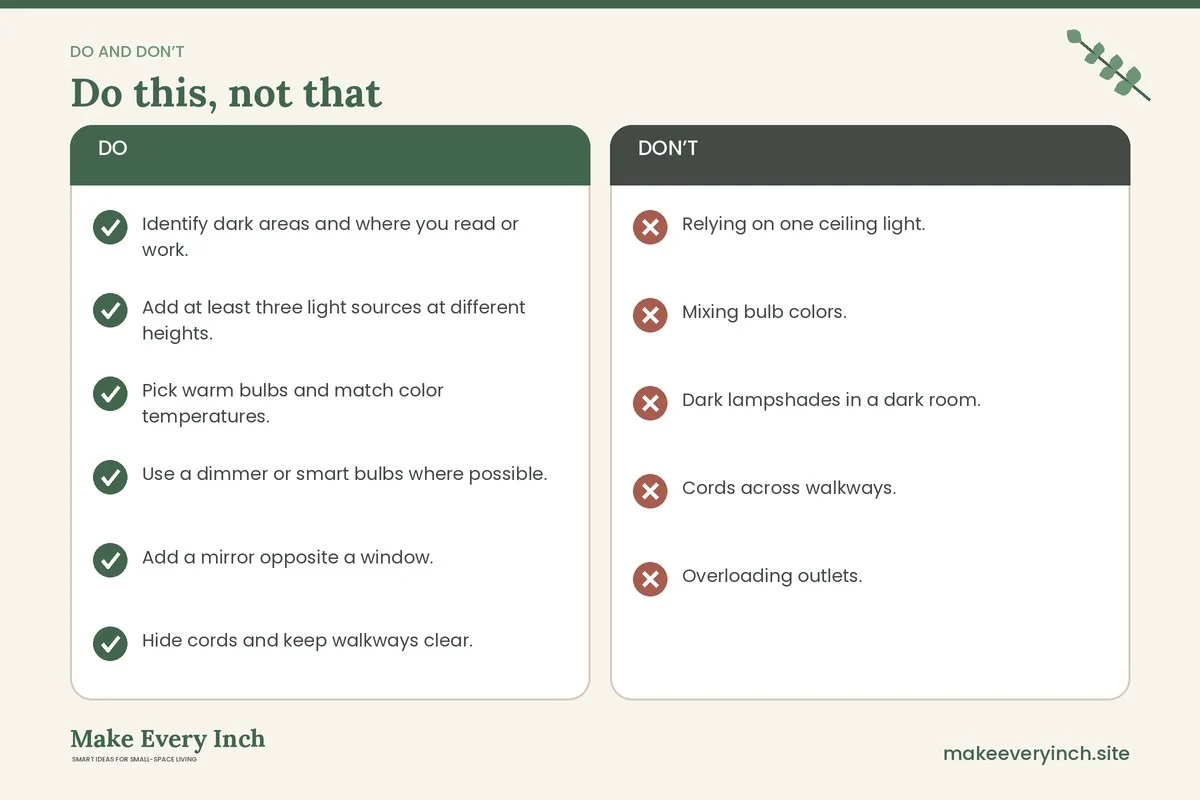
- Relying on one ceiling light. It can flatten the room.
- Mixing bulb colors. It can look uneven.
- Dark lampshades in a dark room. They absorb light.
- Cords across walkways. They are a trip hazard.
- Overloading outlets. Use appropriately rated power strips and follow safety guidance.
How much light does a small living room need?
A common guideline is about 10 to 20 lumens per square foot for living spaces, which means a 10 x 12 foot room (120 square feet) needs roughly 1,200 to 2,400 lumens in total. Split it across layers, since one 2,000 lumen ceiling light will feel flat while four lamps at 400 to 600 lumens each feel balanced. If the room is dark, has dark floors or has one small window, aim for the top of the range. Use dimmers so you can lower the level in the evening.
| Source | Typical lumens | Use |
|---|---|---|
| Ceiling fixture | 800 to 1,600 | Ambient base layer |
| Floor lamp | 400 to 800 | Reading and corners |
| Table lamp | 400 to 600 | Side tables and shelves |
| Plug-in sconce | 300 to 500 | Wall glow, no floor space |
| LED strip | 200 to 400 per section | Accent behind TV or shelves |
Color temperature and bulb details
Warm white bulbs at 2700K create a cozy mood. 3000K is slightly crisper and suits kitchens and offices. Anything above 4000K feels harsh in a living room. Look for a CRI of 90 or higher so wood, fabric and skin tones look natural. Check that the bulb is dimmable and that your dimmer switch is compatible, since some LED bulbs flicker on older dimmers. Smart bulbs let you change brightness and color from your phone, which helps in a rental without dimmers. Keep all bulbs in the room at the same temperature so the light looks even.
Lighting plans by room problem
A room with no ceiling light
Use three lamps at different heights, such as a floor lamp by the sofa, a table lamp on a console and a small lamp on a shelf. Plug them into smart plugs so one command turns them all on. Add a plug-in sconce if you want more height.
A room with a dark corner
Place a slim floor lamp or an arc lamp in the corner, aimed upward or toward the wall. A mirror on the adjacent wall bounces the light back. A plant with an uplight can turn the same corner into a feature.
A room that doubles as a workspace
Use a task lamp with a neutral white bulb at the desk and keep the rest of the room warm. A clip-on or swing-arm lamp avoids using desk space. Point the light across your work rather than at the screen to prevent glare.
A room with a TV
Put a soft light behind the TV to reduce eye strain, and avoid lamps that reflect on the screen. Use dimmable bulbs so you can lower the level during movies. See TV wall ideas.
Lighting by time of day
Morning needs bright, cooler light to wake up, so open curtains fully and use the ceiling light on a high setting. Afternoons rely on daylight, so keep windows clear and use sheer panels. Evenings call for warm, low lamps and dimmed overhead light. A smart bulb or plug can set scenes for each time of day. Late at night, a small lamp or a night light on a low setting prevents glare when you walk through the room.
Fix common lighting problems
- Harsh shadows: replace a bare bulb with a diffused shade and add a second light at a different height.
- Flickering LEDs: check that the bulb is dimmable and that the dimmer is rated for LEDs.
- Glare on the TV: move lamps off the screen line and use matte shades.
- Cords in the walkway: run cords along the wall or use a cord cover painted the wall color. See renter ideas.
- Too little light in winter: add one more lamp, use lighter curtains and keep windows clean.
Choosing lamps for a small room
Look for lamps with a small base and a narrow footprint. A lamp 24 to 30 inches tall suits a side table next to the sofa, while a floor lamp should be 55 to 65 inches tall. Choose a shade that matches the bulb: a drum shade spreads light evenly, while a cone directs it up and down. Light-colored shades give a soft glow. Metal and glass bases look lighter than heavy ceramic ones. If you are unsure, buy one lamp first and see how it looks in the room before adding more. Our cozy living room ideas include lamp styling tips.
Lighting on a budget
You can improve a small living room with very little money. Swap every bulb for a warm 2700K LED, which costs a few dollars and changes the mood immediately. Add a plug-in lamp or a clip-on light, and use a smart plug so you can control it from your phone. Use a lampshade to soften a bright bulb. Clean the windows and shades, since dirt blocks light. Move a mirror to reflect a window. If you rent, avoid any fixture that needs wiring and choose plug-in options that move with you. See makeover ideas for how lighting fits into a full refresh.
Safety and energy notes
Use LED bulbs, which stay cool and last longer. Keep cords out of walkways and away from heat. Do not put a bulb in a shade that is rated for a lower wattage. Use surge protectors on plug strips and avoid daisy-chaining them. Turn off lights when you leave to save energy and extend bulb life. In older buildings, check that the outlet and the plug fit well, because loose plugs can overheat. If a lamp flickers or the cord feels warm, stop using it and replace it.
A final lighting test
Stand in the room at night and look at each corner. If any area feels dark, add a light there. Walk to the door and check for glare. Sit on the sofa and make sure you can read comfortably. Take a photo of the room with the lights on and ask whether the room looks even. Adjust the shade, bulb or position and test again.
Lighting ideas for specific furniture
A sectional benefits from an arc lamp that reaches over the corner, while a loveseat works with two matching table lamps on a console behind it. A reading chair needs a light from behind the shoulder, so use a floor lamp with an adjustable head. Shelves look best with a small picture light or an LED strip underneath. A gallery wall looks richer with an adjustable spotlight aimed at the center. Plants glow with an uplight placed at the base. Match each light to a task, and your room will feel designed. See our sectional ideas for layouts that leave room for lamps.
Switches, plugs and smart controls
A small room usually has one switch for the ceiling fixture and a few outlets. Add smart plugs to turn lamps on together, a smart bulb to dim a lamp without a dimmer or a remote-controlled plug if you want simplicity. Position a lamp near the door so you can turn it on when you come in. A switch on the cord is easier to reach than a button on the base. Set a schedule so lights come on before you arrive home.
Checklist
- Identify dark areas and where you read or work.
- Add at least three light sources at different heights.
- Pick warm bulbs and match color temperatures.
- Use a dimmer or smart bulbs where possible.
- Add a mirror opposite a window.
- Hide cords and keep walkways clear.
FAQ
How many lights should a small living room have?
Three to five light sources at different heights is a good target, including a mix of ambient, task and accent lighting.
What color temperature is best for a living room?
Many people prefer warm white around 2700K to 3000K for relaxing spaces.
How can I brighten a dark small living room?
Use light wall colors, mirrors, sheer curtains and several lamps. Avoid blocking windows with large furniture.
Are floor lamps or table lamps better in small rooms?
Floor lamps save surface space, while table lamps work well on shelves and consoles. Many rooms use both.
What lighting works without wiring?
Plug-in sconces, floor lamps, table lamps and smart bulbs need no rewiring.
Can lighting make my room look bigger?
Yes. Even light on walls and corners and reflective surfaces can make a room feel more open.
What if my living room has no overhead light?
Use three or more lamps at different heights. Floor, table and wall lamps can fully light a room without any ceiling fixture.
Are LED bulbs good for living rooms?
Yes. LEDs use less energy and last longer. Choose a warm color temperature and dimmable versions if you use dimmers.
How do I hide cords from plug-in lights?
Use paintable cord covers, run cords along baseboards or behind furniture and secure them safely.
Keep going: Explore our cozy small living room ideas, small apartment living room ideas and small living room ideas.
Save this guide for later
Pin the ideas you like to Pinterest so you can come back to them when you plan your space.