Small Bedroom Ideas for Adults
Quick answer: The best small bedroom ideas for adults treat the room as a calm retreat first. Keep the bed as the focal point, limit the palette to two or three soft colors, hide storage behind closed doors, keep work and screens out of bed and use warm, dimmable light. Aim for 24 to 30 inches of clear floor beside the bed, and let every object earn its place.
Small bedroom ideas for adults start from a different question than ideas for children or teenagers. A grown-up bedroom is rarely asked to be a playroom or a study hall. It is asked to be a place where you fall asleep quickly, wake up rested and feel calm when you walk in. In a small room that is harder than it sounds, because the bed takes up half the floor, the closet is never big enough and the laptop is always within reach. This guide shows how to plan a small adult bedroom as a retreat. It covers what a retreat actually needs, the measurements that keep the room restful, sleep-friendly choices for light, sound and air, 15 ideas for grown-up decor and quiet storage, how to set boundaries if you work from bed, a comparison table, three example rooms, a weekly reset routine and a checklist. For the wider topic, read our main guide to small bedroom ideas, and for the younger version of the same challenge, see small bedroom ideas for teens.
Decide what the room is for
Before you buy or move anything, write down the three jobs the room must do. For most adults they are sleep, dressing and a little private time, such as reading or listening to music. If you also work, study or exercise in the room, add those, but put them in a lower priority. A room that tries to do six jobs equally ends up doing none of them well.
Then list what the room currently does that it should not. Common culprits are a pile of unfolded laundry, a desk that faces the bed, a television at the foot of the mattress, a nightstand crowded with chargers and a closet door that never shuts. Cross out what you do not need. Moving a task out of the bedroom, such as keeping the ironing board in a hallway cupboard, often does more than any piece of furniture.
Finally, name a mood. Calm retreat, hotel suite, quiet library and soft studio are all good guides. Choosing a mood in advance makes every later decision easier, because you can ask a single question about any object: does this belong in a calm retreat?
Plan the room for sleep first
Sleep quality depends on a handful of environmental factors, and most of them are cheap to improve. General sleep guidance commonly suggests a cool, dark, quiet room, though the right level varies from person to person. If you have a sleep concern, speak to a health professional rather than relying on decor.
Light
Dark rooms help most people fall asleep. Use curtains or blinds that block most of the outside light, and add a lining or a second layer if street light leaks in. Choose warm bulbs for the evening, usually labelled 2700K or lower, and use a dimmer or a lamp with several settings. Cover or turn away the glowing lights on chargers and devices. Our small bedroom lighting ideas guide covers lamp positions and heights.
Sound
Noise is harder to change, but soft materials help. A rug, lined curtains, upholstered headboards and a bookcase against a shared wall all absorb some sound. Some people prefer a fan or a white noise machine to cover traffic or neighbors. Place any device across the room, not under the pillow, and follow the manufacturer’s volume advice.
Air and temperature
Many sleep guides suggest a bedroom in the range of 60 to 67 degrees Fahrenheit, though comfort varies. Ventilate daily by opening a window for a short time, and keep heaters and radiators clear of fabric. If you use a humidifier or air purifier, place it on a stable surface away from the bed, and clean it as the maker advises.
Bedding and mattress
Make the bed with layers you can add or remove: a fitted sheet, a flat sheet, a blanket and a duvet or quilt. Breathable natural fibers suit many sleepers. Rotate and replace pillows and mattresses as the maker suggests. A neat bed also makes the biggest visual difference in a small room, because it takes up the most space.
The measurements that keep a small adult bedroom restful
A bedroom feels calm when you can move without squeezing. These figures are a starting point.
- Queen bed: 60 by 80 inches. It needs a room of about 10 by 10 feet to leave comfortable walkways. A full bed (54 by 75 inches) suits rooms of 9 by 10 feet, and a double sleeper in a 9 foot room is a tight fit.
- Walkway beside the bed: 24 inches minimum, and 30 inches on the side where you get in and out. If the bed is against a wall, plan on one side only, but note that making the bed becomes harder.
- Foot of the bed to the wall or dresser: 30 to 36 inches, so a drawer or door can open.
- Nightstand: 14 to 20 inches wide and level with the top of the mattress, or about 2 inches lower. A wall-mounted shelf or a narrow table keeps the floor free.
- Dresser drawers: 18 inches of clear floor in front, plus the drawer’s full pull length.
- Wardrobe doors: 24 inches in front for a hinged door, or less for a sliding or folding one.
- Mirror: centered at about 57 inches from the floor, or leaning on the floor if it is full-length.
- Lamp or sconce: the bottom of a bedside shade level with your shoulder when you sit up to read, which is typically 20 to 26 inches above the mattress.
Tape the footprint of the bed and each piece of furniture on the floor. Sit up in bed, step out and walk to the door. Then pretend to open each drawer and door. If anything collides, adjust the layout before you buy.
15 small bedroom ideas for adults
Calm retreat ideas
1. A restrained palette
Pick two or three colors, such as warm white, soft gray-green and one deeper accent. Repeat them in the walls, the bedding and the curtains. A small room with fewer colors looks larger and calmer. If you paint, use a low-VOC paint, open the window while you work and let the room air before you sleep there. In a rental, ask first and consider removable options. For a lower-effort look, see small bedroom ideas, minimalist.
2. The bed as the only focal point
Let the bed take the spotlight. Choose a simple headboard, upholstered if you like to sit up in bed, and keep the wall above it clear or hung with one large piece of art. Everything else, including the dresser and the chair, should be quieter than the bed.
3. Texture instead of pattern
A linen duvet cover, a wool throw, a woven basket and a cotton rug add depth without noise. Texture reads as luxury in a small room, and it does not date like trends.
4. A soft scent or a clear air routine
Open the window each morning, and keep the room free of heavy fragrance if you are sensitive. If you like a candle or diffuser, keep it away from fabric, never leave a flame unattended and follow the maker’s guidance.
Grown-up decor ideas
5. One large piece of art
One large framed print, 24 by 36 inches or bigger, looks more adult than a grid of small frames. Hang it so the center is at about 57 inches from the floor, or lean it on a dresser. Read about options that avoid damage in renter-friendly wall decor ideas.
6. A pair of bedside lamps or sconces
A matching pair makes a bed look balanced. Wall sconces with plug-in cords or hardwired ones that an electrician has installed free the nightstand. Hide cords with a cord cover painted to match the wall, and never run a cord under a rug.
7. Curtains hung high and wide
Hang the rod 4 to 6 inches above the window frame, or near the ceiling, and let the curtains extend 6 to 10 inches beyond each side. The window looks larger, the wall looks taller and the light is easier to block.
8. A mirror that bounces light
A large mirror opposite a window doubles the light. Avoid placing one directly facing the bed if it bothers you at night. A leaning floor mirror suits a room where you cannot drill, and must be stable. Anchor it or choose one with a safe base.
9. A reading chair or bench
A small armchair or a bench at the foot of the bed gives you somewhere to sit that is not the mattress. It also becomes a spot for tomorrow’s clothes. Keep it to 24 to 28 inches wide in a small room.
Quiet storage ideas
10. Under-bed drawers or flat bins
Store off-season clothing, extra bedding and shoes below the mattress. Choose closed drawers or lidded bins so dust stays out. Read under-bed storage ideas for sizes and options, and consider a frame with built-in drawers from our best beds with storage list.
11. Closed storage above head height
Cabinets above the bed or on the wall hold bedding you rarely need. Any wall-mounted unit must be fixed to studs or with the right anchors, so check the fixings and the lease, and keep heavy items low. If you cannot mount anything, use a tall wardrobe anchored to the wall.
12. A narrow dresser with a tidy top
A 6-drawer dresser 16 to 18 inches deep stores more than a nightstand, and a tray on top gathers watch, wallet and keys. Anchor tall dressers to the wall with the supplied kit, since a tipped dresser can cause serious injury. If you cannot anchor, choose a low, wide dresser.
13. A closet that closes
Even a modest closet looks calm when the doors shut. Add a second rod, stackable shelves and matching hangers. See small closet organization ideas for step-by-step plans, or small bedroom ideas without a closet if you have none.
14. A hamper that hides
A lidded basket or a hamper inside the closet keeps laundry out of sight. Empty it once a week.
15. A single nightstand drawer for the essentials
Keep a book, lip balm, a pair of earplugs and a charging cable in one drawer, and keep everything else out of reach. A bedside table with a drawer reduces the temptation to leave things on top. For a wider system, see small bedroom organization ideas.
If you work from bed (or near it)
Many adults work, study or answer messages in a small bedroom, and a bed is the most tempting spot. The trouble is that working in bed can train the brain to link it with alertness, and a small room has few places to hide the laptop. These steps help set a boundary without a big change.
Create a physical edge
Choose a spot for work that is not the bed, even if it is a small one. A 30 by 16 inch wall desk, a console used as a desk or a drop-leaf table can serve. Face it away from the bed if possible. Our small bedroom desk ideas guide has layouts for every room size.
Make the setup disappear
At the end of the day, close the laptop, put it in a drawer or a basket, and cover the desk with a cloth or a closed lid. A fold-down desk, a rolling cart or a cabinet desk lets you put work out of sight in under a minute. Pulling a curtain or a screen over the work area gives the same effect.
Set a time boundary
Decide on a stop time, and a single ritual that marks it, such as shutting the laptop and turning on the lamp. If your job does not allow a fixed finish, a shorter version still helps. A short walk or a cup of tea after work signals the switch.
Use a different chair
If you must work on the bed in a pinch, sit up with a lap tray and a back support, and plan on moving to a chair when you can. Take breaks to stand and stretch.
Keep the phone out
Charge your phone across the room or in a drawer, and use a simple alarm clock. This single change helps many people.
Comparison table: choosing the right storage for a calm room
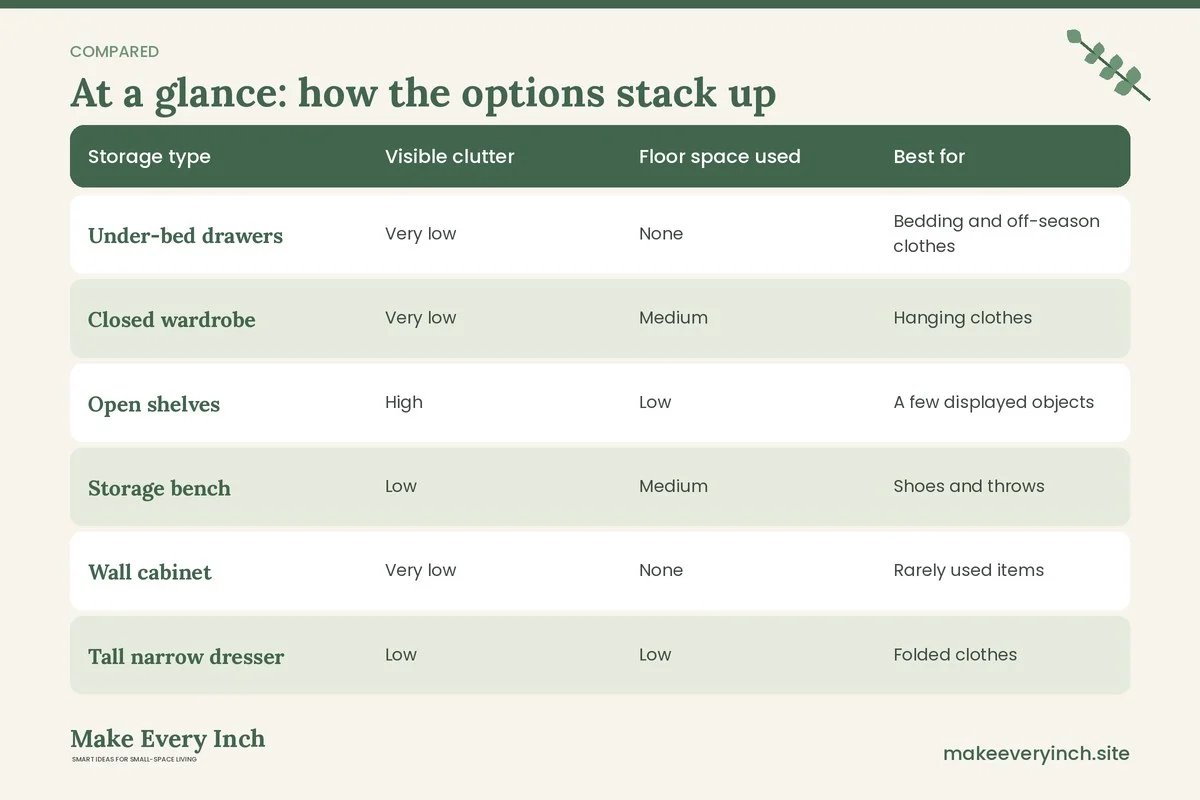
| Storage type | Visible clutter | Floor space used | Best for | Main caution |
|---|---|---|---|---|
| Under-bed drawers | Very low | None | Bedding and off-season clothes | Check clearance and rails |
| Closed wardrobe | Very low | Medium | Hanging clothes | Anchor to the wall |
| Open shelves | High | Low | A few displayed objects | Needs regular editing |
| Storage bench | Low | Medium | Shoes and throws | Check the lid hinge |
| Wall cabinet | Very low | None | Rarely used items | Needs secure fixings |
| Tall narrow dresser | Low | Low | Folded clothes | Anchor with the kit |
| Hamper in the closet | Very low | None | Laundry | Empty weekly |
Three example rooms
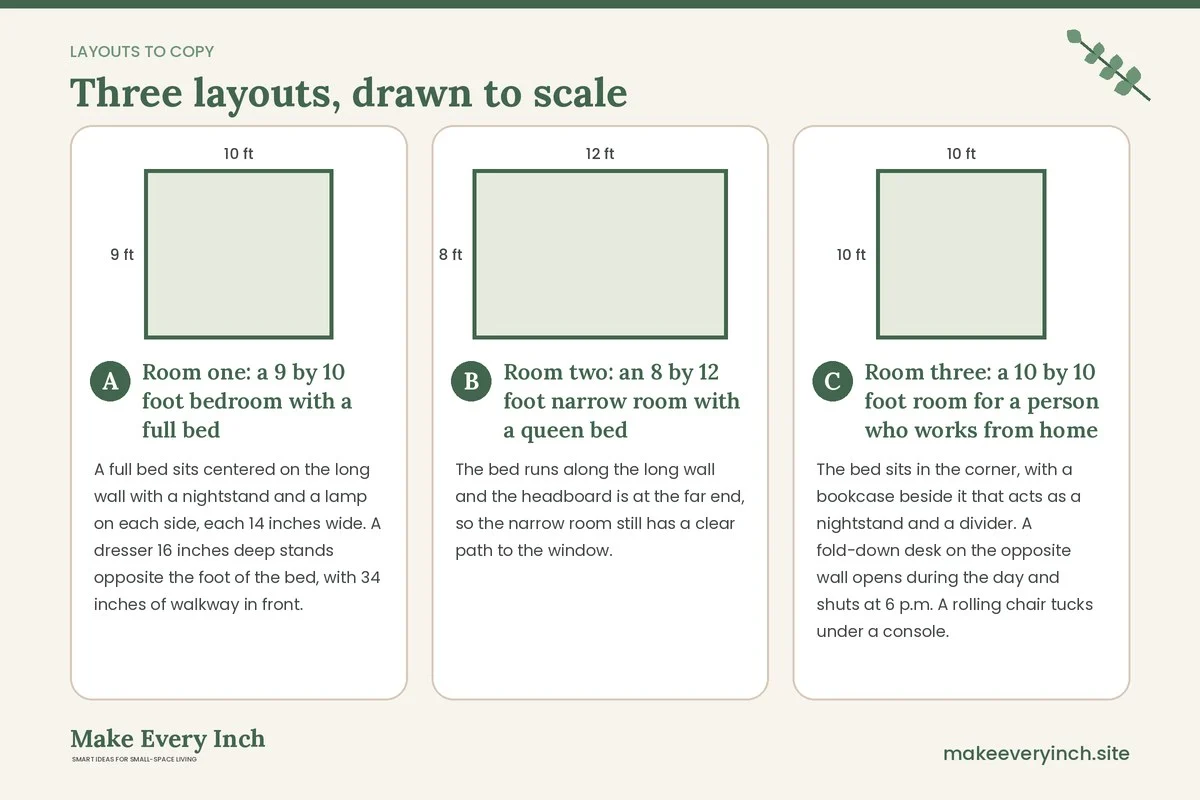
Room one: a 9 by 10 foot bedroom with a full bed
A full bed sits centered on the long wall with a nightstand and a lamp on each side, each 14 inches wide. A dresser 16 inches deep stands opposite the foot of the bed, with 34 inches of walkway in front. A curtain rod hung high makes the window look taller. The palette is warm white, sand and one dark green accent. Under the bed, two drawers hold bedding. The closet has been fitted with a second rod and a lidded hamper. A small bench sits at the foot of the bed.
Room two: an 8 by 12 foot narrow room with a queen bed
The bed runs along the long wall and the headboard is at the far end, so the narrow room still has a clear path to the window. Wall sconces replace the nightstands to save 14 inches on each side, and a shelf above the headboard holds a lamp and a book. A narrow console on the opposite wall acts as a dresser and a work surface, with a laptop that goes into a basket at night. Blackout curtains and a fan support sleep. The room has only three colors, and the console holds a tray for daily items. For more arrangements, read small bedroom layout ideas.
Room three: a 10 by 10 foot room for a person who works from home
The bed sits in the corner, with a bookcase beside it that acts as a nightstand and a divider. A fold-down desk on the opposite wall opens during the day and shuts at 6 p.m. A rolling chair tucks under a console. A curtain on a ceiling track can pull across the desk. The phone charges on the desk side of the room, and a simple alarm clock sits by the bed. A rug under the bed, extending 18 to 24 inches on each side, defines the sleeping area. Lamps with warm dimmable bulbs complete the evening change.
A ten-minute weekly reset
Calm rooms are mostly maintained, not designed. A short routine keeps the retreat feeling. Each week, do these things.
- Strip the bed, wash the sheets and make it with fresh linen.
- Empty the hamper and put away clean clothes.
- Clear the nightstand and the dresser top, leaving only what has a home.
- Dust the lamp shades, the headboard and the window ledge.
- Check the cords behind the bed and the desk for tangles and wear.
- Open the window for a few minutes.
- Put one thing in the donate bag.
Once a season, take everything out of the closet, edit it, and swap the bedding to suit the weather. If you are planning bigger changes, read our small bedroom makeover ideas.
Safety notes for an adult bedroom
- Anchor tall furniture such as dressers, wardrobes and bookcases to the wall with the supplied kit. If you rent, ask permission before drilling, or choose low furniture that is stable on its own.
- Electrical: do not overload sockets, and do not plug power strips into each other. Keep cords out of walkways and away from the bed frame, and never run them under rugs.
- Lighting: use bulbs that match the lamp’s rating, and keep fabric away from hot bulbs.
- Ventilation: open a window daily, and keep vents and radiators clear.
- Paint and finishes: choose low-VOC products, ventilate while they dry and give the room a day or two to air before sleeping in it.
- Candles and heaters: never leave them unattended, and keep them away from fabric.
Common mistakes to avoid
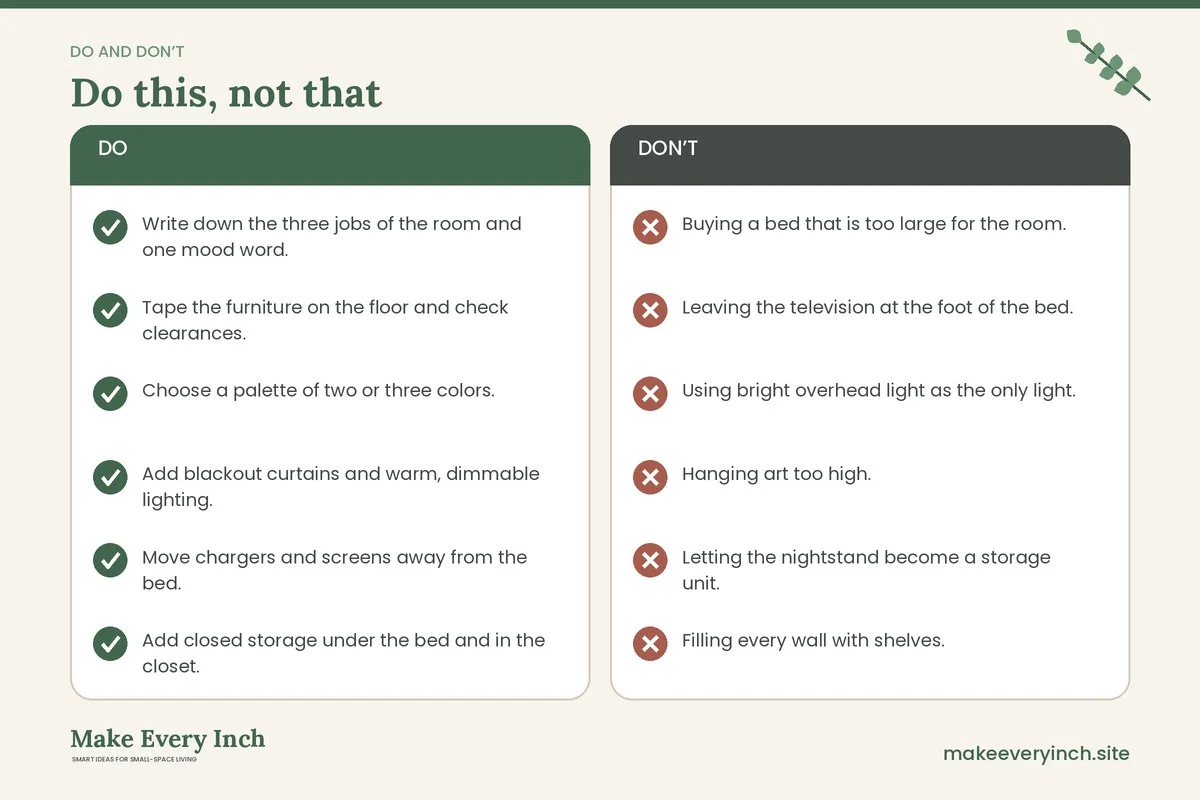
- Buying a bed that is too large for the room.
- Leaving the television at the foot of the bed.
- Using bright overhead light as the only light.
- Hanging art too high.
- Letting the nightstand become a storage unit.
- Filling every wall with shelves.
- Working in bed every day.
- Skipping the weekly reset.
Checklist
- Write down the three jobs of the room and one mood word.
- Tape the furniture on the floor and check clearances.
- Choose a palette of two or three colors.
- Add blackout curtains and warm, dimmable lighting.
- Move chargers and screens away from the bed.
- Add closed storage under the bed and in the closet.
- Anchor tall furniture or choose low pieces.
- Set a work boundary: a spot, a stop time and a way to hide the setup.
- Choose one large piece of art or one special object.
- Schedule a ten-minute weekly reset.
FAQ
How do I make a small bedroom feel calm and grown-up?
Limit the palette, choose one focal point, hide clutter behind closed doors, use warm lighting and add texture through bedding and curtains. Avoid piles of decor and busy patterns.
What size bed is best for a small adult bedroom?
A full bed suits rooms near 9 by 10 feet. A queen fits in rooms about 10 by 10 feet or larger, with the walkways described above. Pick the largest bed that leaves at least 24 inches of walkway.
How can I improve sleep in a small room?
Aim for a dark, quiet, comfortable room, keep screens away from the bed and keep a regular routine. If you have ongoing trouble, talk to a health professional.
Can I work in my bedroom without hurting my sleep?
Many people do. Keep work at a desk, not the bed, put the setup out of sight at the end of the day and set a stop time.
How do I add storage if I cannot drill?
Use under-bed drawers, a freestanding wardrobe, a tall narrow dresser, a bench with storage and over-the-door hooks. Choose low furniture that is stable on its own. Our small bedroom storage ideas guide has more.
What colors suit a small adult bedroom?
Soft neutrals, muted greens, warm grays and gentle blues are popular choices. Test paint samples on the wall and look at them in morning and evening light before you commit. For a lighter look, see small bedroom ideas, Japandi.
How do I keep the bedroom cozy but not cluttered?
Choose a few soft layers, such as a throw and two pillows, and give every object a home. Our cozy small bedroom ideas post gives more examples.
Keep going: Keep planning with our small bedroom furniture ideas, small bedroom lighting ideas and small bedroom ideas for renters.
Save this guide for later
Pin the ideas you like to Pinterest so you can come back to them when you plan your space.