Small Entryway Ideas That Keep Clutter Under Control
Quick answer: Small entryway ideas that keep clutter under control work because of rules, not extra furniture. Map the arrival flow in the order you actually walk it, give every item a single landing spot, set a hard capacity limit for each spot (for example four pairs of shoes and one hook per person) and adopt one-touch habits so nothing is put down twice. When a spot is full, something leaves.
Small entryway ideas that keep clutter under control begin with an unglamorous truth: a tiny entry rarely fills up because it lacks storage. It fills up because it is the first place your hands are free, and every object you carry in gets set down there. Keys, mail, bags, shoes, umbrellas, packages and jackets all arrive within the same ninety seconds. If the space has no clear rule for each of them, the pile wins. This guide is built around rules rather than products. It covers how to map your arrival flow, how to design a daily landing sequence, how to set capacity limits, how to build one-touch habits, a comparison table of landing spots, three example entries, a weekly reset, mistakes to avoid, a checklist and an FAQ. For the full overview of the topic, start with our main guide to small entryway ideas, and pair this post with our deeper pieces on small entryway storage and small entryway organization.
Why small entries clutter so fast
Think of an entryway as a loading dock. Everything that enters the home passes through it, and everything that leaves the home starts there. In a large house the dock has room to buffer a busy morning. In a small apartment it has perhaps nine square feet, so there is no buffer, and the overflow lands on the floor, the nearest chair or the first flat surface in the next room.
Three forces drive the mess. The first is speed. Arriving is a tired, hurried moment, and people choose the nearest option rather than the correct one. The second is ambiguity. If nobody has decided where the mail goes, then it goes wherever the hand stops. The third is accumulation without limits. A hook that holds one jacket will happily hold five, and a basket never says no. Once a spot has no ceiling, it stops being storage and becomes a pile with a container around it.
The fix works against all three forces at once. Place the right spot within a step or two of where the item is set down, decide in advance what belongs in each spot, and cap every spot so it cannot grow. The rest of this guide shows how.
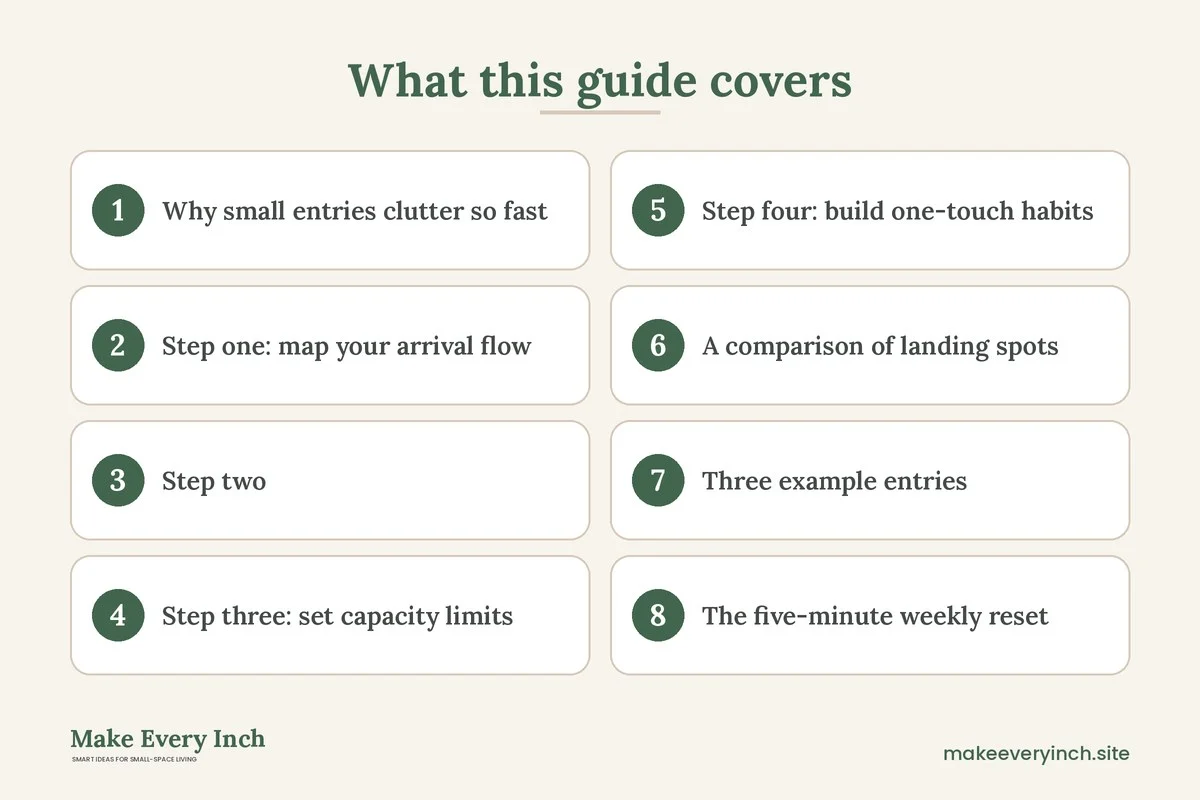
Step one: map your arrival flow
Before you add a hook or a shelf, trace what really happens in the first two minutes after you come in. Do this for three days, and write down what you do, not what you intend to do. Most people discover a repeating sequence that looks something like this: open the door, step in, close and lock it, put down a bag, take off shoes, hang a jacket, set down keys, carry mail or a package to the kitchen or sofa.
Draw the sequence as a simple line on a sketch of your floor plan. Mark where you stand when you take off your shoes, where your free hand lands, and where you turn. These points are the places where storage will work, because they are the places where you already stop. Storage that sits off this line, however neat, gets ignored.
Pay special attention to three details.
- The pivot point. This is the spot where you turn from the door toward the home. Whatever you are carrying is usually put down within an arm’s reach of it.
- The shoe stop. Most people remove shoes within one or two steps of the door. A bench, a mat or a tray should live here, not across the room.
- The key reach. Keys and wallet land on the first surface at hip height. A hook or a small dish at that height, on the side of your dominant hand, catches them.
Once the line is on paper, circle every spot where clutter currently collects. Each circle is a place where the flow and the storage are out of alignment. The goal is to move the storage to the flow, rather than ask the flow to bend toward the storage.
Step two: write a daily landing sequence
A landing sequence is a short, fixed order of actions that turns the arrival flow into a habit. It should be so short that it can be done while tired and holding a bag. A good sequence has four to six steps and no more.
Here is a model for a single adult in a small apartment.
- Lock the door, then drop keys into the dish or onto the hook at hip height.
- Step onto the mat, take off shoes and place them on the shoe tray or the shelf.
- Hang the outer layer on its own hook, and put the bag on the second hook or the floor basket.
- Open the mail over the recycling bin or tray, and keep only what needs action.
- Carry packages straight to a single spot to open them, and flatten the box within the hour.
For two people or a family, assign each person a hook, a shoe position and a mail slot, so the sequence is the same for everyone and nobody has to guess. Children can do a two-step version: shoes on the shelf, bag on the hook. A simple picture or a small label near the hook helps, and a hook placed at a child’s reach height makes compliance far easier than any reminder.
The sequence matters because it replaces decisions with a routine. When there is no decision, there is no delay, and delay is what turns an item into a pile.
Step three: set capacity limits
A capacity limit is a number. It states how many items a spot may hold, and it must be small enough that the spot stays tidy at its fullest. Without a number, the rule becomes a wish.
These starting points suit a small entry. Adjust them to your household, and write the number on a label or in your notes so that it is clear.
- Hooks: one hook per person for the current jacket, plus one shared hook for bags. Seasonal coats go elsewhere.
- Shoes: two to four pairs per person in the entry, which usually means the pairs worn this week. The rest live in a bedroom closet or under a bed.
- Mail surface: a tray or a slot that holds no more than about a week of paper. When the tray is full, it is sorting day.
- Bag position: one bag per hook. If a bag lives on the floor, it needs a basket that fits one or two bags.
- Umbrellas: one or two in a stand or on a hook, and extras elsewhere.
- Outbound items: a single basket or shelf for things that must leave the home, such as returns and library books. When it overflows, make the trip.
The capacity limit changes how you think about the space. Instead of asking where a new item can fit, you ask what leaves to make room. This rule, sometimes called one in, one out, protects the entry from growth over months. Our guide to decluttering rules for small homes goes deeper on setting limits that stick.
A useful trick is to make the limit visible. A shoe shelf with two slots per person shows when it is full. A row of three hooks shows when someone has hung a fourth jacket on top of another. Where a limit is visible, nobody has to police it.
Step four: build one-touch habits
A one-touch habit means an item is handled once and put in its final place the first time you pick it up. The opposite is a two-touch habit, where you drop the item somewhere temporary, then deal with it later. Every temporary spot in an entry becomes a permanent pile.
Here are the one-touch habits that make the biggest difference.
- Keys: from the lock to the hook, no stops in between. If the hook is on the wall beside the door, the motion is almost automatic.
- Mail: sort standing up, with a recycling bin within reach. Junk goes directly into the bin, and anything that needs action goes into a labeled tray.
- Shoes: off and placed in one motion. A tray or a shelf slot with a defined edge makes it clear when a pair is in the right place.
- Jackets: straight onto a hook, never onto a chair. A chair in an entry is a clutter magnet and should be removed unless it is a bench with storage underneath.
- Packages: opened at once in the entry, with the packaging into recycling and the contents carried to their home.
- Bags: empty the bag of anything that does not belong in it, and then hang it. A hanging bag that is half full of last week’s receipts stays heavy and ugly.
One-touch habits work best when the final place is closer than the temporary one. If the hook is two steps away and the kitchen counter is five, the hook wins. This is why placement matters more than the product you buy.
A comparison of landing spots
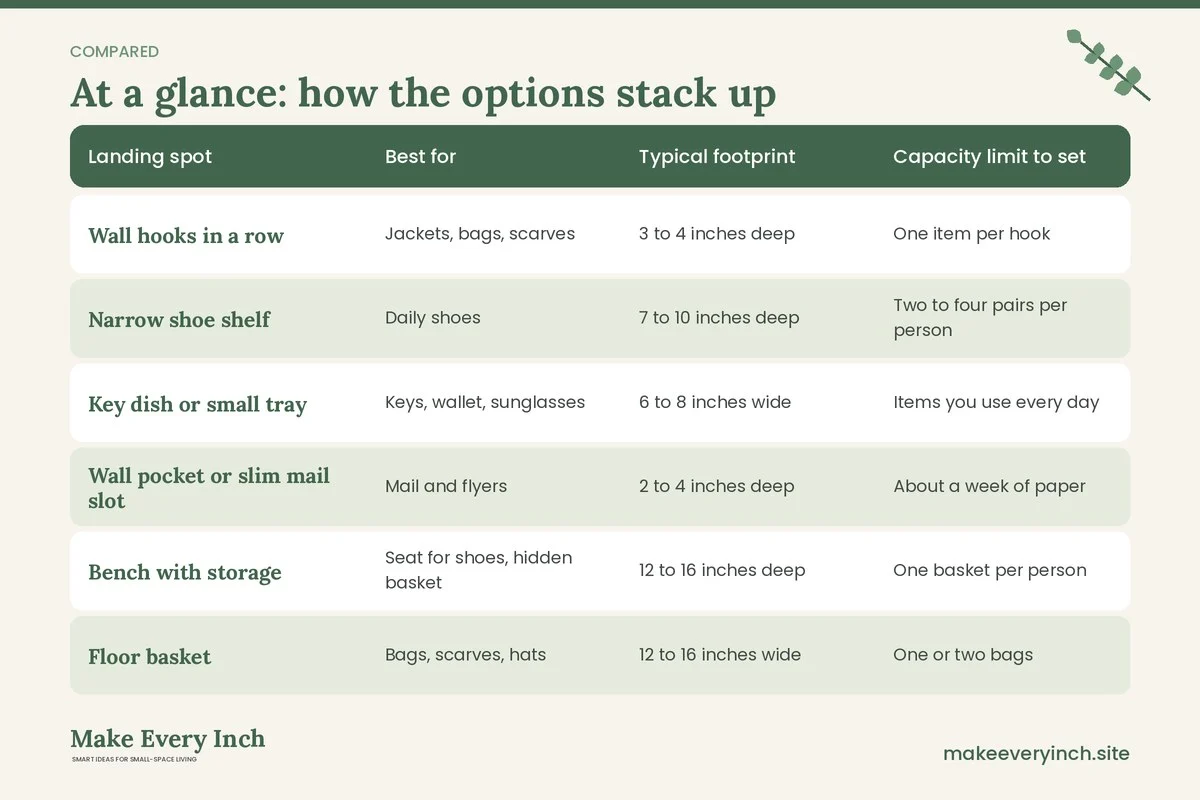
Different items need different kinds of spots. The table below compares common options for a small entry, with the typical footprint and the main limit to watch. Use it to choose one spot per category, not to buy one of everything.
| Landing spot | Best for | Typical footprint | Capacity limit to set | Watch out for |
|---|---|---|---|---|
| Wall hooks in a row | Jackets, bags, scarves | 3 to 4 inches deep | One item per hook | Heavy stacking pulls hooks down |
| Narrow shoe shelf | Daily shoes | 7 to 10 inches deep | Two to four pairs per person | Boots may not fit on shallow shelves |
| Key dish or small tray | Keys, wallet, sunglasses | 6 to 8 inches wide | Items you use every day | Becomes a junk dish if unlimited |
| Wall pocket or slim mail slot | Mail and flyers | 2 to 4 inches deep | About a week of paper | Needs a regular sort day |
| Bench with storage | Seat for shoes, hidden basket | 12 to 16 inches deep | One basket per person | Lid can become a surface for piles |
| Floor basket | Bags, scarves, hats | 12 to 16 inches wide | One or two bags | Items slump and hide at the bottom |
| Outbound basket or shelf | Returns, library books | 10 to 12 inches wide | One basket full | Needs a weekly trip to empty |
| Boot tray | Wet shoes, snow boots | 12 to 16 inches by 24 to 30 inches | Pairs in use this week | Must be wiped dry to avoid mold |
If your entry is too tight for most of these, look at our guides on small coat storage ideas and small shoe storage ideas, and consider that a few well-chosen items often work better than a full set.
Three example entries
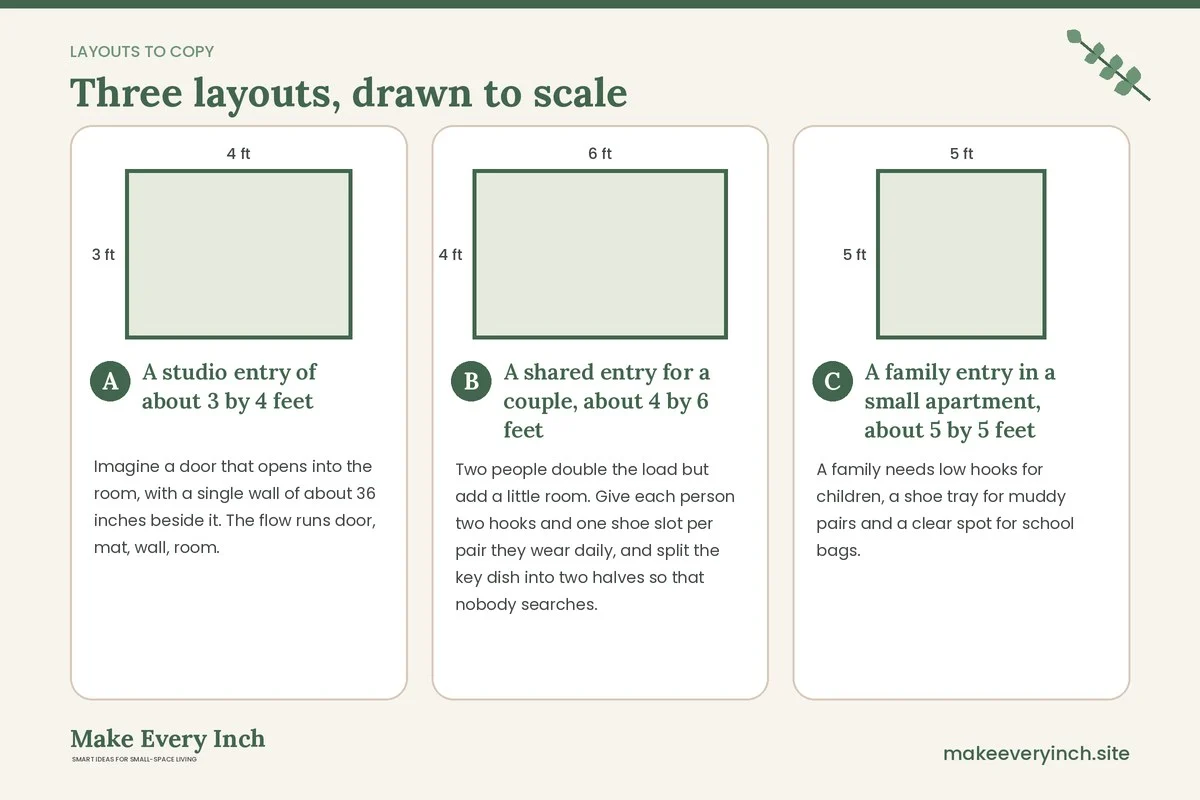
The same rules adapt to different footprints. Each of these examples is a plan, not a prescription, so adjust the measurements to your own door and walls.
A studio entry of about 3 by 4 feet
Imagine a door that opens into the room, with a single wall of about 36 inches beside it. The flow runs door, mat, wall, room. Install a row of three hooks at 60 to 66 inches high for jackets and a bag, and put a key dish on a small shelf at about 40 inches directly beside the door. Below the hooks, place a shoe shelf about 8 inches deep that holds two pairs. Add a narrow wall pocket for the week’s mail.
The capacity limits are strict because the footprint is small. Three hooks means three items, and two shoe slots mean two pairs. A flat basket under the hooks holds one pair of boots in winter. When the flow is mapped, the plan fits within the 24 inches of floor that remain clear, and the door can still swing open. Check the door swing before fixing anything to the wall.
A shared entry for a couple, about 4 by 6 feet
Two people double the load but add a little room. Give each person two hooks and one shoe slot per pair they wear daily, and split the key dish into two halves so that nobody searches. Use a slim bench about 14 inches deep, with a basket underneath for each person’s bag, labeled with a name or a color.
The mail goes to one shared tray on a wall shelf above the bench, with a bin for junk beside it. The landing sequence is the same for both people, and the Sunday reset takes five minutes. In this setup the most common problem is a bench that turns into a shelf for mail and bags, so set a rule that nothing lives on the seat.
A family entry in a small apartment, about 5 by 5 feet
A family needs low hooks for children, a shoe tray for muddy pairs and a clear spot for school bags. Mount a row of hooks at two heights, with the lower row at about 40 to 48 inches for children and the upper row at about 60 to 66 inches for adults. Place a tray on the floor for wet shoes, and a tall narrow cabinet or shelf for the dry pairs.
Give each child a labeled basket for hats, gloves and a school folder, and set a weekly rule that the baskets are emptied on Friday. Add one tall cabinet or bookcase only if it can be anchored to the wall, because a tipped cabinet is a real danger around small children. The family sequence is shoes, bag, jacket and folder, in that order, and the landing spots are placed in the same order along the wall.
The five-minute weekly reset
Even the best rules drift. A short reset once a week catches the drift before it becomes a pile. Pick a consistent day, such as Sunday evening, and work through these steps.
- Clear the key dish and the mail tray, and recycle anything that is not needed.
- Take away shoes and coats that are out of season or have not been used this week.
- Empty the outbound basket by making the trip, or by scheduling it for the next day.
- Wipe the floor mat or boot tray and shake out any grit.
- Check that every hook holds one item and every shelf slot holds one pair.
A five-minute reset is short enough to survive a busy week, and the entry will be ready for Monday. If you miss a week, the limits still protect you, because the entry cannot hold more than the numbers allow.
Mistakes that bring the clutter back
Most failures are predictable, so you can avoid them.
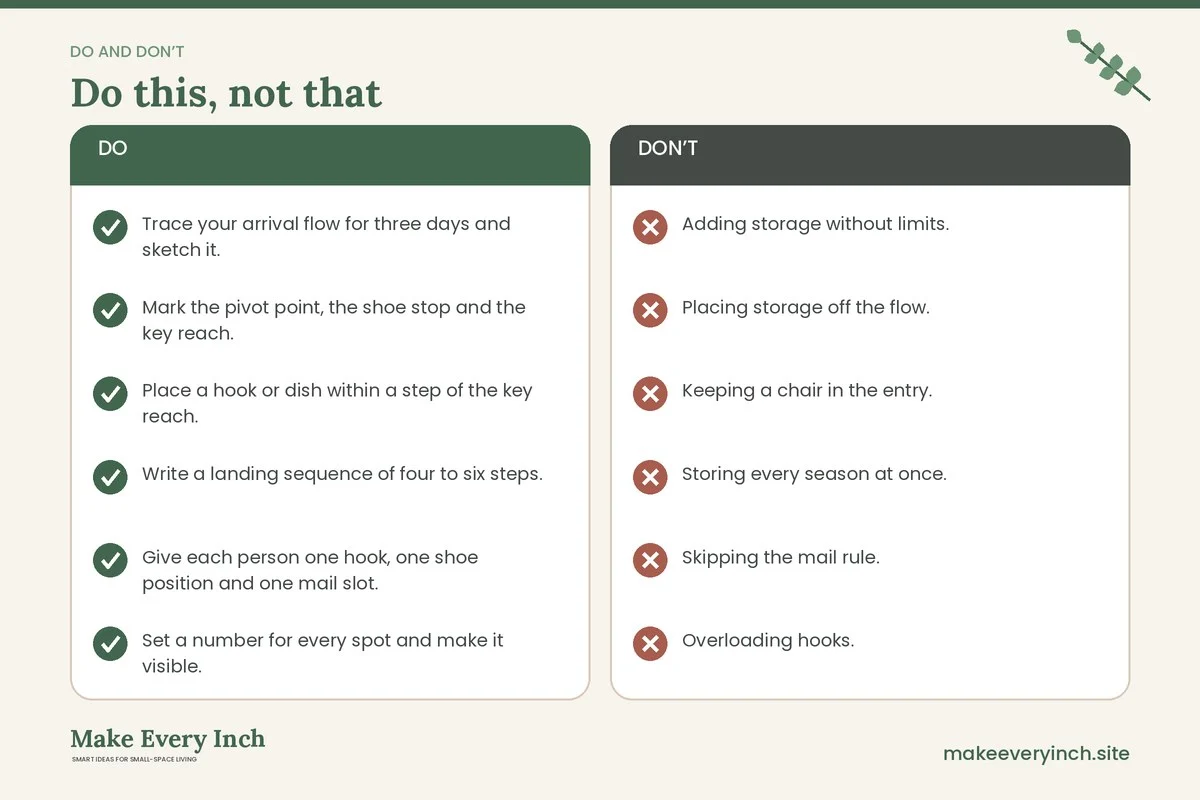
- Adding storage without limits. A basket without a cap becomes a bin, and the entry looks full even when it is tidy.
- Placing storage off the flow. A hook around the corner or a shelf across the room will be ignored, because it adds steps.
- Keeping a chair in the entry. A loose chair collects bags and coats. Choose a bench with a purpose, or no seat at all.
- Storing every season at once. Heavy winter coats in July take space that the daily items need.
- Skipping the mail rule. Paper is the most common source of entry clutter, so give it a tray, a bin and a sort day.
- Overloading hooks. A hook layered with several jackets pulls from the wall and makes every item hard to reach.
- Ignoring the door swing. A shelf or a basket that blocks the door will be bumped, moved and eventually removed. Test the swing with the door fully open.
- Forgetting the last step. A landing zone only works if the items go onward, so empty the outbound basket regularly.
Safety and rental notes
Some details deserve care when you set up an entry.
- Anchor tall furniture. Any tall cabinet, shoe tower or bookcase should be fastened to the wall with the anchors made for it, particularly if children live in or visit the home.
- Ask before drilling. If you rent, read your lease and ask your landlord before putting screws in a wall. Adhesive hooks and over-the-door hooks are alternatives, though you should follow the weight rating on the package. Our guide to no drill storage ideas for renters covers many options.
- Respect weight limits. Wall hooks and shelves have limits, and heavy winter coats can exceed what an adhesive hook is rated for.
- Keep the exit clear. The entry is also your escape route. Do not place anything that could block the door or trip a person in a hurry.
- Mind the floor. Wet shoes and mats can create a slip risk. Use a mat with a grippy underside and dry it often.
- Power safely. If you add a plug-in light or a charging spot, avoid overloading outlets and keep cords away from foot traffic.
Making the entry look good, too
Rules do not have to look severe. A tidy entry can still feel welcoming if you keep one or two decorative touches in proportion. A small mirror above the key shelf helps you check your appearance before leaving and bounces light into a dark corner. A single plant, a small print or a tray in a pleasant color adds warmth without taking up the space that the limits protect. The principle is to let the decorative item occupy a spot that is not a landing spot. For more on style, read our guide to apartment entryway decorating.
If your home has no true entry at all, the same rules apply on a smaller scale. A single wall near the door can host a hook rail, a shelf and a mat. See our guides to no entryway apartment ideas and tiny foyer ideas for ways to define that zone, and our piece on a small home drop zone for the broader landing concept.
Entry clutter checklist
- Trace your arrival flow for three days and sketch it.
- Mark the pivot point, the shoe stop and the key reach.
- Place a hook or dish within a step of the key reach.
- Write a landing sequence of four to six steps.
- Give each person one hook, one shoe position and one mail slot.
- Set a number for every spot and make it visible.
- Remove any loose chair that collects bags.
- Add a recycling bin or tray for mail.
- Create one outbound basket and a weekly trip to empty it.
- Check the door swing before fixing any item to the wall.
- Anchor any tall furniture and ask permission before drilling.
- Schedule a five-minute reset on the same day each week.
FAQ
How many hooks does a small entry need?
Plan one hook per person for the current jacket and one shared hook for bags. Extra hooks invite extra items, so fewer is usually better in a very small entry.
How many pairs of shoes should stay by the door?
Many households find that two to four pairs per person is workable, which usually covers the pairs worn this week. Store the rest in a closet or under the bed, and rotate them with the season.
What is the best way to handle mail?
Sort it standing up the moment it arrives, with a recycling bin within reach. Keep a tray or slot for items that need action, and empty it on a fixed day each week.
What if my entry has no wall space?
Use the back of the door with an over-the-door rack, or a single slim shelf above the door handle height. Look at our vertical storage ideas for ways to use height instead of floor.
How do I stop family members from dropping things on the bench?
Make the seat a no-storage zone by rule, and give each person a basket underneath. When the landing sequence is short and the baskets are labeled, the habit usually follows within a few weeks.
Should I buy a shoe cabinet?
Only if the capacity limit says you need one. A slim cabinet can help if you have more than a few daily pairs, and our guide to the best narrow shoe cabinets lists what to look for in a shallow design.
How often should I reset the entry?
A weekly five-minute reset is enough for most households. If your entry handles children, pets or heavy deliveries, a short daily tidy before bed may also help.
Keep going: Keep going with our small entryway ideas guide, our companion post on narrow entryway ideas for better flow and our guide to small entryway storage.
Save this guide for later
Pin the ideas you like to Pinterest so you can come back to them when you plan your space.