Best Ottomans with Storage for Small Homes: A Buying Guide
Quick answer: The best storage ottoman for a small home is sized to its job: about 16 to 18 inches high for a footrest or seat, 30 to 40 inches wide for a coffee table role, and a lid that opens or lifts without trapping fingers. Choose a firm top, a sturdy frame, a fabric that wipes clean and an interior deep enough for what you actually want to hide.
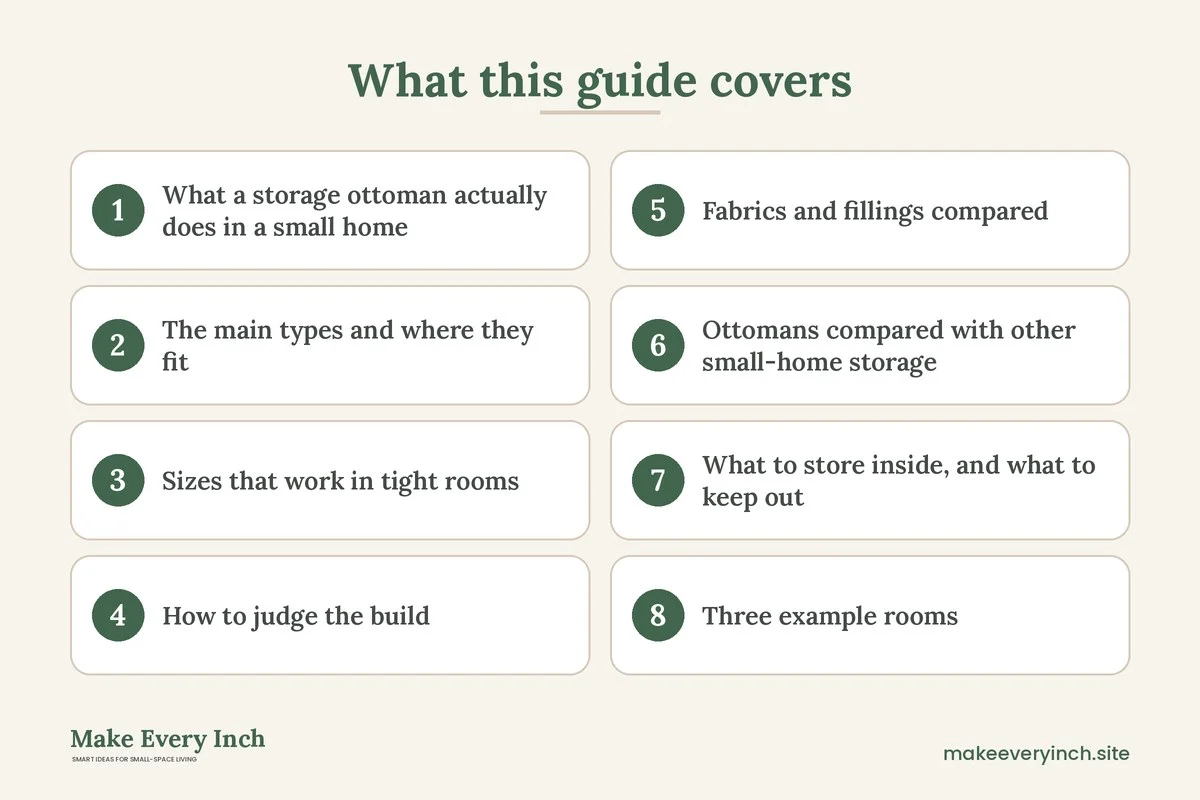
Ottomans storage small homes rely on is one of the few furniture categories that does three jobs in one footprint: a seat, a table and a hidden cupboard. In a small living room or bedroom, that kind of overlap is what keeps the floor clear. This guide is a buying guide rather than a product list. It explains the main types, the sizes that work in tight rooms, how to judge the lid, the hinge and the interior, how fabrics and fillings compare, the safety points that matter for lifting lids, and how to pair an ottoman with the rest of your furniture. There is also a comparison table, three example rooms, a mistakes list, a checklist and an FAQ. For the bigger picture of choosing pieces for a compact home, start with our pillar guide on the best furniture for small apartments. If you also need flexible surfaces, read our sibling guide to the best nesting tables for small apartments.
What a storage ottoman actually does in a small home
An ottoman earns its place when it replaces something else. A square or rectangular one can stand in for a coffee table, and it holds throws, remotes, board games or spare bedding inside. A bench-style ottoman at the foot of a bed replaces a chest and gives you a seat for putting on shoes. A small cube beside a chair is a footrest and a side table. Because the storage is inside, you do not add visual clutter, which is useful in a room where every shelf is already full.
The honest limits are worth knowing. An ottoman holds soft, light, infrequently used items best. Anything heavy, fragile or needed every day is awkward to reach, because you must clear the top, lift the lid and dig. The inside can also become a black hole where things are forgotten. And a very large ottoman with a full load can be heavy to move, which matters if you rearrange often. Think of the ottoman as the place for seasonal or occasional items and keep daily items in open baskets or drawers. Our existing guide to the best storage ottomans covers the product category in general, and this post adds sizing, mechanisms and room plans for compact homes.
The main types and where they fit
Lift-top (hinged) ottomans
The lid is attached at one edge and lifts to open. These are the most common type and offer the largest unbroken interior. The trade-off is that the lid needs headroom and clearance to swing, and a heavy lid can drop. Check that the hinge has a stay or a soft-close mechanism that holds the lid in place or slows it down, so fingers are not caught.
Lift-off (removable lid) ottomans
The lid is not attached, so you simply lift it off and set it aside. This avoids pinch points at a hinge, and the lid can be used as a tray if the other side is flat. The downside is that you need somewhere to put the lid, and in a tight room that can be awkward. Some lids have a second finished side so you can flip them.
Tray-top ottomans
A flat tray surface on top, often reversible, turns the ottoman into a table. Under the tray there is a lid or a hinged top. These suit a coffee table role because the tray holds a drink steady. Check that the tray sits firmly and does not slide when the lid is lifted.
Bench ottomans
Long and narrow, these live at the foot of a bed or along a wall. A length of 36 to 48 inches suits a small bedroom, and a depth of 14 to 18 inches keeps the path clear. A bench with a padded top doubles as a seat.
Cube and pouf ottomans
Small, soft cubes and poufs are footrests and extra seats. Some have a hollow interior with a removable top, which is good for hiding a few small items. They are light and easy to move, but they hold less than a larger box.
Sliding and drawer ottomans
A few designs have a sliding top or a drawer on the side. They avoid the lid swing and suit a spot where headroom is limited, such as under a window or beneath a shelf. They tend to have smaller interiors, so check the depth.
Sectional-style and modular ottomans
Some ottomans are designed to match a sectional or to link with another unit. They can extend a sofa into a chaise. They take up more room and are best for a living room where the ottoman is a main piece rather than an accessory.
Sizes that work in tight rooms
Size is the most common reason for a bad purchase. A big ottoman can swallow a small living room, and a tiny one can be too light to use as a table. These ranges are starting points, and you should always measure your own space.
- Height: 16 to 18 inches suits a footrest or seat, since that is close to a typical sofa seat height. A coffee table role often feels best a little lower or equal to the sofa seat, so 15 to 18 inches. A bedroom bench can be 17 to 20 inches.
- Width and length: 30 to 40 inches works as a coffee table for a loveseat or a small sofa. A cube of 14 to 18 inches suits a chair. A bench of 36 to 48 inches suits a double bed, and a longer one suits a larger bed.
- Depth: 18 to 24 inches for a rectangular ottoman in a small living room. Deeper pieces take up more of the walkway.
- Distance from the sofa: Keep about 14 to 18 inches between the sofa and the near edge of the ottoman, so knees clear and the surface is within reach.
- Walkway: Leave about 30 to 36 inches for the main path and around 24 inches for a secondary one. These are hedged ranges, so adjust for your room.
- Interior depth: 10 to 16 inches is typical. Check the internal measurements, because thick walls and padding reduce the usable space.
- Lid clearance: Allow room for the lid to open fully, usually 15 to 20 inches above the closed ottoman, depending on the hinge.
Tape the footprint on the floor and live with it for a day. Walk the path, sit on the sofa and lift an imaginary lid. If you must scoot the ottoman each time you open it, the size or the location is wrong.
How to judge the build
The frame
A solid frame of hardwood, plywood or similar engineered wood is more stable than thin particleboard, which can crack when sat on. Look for corner joints that are glued and screwed or braced. Press on the top and the sides in your mind, or if you can see one in person, sit on it and check there is no flex. If you plan to use the ottoman as a seat, check its listed weight capacity and look for a rating that suits the heaviest person likely to sit on it. Be wary of any piece that gives no capacity at all.
The lid and hinge
This is the part to examine most closely. A lid that is thick and firm gives a stable seat and a good tabletop. Hinges should be metal and fixed with screws, not staples. Look for a soft-close or slow-drop mechanism, or a stay arm that holds the lid open. Without these, a lid can slam shut, which is a pinch hazard for fingers and a risk to children. Never leave a lid propped on a loose item. Keep fingers away from the hinge edge when you close the lid, and close it with a flat hand on the top surface, away from the gap.
The interior
Check whether the inside is lined, so that fabric and paper do not snag on rough wood. Some ottomans have a removable bin or a fabric liner, which makes it easier to lift items out. A separate bin can be useful in a small home because you can carry it to the closet. Look for vents or small gaps if you plan to store textiles for a long time, since air flow helps prevent musty smells. Add a sachet or a cedar block in the bin, and avoid storing damp items.
Feet and base
Short legs or glides lift the ottoman off the floor, which helps with cleaning and keeps it from scratching. Make sure each foot has a pad, or add felt pads. A visible leg also adds a lighter look than a box that sits on the floor. If the ottoman will sit on a rug, choose a style with a wider foot so it does not sink.
Handles and weight
Side handles help you move the ottoman and carry the lid. If the ottoman will move often, avoid very heavy materials and check how much it weighs empty. A full ottoman is heavier still, so empty it before moving it.
Fabrics and fillings compared
The covering decides how the ottoman looks, how it wears and how easy it is to clean.
Woven fabric and linen blends
Woven fabrics feel warm and look at home in most rooms. They can stain, so look for a tight weave and, if the maker offers it, a stain-resistant treatment. Test any cleaner on a hidden spot first.
Performance fabrics
Some fabrics are made to resist stains and wear, which suits a house with children or pets. They are usually easy to clean with a damp cloth. Check the care label so you know what is safe to use.
Velvet
Velvet looks rich and takes color well, but it shows marks and crushes where people sit. It is best for a spot that gets light use.
Faux leather and leather
These wipe clean, which is useful for a coffee table role. Faux versions can peel over time, especially in strong sun or with heavy use, while real leather develops character but needs care. Both can stick to bare legs in warm weather.
Boucle and textured weaves
Texture hides small marks and adds interest to a plain room. Loops can snag on pet claws and zips, so think about your household.
Wood, rattan and cane
A wooden or woven ottoman has a hard top that is easy to wipe and often comes with a tray. It is less comfortable as a seat unless you add a cushion.
Cushioning
Foam fillings keep their shape, while softer fillings can sag. For a seat, a firm cushion supports better. For a table, you want a firm lid or a tray. Soft tops are comfortable but unstable for a glass.
Ottomans compared with other small-home storage
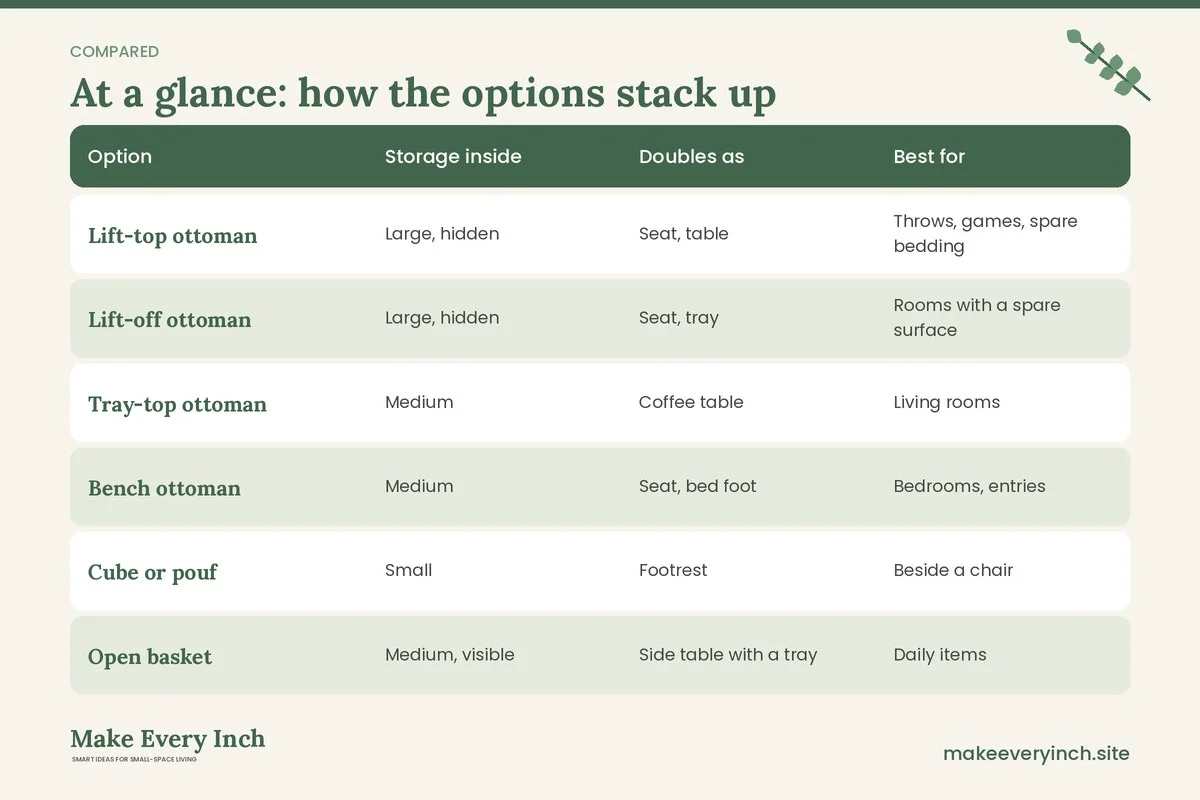
The table below shows how a storage ottoman fits among other small-home options, so you can decide whether it is the right tool.
| Option | Storage inside | Doubles as | Best for | Main trade-off |
|---|---|---|---|---|
| Lift-top ottoman | Large, hidden | Seat, table | Throws, games, spare bedding | Lid can pinch |
| Lift-off ottoman | Large, hidden | Seat, tray | Rooms with a spare surface | Needs a place for the lid |
| Tray-top ottoman | Medium | Coffee table | Living rooms | Heavier to move |
| Bench ottoman | Medium | Seat, bed foot | Bedrooms, entries | Long, needs wall space |
| Cube or pouf | Small | Footrest | Beside a chair | Small interior |
| Open basket | Medium, visible | Side table with a tray | Daily items | Visible clutter |
| Trunk or chest | Large | Table, seat | Larger rooms | Very heavy, deep lid |
The takeaway is that an ottoman suits the middle of the storage ladder. It handles things you want to keep out of sight but still reach occasionally. For daily items, pair it with open baskets or a shelf. For more ideas, see our post on small space storage furniture and our guide to hidden storage ideas.
What to store inside, and what to keep out
Good candidates are throws and spare blankets, extra pillow covers, board games, a spare set of sheets, out-of-season scarves and gloves, kids’ toys, craft supplies in a tote and extra remote batteries. Avoid anything fragile or sharp, anything that is damp, loose liquids, aerosol cans, candles and anything heat-sensitive. Do not store important papers or electronics without a protective box. Keep medicines, cleaning products and anything harmful out of reach of children, and never store these in an ottoman that a child can open.
Put a list or a label on the lid of the bin inside, so you can remember what is where. Group items in fabric cubes or soft bags so you can lift them out together. Keep the heaviest items at the bottom and the lightest on top.
Three example rooms
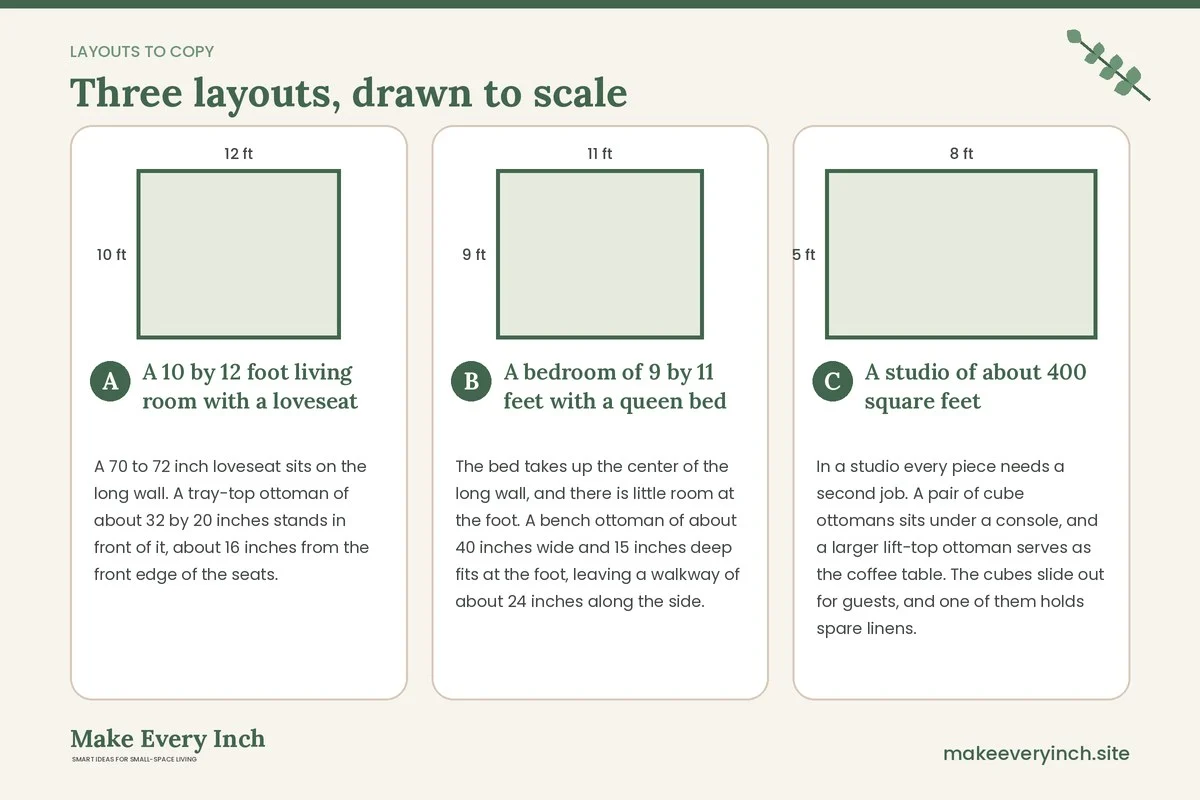
A 10 by 12 foot living room with a loveseat
A 70 to 72 inch loveseat sits on the long wall. A tray-top ottoman of about 32 by 20 inches stands in front of it, about 16 inches from the front edge of the seats. The ottoman holds two throws and a game, and its tray holds drinks. Without a coffee table, the walkway to the window stays near 36 inches. A narrow side table sits at one end. For more planning in this size of room, read our guide to small living room layout ideas.
A bedroom of 9 by 11 feet with a queen bed
The bed takes up the center of the long wall, and there is little room at the foot. A bench ottoman of about 40 inches wide and 15 inches deep fits at the foot, leaving a walkway of about 24 inches along the side. The bench holds spare bedding, and it is a seat for putting on shoes. A lift-off lid is helpful here, since a lifted hinge lid could hit the bed frame. Check the clearance before you buy. For more bedroom tips, see our collection of small bedroom ideas.
A studio of about 400 square feet
In a studio every piece needs a second job. A pair of cube ottomans sits under a console, and a larger lift-top ottoman serves as the coffee table. The cubes slide out for guests, and one of them holds spare linens. The large ottoman hides off-season items and the pet’s toys. A rug of about 5 by 8 feet helps define the living area. See our guide to studio apartment ideas for more on zoning, and our small space organization ideas for ways to keep it tidy.
Where an ottoman works best
- In front of a sofa: as a coffee table, with a tray on top.
- Beside an armchair: as a footrest and a side table.
- At the foot of a bed: as a bench and a bedding store.
- In an entryway: as a seat for shoes, with a place for scarves inside. See our guide to small entryway storage.
- Under a window: as a reading seat with a cushion, if the lid does not need much clearance.
- Beside a desk: as extra seating for a guest or a spot for paper storage. See our guide to the best desks for small apartments.
- In a dining nook: as extra seating, though it should not replace proper chairs for long meals. For ideas, see our guide to the best small dining tables.
Safety and lease notes
An ottoman is simple furniture, but a few points deserve attention in a small home.
- Pinch points: A hinged lid can fall and trap fingers or hands, especially those of children. Choose a soft-close hinge or a stay, close the lid with care and keep children away from the hinge edge.
- Entrapment: Never allow a child or a pet to climb inside a storage ottoman. Choose one whose lid does not latch shut, and keep the lid closed when it is not in use, but not so tightly that a child could be trapped. Fit a ventilated design if you have small children, and consider a lift-off lid.
- Weight limits: Do not stand on the lid, and do not exceed the listed weight capacity when you sit on it. Check the manufacturer’s guidance.
- Moving a full ottoman: Empty it before moving it, and lift with your legs, not your back.
- Tall furniture nearby: If the ottoman sits near a tall bookcase or shelving, anchor the tall piece to the wall using hardware suited to your wall type. Find the studs first and only anchor with your landlord’s permission. Never drill without permission, and consider a low freestanding unit in a rental.
- Wall-mounted shelves above: If you add a shelf above the ottoman, check the load limits and the stud positions, and ask your landlord before you drill.
- Floors: Add felt pads to protect floors, and lift the ottoman rather than dragging it.
- Fire safety: Keep the ottoman away from heaters and open flames, and avoid storing flammable items inside.
Mistakes to avoid
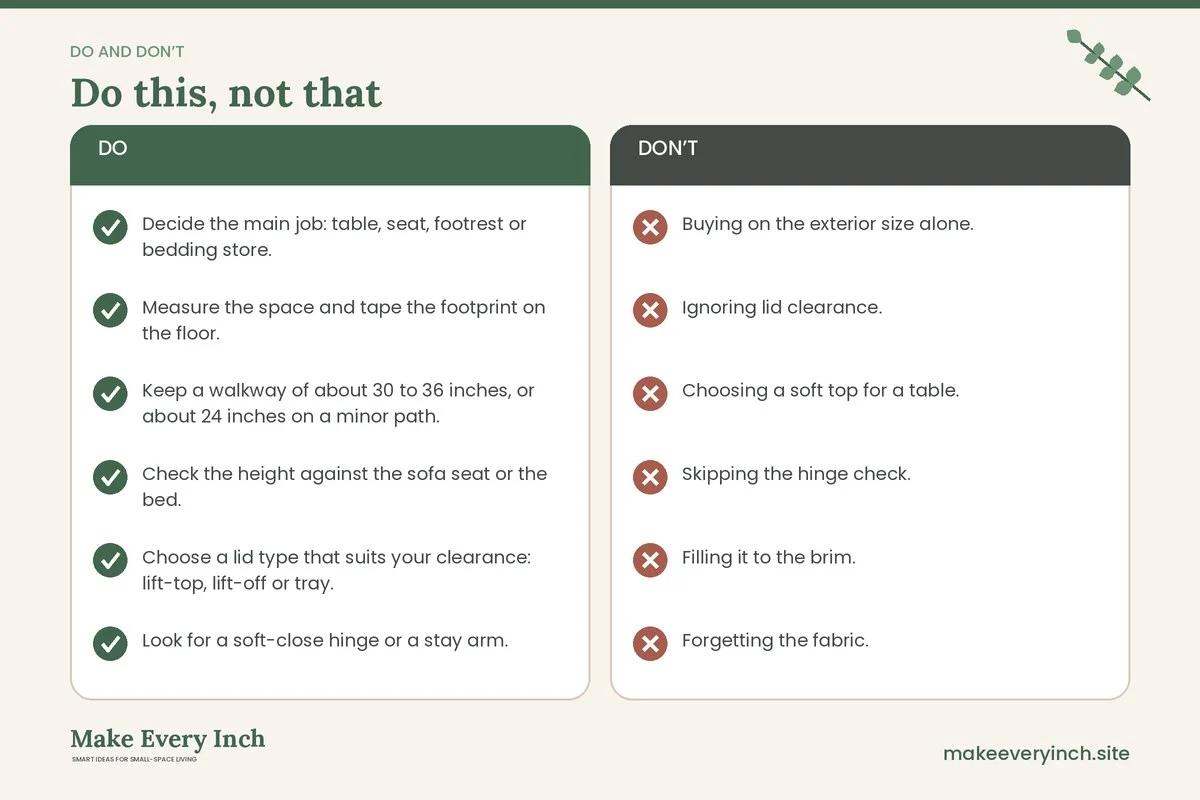
- Buying on the exterior size alone. The inside may be much smaller than you expect, so check the internal measurements.
- Ignoring lid clearance. A lid that hits the sofa or the bed is a daily irritation.
- Choosing a soft top for a table. Drinks tip on a soft surface. Use a tray or a firm lid.
- Skipping the hinge check. A slam-down lid is a hazard and a nuisance.
- Filling it to the brim. An overfull ottoman will not close properly and puts strain on the hinge.
- Forgetting the fabric. A pale velvet in a home with pets will show every mark.
- Overlooking weight. If you rearrange often, a very heavy ottoman will stay put forever.
- Hiding daily items. Anything you use daily should live in an easy-reach spot.
How to make an ottoman look good
A storage ottoman should look like furniture, not a box. Add a tray with a candle or a small plant on the top, and keep two or three items at most. Choose a color related to the room, such as a muted tone from the rug or the curtains. If the sofa is plain, an ottoman in a bold pattern can add interest. If the room is busy, choose a solid color. Place the ottoman centered on the sofa or slightly off, but keep its edges parallel to the sofa so the room looks neat. Use a rug that is large enough to hold the front feet of the sofa and the ottoman so they look like one group. For more help with a living room look, see our guide to small living room ideas.
Care and cleaning
Vacuum fabric with a soft brush once a week. Blot spills right away and do not rub. Follow the care label, and test cleaners on a hidden spot. Wipe wood and faux leather with a damp cloth. Open the lid every few months to air the interior and look for dust, damp or pests. Tighten any loose screws on the hinge once a year, and check the stay or soft-close mechanism. If a lid begins to drop too fast, replace the hinge before it causes an injury.
A simple buying checklist
- Decide the main job: table, seat, footrest or bedding store.
- Measure the space and tape the footprint on the floor.
- Keep a walkway of about 30 to 36 inches, or about 24 inches on a minor path.
- Check the height against the sofa seat or the bed.
- Choose a lid type that suits your clearance: lift-top, lift-off or tray.
- Look for a soft-close hinge or a stay arm.
- Check the internal dimensions and the depth.
- Check the weight capacity if you will sit on it.
- Choose a fabric that suits your household.
- Look for feet or glides that protect the floor.
- Plan what goes inside and what stays out.
- Check the return policy in case it does not fit.
FAQ
What size storage ottoman suits a small living room?
For a coffee table role, a rectangle of about 30 to 40 inches wide and 18 to 24 inches deep suits most small living rooms, with a height of 15 to 18 inches. Measure your walkway first and leave about 30 to 36 inches.
Is a storage ottoman a good coffee table?
Yes, if it has a firm top or a tray. A soft top is comfortable but unstable for drinks. A storage ottoman also gives you somewhere to put throws and games, which helps a small room.
What should I store in an ottoman?
Soft, light and occasionally used items work best, such as throws, spare bedding, games and out-of-season accessories. Avoid fragile, damp or flammable items.
Are lift-top ottomans safe for children?
They can be, with care. Choose a soft-close hinge or a removable lid, keep children away from the hinge edge and never let a child climb inside. Always follow the manufacturer’s guidance.
How much weight can an ottoman hold?
It varies, so check the maker’s stated capacity. Do not stand on it, and avoid sitting on an ottoman that gives no capacity rating or that flexes under weight.
Can I use an ottoman at the foot of a bed?
Yes, if you leave a walkway of around 24 inches at the side and if the lid will clear the bed frame. A bench style or a lift-off lid works well in a small bedroom.
How do I stop an ottoman from smelling musty?
Store only dry items, air the interior from time to time and add a sachet or a cedar block. Avoid storing damp fabrics, and look for a design with some ventilation.
Do I need landlord permission?
No, a freestanding ottoman needs none. You only need permission if you fix anything to a wall, such as a shelf or an anchor for tall furniture, and you should never drill without it.
Keep going: Keep planning with our best furniture for small apartments guide, our small living room furniture ideas and our small bedroom storage ideas.
Save this guide for later
Pin the ideas you like to Pinterest so you can come back to them when you plan your space.