19 Small Kitchen Lighting Ideas to Brighten Every Corner
Quick answer: The best small kitchen lighting ideas use three layers: bright ambient light on the ceiling, task light under the cabinets and a soft accent light such as a pendant or lamp. Choose LED bulbs of 3000K to 3500K, put the counter and sink in direct light and add a dimmer for evenings.
Small kitchen lighting ideas matter more than most upgrades, because a dim kitchen feels smaller, hides dirt and makes knife work harder. One ceiling light almost always leaves shadows on the counter, where you need light most. This guide shares 19 ideas, bulb basics, a fixture comparison, a lumens guide, three example plans, a renter section and a checklist, so every part of a small kitchen is bright without glare.
How much light a small kitchen needs
Kitchens need more light than living rooms because you work with knives, heat and small details. A general guide is 30 to 40 lumens per square foot for the whole room and a higher level at the counters. A 70 square foot kitchen therefore needs about 2,100 to 2,800 lumens in total, with the counters getting at least 400 lumens per 3 feet of run. Use a dimmer on the ceiling light so you can lower it in the evening.
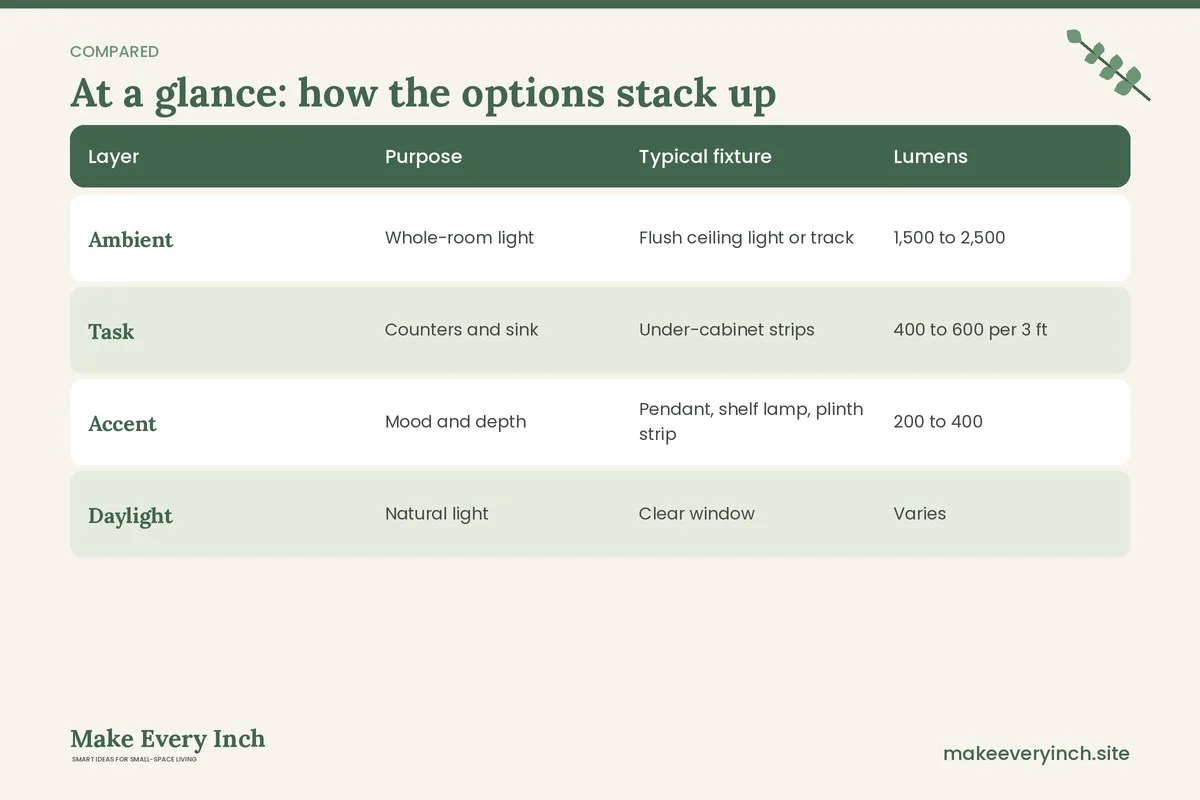
Think in layers. Ambient light fills the room, task light shines on the work surfaces and accent light adds depth. A small kitchen with all three layers feels larger and more welcoming than one with a single bright fixture.
| Layer | Purpose | Typical fixture | Lumens |
|---|---|---|---|
| Ambient | Whole-room light | Flush ceiling light or track | 1,500 to 2,500 |
| Task | Counters and sink | Under-cabinet strips | 400 to 600 per 3 ft |
| Accent | Mood and depth | Pendant, shelf lamp, plinth strip | 200 to 400 |
| Daylight | Natural light | Clear window | Varies |
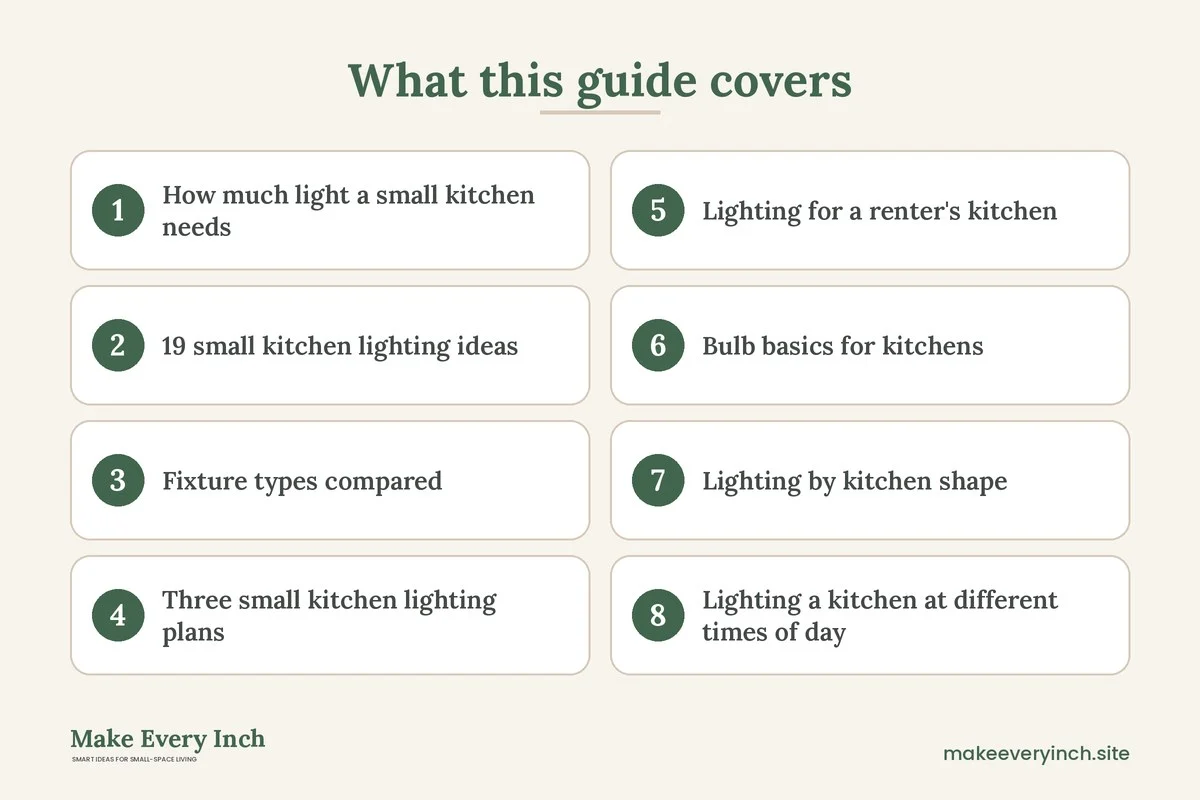
19 small kitchen lighting ideas
1. Add under-cabinet LED strips
Strips under the upper cabinets light the counter from the front and remove the shadow your body casts. Choose 3000K to 3500K and a strip with a diffuser for even light. Plug-in versions need no wiring.
2. Replace a dim fixture with a bright flush mount
A flush or semi-flush light of 1,500 to 2,000 lumens spreads light across the ceiling without hanging into the room. Choose a frosted shade to avoid glare.
3. Use track or rail lighting
A short track with two or three adjustable heads lets you aim light at the counter, the stove and the sink. It needs only one power point.
4. Light the sink separately
A small light above the sink, a swing-arm lamp or a recessed spot keeps your hands in the light while you wash. Avoid placing a light behind you.
5. Add a pendant over a table or counter
A single pendant over a small table or bar adds a focal point and a warm pool of light. Hang it 30 to 36 inches above the surface.
6. Use a lamp on a shelf
A small table lamp on a shelf or the end of the counter adds warm light in the evening and makes the kitchen feel like part of the home.
7. Add a light inside glass cabinets
LED puck lights in a glass-front cabinet show off dishes and add a soft glow.
8. Light the toe-kick
A strip along the base of the cabinets creates a subtle night light and makes the room feel bigger. It is useful for late-night trips.
9. Choose the right bulb color
Use 3000K for a warm yet clear light and up to 3500K for work areas. Avoid bulbs above 4000K, which can feel clinical and make food look gray.
10. Choose a high color rendering index
A CRI of 90 or higher makes food, wood and skin tones look natural. Check the packaging before you buy.
11. Use a dimmer
A dimmer on the ceiling light lets you switch from bright prep light to softer dining light. Check that the bulbs and the dimmer are compatible.
12. Use smart bulbs or plugs
Smart bulbs change brightness and color from a phone, and smart plugs let you switch a lamp on a schedule or by voice. They are ideal for rentals.
13. Add a mirror or glossy backsplash
Reflective surfaces bounce light and make the kitchen look deeper. Place a mirror opposite the window if there is room.
14. Keep the window clear
Remove heavy curtains and clutter from the sill. Use a sheer or a café curtain to keep privacy and let daylight in.
15. Use light-colored surfaces
White, cream and pale sage walls and cabinets reflect more light than dark ones. Choose a satin or semi-gloss finish for the cabinets.
16. Light the pantry or closet
A battery LED puck or a motion-sensor strip lights a dark pantry and prevents hunting for items.
17. Light the range
A hood with a built-in light or a small clip-on lamp near the stove helps you see what is cooking. Keep any lamp away from heat and splatter.
18. Add a light to a dark corner
A slim floor lamp, a wall sconce or a plug-in light brightens a corner that the ceiling light does not reach.
19. Clean fixtures and bulbs
Grease and dust can cut light by 10 to 20 percent. Wipe shades and bulbs every few months and replace flickering bulbs.
Fixture types compared
| Fixture | Best for | Cost | Install | Notes |
|---|---|---|---|---|
| Under-cabinet strip | Counters | Low to medium | Plug-in or hardwired | Choose a diffuser |
| Flush mount | Ambient | Medium | Replace existing | Use frosted glass |
| Track light | Flexible task light | Medium | Needs a power point | Aim carefully |
| Pendant | Over a table | Medium | Hardwired or hook | Hang at the right height |
| Plug-in sconce | Renters | Low | None | Hide the cord |
| Puck light | Cabinets and pantry | Low | Adhesive | Use rechargeable ones |
| LED toe-kick strip | Night light | Low | Adhesive | Use a motion sensor |
Three small kitchen lighting plans
Plan A: a 6 x 8 foot galley
Replace the ceiling fixture with a 1,800 lumen flush mount, add under-cabinet strips on both runs and put a small light over the sink. Use a mirror at the end wall to reflect light. Keep the aisle clear so light reaches the floor. See galley kitchen ideas.
Plan B: a studio kitchenette
Use a plug-in strip under the shelf, a clip-on lamp for the counter and a pendant over the table. Add smart plugs on the lamps so one command switches them on. Use warm bulbs at the table and brighter ones at the counter. See tiny kitchen ideas.
Plan C: an L-shaped rental kitchen
Use battery strips under the shelves, a plug-in lamp on a shelf and a bright LED bulb in the existing fixture. Add a mirror or glossy peel-and-stick tile behind the stove. Keep the original shade in a box. See renter kitchen ideas.
Lighting for a renter’s kitchen
If you rent, avoid anything that needs wiring and choose products that can move with you. Rechargeable strips with adhesive backing, plug-in sconces, clip-on lamps and smart bulbs are all easy to install and remove. Use cord covers painted the wall color to hide wires. Replace bulbs in the existing fixtures with brighter LEDs and keep the originals. Some leases allow you to swap a shade or a fixture if you store the original and put it back, so ask in writing.
Bulb basics for kitchens
LED bulbs use less power, stay cool and last about 15,000 to 25,000 hours. Check three numbers on the box: lumens for brightness, kelvin for color and CRI for color accuracy. A standard 60-watt replacement is about 800 lumens, and a 100-watt replacement is about 1,600 lumens. Choose dimmable bulbs if you have a dimmer, and enclosed-rated bulbs if the fixture is closed. Use the same color temperature throughout the kitchen so the light looks even. Keep a spare bulb for each type in a labelled drawer.
Lighting by kitchen shape
A galley kitchen
Galleys are long and narrow, so light the length evenly. Use two ceiling lights or a track along the aisle and strips under the cabinets on both runs. A bright end wall, a mirror or a window at the end draws the eye along the room and prevents the tunnel effect.
An L-shaped kitchen
The corner is the dark spot. Place a task light in the corner, such as a swing-arm lamp or an under-cabinet strip that wraps the angle, and use a pendant or a flush light in the center of the room. Check that the sink and the stove each have their own light.
A single-wall kitchen
Here, one run of counters carries all the work, so a long strip or a track along the wall does the most good. Add a small pendant or a lamp on the opposite wall or the table to make the dining area feel separate.
A U-shaped kitchen
Light each arm of the U, since shadows fall in the corners. Use strips under the upper cabinets on all three runs, and a bright ceiling light in the middle. Keep the color temperature the same.
Lighting a kitchen at different times of day
In the morning, open the window fully and use the ceiling light to wake up. In the afternoon, rely on daylight and keep artificial light low, except at the counter where you may need task light. In the evening, switch to warm light and dim the ceiling, then turn on the pendant or a lamp. At night, use the toe-kick strip or a small plug-in light so you can find the fridge without waking the household. A smart bulb can set these scenes in one command. Even without smart devices, a few switches and a dimmer give you the same range.
Maintaining kitchen lighting
Kitchens are greasy places, and lights collect a film that dims the output. Wipe shades and diffusers with warm, soapy water every few months and dry them well. Replace bulbs when they flicker or dim. Keep spare bulbs of each type in a labelled box. Check plug-in strips and adhesive backs for peeling, especially near the stove, and replace them if the glue fails. If a fixture gets very hot, switch to a lower-wattage LED, or move it away from the heat. Turn off the lights when you leave to save energy.
Safety notes for kitchen lighting
Keep cords away from the stove, the sink and any water. Use plug-in lights rated for kitchens and do not place a lamp where steam or splatter can reach the socket. Use a grounded outlet and avoid daisy-chaining power strips. If you install hardwired lights, hire a licensed electrician, since wiring near water must meet code. Keep fixtures at least 12 inches from the stove, and use heat-rated bulbs in enclosed fixtures. Test smoke detectors each month, and keep the kitchen well lit so you can see hazards.
Lighting mistakes in small kitchens
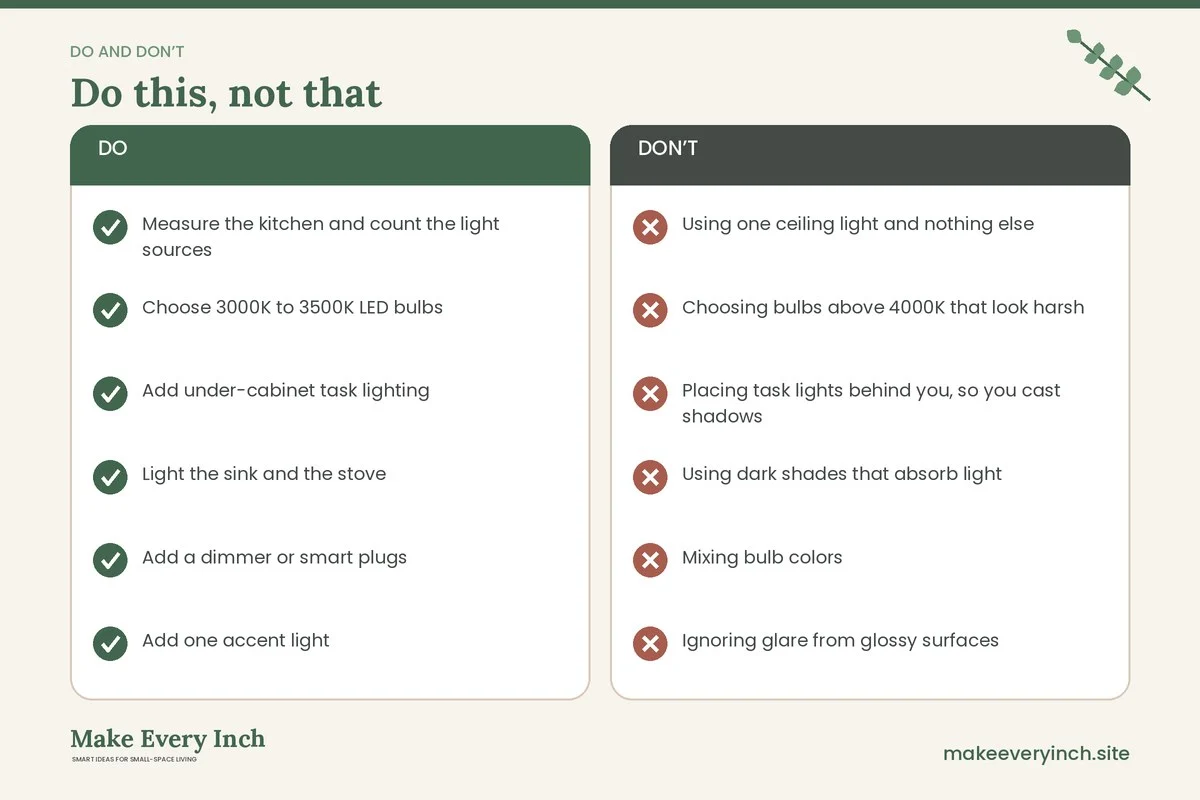
- Using one ceiling light and nothing else
- Choosing bulbs above 4000K that look harsh
- Placing task lights behind you, so you cast shadows
- Using dark shades that absorb light
- Mixing bulb colors
- Ignoring glare from glossy surfaces
- Forgetting to clean fixtures
- Using non-dimmable bulbs on a dimmer
Lighting for different tasks
Chopping needs bright, even, shadow-free light at the counter. Reading a recipe needs light on the page, so place a lamp or a strip near the cookbook stand or the tablet. Stove work needs light that shows color and doneness, so use neutral white and avoid yellow glare. Dining needs a softer, lower light, so dim the ceiling and turn on the pendant or the lamp. Cleaning needs bright light so you can see crumbs and spills. Night use needs a dim glow so you can find a glass of water without waking the household. Match each task to a light, and the kitchen will feel easy to use at any hour.
Lighting and mood
Light changes how a kitchen feels. A cool, bright light is energizing in the morning, and a warm, dim light helps you relax after dinner. Use a dimmer and a lamp or pendant to change the mood. Add a small candle or a battery light on a shelf for a cozy touch. Use warm light on the wall to make it look softer, and avoid pointing lights straight at a glossy backsplash, which creates glare. If the kitchen is open to the living room, match the bulb color so the two rooms look consistent. See small living room lighting ideas for the layered approach in the next room.
Testing a lighting plan before you commit
Before buying fixtures, test the plan with cheap tools. Tape a battery puck light under a cabinet for a night and see whether the work surface feels better. Swap one bulb for a warmer or brighter one and cook a meal. Notice shadows on the cutting board, glare on the backsplash and whether the corners are still dark. A few days of testing costs little, and it shows which fixture solves the real problem before you spend on more.
A weekend lighting upgrade plan
On Friday evening, switch on every light in the kitchen and note each dark spot. On Saturday morning, replace every bulb with a warm LED of the same color, and wipe each shade. On Saturday afternoon, install the under-cabinet strips or place plug-in lights, hide the cords and test the counters. On Sunday, add the accent light, such as a pendant or a lamp, and set the dimmer or smart plug schedule. Stand at the stove, the sink and the counter and check for shadows. A single weekend is enough to transform a dim kitchen for under 150 dollars.
Finish the upgrade by cooking one meal and noting every spot where the light falls short; add one more fixture for the worst spot.
Lighting checklist
- Measure the kitchen and count the light sources
- Choose 3000K to 3500K LED bulbs
- Add under-cabinet task lighting
- Light the sink and the stove
- Add a dimmer or smart plugs
- Add one accent light
- Clean fixtures and bulbs
- Test the lighting at night
FAQ
What is the best lighting for a small kitchen?
A bright ceiling light with under-cabinet task lights and a soft accent light, using LED bulbs of 3000K to 3500K.
How many lumens does a small kitchen need?
About 30 to 40 lumens per square foot overall, with extra light at the counters.
What color temperature is best for kitchen lighting?
Warm white to neutral white, 3000K to 3500K, is clear for work and still comfortable.
How do I light a kitchen without ceiling lights?
Use plug-in strips, lamps, track lights and sconces, and aim them at the counters and the stove.
How do I brighten a dark small kitchen?
Use light colors, a mirror or glossy backsplash, bright bulbs and under-cabinet lights, and keep the window clear.
Are LED strips good for kitchens?
Yes, if you choose ones with a diffuser, a high CRI and a color of 3000K to 3500K. Keep them away from direct heat and splatter.
Can renters improve kitchen lighting?
Yes, with plug-in lights, rechargeable strips, smart bulbs and lamps that need no wiring.
How do I avoid glare from lights on glossy surfaces?
Use diffused lights, aim them away from the backsplash and choose matte finishes where possible.
Keep going: Explore our small kitchen ideas, small kitchen storage ideas and small apartment kitchen ideas.
Save this guide for later
Pin the ideas you like to Pinterest so you can come back to them when you plan your space.