How to Furnish a Small Apartment on a Budget: Buy in Order
Quick answer: To furnish small apartment on budget, measure first, then buy in order: a bed or sleep surface, one seat, a light source, a surface for eating and working, and storage last. Spread purchases over several weeks, keep 30 to 36 inches of walkway, choose pieces that do two jobs, anchor anything tall, and wait on decor until the room shows you what it needs.
If you want to furnish small apartment on budget, the biggest mistake is buying a room’s worth of furniture in one weekend. An empty apartment creates pressure to fill it, and that pressure leads to pieces that are too big, too similar or too hard to move later. This guide takes a different route. It treats furnishing as a sequence, with a first night kit, a first week list, a first month list and a long-term list, so that every purchase has a reason and a place before it arrives. You will find the measurements to take before you shop, a priority table, a sourcing guide, three example apartments, safety notes, mistakes to avoid and a checklist. For the full set of ideas on the topic, read our pillar guide on budget small space ideas, and for the visual side of the story see the sibling post on before and after budget small space makeovers.
Why the order of purchases matters more than the prices
A small apartment forgives almost nothing. If a sofa is four inches too deep, the walkway disappears. If a bookcase is the wrong height, it blocks a window or tips forward. Money wasted on one wrong piece is hard to recover, because returns, resale and delivery all cost time. Buying in order protects you in three ways.
First, it lets you live in the space before you commit. After a week you know where you drop your keys, where you sit in the evening and which wall is always in the way. Those observations are free, and they beat any inspiration photo. Second, it spreads spending out, so a mistake in week one does not drain the money you need for week four. Third, it makes the secondhand route practical. Good used furniture appears slowly, and shoppers who can wait a few weeks usually find better pieces than those who need everything by Friday.
The plan below uses four stages. Stage one covers the first night. Stage two covers the first week. Stage three covers the first month. Stage four covers everything else, which can wait for months without harm.
Measure before you shop
Measurements are the cheapest tool you have. Spend an hour with a tape measure and a notebook, and record the following.
The room itself
- Wall lengths, floor to ceiling height and the width of every doorway
- Window positions, including the sill height and how far the window opens
- Radiators, vents, baseboard heaters and outlets, since these limit where furniture can stand
- Door swings, including the closet, the bathroom and the entry, because a door that cannot open fully is a daily annoyance
- The path from the building entrance to your unit, including stair width, elevator size and the tightest corner, so you know what can be delivered
Clearance rules to write at the top of the page
- Main walkways: about 30 to 36 inches wide
- Secondary paths, such as beside a bed: about 24 inches
- Space in front of a dresser or closet: about 36 inches so drawers and doors can open
- Sofa to coffee table or ottoman: about 14 to 18 inches
- Dining or desk chair pulled out: about 24 to 30 inches behind the seat when someone sits down
- Bed to wall on a side you use: about 24 inches, though one side can be tighter if the bed is pushed against a wall
Make a paper plan
Draw the room on graph paper with one square for each foot, or use painter’s tape on the floor to mark the footprint of each planned piece. Tape is the more honest method. Live with the outlines for a day and walk through them carefully, including at night with the lights low. If the tape makes you turn sideways, the piece is too big or in the wrong place. Take the tape up before you sign for any delivery. Do not use tape on delicate floors for long periods, since some adhesives leave marks.
The buy-in-order priority table
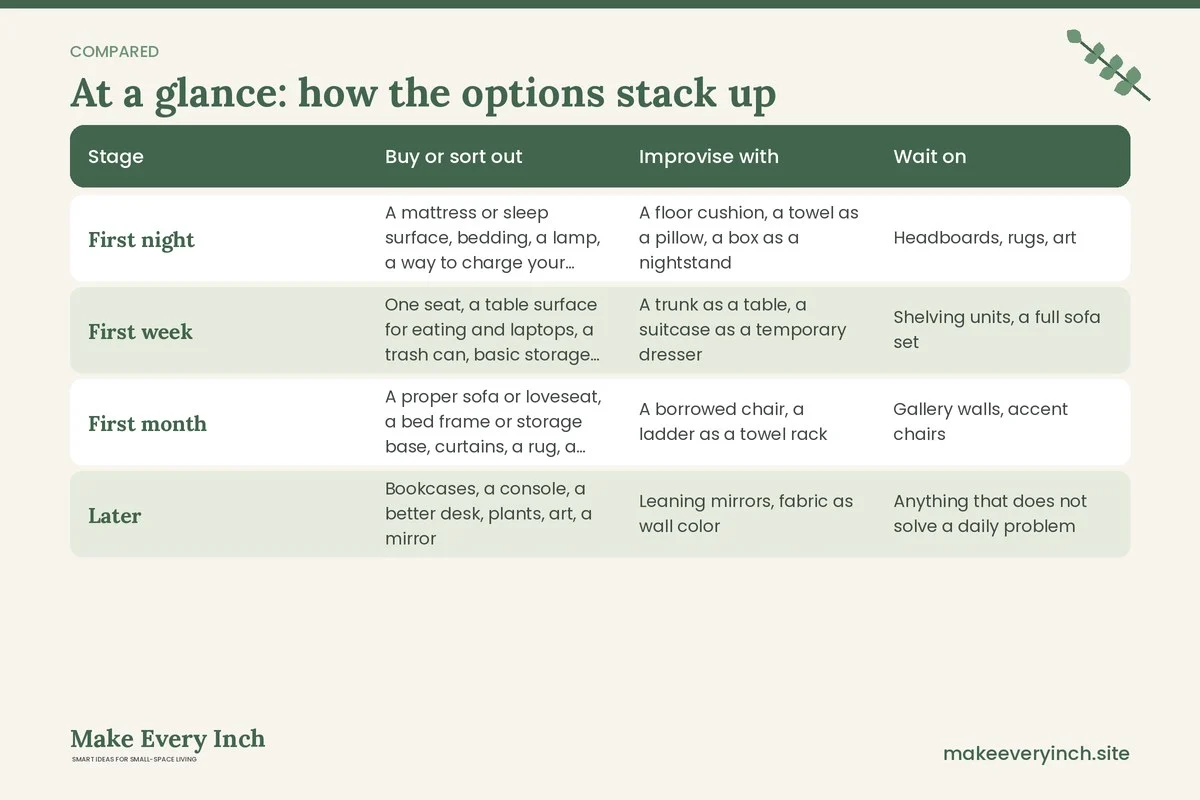
The table shows what to buy at each stage, what to borrow or improvise and what to leave for later. Treat it as a map to adapt, not a rule.
| Stage | Buy or sort out | Improvise with | Wait on |
|---|---|---|---|
| First night | A mattress or sleep surface, bedding, a lamp, a way to charge your phone | A floor cushion, a towel as a pillow, a box as a nightstand | Headboards, rugs, art |
| First week | One seat, a table surface for eating and laptops, a trash can, basic storage bins | A trunk as a table, a suitcase as a temporary dresser | Shelving units, a full sofa set |
| First month | A proper sofa or loveseat, a bed frame or storage base, curtains, a rug, a second light | A borrowed chair, a ladder as a towel rack | Gallery walls, accent chairs |
| Later | Bookcases, a console, a better desk, plants, art, a mirror | Leaning mirrors, fabric as wall color | Anything that does not solve a daily problem |
The logic is simple. Each stage fixes the problem you feel most strongly right now. Sleep comes first because exhaustion makes every other decision worse. Seating and a surface come next, because you will eat and work somewhere. Light and storage follow, and decoration waits until the room has told you what it lacks.
Sourcing: where the budget really stretches
Secondhand and community sources
Used furniture is the main reason a tight budget works. Look at neighborhood swap groups, community listings, estate and moving sales, thrift stores and charity resale shops. Solid wood pieces from earlier decades are often sturdier than new flat-pack furniture, and they hold their value if you decide to resell. Check every used piece in person when possible. Open drawers, sit on seats, wobble tables and look under cushions. Smell upholstery for smoke and damp. Look closely at seams and joints for signs of insects. Avoid used mattresses and upholstered pieces with any sign of pests, and clean everything before it enters the apartment. For more on the style side, see our guide to thrifted apartment decor ideas.
New, but chosen carefully
Some things are better new, such as mattresses, pillows, cords and anything that holds heat. For new furniture, choose simple shapes, standard sizes and finishes that hide wear. Flat-pack furniture can work well in a small apartment, but it needs time to assemble, and it is not always built to be taken apart and put together repeatedly, so plan to keep it in place for a while. Read the weight limits for shelves and desks, and keep the assembly hardware and instructions in a labeled bag.
Borrowing, trading and making
Friends and relatives often have a spare chair, a lamp or a small table collecting dust. Ask openly and early. A simple trade, such as helping with a move in return for a side table, can furnish a corner. Making small pieces is another route. A plank on two sturdy bases becomes a desk, and a crate stack becomes a bedside table. If you want ideas, our DIY apartment upgrades guide covers projects that work in a rental.
A note on timing
Prices and availability move through the year. Many people clear out furniture at the end of a lease, at the turn of a semester and around holidays when they upgrade. Watching listings for a few weeks helps you spot what a fair range looks like for a given item. Give yourself a ceiling for each piece before you start looking, so a good-looking item does not talk you into overspending.
The first night kit
You do not need a furnished apartment on day one. You need a place to sleep, light, clean water to drink and somewhere to put your things. A reasonable first night kit contains the following.
- A mattress or a sleep surface that you can sleep on comfortably, and bedding that fits it
- One lamp with a warm bulb of the type the fixture allows, so you are not stuck with a harsh ceiling light
- A power strip with surge protection, used within its rating, so you can charge devices where you actually sleep
- A few hangers and a tension rod or a rolling rack, so clothes are not on the floor
- Cleaning supplies, trash bags and a basic toolkit
- Two or three boxes to use as temporary tables
Do not run extension cords under rugs or across walkways, and do not plug high-draw appliances into a power strip. Keep strips off damp floors and away from bedding. If outlets are scarce, ask the landlord about adding a few instead of overloading what you have.
The first week: one seat, one surface
After a night or two, you will know whether you need a table more than a chair or the other way round. In most small apartments, the answer is a surface that handles three jobs: eating, working and holding things. A drop-leaf table, a small round table or a narrow console that pulls out can be moved around as needed.
Choosing the first seat
Pick one seat that you would enjoy sitting in for an hour. A small armchair, a two-seater or a firm daybed all work. Measure the seat depth and overall depth, and compare them with your tape outline. In a narrow room, a slim-arm design with raised legs looks lighter, since you can see the floor beneath. See our post on best sofas for small apartments for what to look for.
Choosing the first surface
If you will work from home, make the surface at least 24 inches deep and 36 to 48 inches wide, with the top at a comfortable height, typically around 28 to 30 inches. If you only eat there, a round table about 30 to 36 inches across seats two. If you want a hybrid, a drop-leaf table or a wall-mounted fold-down is ideal, but never fix anything to a wall without permission, and use the correct fasteners for the wall type. A freestanding folding table is the lease-safe option. For more on this, our guide to studio apartment furniture ideas walks through compact pieces.
Storage bins as a bridge
Buy a few simple bins, baskets or crates. They hold things off the floor, keep clutter hidden and can be reused later in a closet, under a bed or on a shelf. Choose one size and color if you can, since uniform storage looks calm. Label them. A tidy start makes the later purchases clearer.
The first month: sofa, bed frame, curtains and light
By the third or fourth week, the room will have taught you more than any floor plan. You will know where you sit and what annoys you.
The sofa decision
A sofa is the largest purchase in most small apartments, so make it carefully. Check the width against your tape, the depth against the walkway and the height against your windows. Measure doorways, stairwells and corners on the delivery route. Look for pieces with legs and with removable covers, since covers can be washed, and legs make cleaning under the sofa easy. A loveseat, a sofa about 60 to 72 inches wide, or a small sectional fits many studios. A sofa bed can double as a guest bed, though comfort for daily sleeping varies, so check it in person. If space is very tight, a daybed or a firm bench with cushions and a back support works instead.
The bed frame
A frame is optional if your mattress sits on a firm, well-ventilated platform. If you want storage, choose a frame with drawers or one that lifts, or raise the bed on sturdy risers to fit boxes below. Make sure risers are rated for the weight and sit evenly. Keep the area under the bed ventilated, and avoid storing damp items there. For a tight room, a frame without a footboard saves a few inches.
Curtains and light
Curtains do more for a room than almost any other item, for their cost. Hang a rod wider than the window and as high as the ceiling or the lease allows, so the window looks taller. Use tension rods or adhesive hooks where drilling is not permitted. Combine a sheer layer for daylight with a heavier layer for privacy. Add a second and third light source at different heights, such as a floor lamp, a table lamp and a small clip light. Layered light makes a small room look larger and more calm. Our post on layered lighting ideas for small apartments explains how.
A rug that fits the room
A rug anchors a zone. In a small apartment, it should be large enough that at least the front legs of the sofa and chairs sit on it. Many people buy rugs that are too small and end up with a floating look. Choose a flat weave or a low pile, which lies flat, is easy to vacuum and does not catch the door. Use a rug pad for grip, and check that corners do not curl, since a curled corner is a trip hazard.
Furniture that earns its place by doing two jobs
In a small apartment, each piece should justify its footprint. Dual-purpose furniture is not about gimmicks. It is about asking what a piece does, beyond its main purpose.
- A storage ottoman provides a footrest, extra seating and a hidden place for blankets
- A bench at the foot of the bed offers seating and a spot to put a bag
- A nesting table set provides a side table for daily use and extra surfaces for guests
- A trunk acts as a coffee table, a blanket chest and a place for out-of-season clothes
- A console behind a sofa creates a desk, a drop zone and a place for a lamp
- A shelf with a deep top can serve as a nightstand, a plant stand and a small bar
Our guide on best nesting tables for small apartments can help you compare shapes, and convertible furniture ideas for studio apartments goes deeper on pieces that change form.
Safety notes when you furnish on a budget
Saving money should never mean taking risks. A few points matter in nearly every small home.
Anchor tall furniture
Bookcases, dressers, wardrobes, shelving units and tall cabinets can tip, especially when drawers are open or a child climbs on them. Use the anti-tip hardware that comes with the piece or a suitable kit, and attach it to a wall stud or a fixing designed for the wall type. In a rental, ask permission first. If drilling is not allowed, ask your landlord about options, and choose low furniture, or keep tall pieces away from areas where children and pets play. Place heavy items low and light items high.
Respect weight limits
Shelves, desks, loft beds and wall hooks have limits. Check the label or the instructions. Do not stack monitors, books and plants on a shelf that is designed for light decor. Spread the load, and keep the heaviest items near the supports.
Electrical and ventilation
Do not cover vents, radiators or heaters with furniture, and keep a safe gap between heat sources and fabric, paper or wood. Do not daisy-chain power strips, and avoid cords across doorways. Make sure that a bed or a wardrobe does not block a window that you may need for fresh air or to get out in an emergency.
Wet areas and GFCI
In kitchens, bathrooms and laundry areas, keep electric devices away from sinks, tubs and splash zones. Outlets near water are normally protected by a ground fault circuit interrupter, often called GFCI. If an outlet near water is not protected, tell your landlord, and do not use it for appliances meanwhile. Choose moisture-resistant finishes for furniture in damp areas.
Paint and finishes
If you refresh a secondhand piece with paint, choose low-VOC products, work with windows open and let the piece cure fully outside the bedroom before using it. Wear a mask designed for the product, and keep children and pets away. Sand old finishes carefully, since older paint may contain lead. If you suspect it, avoid sanding and consult guidance from a local health authority.
Children and pets
Secure cords, avoid small loose parts and check that no furniture can trap a head or paw. Keep poisonous plants out of reach, and anchor anything a climbing child or a cat could topple.
Lease permission
Always read the lease before you attach anything to a wall, ceiling or floor. Ask in writing. Photograph the apartment when you move in and again before you leave. For safe upgrades, see security deposit safe apartment upgrades.
Three example apartments
The following scenarios are illustrations, not case studies. They show how the same logic applies at different sizes. Measurements are approximate.
Scenario one: a studio of about 350 square feet
A single person moves into a long, narrow studio with one window at the far end. The first night kit is a mattress on the floor, a lamp and a rolling rack. In week one, they add a folding table that works as a desk and a dining spot, and a single chair that can be moved to the window. By the end of the month, they have a loveseat about 60 inches wide, placed against the long wall with a slim console behind it to define a sleeping zone. A bed frame with drawers replaces the floor mattress, so a closet is not necessary for off-season clothes. Curtains hang high and wide, and a floor lamp sits in the corner. Walkway width stays at about 32 inches. The overall impression is of two rooms in one, with the bed zone calm and the living zone open. For more on zoning, read studio apartment layout ideas that create zones.
Scenario two: a one bedroom of about 550 square feet for a couple
A couple has a small living room with a window wall and a bedroom that holds a queen bed and little else. They start with the bedroom, because sleeping is the priority. In week one, they add a pair of narrow nightstands, which could be stools or small crates, and a second lamp. The living room gets a loveseat, a folding table and two cushions. In week three, they find a second-hand sideboard in the right depth, about 16 inches, which fits behind the sofa and holds board games, a printer and a tray for keys. A round table seating two sits near the kitchen. They choose a rug about 5 by 7 feet, which fits beneath the loveseat and the table. Wardrobe storage comes last, after they see how much hanging space they need. Tall pieces are anchored with permission from the landlord.
Scenario three: a micro apartment of about 250 square feet
A student rents a micro unit with a kitchenette and a combined living and sleeping area. The priority is to avoid furniture that cannot be moved. They buy a sofa bed in the first week, since it has to be both seat and bed, and they choose a design that opens without hitting the wall. The table is a freestanding drop-leaf design stored behind the sofa. A tall, slim shelving unit goes beside the door and is anchored. Under-bed bins and an over-the-door organizer take care of the rest. They stay away from big rugs, and use a runner by the entry instead. The kit of items comes to a few boxes at move-out, which is exactly what they need.
Smart ways to cut costs without cutting quality
Buy fewer, bigger-impact pieces
A room with five well-chosen items looks better than a room with fifteen random ones. Choose a few anchor pieces, and keep the rest simple. Empty floor space reads as luxury in a small apartment.
Keep a consistent palette
Stick to two or three main colors, plus one accent. This lets mismatched pieces look like a collection. If a used table is not quite right, a coat of paint in a color that appears elsewhere in the room can make it belong. Use low-VOC paint, and ventilate.
Use what you have in new ways
A suitcase can be a side table, and a ladder can be a towel rack or a blanket stand. A tray placed on top of an ottoman creates a table. Move things between rooms before buying anything new. A bookcase in the hallway may be a better nightstand than any new piece.
Upgrade the hardware
New knobs and pulls can make old furniture look fresh. If you are renting, keep the original hardware in a bag so you can restore it before you move out.
Wait for the second look
If you are unsure about a purchase, leave it in the listing or the store for 48 hours. If you still want it and can measure where it will sit, buy it. Many impulse buys disappear after a night’s sleep.
For more ideas, see our guides to small apartment decor under 100 and cheap storage ideas for apartments.
Common mistakes to avoid
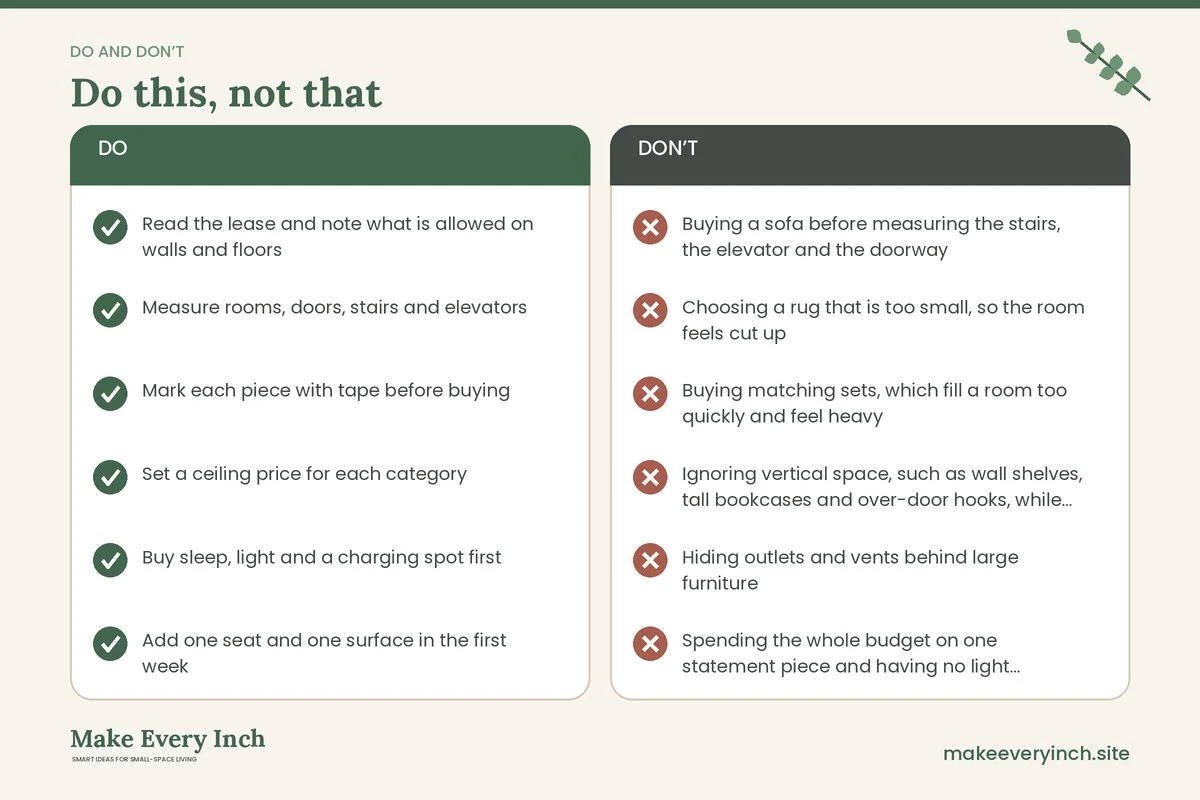
- Buying a sofa before measuring the stairs, the elevator and the doorway
- Choosing a rug that is too small, so the room feels cut up
- Buying matching sets, which fill a room too quickly and feel heavy
- Ignoring vertical space, such as wall shelves, tall bookcases and over-door hooks, while still anchoring tall pieces
- Hiding outlets and vents behind large furniture
- Spending the whole budget on one statement piece and having no light, curtains or storage
- Skipping a trial run with tape on the floor
- Not asking the landlord about what is allowed on walls
- Treating decor as a first-week purchase instead of a final layer
- Keeping every box and bag of packing material, which creates clutter before the furniture arrives
A four-week schedule you can follow
Week one
Measure everything. Mark pieces on the floor with tape. Buy or sort the first night kit, a seat and a surface. Unpack the essentials, and put away the rest in labeled bins. Photograph the apartment for the lease record.
Week two
Live with the layout. Note what bothers you. Watch listings for a sofa, a chair or a table in the sizes you measured. Visit one or two second-hand sellers in person. Decide your ceiling for each purchase.
Week three
Buy the sofa or main seat, the lamp or lamps, and curtains. Hang the curtains high and wide. Set up the work zone, and test it for a few days.
Week four
Add the rug and storage that you now know you need. Choose one thing to build or restore yourself. Edit out anything that does not fit. Take photos of the finished layout to compare with your tape plan, and to remember what worked.
Checklist for furnishing a small apartment on a budget
- Read the lease and note what is allowed on walls and floors
- Measure rooms, doors, stairs and elevators
- Mark each piece with tape before buying
- Set a ceiling price for each category
- Buy sleep, light and a charging spot first
- Add one seat and one surface in the first week
- Use bins as temporary storage
- Choose furniture with legs, light visual weight and two jobs
- Anchor tall furniture, with permission where required
- Keep walkways at about 30 to 36 inches
- Check vents, outlets and window access
- Use low-VOC paint and ventilate when refinishing
- Keep decor for last
- Photograph the apartment at move-in and at move-out
FAQ
How do I furnish a small apartment on a very tight budget?
Start with sleep, light and a simple surface, then add pieces slowly. Use secondhand and borrowed items, avoid matching sets and wait for decor. Spreading purchases over a month helps you avoid mistakes.
What should I buy first for a new apartment?
A place to sleep, bedding, a lamp and a way to charge your phone. Then a seat and a surface for eating and working. Everything else can wait until you have lived there for a week or two.
Is it better to buy used or new furniture?
Used furniture often gives better value, especially solid wood pieces. Buy new for mattresses, pillows, cords and anything that is hard to clean. Inspect used pieces in person when you can.
How much walking space do I need in a small apartment?
Aim for about 30 to 36 inches on main routes and about 24 inches on secondary paths. Check that doors, drawers and appliances open fully.
How can I make a small apartment feel bigger when furnishing it?
Choose furniture with legs, keep floors visible, hang curtains high, use mirrors and layered light and limit the palette. Avoid filling every wall.
Do I need to anchor furniture in a rental?
Tall furniture should be anchored to prevent tipping, especially around children and pets. Ask your landlord for permission and for approved methods before drilling. If anchoring is not allowed, choose low pieces.
Can I paint secondhand furniture safely?
Yes, with care. Use low-VOC paint, work in a ventilated area and let it cure fully before using it indoors. Do not sand old painted pieces without checking for lead.
How long should it take to furnish a small apartment?
Many people live comfortably after one to two weeks with the basics and finish over a month or two. Taking your time is cheaper than rushing.
Keep going: Keep going with our pillar on budget small space ideas, the sibling guide to before and after budget small space makeovers and our tips for a small apartment makeover on a budget.
Save this guide for later
Pin the ideas you like to Pinterest so you can come back to them when you plan your space.