Small Room Decor Ideas: The Complete Guide to Color, Lighting and Style
Quick answer: The best small room decor ideas follow a short order of operations. Settle the color story first, light the room in layers, add mirrors and window treatments that bounce and soften daylight, then style the walls, floor and shelves with restraint. Keep one or two big moves, repeat a few materials, edit ruthlessly and leave some empty space so the room can breathe. Measure before you buy and check your lease before you paint or drill.
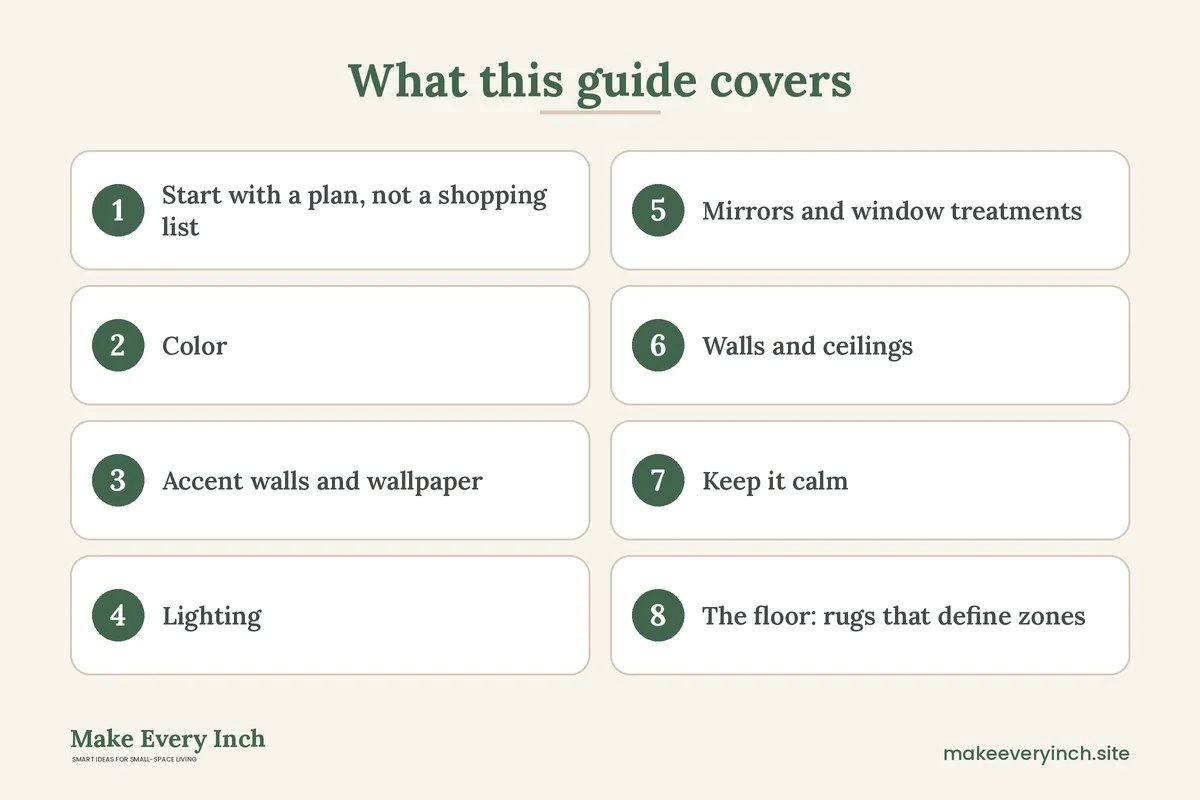
Small room decor ideas work best when they treat the room as one connected picture rather than a pile of separate purchases. A little room has no space to hide a bad decision: a clashing paint color, a harsh ceiling light or an oversized rug is visible from every angle. The same fact is also your advantage, because a small room needs fewer things to look finished, and every good choice is multiplied. This pillar guide gathers everything we know about styling compact spaces. It covers color and paint, accent walls and wallpaper, lighting, mirrors, window treatments, wall art, clutter control, shelves, rugs, curtains, ceilings, plants and a few style directions, then ends with a table, a checklist and a list of every guide in the series. Each section links to a detailed post, so you can dive into whichever problem is bugging you today. If you rent, keep your lease in mind throughout.
Start with a plan, not a shopping list
Before you open a single paint can, stand in the doorway and describe the room in three words. Maybe it is dark, narrow and busy. Maybe it is bright, boxy and bare. Those three words are your brief, and every decor decision should move the room toward the opposite. A dark room wants reflected light and pale surfaces. A narrow room wants horizontal lines and a focal point at the far end. A busy room wants fewer colors and more calm.
Next, note what the room has to do. A bedroom needs rest, a living room needs seating and conversation, a studio needs several zones, and a hallway needs to move people along. Decor that fights the job of the room never feels right, however pretty it looks in a photo. If you are working on a particular room, our pillar guides on small living room ideas, small bedroom ideas, small kitchen ideas, small dining room ideas and small bathroom ideas cover layout and furniture, while this guide focuses on the decor layer on top.
Finally, collect a few images you love and look for what they share. You will probably find a repeated color, a repeated material or a repeated mood. That pattern is your style, and it will save you from impulse buys that do not belong. Photograph the room in daytime and at night, because it will look different, and decide which version you want to improve.
Color: the biggest lever in a small room
Color changes how a room feels more than any other decor choice, and it costs very little compared with new furniture. The old rule that small rooms must be white is a myth, but there is real logic behind it: pale, warm, low-contrast colors reflect light and blur the edges of the room, which can make walls feel farther away. Deeper colors can work too, as long as you choose them on purpose and commit.
Colors that make a room look bigger
Light neutrals, soft greens, pale blues and warm whites are the usual starting points, because they bounce light and keep the eye moving. Painting the walls, trim and even the ceiling in close tones removes the hard lines that chop a room into pieces. Our guide to colors that make small rooms look bigger explains which undertones help, which to avoid and how to test a shade at different times of day.
Schemes that feel cohesive
A small room has no room for five competing colors. A reliable approach is a main color for the walls, a secondary tone for large textiles and a small dose of accent color in objects. Repeating each color in at least two places makes the room feel planned. See small room color schemes that feel cohesive for palettes you can adapt, including how to connect rooms that open onto one another.
Paint for low light
Rooms with little daylight, such as north-facing rooms, basement rooms and rooms facing a wall, behave differently. Cool grays can turn gloomy, while warm whites, soft clays and light creams usually hold up better. Some people choose to embrace the dimness with a deep, moody shade instead of fighting it. Read small room paint ideas for low light for ways to judge the light before you commit, and how finish affects bounce.
Test before you commit
Paint a large sample board or a big patch on two walls, and look at it in the morning, midday and evening, with the lamps on and off. Light changes color dramatically, and a swatch under shop lighting tells you very little. Live with the samples for a few days before you buy gallons. If you rent, ask permission in writing before painting, and consider the other options below.
Accent walls and wallpaper: pattern with a plan
An accent wall can make a small room feel designed, but only when it has a purpose. The best accent wall sits behind a focal point, such as a bed, a sofa or a desk, and draws attention to the part of the room you want to be seen. Placed on the wrong wall, an accent can chop the room in half and make it feel smaller. Our guide to small room accent wall ideas covers color, texture, paneling and painted shapes, and explains how to pick the wall that helps rather than hurts.
Wallpaper is the bolder cousin. Pattern in a small room can be lovely, but it asks for care with scale, contrast and placement. A small, airy pattern in a pale palette tends to recede, while a large, high-contrast print can feel heavy on every wall. Using paper on a single wall, inside a niche, on the back of a bookcase or on a ceiling gives the effect without the weight. See small space wallpaper ideas that do not overwhelm for the choices that keep a room calm, and read our post on renter-friendly wall decor ideas if you need removable options.
Lighting: the layer that makes everything else work
A beautiful palette will look flat under a single bright ceiling bulb. Good lighting is layered, with ambient light for general use, task light for jobs and accent light for mood. In a small room, those layers do a second job as well: they pull light to the edges and make the room feel wider and softer.
Light every corner
Dark corners shrink a room, because the eye reads them as the end of the space. A small lamp, a wall light or a plug-in sconce in each corner pushes the edge of the room outward. Our guide to small room lighting ideas for every corner shows how to place lamps at different heights, choose bulb warmth and avoid glare.
Build layers in a small apartment
In a small apartment, one fixture often has to serve several areas. Layering means adding a floor lamp near the sofa, a table lamp by the bed, a shelf light or strip light for accent and a task lamp where you read or work. Read layered lighting ideas for small apartments for plans that work with few outlets and no ceiling wiring, and our pillar on renter-friendly lighting ideas for plug-in and adhesive solutions that leave no trace.
Bulb basics
Warm white bulbs, often described as a color temperature of about 2700 to 3000 kelvin, flatter most living and sleeping areas. Cooler bulbs can suit kitchens and workspaces. Use the same warmth across a room so the light does not look patchy, and add dimmers where you can. Always check the maximum bulb wattage listed on a lamp, and use bulbs that match the fixture to avoid overheating.
Mirrors and window treatments: borrowing and shaping light
Two items can change a small room’s light more than any lamp: mirrors and window coverings. Both are about controlling what daylight does once it enters.
Mirror placement
A mirror reflects whatever it faces, so the placement matters more than the size. A mirror opposite a window doubles the daylight, a mirror on a side wall widens a narrow room and a mirror reflecting a clutter pile just doubles the clutter. Tall leaning mirrors add height, round mirrors soften boxy rooms and a group of small mirrors can make a gallery. Our guide to small room mirror placement ideas walks through each position, and explains how to hang heavy glass safely. Always secure large mirrors to the wall with suitable hardware, and keep them away from sources of heat.
Window treatments
The window is often the largest feature in a small room, and the treatment sets the tone. Sheer panels soften light without blocking it, roman shades keep the lines clean and blinds give control. Mount treatments wide enough that the glass is not covered when open, so the window appears larger. See small room window treatment ideas for options by room type, including privacy solutions for street-level windows.
Curtains that add height
Hanging the rod close to the ceiling, or even at the ceiling line, and letting fabric fall to the floor draws the eye up and makes the walls look taller. Choose a light, simple fabric in a tone close to the wall, and add enough width for gentle folds. Our guide to small space curtain ideas to add height explains rod height, length and fullness, and how to handle a low ceiling or a radiator under the window.
Walls and ceilings: use the surfaces you already have
In a small room, the floor is precious and the walls and ceiling are not. The more decor you move to the vertical surfaces, the freer the floor can stay.
Wall art that fits
Large pieces often work better than many small ones, because one confident frame looks calmer than a dozen little ones. Hang art with the center near eye level, about 57 to 60 inches from the floor, and keep the group tied to a piece of furniture beneath. A gallery wall needs a shared element, such as matching frames or a limited palette, to avoid looking busy. Our post on small space wall art ideas covers sizing, spacing and groupings, and the pillar on renter-friendly wall decor ideas shows how to hang without damage.
Ceilings that draw the eye up
The ceiling is the fifth wall and the most overlooked. Painting it a pale shade slightly lighter than the walls can lift the room, while a soft color, a gentle pattern or a painted trim can make a low ceiling feel intentional. Vertical stripes, tall bookcases and long curtains all help the eye travel upward. Read small room ceiling ideas that draw the eye up for paint, paper and lighting ideas for ceilings of different heights.
Keep it calm: clutter, shelves and editing
Decor fails fastest when there is too much of it. Because small rooms show every object, the difference between styled and messy is often a matter of quantity rather than taste. The best decorators in small spaces edit more than they add.
Decor that avoids clutter
Start by giving every category of object a home, then display only the best. Group small items on trays so they read as one object. Choose a few larger pieces rather than many tiny ones. Keep surfaces such as the coffee table and the nightstand at about two-thirds empty. Our guide to small room decor ideas that avoid clutter goes through the rules in detail, and the pillar on small-space decorating ideas on a tight budget shows how to refresh a room by removing things rather than buying.
Styling open shelves
Open shelves look wonderful and fall apart quickly. The trick is to mix books, objects and empty space in a rhythm, to repeat a color or material and to leave a third of each shelf blank. Stack some books horizontally, stand others upright and place a plant or a small piece of art as a pause. See small space styling rules for open shelves for formulas you can follow shelf by shelf. Anchor tall shelving to the wall so it cannot tip.
Edit with one question
For each item, ask whether it is useful, beautiful or meaningful. If it is none of those, it probably does not belong in a small room. Rotate seasonal pieces from storage instead of keeping everything out. Photograph the room once a month and look at the picture; it shows clutter your eyes have learned to ignore.
The floor: rugs that define zones
A rug anchors furniture, adds warmth and, in a studio or an open plan, marks where one zone ends and the next begins. In a small room, the wrong rug is a common mistake: too small and it looks like a doormat floating in the room, too large and it swallows the floor. Our guide to small room rug ideas to define zones covers placement, shape and pattern for living, sleeping and dining zones.
Size is the part people get wrong most often. In a living room, at least the front legs of the sofa and chairs should sit on the rug, which is why a rug about 5 by 8 or 8 by 10 feet is common for compact seating areas. Measure your furniture, tape the rug outline on the floor and adjust before you buy. Our detailed post on how to choose rug size for a small living room gives layouts for sofas, chairs and coffee tables. Use a non-slip pad, and keep the edges flat so nobody trips.
Plants and natural materials: life in a small footprint
Plants soften hard lines, add color and help a room feel alive. They also take space, so choose them for their shape. Trailing plants on a shelf, a tall slim plant in a corner, a hanging planter near a window and a few small pots on a sill each use different parts of the room. Pick species that suit your light, and check which plants are safe if you share your home with pets or small children. See small space plants and planters ideas for placement, drainage and styling tips, including ways to protect furniture from water.
Natural materials do similar work. Wood, linen, cotton, wool, rattan and stone add texture so a simple palette never feels flat. A small room with a calm color story and rich textures often looks more expensive than one with many colors and no texture, even when the budget is modest.
Choose a style direction
You do not need to pick a named style, but it helps to know which direction you lean toward, because it narrows your choices. Two directions suit small rooms especially well.
Neutral lovers
If you love a pale, quiet room, texture and tone become your tools. Layer whites, creams, stone and oatmeal, add a darker accent such as black or deep brown for contrast and vary the finishes between matte, woven and soft. Our guide to small room decor ideas for neutral lovers shows how to keep a neutral room warm instead of bland.
Warm wood
Wood brings warmth and grounding to compact spaces. A few wooden pieces in a similar tone, such as a bench, a shelf and a frame, tie a room together. Mixing too many tones can look busy, so pick one dominant tone and one or two supporting ones. See small room decor ideas with warm wood for combinations with paint, textiles and metal.
Match the style to the home
If you are still deciding on a direction for your whole home, our pillar on apartment decorating styles compares the popular looks and shows what suits a small footprint. For smaller budgets, the guide to budget small space ideas shows how to build a style with secondhand finds and simple upgrades.
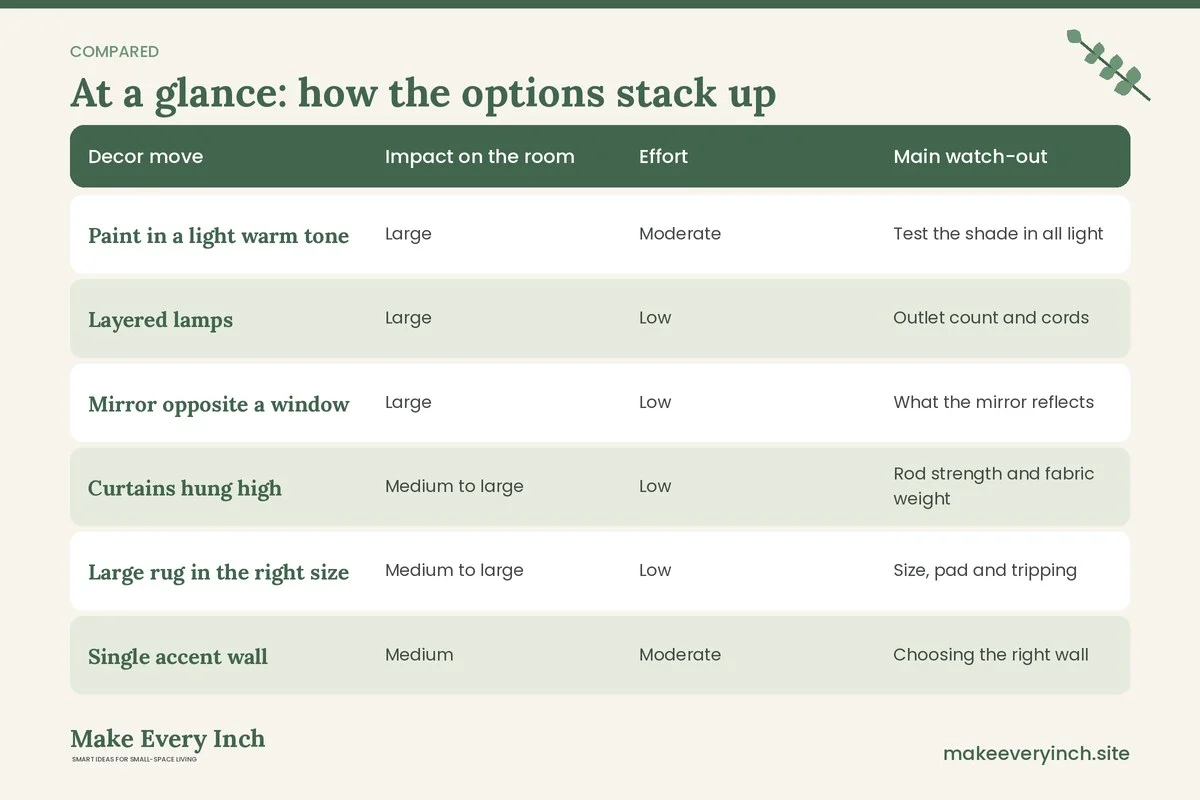
Choosing the right move: a comparison table
The table below compares common small room decor moves by impact, effort and the main watch-out. Use it to decide where to start, and read the linked guide for each.
| Decor move | Impact on the room | Effort | Main watch-out |
|---|---|---|---|
| Paint in a light warm tone | Large | Moderate | Test the shade in all light |
| Layered lamps | Large | Low | Outlet count and cords |
| Mirror opposite a window | Large | Low | What the mirror reflects |
| Curtains hung high | Medium to large | Low | Rod strength and fabric weight |
| Large rug in the right size | Medium to large | Low | Size, pad and tripping |
| Single accent wall | Medium | Moderate | Choosing the right wall |
| Wallpaper on one wall | Medium | Moderate to high | Scale of the pattern and the lease |
| Large wall art | Medium | Low | Hanging height and fixings |
| Edited open shelves | Medium | Low | Leaving empty space |
| Plants and planters | Small to medium | Low | Light, water and pet safety |
Common mistakes to avoid
Most small room decor problems come from a handful of repeat errors. Choosing a color from a tiny swatch, relying on one overhead light, hanging art too high, buying a rug that is too small, filling every shelf, crowding the window and mixing too many patterns are the usual ones. Another is treating a small room like a miniature of a big room, with the same furniture shrunk down. Small rooms need fewer, better-chosen pieces, and room to move. Our guide to small space decorating mistakes to avoid lists the full set with fixes, and it is a good read before you start any project.
Safety, anchoring and the lease
A few practical points deserve their own section.
- Anchoring: tall shelves, large mirrors and heavy frames can fall. Anchor tall furniture to the wall with hardware suited to your wall type, and fix mirrors and heavy art with proper anchors rated for the load.
- Lighting and electricity: do not overload outlets, avoid daisy-chaining power strips, keep cords out of walkways and match bulbs to the fixture rating. If in doubt, ask a qualified electrician.
- Fabric and fire safety: keep curtains, plants and paper away from heaters and open flames, and never cover a smoke alarm.
- Lease permission: many leases limit painting, drilling and fixed installations. Ask in writing, choose removable or freestanding options when you cannot get permission, and photograph the walls before and after.
- Paint and ventilation: open windows when painting, follow the label on every product and keep children and pets out of the room until it has aired.
Also keep exits clear. A shelf, a plant or a rug should never block a door, a window you might need in an emergency or access to a smoke alarm.
A simple checklist for decorating a small room
Use this list to plan, build and maintain your space.
- Describe the room in three words and decide what it needs most.
- Note what the room has to do and keep decor in service of that.
- Choose a main wall color and test it at several times of day.
- Limit the palette to a main color, a secondary tone and one accent.
- Add light at three levels: ambient, task and accent.
- Place a mirror where it reflects something worth doubling.
- Hang curtains high and wide so the window looks larger.
- Pick a rug that lets at least the front legs of the furniture sit on it.
- Hang art near eye level and favor fewer, larger pieces.
- Leave about a third of every shelf and surface empty.
- Add one or two plants chosen for your light.
- Anchor tall furniture and heavy mirrors properly.
- Ask the landlord before painting or drilling.
- Review the room each month and edit what no longer earns its place.
Frequently asked questions
What are the best small room decor ideas for a beginner?
Start with the changes that have the biggest effect for the least effort: a light, warm wall color, layered lamps instead of one ceiling light, a mirror placed to catch daylight and curtains hung high. Then edit your surfaces so only a few well-chosen items remain. These steps change how the room feels before you buy any large furniture.
Do small rooms have to be painted white?
No. Light, warm tones tend to reflect more daylight and can make walls feel farther away, but deep colors can look rich and cozy when they are chosen on purpose. The key is to test the color in your own light and to keep the rest of the room simple. Our guides on color and low-light paint explain both approaches.
How do I make a small room look bigger without moving walls?
Use light, low-contrast color, reflect daylight with a mirror, hang curtains close to the ceiling, keep the floor visible with slim or leggy furniture and reduce clutter. Lighting every corner also helps, because dark corners make a room feel smaller than it is.
How many colors should I use in a small room?
Many designers suggest working with three: a main color, a secondary tone and an accent. Repeat each in more than one place so the room feels planned. Neutrals, wood and metal finishes can be added without counting as extra colors, as long as they sit comfortably with the main palette.
Where should I put a mirror in a small room?
A common choice is opposite or beside a window, so the mirror doubles daylight. A mirror on a side wall can widen a narrow room, and a tall mirror leaning in a corner adds height. Avoid placing a mirror where it reflects clutter or a harsh bulb. Secure large mirrors with suitable hardware.
What size rug works in a small living room?
It depends on the layout, but a good guide is that at least the front legs of the sofa and chairs should rest on the rug. Many compact seating areas suit a rug about 5 by 8 or 8 by 10 feet, though your own measurements matter most. Tape the outline on the floor before you buy.
Can I decorate a small room if I rent?
Yes. Use plug-in lamps and sconces, removable hooks, leaning mirrors and art, curtains on tension rods, peel-and-stick options where the lease allows, rugs, plants and textiles. Always check your lease, ask in writing before you paint or drill and photograph the walls before and after.
How do I decorate a small room on a budget?
Edit first, because removing clutter is free. Then repaint a single wall or piece of furniture, move lamps and mirrors around, shop secondhand for frames and shelves and add plants and textiles slowly. Our pillar on decorating small spaces on a tight budget has more ideas, and prices vary so compare locally.
All our small room decor guides
Every guide in this cluster is listed below. Pick the one that matches your room or your question.
- Colors that make small rooms look bigger: light, warm and low-contrast palettes that open up a room.
- Small room color schemes that feel cohesive: build a main, secondary and accent palette that holds together.
- Small room paint ideas for low light: shades and finishes that work in dim rooms.
- Small room accent wall ideas: choose the right wall and treatment for a focal point.
- Small space wallpaper ideas that do not overwhelm: pattern scale and placement for compact rooms.
- Small room lighting ideas for every corner: lamps and fixtures that push back dark corners.
- Layered lighting ideas for small apartments: ambient, task and accent light with few outlets.
- Small room mirror placement ideas: where mirrors double light and where they hurt.
- Small room window treatment ideas: sheers, shades and blinds that suit tight rooms.
- Small space wall art ideas: sizes, heights and groupings for small walls.
- Small room decor ideas that avoid clutter: rules for editing and displaying less.
- Small space styling rules for open shelves: formulas for shelves that look styled, not stuffed.
- Small room rug ideas to define zones: use rugs to mark living, sleeping and dining areas.
- Small space curtain ideas to add height: rod height and fabric choices that lift the walls.
- Small room ceiling ideas that draw the eye up: paint, paper and light for the fifth wall.
- Small space plants and planters ideas: greenery that fits shelves, sills and corners.
- Small room decor ideas for neutral lovers: texture and tone for a calm, warm neutral room.
- Small room decor ideas with warm wood: bring in wood tones without making the room heavy.
- Small space decorating mistakes to avoid: the common errors and how to fix them.
- How to choose rug size for a small living room: measure and place a rug that fits the seating.
Keep going: Keep going with colors that make small rooms look bigger, small room lighting ideas for every corner and small room decor ideas that avoid clutter.
Save this guide for later
Pin the ideas you like to Pinterest so you can come back to them when you plan your space.