19 Renter Friendly Bathroom Upgrades With Costs and Risk Ratings
Quick answer: The best renter friendly bathroom upgrades are a new showerhead, a toilet seat, a shower curtain and liner, a bath mat, a mirror or light you can swap back, peel-and-stick floor tiles and a freestanding storage unit. Most cost $10 to $120, take under two hours, and carry low risk, as long as you keep every original part, check the lease and photograph before and after.
Renter friendly bathroom upgrades are different from decorating ideas, because a bathroom has plumbing, wet surfaces and fixtures the landlord owns. Swapping a showerhead is a ten-minute job that can change your mornings, while a badly chosen adhesive can leave a stain on grout or peel a glazed surface. This guide gives each of the 19 upgrades a price range, the tools you need, how long it takes, a risk rating and the exact steps to put the original back. For general styling and layout ideas, see our separate guide to renter friendly bathroom ideas, and for the small-space side, see small bathroom ideas.
How the risk ratings work
Each upgrade has one of three ratings. Low means nothing is attached to a wall, floor or fixture in a way that can leave a mark, or the original part is kept and refitted by hand. Medium means an adhesive, a clamp or a swap of a landlord’s fixture is involved, so you must follow the removal steps. High means a mistake could cause leaks, water damage, stains or a deposit deduction, so ask first, in writing, or skip it. These ratings are practical guidance, not a promise, so judge each case by your own surfaces.
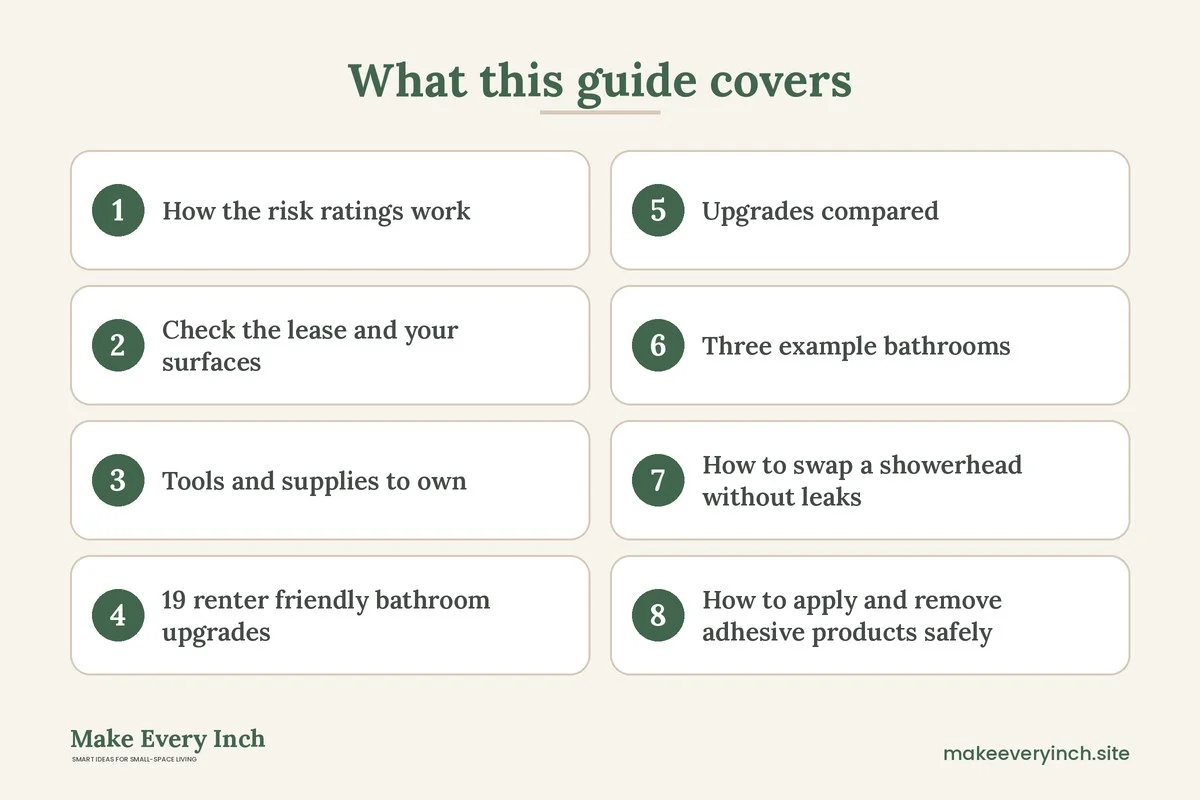
Check the lease and your surfaces
Read the lease for the words repairs, alterations, fixtures, plumbing and decorating. Many leases let you swap items you can reverse, as long as you store the originals and put them back. Some forbid any change to plumbing fixtures, even a showerhead. If unsure, email your landlord a short list of what you plan, and keep the reply.
Photograph the whole bathroom before you touch anything: the toilet, the tub or shower, the sink, the mirror, the light, the walls, the floor and the grout, and the water heater temperature if you can see it. Take close-ups of any chips, stains or cracks. Photograph again after the upgrades, and again at move-out.
Then check your surfaces. Glazed tile and porcelain take adhesive well and clean easily. Painted drywall in a bathroom may be older paint with a weak bond, and steam can loosen adhesive over weeks. Grout is porous and can stain. Fiberglass tubs scratch. Know what you have before choosing a method.
Tools and supplies to own
A small kit covers most upgrades: an adjustable wrench, a pair of slip-joint pliers, a cloth to protect chrome finishes, plumber’s thread seal tape (also called PTFE tape), a flat screwdriver, a Phillips screwdriver, a tape measure, a small level, a hair dryer, rubbing alcohol, microfiber cloths, a plastic scraper and a labeled zip bag for original parts. Total cost is about $25 to $45 if you own none of it.
19 renter friendly bathroom upgrades
Fixtures you can swap and reverse
1. A new showerhead
Cost: $15 to $60. Time: 10 minutes. Risk: low. Wrap the shower arm threads with 2 or 3 turns of PTFE tape, hand tighten the new head, and finish with a gentle quarter turn from a wrench over a cloth. Keep the old head in a bag, and refit it at move-out. Check the product label for its water flow rate if your area has limits.
2. A handheld shower on a bracket
Cost: $30 to $90. Time: 20 minutes. Risk: low to medium. Many kits screw onto the existing arm and include a diverter, with a bracket that hooks onto the arm, so no drilling is needed. A handheld wand also makes cleaning the tub easier.
3. A toilet seat
Cost: $20 to $50. Time: 15 minutes. Risk: low. Unscrew the plastic bolt caps, turn the nuts under the seat, lift off the old seat and bolt on the new one. Measure the bowl as round or elongated before buying, and keep the old seat in a bag.
4. A new faucet aerator
Cost: $5 to $15. Time: 5 minutes. Risk: low. The aerator is the small screen at the spout tip, and it unscrews by hand or with a key. A new one can add spray control and slightly improve water pressure feel, and it takes seconds to swap back.
5. Cabinet knobs or drawer pulls
Cost: $10 to $40. Time: 20 minutes. Risk: low. If the vanity has knobs on a single screw, replace them with the same size screws, and keep the old ones. Match the hole spacing for pulls, since you cannot add new holes.
6. A swap-in light shade or a vanity light bulb change
Cost: $8 to $30. Time: 10 minutes. Risk: low. Replace builder-grade bulbs with LED bulbs of 2700K to 3000K for a warm look, or higher for makeup. Use bulbs rated for damp rooms if the fixture is near the shower. See small bathroom lighting ideas and renter friendly lighting ideas.
Soft goods and surfaces
7. A shower curtain, liner and rod
Cost: $25 to $70. Time: 15 minutes. Risk: low. A cloth curtain with a separate, weighted liner changes the whole room. Choose a liner marked as mildew resistant, wash it monthly and hang the curtain a few inches above the floor. A tension rod works if the alcove walls are tile or fiberglass, and the rod must be rated for the weight.
8. A bath mat and rug set
Cost: $20 to $80. Time: 5 minutes. Risk: low. Choose a mat with a non-slip backing, and dry it weekly. Rubber backing can stick to or mark some vinyl floors, so test a small corner, or use a mat with a cloth backing on sensitive floors.
9. New towels, hooks and a towel bar swap
Cost: $15 to $60. Time: 20 minutes. Risk: low to medium. Hang an over-door hook rack, or a freestanding towel ladder, instead of drilling. If you use adhesive hooks, buy ones rated for bathrooms and wait the full time before hanging weight.
10. A shower caddy
Cost: $15 to $45. Time: 5 minutes. Risk: low. Hang a rust-resistant caddy from the shower arm or the curtain rod instead of sticking it to tile. Keep the load light, and rinse it monthly.
11. Peel-and-stick floor tiles
Cost: $40 to $120 for a typical 25 to 40 square foot floor. Time: 2 to 4 hours. Risk: medium to high. Peel-and-stick tile can cover worn vinyl, and it can tear flooring on removal. Test one tile in a corner for a week, and ask your landlord first. Do not use on a floor that gets pooled water, and keep tiles off the subfloor.
12. A large rug or a floor mat over tired flooring
Cost: $30 to $120. Time: 5 minutes. Risk: low. If you want to hide a cracked or ugly floor, a washable rug with a non-slip pad is a safer option than tile. Wash it often, and dry it fully.
Walls and mirrors
13. A framed mirror leaned or hung with strips
Cost: $30 to $120. Time: 15 minutes. Risk: low to medium. Lean a mirror on the vanity or on a shelf, or hang a lightweight one with strips rated for damp rooms and well above its weight. Never hang a large mirror over a toilet or tub on adhesive alone.
14. A mirror frame kit
Cost: $25 to $80. Time: 45 minutes. Risk: medium. Some kits clip onto the edge of a builder-grade mirror and hide the bare edge. Choose clip-on types rather than glued ones, and check they can be removed without marking the mirror.
15. Peel-and-stick wallpaper on one dry wall
Cost: $30 to $120. Time: 2 to 3 hours. Risk: medium. Use it outside the splash zone, with an exhaust fan, and on satin or semi-gloss paint. See removable wallpaper ideas for prep and removal.
16. A peel-and-stick backsplash behind the sink
Cost: $30 to $100. Time: 1 to 2 hours. Risk: medium. Choose a gel-tile or vinyl sheet made for splashes, press it on clean, dry tile or paint, and seal the top edge only if the instructions say so. See temporary backsplash ideas.
Storage and extras
17. A freestanding storage unit
Cost: $40 to $150. Time: 30 to 60 minutes. Risk: low. An over-toilet etagere, a slim rolling cart or a corner shelf adds storage without walls. Check the unit’s footprint against the door swing, and choose one with feet or a base that sits on a mat. See small bathroom shelving ideas.
18. Under-sink organizers
Cost: $15 to $60. Time: 20 minutes. Risk: low. Stacking bins and a tension rod under the sink hold cleaning supplies and spare rolls. Keep them away from any pipe joints, so you can see leaks quickly.
19. A plug-in or battery light and a small plant
Cost: $15 to $50. Time: 10 minutes. Risk: low. A battery-powered LED light and a plant that tolerates humidity, such as a pothos or a snake plant, soften a bathroom. Keep electric items away from water, and use outlets with ground-fault protection, which are standard in modern bathrooms.
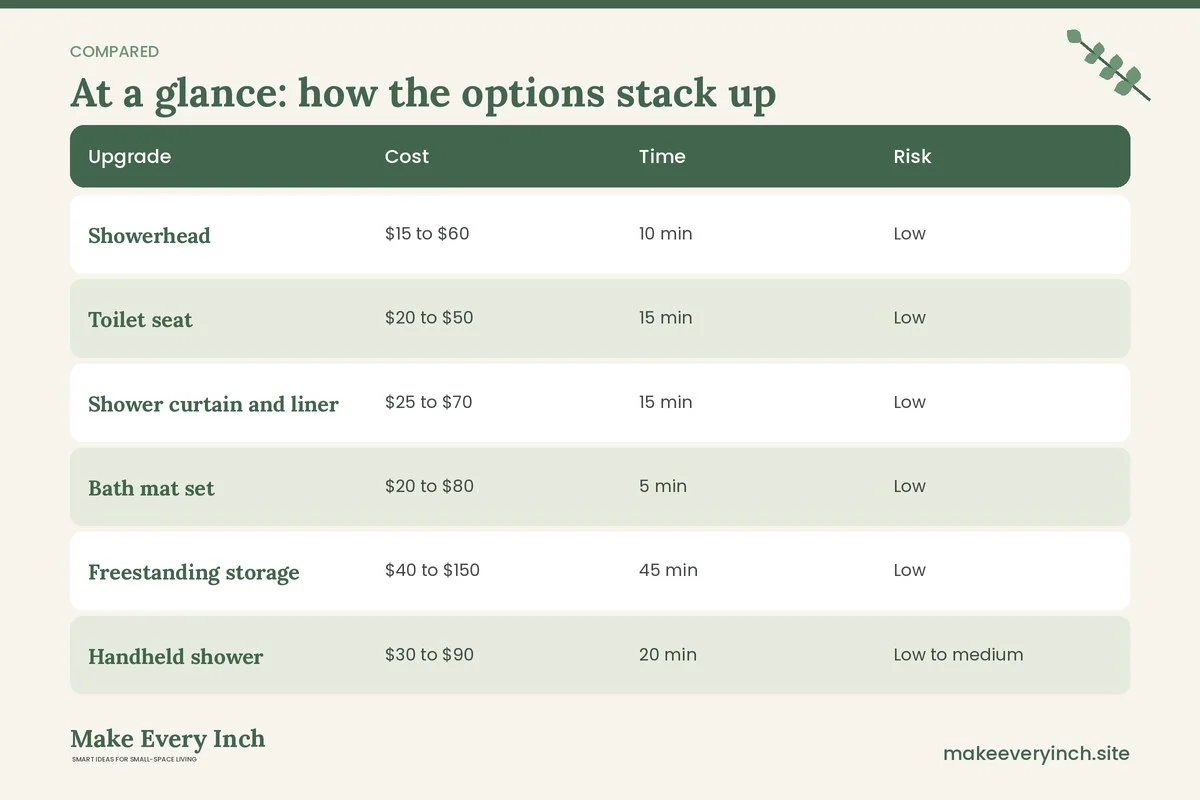
Upgrades compared
| Upgrade | Cost | Time | Risk | Removal |
|---|---|---|---|---|
| Showerhead | $15 to $60 | 10 min | Low | Refit old head |
| Toilet seat | $20 to $50 | 15 min | Low | Refit old seat |
| Shower curtain and liner | $25 to $70 | 15 min | Low | Fold and pack |
| Bath mat set | $20 to $80 | 5 min | Low | None |
| Freestanding storage | $40 to $150 | 45 min | Low | Carry out |
| Handheld shower | $30 to $90 | 20 min | Low to medium | Refit old head |
| Framed mirror | $30 to $120 | 15 min | Low to medium | Peel strips slowly |
| Peel-and-stick wallpaper | $30 to $120 | 3 hr | Medium | Heat and peel |
| Peel-and-stick backsplash | $30 to $100 | 2 hr | Medium | Heat and peel |
| Peel-and-stick floor | $40 to $120 | 3 hr | Medium to high | Heat, peel, clean |
Three example bathrooms
The $60 morning refresh
A renter with a plain white bathroom replaces a worn showerhead for $22, buys a cloth curtain and liner for $26 and a cotton bath mat for $14. The job takes an hour. The old head goes into a labeled bag and then into a storage box. Risk stays low, and the room feels new.
The $200 upgrade for a dark windowless bath
A tiny bathroom has yellow light and builder-grade mirrors. The renter swaps in 3000K LED bulbs for $14, adds a framed leaning mirror for $65, a slim rolling cart for $45, a handheld shower for $48 and a plant for $15. Total cost is about $187, and the room reads as brighter and tidier with nothing left on the wall but strips for a towel hook.
The $350 full refresh
A renter with permission from the landlord replaces the toilet seat for $30, the showerhead for $35, adds a peel-and-stick backsplash behind the sink for $55 and a small wallpaper accent for $90, plus a curtain, mats and storage for $140. They photograph each step, store the old fixtures in a labeled bin, and keep the emailed approval. Risk stays medium, mostly from adhesives.
How to swap a showerhead without leaks
You do not need to shut off the supply, but cover the tub drain with a cloth to catch parts. Wrap a cloth around the old head, and turn it counterclockwise with a wrench. Clean the arm threads with a cloth and remove old tape. Wind PTFE tape 2 or 3 times clockwise, looking at the thread end, so it tightens as you screw the head on. Hand tighten the new head, then add a gentle quarter turn with the wrench over the cloth. Run the water and check the joint for drips. If it drips, remove the head, add a turn of tape and try again. Do not overtighten, because it can crack plastic or damage the arm.
How to apply and remove adhesive products safely
Clean the surface with rubbing alcohol on a cloth, since soap residue weakens grip, and let it dry completely. Press the adhesive firmly for the time the package says, often 30 to 60 seconds. Wait the stated time before adding weight, usually 1 hour for strips. In a bathroom, check the pack for damp-room use, and never exceed the weight on the label.
To remove, warm the item with a hair dryer for 20 to 30 seconds. For strips, pull the tab slowly straight down along the wall, stretching it until the adhesive releases. For sheets, peel from a corner at a low angle. Remove residue with a cloth and a little rubbing alcohol on glazed tile, and warm soapy water on paint. Test any cleaner in a hidden spot. Never scrape glazed tile or fiberglass with a metal blade, since it scratches, and use a plastic scraper.
What not to do in a rental bathroom
Do not caulk or reseal a tub or shower without permission, and do not touch plumbing behind the wall, including supply lines and shutoff valves. Do not drill into tile, and do not remove a fixture you cannot easily refit. Do not paint tile or the tub without written approval, since refinishing is permanent. Do not cover or block a vent or fan, and do not plug heaters near water. Report any leak, mold or electrical problem to the landlord in writing, and keep a copy. See our guide to security deposit safe apartment upgrades for the general rules.
Budget guide
Under $60
A showerhead or a toilet seat, plus a new curtain, liner and bath mat. All are low risk and take about an hour.
$100 to $250
Add a handheld shower, a leaning mirror, a freestanding storage unit, LED bulbs and an under-sink organizer.
$300 and up
Add peel-and-stick wallpaper, a backsplash or floor tiles, but only with permission from your landlord, and with tested samples.
Mistakes to avoid
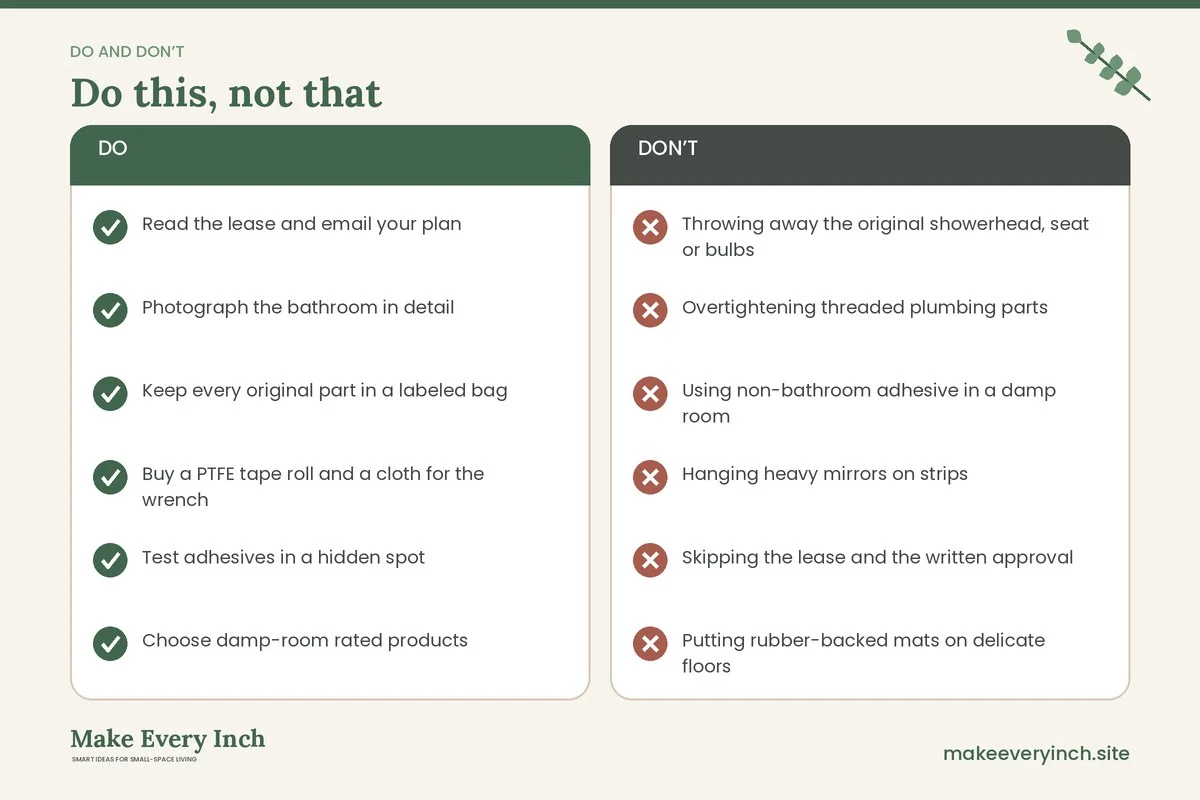
- Throwing away the original showerhead, seat or bulbs
- Overtightening threaded plumbing parts
- Using non-bathroom adhesive in a damp room
- Hanging heavy mirrors on strips
- Skipping the lease and the written approval
- Putting rubber-backed mats on delicate floors
- Forgetting to photograph before and after
- Ignoring leaks or mold, instead of reporting them
Renter bathroom upgrade checklist
- Read the lease and email your plan
- Photograph the bathroom in detail
- Keep every original part in a labeled bag
- Buy a PTFE tape roll and a cloth for the wrench
- Test adhesives in a hidden spot
- Choose damp-room rated products
- Wait for the adhesive time before adding weight
- Check for leaks after each fixture swap
- Store originals together
- Photograph again at move-out
FAQ
What upgrades can renters do in a bathroom?
Showerheads, toilet seats, shower curtains, bath mats, bulbs, freestanding storage, mirrors on strips and removable surfaces, if the lease allows.
Can I change a showerhead in a rental?
Usually yes, if you keep the original and put it back at move-out. Check the lease first.
Is peel-and-stick tile safe on a bathroom floor?
It is medium to high risk, since it can lift vinyl and trap water. Ask your landlord, test one tile and avoid floors that pool water.
How do I hang a towel hook without drilling?
Use an over-door hook, a freestanding ladder or an adhesive hook rated for bathrooms. Follow the weight limit.
What is the cheapest upgrade with the biggest effect?
A new shower curtain and liner, a bath mat and warm LED bulbs often change the room for under $60.
Do I need to tell my landlord about small changes?
For reversible changes, many leases do not require it, but a short email protects you. Always tell them about anything that touches plumbing.
How do I stop adhesive from failing in steam?
Use damp-room products, clean the surface with alcohol, wait the full cure time and keep weight below the rating.
What should I do at move-out?
Refit original parts, remove adhesives slowly, clean the room and photograph everything.
Keep going: Keep going with renter friendly bathroom ideas, small bathroom shelving ideas and security deposit safe apartment upgrades.
Save this guide for later
Pin the ideas you like to Pinterest so you can come back to them when you plan your space.