15 Behind-the-Door Storage Ideas for Entryways and Unused Walls
Quick answer: Behindthedoor storage entryways work best when you measure first. Check how far the door swings, how much clearance the hinge side has and how much weight the door can carry, then choose slim racks, hooks or a shallow wall unit that stays under about 4 inches deep on the door and under 12 inches on the wall behind it. Never block the swing, never load a door beyond its rating and ask permission before drilling.
Behindthedoor storage entryways are the most overlooked space in a small home. The back of the front door and the strip of wall behind it, called the swing zone, are often empty even when the rest of the entry is overflowing. A door that opens inward to 90 degrees leaves a pocket of wall about the width of the door, and that pocket is usually 30 to 36 inches wide and the full height of the room. This guide focuses on that pocket and the door itself. It covers how to measure the swing zone, what the door can safely carry, 15 ideas, a comparison table of depth and weight, three example doors, and a checklist. For the whole entry, read our pillar on small entryway ideas, and for related storage see small coat storage ideas and small closet door storage ideas.
Map the pocket before you buy anything
The space behind a door looks simple, but a few measurements decide what works.
- Swing angle: open the door as wide as it normally goes. Does it stop at a wall, a doorstop or a hook? If it opens to 90 degrees, the pocket is about as wide as the door. If it opens to 120 degrees or more, the pocket is bigger but is also touched by the door edge, so only the wall near the hinge side is truly free.
- Hinge side gap: measure from the hinge to the nearest wall or corner. A gap of 4 to 6 inches is common. Anything thicker than this gap will stop the door from opening fully.
- Latch side clearance: measure from the handle to the wall behind. You need 2 to 3 inches so the handle does not hit the wall or whatever is on it.
- Door thickness and construction: hollow doors are lighter and carry less weight than solid ones. A knock on the panel can tell you which type you have. If you are not sure, ask your landlord or a professional.
- Height of the top edge: many over-the-door racks need a gap of about 1 to 1.5 inches between the top of the door and the frame. Measure at the top, since a hook that is too thick will stop the door from closing.
- Weather seals and fire door rules: some entry doors in shared buildings are fire-rated, and rules may limit what you attach to them. Check building rules before you put anything on the front door itself.
Mark the free wall pocket with painter’s tape, then open and close the door several times. Tape and a few test passes will tell you more than a catalog photo.
What can the back of a door carry?
A door is thin, and its hinges are built to hold the door, not a full wardrobe. As a rule of thumb, keep the total load on a hollow interior door well under the rating on any hardware package, and use lighter loads on exterior doors, which are often heavier but also see more slamming. If the door starts to sag, rub on the frame or close with a bang, remove items. Light items such as scarves, hats, keys, bags of reusable shopping bags and sunglasses suit the door. Heavy winter coats, a full shoe rack or glass jars do not.
Wall-mounted storage in the pocket is a better home for weight, but it needs fixing into studs or solid backing, and that needs permission in a rental. If you cannot drill, stay with freestanding units and rely on racks that hang from the door top.
Safety matters here. A cluttered door is also a door that is awkward to open in an emergency, and the pocket must never hide the handle or the lock. Keep medicines, sharp tools and cleaning products out of reach of children, even in a closet. Do not place anything in the way of an exit path, and do not tape or glue items to a fire door.
15 behindthedoor storage entryways ideas
On the door itself
1. An over-the-door hook rail
A rail with three to five hooks hangs over the top of the door and needs no tools. Use it for lightweight bags, scarves and umbrellas. Choose a model whose hooks are thin enough to let the door close, and pad the back with felt so it does not scratch the paint.
2. A slim over-the-door pocket organizer
A fabric or mesh organizer with clear pockets keeps gloves, hats, dog leash and sunglasses visible. Because pockets are shallow, items stay flat, and the door still closes. Wash the fabric occasionally, and avoid putting anything heavy or sharp in the pockets.
3. A shallow over-the-door shelf set
A set of narrow shelves, less than 4 inches deep, holds mail, keys and small bags. Keep the weight low, and keep the lowest shelf above the height of a small child’s head so nothing hits a face when the door swings.
4. A cork or magnetic board on the inside
If the back of the door is metal, a magnetic board holds keys, notes and a calendar. On a wooden door, use a board hung from the top instead of one fixed by adhesive, since adhesive may mark the finish. Keep magnets away from cards and devices that magnets can affect.
5. A mirror hung from the door top
A slim mirror on a hanging strap lets you check your look as you leave. Make sure the strap is rated for the weight, and that the mirror cannot swing hard into the frame. A plastic or acrylic mirror is lighter and safer in a home with children.
On the wall behind the door
6. A tall, narrow shelf unit in the pocket
A unit 10 to 12 inches deep and 24 to 30 inches wide fits well behind many doors that open to 90 degrees. Put baskets on the shelves for hats, gloves and dog gear. It must be anchored to the wall if it is taller than about 3 feet, or if a child or pet could climb it. Ask for permission before drilling, and use a low unit if you cannot anchor.
7. A wall-hung hook strip with a shelf
A board with hooks along the bottom and a ledge on top uses vertical space without much depth. Install it so the ledge sits at 60 to 66 inches high, above the reach of small children, or lower for a child’s section. Fix it to studs or with the right wall anchors, and check the load rating.
8. A pegboard or rail system
A pegboard allows you to rearrange hooks, baskets and shelves. Use it for leashes, bags and small tools. The hooks must be held firmly, and you should avoid sharp ends that stick out at head height.
9. A shallow cabinet with a door
A cabinet 6 to 8 inches deep, hung at eye level or lower, hides clutter behind a closed front. Use latches if small children could open it, and do not store chemicals or sharp items there if you cannot lock it.
10. A fold-down shelf or drop-leaf surface
A narrow drop-leaf shelf folds flat against the wall when not in use and opens to hold parcels or bags. It needs to be fixed securely and its weight limit must be respected. Keep the surface clear of the door swing when open.
Floor-level ideas
11. A low shoe rack with a tray
A rack that is 6 to 8 inches deep and about 12 inches high takes two to three pairs of shoes in the pocket. Use a tray or a mat to catch dirt. See our guide on small shoe storage ideas for more compact choices, and make sure the rack is ventilated so wet shoes can dry.
12. A narrow basket or bin
A tall, slim basket takes umbrellas, tennis rackets or dog toys. Choose one with a solid base that will not tip.
13. A rolling cart
A slim cart that is 8 to 10 inches wide rolls out when you need it and tucks away behind the door. Look for locking wheels, and do not use a cart if you have toddlers who can pull it over.
14. A bench with storage that is no deeper than the pocket
A short, shallow bench can fit if the door opens only to 90 degrees. Check that the door clears the seat. See small entryway bench ideas for more shapes.
15. A boot tray plus a hook above
A boot tray in the pocket and a single hook above it for a bag or a coat makes a compact station. It suits a studio or a small apartment, and it fits well into the list of small entryway ideas with no closet.
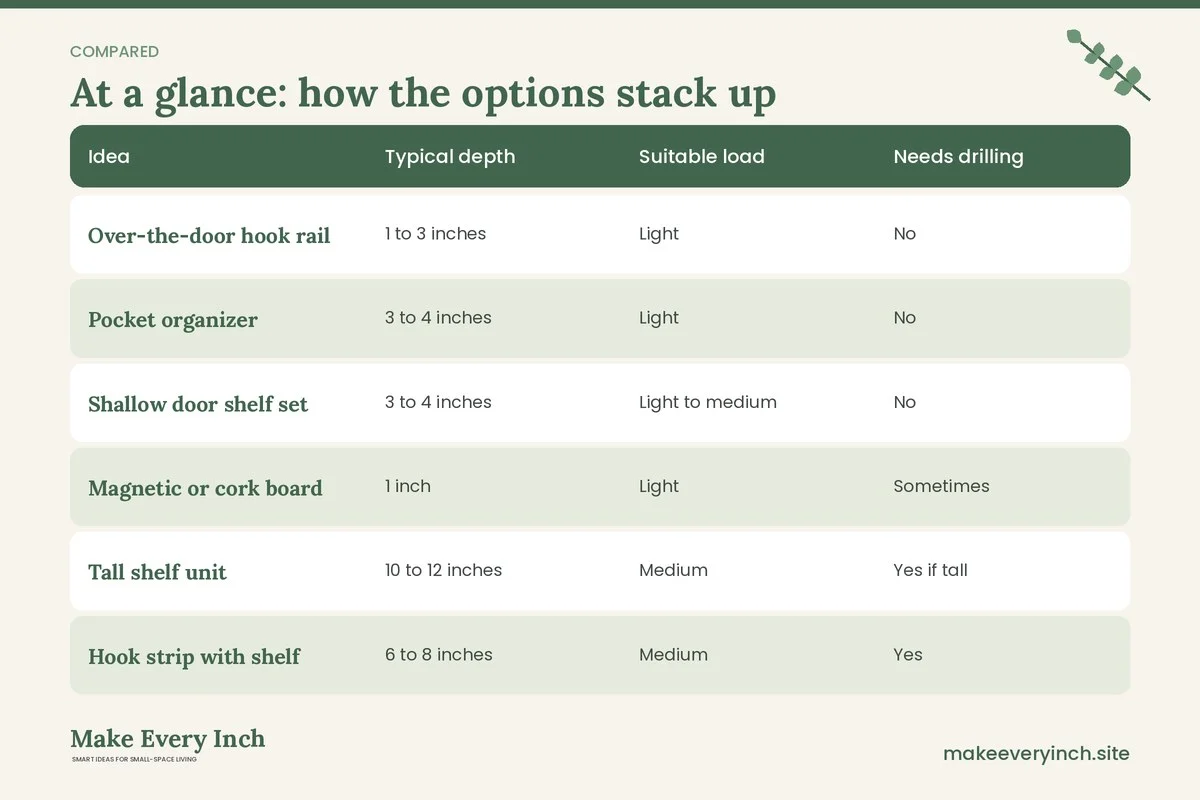
Comparison table: depth, weight and permission
| Idea | Typical depth | Suitable load | Needs drilling | Good for |
|---|---|---|---|---|
| Over-the-door hook rail | 1 to 3 inches | Light | No | Scarves, bags |
| Pocket organizer | 3 to 4 inches | Light | No | Gloves, hats, leash |
| Shallow door shelf set | 3 to 4 inches | Light to medium | No | Mail, keys |
| Magnetic or cork board | 1 inch | Light | Sometimes | Notes, keys |
| Tall shelf unit | 10 to 12 inches | Medium | Yes if tall | Baskets, shoes |
| Hook strip with shelf | 6 to 8 inches | Medium | Yes | Coats, bags |
| Pegboard | 1 to 3 inches | Light to medium | Yes | Leashes, tools |
| Shallow cabinet | 6 to 8 inches | Medium | Yes | Hidden clutter |
| Drop-leaf shelf | 8 to 12 inches open | Light to medium | Yes | Parcels |
| Low shoe rack | 6 to 8 inches | Medium | No | Two to three pairs |
| Slim rolling cart | 8 to 10 inches | Light | No | Seasonal items |
Three example doors
A studio door that opens to 90 degrees against a wall
The pocket is 32 inches wide and the hinge gap is 5 inches. Place an over-the-door hook rail for light bags, and a low shoe rack of 7 inches deep on the floor. On the wall, put a hook strip with a shelf at 60 inches. The door clears the shelf by 2 inches, and the handle has 3 inches. The tray catches wet shoes, and a mat marks the zone.
A one-bedroom door that opens only 70 degrees
The door stops at a closet. Here the pocket is tight, so use only the door itself. Choose a pocket organizer for gloves, hats and a dog leash, and an over-the-door hook rail for two bags. Skip wall storage. Keep the load light and remove items before it sags. Put a freestanding coat rack on the other side of the entry, with a heavy base.
A family door in a rental where drilling is not allowed
The pocket is 36 inches wide and a child’s reach is a concern. Use a freestanding shelf unit with a wide base, 11 inches deep and 30 inches high, which stays stable even without an anchor. Put a basket for each family member on the shelves, and keep heavy items on the lowest shelf. Add an over-the-door rack for adult items and a lower rack at child height. Check the door still closes smoothly, and check the unit weekly for stability. If the lease allows anchoring, use a fixed strap or bracket; if not, choose a lower unit instead.
Safety and damage checklist
- Paint and finish: felt pads protect painted doors, but test them in a hidden spot because some pads can mark a finish.
- Hinges: listen for squeaks and look for sagging. If the door drops, remove items.
- Handle clearance: keep 2 to 3 inches around the handle so a hand fits.
- Emergency exit: never block the lock, the handle or the path to the door.
- Children and pets: keep items on the door lower and softer. Avoid heavy objects, sharp hooks or small items that could be swallowed.
- Electrical: do not run a cord across the door swing, and keep plug-in lights away from the door edge.
- Damp and ventilation: wet coats should hang where air can reach them. A closed pocket organizer can trap damp, so empty it when wet.
- Fire doors: in apartments, check the rules before attaching anything to a fire door.
Keep the pocket tidy
The pocket works only if it stays organized. A simple routine helps. Once a week, take a minute to remove items that do not belong. Each person gets one hook or one basket, and when the space is full, something goes. Label baskets with a tag if you share the space, and use a small tray for keys so that they do not scatter. In a household with children, keep a lower hook for each child and make putting a bag away part of the arrival routine. In a household with pets, keep a leash on a hook near the door and keep treats and bags in a closed container.
Style notes for the back of the door
The back of the door is on view whenever the door is open. Choose racks and baskets in a color that matches the door or the wall, so the storage looks like part of the room. A white door with white racks fades away, while a dark door with brass-tone hooks gives a defined look. Use matching baskets for a calm effect. If you use a mirror, check what it reflects when the door is open. If you want more tips on how to coordinate small spaces, read our article on small home decorating ideas that feel cohesive.
Renting? Stay reversible
Most behindthedoor options hang over the top, stand on the floor or lean against the wall. They need no drilling and leave no marks. If you want something fixed to the wall, ask your landlord in writing first. Never drill into a door that is not yours. For more reversible ideas, see no-drill storage ideas for renters and renter-friendly entryway organization ideas. When you move out, take the pieces with you and check the door and wall for scuffs.
Checklist: behindthedoor storage entryways
- Open the door fully and mark the swing zone with tape.
- Measure the hinge gap and the latch clearance.
- Measure the gap at the top of the door.
- Find out if the door is hollow, solid or fire-rated.
- Choose items under 4 inches deep for the door.
- Choose items under 12 inches deep for the wall pocket.
- Keep loads well below the rating on any hardware.
- Anchor any tall unit, or use a low one.
- Keep the handle, lock and exit path clear.
- Add a tray under the shoes and ventilate wet items.
- Keep chemicals and sharp objects out of children’s reach.
- Ask permission before drilling.
- Test the door for sag after a week.
FAQ
How much weight can the back of a door hold?
It depends on the door and the hardware. Hollow doors hold less than solid ones. Follow the rating on the product, stay well below it and remove items if the door sags or sticks. Keep heavy items on the floor or on the wall.
Can I use behindthedoor storage on a front door?
Often yes, but check your building rules, especially for fire-rated doors, and keep the load light. Avoid anything that stops the door from sealing, and avoid covering the peephole or lock.
What if my door opens into a hallway?
If the door opens outward, use the inside face of the door for light storage and keep the hallway clear. Never put a rack on the outside that could trip a neighbor or block an exit.
What is the best storage for a narrow pocket?
A hook strip with a narrow shelf, or a slim cabinet that is 6 to 8 inches deep, makes good use of a narrow pocket. For a pocket under 30 inches wide, use a single column of hooks.
Will over-the-door hooks damage my door?
They can scratch paint or dent a weather seal if they are too thick or too heavy. Add felt pads, choose thin hooks and check the door closes fully. If the door does not close, remove the rack.
How do I keep wet coats from damaging the pocket?
Hang them so air can reach them, put a tray below, and let them dry before storing them in a closed bin or pocket. A small fan nearby, kept clear of fabric and away from water, can help, but never leave one unattended.
Keep going: Ready to use the wall nobody uses? Start with small entryway ideas, organize the closet side with small entry closet organization ideas and add a landing spot with small home drop zone ideas.
Save this guide for later
Pin the ideas you like to Pinterest so you can come back to them when you plan your space.