25 Security Deposit Safe Apartment Upgrades You Can Undo
Quick answer: The safest apartment upgrades are the ones you can reverse completely: plug-in lighting, rugs, curtains, swapped hardware with the originals stored, freestanding shelves and carefully tested peel-and-stick products. Read the lease, ask in writing for anything gray, photograph everything before and after and keep receipts. Laws vary by state, so check your local rules.
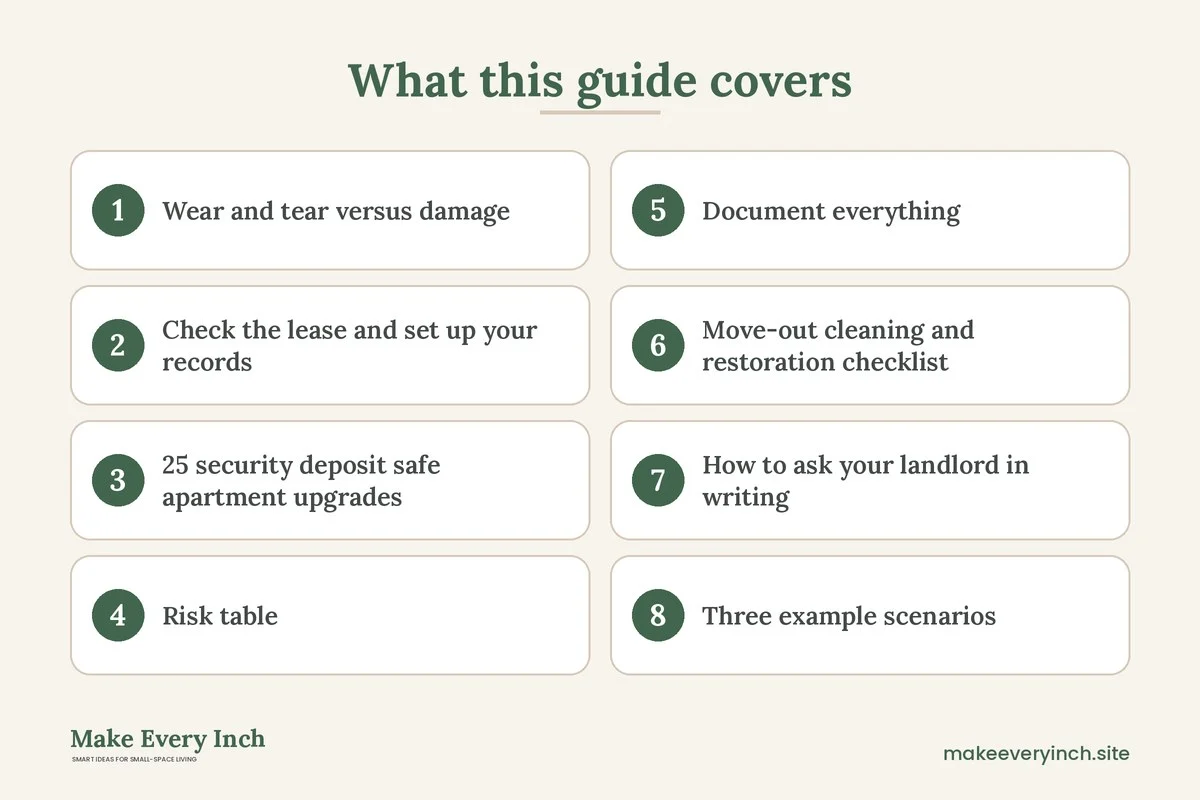
Security deposit safe apartment upgrades let you make a rental feel like yours while keeping your money at move-out. The rule behind every idea here is simple: if you can put the place back exactly as you found it, the change is low risk, and if you cannot, it needs written permission first. This guide covers what counts as normal wear and tear versus damage, the lease check, 25 upgrades across the home, a risk table, documentation habits, a move-out cleaning checklist and a short sample email for asking your landlord. It is general information, not legal advice. Deposit rules differ by state and region, so check your local tenant rules or a tenant organization for the details that apply to you.
Wear and tear versus damage
Most places treat deposits as a way to cover damage and unpaid rent or fees, and not the ordinary aging of a home. Normal wear and tear usually means the gradual effects of living somewhere: faded paint, light scuffs on walls, worn carpet in high traffic areas, a few tiny nail holes from pictures in some jurisdictions. Damage usually means something beyond that: large holes, stains, burns, broken fixtures, pet scratches, paint colors you chose without permission or sticky residue that pulls off the paint.
The line is not the same everywhere, and landlords and courts may view the same mark differently. The practical lesson is to prefer changes that leave nothing to argue about. Do not assume that a mark is excused as wear and tear, and look up the rules where you live before you rely on that idea.
Check the lease and set up your records
Read the lease for sections on alterations, paint, nails, adhesive, light fixtures, appliances and “improvements.” Note anything that requires written consent. Some leases allow small nail holes and ban everything else, and others ban all attachments. If the wording is unclear, ask in writing, and keep the reply.
Build a simple record before you change anything. See the documentation section below for the full routine, since photos taken on move-in day are the foundation of every upgrade here.
25 security deposit safe apartment upgrades
Lighting
1. Swap shades and bulbs, not fixtures
Replace the bulbs with warm white LEDs, usually 2700 to 3000 kelvin, and add a clip-on or plug-in shade only if it does not alter the fixture. A bulb swap is fully reversible. Keep the originals in a labeled bag if you replace any. See our guide to renter friendly lighting ideas.
2. Plug-in wall sconces
A sconce with a plug and a cord cover gives the look of a wired light with no electrician. Mount with adhesive hooks only if the lease allows and the weight is small, or choose a floor or table lamp. Hide the cord with a paintable cover.
3. Under-cabinet strip lights
Battery or plug-in LED strips under kitchen cabinets brighten a counter. Use clips or removable mounting tape, and test the tape on a hidden spot. Remove it slowly, and warm it with a hair dryer.
4. Floor and table lamps
Lamps are the easiest upgrade of all. Use a tall lamp in a dim corner, and a small lamp at the bed. They cost $20 to $80, and they go with you.
Hardware swaps
5. Cabinet knobs and pulls
Unscrew the old hardware, store it in a labeled bag taped inside a cabinet or a drawer, and install new pieces in the same holes. Measure the hole spacing first, because pulls come in standard center-to-center sizes such as 3 inches and 3.75 inches. Reinstall the originals at move-out.
6. Towel bars and hooks
Swap a dated towel bar for a new one using the existing mounting holes, if the lease allows. Keep every screw and the original bar. If the holes do not match, do not drill new ones.
7. A showerhead
Most showerheads thread on by hand or with a wrench. Wrap the thread with plumber’s tape, and store the original. A new head can cut water use, and it is a common request landlords approve. Check that the new one fits the arm.
8. Switch plates and outlet covers
Replacing plastic covers with metal or fabric ones takes a screwdriver and a minute. Turn off the power at the breaker if you are uncomfortable. Keep the originals, and refit them at move-out.
9. Door handles and cabinet latches
Handles can be swapped if you keep the originals, but only if the lock and latch parts fit. Do not change entry locks without permission, since the landlord needs access and the lease may require keys.
Floors and windows
10. Area rugs
A rug covers worn flooring and adds warmth. Use a felt or rubber pad, but check that the pad is safe for your floor, since some rubber can stain vinyl or wood finishes. Vacuum under it from time to time.
11. Rug tape and grippers
Use removable rug tape on hard floors, and test on a hidden area. Remove slowly, and clean any residue.
12. Curtains on tension rods
A tension rod inside the window frame holds curtains without holes. Check the rod’s weight limit, and use lightweight fabric. For taller windows, use a second rod.
13. Curtains on existing hardware
If the window already has a rod or brackets, use those. Do not add new screws. Long curtains hung high make a ceiling look taller.
14. Window film
Frosted or privacy film is a static-cling product on glass, and it comes off cleanly. Clean the glass first, apply it with water and a squeegee and check the lease on window changes.
Walls
15. Adhesive strips for light frames
Strips rated for the weight of the frame hold light art on smooth, fully cured paint. Use the right size, press for the time on the packaging and remove slowly by stretching the tab down along the wall. See our guide to renter friendly wall decor ideas.
16. Peel-and-stick wallpaper, tested first
Peel-and-stick wallpaper can look great, and it can also pull paint. Test a hidden corner for a week, use it on smooth, well-cured paint and ask permission when the lease is vague. Avoid new paint, flat finishes and textured walls. See removable wallpaper ideas.
17. Removable decals
Decals are a lower commitment than wallpaper, and they work on small areas. Peel from a corner at a low angle, and warm the surface.
18. A leaning mirror or art
Lean a big mirror or canvas on a wall or a dresser. It leaves no mark, and it adds light. Use a wall anchor strap only if the lease allows.
Storage
19. Freestanding shelving
A bookcase, a ladder shelf or a cube unit stands on the floor and needs no fixings. See our guide to renter friendly shelving.
20. Over-door and tension-pole storage
Over-door hooks and tension poles use the door and the room’s own structure. Put felt on the contact points so they do not scuff paint. See no-drill storage ideas for renters.
Kitchen and bathroom
21. A temporary backsplash
Peel-and-stick tiles or a removable panel can cover a dated or stained wall behind a sink or stove. Keep it away from direct flame and high heat, test a spot and read our guide to temporary backsplash ideas.
22. A shower curtain and bath mat update
A new curtain, liner and mat refresh a bathroom for under $50. Wash the old ones, and store them if the originals belonged to the unit. See renter-friendly bathroom upgrades.
23. A faucet aerator and a toilet seat
Aerators screw on by hand, and a toilet seat swap takes minutes. Keep the originals, and check that the new seat fits the bowl shape.
Entry
24. A bench, mirror and tray
At the entry, use a bench or a narrow console, a leaning mirror and a tray for keys. It makes a drop zone with no fixings. See small entryway ideas and no entryway apartment ideas.
25. A door mat and over-door hooks
A new mat and hooks that hang over the top of the door cost little and leave no trace. Make sure the door still closes and the hooks do not scrape the paint.
Risk table
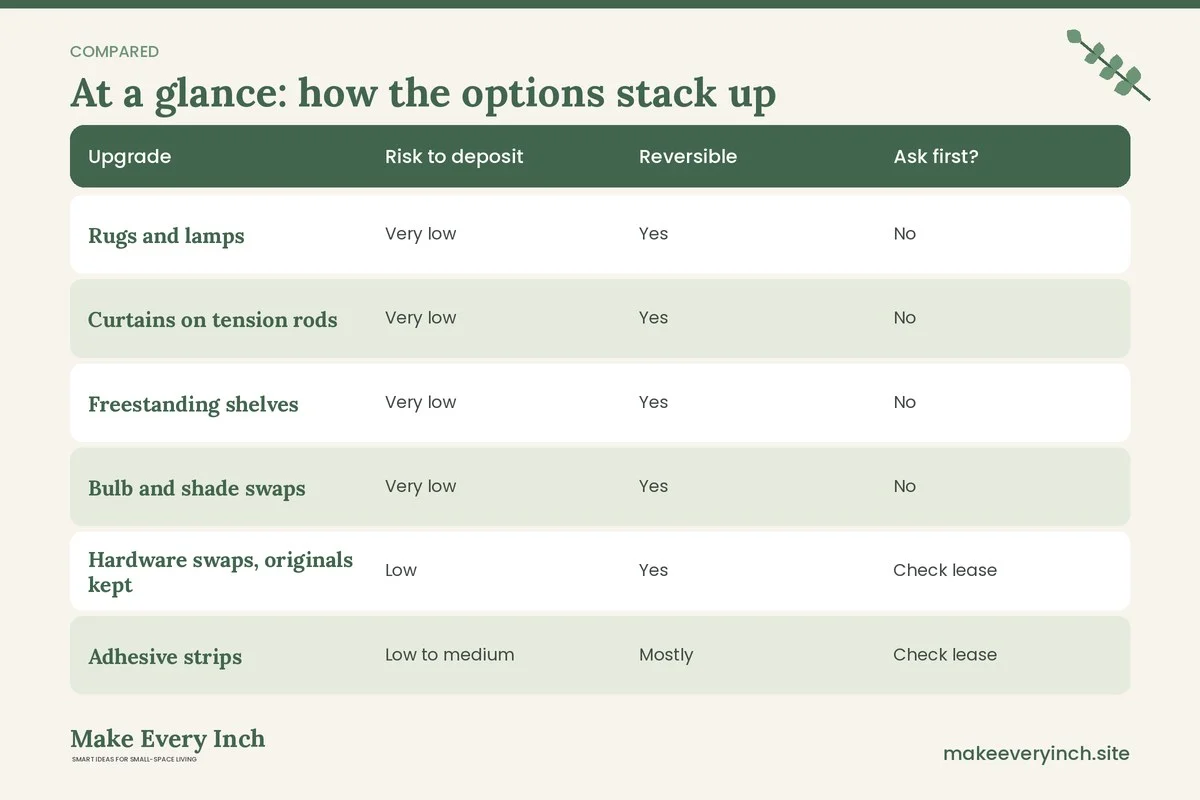
| Upgrade | Risk to deposit | Reversible | Ask first? |
|---|---|---|---|
| Rugs and lamps | Very low | Yes | No |
| Curtains on tension rods | Very low | Yes | No |
| Freestanding shelves | Very low | Yes | No |
| Bulb and shade swaps | Very low | Yes | No |
| Hardware swaps, originals kept | Low | Yes | Check lease |
| Adhesive strips | Low to medium | Mostly | Check lease |
| Window film | Low | Yes | Check lease |
| Peel-and-stick tile | Medium | Mostly | Yes |
| Peel-and-stick wallpaper | Medium to high | Depends on paint | Yes |
| Painting | High | Needs repaint | Always |
| Hardwired fixtures | High | Needs electrician | Always |
Document everything
Move-in photos
On day one, photograph every wall, floor, ceiling, window, appliance, cabinet and fixture, with wide and close shots. Photograph existing damage, such as stains, chips and scuffs, even small ones. Store the photos in cloud storage, and keep the original files with their time stamps.
Emails and approvals
Any permission should be in writing, even a short email or text. A verbal yes is easy to forget or dispute. Save replies in a folder, and note the date.
Receipts and item lists
Keep receipts for anything you buy, and a list of what you changed with the date and the location of the originals. A simple table or a notes file works well.
Move-out photos
Photograph the same areas after you clean, and include shots of each swap restored to its original state. Many places allow or require a move-out inspection, so check your local rules and ask for one if you can.
Move-out cleaning and restoration checklist
- Reinstall all original hardware, bulbs, shades and showerheads
- Remove all adhesive, strips, hooks and tape, and clean residue
- Patch any small holes only if the lease allows, and match the paint
- Wash walls gently, starting with a damp cloth
- Clean the oven, stove, fridge and cabinets inside and out
- Scrub the bathroom, including the tub, toilet, sink and grout
- Wipe baseboards, switch plates and door frames
- Vacuum and mop floors, and clean under rugs
- Clean windows and tracks, and remove window film
- Remove all your belongings and trash
- Return keys, and keep proof of the return
- Photograph every room, and save the photos
How to ask your landlord in writing
Keep the request short, specific and polite. Say what you want to change, where, how it will be reversed and when. Offer to restore the space at move-out, and ask for a written reply. Keep a copy.
A sample you can adjust:
Subject: Request to install removable items in Unit 4B
Hello Ms. Rivera, I would like to make a few changes that I will fully reverse before I move out. I would like to replace the kitchen cabinet pulls with new ones using the existing holes, and I will store the originals and reinstall them. I would also like to apply removable peel-and-stick tiles behind the stove, and I will test a small area first. Please let me know if this is acceptable, and whether you have any conditions. I will send photos before and after. Thank you, Sam Lee
If the answer is yes, save it. If the answer is no, respect it, and choose freestanding options. If there is no answer, do not treat silence as approval.
Three example scenarios
A tenant with a no-adhesive lease
A renter with a strict lease uses lamps, a large rug, tension rod curtains and freestanding shelves. Nothing touches a wall, and the whole setup moves with them. They photograph the rooms on arrival and on departure.
A tenant who wants a kitchen refresh
A renter asks in writing to swap cabinet pulls and add peel-and-stick tile behind the sink. The landlord approves the pulls and asks them to skip the tile. They store the originals in a labeled bag and photograph the work.
A tenant leaving after two years
A renter spends one weekend restoring the home: reinstalling hardware, removing strips, cleaning the oven and mopping. They take photos of each room and send them to the landlord with the keys. The reply is saved for their records.
Method: plan any upgrade in five steps
1. Read the lease and note the rules for the room.
2. Photograph the area, including close shots of the surfaces you will touch.
3. Choose a reversible option, and test it on a hidden spot.
4. Ask in writing if there is any doubt, and keep the reply.
5. Make the change, label and store the originals, photograph the result and save the receipt.
Budget guide
Under $50
Bulbs, a shower curtain and mat, a door mat, adhesive hooks and a set of cabinet knobs.
About $150
A rug, a lamp, tension rod curtains and a showerhead.
$400 and up
A larger rug, a bookcase, peel-and-stick tile for a backsplash and a couple of quality lamps. Spend where items travel with you.
Mistakes to avoid
- Starting without reading the lease
- Painting without written permission
- Throwing away the original hardware
- Using strong adhesive on fresh paint
- Making repairs with no record
- Assuming silence means yes
- Skipping move-in photos
- Leaving residue behind
Deposit safety checklist
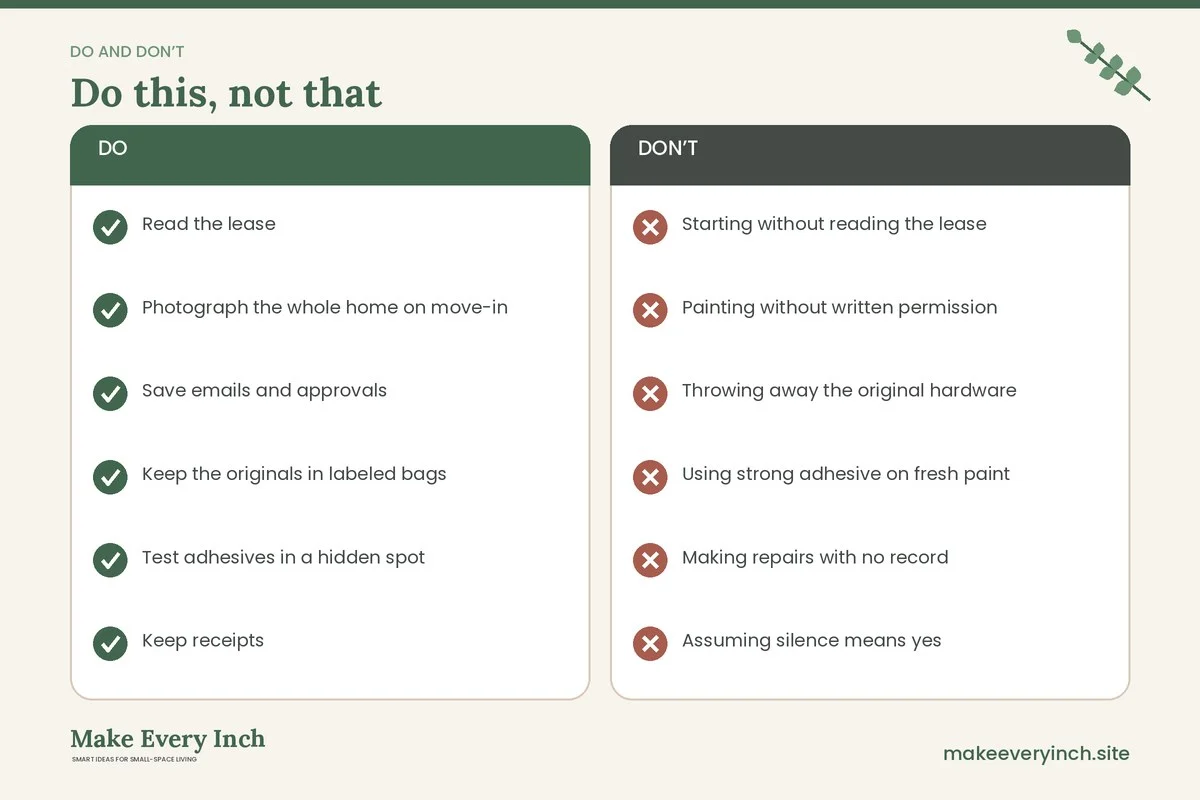
- Read the lease
- Photograph the whole home on move-in
- Save emails and approvals
- Keep the originals in labeled bags
- Test adhesives in a hidden spot
- Keep receipts
- Clean thoroughly at move-out
- Photograph every room again
- Check your local deposit rules
FAQ
Can a landlord keep my deposit for nail holes?
It depends on local law and the size and number of holes. Small holes may be treated as normal wear in some places and as damage in others, so check your local rules.
Is peel-and-stick wallpaper safe for a deposit?
It can be on smooth, cured paint, but it can pull paint on fresh or flat finishes. Test a corner, and ask permission when in doubt.
Do I need permission to change cabinet hardware?
Check the lease. Many landlords agree if you keep the originals and reinstall them, but ask in writing.
What counts as normal wear and tear?
Generally it is gradual aging from ordinary living, though the exact definition varies by state. Look up the rules for your area.
How should I photograph my apartment?
Take wide and close shots of every room, surface and fixture, and include existing damage. Save the originals in a safe place.
What if my landlord does not reply to my request?
Do not assume yes. Follow up once in writing, and keep the record. If it stays unclear, choose a reversible option.
Can I paint a rental?
Only with written permission, and many landlords require you to repaint it to the original color. Ask first.
When do I get my deposit back?
Timelines and itemization rules vary by state. Check your local law, and keep your forwarding address in writing.
Keep going: Keep going with renter friendly wall decor ideas, renter-friendly kitchen upgrades and organization ideas for renters.
Save this guide for later
Pin the ideas you like to Pinterest so you can come back to them when you plan your space.