19 Organic Modern Apartment Ideas for Warm, Natural Rooms
Quick answer: The best organic modern apartment ideas pair clean, simple furniture with natural materials such as oak, linen, jute, stone and ceramic. Use a creamy, earthy palette, curved shapes, layered texture, soft paper or ceramic lamps and a branch or plant. Most pieces are portable, so the look works in a rental.
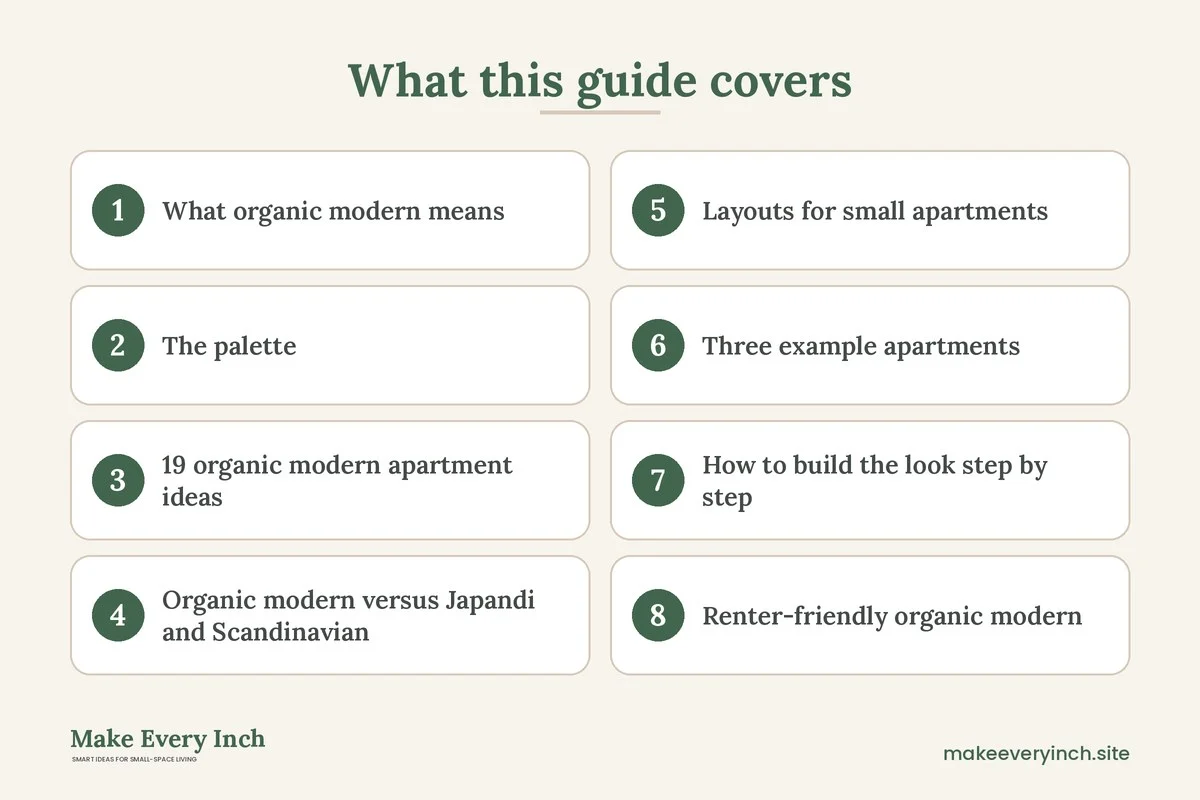
Organic modern apartment ideas are about warmth without clutter. The style takes the straight lines and restraint of modern design and softens them with natural materials, rounded forms and honest texture. In a small apartment that mix is useful, because it feels calm and finished without needing many objects. This guide defines the style, then covers the palette, materials, curves, layers of texture, lighting, plants and branches, layouts, renter tweaks, a comparison table, three example homes, a budget guide and common mistakes. If you are choosing between related looks, we also compare it with Japandi apartment ideas and Scandinavian small apartment ideas below.
What organic modern means
Organic modern is a blend of two ideas. The modern part gives you simple lines, uncluttered surfaces and a limited palette. The organic part brings in things that look like they came from the earth: wood with visible grain, woven fibers, handmade ceramics, rough stone and plants. The result sits between a sleek modern room and a rustic one.
What sets it apart is how the pieces are chosen. Furniture is simple in shape, but its surface is tactile. A plain boxy sofa is covered in a nubby bouclé or washed linen. A rectangular table has a rounded edge and a visible oak grain. Nothing is glossy, and nothing is overly ornate, so the room reads as quiet and soft.
The palette
Creamy neutrals and earth
Think of sand, oat, cream, warm white, clay, olive, soft brown and charcoal. Stay with colors that look like they came from the ground or a plant, and avoid anything bright or glossy. A warm white wall with a slightly yellow undertone works better than a cool one, since it makes natural wood look richer.
The 60-30-10 approach
Use about 60 percent of a room in the base color, such as warm white or cream. Use about 30 percent in a mid tone, such as oak, sand or linen. Use about 10 percent for deep contrast, such as black iron, dark brown or olive. This is a guide rather than a law, and it keeps a small room from looking either flat or busy.
19 organic modern apartment ideas
Materials
1. Choose oak or ash for the main wood
Light to medium oak, white oak and ash are the signature woods of the style. Choose a matte or oiled finish, not a thick gloss, so you can see the grain. If real wood is too costly, look for a thin veneer on a solid base, or buy secondhand.
2. Use linen and cotton for upholstery and curtains
Washed linen has soft wrinkles that read as relaxed, and cotton slipcovers can be laundered. A linen blend costs less than pure linen and holds its shape better. Choose oat, stone or warm white, and avoid shiny weaves.
3. Bring in stone, even in small doses
Marble, travertine, limestone and slate give weight to a room of wood and cloth. A small travertine side table, a stone tray or a marble lamp base is enough. Stone is heavy, so place it on a sturdy surface, and use felt pads to protect floors.
4. Layer jute, sisal and wool underfoot
A jute rug adds coarse texture and a natural color that hides dust. Place a smaller wool rug on top for softness, since jute can feel scratchy on bare feet. A jute rug about 5 by 8 feet suits a studio, and a non-slip pad beneath protects floors in a rental.
5. Show ceramic and clay
Handmade bowls, vases and pitchers in matte glazes bring in the organic feel. Choose a few larger pieces in similar tones instead of many small ones. A single big vase with a branch looks better than a collection of tiny figures.
6. Add rattan and cane with restraint
A cane-front cabinet, a rattan chair or a woven pendant adds a handmade look. Keep it to one or two pieces, since too much woven material can drift into a beach house or boho look. Cane is a good way to hide clutter behind an open weave.
Shape and furniture
7. Choose curved furniture
A rounded sofa, an arc-shaped chair or a round table softens the straight lines of an apartment. Curves also help you move around in a small room, since there are no sharp corners to catch a hip. A round coffee table about 30 to 36 inches across suits most small sofas.
8. Pick a low, simple sofa
A sofa with a low back and plain arms feels calm and keeps sightlines open. Look for a width between 70 and 84 inches for a small living room. A light cream or oat fabric works best, and a washable cover is a practical choice.
9. Use a statement wood piece
One substantial piece of wood furniture anchors the room, such as a dining table, a console or a bench. Choose a piece with a clear grain and a simple shape, and let it be the main event. Because it is tactile and heavy looking, you can keep everything else quiet.
10. Choose a bed with a soft, simple frame
A wood or upholstered bed frame with a low headboard keeps a bedroom calm. Dress it in linen sheets, a textured duvet and one wool throw. Two matching bedside tables or a pair of stools in a wood tone finish the picture, and the room does not need more.
Texture and surfaces
11. Layer many textures in one color family
Texture is the heart of this style. Combine bouclé, linen, wool, jute, wood and ceramic in similar tones, so the room feels rich without being busy. A good test is to touch each item and ask whether the surface is different from its neighbor.
12. Use limewash effects carefully
Limewash gives walls a soft, cloudy depth, but real limewash is a commitment. Renters can look for removable wallpaper that imitates the effect, and test a sample first. Our guide to removable wallpaper ideas explains the risks and the removal steps.
13. Hang one large textile or piece of art
A woven wall hanging, a large abstract in earth tones or a plain linen panel gives the wall presence. Keep the frame thin, in oak or black. In a rental, lean it on a console or a dresser, and keep the lease in mind for any adhesive.
Light and nature
14. Choose paper and ceramic lamps
Paper lanterns, plaster shades and ceramic bases give glowing, soft light with a handmade look. Use warm 2700 kelvin bulbs, and place lamps at different heights. A ceramic table lamp about 18 to 24 inches tall suits a console or a nightstand. See our renter friendly lighting ideas for plug-in options.
15. Use branches in a tall vase
A few bare branches, dried pampas or olive stems in a big vase create height and an organic line without watering. Place the vase on the floor in a corner or on a console. Replace the stems each season, or keep dried ones for months.
16. Choose plants with sculptural shapes
Olive trees, fiddle leaf figs, rubber plants and snake plants have strong forms. Place them in plain clay, stone or ceramic pots. One large plant in a corner is better than several small ones on every shelf, and a plant stand raises it into the light.
17. Keep windows soft and simple
Use linen curtains in a warm white or oat, hung high and wide. Natural woven shades in bamboo or grass add texture, though they let in less light. If privacy matters, layer a sheer behind a woven shade, and fit them with a tension rod or a no-drill bracket.
Finishing touches
18. Style with few objects and negative space
A calm room depends on empty space. Group three items on a tray, such as a candle, a small bowl and a book, then leave the rest of the surface bare. A bare section of wall or table matters as much as what is on it.
19. Use a mirror with an organic shape
An arched or round mirror with a thin wood frame reflects light and echoes the curves in the room. Lean a tall one against a wall beside a window, and keep what it reflects tidy. It is one of the most useful pieces in a small apartment.
Organic modern versus Japandi and Scandinavian
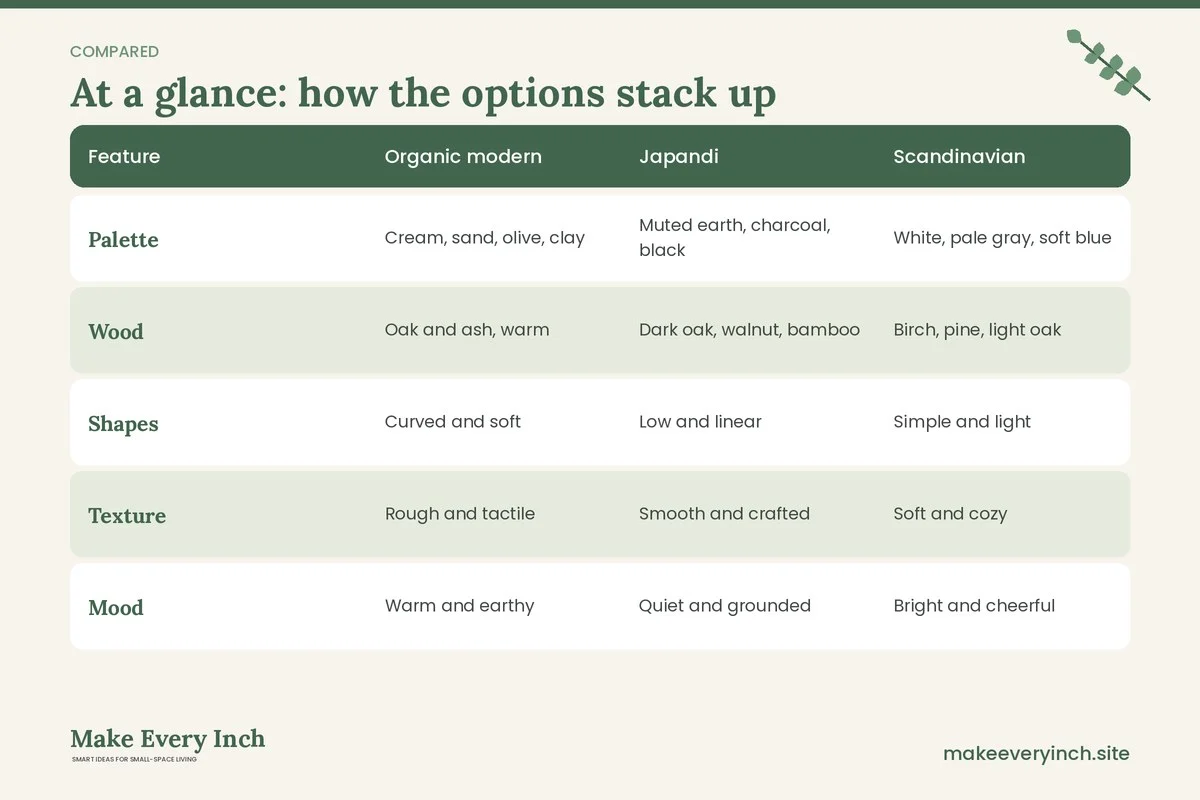
These three styles share calm, natural materials and edited rooms, so they are easy to confuse. The differences are in color, weight and mood.
| Feature | Organic modern | Japandi | Scandinavian |
|---|---|---|---|
| Palette | Cream, sand, olive, clay | Muted earth, charcoal, black | White, pale gray, soft blue |
| Wood | Oak and ash, warm | Dark oak, walnut, bamboo | Birch, pine, light oak |
| Shapes | Curved and soft | Low and linear | Simple and light |
| Texture | Rough and tactile | Smooth and crafted | Soft and cozy |
| Mood | Warm and earthy | Quiet and grounded | Bright and cheerful |
Japandi leans darker and more formal, with low furniture and a focus on handcraft. Read our guide to Japandi apartment ideas if you prefer that restraint. Scandinavian rooms are lighter, with more white and a stronger emphasis on daylight and hygge, and you can see that in Scandinavian small apartment ideas. Organic modern sits between them, with more texture and rounder shapes than either.
Layouts for small apartments
The open studio
Use a curved sofa to define the living zone, and float it at an angle if there is room. Put a low console or a cane cabinet behind it as a divider. Mark the sleeping zone with a rug and a plant, and use a round dining table of about 30 inches across that can also serve as a desk.
The one-bedroom living room
Keep a clear walkway of about 30 inches around the sofa and coffee table. Place the sofa against the longest wall, with a round table in front and an accent chair at an angle. Put the biggest plant in the corner nearest the window, and keep surfaces open. See our guide to small apartment living room ideas for more arrangements.
The small bedroom
Position the bed centered on the wall opposite the door if possible, with at least 24 inches on each side. Use wall-mounted or very slim bedside tables, hang or lean a mirror, and keep the floor mostly clear. A jute rug extending 18 to 24 inches beyond the bed on each side looks proportionate. More ideas appear in small bedroom ideas.
Three example apartments
The 450 square foot studio
A renter kept her warm white walls and added a cream bouclé loveseat, a round oak table, a jute rug and a ceramic lamp on a stool. A tall mirror leaned beside the window and a large branch stood in a stoneware vase. She spent about $900, mostly on the loveseat and the rug, and everything came with her when she moved.
The 700 square foot one-bedroom
A couple chose an oat linen sofa, a travertine side table and a wood console with cane doors that hid the router and cables. The bedroom used linen bedding, a woven pendant and two ceramic lamps. The only art was a single large textile in a thin oak frame, leaned on a dresser.
The rented loft with dark floors
Dark flooring made the room heavy, so the renter laid a large cream wool rug over a jute one, and used pale oak furniture to balance the floor. White curtains hung floor to ceiling, and three plants stood in clay pots. The room read as warm rather than dark, and the layers hid scratches.
How to build the look step by step
Step 1. Edit the room
Remove excess decor and anything glossy, plastic or bright. Keep what is wood, cloth, ceramic or stone, and store the rest. You will see quickly what the room already has.
Step 2. Set the base
Choose a warm white and an oak tone, and note the undertone of your floor. Hold fabric swatches against the floor in daylight and in lamplight.
Step 3. Choose the anchor pieces
Buy or borrow the sofa, the rug and one wood piece. These three set the scale and color. Take measurements first, and tape the footprints on the floor to check the fit.
Step 4. Layer the texture
Add linen curtains, a wool throw, a ceramic lamp and two or three cushions in different textures but the same color family. Avoid more than three accent colors.
Step 5. Add the living elements
Bring in plants and branches, and a few handmade objects. Place them in groups of one, three or five, and leave space around each.
Renter-friendly organic modern
Nearly every idea here is movable. Furniture, rugs, lamps, mirrors, plants and ceramics need no changes to the apartment. For walls, choose leaning art, a tension rod for curtains and removable adhesive in a test spot. Read the lease before using any adhesive or paint, and photograph walls, floors and fixtures before you begin. Cover any rental flooring you dislike with a large rug, and add felt pads under stone and wood. Keep original curtains and light shades in a box. Our guide to renter friendly apartment decorating ideas lists methods that leave no trace.
Budget guide
Under $150
A jute rug in a small size, a linen cushion cover set, a ceramic vase with branches, warm bulbs and a paper lampshade. Secondhand shops often have ceramics and wooden trays at low prices.
About $500 to $900
A larger jute rug, linen curtains, a ceramic lamp, a round side table in oak or travertine, a mirror and a bouclé or linen sofa cover. Prices vary widely by brand, so compare before buying.
$1,500 and up
A solid oak table or console, a quality sofa, a curved accent chair and a stone coffee table. Buy these slowly, and choose real wood and washable fabrics for the pieces that will last.
Mistakes to avoid
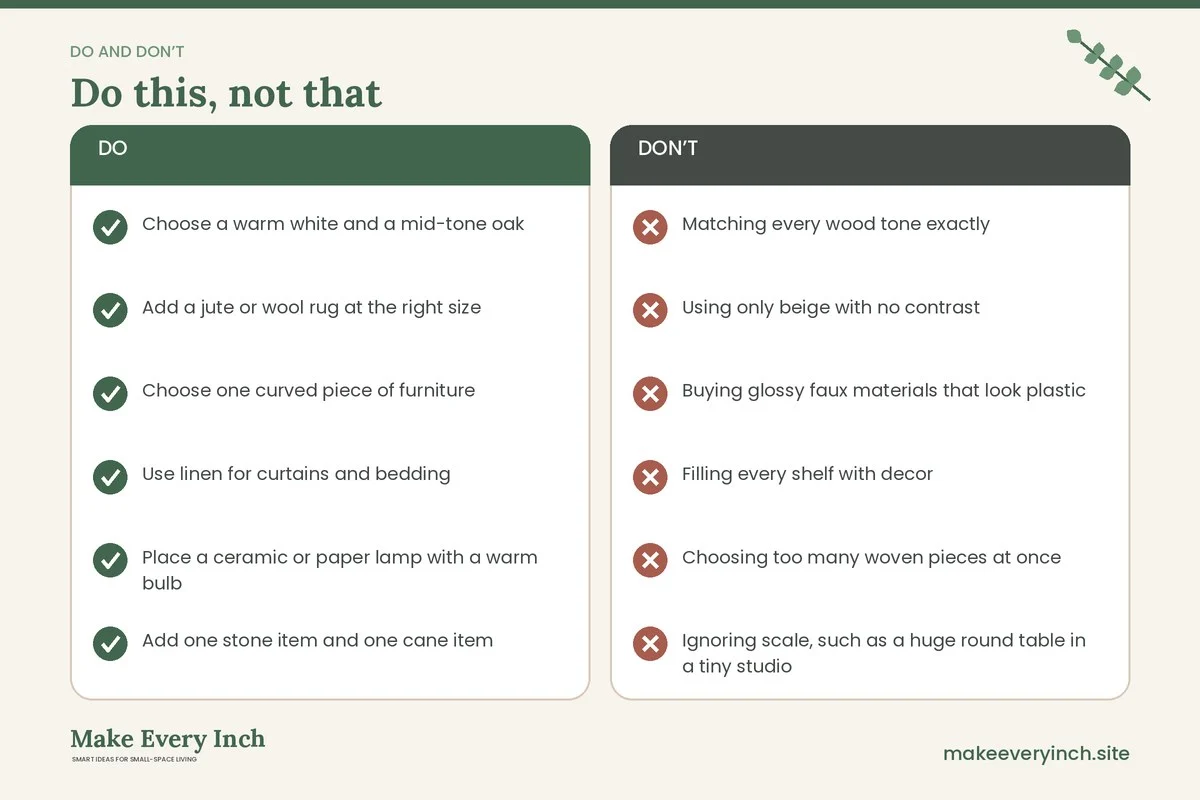
- Matching every wood tone exactly
- Using only beige with no contrast
- Buying glossy faux materials that look plastic
- Filling every shelf with decor
- Choosing too many woven pieces at once
- Ignoring scale, such as a huge round table in a tiny studio
- Using cool white bulbs that flatten the warmth
- Forgetting a darker accent for depth
- Leaving the lease unread before changing walls
Organic modern checklist
- Choose a warm white and a mid-tone oak
- Add a jute or wool rug at the right size
- Choose one curved piece of furniture
- Use linen for curtains and bedding
- Place a ceramic or paper lamp with a warm bulb
- Add one stone item and one cane item
- Bring in a branch and a sculptural plant
- Keep surfaces to three objects
- Lean a mirror near the window
- Photograph the apartment for your records
FAQ
What is organic modern style?
It combines modern simplicity with natural materials, curves and texture. Think oak, linen, stone, jute and ceramic in warm, earthy colors.
Is organic modern good for a small apartment?
Yes. The edited look and soft materials make small spaces feel calm, and curved furniture helps movement in tight rooms.
How is organic modern different from Japandi?
Organic modern is warmer, rounder and more textured, with creamy neutrals. Japandi is darker, more linear and focused on craft and low furniture.
How is it different from Scandinavian style?
Scandinavian rooms are whiter and lighter, with an emphasis on daylight and cozy hygge. Organic modern is earthier and more tactile.
Can renters do organic modern?
Yes. Furniture, rugs, lamps, mirrors, plants and ceramics are portable, and leaning art avoids holes. Check your lease before changing walls.
What colors work best?
Cream, sand, oat, clay, olive, soft brown and charcoal. Keep tones muted and earthy, and avoid bright or glossy colors.
How much does it cost to start?
A small refresh can cost under $150, and a full room often costs $500 to $1,500. Secondhand wood and ceramics help lower the cost.
What plants suit this style?
Olive trees, rubber plants, snake plants and fiddle leaf figs have strong shapes. Use plain clay or ceramic pots, and add dried branches for height.
Keep going: Explore our Japandi apartment ideas, Scandinavian small apartment ideas and cozy apartment ideas.
Save this guide for later
Pin the ideas you like to Pinterest so you can come back to them when you plan your space.