Small Bathroom Mirror Ideas for Light, Depth and Storage
Quick answer: The right small bathroom mirror is sized to the vanity, centered on the sink or the face, hung so its middle sits near eye level and placed to bounce light from the window or the main fixture. Choose a moisture-rated mirror, keep it clear of splashes, and confirm the mounting method with your landlord before you drill or stick anything to a wall.
A small bathroom mirror does more work than any other single object in the room. It is a grooming tool, a light source, a storage opportunity and the cheapest way to change how deep the room feels. It is also the first thing people see when they open the door, so a poor choice shows at once. A mirror that is too small makes the wall look bare, one that is too large can swallow the vanity and one in the wrong spot reflects the toilet instead of the window. This guide focuses on the mirror itself. It covers how to measure for one, which shapes and sizes suit which rooms, the height and position rules, 16 specific ideas, a comparison table, three example bathrooms, safe mounting, cleaning and a checklist. For the whole room, start with our pillar on small bathroom ideas, and for how mirrors behave in other rooms, read our guide to small room mirror placement ideas.
What a mirror actually does in a small bathroom
A mirror has three jobs in a compact room, and it helps to rank them before you shop. The first is practical: you need to see your face for shaving, skin care, makeup or hair. The second is optical: a mirror doubles the visible depth of the wall it hangs on, spreads daylight and makes light fittings count twice. The third is storage: a mirror can hide a cabinet, carry a shelf or hold hooks, which matters when the bathroom has no counter space.
Most small bathroom mirror mistakes come from picking for only one job. A person who chooses for looks may end up with a thin decorative round that is too small to shave in. A person who chooses for storage may end up with a deep cabinet that juts out into a narrow room and catches an elbow. Ask which job matters most to you, and let that decide the type. Then check the others against the measurements below.
Measure before you choose
Take five measurements and write them down. They prevent most returns.
- Vanity width: measure the sink top or the cabinet below. A mirror that is the same width as the vanity looks planned, and one that is a few inches narrower looks deliberate. A mirror wider than the vanity can look top-heavy unless it is centered on a larger wall feature.
- Wall space above the sink: measure from the top of the backsplash or sink rim to the ceiling, and from side wall to side wall. Note switches, outlets, light fixtures and window trim, since they all limit the size.
- Eye level of the tallest and shortest users: most adult eye levels fall between about 56 and 66 inches from the floor. Mark both on the wall with painter’s tape.
- Light fixture position: note where the main light and any sconces sit. A mirror should not hide an electrical box or sit directly under a fixture that drips condensation.
- Door swing and passing space: a mirror on the back of a door or on a wall facing the entrance changes how the room feels when someone walks in. Measure how far the door opens and where it stops.
A useful starting rule is to choose a mirror that is 2 to 4 inches narrower than the vanity and at least 24 inches tall. For a pedestal sink, a mirror of 18 to 24 inches wide is usually enough. In a very narrow room, a tall and slim mirror reads better than a wide short one.
Height and position rules
The center of the mirror should fall near eye level for the people who use it most. In a shared bathroom, centering the mirror at about 60 inches from the floor works for many households. If one user is much shorter or taller, consider a taller mirror, around 30 to 40 inches high, so the same piece covers both. A tilting mirror, a pair of mirrors or a mirror with an adjustable arm can also help.
Leave a gap of 4 to 8 inches between the bottom of the mirror and the faucet or sink back so water does not splash onto it and so you can wipe the area behind the tap. If you are placing a mirror above a toilet tank, check that it does not reflect the toilet directly from the doorway. A good test is to stand in the doorway and look at the mirror: you want to see the window, a plant or a light wall, not the toilet seat.
Shape: which suits your room
Shape changes the feel of a room more than most people expect. This section explains how each shape behaves, so that you can match it to your layout.
Rectangles and squares
A rectangular mirror is the safest choice. It matches the lines of a vanity, the tile and the door frame, and it is easy to center. A vertical rectangle stretches the wall and suits narrow rooms and low ceilings. A horizontal rectangle widens the wall and suits a long vanity.
Rounds and ovals
A round mirror softens a room full of straight lines, which is common in bathrooms with square tiles. It works best over a single sink and is easy to hang because it has no corners to level. In a small room, choose a round mirror of at least 24 inches across so it does not read as a decoration. An oval hung vertically gives height without the hard edge of a rectangle.
Arches and pill shapes
An arched or pill-shaped mirror pulls the eye upward and suits ceilings that feel low. It looks best with a plain wall, because the curve itself is the statement.
Frameless and thin-framed mirrors
A frameless mirror reads as part of the wall, so it adds depth with the least visual weight. A thin frame in a dark or metallic finish adds definition. A thick, ornate frame in a tiny room can feel heavy, so keep it to a larger wall or a single focal piece.
16 small bathroom mirror ideas
Over the sink
1. A mirror sized to the vanity
Choose a mirror that is slightly narrower than the sink cabinet. This looks tidy, uses the available width and leaves room for a sconce on each side if the wiring is already in place.
2. A tall, slim mirror in a narrow room
If the room is only 5 feet wide, a tall mirror of about 18 inches by 40 inches is easier to use than a wide one. It draws the eye up and avoids the feeling of a wall filled with glass.
3. A pair of mirrors over a double vanity
Two mirrors above two sinks give each user their own space, and they look more intentional than one large piece that needs a seam. Keep an even gap of 3 to 6 inches between them.
4. A round mirror over a pedestal sink
A pedestal sink has no cabinet, so the mirror carries more visual weight. A round mirror centered on the faucet balances the thin base and keeps the room airy.
5. A mirror taller than it is wide for a corner sink
In a corner, an angled or off-center mirror can feel awkward. A tall rectangle centered on the sink keeps the lines simple.
Mirrors that store things
6. A medicine cabinet with a mirrored door
A recessed cabinet sits flush with the wall, which keeps a tight room clear. If you cannot cut into the wall, a surface-mounted cabinet adds a few inches of depth, so measure the elbow space first. Check the cabinet weight and mount it into studs or with rated anchors, and only with permission if you rent.
7. A mirror with a narrow shelf below
A mirror with an attached ledge holds a toothbrush cup, a small plant or a soap dish. It saves a separate shelf and works when the counter is small. Compare this with our ideas for small bathroom shelving.
8. A mirror with hooks or a rail
A mirror frame with hooks gives you a place for a towel or a robe. Keep hooks away from the face area and check the weight limit.
9. A mirrored door on a wall cabinet
A wall cabinet with a mirrored front doubles as storage and a mirror. It suits bathrooms with no counter space, which we discuss in small bathroom ideas with no counter space.
Mirrors for depth and light
10. A mirror opposite the window
Hang a mirror on the wall that faces the window or the brightest light, and it spreads that light across the room. This is one of the best ways to brighten a dim space. If your room has no window at all, take a look at small bathroom ideas without a window.
11. A wide mirror above a tub
A mirror above a bathtub, set well away from the spray, widens a narrow tub wall. Use a moisture-rated product, keep it clear of direct water and make sure the edges are sealed.
12. A mirror on the back of the door
An over-the-door full-length mirror gives you a view of your outfit without taking up any wall. Check the door thickness and clearance, and confirm that it does not hit the towel hook or the wall when opened.
13. A leaning floor mirror
A tall mirror leaned against a wall is a no-drill choice for rental bathrooms and gives a full-length view. Anchor it with a safety strap or a restraint so it cannot slide or fall, especially if children or pets are in the house.
Mirrors that add style
14. A mirror with built-in lighting
A mirror with integrated LED strips gives even light on the face and removes the need for a separate fixture. It must be rated for use in a bathroom and wired by a qualified person. See our small bathroom lighting ideas for how to combine it with ceiling light.
15. A beveled or vintage mirror
A beveled edge catches light and adds character. Use it over a narrow console or as the only decoration on an otherwise plain wall.
16. Two small mirrors in a gallery
A pair of small mirrors with a plant between them works in a powder room or half bath where steam is low. In a full bath with a shower, keep to a single, moisture-rated piece.
Comparison table: which mirror type for which problem
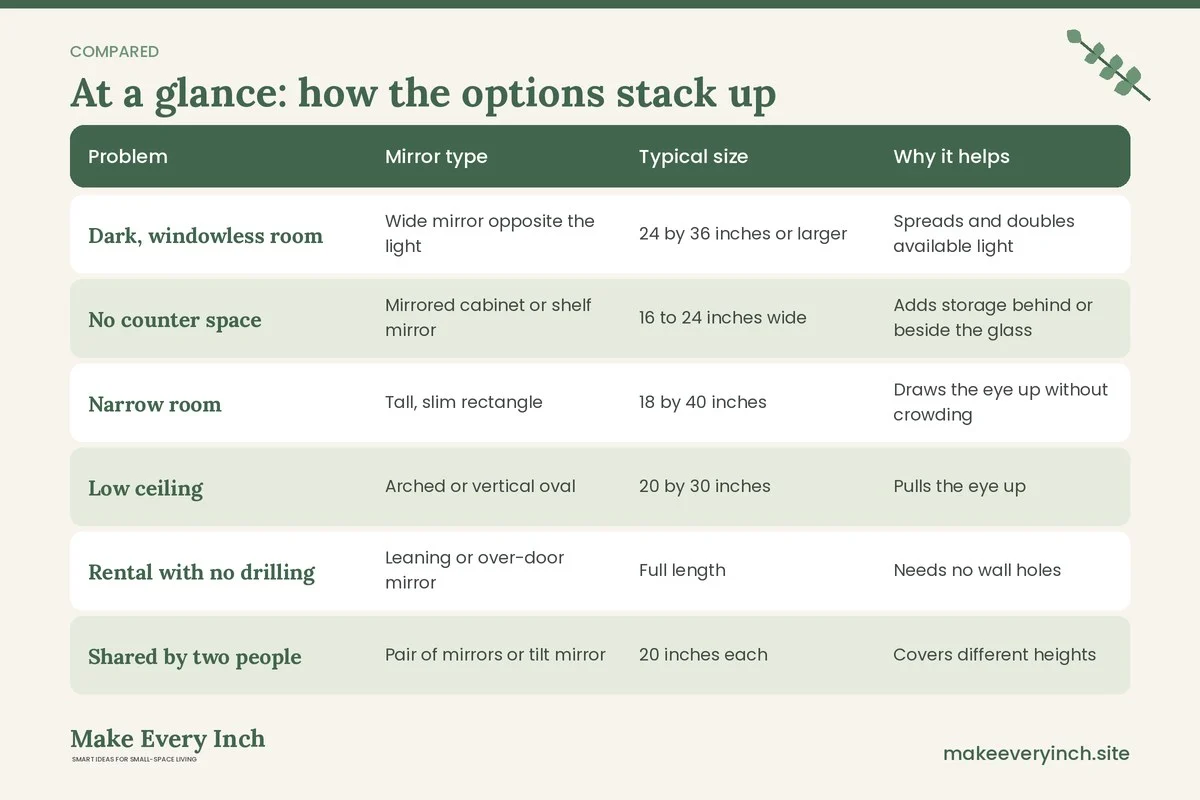
| Problem | Mirror type | Typical size | Why it helps |
|---|---|---|---|
| Dark, windowless room | Wide mirror opposite the light | 24 by 36 inches or larger | Spreads and doubles available light |
| No counter space | Mirrored cabinet or shelf mirror | 16 to 24 inches wide | Adds storage behind or beside the glass |
| Narrow room | Tall, slim rectangle | 18 by 40 inches | Draws the eye up without crowding |
| Low ceiling | Arched or vertical oval | 20 by 30 inches | Pulls the eye up |
| Rental with no drilling | Leaning or over-door mirror | Full length | Needs no wall holes |
| Shared by two people | Pair of mirrors or tilt mirror | 20 inches each | Covers different heights |
| Very humid room | Sealed or moisture-rated mirror | Any | Resists edge damage and spotting |
Three example bathrooms
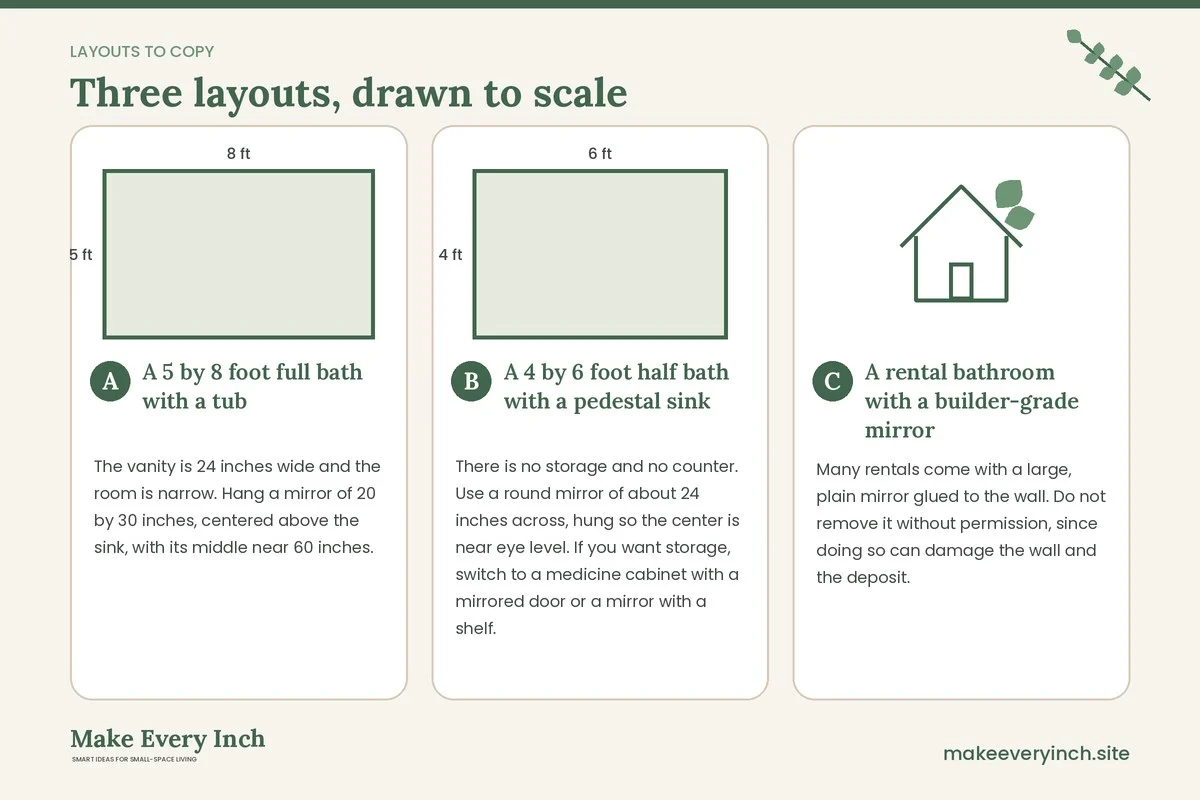
A 5 by 8 foot full bath with a tub
The vanity is 24 inches wide and the room is narrow. Hang a mirror of 20 by 30 inches, centered above the sink, with its middle near 60 inches. Add a small mirror or a shelf-mirror on the long wall only if it stays well away from the shower spray. Paint the walls in a pale color, and the mirror will bounce light from the ceiling fixture across the room. Keep the shower curtain light so it does not swallow the reflection. For layouts, take a look at our small bathroom layout ideas that work.
A 4 by 6 foot half bath with a pedestal sink
There is no storage and no counter. Use a round mirror of about 24 inches across, hung so the center is near eye level. If you want storage, switch to a medicine cabinet with a mirrored door or a mirror with a shelf. A mirror that sits opposite the door gives the first impression a sense of depth. Keep the wall otherwise clear so the room does not feel crowded.
A rental bathroom with a builder-grade mirror
Many rentals come with a large, plain mirror glued to the wall. Do not remove it without permission, since doing so can damage the wall and the deposit. Instead, add a light frame kit made for the purpose, or hang a smaller decorative mirror on a hook over the top if the lease allows. Add a leaning mirror or an over-door mirror for a full-length view. Our renter-friendly bathroom ideas and security-deposit-safe apartment upgrades give more options.
Light: pair the mirror with the right fixture
A mirror is only as good as the light that falls on your face. Overhead light alone casts shadows under the eyes and chin. Side light from sconces or a lit mirror is gentler and more even. If you can only have one light, aim for a fixture above the mirror with a wide diffuser. Choose warm to neutral light, about 2700 to 4000 kelvin, for a natural skin tone. Keep any light near water rated for damp or wet locations, and have a qualified electrician do any wiring changes. Outlets in a bathroom should be on a GFCI-protected circuit, and you should never use a plug-in appliance near a sink or tub unless the outlet is protected.
Safe mounting and moisture
A bathroom mirror is heavy, and the room is humid. Both facts shape how you hang it.
- Check the weight. A 24 by 36 inch glass mirror can weigh far more than people expect. Check the product’s weight and choose hardware rated well above it.
- Find the studs. Hang heavier mirrors into studs or use rated wall anchors suited to your wall type. Adhesive strips are not meant for heavy glass in a damp room.
- Ask first. If you rent, never drill without permission. Ask your landlord in writing, and photograph the wall before you start.
- Protect the edges. Moisture creeps behind a mirror and darkens the silver. Choose a mirror with sealed or backed edges, and leave a small gap for air to move.
- Ventilate. Run the fan during and after showers, since steam is the main cause of spotting and peeling.
- Think about safety glass. Choose a mirror with a safety backing if there are children in the house, so that a break does not scatter shards.
- Anchor leaning mirrors. A tall leaning mirror should be strapped or secured so that a child, a pet or a bump cannot tip it.
Cleaning and keeping a mirror clear
A fogged or streaky mirror makes a bathroom feel smaller. Wipe the glass with a soft cloth and a gentle glass cleaner, and spray the cleaner onto the cloth rather than the mirror so it does not run into the edges. Wipe the frame, shelves and the wall behind. Keep toothpaste splashes, hair spray and toiletries off the glass, since they leave films that dull the reflection. If a mirror fogs often, run the fan for 20 to 30 minutes after a hot shower, and open the door for a few minutes.
Common mistakes with a small bathroom mirror
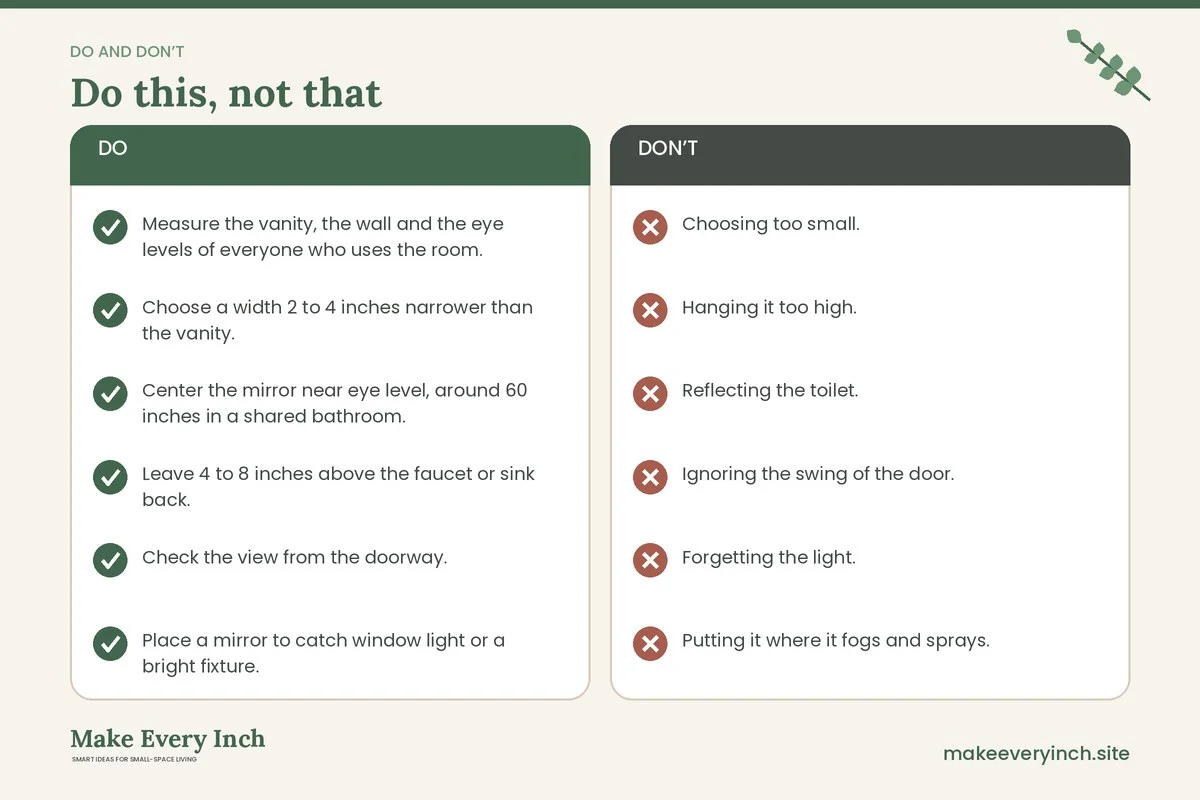
- Choosing too small. A tiny mirror on a big wall looks lost. Match the width to the vanity.
- Hanging it too high. A mirror hung for a tall person leaves a short user looking at the top of their head.
- Reflecting the toilet. Check the view from the doorway before you commit.
- Ignoring the swing of the door. A mirror on a door or opposite a door needs clear room to move.
- Forgetting the light. A mirror without a good fixture will not brighten a room.
- Putting it where it fogs and sprays. Keep it away from the shower stream and from the splash zone.
- Skipping the check on the lease. Even small holes can cost you a deposit.
Mirror and the rest of the room
A mirror works best when the wall behind it and the surfaces around it are chosen with care. Pale walls and a light vanity reflect more, while dark colors and busy tile patterns can cut the effect. If you want to pair the mirror with color, take a look at small bathroom color schemes that open up the room and small bathroom tile ideas. For the vanity itself, read our post on small bathroom vanity ideas. If your room feels long and thin, our guide to small bathroom ideas for narrow rooms pairs well with the tall-mirror idea above.
Quick checklist
- Measure the vanity, the wall and the eye levels of everyone who uses the room.
- Choose a width 2 to 4 inches narrower than the vanity.
- Center the mirror near eye level, around 60 inches in a shared bathroom.
- Leave 4 to 8 inches above the faucet or sink back.
- Check the view from the doorway.
- Place a mirror to catch window light or a bright fixture.
- Pick a moisture-rated product with sealed edges.
- Check the weight and use the right hardware or a no-drill alternative.
- Confirm lease permission before drilling or gluing.
- Pair the mirror with even, warm to neutral light.
- Run the fan after showers and wipe the glass regularly.
- Strap any leaning mirror.
FAQ
What size mirror is best for a small bathroom?
A mirror about 2 to 4 inches narrower than the vanity and at least 24 inches tall suits most rooms. A pedestal sink can take a mirror of 18 to 24 inches wide, and a narrow room often does better with a tall, slim piece.
How high should I hang a bathroom mirror?
Center it near eye level, which is around 56 to 66 inches from the floor for most adults. In a shared bathroom, about 60 inches is a common middle point, and a taller mirror covers a wider range of heights.
Does a mirror make a small bathroom look bigger?
It makes the room feel deeper and brighter, because it repeats the view and bounces light. It does not change the real dimensions, and the effect depends on what it reflects, so face it toward a window or a clean, light wall.
Can I hang a mirror in a rental bathroom without drilling?
You can lean a full-length mirror against a wall with a safety strap, hang one over the door or add a frame or a smaller mirror over an existing glued piece. Confirm with your landlord before gluing anything or drilling.
Should the bathroom mirror match the faucet?
It does not need to match, but a shared tone makes the room feel planned. Repeating one finish in the frame and the fixtures is a simple way to do it.
Is a round or a rectangular mirror better in a small bathroom?
Round mirrors soften straight lines and suit a single sink, while rectangles work for most layouts and long vanities. Choose according to your tile, your vanity and the shape of the wall.
How do I stop my mirror from fogging?
Run the exhaust fan during and for 20 to 30 minutes after a shower, keep the door ajar and consider a mirror with a built-in defogger if your electrics support it and it is rated for the room.
Is it safe to put a mirror above a tub?
It can be, if the mirror is rated for damp areas, the edges are sealed and it is mounted securely and away from direct spray. Keep any electrical mirror lighting on a protected circuit and installed by a qualified person.
Keep going: Keep going with our full guide to small bathroom ideas that feel spacious, the companion post on how to make a small bathroom look bigger and our small bathroom storage ideas for tight spaces.
Save this guide for later
Pin the ideas you like to Pinterest so you can come back to them when you plan your space.