15 Narrow Living Room Ideas Budget Fixes for Long Thin Rooms
Quick answer: The best narrow living room ideas budget plans spend money in a fixed order: first fix the layout with furniture you already own, then add light and a rug, then replace only the one piece that blocks the walkway. Keep 30 to 36 inches of clear path, choose furniture 30 to 36 inches deep at most, and treat any estimate as a rough range because local prices vary widely.
Narrow living room ideas budget plans begin with an unglamorous truth: in a long thin room, the layout is worth more than the shopping list. A room that is 8 to 10 feet wide and 14 to 20 feet long punishes the wrong purchase. A sofa that is 4 inches too deep, a rug that is the wrong shape or a bulky console can eat the walkway and make the room feel like a corridor with a sofa in it. The reverse is also true, and it is good news for a tight budget. Moving what you own, adding one or two well-chosen pieces and fixing light and color can change a thin room more than a full furniture set would. This guide is about spending in the right order. It covers how to measure, what to try before you buy, 15 low-cost ideas, a table that ranks each fix by effort and rough cost, swap-versus-buy rules, thrift and secondhand tips, a safety note for tall furniture and a checklist. For the wider picture of long thin rooms, start with our parent guide to narrow living room ideas, and for general tactics see small living room ideas.
Why narrow rooms waste money
Most budget mistakes in a narrow room come from buying for the room you wish you had. Shop listings show furniture in wide, square spaces, so a sofa looks modest in the photo and then fills one entire wall in your home. Depth is the number that matters in a thin room, not length. A sofa that is 38 to 40 inches deep in a room that is 9 feet (108 inches) wide leaves about 68 to 70 inches across, and once you add a table at the other wall, the walkway can fall below 24 inches. Nobody wants to turn sideways to cross their own living room.
The second source of waste is buying small things to fix a big layout problem. Three small baskets, a cheap shelf and a runner will not help if the sofa blocks the door swing. Fix the layout, then buy.
The third source is buying to match. A narrow room hides a mismatched collection better than a wide room, because the eye travels along the length and sees repetition of color rather than a set of identical pieces. You do not need a matching suite. You need a calm palette, a clear path and a few repeated shapes.
Measure first, spend second
Measuring costs nothing, and it prevents the most expensive errors. Use a tape measure and write these numbers on a sheet of paper.
- Width at the narrowest point. Measure at floor level and again at shoulder height, since baseboards and radiators change the real number.
- Length of each wall. The long walls decide where the sofa can sit.
- Door swings and openings. Note which way each door opens and how far it swings. A door that opens 30 to 36 inches into the room claims that space.
- Window and radiator positions. Furniture in front of a radiator can be a problem, so check the manufacturer’s advice and local rules.
- Outlets and switches. Mark them. A lamp needs a plug.
- Your current furniture depths. Sofa, chairs, tables and shelves. You will compare these with the clearance targets below.
Then tape the outline of each piece on the floor with painter’s tape. If you plan to buy something, tape its stated size first. Walk the room for a day. This free test shows whether a new piece will block a path before you spend anything on it.
Clearance targets for a long thin room
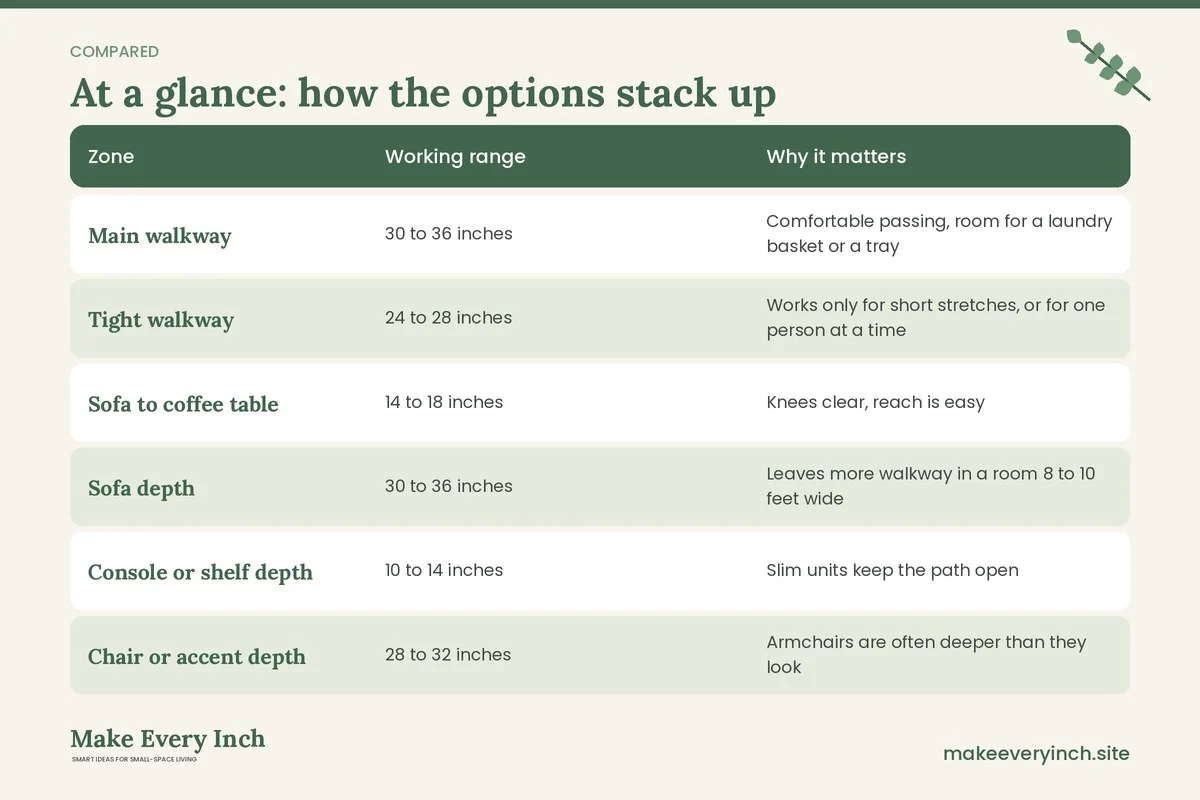
Use these as working ranges, and adjust to your household. They are common planning guidelines, not strict rules.
| Zone | Working range | Why it matters |
|---|---|---|
| Main walkway | 30 to 36 inches | Comfortable passing, room for a laundry basket or a tray |
| Tight walkway | 24 to 28 inches | Works only for short stretches, or for one person at a time |
| Sofa to coffee table | 14 to 18 inches | Knees clear, reach is easy |
| Sofa depth | 30 to 36 inches | Leaves more walkway in a room 8 to 10 feet wide |
| Console or shelf depth | 10 to 14 inches | Slim units keep the path open |
| Chair or accent depth | 28 to 32 inches | Armchairs are often deeper than they look |
| Door swing zone | Leave clear | Never plan furniture in the arc |
In a room 8 feet wide (96 inches), a sofa 34 inches deep leaves 62 inches. A slim side table 14 inches deep on the opposite wall leaves 48 inches, which is enough for two people to pass. Add a 24-inch-deep armchair and it falls to 24 inches, which is tight. The numbers show why one deep chair can matter more than a cheap rug.
What to try before you buy anything
The first tier of a budget plan costs little or nothing. Try each of these for a week before you shop.
Rotate the layout
Most long rooms have two layouts: the sofa along the long wall, or the sofa across the short end facing the length. Moving a sofa from the long wall to the short end can open a path along one side and turn the other end into a defined zone. Test both with tape and with your real furniture.
Edit the furniture
Remove one item at a time and live without it for several days. A second armchair, a bulky side table and a floor basket are frequent culprits. Store them in a closet or a bedroom, and see whether you miss them. Selling the extra pieces secondhand may pay for the things you really need, though what pieces sell for varies by area.
Use what the rest of the home has
A slim bedroom nightstand can be a side table. A kitchen stool can be an accent seat or a plant stand. A dining chair can sit by the window for guests. A bookshelf from a hallway might fit the short wall. Shopping from your own home is the cheapest store you have.
Clear the floor
In a thin room, floor items count twice, since they take space and break up the line of sight. Baskets, bags, shoes and cords narrow the room. Gather them off the floor with hooks, a slim shelf or a closed basket under a table.
15 narrow living room ideas budget fixes
Layout ideas that cost almost nothing
1. Float the sofa a few inches off the wall
A sofa pushed flat against the wall can make a thin room feel like a bench. Pulling it out 3 to 6 inches can give you room for cords and a table behind. In a very narrow room, keep it against the wall and save the inches.
2. Put the sofa on the short wall
With the sofa across one end, the long axis becomes a clear runway toward the window. Use it when the room is 14 feet or longer, and the sofa is about 72 to 84 inches wide.
3. Create two zones with a rug or a shelf
A long room reads better as two short rooms. Define a seating zone at one end and a flexible zone at the other, such as a reading chair, a desk or a dining perch. A rug marks the first zone, and a low shelf or a floor lamp marks the edge of the second.
4. Keep one wall nearly empty
Place heavier pieces on one long wall and leave the other nearly clear. A single clear wall makes the room feel wider, and the walkway stays straight.
5. Pull furniture away from doors and windows
A sofa that blocks the line between the door and the window makes the room feel shorter. Keep that path open, even if it means a smaller sofa placement.
Low-cost furniture swaps
6. Replace one deep piece, not everything
If one chair or sofa is the main blocker, replace only that piece. Look for a sofa that is 30 to 34 inches deep with slim arms. Narrow arms can save 4 to 8 inches of width, and raised legs show floor, which makes the room feel lighter.
7. Choose a slim console behind or beside the sofa
A console 10 to 12 inches deep can hold a lamp, a plant and a tray. Behind a sofa it creates a soft divider between the zones, though it needs about 3 inches of space to the sofa back. Secondhand consoles and entry tables are often easy to find in a range of prices.
8. Swap a coffee table for nesting tables
A rectangular coffee table can block a thin room, while two nesting tables of different heights can tuck away. Small round tables, 18 to 22 inches across, soften the lines. For more on that approach see small living room ideas without a coffee table.
9. Add a bench or a pouf for flexible seating
A bench along a wall seats guests and holds blankets. A pouf tucks under a console. Neither blocks the path, and both can be moved at a moment’s notice. A bench around 14 to 16 inches deep is often a good fit in a thin room.
Light, color and surface
10. Use a long runner and a rug with the grain
A rug that is too small makes a thin room look chopped up. Choose a rug about 5 by 8 feet in a room 9 feet wide, which leaves a visible border of floor on each side. A flat-weave rug lies flat and is easy to move. Lay stripes or patterns lengthwise only if you want the room to look longer, and across if you want it to look wider.
11. Paint the short walls
Painting the two short end walls in a slightly deeper tone can make the room feel less like a tunnel, since the eye reads the walls as closer. Paint is one of the cheapest changes, but check your lease first. If you rent, see renter-friendly apartment decorating ideas for options that leave no mark.
12. Add a mirror opposite the window
A large mirror on a long wall opposite a window bounces light across the room and visually doubles the width. A secondhand mirror in a plain frame costs far less than new, and a leaning floor mirror avoids drilling.
13. Layer lamps instead of buying a big fixture
Three low light sources look better than one ceiling light. A floor lamp at the far end, a table lamp on a console and a clip light on a shelf can pull the eye along the whole length. See small living room lighting ideas for more.
14. Hang curtains high and wide
Mount the rod 4 to 6 inches above the window frame and extend it 6 to 10 inches on each side. Floor-length curtains in a light color make the wall look taller. If you rent, a tension rod or an adhesive rail can hold light curtains.
15. Add vertical storage along the short wall
A narrow bookshelf 8 to 12 inches deep can hold a lot without taking walkway. See best narrow bookshelves and vertical storage ideas for ideas.
Tall furniture needs anchoring
Tall, narrow furniture such as bookcases, shelving units and slim cabinets can tip, particularly when shelves are loaded unevenly or a child pulls on a drawer. In a thin room these pieces sit close to the walkway, so a tip would land in your path. Anchor every tall piece to a wall stud or to the structure with the hardware the manufacturer recommends, and put heavier items on the lower shelves. If you rent and cannot drill, check the lease and talk to your landlord, or choose lower furniture instead. A low shelf is often a safer choice than an unanchored tall one. See no-drill storage ideas for renters for alternatives that suit rental rules.
Ideas ranked by effort and rough cost
Costs below are broad bands only. Prices change by region, season and condition, so use them to compare ideas rather than to plan a final budget.
| Idea | Effort | Rough cost band | Space gained | Best for |
|---|---|---|---|---|
| Rotate the layout | Low | Free | High | Any narrow room |
| Edit furniture | Low | Free | High | Cluttered rooms |
| Shop your own home | Low | Free | Medium | Side tables, stools |
| Floor items off the ground | Low | Low | Medium | Cords, shoes, bags |
| Lamps and bulbs | Low | Low | Feels wider | Dim rooms |
| Leaning mirror | Low | Low to medium | Feels wider | Rooms with one window |
| Secondhand console | Medium | Low to medium | Medium | Divider and storage |
| Nesting tables | Low | Low to medium | Medium | Replacing a coffee table |
| Rug 5 by 8 feet | Low | Medium | Defines zones | Wood or tile floors |
| Slim sofa | High | Medium to high | High | Sofa deeper than 36 inches |
| Paint the short walls | Medium | Low to medium | Feels wider | Owners, flexible leases |
Narrow living room ideas budget: spend in this order
A budget works best when each stage depends on the one before. If you can only afford one step this month, pick the earliest one that you have not yet done.
Stage one: free fixes
Rotate the layout, remove extra furniture, clear the floor and bring in pieces from other rooms. Live with the new arrangement for a week. Many people find that the room is already much better, and the list of things to buy gets shorter.
Stage two: light and surface
Add lamps, a mirror and a rug. These change how the room feels and cost less than most furniture. Warm bulbs of about 2700K give a cozy glow, and cooler ones of 3000K to 3500K can suit a room used for work. Check the label for brightness, since a narrow room usually needs light at several points.
Stage three: one key piece
If the room still feels cramped, identify the single piece that causes it. Often this is a deep sofa, a large TV unit or a coffee table. Replace that item with a slimmer version, and keep the rest. Spending on the one piece that blocks the path often gives more than spreading the same money across many accessories.
Stage four: storage and finishing
Add a slim shelf, baskets that fit inside it and a tray for the table. Add art last, and keep it large and sparse. See small living room storage ideas for ideas.
Swap, thrift or buy new
| Item | Thrift or secondhand | Buy new | Notes |
|---|---|---|---|
| Side tables | Usually easy | Optional | Check wobble and stains |
| Console | Often easy | Optional | Measure depth, not just width |
| Mirror | Often easy | Optional | Check the backing and the hanging hardware |
| Lamps | Often easy | Optional | Replace the cord if frayed |
| Rug | Possible | Often better | Check for odors and pests |
| Sofa | Possible | Often better | Check the frame, the smell and the depth |
| Mattress or cushions | Avoid | Better | Hygiene concerns |
Secondhand shopping works best with a tape measure and a short list. Take the depth and width limits with you and say no to anything that does not fit. Check stability by pushing on tall items, since a wobbly shelf will be even less safe when loaded. Smell upholstery before you buy it, and inspect seams for signs of pests. Wipe wood with a mild cleaner and sand and refinish if you like. Paint can turn a mismatched set into one family of pieces.
Sample layouts for common narrow rooms
A room 8 feet by 16 feet
Place a sofa 32 to 34 inches deep along one long wall, offset from the center toward the far end. Use a 5 by 8-foot rug under the front legs. Put a slim console 10 inches deep on the opposite wall near the door, with a lamp. Leave the center clear and place a floor lamp and a small chair at the window end. The path from the door to the window stays about 36 inches wide.
A room 9 feet by 18 feet
Create two zones. The seating zone has a sofa across the short wall with two nesting tables. The other end holds a small desk or a reading chair. A rug under the seating zone and a runner or bare floor in the middle mark the change. This room has space for a bookshelf 10 inches deep on a long wall, anchored to the wall.
A room 10 feet by 14 feet
This room is on the wider side of narrow and can take a 34-inch sofa and a 28-inch armchair on opposite sides of a 20-inch round table. Check the walkway on each side of the table to be sure it stays above 28 inches. Skip the console, and use wall shelves or a slim bookshelf for storage.
A room with a door at one end and a window at the other
Keep the line between the door and the window open, since it makes the room feel longer. Place the sofa off that line, on the long wall, with the arms toward the door so people do not walk into them. Hang curtains wide, and place a mirror opposite the window.
Common budget mistakes in narrow rooms
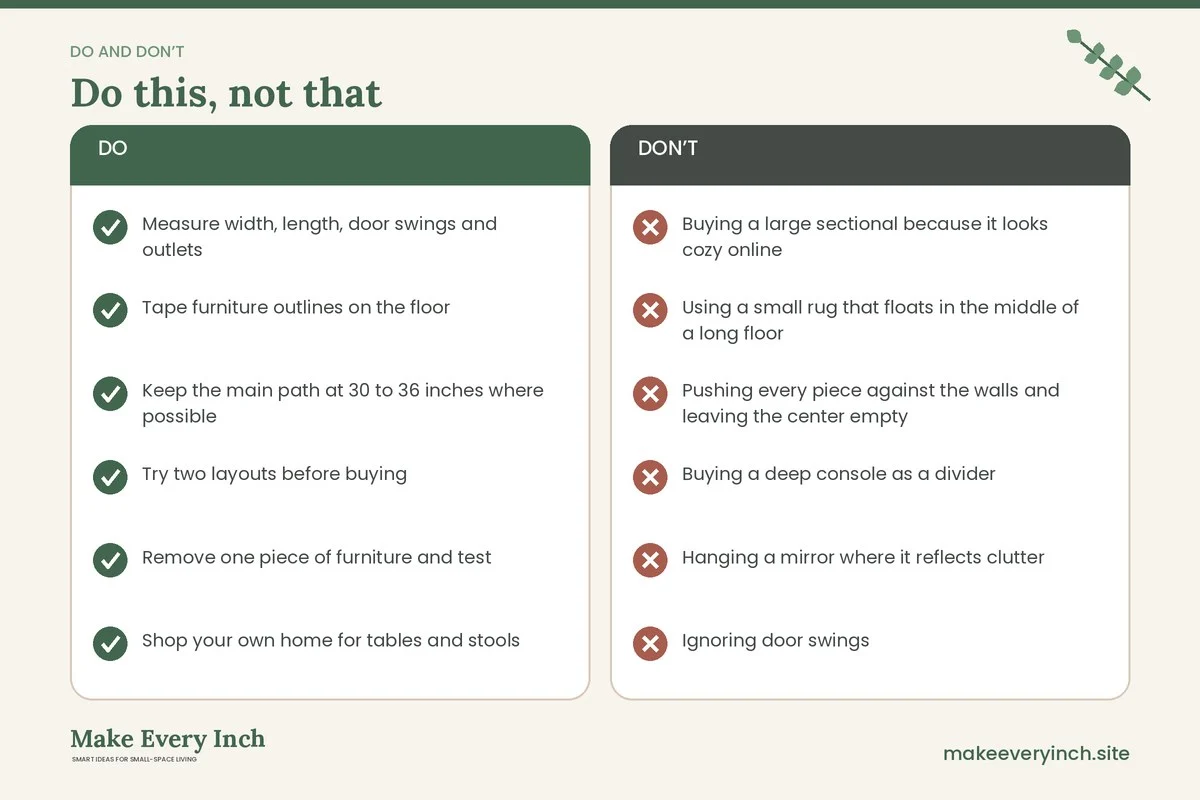
- Buying a large sectional because it looks cozy online
- Using a small rug that floats in the middle of a long floor
- Pushing every piece against the walls and leaving the center empty
- Buying a deep console as a divider
- Hanging a mirror where it reflects clutter
- Ignoring door swings
- Buying many small decor items instead of a few large ones
- Skipping the tape test
- Leaving tall furniture unanchored
- Spending on accessories before fixing the layout
Small upgrades that make a thin room feel intentional
Repeat a color at both ends
Place the same accent color at the sofa end and the far end, such as a cushion and a vase. The repetition draws the eye along the length and ties the zones together.
Use one large piece of art
A single piece, 24 to 36 inches wide, on the short wall at the end of the room becomes a focal point and ends the tunnel effect. A cluster of small frames can feel busy on a long wall, so keep the gallery for the wall that has the most space.
Keep sightlines low
Low furniture along the window wall lets light and air through, and makes the room feel wider. Save tall pieces for the end wall, where they do not cut the room in half.
Choose light-reflecting finishes
Pale walls, light curtains and a glossy or satin surface on one side table bounce light. You do not need to paint everything, as one or two reflective touches can help.
Hide the cords
Cords on the floor shorten the room visually and cause trips. Use cord clips along the baseboard, or run a cord behind a console. A power strip with a switch can tuck under a table.
Money-saving habits that last
Track what you spend in a note on your phone, with a column for the idea number from this guide. After a month, you will see which fixes did the most for the least. Wait seven days before buying anything that is not urgent, and use the time to re-measure. Search several sources for the same item, and compare the depth and the return policy. Keep receipts and packaging until you are sure the piece fits. If an item does not fit, return it right away while it is still allowed.
Resist the urge to fill every gap. A narrow room that feels spare is easier to move through, easier to clean and cheaper to furnish. Leave a little empty floor, and the room will repay you.
A four-weekend plan
Weekend one
Measure the room and tape outlines. Try both layouts. Remove extra furniture and clear the floor. Photograph the best arrangement.
Weekend two
Add lamps, test a mirror and look for a rug. Shop your own home for side tables, trays and baskets. Make a short list of items with maximum depth and width written on it.
Weekend three
Visit secondhand sellers with your list and tape measure. Buy only items that meet the limits. Anchor any tall furniture, and put heavier items low.
Weekend four
Style the room. Repeat a color at both ends, add one large piece of art and tuck away cords. Live in it for a week before you buy anything else. Pair this plan with small living room layout ideas and narrow hallway ideas if your living room opens into a corridor.
Narrow living room budget checklist
- Measure width, length, door swings and outlets
- Tape furniture outlines on the floor
- Keep the main path at 30 to 36 inches where possible
- Try two layouts before buying
- Remove one piece of furniture and test
- Shop your own home for tables and stools
- Choose a sofa 30 to 36 inches deep
- Pick slim consoles of 10 to 14 inches
- Add a mirror opposite the window
- Layer three light sources
- Choose a rug that leaves a floor border
- Anchor tall furniture to the wall
- Check secondhand items for stability and smell
- Replace only the piece that blocks the path
- Keep receipts until you are sure it fits
FAQ
How can I decorate a narrow living room on a budget?
Start with free layout changes, then add light, a mirror and a rug, and replace only the one piece that blocks the path. Spend last on accessories.
What size sofa suits a narrow living room?
Many people aim for a depth of 30 to 36 inches, and a width that leaves at least 30 inches of walkway. In a room 8 feet wide, choose the shallower end of that range.
How much space should I leave to walk through?
A working range is 30 to 36 inches for the main path. Shorter stretches of 24 to 28 inches can work for one person at a time.
Is a rug worth it in a thin room?
Often yes, because it defines a zone and adds warmth. Choose a size that leaves a border of visible floor, and a flat weave that lies flat.
Should I buy secondhand furniture?
It can save a lot, particularly for tables, consoles and mirrors. Measure first, check stability, and avoid used mattresses and cushions.
Can I make a narrow room look wider without painting?
Yes. Use a mirror opposite the window, light curtains hung high, low furniture along the window wall and a clear walkway. Layered lamps also help.
How do I secure tall bookcases?
Anchor them to a wall stud with the recommended hardware, and keep heavy items low. If you cannot drill, consider lower furniture instead.
Where should the TV go in a narrow room?
Most often on the short wall at the end, so the seating faces along the length. Keep viewing distance and glare in mind. See small living room TV wall ideas.
What should I buy first?
Usually lighting, because it changes the feel of the room for a small spend. Only buy furniture after you have tested layouts with tape.
Keep going: Read our narrow living room ideas guide, then explore small living room ideas, small living room makeover under 500 and small apartment living room ideas on a budget.
Save this guide for later
Pin the ideas you like to Pinterest so you can come back to them when you plan your space.