15 Laundry Closet Organization Ideas for Tight Hall and Bedroom Closets
Quick answer: Good laundry closet organization starts with the machines, not the shelves. Confirm the clearance your appliance manuals ask for, keep the vent path and floor drain area clear, then use the vertical space above the machines for bins, a hanging rod and a few anchored shelves. Keep chemicals high and closed, lint out of the closet, and the doors easy to open.
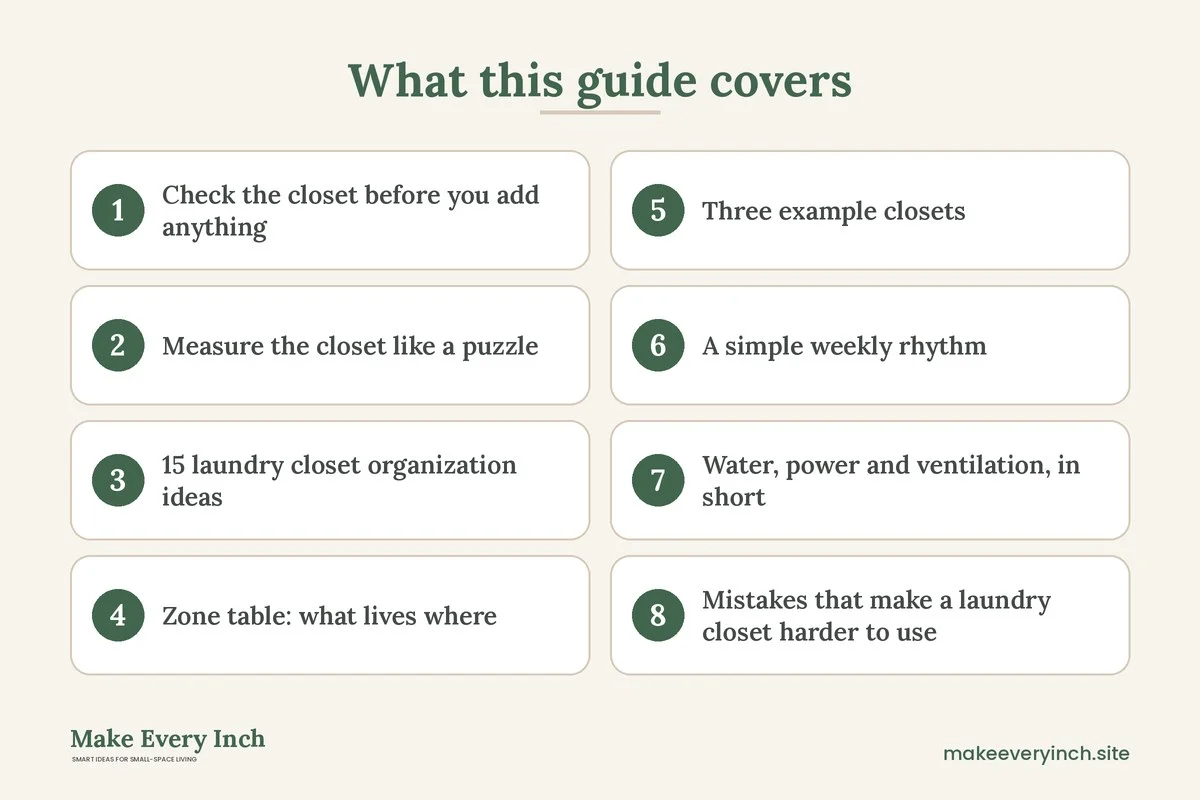
Laundry closet organization is a different puzzle from organizing a full laundry room, because a closet gives you almost no floor, a narrow door opening and machines that already fill most of the width. Every inch above, beside and behind the appliances has a job, and some of those inches are not yours to use at all, since a dryer needs air, a vent and a clear path to work safely. This guide walks through the clearance and safety checks first, then 15 ideas that fit a closet, a zone table, three example closets, a weekly routine, mistakes to avoid and a checklist. For the larger picture, read our pillar guide on small laundry room ideas, then come back here for the closet-specific details.
Check the closet before you add anything
A laundry closet is a utility space first and a storage space second. Before you buy a single bin, spend twenty minutes on the following checks. They protect your machines, your walls and your lease.
- Read the appliance manuals. Both the washer and the dryer manual list the clearance they need at the sides, the back and the top. Many manuals call for a small gap on each side and a larger one behind the dryer for the vent duct. Treat the manual as the final word and use the numbers in this guide only as a rough planning range. If you no longer have the manual, most makers post a copy online under the model number printed inside the door or on the back panel.
- Look at the door. Louvered or vented doors are often there on purpose, because they let air reach a dryer or a water heater. A solid door added later can trap heat and moisture. If the closet has a vented door, leave the vents uncovered and do not stack things against them.
- Find the shutoffs. Locate the water supply valves for the washer and the electrical outlet or breaker for the dryer. Keep a clear route to both. In an emergency you should be able to reach them in seconds without moving boxes.
- Check for a drain pan or floor drain. Some closets, especially those above living space, have a pan under the washer. Do not block it, and do not store paper or cardboard on the floor of the closet.
- Know who owns what. In a rental, ask in writing before drilling into walls, adding a rod or changing a door. A closet with a water heater, a furnace or a utility panel inside is a mechanical space, and the landlord may have rules about what can be stored in it.
If any of these checks turn up something unclear, stop and ask a professional or your landlord before you organize around it. Good organization never means blocking air, access or safety devices.
Measure the closet like a puzzle
Write down five numbers before you shop. First, the interior width and depth of the closet. Second, the width of the door opening, which is often narrower than the closet itself. Third, the height from the top of the machines to the shelf or ceiling above them. Fourth, the gap at each side of the machines. Fifth, the gap behind them, measured at the widest point of the vent connection. A gap of about 1 inch on each side and 4 to 6 inches behind is a common starting point for planning, though your own manual may say something different.
Next, draw a simple elevation on paper: a rectangle for the closet wall and two rectangles for the machines. Mark the door swing. If a door swings into the closet, shelves on its back may be possible, but only if the shelf depth leaves the door free to close. A bifold or sliding door changes everything, because the hardware sits right at the front edge. Keep every shelf and bin shallower than the door hardware, and test the door before you fill the shelf.
Last, stand in the doorway and notice what you can see and reach. Eye level to shoulder height is prime space, and the highest shelf and the floor are for rarely used items. This simple observation, more than any product choice, decides whether the closet stays tidy.
15 laundry closet organization ideas
Use the space above the machines
1. One deep shelf, anchored to studs
A single sturdy shelf above the washer and dryer is the most useful storage in most closets. Mount it high enough that you can still open a top-loading lid or reach the controls, and fasten it to wall studs, not just drywall. Use hardware rated for the load, and ask permission first if you rent. Do not overload it, because a loaded shelf that pulls from the wall can fall onto the machines or onto you.
2. Two shorter shelves with a gap between
If the closet is tall, two shelves 12 to 16 inches apart hold bins on each level. The lower shelf takes everyday items and the upper one takes backups. Check that you can reach the upper shelf without a chair, since reaching overhead with a heavy bin is how backs and shoulders get hurt.
3. Lidded bins that match
Uniform lidded bins make a closet look calm. Label the front of each bin with a word or a symbol. Use lids on anything that holds dust-prone items, and keep bins light enough to lift with one hand when full.
4. A tension rod above the machines
In a rental where you cannot drill, a tension rod across the closet holds a few hangers for delicates, shirts that need to drip dry and a small laundry bag. Choose a rod rated for more weight than you plan to hang, and keep it clear of the dryer vent and any heat source. Our guide to no-drill storage ideas for renters covers more ways to add hanging space without tools.
Make the door work
5. A slim over-the-door organizer
Hang a narrow organizer on the back of a swing door for dryer sheets, stain sticks, small brushes and spare buttons. Check that the door still closes fully and that the organizer does not catch on the hinge side. Leave louvers and vents uncovered. This is the kind of reach-and-grab storage that also works in a small closet.
6. A hook rail on the inside of the door
A short rail with three or four hooks holds a lint brush, a mesh bag and a hanging clothespin bag. Use removable adhesive hooks rated for the weight, and test one in a hidden spot first.
7. A pocket for the laundry list
A clipboard or a small chalk label inside the door keeps a wash plan in view: what is due this week, which loads need cold water, and which items need to air dry. It removes a surprising amount of guessing.
Work the sides and the floor
8. A narrow rolling cart in the side gap
If the manual allows a gap of 6 inches or more on one side, a slim rolling cart can slide in and out for detergent, softener and a stain remover. It must be easy to pull out, must never touch the dryer exhaust or the machine back, and must have a lip or a tray to catch drips. Skip this idea entirely if the gap is tight.
9. A tall hamper that doubles as a sorter
A two-section hamper that stands beside the machines separates lights from darks before the wash even starts. In a very narrow closet, a hanging mesh sorter on the door or a pair of stackable baskets does the same job. Keep soiled laundry off the closet floor, where it can collect damp and lint.
10. Nothing stored on top of the dryer when it runs
The top of a dryer is tempting, but it gets warm, and loose fabric or paper can slide off behind the machine. Use the top of the washer for folding, and keep the dryer top clear while it runs. If you must store something on the dryer, make it a small, empty, heat-safe tray.
Keep the supplies safe
11. A high, closed shelf for chemicals
Detergent, bleach, stain remover and fabric softener belong on a high shelf with a lid or a latch, out of reach of small children and pets. Keep each product in its original container with the label readable, and do not decant cleaners into food containers. Never mix cleaners, especially bleach with anything containing ammonia or acid, because the fumes can be harmful. A closet is a small, enclosed space, so a spill or a mix is more concentrated than it would be in a larger room.
12. A spill tray under liquids
A shallow plastic tray under detergent jugs catches drips and protects the shelf. Wipe it weekly. Sticky rings on a shelf are a sign that a bottle needs a tray.
13. A lint plan, not a lint pile
Empty the lint screen after every load and drop the lint into a small covered bin outside the closet or in the trash. Lint is flammable, and buildup in the screen housing and the vent duct is a recognized fire risk. Do not store a bin of lint, dryer sheets, rags or paper inside the closet. Once or twice a year, follow the manual to have the vent duct cleaned.
Add function without adding clutter
14. A fold-down drying rack
A wall-mounted fold-down rack, or a slim freestanding one that tucks behind the door, gives delicates a place to dry. If you mount it, ask permission and fasten it into studs. Keep it away from the dryer exhaust, and make sure the closet has enough airflow so damp items do not raise humidity.
15. A lighted, labeled check point
A battery-powered stick-on light and one label on the shelf edge are enough to make the closet feel organized. Use a light you can remove, and avoid plugging anything into an outlet that is already in use by the dryer or washer. Dryers often use a dedicated circuit, so an extension cord or a power strip on that outlet is a bad idea.
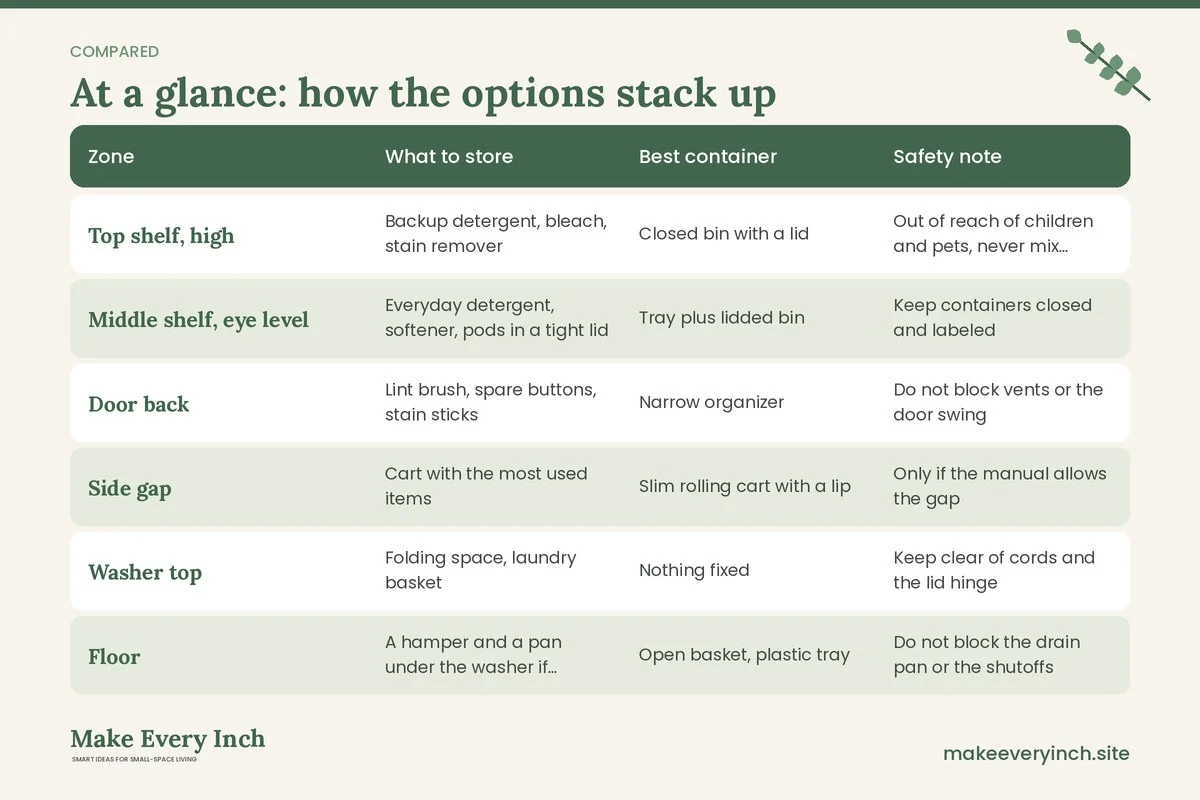
Zone table: what lives where
| Zone | What to store | Best container | Safety note |
|---|---|---|---|
| Top shelf, high | Backup detergent, bleach, stain remover | Closed bin with a lid | Out of reach of children and pets, never mix products |
| Middle shelf, eye level | Everyday detergent, softener, pods in a tight lid | Tray plus lidded bin | Keep containers closed and labeled |
| Door back | Lint brush, spare buttons, stain sticks | Narrow organizer | Do not block vents or the door swing |
| Side gap | Cart with the most used items | Slim rolling cart with a lip | Only if the manual allows the gap |
| Washer top | Folding space, laundry basket | Nothing fixed | Keep clear of cords and the lid hinge |
| Floor | A hamper and a pan under the washer if needed | Open basket, plastic tray | Do not block the drain pan or the shutoffs |
| Behind the machines | Nothing | None | Leave the vent path and hoses clear |
Three example closets
The hallway closet with a stacked pair
A tall, narrow closet holds a stacked washer and dryer with a shelf of about 14 inches deep above them. The owner mounts one anchored shelf above the stack, with two lidded bins on it for detergent and for spare dryer supplies. A slim organizer on the back of the door holds lint brushes and stain sticks. There is no floor space, so the hamper lives in the bedroom, and laundry travels to the closet in a basket on wash day. The key lesson is that when floor space is zero, storage moves up and out. For more on the stack itself, see our post on stacked washer dryer storage ideas.
The side-by-side pair behind bifold doors
A wider closet holds two machines side by side with a shelf above. Bifold doors mean the shelf cannot be deep, so the owner uses shallow baskets with 8 inches of depth, and a tension rod for two hangers beside the shelf. There is a gap on the right of about 7 inches, and a slim cart rolls in for detergent. The cart has a lip, and the owner pulls it out and sets it aside whenever the dryer is moved for cleaning. The lesson: with bifolds, shelf depth is decided by the door hardware, not the wall.
The bedroom closet with a combined washer and dryer
A single unit sits at the end of a bedroom closet with a short hanging rod on the other side. The owner keeps a lidded bin above the unit, a rolling cart at the open end and a hook rail inside the door. The vent runs through the wall, so nothing touches that area. Because the closet is next to the bed, the owner runs the unit only when someone is home, uses a drip tray on the floor and checks the hoses monthly. The lesson: a laundry closet next to living space needs an extra margin for water, noise and humidity.
A simple weekly rhythm
Good systems are maintained in a few minutes a week. Pick a day and do the following.
- Empty the lint screen after every load, and check for lint around the door seal.
- Wipe the shelf and the tray under liquid products, and replace any cracked bottle.
- Look at the hoses and the floor for damp spots, drips or rust marks. A small leak caught early saves a ruined floor.
- Empty the hamper and the sorting bags, and put the lids back on bins.
- Clear anything that has migrated to the top of the machines, the front of the door or the floor.
Once a month, pull the machine out only if the manual and your landlord allow it, and only if you can do so safely. Clean behind it, check the vent connection and look at the water hoses for bulges. If a hose looks worn, replace it before it fails. If you smell gas or see sparks, stop and call a professional.
Water, power and ventilation, in short
Water and electricity share the same small room, so a few rules matter more than any organizing trick.
- Shutoff valves: know where they are, and keep them reachable. If a valve is stuck or leaking, call a plumber or your landlord.
- Outlets near water: laundry areas are a place where ground fault protection is commonly expected. If your outlet does not have it and you are unsure, ask an electrician or your landlord. Do not alter wiring yourself.
- Venting: a dryer vent should lead outdoors and follow the manual. Local codes can differ on duct material and length. Never vent a dryer into a closet, a cabinet or a space under the home, and do not crush the duct behind the machine.
- Heat and airflow: do not pack the closet so tightly that air cannot move. A cool, ventilated closet is safer and keeps towels from smelling damp.
- Weight on shelves: machines vibrate, so anchor shelves properly and keep heavy items low.
If anything feels off, such as a burning smell, a warm outlet or a tripped breaker, stop using the machine and get professional help.
Mistakes that make a laundry closet harder to use
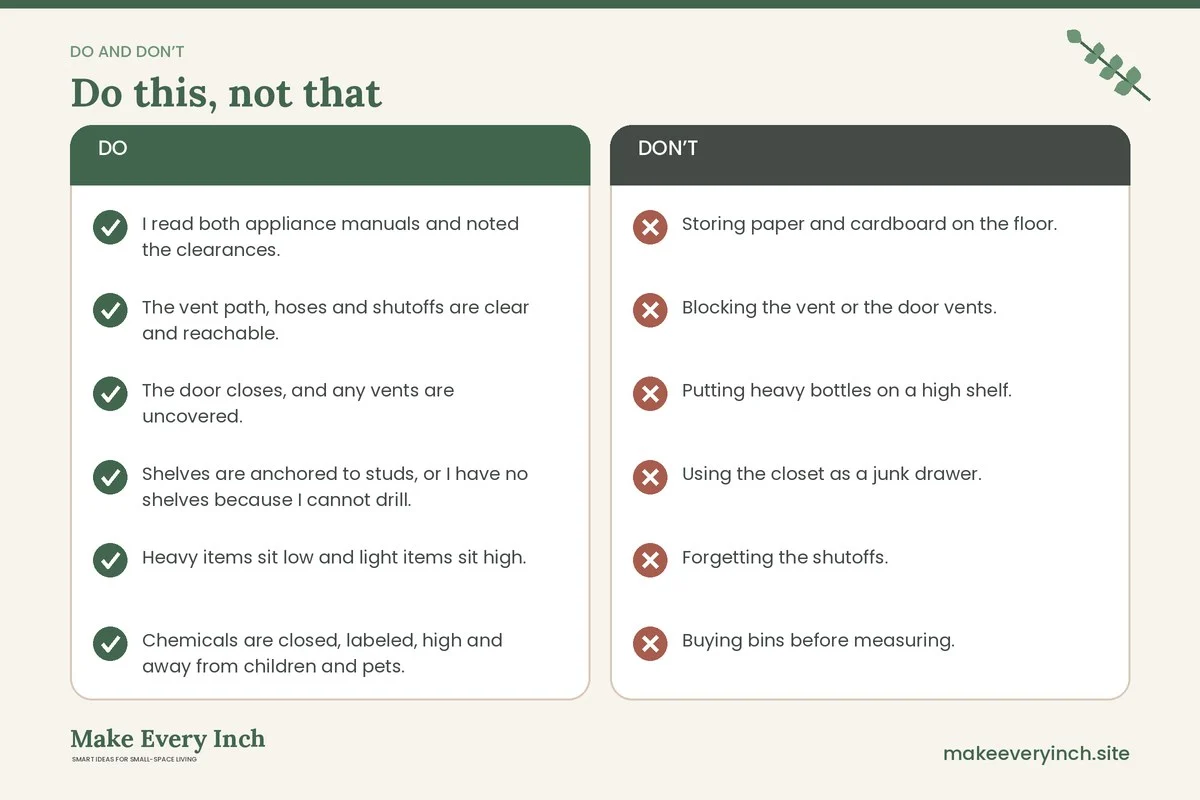
- Storing paper and cardboard on the floor. Damp cardboard collects mold and is a trip hazard, and paper near a dryer is fuel for a fire.
- Blocking the vent or the door vents. A tidy closet is not worth a hot dryer.
- Putting heavy bottles on a high shelf. Keep the heaviest items between knee and shoulder height.
- Using the closet as a junk drawer. Brooms, tools and seasonal decor creep in quickly. Give each zone a single job.
- Forgetting the shutoffs. If a hose bursts, you want a clear path in seconds.
- Buying bins before measuring. A bin 1 inch too deep can stop a door from closing.
- Decanting chemicals. Original labels matter in an emergency.
Budget and renter approach
Most of the ideas above can be done in stages. Start with the free parts: clear the clutter, measure the gaps and read the manuals. Next, add lidded bins and a hook rail, which cost little compared with built-ins. Finally, if you own the home or have written permission, add anchored shelves. If you rent and cannot drill, stick to freestanding and tension-based pieces. For a broader plan, see our guides on budget small space ideas, renter-friendly apartment decorating ideas and renter-friendly shelving ideas without drilling.
Where the rest of the home helps
A laundry closet works best when it is not asked to hold everything. Move linens to a bedroom shelf or a hallway cabinet, as described in our guide to linen storage ideas without a linen closet. Keep cleaning tools in the kitchen or the bathroom, where you use them. If your whole home is short on space, our overview of small space organization ideas shows how to spread storage across rooms, and vertical storage ideas has more ways to use wall height safely.
Laundry closet checklist
- I read both appliance manuals and noted the clearances.
- The vent path, hoses and shutoffs are clear and reachable.
- The door closes, and any vents are uncovered.
- Shelves are anchored to studs, or I have no shelves because I cannot drill.
- Heavy items sit low and light items sit high.
- Chemicals are closed, labeled, high and away from children and pets.
- No cleaners are mixed, and no lint or paper is stored in the closet.
- The lint screen is emptied after every load.
- A tray sits under liquid products.
- Hoses and the floor are checked monthly.
- I have written permission for anything I drilled or changed.
- Outlets near water have the protection my electrician or landlord recommends.
FAQ
How much space does a washer and dryer need in a closet?
It depends on the model. Many manuals ask for about 1 inch at the sides and several inches behind the dryer for the vent, with extra space above for airflow. Always follow your own manual, since the numbers vary.
Can I put shelves above my washer and dryer?
Usually yes, if they are anchored to studs, hold hedged loads and leave room to open lids and doors. Renters need written permission before drilling.
Is it safe to store detergent in a laundry closet?
Yes, if containers stay closed, labeled and out of reach of children and pets, and you never mix products. Keep them away from heat.
How do I stop lint from building up?
Empty the lint screen after every load, keep the vent duct short and straight, and have the duct cleaned on the schedule your manual suggests. Do not store lint inside the closet.
What if my closet has a vented door?
Leave the vents open. They often provide the air the dryer needs, so avoid covering them with bins or hanging organizers.
Can I add a light or outlet in the closet?
Use a battery or stick-on light you can remove. For any new outlet or wiring, hire a licensed electrician and get your landlord’s permission.
Where do I keep a hamper if there is no floor space?
Keep it in the bedroom or hallway, and carry laundry in a basket on wash day. Or hang a mesh sorter on the closet door if the door allows.
Keep going: Keep going with our small laundry room ideas, small laundry room organization and stacked washer dryer storage ideas.
Save this guide for later
Pin the ideas you like to Pinterest so you can come back to them when you plan your space.