13 Small Laundry Room Countertop Alternatives for a Folding Surface
Quick answer: The best small laundry room countertop alternatives are a fold-down wall shelf, a removable board that rests across the washer and dryer, a rolling cart, a drying rack with a flat top, a hanging bar plus a basket shelf, and a narrow rolling table. Pick the surface that can be cleared in seconds, keep the dryer vent and appliance doors clear, and check your manuals before you rest anything on top of a machine.
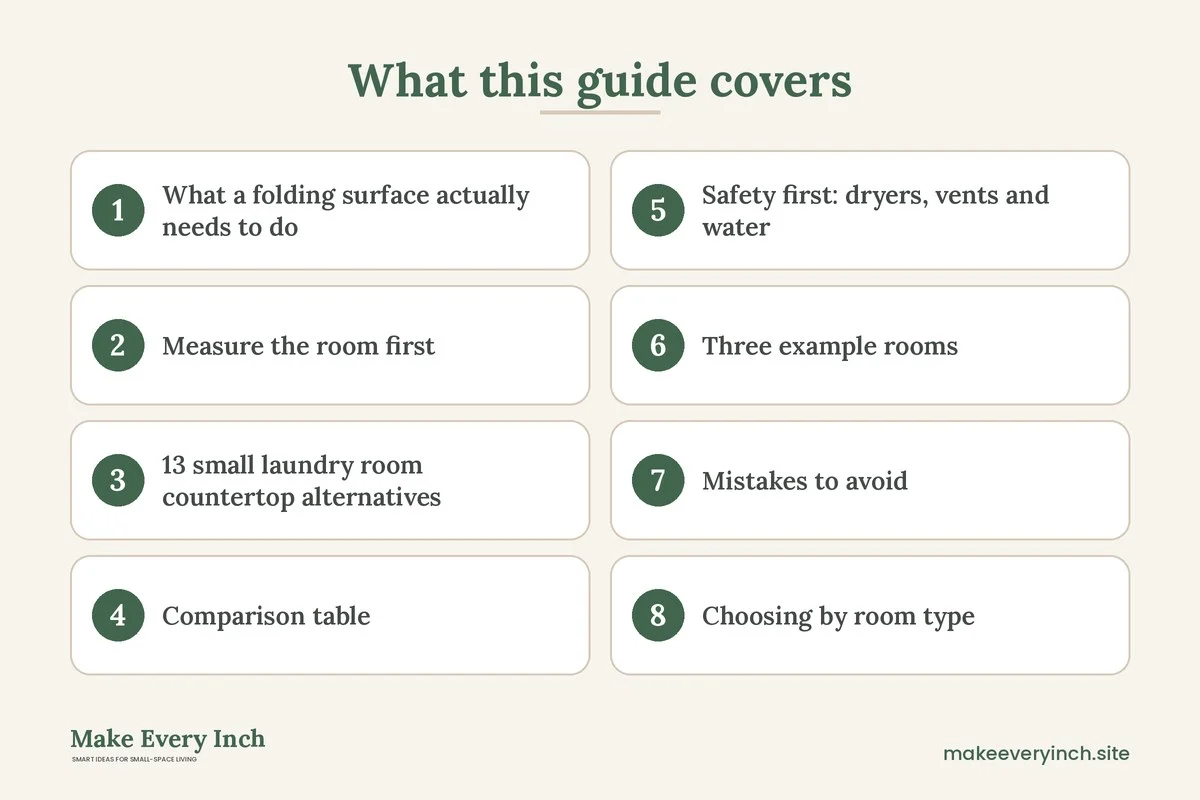
Small laundry room countertop alternatives matter because the classic answer, a built-in counter over front-loading machines, assumes you own the space, have the budget for carpentry and have room for a stacked or side-by-side layout with a few spare inches. In a rental closet, a hallway alcove or a corner of a kitchen, none of that is guaranteed. Yet folding laundry on the bed or the sofa is the habit most people want to break. This guide covers the measurements that decide what fits, 13 surfaces that work without a permanent counter, a safety section on dryers, vents and vibration, a comparison table, three example rooms, a checklist and a FAQ. For the bigger picture, start with our main guide to small laundry room ideas, then pair it with the family-focused plan in small laundry room organization for families.
What a folding surface actually needs to do
Before choosing anything, be clear about the job. A folding surface is not storage. It is a temporary flat area where you can lay out a towel, a fitted sheet or a stack of shirts and smooth them. Most people only need that surface for ten to twenty minutes per load, which is why a surface that appears and disappears often beats a permanent one in a small room.
Think about three things.
- How big the items are. A folded bath towel is commonly around 24 to 30 inches long when laid flat and quartered, and a shirt laid open can be about 20 to 28 inches wide. A surface around 24 inches wide and 18 inches deep handles shirts, small towels and kids’ clothing. Sheets and large towels are easier on a surface that is 30 inches or wider, or on a bed.
- How high it should be. A comfortable folding height is generally near the height of your hip bones, often 34 to 38 inches from the floor for many adults. Many washers and dryers have tops at about 36 inches, but sizes vary, so measure your own units and read the manual.
- How long it needs to stay out. If it can be cleared in under a minute, it can live in a walkway. If it takes five minutes to unfold, it needs a spot that never blocks the door.
These ranges are typical and hedged on purpose. Your appliances, your height and your room will move the numbers up or down, so treat them as starting points and confirm with a tape measure.
Measure the room first
Grab a tape measure and a notepad. Write down the following before shopping or building anything.
- Width, depth and height of each appliance, including the knobs and any hoses or vent connection behind them.
- The gap behind each machine. Manuals commonly call for several inches behind a dryer so the vent can move air freely. Your manual states the actual number.
- Door swing. Front-loading doors usually swing out 90 degrees or more. A surface or cart must not hit the door when it opens.
- Floor-to-ceiling height and the position of the wall studs, if you plan to mount anything and you have permission.
- Walkway width. Aim for about 24 to 30 inches of clear floor in front of the machines in a tight room so you can load, unload and carry a basket. In a very small space you might make do with less, but test it by carrying a full basket through.
- Where the shutoff valves, the dryer vent and the electrical outlets are. You must be able to reach the valves quickly, so nothing permanent should block them.
Sketch the room as a top view on paper. Draw the door swing arcs in a light color. Whatever you add must sit outside the arcs, and it must not cover vents, valves or the dryer exhaust.
13 small laundry room countertop alternatives
Wall-mounted and fold-down surfaces
1. A fold-down wall shelf
A hinged shelf mounted on the wall at folding height flips up to rest flat against the wall when it is not in use. In a narrow room it is the closest thing to a counter that disappears. A depth of about 16 to 20 inches is plenty for clothes. Look for a model that has a support bracket or a locking arm, and check its weight rating before you load it. Mounting means drilling into studs, so this idea is for owners or renters with written permission. If you rent, ask your landlord first and never drill without approval.
2. A fold-down drying rack on the wall
Some wall-mounted racks swing out for hanging damp clothes and fold flat when done. They are not folding surfaces, but they free the folding surface from the job of holding drying clothes. In a laundry room with no counter, this pairing is useful: dry on the rack, fold on the board. As with any wall hardware, anchor it into studs or use the correct anchors for your wall, and check the load rating.
3. A shelf bracket pair with a removable board
Two sturdy brackets on the wall with a board that sits on top can create a folding shelf above a washer-dryer pair that you lift off when you need the wall back. Keep the shelf well above the machines so you can open lids and doors. Again, this needs drilling and anchoring, so confirm permission in a rental, and use the correct fasteners for the wall type.
Surfaces that rest on or beside the machines
4. A removable board over the washer and dryer
A flat board that rests across the tops of a side-by-side washer and dryer gives you a long counter on laundry day, and you lift it off to use the machines. Consider the following safety points. Top-loading washers need their lids to open, so a board would block them. Front-loading machines with flat tops are better candidates. Do not cover vents, controls or air openings. Check your manuals before placing anything on top of a machine, because some manufacturers warn against heavy loads or recommend certain clearances. Vibration during the spin cycle can move a loose board, so use a non-slip liner and remove the board before running a load, or confirm that the setup is stable. Never leave items on the board during the spin.
5. A dryer-top mat for light folding
If the dryer manual allows it, a thin rubber or fabric mat on top gives a little grip for folding a few shirts. It is a stopgap, not a counter. Keep the mat away from the vent and any control panel, and take it off before you run the dryer so heat can escape. Never rest detergent, bleach or other chemicals on a heated or vibrating machine.
6. A shallow tray lid for the sink or a utility tub
If you have a deep utility sink, a board or tray cut to fit across the rim creates a work surface. Keep the faucet clear and remove the board when you need the tub. Do not use it in a way that blocks the drain or leads to water pooling. Keep electrical devices well away from wet areas.
Rolling and freestanding options
7. A narrow rolling cart with a flat top
A rolling cart about 12 to 18 inches wide can slide into the gap beside the machines or live in a closet. Wheels should lock. Pick a model with a solid top at folding height or close to it. Use the shelves for detergent, a basket and stain sticks. In a small room this is often the best answer because it works in a rental with no tools and no drilling.
8. A folding table that tucks behind a door
A drop-leaf or folding table that stores flat behind a door provides a surface for ten minutes at a time. The risk is the door swing, so test the full path of the door with the table out. Put a stop on the floor or a hook on the wall so the table is not left in the way.
9. A rolling island or butcher-style trolley
If the laundry area is part of a kitchen or hallway, a small rolling island can double as a folding table and a spot for a basket. Lock the wheels when in use and roll it back out of the walkway when done. This idea suits open floor plans more than closets.
10. A drying rack with a flat top
Some collapsible racks have a flat shelf on the top for folding. They are less sturdy than a table but can sit over a bathtub or in a corner. Check the weight rating, never overload, and keep the rack away from the dryer vent and from open flames or heaters.
Surfaces that live elsewhere in the home
11. The dining table or desk during a quick fold session
If the laundry area truly has no space, plan a folding spot elsewhere. A basket sits by the machines, and the folding happens at a dining table, a desk or an ironing board. The key is a routine: carry one basket, fold in one place, put away in one trip.
12. An ironing board as a folding surface
A wall- or door-mounted ironing board is a flat, adjustable surface that stores in a narrow slot. It is narrow, so it works for shirts and small items better than for sheets. Mounting hardware needs permission in a rental. A freestanding board stored behind a door is a no-tools alternative.
13. A bed as the planned folding zone
Many people already fold on the bed. Make it a plan rather than a habit. Keep a clean throw or a bed tray, fold in a defined spot, and immediately put the stacks away. This works especially well for sheets and towels.
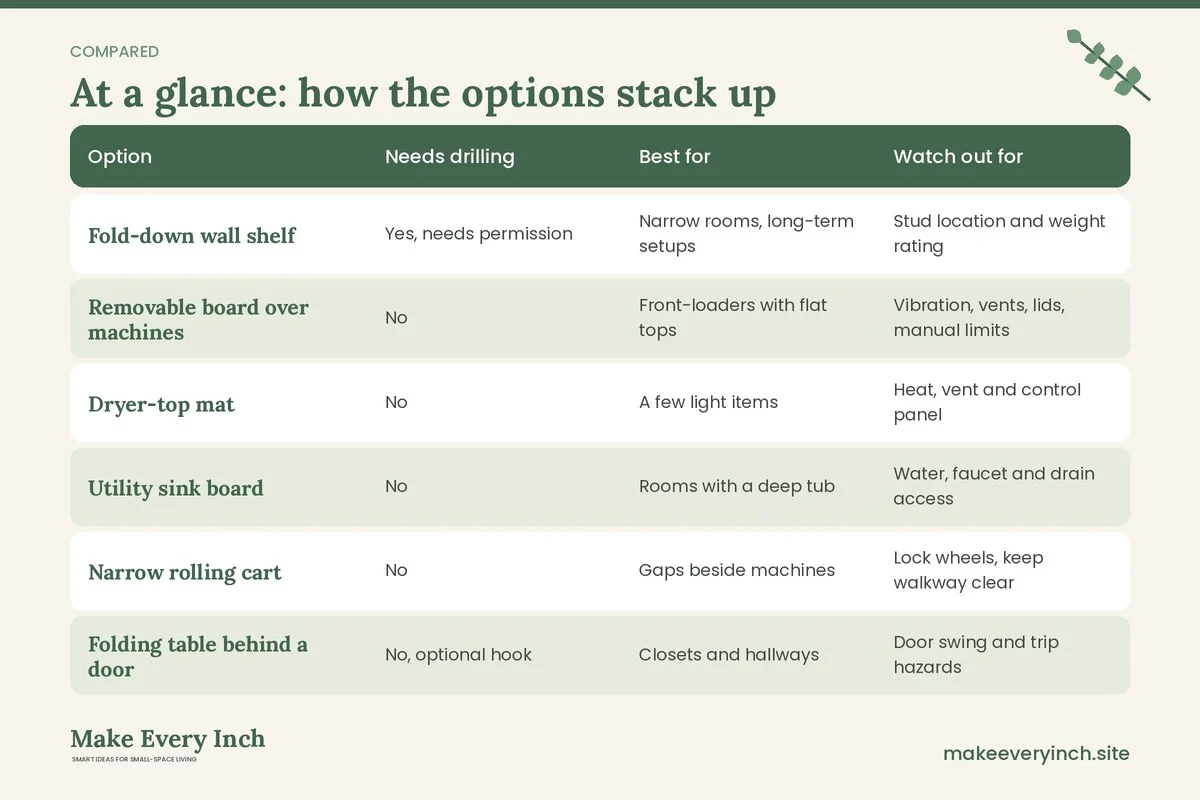
Comparison table
| Option | Needs drilling | Best for | Watch out for |
|---|---|---|---|
| Fold-down wall shelf | Yes, needs permission | Narrow rooms, long-term setups | Stud location and weight rating |
| Removable board over machines | No | Front-loaders with flat tops | Vibration, vents, lids, manual limits |
| Dryer-top mat | No | A few light items | Heat, vent and control panel |
| Utility sink board | No | Rooms with a deep tub | Water, faucet and drain access |
| Narrow rolling cart | No | Gaps beside machines | Lock wheels, keep walkway clear |
| Folding table behind a door | No, optional hook | Closets and hallways | Door swing and trip hazards |
| Rolling island | No | Open floor plans | Needs floor space |
| Drying rack with flat top | No | Small items | Weight limit and heat sources |
| Dining table or desk | No | Homes with no laundry space | Carrying distance |
| Wall or door ironing board | Often yes | Shirts and small items | Narrow width |
| Bed fold zone | No | Sheets and towels | Needs a clean surface and a plan |
Safety first: dryers, vents and water
A surface is only useful if it is safe. These points apply to every option above, and they take priority over style or convenience.
- Clearance and ventilation around dryers. Dryers push hot, moist air through a vent. Blocking that path can raise the temperature and moisture. Keep the area around the machine and the vent clear, and follow the clearances in the manual. Do not push a cart, board or basket tight against the back.
- Lint buildup and fire risk. Lint is flammable. Clean the lint trap after every load, and have the vent duct checked and cleaned on a regular schedule as recommended by the manual or a professional. Do not store towels, cleaning rags with solvents, or stacks of paper on or against the dryer.
- Venting rules. Dryer vents should follow local code and the manufacturer’s instructions. If you are changing the layout, do not alter the vent run without a professional, and never vent a dryer into a closet or living space. Ask your landlord or a licensed professional if you are unsure.
- Water leaks and shutoff valves. Know where the washer shutoff valves are and keep them reachable. Check hoses for cracks and bulges from time to time, and replace them according to the manual. Avoid placing a board or cart where it traps water or hides a leak.
- GFCI near water. Outlets near sinks and washers are commonly required to be GFCI-protected. If you add a lamp or a small appliance, use a protected outlet, keep cords away from water and never use an extension cord as a permanent solution.
- Weight and vibration of stacked units. A stacked washer and dryer is tall and vibrates during the spin. Do not lean on it or rest heavy items on top. Use only the stacking kit specified by the manufacturer, and follow the manual for leveling.
- Anchoring shelves and fold-down hardware. Anything that holds weight above your head or at your hips should be anchored into studs or rated anchors. Check weight ratings, and re-tighten fasteners now and then.
- Chemical storage. Detergents, bleach, stain removers and pods should be stored out of reach of children and pets, in their original containers with labels. Never mix cleaners, and bleach plus ammonia-based products can produce dangerous fumes. Store chemicals on a high shelf or in a closed cabinet with a child lock.
- Lease permission. Many leases restrict drilling, wall changes and plumbing or vent work. If you rent, get written permission before installing anything on the wall, and choose no-drill options when you can.
- Check the manuals. The appliance manual is the final word on clearance, placement and what can sit on top.
None of the above is legal or engineering advice. When in doubt, ask a licensed professional or your landlord.
Three example rooms
Example 1: The closet laundry
A stacked washer and dryer lives in a closet with bifold doors, with an opening about 30 inches wide and a floor depth of around 28 inches in front before you hit the hallway wall. There is no room for a table inside. The plan is a narrow rolling cart stored in the hallway, a basket for each person and a fold session on the bed. The cart rolls to the closet door on laundry day and holds detergent on a lower shelf, which should be on a high shelf if children or pets are around. The rack for delicates hangs on the back of the door, with a hook rated for the load.
What works: nothing is installed, nothing blocks the vent, and the closet stays empty when closed. What to watch: the cart must not block the bifold swing. Keep a clear path to the shutoff valves.
Example 2: The kitchen corner
Side-by-side machines sit at one end of a galley kitchen. A removable board rests across the tops during folding, and the board lives against the wall the rest of the time. The tall side of the room holds a wall-mounted drying rack that folds flat. A caution: the board is lifted off before the spin cycle, and nothing is left on top of the dryer. A lipped tray catches small items. The cleaning products sit in a locked cabinet away from the food prep area.
What works: a full-width folding surface on laundry day, and a clear counter the rest of the week. What to watch: a vented dryer and a gas line, if present, need the clearances stated in the manual.
Example 3: The hallway alcove
A narrow alcove holds a front-loading washer and a ventless dryer. The wall above has studs, and the landlord has agreed in writing to a fold-down shelf. The shelf sits at about hip height with a depth of around 16 inches, anchored into studs. On laundry day it drops flat, and at all other times it folds up and the hallway looks tidy. A small floor mat provides comfort, and a wall hook holds a mesh bag.
What works: a real surface in a space with no floor to spare. What to watch: the shelf must be rated for the load, and the arm must lock.
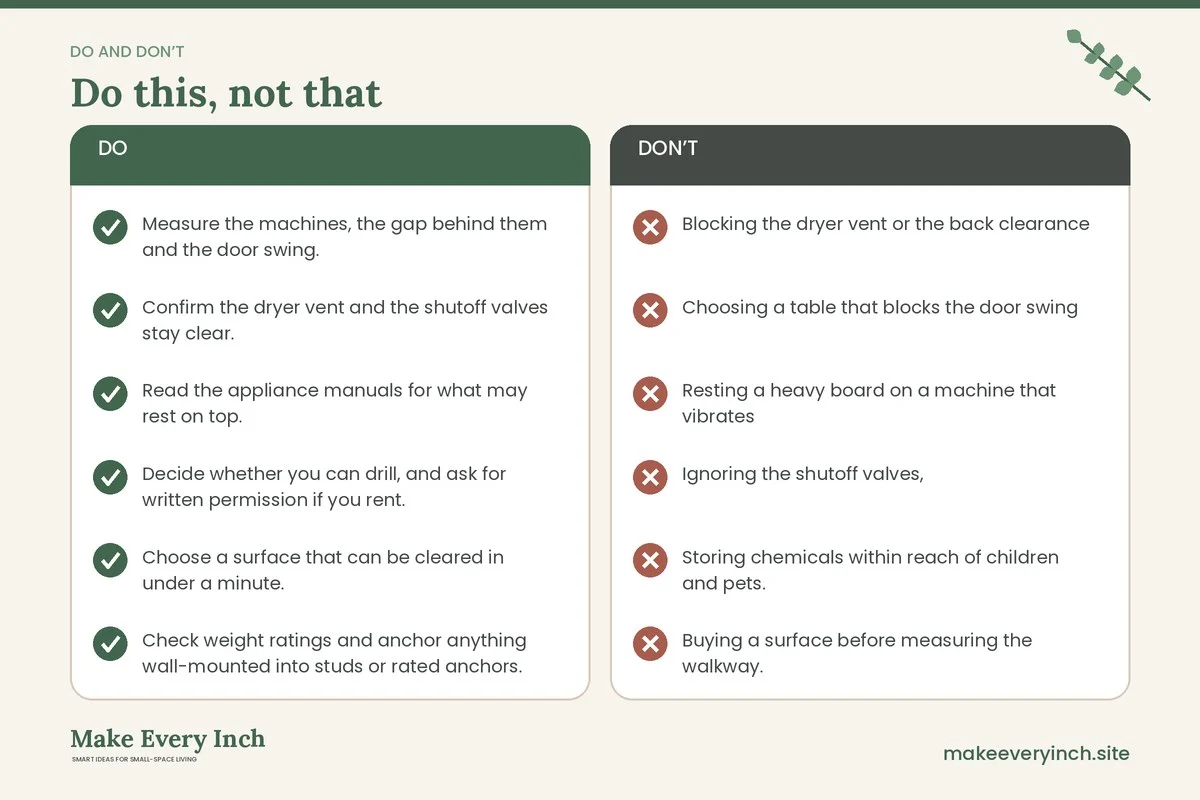
Mistakes to avoid
- Blocking the dryer vent or the back clearance with a cart or a basket.
- Choosing a table that blocks the door swing and then leaving it permanently open.
- Resting a heavy board on a machine that vibrates without a non-slip layer and without checking the manual.
- Ignoring the shutoff valves, so that a leak becomes an emergency.
- Storing chemicals within reach of children and pets.
- Buying a surface before measuring the walkway.
- Drilling without permission in a rental.
- Keeping a surface that takes more effort to set up than the fold itself.
Choosing by room type
A quick decision path can save a lot of time. If your laundry is in a closet, start with a rolling cart or a fold session at a table elsewhere in the home. If it is in a kitchen or hallway, consider a removable board or a fold-down shelf, depending on permission. If you have a stacked unit with no side space, a wall-mounted shelf above the stack is rarely safe because the unit vibrates, so favor a cart or a table elsewhere. If you have a deep utility sink, a board across the rim is a free upgrade. If you rent, use the no-drill options first and ask for approval before anything else.
Also think about who will use it. A tall adult and a teenager prefer different heights. A surface at the wrong height causes back strain over time, so test with a stack of books on the machine to see what feels right before building or buying.
Laundry zones often share space with other rooms, so it helps to borrow ideas from them. A kitchen corner benefits from the thinking in our small kitchen ideas, a bathroom laundry nook from small bathroom ideas, a hall closet from small closet ideas and a mudroom-style alcove from small entryway ideas. For the storage side of the room, read small laundry room organization.
For storage around the folding spot, keep one basket per person and a small caddy for lint-roller and stain sticks. Items that live near the machines should be few. For more ideas on keeping a small utility zone tidy, see our guides to small space organization ideas and hidden storage ideas.
Finishing touches without clutter
Once the surface works, a few small additions make the folding session easier.
- Light. A bright, even light at the folding surface helps you spot stains before drying. If you add a lamp, choose a low-heat bulb and a protected outlet.
- A hook or rail for hanging delicates, mounted only with permission or using a no-drill method.
- A basket per person, so folded stacks go straight into the right bin.
- A small trash bin for lint and dryer sheets, emptied after each load.
- A label on shelves so everyone knows where things go.
- A mat in front of the machines for comfort, with a non-slip backing.
For wider renter-friendly thinking, our posts on no-drill storage ideas for renters and renter-friendly apartment decorating ideas cover adhesive-free options for the rest of the home. If you are stretching a budget, see budget small space ideas.
Using the surface across the week
A folding surface works best when it fits a rhythm. Pick a set day, or fold each load as it leaves the dryer. The second approach prevents a mountain of clean clothes from accumulating. If you only have a rolling cart, roll it out when the dryer buzzer sounds, fold, then park it. If you use a removable board, lift it off before starting the next load. If you use the bed, fold in the same place each time so the habit sticks.
Pair the surface with a sorting system upstream. A three-bin hamper in the bedroom or hall means each load is already sorted when you start. Sorting at the point of removal saves time at the folding surface and keeps the area from filling with piles.
Checklist
- Measure the machines, the gap behind them and the door swing.
- Confirm the dryer vent and the shutoff valves stay clear.
- Read the appliance manuals for what may rest on top.
- Decide whether you can drill, and ask for written permission if you rent.
- Choose a surface that can be cleared in under a minute.
- Check weight ratings and anchor anything wall-mounted into studs or rated anchors.
- Keep chemicals high, closed and away from children and pets.
- Never mix cleaning products.
- Clean the lint trap after every load.
- Check that outlets near water are GFCI-protected.
- Test the setup with a full basket before committing.
FAQ
Can I put a board on top of my washer and dryer?
Often yes for flat-top front-loading machines, but not always. Check the manuals for limits, never cover vents or controls, use a non-slip layer, and remove the board before the spin cycle if it moves. Top-loading washers need their lids to open, so a board may not work.
How high should a folding surface be?
Many adults find 34 to 38 inches comfortable, roughly hip height. Your height and posture matter, so test with a stack of books before you commit.
What is the best option for a renter?
Usually a rolling cart or a folding table that stores behind a door, because neither needs drilling. If you want a wall-mounted shelf, ask your landlord for written permission first.
Is it safe to fold on top of the dryer?
Only when the manual allows it and the dryer is off and cool. Do not block the vent, and do not leave items on top while it runs. Never rest chemicals on it.
How much floor space do I need in front of the machines?
A clear 24 to 30 inches is a common target for loading and carrying a basket, but your appliances and door swing decide the real number.
What if there is no room for any surface?
Plan an off-site folding spot, like the dining table, a desk or the bed, and use a basket to carry the load. Pair it with a simple routine so it becomes automatic.
Keep going: Keep planning with our small laundry room ideas, small space organization ideas and no-drill storage ideas for renters.
Save this guide for later
Pin the ideas you like to Pinterest so you can come back to them when you plan your space.