Small Home Organization Ideas That Actually Last
Quick answer: Small home organization ideas that actually last rely on systems, not one big tidy-up. Give every category a fixed home with a capacity limit, place that home where the item is used, keep the daily reset under ten minutes, and run a short monthly review. Organization fails when storage is full, hard to reach or too fussy to maintain, so design for the lazy day, not the perfect weekend.
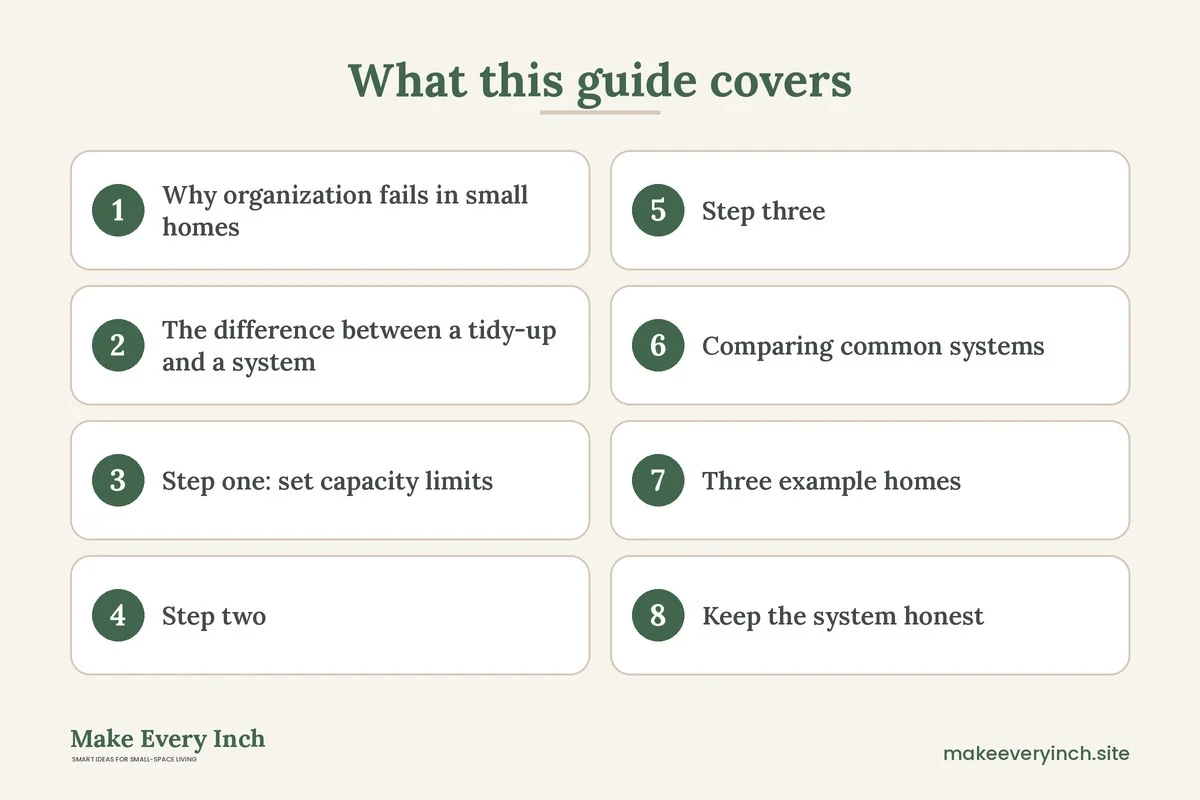
Small home organization ideas that actually last begin with an honest admission: most of us have organized the same drawer three times. The first tidy-up feels great, the second feels familiar, and by the third we start to suspect that we are the problem. We are not. A one-off tidy is an event, and events do not hold up against daily life. What holds up is a system, which is a set of decisions about where things live, how much of each thing you keep and how the home gets back to normal every day. This guide explains why organization fails in small spaces, how to set capacity limits, how to design homes for your habits, which reset routines are realistic, and how to review the system so it keeps working. It also includes a comparison table, three example homes, a checklist and an FAQ. For the wider topic, read our main guide to small space organization ideas, and for a room-by-room storage inventory, see the companion post on small home storage ideas for every room.
Why organization fails in small homes
Before building something that lasts, it helps to know why the last attempt did not. In small homes the same few causes show up again and again.
- There is no capacity limit. A shelf, a drawer or a closet that has no limit simply fills. The tidy-up that felt like a win leaves a little free space, and the next shopping trip fills it. When a space is always full, putting something away takes effort, and effort is what people skip.
- The home is far from the use. If the scissors live in a bedroom drawer and you wrap gifts in the living room, the scissors will end up on the sofa. Items migrate toward the place where they are used, and a system that fights that pull loses.
- The system has too many steps. A lidded box inside a basket inside a cupboard needs three moves to put away one item. People tolerate two steps for things they use weekly and one step for things they use daily.
- Categories are vague. A drawer labeled miscellaneous is not a category. It is a place where decisions go to wait.
- Everything is stored at the same effort level. Daily items, seasonal items and sentimental items need different access. When all of them share the front of the closet, the daily ones get buried.
- The system was built in one burst of motivation. Motivation fades and habits stay. A system that needs motivation to survive will not survive.
- Nobody else agreed to it. In a shared home, a system that only one person understands lasts as long as that person is in the room.
Notice that none of these is a character flaw. They are design faults, and design faults can be fixed. In a small home they matter more than in a large one, because there is no spare room to absorb the overflow. A large house can hide a lazy system in a spare closet. A small one shows it on the counter.
The difference between a tidy-up and a system
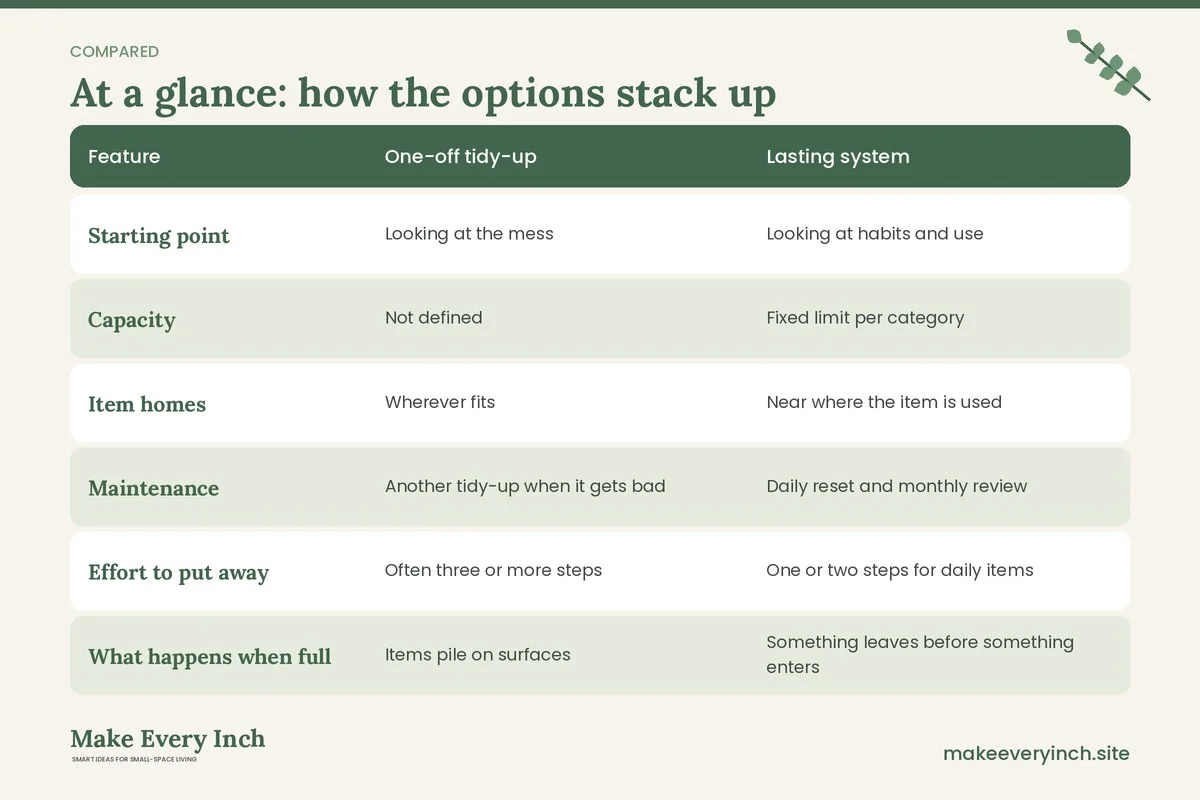
A tidy-up moves items into a better arrangement. A system also decides how many items belong, where each lives, what happens when the home is full and how the home resets after a busy day. The table below sets the two side by side.
| Feature | One-off tidy-up | Lasting system |
|---|---|---|
| Starting point | Looking at the mess | Looking at habits and use |
| Capacity | Not defined | Fixed limit per category |
| Item homes | Wherever fits | Near where the item is used |
| Maintenance | Another tidy-up when it gets bad | Daily reset and monthly review |
| Effort to put away | Often three or more steps | One or two steps for daily items |
| What happens when full | Items pile on surfaces | Something leaves before something enters |
| Typical result | Looks good for a few weeks | Holds its shape for months |
The right column does not need more storage. It needs more decisions, made once, so you do not have to make them every day.
Step one: set capacity limits
A capacity limit is the single most useful tool in a small home. It means that a given space holds a given amount, and when it is full, you stop. Think of each storage space as a container with a fixed volume, not a place to push things into.
How to set a limit
- Use the space itself. A shelf holds one row of mugs, or one stack of towels, or one basket of cables. When the row is full, the limit is reached.
- Use the 80 percent rule. Fill each drawer, shelf or cupboard to about 80 percent. The empty fifth is not wasted. It is the space that lets you see items, grab them and put them back without moving something else.
- Use one in, one out. When a new item arrives, an old item of the same type leaves. This is easy for clothes, mugs, towels and books. It is harder for tools and gadgets, so for those use a box limit instead.
- Use a box limit. A single bin or box for a category, such as a bin for chargers or a box for craft supplies. When the box is full, the category is full.
- Use a visible line. For a closet rail, decide that clothes must hang with about an inch of breathing room between hangers. When you cannot slide a hanger without a fight, you are over the limit.
Where limits matter most
Limits matter most in the categories that grow quietly. Clothes, paper, food, towels, bags, cleaning supplies and toys top the list. Sentimental items also grow without anyone noticing, so give them one box and one shelf and let the box decide. If you need help working out what should leave first, read our guide to small apartment decluttering ideas.
Measure before you buy anything
Many organization failures come from buying containers first. Measure the shelf depth, the drawer interior and the door clearance, then buy to fit. A typical kitchen drawer interior is often 18 to 22 inches wide and 2 to 4 inches high, but your own drawer may differ, so measure it. A basket that is 1 inch too wide will never sit properly, and a bin that blocks the drawer front will be left on the counter. Write the measurements in your phone so you have them in the shop.
Step two: give every item a home that matches its use
Capacity says how much. Placement says where. The second rule of a lasting system is to store things at the point of first use, at an effort level that matches how often you use them.
Store at the point of use
Ask where each item is first picked up. Keys are picked up at the door, so the key hook goes at the door. The pan is picked up at the stove, so it lives within a step of the stove. The charger is picked up at the bedside, so the charger lives at the bedside. This sounds obvious, and yet many homes store things where they fit instead of where they are used. If you want ideas for entry points, read our guides to small entryway organization and small coat storage ideas.
Match the effort level to the frequency
Divide storage into three zones by effort.
- Easy zone (between knee and shoulder height, in front): daily items. One move to take out, one move to put back. No lids, no stacking.
- Medium zone (higher shelves, lower drawers, behind a door): weekly or monthly items. Two moves are acceptable, so lidded boxes and baskets belong here.
- Hard zone (top shelves, under the bed, the back of a cupboard): seasonal or rarely used items. Labeled boxes work well, and you do not mind the effort because you rarely go there. For under-bed options, see our guide to under-bed storage ideas.
The most common reason for a system to fail is a daily item in the hard zone. If you reach for it every day and it needs a step stool, it will end up on the counter.
Keep categories narrow
A category such as cables, batteries or baking tools is narrow enough to find and to limit. A category such as stuff is not. Aim for a category that fits in one small container, and name it on a label if more than one person uses the space.
Use vertical space last, not first
Walls and doors give you more room, but they also add steps. Add vertical storage once the floor and the shelves are working, not before. Our guide to vertical storage ideas shows how to choose which wall deserves the extra hooks and shelves. If you rent, see no-drill storage ideas for renters and ask permission before drilling anything into a wall.
Step three: build reset routines you will really do
A home is organized when it can return to its default state quickly. A reset routine is the habit that does this. The key is to make it so short that doing it is easier than skipping it.
The daily reset (five to ten minutes)
Choose a time, usually just before bed or just after dinner, and run through a short list.
- Return stray items to their homes. Carry a basket if you have several rooms.
- Clear surfaces that are meant to stay clear: the table, the counter, the bed and the floor path.
- Wash or load the dishes, and wipe the main counter.
- Put tomorrow’s items in the entry zone: the bag, the keys, the shoes.
- Check the sink and the bathroom counter for stray items.
If it takes more than ten minutes, the system has too many homes or too many things. Take that as feedback about the system, not about your discipline.
The weekly reset (twenty to thirty minutes)
Once a week, deal with the places that quietly collect clutter.
- Empty the entry basket or tray and sort the mail.
- Clear the fridge of anything past its date and wipe one shelf.
- Strip the bed and wash the bedding, and tidy the bedside table.
- Reset the laundry area: empty the lint trap, check supplies and return baskets to their places.
- Skim the desk and the nightstand for items that belong elsewhere.
The monthly review (thirty to forty-five minutes)
Once a month, review one zone, not the whole home. January might be the kitchen counters, February the bathroom, and so on. Ask three questions of each space. What is full? What is unused? What is in the wrong place? Then remove or move what does not belong. Rotate zones so each gets a review a few times a year.
The seasonal swap (twice a year)
Swap clothing, bedding and decor that belong to the next season. This is also the moment to apply the one-in, one-out rule to clothes. Store the off-season items in the hard zone and bring forward the ones you need.
Make the routine easy to start
A routine lasts when the first step is trivial. Keep a basket by the stairs or the sofa for stray items, set a phone reminder, and attach the reset to something you already do, such as brushing your teeth or making tea. Short routines attached to existing habits are far more likely to stick than long routines that need a plan.
Comparing common systems
Different systems suit different people. Use the table to choose the one that matches your habits, and be honest about how much effort you will give.
| System | Best for | Effort to maintain | Where it fails |
|---|---|---|---|
| Open shelves and visible baskets | People who forget what they own | Low, if the shelf is edited | Looks messy when overfilled |
| Closed cabinets with labeled boxes | People who like a calm look | Medium | Hidden items are forgotten |
| Drawer dividers | Small items, kitchen and desk | Low | Dividers that do not fit shift and jam |
| Hooks and rails | Daily items, bags, tools | Very low | Visible clutter if overloaded |
| Zone baskets (one basket per category) | Shared homes and families | Low to medium | Baskets become dumping grounds |
| Rotating storage (seasonal swap) | Small closets and short cupboards | Medium, twice a year | Skipped swaps lead to overstuffing |
| Everything labeled | Shared homes, kids, roommates | Medium to set up | Labels get out of date |
Many homes need a mix. For example, you might keep hooks at the door, drawer dividers in the kitchen and labeled boxes on the top shelf of the closet.
Three example homes
A one-bedroom apartment of about 550 square feet
A single person lives in a one-bedroom with a small closet and a galley kitchen. The old problem was a counter that was never clear. The fix started with a capacity limit: eight mugs, six plates, one shelf of pantry items and a single basket for takeout menus and loose papers. The coffee station moved from a cupboard to the counter’s end, since it is used every morning, and the rarely used blender went to the top shelf. A tray by the door holds keys and mail, with a ten-minute evening reset that begins with clearing the tray. After two months, the counter stays clear on most days because the daily items have homes that are easy to use. See also our guide to small kitchen organization ideas.
A two-bedroom apartment for a couple with a child
The family had plenty of storage but constant clutter. The problem was that no one agreed on where anything went. They set up zone baskets: one for each person’s incoming items at the entry, one for toys in the living room and one for shared papers. They added a weekly reset on Sunday, when everyone puts their basket items away. The child’s toys are limited to one bin and one shelf, with a rule that new toys replace old ones. Labels use pictures for the youngest child. The weekly reset is brief because each basket is small. For wardrobe space, see small closet organization ideas.
A studio of about 400 square feet
A studio has to work as a bedroom, an office and a kitchen. The old setup left clothes on a chair and papers on the bed. The new system draws a line between the zones: a closed cabinet for papers beside the desk, a hamper with a lid, and a rail for tomorrow’s clothes. The bed has under-bed boxes for off-season clothes, and the bedside table holds only items used nightly. At the end of each day, the work items go into the closed cabinet, which signals that the day is over. This habit makes the studio feel like a home instead of an office. For ideas on the sleeping area, read our post on small bedroom organization ideas.
Keep the system honest
A system that works at the start can drift. Watch for these warning signs, and respond before the clutter returns.
- A surface that is never clear. The surface is serving as a home for something that has no home. Create one.
- A drawer that will not close. The drawer is over its limit. Remove something or move a category.
- A container you never use. Either the container is wrong or the category does not exist for you. Move it on.
- An item you keep putting in the wrong place. The place is wrong, not the person. Move the home to where the item lands.
- A basket that is always full. It has become a dumping ground. Empty it, name its contents and set a limit.
- Things you buy twice. You cannot find what you own. Improve visibility in that category.
When you see a warning sign, resist the urge to start over. A small adjustment, such as shifting a home by a few feet, is usually enough.
Habits that protect the system
Shelves and boxes are only half of the picture. A few small habits keep a small home calm.
- Handle it once. When mail, a receipt or a package arrives, put it where it belongs right away or put it in the single inbox.
- Shop with the space in mind. Before buying a food item, a piece of clothing or a gadget, picture where it will live. If you cannot, wait.
- Do not store gifts of guilt. If an item was a present and you do not use it, thank the giver in your heart and let it go. Keep what you use or love.
- Use a waiting box. Put items you are unsure about in a box for a month. If you did not need anything inside, donate the box.
- Share the rules. In a shared home, explain the system in one minute, write the rules on a card and put it inside a cupboard. A system everyone understands lasts longer.
- Keep the exits open. Have a bag or a box ready for donations, so items leave the home easily.
Safety and rental notes
A few practical notes keep your organization safe and lease-friendly.
- Anchor tall furniture. Bookcases, tall shelving units and dressers can tip, especially with children around. Use the anti-tip hardware that comes with the furniture, and ask your landlord before drilling into walls. If you cannot drill, choose lower units or ones that lean securely.
- Do not overload shelves, hooks or over-door racks. Follow the weight limits on the packaging, and keep heavy items low.
- Mind electrical safety. Do not tuck power strips or chargers inside closed boxes where heat can build up, and do not run cords under rugs. Keep clutter away from heaters and outlets.
- Keep walkways clear. Hallways, exits and the area around the stove should never be blocked by storage.
- Store cleaning products safely. Keep chemicals in their original containers, out of reach of children and pets, and away from food.
- Ventilate. If you are cleaning, painting or using strong products while organizing, open a window. Choose low-VOC paint if you repaint a shelf or a cupboard.
- Never drill without permission. In a rental, check the lease first. For no-drill options, read our guide to organization ideas for renters.
A first-week plan
If you want to start now without a weekend of work, spread it over seven days.
- Day one: choose the one place that annoys you most, such as the counter, the entry or the bedside. Take a photo.
- Day two: empty that place and sort the items into keep, move and leave. Be quick.
- Day three: decide the capacity limit and measure the space. Write down the numbers.
- Day four: assign homes at the point of use, and buy only the container you need.
- Day five: set up the daily reset: choose the time and place a basket.
- Day six: run the reset and notice what is awkward. Adjust one thing.
- Day seven: compare with the photo, and pick the next place.
Do one place per week for a couple of months and the home starts to run itself. It is much easier than a marathon that wears you out.
Checklist for a system that lasts
- Pick one space at a time and photograph it first.
- Define the categories in plain words.
- Set a capacity limit for each category.
- Fill containers to about 80 percent at most.
- Measure before buying any container.
- Store each item at the point of first use.
- Keep daily items in the easy zone.
- Put seasonal items in the hard zone.
- Avoid containers that add steps for daily items.
- Choose a daily reset time and a basket.
- Schedule a weekly reset and a monthly zone review.
- Adopt one in, one out for clothes and towels.
- Keep a donation bag ready.
- Anchor tall furniture and ask before drilling.
- Share the rules with everyone in the home.
FAQ
Why does my organization never last?
Usually because the space has no capacity limit, items are stored far from where they are used, or the system takes too many steps. Fix those three and most systems hold.
How long does it take to build a lasting system?
Expect a few weeks to a few months, depending on the size of the home. Working on one place per week is slower than a weekend purge, but it tends to stick.
How much empty space should I leave in a drawer or shelf?
Aim for roughly 20 percent. That margin lets you see items and put them back without rearranging others. Your own ideal may vary by category.
Do I need to buy containers to get organized?
Not at first. Declutter and set limits using what you have, then buy only the containers that solve a specific problem. Measure before you buy.
How do I get a partner or roommate to follow the system?
Keep it simple, label the homes, and agree on the daily reset together. Systems that need few steps are easier for everyone to follow.
What if I do not have time for a daily reset?
Cut the list to three items: clear the surface, return stray items and set out tomorrow’s essentials. Even three minutes beats none.
Is it better to hide things or leave them visible?
It depends. Visible storage helps you remember items and put them back, while closed storage looks calmer. Use visible storage for daily items and closed storage for the rest.
How often should I reorganize?
Rather than reorganizing, review. A monthly check of one zone and a seasonal swap are enough for most homes.
Keep going: Keep going with our guides to cheap storage ideas for apartments, hidden storage ideas and small bathroom organization ideas.
Save this guide for later
Pin the ideas you like to Pinterest so you can come back to them when you plan your space.