Kids Closet Organization for Small Spaces
Quick answer: Kids closet organization for small spaces works best when a child can reach everything they use daily. Lower one rod to about 36 to 42 inches for a young child, add hooks at 36 to 48 inches, split the space into a clothes zone and a toy zone, keep a labeled outgrown bin, and make the whole setup growth adjustable. Anchor tall units, avoid dangling cords, and keep breakables and heavy items out of reach.
Kids closet organization for small spaces has a different goal from adult closet planning. An adult closet is built to hold as much as possible. A child’s closet is built so that a small person can get dressed, put things away and find a favorite toy without calling for help. That means the best storage is often lower, simpler and more flexible than anything in a standard closet. It also means safety matters more, because a child will climb, pull, tug and swing from whatever is in reach. This guide covers how to measure a child, how to set rod and hook heights, how to divide a small closet into zones, 16 ideas, a comparison table, three example rooms, a growth plan, a safety section, a routine and a checklist. For the broader topic, read our pillar on small closet ideas, our general guide to small closet organization ideas and the companion post on linen storage ideas without a linen closet.
Start with the child, not the closet
Before buying a single bin, look at how your child actually behaves around their clothes. A toddler wants to pull things down and carry them to you. A four year old wants to choose an outfit and may insist on doing it alone. A seven year old wants to put things where they can find them, and a ten year old wants some privacy and a bit of style control. Each stage asks something different of the closet, and a setup that ignores the stage will be undone within a week.
Spend one morning watching the routine. Notice where clothes pile up, which drawer or shelf is hardest to reach, and which items are never worn because they are too high or too buried. Count the clothes that are worn weekly, the clothes that are for special days and the clothes that no longer fit. Most small closets are crowded because the three groups share the same space. Separating them is the single biggest improvement you can make.
Next, measure the child. Stand them against a wall and mark their standing height, their comfortable reach with one arm straight out, and the height of their shoulder. These three numbers drive every decision that follows. A child can usually hang something on a hook at about shoulder height, reach a rod at about the height of their raised hand if they have a step, and pull a bin from a shelf at about waist to chest height.
The measurements that make a kid’s closet work
Use these hedged ranges as a starting point, and adjust to your own child’s body. Children of the same age vary a lot.
- Low rod height: about 36 to 42 inches from the floor for a child of roughly three to six years, and about 42 to 48 inches for roughly seven to nine. This lets them hang and unhang their own clothes without a stool.
- High rod height: about 60 to 66 inches for the parent-reach rod, with seasonal and special-occasion clothes.
- Hook height: about 36 to 48 inches for young children, with the hook center at about shoulder height. Keep a second row higher for items an adult manages.
- Shelf height: the lowest shelf at 6 to 10 inches from the floor for bins a toddler can pull out, and the next at 24 to 30 inches for folded clothes.
- Bin depth: shallow bins, around 6 to 10 inches deep, so a child can see what is inside. Deep bins hide items and turn into toy graves.
- Rod load: check the rod, the brackets and the wall anchors for their weight rating. Kids’ clothes are light, but a child may hang on the rod, and that load is much more than a row of shirts.
Use painter’s tape on the inside of the closet door frame to mark each height before you change anything. Ask your child to reach for a pretend jacket. If they stretch, lower the mark. If they stoop, raise it. The easy reach is the right reach.
Zone the closet: clothes, toys and the outgrown bin
A kid’s closet usually has to hold three kinds of things: clothes, toys or school gear, and the pile of outgrown items waiting to be passed on. Give each a clear zone so none leaks into the others.
The clothes zone
Put the clothes zone where the child can get dressed. That usually means the low rod and the lowest drawers or bins on the side nearest the door. Keep everyday clothes at kid height and everything else above. A good rule is that if a child wears it weekly, they should be able to reach it unaided.
The toy zone
Toys do not belong in a closet by default, but in a small bedroom the closet may be the only storage. Put toys on the floor level or on the lowest shelf, in open bins or low baskets. Limit the amount to what fits in two or three bins. When the bins are full, something goes, either to the outgrown bin or to a rotation box. This turns the zone into a natural limit rather than a pile.
The outgrown bin
Keep one labeled bin for clothes and toys that no longer fit or interest your child. Place it on a high shelf or at the back so it is out of the way. When the bin is full, you donate, pass on or store it. This stops outgrown items from creeping back into the daily rotation, and it saves you from the ritual of sorting a packed closet twice a year. Label the bin with a note for the next size, and add the date in the label. Check the label every few months.
16 kids closet organization ideas for small spaces
Rods and hooks
1. A double-hang with a low rod
Install one rod at about 36 to 42 inches for the child, and one at about 60 to 66 inches for adults. The low rod holds everyday shirts, pants and jackets. The high rod holds dressier items and out-of-season clothes. In a closet 36 inches wide, this alone can double hanging space.
2. Adjustable rod brackets
Choose brackets with several height holes, or a rod that slides on a vertical track. As the child grows, move the rod up. This is the heart of growth adjustable design, and it avoids buying new storage every two years.
3. A tension rod for a low rod
In a rental, or when you do not have permission to drill, a tension rod across a closet alcove can hold light kids’ clothes. Check the weight rating, and test it with a short load before trusting it. A child who swings from the rod will pull it down, so keep it for light clothes only.
4. Hooks at three heights
Install a row of hooks at kid height, a second row at adult height and a third on the back of the door. Use hooks for daily items such as a coat, a backpack and a hat. A hook is faster than a hanger for a child, and it is one fewer step in the morning routine.
5. Hooks with a rounded end
Choose hooks with rounded, wide ends, not sharp points. A child may bump into the hook at eye level, and a rounded end is safer. Space hooks 6 to 8 inches apart so jackets do not tangle.
6. An over-door hook rack for light items
An over-door rack can hold a backpack, a robe and a hat. Check that the door still closes, and that the rack does not scrape the paint. Keep the load light, because a heavy rack stresses the door hinges.
Shelves and bins
7. Low open shelves
Put a low shelf or a cube unit at the floor level for a toddler’s reach. Fill it with shallow bins for socks, underwear and pajamas. Pull-out bins are easier than drawers for small hands.
8. Labels with pictures
For a pre-reader, label each bin with a picture or a photo of the contents. For a reader, add the word too. A label tells a child where something goes and cuts the daily “where does this go” question.
9. A hanging shelf organizer
A fabric organizer on the low rod adds six or eight small shelves in a 12 inch wide space. It is good for folded shirts, shorts and small toys. Choose a sturdy fabric, and check that the loops sit securely on the rod.
10. A shoe zone on the floor
Give shoes a tray, a low rack or a shallow bin at the floor level. A child can drop shoes in the tray without bending far. Keep the number of pairs to what the child wears in one season.
11. A rotating toy box
Keep half the toys in a high bin. Swap every few weeks. The closet holds fewer toys, and the child sees “new” toys without any new purchase.
12. Stackable bins for the top shelf
Use a few uniform bins on the top shelf for the outgrown bin, special occasion items and seasonal gear. A uniform set looks neater and stacks safely. Keep heavy bins low.
Doors, walls and extras
13. A pocket organizer on the door
A hanging pocket organizer holds socks, tights, hair accessories and small toys. Hang it from the top of the door with hooks, and check that nothing sticks out and catches fingers.
14. A corkboard or a magnet strip
A small board on the closet wall holds hair clips, a weekly outfit chart and school notes. Mount it only with permission, or use a strip designed for light loads.
15. A mirror at kid height
A mirror at a child’s eye level helps them dress themselves. Use an acrylic or shatter-resistant mirror in a young child’s room, and mount it according to the instructions. A glass mirror must be anchored and kept away from the reach of toddlers.
16. A weekly outfit setup
Choose five outfits on Sunday with your child, and hang them together on the low rod. The week is planned in one step, and the morning negotiation is gone. For a younger child, two choices are enough.
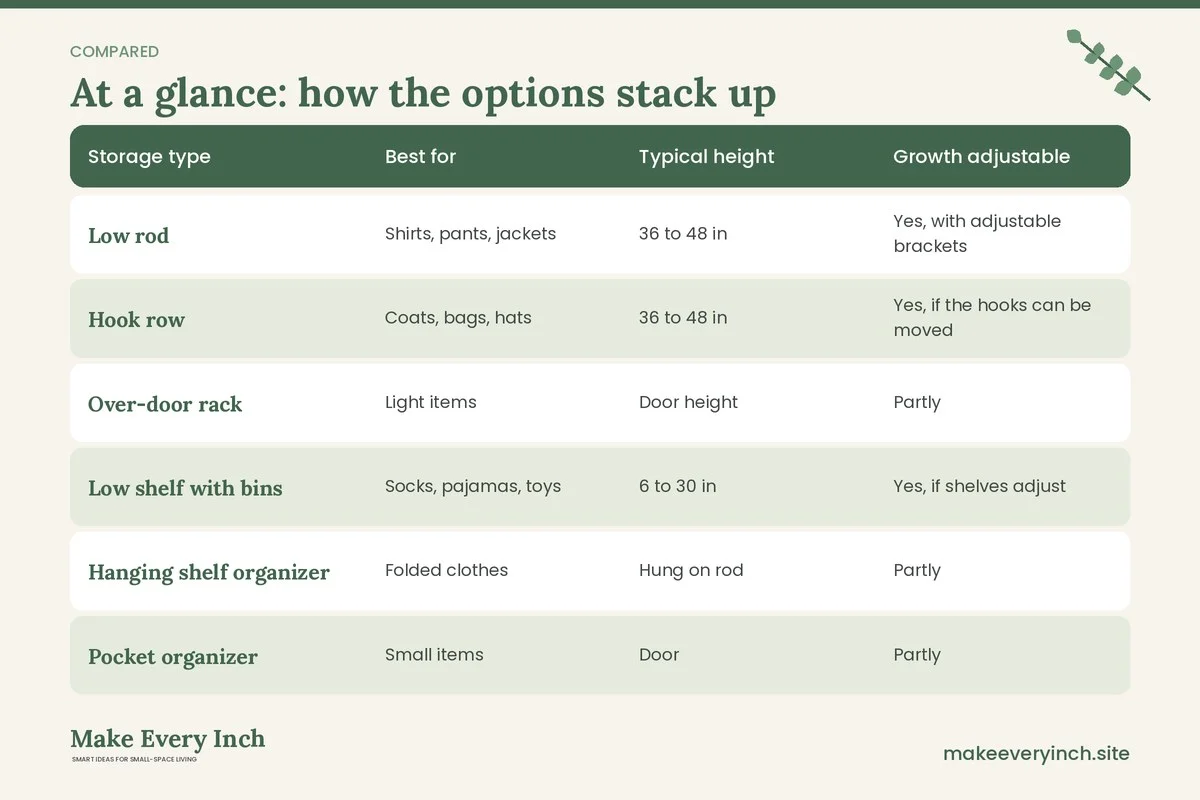
Comparison table: rods, hooks and bins for a child’s closet
| Storage type | Best for | Typical height | Growth adjustable | Main caution | |
|---|---|---|---|---|---|
| Low rod | Shirts, pants, jackets | 36 to 48 in | Yes, with adjustable brackets | Child may hang on it | |
| Hook row | Coats, bags, hats | 36 to 48 in | Yes, if the hooks can be moved | Sharp ends at eye level | |
| Over-door rack | Light items | Door height | Partly | Hinge stress, finger pinch | |
| Low shelf with bins | Socks, pajamas, toys | 6 to 30 in | Yes, if shelves adjust | Tipping, if tall | |
| Hanging shelf organizer | Folded clothes | Hung on rod | Partly | Weight on the rod | |
| Pocket organizer | Small items | Door | Partly | Overloading | |
| Top shelf bins | Outgrown, seasonal | 60 in and above | Yes | Keep heavy items low | |
| Tension rod | Light clothes in a rental | Variable | Yes | Can fall under load |
Plan the closet to grow
A child grows fast, so a closet built for a four year old will not suit a nine year old. Plan the change before it happens.
Use adjustable parts wherever possible. A closet system with holes at 1 to 2 inch intervals, a rod on adjustable brackets and shelves on movable pins will let you reshape the closet without tools. If you cannot drill, use freestanding units on the floor, which are easy to move and replace.
Rethink the closet every six to twelve months. Take everything out, sort into wear, keep and outgrown, and put the wear group back at the right height. Update the label on the outgrown bin. Ask your child what is hard to reach, and move it.
At about seven or eight, children often want a say in their own clothes. Move the low rod up a notch, give them a drawer or bin that is theirs, and let them choose the layout within reason. At about ten or eleven, they may want a door that closes and a hamper that is private. Shift the closet from a parent’s system to a shared one. Each step builds independence and takes work off your plate.
Child safety in a small closet
A closet is a small, enclosed place where a child may climb, hide and play. These rules reduce the risk.
- Anchor tall units. Dressers, tall shelves and cube stacks can tip if a child climbs them. Anchor each to the wall with the hardware designed for it, and into a stud when possible. Check with your landlord before you drill, and use a freestanding option or a short unit if drilling is not allowed. Never place a heavy item on top.
- No dangling cords. Cords from blinds, curtains, lamps and chargers are a strangulation and tripping risk. Keep cords short, tied or cut off, and out of the closet. Hanger loops, drawstrings on hoods and long ribbons on clothes also deserve a look. Remove drawstrings from hoods when the manufacturer advises it.
- Keep breakables out of reach. Glass, ceramic, mirrors and picture frames belong high, behind a latch, or elsewhere. In a child’s closet, choose plastic, fabric and wood.
- Heavy items low. A heavy bin on a high shelf can fall on a child. Keep bins that weigh more than a few pounds on the lowest shelves.
- Respect weight limits. Check the rating of the rod, the shelf, the bracket and the hook. A child hanging on the rod may exceed the limit of a tension rod or an adhesive hook.
- Use safe hardware only with permission. Never drill, anchor or mount into a wall without the owner’s permission. If you rent, ask in writing.
- Door safety. Use a soft-close or a finger-pinch guard on the closet door, and avoid a latch that can lock a child inside. A door that a child can open from inside is safer.
- Mind the chemicals. Keep mothballs, cedar oils, cleaning sprays and other chemicals away from a child’s closet. Avoid mothballs completely near a child’s clothes, because they are a poison hazard if swallowed and they give off fumes. If you refinish a shelf or paint the closet, use a low-VOC product, ventilate the room, and let it cure before the child uses the space.
- Small parts. Keep small items such as coins, batteries, magnets and button cells out of the closet if a child under three lives in the house. Store them high and closed.
- Lighting. A battery or plug-in light with a short cord, mounted out of reach, helps a child see. Do not run an extension cord through the closet.
Three example rooms
A shared bedroom for two children, 10 by 11 feet
The closet is 4 feet wide and 22 inches deep. Install a double rod, with a low rod at about 40 inches on one side and a second low rod on the other. Give each child a floor-level bin for toys and a hook row of their own at different heights. Use the top shelf for two outgrown bins, one per child. The closet now holds two separate sets of clothes, and each child can reach their own. Anchor a short cube unit beside the closet for shoes. Because the room is small, keep the toys to two bins each, and rotate.
A toddler’s nursery closet, 3 feet wide
For a toddler, the clothes are folded or hung by a parent. Install one rod at about 36 inches for hanging items, a small stack of drawers or bins below for diapers and sleepwear, and the outgrown bin on the top shelf. Hang a hook near the door for the daily outfit. Keep the changing area outside the closet if possible. As the child grows, raise the rod and swap the bins for shoes and toys. Keep cords, wipes and creams on a high shelf behind a latch.
A reach-in closet for a seven year old, 5 feet wide
Split the closet into three sections. On the left, a low rod at about 44 inches for everyday clothes, with shallow bins on the floor for shoes. In the middle, a set of cubes with labeled bins for socks, underwear, pajamas and sports gear. On the right, a high rod and a top shelf for dressy clothes, the outgrown bin and a rotating toy box. A hook row on the door holds the backpack, the jacket and the next day’s outfit. Together they let a child get ready alone.
A weekly and seasonal routine
A good system stays good only if it is easy to keep. Build a short routine around the closet.
- Daily: the child hangs the coat, drops the shoes in the tray and puts dirty clothes in the hamper. This takes under two minutes with the right heights.
- Weekly: pick the next week’s outfits, check the hamper and put away the folded clothes. Do it on the same day each week.
- Monthly: open the outgrown bin and add what no longer fits. Check the toy bins and rotate.
- Each season: take everything out, wash or air out what is going into storage, and swap the seasonal items. Check the hardware, the rod and the anchors for wear.
- Each year: reset the heights, relabel, and ask your child what is not working.
Keep the routine light. A closet that takes thirty minutes to reset will not be reset. A closet that takes five will be.
Common mistakes to avoid
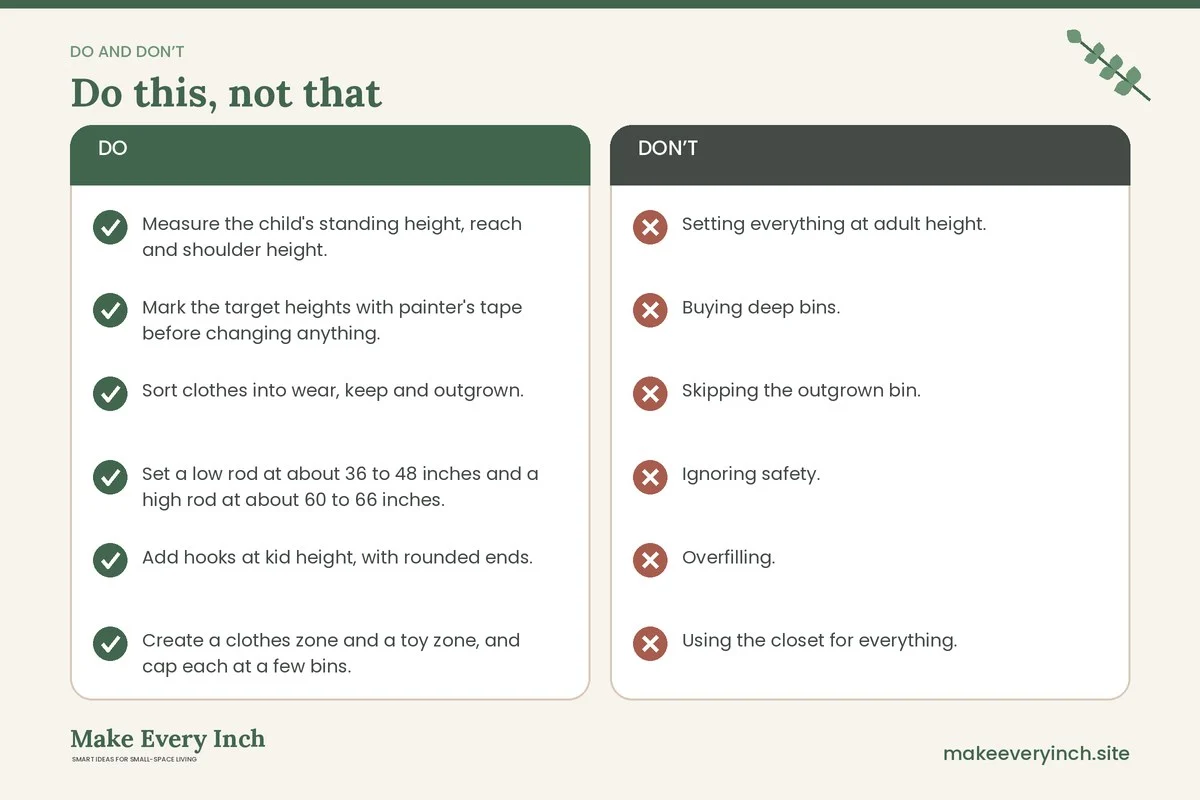
- Setting everything at adult height. If a child cannot reach, the closet will not work, and the pile will return.
- Buying deep bins. They hide items and become dumping grounds.
- Skipping the outgrown bin. Clothes that no longer fit take up the same space as clothes that do.
- Ignoring safety. A tall unit without an anchor, a cord in reach or a heavy item on a high shelf can lead to a serious accident.
- Overfilling. A closet at 100 percent is a closet that fails. Aim for about 80 percent so there is room for a new item.
- Using the closet for everything. Not every toy belongs here. Be willing to move some things to a shared room or a shelf outside.
- Forgetting the child. A system that only the adult understands will be undone by the child. Involve them in choosing labels, colors and the layout.
- Mixing sizes. Keep each size in its own bin or section, and store the next size up in a labeled bin.
Checklist
- Measure the child’s standing height, reach and shoulder height.
- Mark the target heights with painter’s tape before changing anything.
- Sort clothes into wear, keep and outgrown.
- Set a low rod at about 36 to 48 inches and a high rod at about 60 to 66 inches.
- Add hooks at kid height, with rounded ends.
- Create a clothes zone and a toy zone, and cap each at a few bins.
- Label the outgrown bin and place it high.
- Use shallow bins and picture labels for pre-readers.
- Anchor tall furniture and check all weight limits.
- Remove or shorten cords, and keep breakables and chemicals out.
- Ask permission before drilling, or choose freestanding and tension options.
- Set a short weekly and seasonal reset routine.
FAQ
How low should a kid’s closet rod be?
For a child of roughly three to six, about 36 to 42 inches from the floor is a common starting point, and roughly 42 to 48 inches for ages seven to nine. Measure your own child, because height varies. The child should be able to hang a coat without standing on tiptoe.
Can I install a low rod without drilling?
A tension rod can hold light clothes in a rental, but check the weight rating, and keep in mind that a child may hang from it. For heavier loads, use a freestanding clothes rack or a stand, or ask for permission to install a proper rod.
What is an outgrown bin?
It is a labeled bin, usually on a high shelf, that holds clothes and toys your child no longer uses. When it is full, you donate, pass on or store the contents. It keeps outgrown items out of the daily rotation.
How many toys should live in the closet?
In a small closet, keep two or three bins of toys at most, and rotate the rest. The cap keeps the zone tidy and makes it easier for a child to put things away.
How do I keep a tall dresser or shelf safe?
Anchor it to the wall with the hardware made for the purpose, preferably into a stud, and never put heavy items on top. If you cannot drill, choose a shorter, wider unit that is harder to tip, and keep it away from climbing spots. Always check with your landlord before drilling.
Is it safe to use cedar or mothballs in a child’s closet?
Avoid mothballs near a child’s clothes and toys, because they are toxic if swallowed and give off fumes. Cedar blocks and oils can irritate some children, so use them sparingly and keep them out of reach. Airing clothes and using washable storage bags is a safer approach.
How often should I reorganize?
A quick weekly reset and a fuller seasonal sort work for most families. Re-measure at least once a year, or whenever a growth spurt makes things hard to reach.
Keep going: Keep going with our pillar guide to small closet ideas, the practical small closet organization ideas and the companion post on linen storage ideas without a linen closet. For more family-friendly storage, see small bedroom ideas for families.
Save this guide for later
Pin the ideas you like to Pinterest so you can come back to them when you plan your space.